
India Cashew Market Analysis by Mordor Intelligence
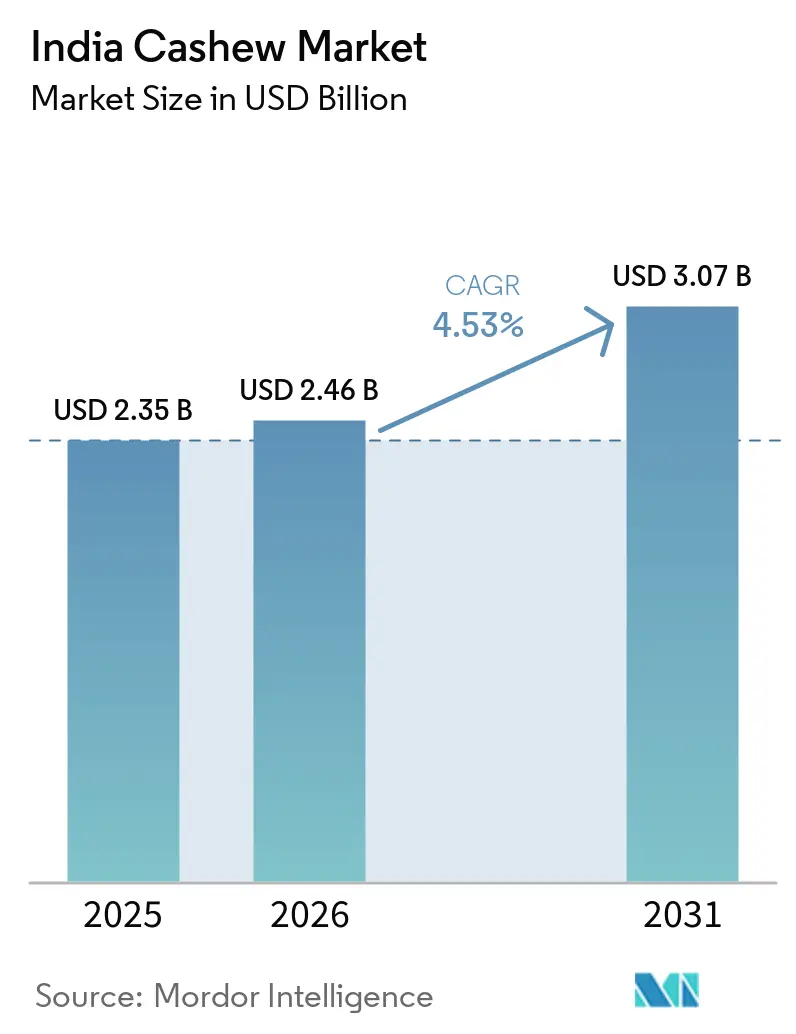
The India cashew market size is projected to grow from USD 2.35 billion in 2025 to USD 2.46 billion in 2026 and is forecast to reach USD 3.07 billion by 2031 at 4.53% CAGR over 2026-2031. The cashew market is projected to grow from 406.1 thousand metric tons in 2025 to 419.8 thousand metric tons in 2026. It is further projected to reach 489.5 thousand metric tons by 2031, with a CAGR of 3.12% from 2026 to 2031. India's demand momentum is driven by its dual role as the largest global consumer and a leading processor, supported by a vast network of processing units and substantial domestic production. According to the International Nut and Dried Fruit Council (INC), India accounted for 13.5% of global raw cashew production, 36.5% of global processing share as of 2024. Rising urban incomes, growing preference for nutrient-dense snacks, and supportive trade policies that lower import duties on raw nuts all reinforce the upward trajectory of the India cashew market. Competition from Cote d'Ivoire and Vietnam, and retailer consolidation are pushing Indian processors to improve efficiency and comply with stringent quality and traceability standards. The domestic consumption surge has fundamentally altered export dynamics. The sector's future trajectory hinges on technological adoption, sustainability compliance, and the ability to capture value from India's position as both a major processor and the world's largest consumer market.
Key Report Takeaways
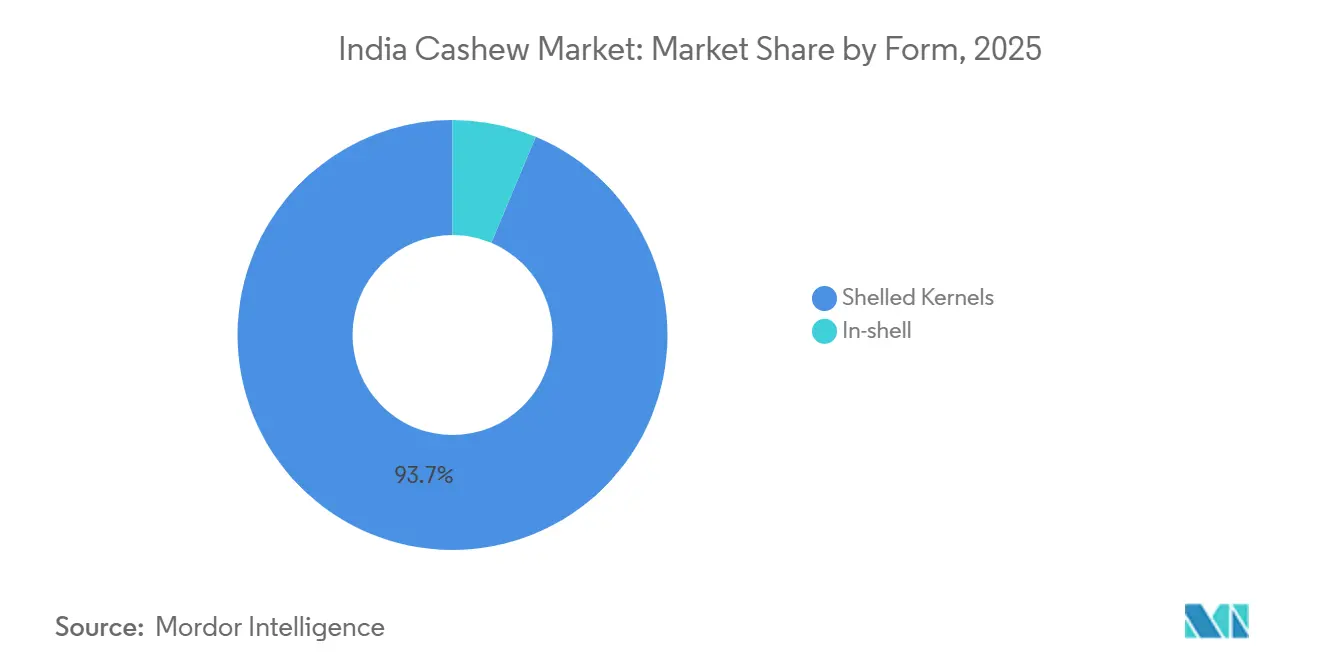
- By form, shelled kernels commanded 93.68% of the India cashew market share in 2025, and are forecast to expand at a 6.07% CAGR through 2031.
Note: Market size and forecast figures in this report are generated using Mordor Intelligence’s proprietary estimation framework, updated with the latest available data and insights as of 2026.
India Cashew Market Trends and Insights
Drivers Impact Analysis*
| Driver | (~) % Impact on CAGR Forecast | Geographic Relevance | Impact Timeline |
|---|---|---|---|
| Growing import volumes from Africa | +0.8% | National, import-dependent processors, especially clusters in Kerala, Goa, Karnataka, Maharashtra | Medium term (2-4 years) |
| Surge in plant-based snacking among Gen-Z consumers | +1.2% | National, with early gains in urban metros and Tier-1 cities | Short term (≤ 2 years) |
| Expansion of private-label cashew offerings in club stores | +0.6% | Indian modern retail networks | Medium term (2-4 years) |
| FDA-qualified health claim for nuts driving functional foods | +0.4% | National, export-focused processors | Long term (≥ 4 years) |
| Adoption of cold-chain logistics | +0.7% | National, concentrated in processing hubs of Kerala, Maharashtra, and Andhra Pradesh | Medium term (2-4 years) |
| Corporate carbon-neutral sourcing mandates | +0.5% | National, Indian exporters to multinational buyers | Long term (≥ 4 years) |
| Source: Mordor Intelligence | |||
Growing Import Volumes from Africa
African suppliers now satisfy over 70% of import demand, ensuring continuous throughput for the India cashew market even when domestic harvests fluctuate. The Cashew Board’s e-tender purchases and Kerala’s support price protect farmer incomes while securing raw inputs for processors. Stable import pipelines also create arbitrage potential because processors can buy lower-priced crops during African gluts and release kernels when global prices tighten. Over the medium term, sustained import growth reinforces processing economies of scale and lifts the India cashew market.
Surge in Plant-Based Snacking Among Gen-Z Consumers
Gen-Z preference for protein-rich, minimally processed foods has pushed annual domestic cashew consumption specifically with the growth of the bakery and snacking industries. Social media messaging that links nuts to heart health amplifies demand for flavored, roasted, and single-serve packs. Processors upgrade packaging lines to deliver resealable pouches and nitrogen-flushed containers that extend shelf life and preserve flavor. Premium positioning allows brands to charge higher retail prices than traditional fried snacks, supporting revenue growth despite relatively flat per capita nut availability. The consumer shift enlarges the India cashew market while simultaneously diverting a larger share of kernels away from export channels.
Expansion of Private-Label Cashew Offerings in Club Stores
Club retailers close procurement deals directly with Indian exporters for W180 and W210 grades, reducing the role of intermediaries. Consistent year-round orders encourage processors to modernize shelling, blanching, and grading systems to meet rigid defect tolerances. Bulk-pack designs lower per-unit packaging costs and align with retail strategies to offer value pricing to large families. Retailer audits covering labor practices, pesticide residues, and allergen controls compel processors to adopt globally recognized certification schemes. Those that comply gain multi-year contracts and predictable cash flows, reinforcing the India cashew market.
FDA-Qualified Health Claim for Nuts Driving Functional Foods
A United States Food and Drug Administration ruling that links nut consumption to cardiovascular health has led to a surge in cashew-based protein bars and dairy alternatives. Indian processors that can supply processed cashews from India with low-defect, low-moisture kernels qualify for premium price differentials in these niche categories. Research collaborations between universities and processors are creating nutraceutical formulations that incorporate cashew phenolics. By aligning product launches with clinical findings, companies penetrate pharmacies and health-and-wellness retail chains abroad, adding export diversity to the India cashew market.
Restraints Impact Analysis*
| Restraint | (~) % Impact on CAGR Forecast | Geographic Relevance | Impact Timeline |
|---|---|---|---|
| Tightening labor market in nut processing | -0.9% | National, concentrated in the processing hubs of Kerala, Karnataka, and Tamil Nadu | Short term (≤ 2 years) |
| Exposure to ocean freight rate volatility | -0.6% | Major import ports in India and key African sourcing routes | Medium term (2-4 years) |
| Stringent aflatoxin limits reduce usable imports | -0.4% | Import-dependent regions, quality control at ports | Long term (≥ 4 years) |
| African Swine Fever-linked feed competition for broken grades | -0.3% | Domestic markets for lower-grade cashews in India and competing Asian feed markets | Medium term (2-4 years) |
| Source: Mordor Intelligence | |||
Tightening Labor Market in Nut Processing
Women constitute 95% of the workforce that manually shells, peels, and grades kernels in India. Competing employment in manufacturing and services has lifted wage expectations well beyond the historical norm, raising unit processing costs. Some facilities have shuttered in Goa, shifting orders to lower-cost states and disrupting local supply networks. Automation vendors now market artificial-intelligence grading stations that cut labor needs per metric ton by half, yet high upfront costs deter smaller mills. Labor scarcity, therefore, continues to temper output expansion in the India cashew market. Automation requires significant capital investment and technical expertise, creating barriers for smaller processors who form the majority of India's cashew processing ecosystem.
Exposure to Ocean Freight Rate Volatility
Raw nut imports must transit the Suez Canal, exposing processors to disruptions from geopolitical tensions and seasonal canal closures. Freight rates have moved in a 30% band over the past 18 months, eroding margins on low-value raw nuts[1]Source: RMT 2024 - Chapter III "Freight rates, maritime transport costs and their impact on consumer prices and economic activity", unctad.org. Larger buyers negotiate annual contracts or use freight futures, while smaller importers remain on spot terms and face price swings. Any sustained spike prompts processors to reduce volumes or switch to alternate origins, causing supply uncertainty within the India cashew market. Freight volatility also affects export competitiveness, as Indian processors must absorb cost fluctuations to maintain price competitiveness against Vietnamese and African competitors in international markets.
*Our forecasts treat driver/restraint impacts as directional, not additive. The impact forecasts reflect baseline growth, mix effects, and variable interactions.
Segment Analysis
By Form: Processing Sophistication Drives Value Capture
Shelled kernels held 93.7% of the India cashew market share in 2025 and captured USD 300.3 million in export revenues in 2024 according to the data from ITC Trade Map, highlighting the ability of local mills to extract value beyond raw nut trading. Automated shellers and deep-learning visual sorters raise recovery of premium W180 and W210 grades, reducing overall processing wastage. Efficiency gains allow processors to absorb higher farm-gate prices without passing full costs to buyers, increasing elasticity of demand in the India cashew market.
Shelled kernels are projected to register a 6.07% CAGR through 2031, the fastest among both forms, underpinned by expanding modern-trade aisles and flavored snack launches. Processors have adopted nitrogen-flush packaging that adds six months of shelf life, enabling entry into distant markets. In-shell nuts appeal to niche consumer segments that prefer whole-nut cracking and enjoy longer room-temperature storage. Their slower growth stems from minimal value addition and less marketing support.



Geography Analysis
The geographic distribution reflects historical cultivation patterns and processing expertise, with coastal states benefiting from direct access to import facilities for raw cashew nuts and export ports for finished products. Maharashtra contributed the largest absolute volume among states, owing to productivity of 1.03 metric tons per hectare in 2024 as per Directorate of Cashewnut & Cocoa Development (DCCD) supported by extension programs. Its coastal belt hosts integrated clusters where plantations lie within 100 kilometers of processing hubs and export ports, reducing transit time and spoilage.
The regional dynamics create competitive advantages for states with integrated cultivation-processing ecosystems, though import dependency means processing centers can operate independently of local raw material availability. Andhra Pradesh and Odisha collectively add good volume and possess emerging small-scale shelling units that leverage lower labor costs. State governments facilitate cold-store loans that help processors counter seasonal price swings, adding resilience to the India cashew market. The food processing sector's projected growth to USD 547.3 billion by 2028, with a 10% CAGR according to the Ministry of Commerce and Industry data, which is projected to create opportunities for cashew processors to leverage broader infrastructure investments and policy support mechanisms.
Kerala remains a historical processing powerhouse even though it ranked fifth in production. The state’s minimum-support price of USD 1.32 per kg encourages farmer retention of cashew groves in the face of shifting to rubber or coconut. Logistics connectivity under the National Logistics Policy further integrates inland assembly centers with the ports of Cochin, enhancing export competitiveness. The geographic analysis reveals that while production concentration provides economies of scale, the sector's resilience depends on maintaining processing flexibility across multiple regions to mitigate localized disruptions and leverage comparative advantages in different market segments.
Regulatory Landscape
India's cashew sector operates under multiple regulators spanning food safety, export facilitation, commodity standards, and crop development. For imports and domestic sales, the Food Safety and Standards Authority of India (FSSAI) applies to raw cashew nuts under general (horizontal) standards on contaminants, toxins, and residues, which in turn shapes importer testing, port-level inspection routines, and processor quality systems.
On standardization and trade readiness, the Warehousing Development and Regulatory Authority (WDRA) maintains grade designation standards for raw cashewnuts (including moisture and other quality parameters), supporting collateralized storage and quality-linked procurement. Export processes and market access are supported through APEDA for agricultural and processed food exports, while the Directorate of Cashewnut and Cocoa Development (DCCD) anchors development-side interventions through schemes and technical programs that influence planting material, orchard management, and productivity upgrades.
Value Chain Analysis
The India cashew value chain begins with smallholder production (notably in coastal belts such as Maharashtra, Karnataka, Kerala, Goa, Andhra Pradesh, Odisha, Tamil Nadu, and West Bengal) and runs through aggregators and traders into a fragmented processing base that shells, peels, grades, and packs kernels for domestic retail and export channels. A structural feature is the raw material gap: domestic raw cashew nut production is around 0.8 million tonnes per annum versus processing capacity near 3 million tonnes, so processors depend heavily on imported raw nuts (primarily from Africa) routed through major ports and onward to clusters in states such as Kerala, Karnataka, Maharashtra, and Tamil Nadu.
Value addition concentrates in processing and packaging (including roasting, flavoring, and single-serve formats), while by-product utilization expands through cashew nut shell liquid (CNSL) and shell-derived energy inputs in better-capitalized facilities. Key bottlenecks include aging orchards (about 40% of plantations reported as senile trees over 25 years), labor intensity in manual processing, and raw-nut price and freight volatility. Public programs under DCCD, MIDH, and RKVY support replanting, high-density planting, nursery accreditation, and scientific pest management to improve supply stability and kernel quality consistency.
Competitive Landscape
The India is the major processor with most industries operating at under 5,000 metric tons per year, while a handful of vertically integrated exporters exceed 25,000 metric tons. Retailers such as Costco anchor global demand and deploy multi-year sourcing tenders that reward mills with traceability, ethical labor, and carbon metrics. Major processors like Olam International implement the Cashew Trail program that maps farmer plots and tracks pesticide inputs, assuring buyers of responsible practices.
Technology adoption differentiates market leaders. Plants outfitted with infrared moisture meters, optical sorters, and robotic packers post defect rates below 0.5%, winning high-margin contracts in Europe and North America. Smaller mills often operate single-shift manual lines and rely on spot raw-nut purchases, leaving them vulnerable to supply shocks and buyer demands.
Sustainability credentials grow in importance as buyers impose Scope 3 emission reporting standards. Facilities investing in rooftop solar arrays and biomass shell dryers reduce the carbon intensity of output, gaining preferred-supplier status. Researchers continue to commercialize cashew nut shell liquid derivatives for surfactants and industrial resins, opening adjacency markets that could absorb lower-grade kernels and improve overall profitability across the India cashew market.
Market Opportunities and Future Outlook
A major opportunity is narrowing the farm-to-factory raw material gap through government-backed productivity and replanting initiatives. The Union Budget 2026-27 proposed a dedicated program for cashew (alongside cocoa, coconut, and sandalwood) in coastal areas with an outlay of INR 350 crore and an explicit self-reliance agenda toward 2030, which creates space for nurseries, high-density planting material, irrigation packages, and service providers supporting orchard replacement in regions with aging plantations.
On the demand and trade side, processors and exporters can expand higher-value product formats (roasted, salted, flavored, and improved shelf-life packs) where margin capture is less dependent on bulk kernel price cycles. APEDA's push to promote value-added cashew exports through ongoing and prospective free trade agreements (including with the UK, Australia, Oman, EFTA countries, and the EU) strengthens the case for investments in food safety systems, traceability, and packaging upgrades aligned to modern retail and contract-manufacturing requirements.
Recent Industry Developments
- July 2026: The Union Government gave in-principle approval to a revival package sought by the Kerala government for the state's cashew processing industry. The move centers on addressing structural distress in a legacy processing hub and supports efforts to keep capacity operational while modernization and institutional support measures are put in place.
- June 2026: NFP Sampoorna Foods announced a cashew nut shell liquid (CNSL) extraction facility at its Neemrana manufacturing complex in Rajasthan, with a stated capacity of 1,000 MT of cashew shells per month. Expanding CNSL capability strengthens by-product monetization and improves margin resilience for processors exposed to kernel price and raw-nut cost volatility.
- August 2024: The Indian Institute of Science unveiled a water-soluble surfactant derived from cashew nutshell liquid. The development broadens industrial end uses for cashew processing by-products and supports diversification beyond kernel revenues for parts of the Indian cashew ecosystem.


Research Methodology Framework and Report Scope
Market Definition and Coverage
For this study, the India cashew market is the value of cashew nuts sold and traded within India across measurable activities tied to production, consumption, imports, exports, and price movements, reported in USD.
Scope exclusions: We do not count other edible nuts, blended snack mixes where cashew value cannot be isolated, or non-food uses that are not reported as cashew demand.
Segmentation Overview
-
By Form (Value)
- Shelled Kernels
- In-shell
-
India
-
Production Analysis
- Production Volume
- Area Harvested and Yield
- Consumption Analysis (Value and Volume)
-
Trade Analysis (Value and Volume)
-
Import Market Analysis
- Import Value and Volume
- Key Supplying Markets
-
Export Market Analysis
- Export Value and Volume
- Key Destinations Markets
-
Import Market Analysis
- Wholesale Price Trend Analysis and Forecast
- Regulatory Framework
- Logistics and Infrastructure
- Seasonality Analysis
-
Production Analysis
Data Sources, Market Sizing, and Validation
Desk Research
Desk research started with building the India cashew supply and demand picture using public statistics that can be cross-checked. Sources used include official trade and tariff data such as UN Comtrade and India customs releases, agriculture and horticulture statistics from Government of India publications, and international agriculture series from FAO, which help anchor volume and yield assumptions.
We also reviewed association updates and market notes such as cashew processing and exporter bodies, along with peer-reviewed food and agri journals that discuss processing recovery rates and quality grades. To avoid missing basic price signals, we screened reported wholesale and farm-gate price references from reputable press and state market updates, then normalized them to a common unit. In addition, a paid subscription for company financials and a paid shipment-level trade dataset were used selectively to validate exporter activity and value realization patterns. The desk sources listed here are illustrative and not exhaustive, and other public materials were also referred to for data collection, validation, and clarification.
Primary Interviews and Surveys
Primary work focused on reconciling volume flow with realized pricing, since values shift with kernel grade mix and import parity. We spoke with processors, traders, distributors, and large buyers to confirm conversion ratios (in-shell to kernel), domestic offtake seasonality, and how prices are set across contracts versus spot.
Coverage was balanced across major consuming and processing belts in India so assumptions around imports, re-exports, and domestic sales splits could be challenged and corrected before finalizing the model.
Distribution of primary research fieldwork respondents
| Company type | Respondent position |
|---|---|
| Top tier: 31% | CXOs: 14% |
| Mid tier: 51% | Functional/Unit leaders: 37% |
| Smaller Players: 18% | Managers: 49% |
Market-Sizing & Forecasting
The sizing model uses a top-down build where production and trade data are stitched into an India demand pool, and then valued using price series aligned to product form and grade mix. To keep totals grounded, selective bottom-up checks were run using sampled processor throughput, channel checks on wholesale volumes, and ASP multiplied by estimated domestic sales quantities. Where gaps were visible, those checks were used to adjust the demand value build.
Key inputs that shaped the model include in-shell to kernel conversion yields, import volumes of raw cashew nuts, export volumes of kernels, domestic consumption growth linked to packaged snack penetration, and wholesale price trends by grade (where available). Forecasting was done using scenario analysis supported by expert views on crop variability, import parity pricing, and demand resilience, and then translated into value by updating ASPs in USD for each year. Where granular splits were not consistently available, gaps were handled using conservative grade-mix bands and then validated through repeated processor and trader feedback.
Data Validation & Update Cycle
Outputs were checked against independent signals such as import bills, export realization, and shifts in procurement patterns, then reviewed for unusual jumps in volume or price that did not match known market timing. When a variance was large, assumptions were revisited and respondents were re-contacted to confirm whether the change came from grade mix, currency movement, or timing in trade reporting.
A multi-step internal review is followed so the model logic and inputs stay consistent across years, and the final numbers are signed off only after variance checks are cleared. Reports are refreshed annually, and interim updates are triggered when material shifts occur, such as sharp moves in raw nut import prices or a trade policy change. Before delivery, one more fresh pass is done so clients receive the latest updated view.
Mordor Intelligence's India Cashew Market Sizing Compared With Other Published Estimates
It is normal to see different market sizes for India cashew because each publisher may draw the market boundary differently and may not value the same volume series in the same way. In this category, small shifts in product form coverage, grade mix assumptions, and price timing can change the final number even when the underlying tonnage looks similar.
A common gap driver is refresh cadence and currency timing, because cashew kernel prices and INR to USD conversion can move quickly within a year, which then changes the implied ASP for the same physical flow. Another driver is whether processed formats (such as roasted and flavored packs) are included, or whether the estimate stays closer to kernels and in-shell trade and consumption, and whether trade unit values are used as a check on reported prices.
Benchmark comparison
| Source | Market Size | Gaps in Research Methodology |
|---|---|---|
| Mordor Intelligence | USD 2.35 B (2025) | |
| Industry Publisher A | USD 2.56 B (2024) | Uses a prior-year value point and does not make the USD conversion date and the ASP refresh window clear, which can inflate or compress the number when prices and exchange rates move. |
| Market Tracker B | USD 2.56 B (2024) | Tracks processed cashews as the main counted product, which can include value added from roasting and flavoring, and the forecast window differs, so the 2024 value is not aligned to a 2025 priced demand pool. |
The comparison mainly points to timing and scope, where 2024 versus 2025 valuation and inclusion of processed formats can widen the spread even before volumes are debated. By locking a clear annual USD conversion timing, refreshing ASPs against trade unit values, and re-checking anomalies during updates, the final number stays consistent year to year, which is how Mordor Intelligence keeps the estimate tied to observable cashew flows.


Key Questions Answered in the Report
What is the projected value of the India cashew market in 2031?
The market is projected to reach USD 3.07 billion by 2031, reflecting steady domestic demand and export opportunities.
How fast will shelled kernels grow through 2031?
Shelled kernels are forecast to post a 6.07% CAGR, driven by processing efficiencies and expanding retail distribution.
Which Indian state produces the most cashews today?
Maharashtra leads with benefiting from higher productivity and government support programs.
How are processors addressing labor shortages?
Firms are installing AI-enabled grading and automated shelling equipment to reduce manual dependence.
Page last updated on:





