
Market Overview
| Study Period | 2021 - 2031 |
|---|---|
| Forecast Data Period | 2026 - 2031 |
| Base Year Market Size (2025) | USD 2.10 Billion |
| Market Size (2026) | USD 2.38 Billion |
| Market Size (2031) | USD 4.42 Billion |
| Growth Rate (2026 - 2031) | 13.22 % |
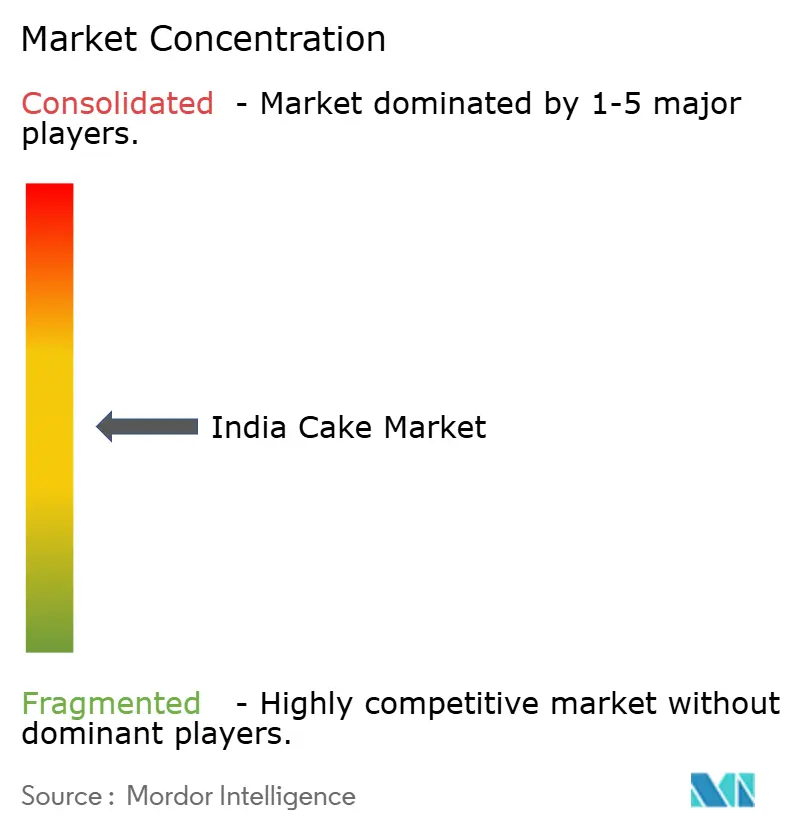
| Market Concentration | Medium |
Major Players *Disclaimer: Major Players sorted in no particular order Image © Mordor Intelligence. Reuse requires attribution under CC BY 4.0. | |
India Cake Market Analysis by Mordor Intelligence
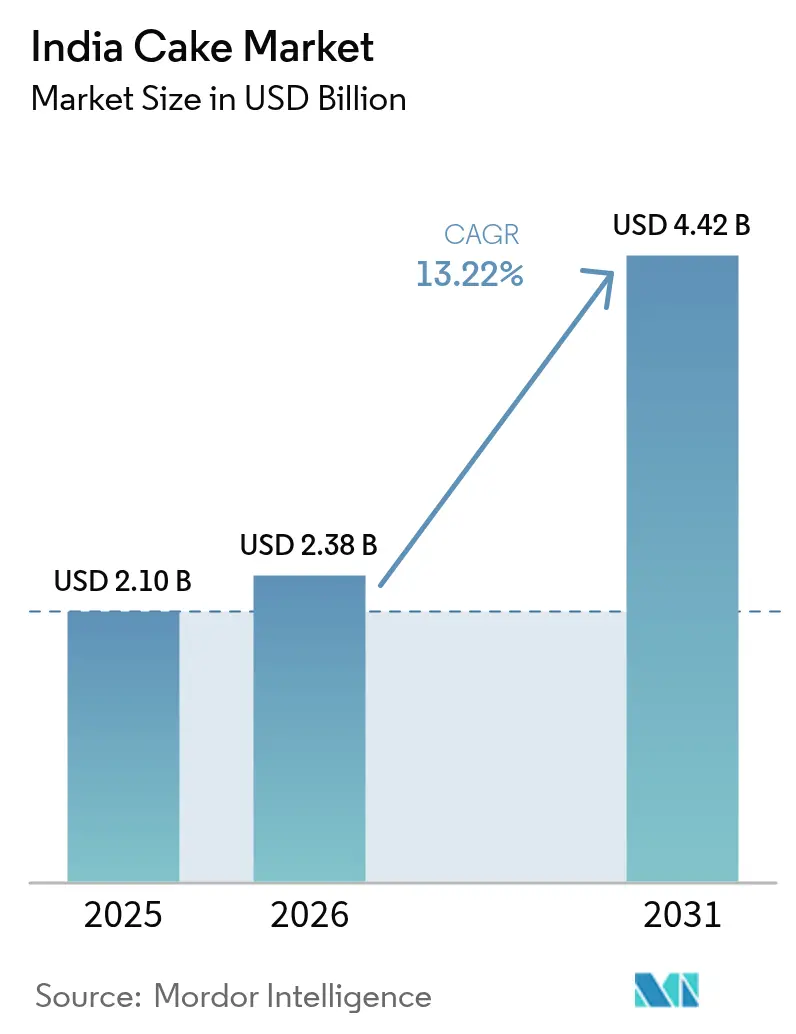
The India cake market size was valued at USD 2.10 billion in 2025 and estimated to grow from USD 2.38 billion in 2026 to reach USD 4.42 billion by 2031, at a CAGR of 13.22% during the forecast period (2026-2031). This growth is driven by factors such as rising disposable incomes, increasing urbanization, and the influence of social media, which has boosted demand for premium products. The expansion of quick-commerce delivery services has also made cakes more accessible to consumers. Trends like corporate gifting during festivals, the growing demand for customized cakes, and the popularity of protein-enriched or egg-free recipes have broadened the consumer base beyond traditional buyers. In terms of product types, cupcakes are gaining popularity for their convenience, while sliced cake variants are appealing to consumers seeking ready-to-eat options. Artisanal bakers are utilizing the premiumization trend to attract customers, and digital commerce is reshaping how consumers access cakes. Regionally, South India is experiencing rapid growth, although North India continues to dominate the market. The competitive landscape is moderately concentrated, with the top 5 packaged cake suppliers holding a significant market share.
Key Report Takeaways
- By product category, sponge cakes held 32.11% of the India cake market share in 2025, while cupcakes are forecast to grow at a 14.33% CAGR to 2031.
- By format, whole cakes commanded 56.53% share of the India cake market size in 2025; sliced formats are projected to advance at 13.71% CAGR through 2031.
- By category, packaged cakes captured 66.08% revenue share in 2025; artisanal cakes are expected to register a 15.28% CAGR to 2031.
- By distribution channel, supermarkets/hypermarkets led with 36.02% share in 2025, whereas online retail channels are poised to climb at 13.76% CAGR over the same period.
- By region, North India accounted for 29.22% of 2025 sales, and South India is set to expand at a 15.12% CAGR up to 2031.
Note: Market size and forecast figures in this report are generated using Mordor Intelligence’s proprietary estimation framework, updated with the latest available data and insights as of 2026.
Market Trends and Insights
Drivers Impact Analysis of India Cake Market*
| DRIVER | (~) % IMPACT ON CAGR FORECAST | GEOGRAPHIC RELEVANCE | IMPACT TIMELINE |
|---|---|---|---|
| Rising disposable incomes among urban middle class | +2.8% | National, with early gains in Delhi, Mumbai, Bangalore | Medium term (2-4 years) |
| Rising social media and food trends | +2.1% | Urban centers, tier-1 and tier-2 cities | Short term (≤ 2 years) |
| Celebration culture and westernization of desserts | +1.9% | National, stronger in South and West India | Long term (≥ 4 years) |
| Growth of corporate gifting culture during festivals | +1.4% | Urban centers, corporate hubs | Medium term (2-4 years) |
| Adoption of customization and personalization in cakes | +1.7% | Metro cities, expanding to tier-2 cities | Short term (≤ 2 years) |
| Emergence of functional/eggless protein cakes | +1.3% | Health-conscious urban segments | Long term (≥ 4 years) |
| Source: Mordor Intelligence | |||
Rising disposable incomes among urban middle class
Increasing disposable incomes among India’s urban middle class are boosting the demand for premium cakes. As more households earn over USD 10,000 annually per person, as per Goldman Sachs, as of February 2024, there is a noticeable shift from budget-friendly options to branded, high-quality cakes, particularly in the Sponge and Celebration categories[1]. The market is expected to grow significantly, with disposable personal income projected to reach INR 305 million in 2024, as per Trading Economics, highlighting the expanding premium segment[2]. Tier-2 cities like Jaipur and Coimbatore are becoming key growth areas, as consumers in these regions increasingly prefer packaged cake brands that were previously popular only in metropolitan areas. To meet this demand, organized players are introducing localized flavors, while artisanal bakeries are establishing outlets in malls and high-street locations to cater to niche and premium preferences.
Growth of corporate gifting culture during festivals
The rise of corporate gifting during festivals is significantly influencing India's premium cake market. Companies are increasingly opting for branded cakes in elegant tin packaging instead of traditional mithai, as these cakes offer better shelf life, portability, and appeal. In March 2024, India had 2,663,016 registered companies, with 64% actively operating, creating a substantial market for corporate gifting, as per India Brand Equity Foundation (IBEF)[3]. These tin-packed cakes, though priced higher than loose mithai, fit well within corporate budgets and are preferred for their premium quality and presentation. Organized players benefit from bulk orders during the festive season, improving their production efficiency and profitability. Their superior logistics, consistent quality, and attractive packaging give them a competitive edge over local bakeries, further driving growth in this segment.
Adoption of customization and personalization in cakes
In India's urban centers, the demand for personalized cakes is rapidly growing as consumers increasingly seek unique and customized experiences. Buyers in metropolitan areas are now opting for cakes with photo-printed designs, gender-reveal themes, and personalized messages, often paying a premium for these tailored options. Cloud kitchens are capitalizing on this trend by using advanced technologies like 3D printers and AI-powered design tools to create intricate and customized cakes with quick delivery times. This focus on personalization has led to higher customer satisfaction and loyalty, with many customers placing repeat orders, especially through subscription services for regular celebrations. Companies such as Bakingo are offering edible print cakes, while platforms like Creme Castle cater to the rising demand for customizable cakes for occasions like baby showers and gender-reveal parties.
Emergence of functional/eggless protein cakes
The growing focus on health and fitness in India is driving demand for functional and eggless protein cakes. Consumers are increasingly looking for healthier options, prompting brands to introduce products like whey-infused brownies with 12 grams of protein per slice, targeting gym-goers and health-conscious individuals. Popular offerings, such as Bakingo's Eggless Cakes, feature reduced sugar levels. To achieve this, brands use soy-based binders and natural sweeteners like monk fruit, which is a zero-calorie sweetener that is 300 times sweeter than table sugar, while maintaining the desired texture. These innovations not only cater to evolving consumer preferences but also prepare brands for potential regulatory changes, such as the introduction of a "sugar tax."
Restraints Impact Analysis of India Cake Market*
| RESTRAINT | (~) % IMPACT ON CAGR FORECAST | GEOGRAPHIC RELEVANCE | IMPACT TIMELINE |
|---|---|---|---|
| Rising health consciousness curbing sugar intake | -1.8% | Urban centers, health-conscious demographics | Medium term (2-4 years) |
| Price wars and fragmentation in unorganized bakeries | -1.2% | Local markets, tier-2 and tier-3 cities | Short term (≤ 2 years) |
| Supply-chain challenges in hot and humid climates | -0.9% | Pan-India, particularly severe in the summer months | Short term (≤ 2 years) |
| Stricter Food Safety and Standards Authority of India (FSSAI) rules on additives raising compliance cost | -0.7% | National, affecting all organized players | Long term (≥ 4 years) |
| Source: Mordor Intelligence | |||
Rising health consciousness curbing sugar intake
Health awareness and regulatory changes are significantly influencing India's cake market, especially traditional high-sugar products. The Economic Survey 2025 has suggested imposing a health tax on ultra-processed foods to address rising obesity and related health issues. Public institutions are also educating consumers by displaying "sugar and oil boards" that highlight the sugar content in commonly consumed items. With an estimated 677.3 million people in India expected to benefit from improved health awareness by 2025, the demand for healthier alternatives is growing[4]. In response, brands like Theobroma are reformulating their products, offering options such as Stevia-Sweetened Cakes. These innovations cater to changing consumer preferences by reducing sugar content while maintaining taste, helping brands align with both consumer needs and regulatory requirements.
Supply-chain challenges in hot and humid climates
The Indian cake market faces significant challenges in maintaining product quality due to the country’s hot and humid climate, which often causes cakes to spoil faster during transportation. With temperatures frequently exceeding 45°C, ensuring proper storage and handling becomes critical to prevent damage. Rising fuel prices further add to logistics costs, particularly for mid-sized bakeries that rely on third-party transport services. These issues can lead to delays, product returns, and dissatisfied customers, creating additional pressure on manufacturers to balance quality and cost. To address these challenges, companies are focusing on improving cold chain logistics, optimizing delivery routes, and investing in better packaging solutions to extend shelf life and ensure customer satisfaction.
*Our forecasts treat driver/restraint impacts as directional, not additive. The impact forecasts reflect baseline growth, mix effects, and variable interactions.
India Cake Market Segment Analysis
By Product Type:
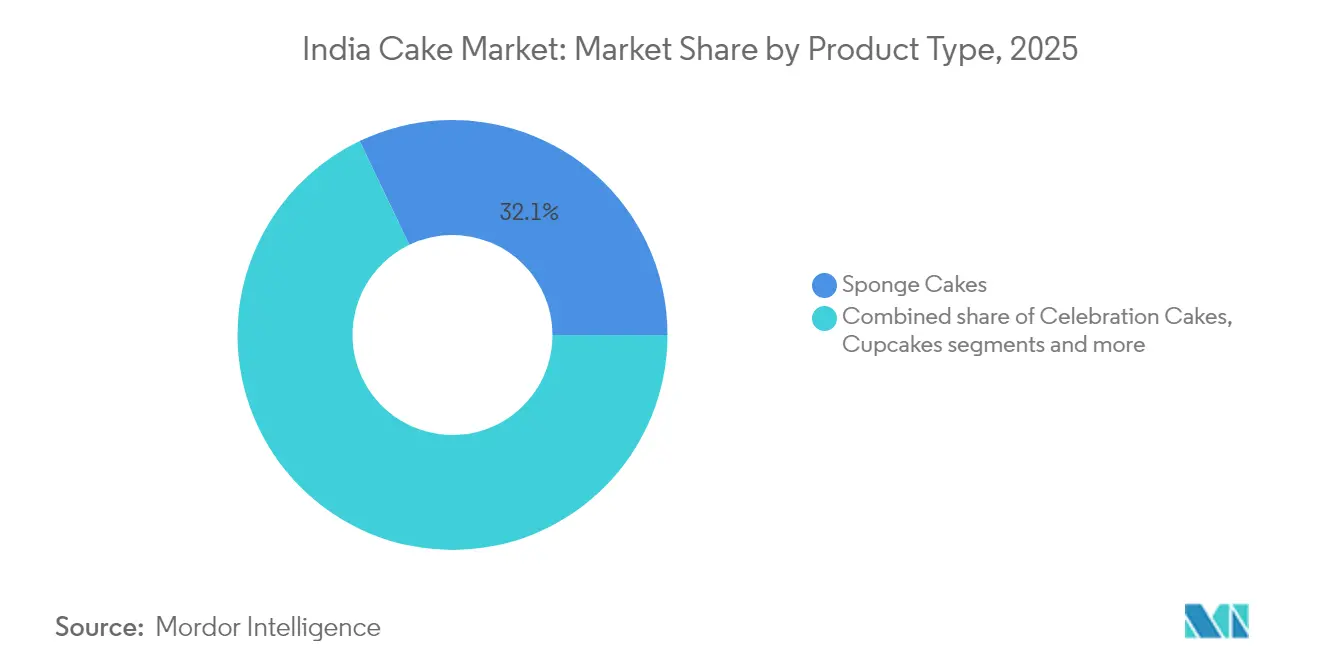
Cupcakes extend reach beyond traditional formatsIn the Indian cake market, sponge cakes were the most popular category in 2025, making up 32.11% of the total market. Their widespread appeal and flexibility make them a favorite for both special occasions and everyday treats, ensuring strong visibility in modern retail stores like supermarkets and hypermarkets. Consumers prefer sponge cakes for their soft texture and ability to include various flavors and fillings, allowing manufacturers to meet a wide range of tastes. This consistent demand makes sponge cakes a major contributor to sales in both packaged and artisanal segments of the market.
Cupcakes are quickly becoming one of the fastest-growing categories in the Indian cake market. They are expected to grow at a strong CAGR of 14.33% from 2026 to 2031, driven by a shift in consumer preferences toward single-serving, portable, and visually appealing baked goods. Cupcakes are especially popular among younger consumers and those active on social media, who value convenience, customization, and attractive designs. Their growth is further supported by increasing demand in gifting occasions and online platforms, suggesting that cupcakes will play a bigger role in shaping product innovation and retail strategies in India’s cake market.

By Format:
Sliced variants ride convenience waveIn the Indian cake market, whole cakes were the most popular category in 2025, holding 56.53% of the market share. Their demand is driven by their suitability for family celebrations, festivals, and social gatherings, where a single, large cake serves as a centerpiece. Whole cakes are also highly customizable, making them a preferred choice for gifting and special occasions. They are widely available in supermarkets, bakeries, and specialty stores, ensuring easy access for consumers. This consistent demand highlights their importance in the overall growth of the cake market.
Sliced cakes, on the other hand, are rapidly gaining popularity, with a projected CAGR of 13.71% through 2031. These cakes cater to the growing preference for portion-controlled and convenient options, especially among nuclear families and individual consumers. Sliced cakes are ideal for on-the-go consumption and are increasingly featured in modern retail formats and online delivery platforms. Their rising demand reflects changing consumer lifestyles and offers significant opportunities for innovation and expansion in India’s cake market.
By Category:
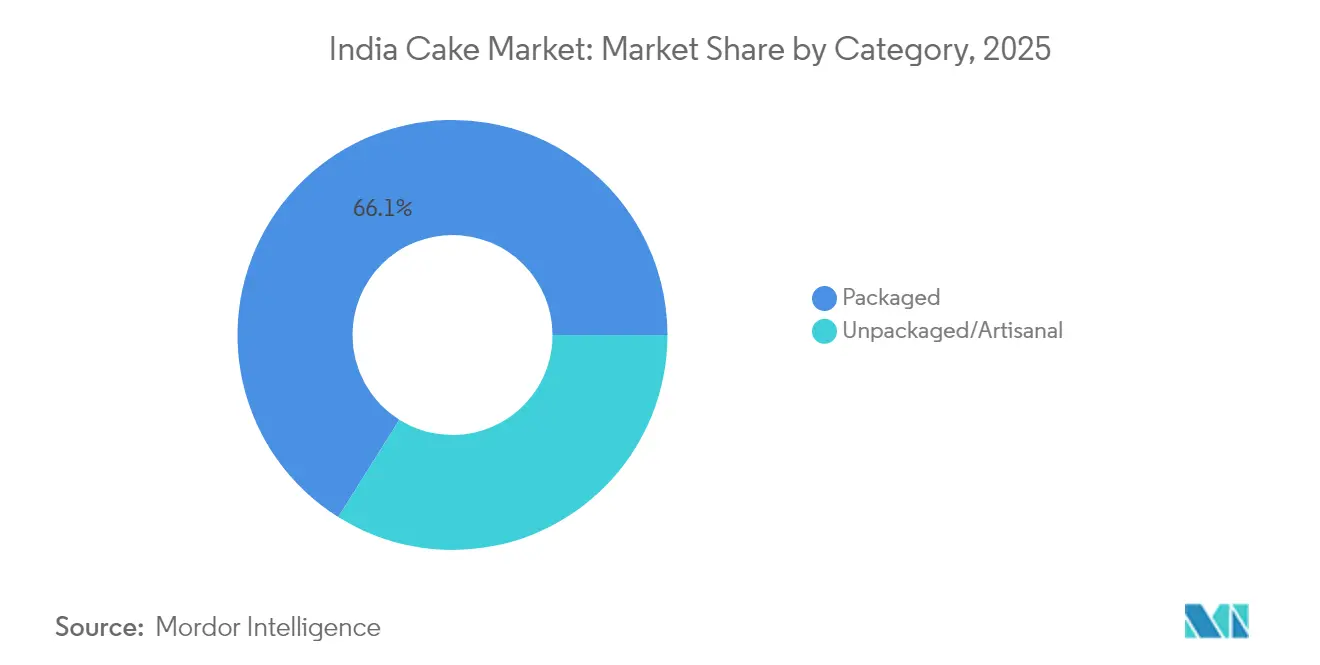
Artisanal bakers capitalize on premiumizationPackaged cakes accounted for 66.08% of the Indian cake market share in 2025, driven by their widespread availability and the trust consumers place in well-known brands. These cakes are popular due to their consistent quality, longer shelf life, and convenience, making them a go-to option for everyday snacking and gifting. Supermarkets and hypermarkets play a significant role in their distribution, ensuring easy access for consumers across urban and semi-urban areas. The affordability and variety offered by packaged cakes further strengthen their position in the market.
Artisanal cakes are projected to grow at a CAGR of 15.28% between 2026 and 2031, as demand for premium, handcrafted products continues to rise. Consumers are increasingly drawn to unique flavors, personalized designs, and high-quality ingredients, which artisanal cakes offer. Investments in cloud kitchens and boutique-style storefronts are also boosting the availability of these cakes, enhancing the overall customer experience. This segment is particularly appealing to urban consumers seeking exclusive and visually appealing options for celebrations and special occasions, making it a key area of growth in the Indian cake market.
By Distribution Channel:
Digital commerce redraws accessSupermarkets/hypermarkets accounted for 36.02% of the Indian cake market share in 2025, primarily because they attract a large number of shoppers and offer a wide variety of cake options. These stores provide a convenient shopping experience, allowing customers to purchase both packaged and specialty cakes under one roof. The availability of different cake formats and flavors caters to diverse consumer preferences, making these outlets a popular choice. Additionally, frequent promotional offers, discounts, and in-store displays further enhance their appeal. As a result, supermarkets and hypermarkets remain a dominant distribution channel in the Indian cake market.
Online retail channels are expected to grow at a CAGR of 13.76%, emerging as the fastest-growing distribution channel in the Indian cake market. The increasing adoption of digital payment systems like UPI and the availability of quick delivery services, such as 30-minute delivery, have made online shopping more convenient and accessible. This has encouraged consumers to make more impulse and repeat purchases online. E-commerce platforms provide smaller bakeries and artisanal brands with an opportunity to reach a wider audience, expanding their market presence. The convenience of doorstep delivery and the ability to explore a variety of options online are key factors driving the growth of online cake sales in India.
Geography Analysis
North India dominated the Indian cake market in 2025, accounting for a 29.22% share. This leadership is attributed to its large urban population, strong cultural traditions of celebrations, and the high concentration of corporate offices in areas like Delhi-NCR. Festivals such as Diwali and the wedding season drive significant bulk orders, ensuring high production levels. However, the region faces challenges like spoilage risks due to extreme summer heat. To tackle this, organized players use insulated vans and schedule nighttime deliveries to maintain product quality. Competition from traditional sweet shops has encouraged cake manufacturers to introduce regional flavors like saffron and pistachio into Western-style cakes, appealing to local tastes.
South India is the fastest-growing region in the Indian cake market, with a CAGR of 15.12%. This growth is driven by the increasing affluence of tech professionals in cities such as Bengaluru, Chennai, and Hyderabad. The demand for keto-friendly and eggless cakes is particularly strong in this region, with premium artisanal bakeries experiencing significant growth in weekday corporate orders. Tamil Nadu’s well-established processed food export industry supports a strong supply chain, enabling the rapid establishment of new factories and attracting private equity investments. The region’s thriving café culture has boosted the popularity of desserts like cheesecakes and tiramisu, further expanding the market.
West India benefits from Mumbai’s high-spending consumer base and Gujarat’s robust manufacturing capabilities, creating opportunities for both premium and mass-market cake products. In Mumbai, quick-commerce platforms have achieved high penetration among smartphone users, enabling delivery times of under 20 minutes for chilled cakes. On the other hand, East India is still developing in terms of market penetration but is showing promising growth in tier-2 cities like Bhubaneswar and Guwahati. Rising disposable incomes and infrastructure improvements in these areas are driving demand for cakes. To attract first-time buyers who are accustomed to traditional sweets, organized brands are experimenting with localized cake variants made with ingredients like jaggery, catering to regional preferences.
Regulatory Landscape
India's cake market operates under the Food Safety and Standards Authority of India (FSSAI) framework, which requires commercial bakers and packaged cake manufacturers to obtain FSSAI registration or licensing through the Food Safety Compliance System (FoSCoS) portal, with licensing type determined by turnover thresholds. For packaged cakes sold through modern trade and online channels, compliance is tied to FSSAI rules on permitted additives and product standards, alongside mandatory declarations under the Food Safety and Standards (Packaging and Labelling) Regulations, 2011, including ingredient listing and date marks such as manufacturing/packing and best before/use by.
Trade and cross-border sourcing of ingredients and finished bakery items is influenced by customs classification under Chapter 19 (pastries and cakes). On April 30, 2026, the Ministry of Finance, Department of Revenue issued Notification No. 14/2026-Customs to align tariff item classifications and related exemption notifications with the Finance Act, 2026, reinforcing the need for importers and organized manufacturers to track updated tariff mappings when calculating landed costs for baking inputs and packaged bakery products.
Competitive Landscape
The competition in the Indian cake market remains moderate, with the top five packaged cake suppliers accounting for over 50% of the revenue in the organized segment. ITC has overtaken Britannia in packaged food sales for FY2024, achieving a turnover of INR 17,194 crore, supported by its extensive distribution network. The company has announced a five-year capital expenditure plan of INR 20,000 crore, with 35-40% allocated to FMCG, highlighting its focus on growth and innovation. On the other hand, Britannia is focusing on diversifying its portfolio and is also promoting its center-filled Sponge variants to maintain its strong brand presence.
Artisanal bakery chains like Theobroma are expanding their presence with the help of private equity investments while maintaining their small-batch production quality. For instance, ChrysCapital acquired a 90% stake in Theobroma for INR 2,410 crore, reflecting strong investor confidence in premium bakery formats. Similarly, Curefoods is bridging the gap between digital and physical markets by operating over 300 cloud kitchens. The company has raised USD 40 million in Series D funding. These developments indicate a growing interest in premium and innovative bakery formats.
Companies are focusing on strategies like increasing production capacity, upgrading cold-chain logistics, and enhancing direct-to-consumer digital platforms. Many manufacturers are adopting AI-driven demand forecasting to minimize waste and ensure product freshness. Regulatory requirements, such as Food Safety and Standards Authority of India's labeling mandates, are also influencing competition, favoring companies with strong research and development and quality assurance systems. Functional cake variants, such as low-sugar, vegan, and protein-rich options, are gaining popularity among health-conscious consumers. As the market evolves, smaller bakeries may face challenges due to rising costs and regulatory pressures, leading to consolidation or adoption of franchise models.
India Cake Industry Leaders
-
Monginis
-
Britannia Industries Limited
-
Parle Products Pvt Ltd
-
Anmol Industries Ltd
-
ITC Limited
- *Disclaimer: Major Players sorted in no particular order
India Cake Market Companies Covered in this Report
- Britannia Industries
- ITC Limited
- Parle Products Pvt. Ltd
- Monginis
- Winkies Products
- Annapurna Swadisht
- Elite Foods
- Dhawala Online Solutions Private Limited (Winni)
- Wenger's
- Anmol Industries Ltd
- Merwans Confectioners Pvt Ltd
- Happy Belly Bakes
- Kitchen Fragrances India LLP (7Th Heaven)
- Theobroma Group
- Bonn Group
- Just Bake
- CakeZone
- Kwality Confectioners and Bakers (India) Pvt. Ltd.
- Surya Food and Agro Ltd
- VM Bakery Products Pvt. Ltd.
Market Opportunities and Future Outlook
Scale-up in bakery manufacturing and broader packaged-food capacity additions create whitespace for cake makers to strengthen presence in underpenetrated cities and improve supply reliability during peak celebration periods. In March 2026, Mrs. Bectors Food Specialities commenced commercial production at its subsidiary Bakebest Foods Private Limited facility in Khopoli, Maharashtra, with 36,464 metric tonnes of annual capacity for bakery products, indicating continued investment into large-format baking infrastructure. In parallel, organized players are building faster, more local fulfillment models for short shelf-life ranges, while ITC highlighted a cloud-kitchen-led expansion of fresh packaged foods (including cakes) across six cities, aligning availability with quick-commerce and time-sensitive gifting use cases.
A second opportunity track is demand capture through digital discovery, personalization, and premium formats. Justdial analysis for June 2025 to May 2026 versus the prior year reported an 11% increase in consumer interest for bakery and homemade dessert services, with Pune, Mumbai, and Delhi showing notable traction, which supports the role of online-led acquisition for both packaged and artisanal brands. As competition increasingly centers on freshness and consistency in hot and humid conditions, automation, AI, and IoT deployment across bakery production floors is a practical lever to reduce waste, improve batch-to-batch quality, and support differentiated portfolios such as customized, egg-free, and functional variants already gaining visibility through specialist platforms and cloud kitchens.
Recent Industry Developments in India Cake Market
- February 2026: Britannia Industries launched Britannia Cake Fudge It Choco Brownie alongside a digital campaign. The company broadened its cake portfolio with a contemporary indulgence-led format and reinforced the role of digital-first marketing in driving trials for packaged cakes in urban micro-markets.
- January 2026: ITC Limited announced plans to expand its fresh packaged foods portfolio, including cakes with about a 30-day shelf life, using cloud kitchens across six cities such as Delhi-NCR, Mumbai, Pune, Chennai, and Hyderabad. This expansion supports faster replenishment cycles and aligns packaged cakes with quick-commerce and short shelf-life distribution models rather than long-haul stocking.
- October 2024: Karnataka Milk Federation (KMF), through its Nandini brand, launched 18 new bakery products across slice cakes, bar cakes, and muffins as part of its diversification push. The rollout increased competitive intensity by leveraging a large dairy-linked distribution ecosystem to scale packaged bakery offerings beyond core dairy categories.
India Cake Market Report Scope and Research Methodology
Market Definition and Coverage
For this study, the India cake market covers the value of cakes sold for consumption in India through retail and foodservice, including packaged cakes and freshly prepared cakes from bakeries.
Scope exclusions: Excludes pastries, sweet pies, cookies, bread, and Indian sweets (mithai) even when they are sold alongside cakes.
Segments Covered in This Report
- By Product Type
- Celebration Cakes
- Cupcakes
- Center-filled
- Plain
- Sponge Cakes
- Plain
- Center-filled
- Others
- Other Cakes (Cheesecake, Pound Cake, etc.)
- By Format
- Whole
- Sliced
- Others
- By Category
- Packaged
- Unpackaged/Artisanal
- By Distribution Channel
- Supermarkets/Hypermarkets
- Convenience Stores
- Bakery Chains
- Online Retail Channels
- Other Channels
- By Region
- North India
- South India
- West India
- East India
Data Sources, Market Sizing, and Validation
Desk Research
To build the base view, we start with public statistics and category cues that explain how demand is forming. Sources used include, such as the Ministry of Statistics and Programme Implementation for household spending signals, the Reserve Bank of India for macro indicators, and the Ministry of Commerce and Industry for trade and channel expansion context. We also review Food Safety and Standards Authority of India notifications for labeling and compliance changes that can affect packaged versus fresh sales.
Next, company annual reports, investor presentations, and reputable news are used to understand distribution shifts, capacity additions, and product launches in cakes. Patent databases are checked selectively to see where product formats and shelf life improvements are being worked on, which helps validate premiumization and packaging trends. The examples listed here are illustrative only, and we referred to many other public sources as well to collect data, validate assumptions, and clear up open questions.
Primary Interviews and Surveys
Primary inputs were taken through expert interviews and structured surveys across packaged cake brands, bakery operators, ingredient suppliers, distributors, and retail channel stakeholders. We also spoke with professionals covering North, South, West, and East India so regional buying patterns, price ladders, and channel mixes could be confirmed, and then used to adjust secondary assumptions where gaps were found.
Distribution of primary research fieldwork respondents
| Company type | Respondent position |
|---|---|
| Top tier: 35% | CXOs: 19% |
| Mid tier: 46% | Functional/Unit leaders: 31% |
| Smaller Players: 19% | Managers: 50% |
Market-Sizing & Forecasting
Sizing is built using a top-down demand pool, where household consumption cues and celebration-led purchase frequency are translated into cake volumes, and then value is reconstructed using observed price bands across packaged and fresh formats. The totals are then corroborated through selective bottom-up checks, such as sampling average selling prices by channel and applying them to reasonable volume splits, followed by distributor and retailer sense checks that help correct overstatements.
Inputs used in the model include category mix between packaged and unpackaged cakes, average pack sizes and typical serving sizes, price progression by format (premium versus mass), share movement across modern trade, convenience, and online delivery, and regional contribution shifts between North and South India. For forecasting, we use scenario analysis supported by trend checks on income growth, urbanization, and store density, and then assumptions are tuned based on what interviewees expect for promotions, premiumization, and new store openings. When bottom-up signals are missing for smaller cities, we fill gaps using comparable-city proxies and then revalidate the implied per-capita spend before finalizing.
Data Validation & Update Cycle
Before results are signed off, we run variance checks across value and volume, and we compare outcomes with independent signals like price inflation trends, channel growth stories, and company-reported category momentum. Any sharp jump in implied per-capita spend, packaged share, or online contribution triggers a re-check of the underlying inputs and, when needed, a follow-up call to re-confirm assumptions.
A multi-step internal review is followed, where another analyst validates calculations, unit conversions, and the logic behind the forecast drivers. The report is refreshed annually, and interim updates are made when material events occur, such as major policy changes, input cost shocks, or channel disruptions. Right before delivery, a final pass is completed so clients receive the latest updated view.
Mordor Intelligence's India Cake Market Sizing Compared With Other Published Estimates
Published market sizes for cakes in India can look far apart, even when the topic sounds identical, because the product basket and selling points are not treated the same way. Differences also come from how prices are averaged across fresh bakery counters versus packaged shelves, and how quickly assumptions are refreshed when consumer spending shifts.
Pastries and other sweet baked goods are excluded, and that product set sits outside Mordor Intelligence's scope, which is a key reason some broader bakery figures do not line up with the table. The spread is also driven by whether estimates lean heavily on brand-only packaged sales, or whether they also count unpackaged bakery cakes, which changes the channel mix and the implied average price. Finally, currency timing and the chosen base year can move the number, especially when inflation and premiumization are active at the same time.
Benchmark comparison
| Source | Market Size | Gaps in Research Methodology |
|---|---|---|
| Mordor Intelligence | USD 2.10 B (2025) | |
| Regional Consultancy A | USD 1.85 B (2024) | Uses a different base year and may lean more on a packaged and organized sales view, which can undercount fresh bakery cake value in smaller cities and local outlets. |
| Industry Publisher B | USD 0.77 B (2024) | Likely reflects a narrower definition with tighter channel capture and more conservative pricing assumptions, which reduces the implied share of premium cakes and online delivery orders. |
Overall, the differences in published values mostly trace back to what gets counted as cake, how fresh bakery sales are handled, and which year anchors the pricing. By keeping assumptions tied to clear demand indicators and then checking them with channel and pricing reality checks, we keep the final estimate easy to explain and repeat.
Key Questions Answered in the Report
How fast is the India cake market projected to grow through 2031?
The market is forecast to rise from USD 2.38 billion in 2026 to USD 4.42 billion by 2031, reflecting a 13.22% CAGR.
Which product segment will add the most incremental value by 2031?
Cupcakes are set to post the quickest 14.33% CAGR, adding the highest incremental revenue as single-serve convenience gains favor.
Which region offers the strongest growth opportunity?
South India is expected to lead with 15.12% CAGR, driven by IT-sector affluence and early adoption of low-sugar and premium variants.
Are artisanal bakeries likely to gain share?
Yes; the artisanal segment is poised for 15.28% CAGR as consumers pay premiums for fresh, customized products, attracting private-equity backing for rapid expansion.