
Market Overview
| Study Period | 2021 - 2031 |
|---|---|
| Forecast Data Period | 2026 - 2031 |
| Base Year Market Size (2025) | USD 3.25 Billion |
| Market Size (2026) | USD 3.47 Billion |
| Market Size (2031) | USD 4.84 Billion |
| Growth Rate (2026 - 2031) | 6.83 % |
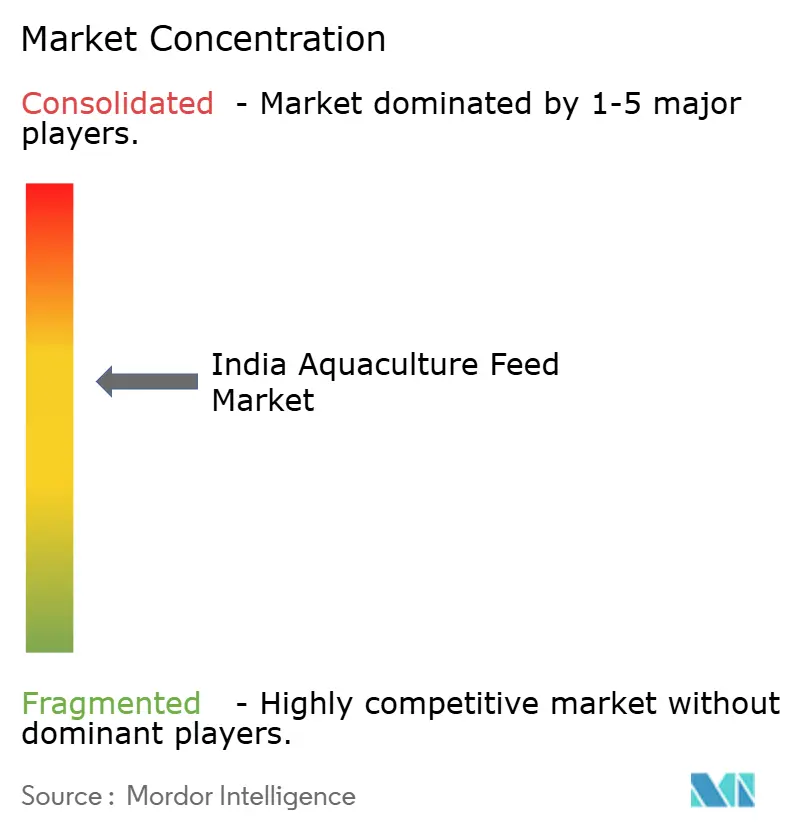
| Market Concentration | Medium |
Major Players
*Disclaimer: Major Players sorted in no particular order Image © Mordor Intelligence. Reuse requires attribution under CC BY 4.0. |
|
India Aquaculture Feed Market Analysis by Mordor Intelligence
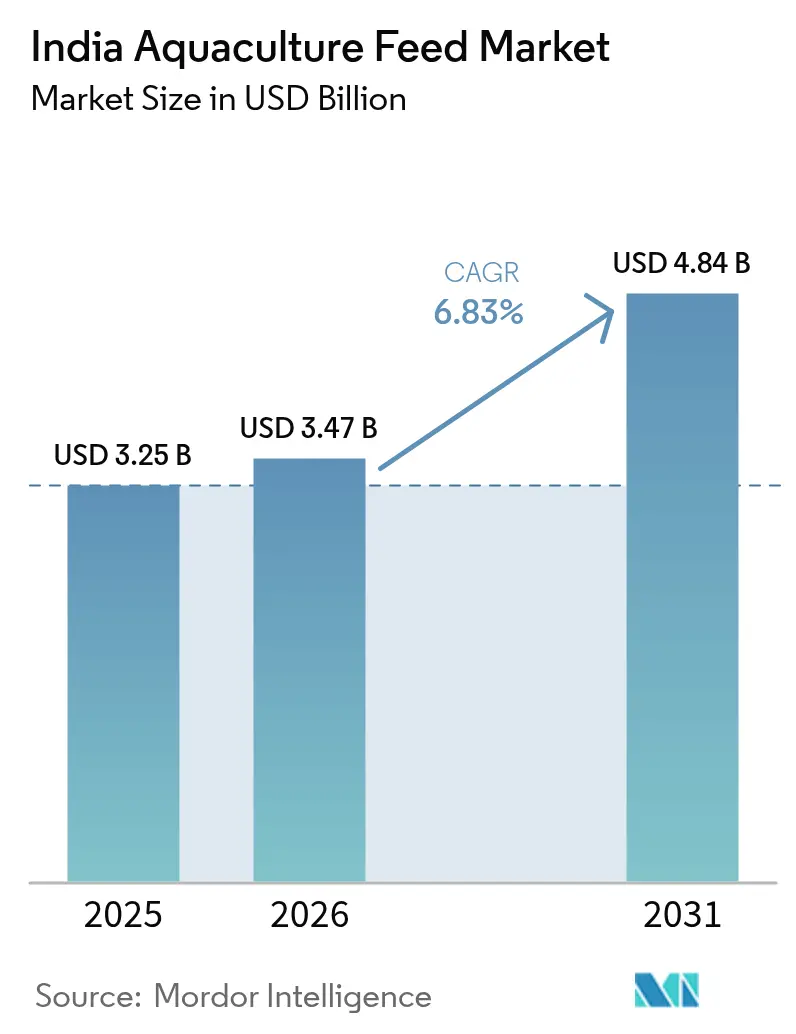
The India aquaculture feed market size was valued at USD 3.25 billion in 2025 and estimated to grow from USD 3.47 billion in 2026 to reach USD 4.84 billion by 2031, at a CAGR of 6.83% during the forecast period (2026-2031). The market demonstrates resilience in managing supply-chain disruptions while maintaining India's position as a key player in Asia-Pacific aquaculture. The implementation of government initiatives through Blue Revolution 2.0, continued growth in shrimp exports, increasing urban seafood consumption, and enhanced technology adoption create favorable conditions for industry growth in 2024. According to the ICAR-Central Marine Fisheries Research Institute, India's marine fish catch volume reached 3.45 million metric tons in 2024, with Gujarat, Tamil Nadu, and Kerala recording the highest landings[1]Source: ICAR-Central Marine Fisheries Research Institute (CMFRI), "CMFRI Annual Report 2024", cmfri.org.in. Feed manufacturers optimize operations through economies of scale, specialized feed formulations, and digital distribution networks, despite challenges from raw material price fluctuations and disease outbreaks. Coastal states dominate market growth, the expansion of inland aquaculture, and increased e-commerce adoption create new opportunities across the country.
Key Report Takeaways
- By type, fish feed accounted for 53.78% of the India aquaculture feed market share in 2025, while shrimp feed is projected to advance at a 9.86% CAGR through 2031.
- By ingredient, soybean meal contributed 34.92% of the India aquaculture feed market size in 2025, whereas corn gluten meal is forecast to grow at a 9.08% CAGR to 2031.
- By lifecycle stage, grower feed captured 50.78% of the India aquaculture feed market size in 2025; starter feed is projected to expand at a 10.35% CAGR through 2031.
- By form, pellets commanded 62.75% of the India aquaculture feed market revenue in 2025, and extruded floating feeds are projected to rise at a 9.42% CAGR through 2031.
- Avanti Feeds Limited, Charoen Pokphand Foods PCL, Growel Feeds Private Limited, IFB Agro Industries Ltd, and Godrej Agrovet Limited together controlled a significant portion of the market share in 2025.
Note: Market size and forecast figures in this report are generated using Mordor Intelligence’s proprietary estimation framework, updated with the latest available data and insights as of 2026.
India Aquaculture Feed Market Trends and Insights
Drivers Impact Analysis*
| Driver | (~) % Impact on CAGR Forecast | Geographic Relevance | Impact Timeline |
|---|---|---|---|
| Rising domestic seafood consumption | +1.2% | Nationwide, strongest in urban centers | Medium term (2-4 years) |
| Expansion of export-oriented aquaculture | +1.8% | South and East coastal belts | Long term (≥ 4 years) |
| Government subsidies and schemes for aquaculture inputs | +0.9% | Nationwide rural clusters | Short term (≤ 2 years) |
| Technical adoption of high-protein formulated feeds | +1.1% | Commercial farms in South and West India | Medium term (2-4 years) |
| Corporate retail chains’ private-label fish demand | +0.7% | Urban markets in North and West India | Medium term (2-4 years) |
| AI-driven pond monitoring improving feed conversion ratios | +0.8% | Tech-enabled farms in South and East India | Long term (≥ 4 years) |
| Source: Mordor Intelligence | |||
Rising Domestic Seafood Consumption
Per capita fish consumption reached 5.7 kg in 2025, driven by urban consumers shifting toward lean protein sources[2]Source: Food and Agriculture Organization, “India Country Profile – Fisheries and Aquaculture,” fao.org. Organized retail chains reported significant growth in seafood sales, leading farmers to improve feed quality for consistent year-round production. The increasing demand for quality fish products has strengthened the aquafeed market, as farmers prioritize feed conversion efficiency to maintain a reliable supply. Consumer preferences for fresh and safe fish products have increased demand for farmed tilapia and pangasius, supporting the growth of India aquaculture feed market. South Indian households, traditionally incorporating fish in their daily diet, have expanded their consumption to include farmed species, increasing the adoption of commercial feed.
Expansion of Export-Oriented Aquaculture
India's seafood exports reached USD 8.09 billion in 2024, with shrimp contributing 75% of the total value[3]Source: Marine Products Export Development Authority, “Annual Report 2023-24,” mpeda.gov.in. Export-oriented farms consume more feed per hectare compared to domestic-focused operations, due to higher stocking densities and intensive farming practices required to meet international quality standards. The United States remains India's primary seafood export destination, accounting for 35% of total shipments. Recent tariff adjustments have led to market diversification toward Europe and the Middle East. The export focus has increased demand for specialized feeds with enhanced nutritional profiles and improved feed conversion ratios.
Government Subsidies and Schemes for Aquaculture Inputs
The Pradhan Mantri Matsya Sampada Yojana allocated INR 6,000 crore (USD 720 million) for fisheries development in July 2025, with 40% dedicated to feed-related infrastructure[4]Source: Department of Fisheries, “Blue Revolution 2.0 – Pradhan Mantri Matsya Sampada Yojana,” Government of India, dof.gov.in. The extension of Kisan Credit Card coverage to fisheries in 2024 enables farmers to access institutional credit at 7% annual interest rates, reducing financial barriers to feed procurement. State-level subsidies differ across regions, with Andhra Pradesh providing 50% capital subsidies for feed manufacturing units, while West Bengal emphasizes input cost support through cooperative societies. The Fisheries and Aquaculture Infrastructure Development Fund supports cold chain and processing facilities, which increases the demand for quality feeds.
Technical Adoption of High-Protein Formulated Feeds
Protein levels in commercial diets increased to 28-32%, reducing feed conversion ratios to below 1.5:1 on export farms. The use of specialized ingredients, including amino-acid supplements, reduced grow-out time by nearly 20%, enabling higher pond densities and export certifications. Export-oriented shrimp farms show the highest adoption rates, as international buyers include feed quality parameters in sustainability certification requirements. Technology transfer from multinational feed companies has improved the availability of specialized formulations, but their premium pricing restricts adoption among small-scale farmers, resulting in varied adoption rates across the Indian aquafeed market.
Restraints Impact Analysis*
| Restraint | (~) % Impact on CAGR Forecast | Geographic Relevance | Impact Timeline |
|---|---|---|---|
| Volatility in fishmeal and raw-material prices | −1.5% | Nationwide; coastal manufacturing clusters | Short term (≤ 2 years) |
| Disease outbreaks in aquaculture farming | −1.2% | Intensive farms in South and East India | Medium term (2-4 years) |
| Tighter environmental norms on feed-mill effluent | −0.8% | Industrial hubs in South and West India | Long term (≥ 4 years) |
| Competition from low-cost homemade feeds | −0.9% | Rural ponds across all regions | Medium term (2-4 years) |
| Source: Mordor Intelligence | |||
Volatility in Fishmeal and Raw Material Prices
Fishmeal prices fluctuated between USD 1,200-1,500 per metric ton in 2024, with quarterly variations of 15-20%[5]Source: United States Department of Agriculture, “Global Agricultural Information Network – India Aquaculture Report,” usda.gov. Soybean meal experienced comparable price volatility, affecting feed production profitability, as raw materials constitute 75% of production costs. Indian feed manufacturers import 60% of their fishmeal requirements from Peru and Chile, making them vulnerable to currency fluctuations and supply chain disruptions. The high proportion of raw material costs in total production expenses makes price stability essential for maintaining export competitiveness.
Disease Outbreaks in Aquaculture Farming
Disease outbreaks significantly impacted aquaculture production in India during 2023-2024. Early Hepatopancreatic Necrosis Syndrome and White Spot Virus reduced shrimp production by 30% in Andhra Pradesh in 2024, decreasing feed consumption and reducing farmer income[6]Source: Central Institute of Brackishwater Aquaculture, “Disease Management in Aquaculture,” ciba.res.in. Disease management protocols require medicated feeds or feeding suspensions, disrupting regular consumption patterns and affecting feed manufacturer revenues. In Tamil Nadu, Tilapia Parvovirus (TiPV) outbreaks in freshwater systems during 2023 resulted in 40-50% mortality rates in severe cases. These recurring disease outbreaks create demand fluctuations that affect production planning and inventory management for feed manufacturers.
*Our forecasts treat driver/restraint impacts as directional, not additive. The impact forecasts reflect baseline growth, mix effects, and variable interactions.
Segment Analysis
By Type: Shrimp Feed Drives Premium Growth
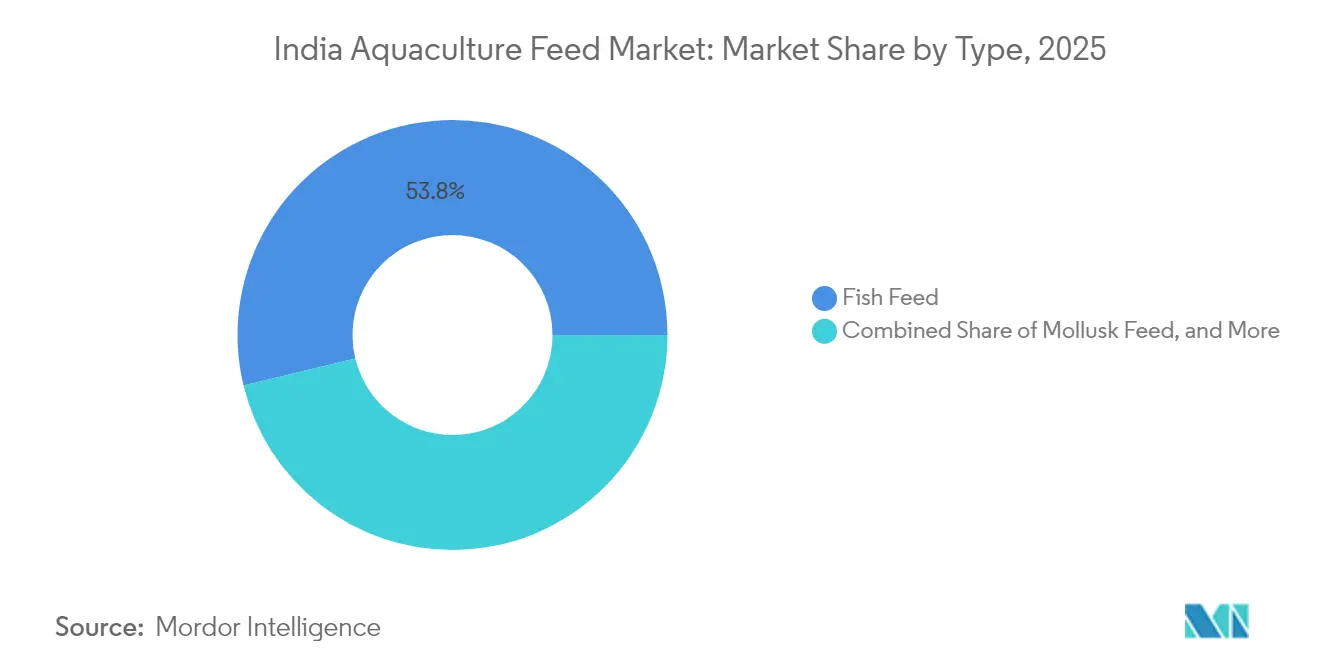
Fish feed constituted 53.78% of the India aquaculture feed market share in 2025, driven by the production of carp, tilapia, and catfish for domestic consumption. The extensive carp farming operations in West Bengal and Odisha maintain consistent demand, while tilapia's rapid growth cycle contributes to increased feed consumption. Crustacean feed, despite lower volume, generates higher margins due to its enhanced nutrient requirements and strict export quality standards.
The shrimp feed segment is anticipated to grow at a 9.86% CAGR through 2031, driven by expanding farm areas and increased stocking densities in export-oriented operations. High-protein formulations specifically designed for vannamei shrimp support value growth, complemented by international certifications that emphasize efficient feed conversion and traceability. Major manufacturers' ongoing research and development in functional feed additives improve shrimp gut health and survival rates, establishing this segment as the key revenue generator in the India aquaculture feed market.



By Ingredient: Soybean Meal Dominated the Market
Soybean meal accounts for 34.92% of the India aquaculture feed market size in 2025, supported by domestic production and its balanced amino-acid profile. While fishmeal maintains importance in marine species feeds, its high costs and environmental concerns drive manufacturers to seek protein alternatives. The corn gluten meal segment is projected to grow at a 9.08% CAGR through 2031, driven by increased corn wet-milling capacity and improved cost efficiency.
The market shows increasing adoption of feed additives, including enzymes and probiotics, to improve feed efficiency. While insect meals and single-cell proteins remain in early development stages, they represent potential future ingredients. The industry prioritizes strategies to manage price volatility, reduce dependency on marine ingredients, and improve feed digestibility to maintain a consistent nutrition supply in the India aquaculture feed market.
By Lifecycle Stage: Starter Feed Innovation
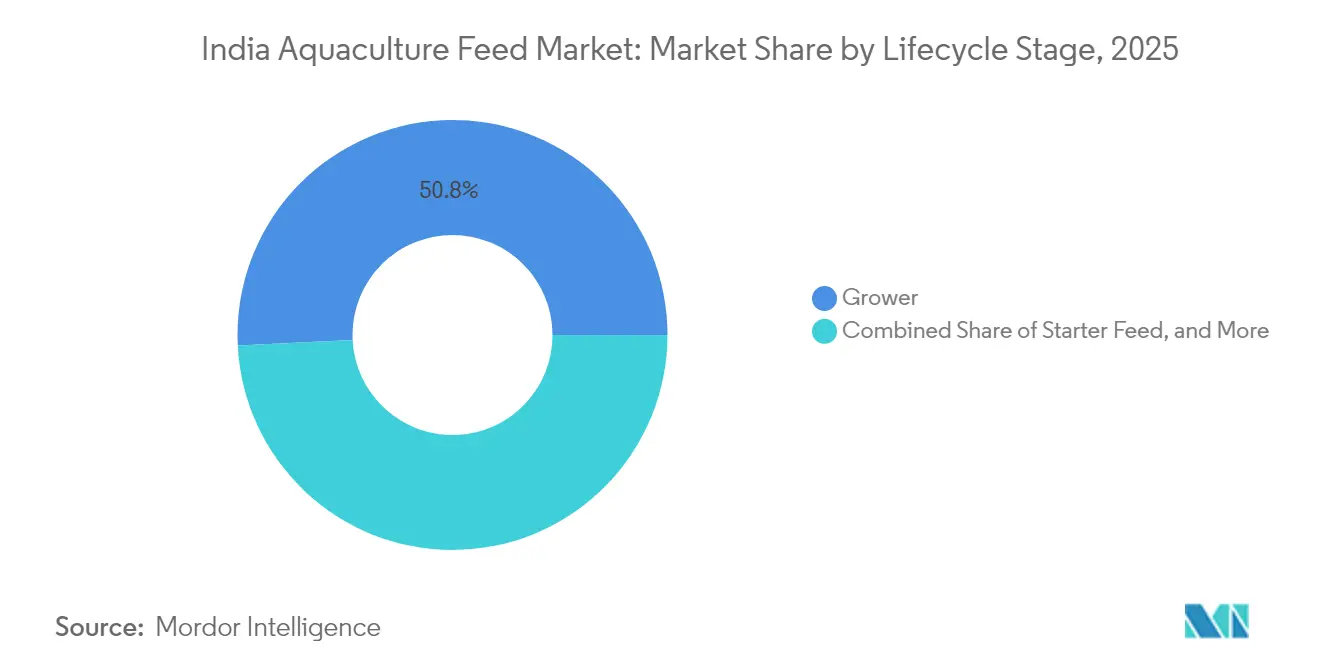
Grower feed accounted for 50.78% of India aquaculture feed market share in 2025, due to high consumption during the extended growth phase of aquatic species. The consistent demand across species is supported by farmers' reliance on balanced grower diets to maintain optimal growth rates and survival.
The starter feed segment is anticipated to grow at a 10.35% CAGR, supported by increasing hatchery operations and advancements in micro-pellet technology that improve early-stage survival rates. The use of precision nutrition during larval and fry phases reduces culture cycles and improves pond utilization efficiency. Manufacturers are focusing on micro-encapsulation and particle-size control techniques to enhance nutrient availability, making starter feed a key segment in the India aquaculture feed market. The segment's development includes specialized formulations that address specific nutritional needs, digestive capabilities, and metabolic requirements during different developmental stages. The Coastal Aquaculture Authority's regulations reinforce the need for appropriate feeding protocols in sustainable production practices.
By Form: Extruded (Floating) Technology Upshift
Pellets hold 62.75% of India aquaculture feed market share in 2025, primarily due to their simple production process and widespread acceptance among farmers. Extruded (floating) feeds are growing at a 9.42% CAGR, driven by their higher digestibility and ability to monitor feed consumption. These floating feeds reduce waste, improve water quality, and align with sustainable farming practices. Farmers can observe feeding patterns and adjust feed quantities accordingly, leading to improved growth outcomes.
Powder and liquid concentrate forms cater to specific applications and early growth stages; they remain minor segments. Manufacturers are investing in twin-screw extrusion and density-control technologies to produce feeds with varying buoyancy levels for different aquatic species. Concentrates occupy a small but expanding segment, particularly for nutritional supplements and therapeutic uses where quick absorption is essential. Feed form preferences differ based on species, farming methods, and regional practices, with shrimp farmers preferring sinking pellets and fish farmers opting for floating varieties.
Geography Analysis
South India is driven by Andhra Pradesh's aquaculture output of 1.8 million metric tons and feed manufacturing capacity of over 2 million metric tons annually. Tamil Nadu and Karnataka contribute to growth through integrated brackishwater systems supported by established cold-chain infrastructure. The region maintains its market dominance through technical expertise, suitable climate conditions, and regulatory oversight from the Coastal Aquaculture Authority.
East India's aquaculture sector is expanding through West Bengal's implementation of modern carp farming practices and scientific feeding methods. Odisha's development of brackishwater ponds, supported by Blue Revolution 2.0 grants, contributes to regional growth. The region's adoption of technology from southern states and new feed production facilities under the Pradhan Mantri Matsya Sampada Yojana has increased feed demand along the Bay of Bengal coastline.
North, West, and Central India demonstrate increasing market potential through inland reservoirs and integrated agri-aquaculture systems. Uttar Pradesh and Bihar implement farmer-training programs and subsidized input schemes to increase commercial feed adoption. Maharashtra and Gujarat develop coastal areas for brackishwater aquaculture, and Central Indian states utilize reservoir cages for optimal water resource use, expanding the India aquaculture feed market geographical reach.
Regulatory Landscape
India's aquaculture feed ecosystem operates under a mix of fisheries policy, coastal aquaculture regulation, standards, and trade controls. The Department of Fisheries (Ministry of Fisheries, Animal Husbandry and Dairying) anchors sector programs and input-oriented schemes such as PMMSY, which shape modernization and financing for feed-related infrastructure. The Coastal Aquaculture Authority (CAA), constituted under the Coastal Aquaculture Authority Act, 2005, regulates coastal aquaculture operations and sets standards that extend to inputs used in coastal systems.
Product and facility compliance is segmented by species and by domestic versus export end-use. The Bureau of Indian Standards (BIS) provides species-specific aquafeed standards under the IS 16150 series (including carp, marine shrimp, freshwater prawn, pangasius, marine carnivorous fish, and tilapia feeds), creating a reference point for formulation and quality benchmarking. For export-linked supply chains, Export Inspection Council (EIC) and Export Inspection Agencies (EIAs) approvals and related notifications (including S.O. 730 (E) dated 21 August 1995) govern quality assurance at the establishment level. Import-linked ingredients and additives move through DGFT controls (Importer-Exporter Code) and Animal Quarantine and Certification Services (AQCS) procedures such as Sanitary Import Permits and health certification.
Competitive Landscape
The leading producers in the India aquaculture feed market for 2024 include Avanti Feeds Limited, Charoen Pokphand Foods PCL, Growel Feeds Private Limited, IFB Agro Industries Ltd, and Godrej Agrovet Limited. These companies collectively account for a substantial market share, reflecting a moderate level of market concentration. Avanti Feeds Limited maintains market leadership through vertical integration from hatcheries to processing plants. Charoen Pokphand Foods India strengthens its position through global research capabilities and an extensive pan-India dealer network. Growel Feeds Private Limited and Godrej Agrovet Limited complete the market leadership segment, focusing on capacity expansion and specialty product lines.
Market players prioritize capacity expansion, product development, and digital farmer engagement. Avanti's USD 25 million Kovvur plant upgrade in 2024 increases capacity by 200,000 metric tons. Godrej Agrovet introduced ArgoRid in 2025, a fish lice controller developed in collaboration with ICAR-CIFE, to address Argulus infections in aquaculture. The product enhances immunity, healing, and productivity, providing Indian fish farmers with research-based solutions. Companies pursue sustainability certifications, including Best Aquaculture Practices and Aquaculture Stewardship Council, to access export markets and achieve premium pricing.
Environmental compliance requirements and raw material price fluctuations create entry barriers that challenge smaller manufacturers, leading to industry consolidation. Companies increase patent filings for functional additives and precision nutrition, focusing on proprietary feed enzymes and gut-health enhancers. The market increasingly integrates digital advisory platforms, credit-linked sales models, and water-quality solutions as essential service offerings in the India aquaculture feed market.
India Aquaculture Feed Industry Leaders
-
Avanti Feeds Limited
-
Charoen Pokphand Foods PCL
-
Growel Feeds Private Limited
-
IFB Agro Industries Ltd
-
Godrej Agrovet Limited
- *Disclaimer: Major Players sorted in no particular order

Market Opportunities and Future Outlook
Policy-led infrastructure financing and input-cost measures continue to create room for capacity upgrades, quality systems, and new distribution models in India aquaculture feed. In March 2026, the Ministry of Fisheries, Animal Husbandry and Dairying indicated that 228 infrastructure projects had been approved under the Fisheries and Aquaculture Infrastructure Development Fund (FIDF), whose scope includes feed mills, hatcheries, cold storage, and integrated cold chains. With shrimp representing 75% of seafood export value in 2024 (MPEDA), export-aligned farms are pulling demand toward traceable, higher-performance feed programs and service bundles (feeding protocols, water-quality guidance, and digital advisory) that improve consistency for certification-led supply chains.
Near-term opportunity is also visible in targeted cost rationalization and consolidation-driven integration. The Government of India reduced import duties on Artemia and Artemia cysts from 5% to 0% in May 2026, directly lowering a key input cost for shrimp hatchery and nursery operations and reinforcing the premium shrimp feed ecosystem. On the corporate side, IFB Agro Industries outlined an integration-first stance after acquiring Cargill India's aquafeed business, and in July 2026 it placed a planned Balasore (Odisha) feed manufacturing project on hold to prioritize operational efficiency of acquired assets, signaling space for other players and regions to pursue FIDF/PMMSY-linked modernization, logistics improvements, and differentiated functional formulations rather than only greenfield expansion.
Recent Industry Developments
- June 2026: CARE Ratings reported a reduction in Growel Feeds Private Limited's long-term bank facilities to INR 184.47 crore. The update indicates a shifting credit footprint around working capital and expansion needs, which can affect procurement flexibility and capacity planning in a raw-material-volatile feed market.
- September 2025: DSM-Firmenich Animal Nutrition and Health opened a new feed additive plant in Jadcherla, Hyderabad, with aquafeed production capabilities and an 11,200-square-meter footprint that includes manufacturing and warehousing. The facility strengthens local availability of functional additives and risk-management solutions, supporting feed formulators seeking higher-performance diets aligned with quality and traceability requirements.
- June 2024: Avanti Feeds continued executing its aquafeed capacity and efficiency agenda following the Kovvur plant upgrade program disclosed for 2024, aimed at expanding output and supporting scale economics. The development reinforces competitive pressure on regional mills through higher volumes, improved formulation capability, and better ability to absorb raw-material price swings.


Research Methodology Framework and Report Scope
Market Definition and Coverage
This market covers the value of formulated feed sold for aquaculture production in India, across major aquatic species and farm systems. It includes commercial feed produced as pellets or extruded products and consumed across key culture stages.
Scope exclusions: On-farm feed mixing using unprocessed ingredients and non-feed farm inputs like medicines, aerators, and pond chemicals are excluded.
Segmentation Overview
-
By Type
-
Fish Feed
- Carp Feed
- Salmon Feed
- Tilapia Feed
- Catfish Feed
- Other Fish Feed (Trout Feed, Rohu Feed, etc.)
- Mollusk Feed
-
Crustacean Feed
- Shrimp Feed
- Other Crustacean Feed (Crab Feed, Prawn Feed, Lobstar Feed, etc.)
- Other Aquafeed (Turtles, Sea Urchins, Frogs, etc.)
-
Fish Feed
-
By Ingredient
- Soybean Meal
- Fish Meal
- Corn Gluten Meal
- Additives (Vitamins, Minerals, Enzymes)
- Others (Blood meal, Meat and Bone Meal, Groundnut Cake, etc.)
-
By Lifecycle Stage
- Starter Feed
- Grower Feed
- Finisher Feed
-
By Form
- Pellets
- Extruded (Floating)
- Powder
- Liquid Concentrates
Data Sources, Market Sizing, and Validation
Desk Research
Desk work starts with building the demand pool for aquaculture feed in India, then checks that demand against production and trade signals. We review public datasets such as Department of Fisheries publications, Marine Products Export Development Authority (MPEDA) statistics, Coastal Aquaculture Authority updates, FAO FishStat and country notes, and official import-export summaries from the Ministry of Commerce.
Model assumptions are then tightened using supplier disclosures and market signals, including company annual reports, investor presentations, port and customs commentary, association websites, and reputed press coverage of shrimp and fish farming cycles. Where available, paid subscriptions for company financials and intelligence are used, along with shipment-level import-export records to cross-check key raw material flows that can affect feed pricing. These desk sources are not exhaustive, and many other references were used to collect data, validate numbers, and clarify open questions.
Primary Interviews and Surveys
Primary inputs are taken through expert conversations and structured surveys with feed manufacturers, distributors, aqua farmers, and technical advisors who track feed conversion, farm stocking, and procurement behavior. Coverage is balanced across major aquaculture belts in India. Respondent input is used to confirm scope boundaries, refine price and volume assumptions, and reconcile differences observed in the desk indicators.
Distribution of primary research fieldwork respondents
| Company type | Respondent position |
|---|---|
| Top tier: 36% | CXOs: 13% |
| Mid tier: 50% | Functional/Unit leaders: 40% |
| Smaller Players: 14% | Managers: 47% |
Market-Sizing & Forecasting
Sizing is built mainly through a top-down approach where aquaculture production and area indicators are converted into feed demand using species mix and typical feeding intensity, then translated into value using observed price bands. To keep the model practical for year-to-year tracking, it uses a small set of inputs, such as shrimp and inland fish output trends, stocking density shifts, adoption of floating extruded feed versus sinking pellets, average feed conversion ratios, protein meal raw-material inflation, and export momentum that pulls farmers toward higher performance feed.
Once the demand pool is built, results are checked with selective bottom-up approximations, including sampled plant capacity and utilization discussions, distributor channel checks on tonnage movement, and a price times volume sense-check for key states. Where bottom-up detail is missing for smaller geographies, gaps are handled using conservative penetration assumptions that are validated in interviews and then stress-tested against production realities. Forecasts are developed using scenario analysis supported by expert expectations on farm expansion, disease cycle impact, and feed price progression, and the pathway is adjusted so it remains consistent with the underlying drivers.
Data Validation & Update Cycle
Validation is done through cross-checking the model output against independent signals, such as aquaculture output series, export performance, and the direction of feed pricing, then tracing any variance back to a specific assumption. Outliers are reviewed in multiple steps, including internal analyst checks on math, unit consistency, and year-on-year jumps, followed by a second pass on whether the narrative matches the numbers.
If a key indicator shifts materially, such as a sharp change in shrimp disease impact, export demand, or raw material costs, re-contacts are triggered to refresh the most sensitive inputs. Reports are refreshed annually, and interim updates are made when major events can change the market direction. Before delivery, a final review is completed so clients receive the latest updated view.
Mordor Intelligence's India Aquaculture Feed Market Size Versus Other Published Estimates
Published market sizes for India aquaculture feed can look far apart because the included products, the base year, and how prices are averaged are not always aligned. Differences also come from how firms treat species coverage, whether they mix volume and value logic, and how frequently assumptions are refreshed when feed prices and farm cycles move.
The main gap comes from whether estimates bundle additives and premixes, or even adjacent animal feed categories, into the same number, where Mordor Intelligence counts only formulated aquaculture feed sales and keeps pricing tied to species and form-level bands that were rechecked with primary respondents.
Benchmark comparison
| Source | Market Size | Gaps in Research Methodology |
|---|---|---|
| Mordor Intelligence | USD 3.25 B (2025) | |
| Global Consultancy A | USD 4.38 B (2022) | Uses an earlier base year and an additives-led segmentation lens, which can inflate totals if additive value is treated as part of finished aquafeed revenue and if price levels are not normalized to current feed forms. |
| Industry Publisher B | USD 4.03 B (2024) | Reports a broader aquafeed view for India with a different time window, and the estimate can shift upward when farm-made feed and wider ingredient baskets are implicitly captured through high average price assumptions. |
The spread across figures mainly tracks back to scope decisions and to how price per ton is constructed across shrimp and fish feed forms. By keeping the demand pool connected to production signals and by rechecking price and conversion assumptions with interviews, we end up with a number that is easier to trace and repeat when new data becomes available.


Key Questions Answered in the Report
What is the current value of the India aquaculture feed market?
The market is worth USD 3.47 billion in 2026 and is projected to reach USD 4.84 billion by 2031.
Which segment shows the fastest growth within India's aquaculture feed space?
Shrimp feed is projected to expand at a 9.86% CAGR through 2031, driven by export-oriented farming.
Why is soybean meal dominant in India aquaculture feed formulations?
Soybean meal accounts for 34.92% share because it is readily available domestically and offers a balanced amino-acid profile suitable for multiple species.
What regulatory changes affect feed manufacturers most?
Stricter effluent rules introduced in 2024 require zero liquid discharge, prompting investment of USD 50,000-100,000 per plant in treatment systems.
Page last updated on:




