
Market Overview
| Study Period | 2020 - 2031 |
|---|---|
| Forecast Data Period | 2026 - 2031 |
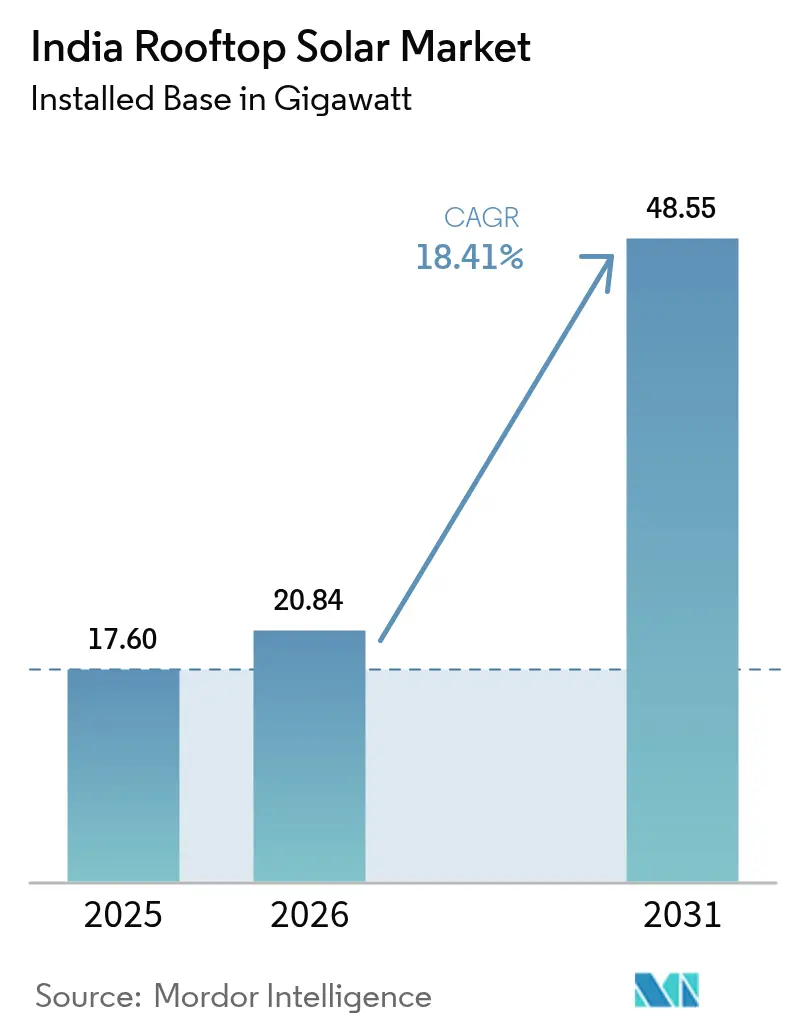
| Base Year Market Size (2025) | 17.60 gigawatt |
| Market Volume (2026) | 20.84 gigawatt |
| Market Volume (2031) | 48.55 gigawatt |
| Growth Rate (2026 - 2031) | 18.41 % |
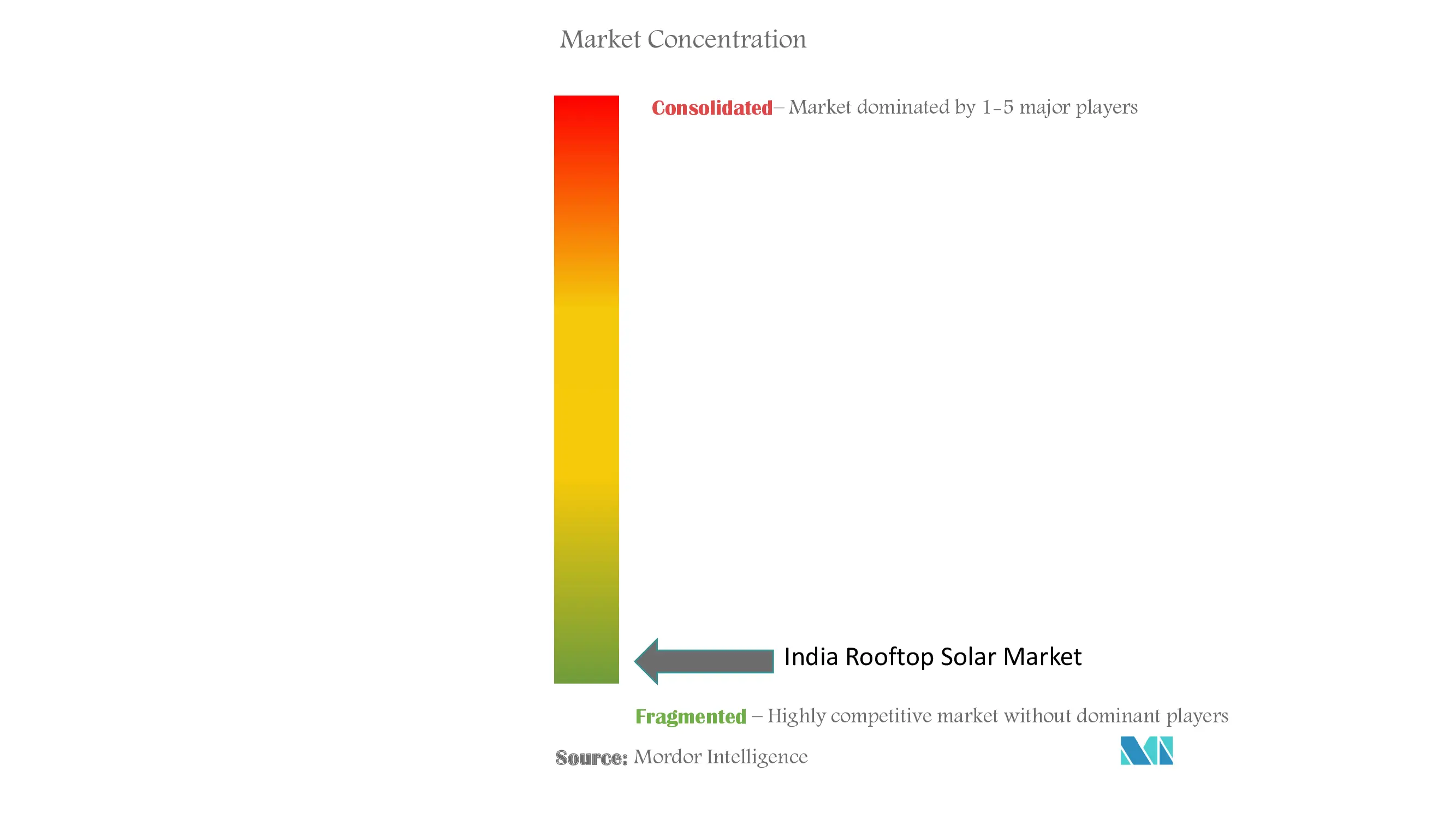
| Market Concentration | Low |
Major Players *Disclaimer: Major Players sorted in no particular order Image © Mordor Intelligence. Reuse requires attribution under CC BY 4.0. | |
India Rooftop Solar Market Analysis by Mordor Intelligence
India Rooftop Solar Market size in 2026 is estimated at 20.84 gigawatt, growing from 2025 value of 17.60 gigawatt with 2031 projections showing 48.55 gigawatt, growing at 18.41% CAGR over 2026-2031.
India's renewable energy landscape has witnessed a remarkable transformation, driven by technological advancements and declining costs in the solar installation sector. According to the International Renewable Energy Agency (IRENA), the total average installed costs in the residential rooftop solar PV sector decreased by over 80% between 2010 and 2022, making solar installations increasingly accessible to various consumer segments. The integration of advanced technologies like smart inverters and monitoring systems has enhanced the efficiency and reliability of rooftop solar installations. The country's commitment to renewable energy is evident in its achievement of reaching 81.81 GW of total solar power system capacity as of March 2024, with grid-connected rooftop solar capacity accounting for 11.87 GW.
The market is experiencing a significant shift towards distributed generation, particularly in urban and semi-urban areas. Mumbai's climate action plan exemplifies this trend, identifying the potential for generating approximately 1.72 GW through rooftop solar power plants across commercial, industrial, and residential segments. The adoption of net metering policies across various states has created a more favorable environment for consumers, with states like Rajasthan raising the limit for net metering from 500 kW to 1 MW for rooftop solar installations in March 2024. These policy reforms have made rooftop solar installations more financially attractive for consumers while contributing to grid stability.
The integration of battery energy storage systems (BESS) with rooftop solar installations has emerged as a crucial trend, particularly in regions with unreliable grid power. The decreasing cost of batteries, which fell to USD 151 per kilowatt-hour in 2022, has made hybrid solar-plus-storage systems more economically viable. This integration enables consumers to maximize self-consumption of solar energy system power and maintain a reliable power supply during grid outages, addressing one of the key challenges in India's power sector.
The market is witnessing innovative financing models and implementation approaches, particularly in rural and semi-urban areas. Healthcare facilities have emerged as significant adopters of rooftop solar solutions, with successful implementations in government hospitals providing both environmental and economic benefits. The introduction of virtual net metering and peer-to-peer energy trading concepts has opened new possibilities for community solar projects and shared solar installations. For instance, in January 2024, Karnataka's draft plan to enable peer-to-peer trading of solar energy through blockchain technology represents a significant step towards modernizing the rooftop solar ecosystem and creating more flexible energy-sharing models.
Note: Market size and forecast figures in this report are generated using Mordor Intelligence’s proprietary estimation framework, updated with the latest available data and insights as of 2026.
Market Trends and Insights
Government Emphasis Toward Rooftop Solar Integration
The Indian government has demonstrated a strong commitment to rooftop solar integration through comprehensive policy frameworks and financial incentives. In February 2024, the government announced plans to increase the subsidy for rooftop solar installations to approximately 60% under the new Pradhan Mantri Suryoday Yojana. Additionally, the Ministry of New and Renewable Energy unveiled draft guidelines for the PM Surya Ghar: Muft Bijli Yojana initiative, aimed at facilitating rooftop solar installations in 10 million households with central government subsidy assistance. The program specifically targets households consuming up to 300 units of electricity per month, with implementation planned through March 31, 2027.
State governments have also introduced significant initiatives to promote residential solar adoption. For instance, in February 2024, the Uttar Pradesh government launched an ambitious program to install solar rooftop systems on 25,000 households in Varanasi within a two-month period. Similarly, in November 2023, the Haryana New and Renewable Energy Department introduced the 'Haryana Solar Power Policy, 2023,' which emphasizes various solar initiatives and targets the installation of 1,600 MW through rooftop solar installations by 2030. The government has also streamlined the installation process through the National Portal launched in September 2023, enabling residential consumers nationwide to apply for solar installation and receive subsidies directly in their bank accounts.
Increasing Demand in the Commercial & Industrial Sector
The commercial and industrial sector has emerged as a significant driver of India's rooftop solar market, with solar panels offering a levelized cost of power as low as INR 2-3 per kWh over their 25-year lifespan, compared to much higher grid tariffs of INR 7-9 for industrial power. This substantial cost difference has resulted in average payback periods of just over three years, making solar installation financially attractive for businesses. The sector's growth is further supported by recent technological advancements and innovative financing solutions, particularly for the MSME segment, where several rooftop solar financers have recently formulated MSME-focused lending plans allowing collateral-free loans.
Recent developments demonstrate the sector's growing adoption of commercial solar solutions. In March 2024, Gensol Engineering completed the installation of a 10.6-megawatt rooftop solar project at Trident Ltd's Budhni textile unit in Madhya Pradesh, featuring nearly 20,000 solar modules and offsetting approximately 11,000 tons of carbon dioxide emissions annually. The project ranks among the top five largest rooftop solar projects globally, covering a rooftop area exceeding 70,000 square meters. Additionally, emerging trends such as battery energy storage, virtual net-metering, and peer-to-peer energy trading are expected to boost electricity generation from solar rooftop power plants in the commercial & industrial sectors, with battery costs having decreased significantly from USD 1,220 per kilowatt hour in 2010 to USD 151 per kilowatt hour in 2022.
India Rooftop Solar Market Segment Analysis
Industrial Segment in India Rooftop Solar Market
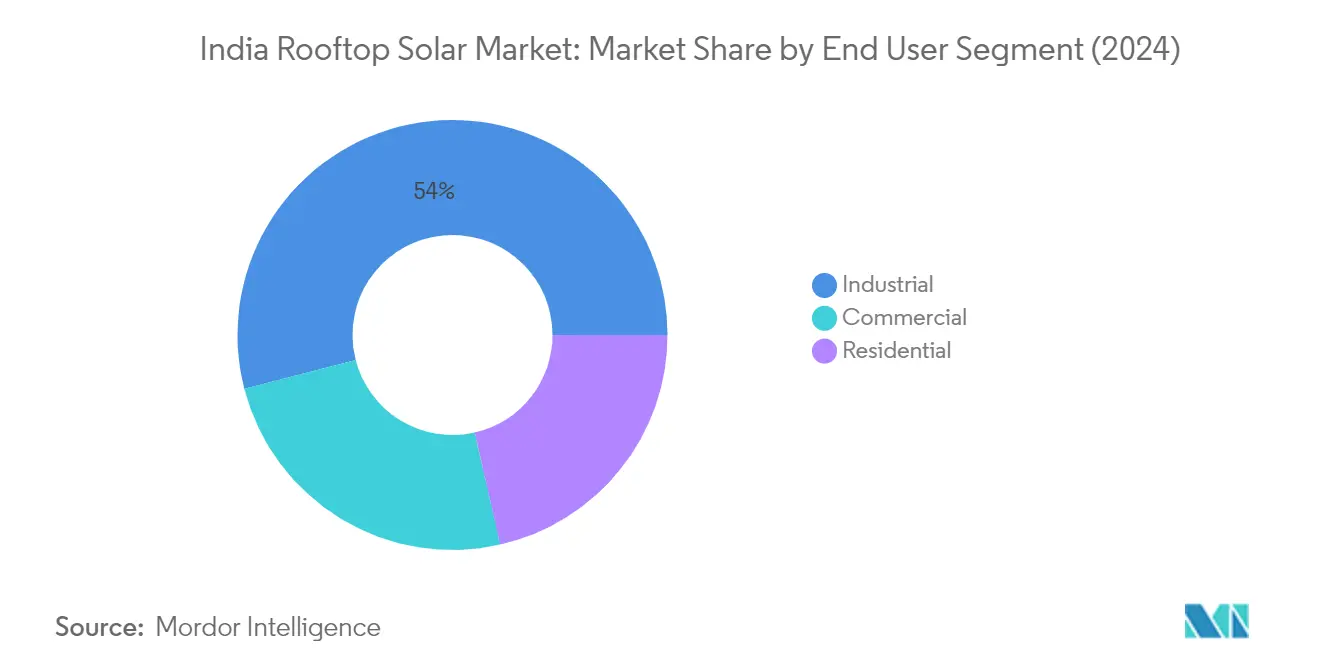
The industrial segment continues to dominate the India rooftop solar market, holding approximately 53.60% of the total market share in 2025, with an installed capacity of around 9,402 MW. This significant market position is primarily driven by the sector's high electricity consumption patterns and the increasing focus on reducing operational costs through renewable energy adoption. The segment's growth is further supported by various government initiatives and policies promoting solar installation in industrial sectors, particularly focusing on MSMEs (Micro, Small, & Medium Enterprises). Industrial consumers are increasingly adopting rooftop solar solutions due to the attractive cost economics, with solar panels offering a levelized cost of power as low as INR 2-3 per kWh over their 25-year lifespan, compared to the much higher grid tariffs of INR 7-9 for industrial power. The sector's dominance is also reinforced by the availability of larger roof spaces in industrial facilities, making them ideal for high-capacity solar array installations.
Residential Segment in India Rooftop Solar Market
The residential solar segment is emerging as the fastest-growing sector in the India rooftop solar market, projected to expand at a CAGR of approximately 22.26% during 2025-2031. This remarkable growth trajectory is primarily driven by increasing government support through initiatives like the Pradhan Mantri Suryoday Yojana, which offers substantial subsidies for residential solar installations. The segment's growth is further accelerated by rising electricity tariffs in residential sectors across various states, prompting homeowners to seek cost-effective alternatives. The implementation of simplified procedures for residential solar installations through the national portal, coupled with the availability of Central Financial Assistance (CFA) of around 40% for systems up to 3 kW and 20% for systems between 3-10 kW, has made solar adoption more accessible to residential consumers. Additionally, the increasing awareness about renewable energy benefits and the growing focus on energy independence among households are contributing to the segment's rapid expansion.
Commercial Segment in India Rooftop Solar Market
The commercial solar segment, including public sector installations, represents a significant portion of the India rooftop solar market, offering unique opportunities and growth potential. This segment benefits from the availability of large rooftop areas in commercial buildings such as malls, hospitals, educational institutions, and office complexes, making them suitable for medium to large-scale solar energy system installations. The segment's growth is supported by various state-specific incentives and net metering policies, particularly in states like Gujarat, Maharashtra, and Karnataka. Commercial establishments are increasingly adopting rooftop solar solutions to offset high commercial electricity tariffs and demonstrate their commitment to sustainability. The segment also benefits from innovative financing options and power purchase agreements (PPAs) that make solar adoption more feasible for commercial entities.
Segment Analysis: Grid Type
On-Grid Segment in India Rooftop Solar Market
The on-grid segment dominates the India rooftop solar market, holding approximately 80% market share in 2024, with an installed capacity of 11,869.63 MW. This significant market position is primarily driven by the government's Grid Connected Solar Rooftop Scheme and various supportive policies aimed at achieving 40,000 MW from grid-connected rooftop solar projects by March 2026. The segment's growth is further bolstered by the implementation of net metering policies across various states, with Maharashtra and Rajasthan recently increasing their net metering limits to enhance adoption. The Central Financial Assistance (CFA) scheme, offering substantial subsidies for residential installations, has also played a crucial role in driving the segment's expansion. Additionally, the launch of the National Portal in 2023 has streamlined the online process for consumers to install rooftop solar panels and receive subsidies directly in their bank accounts, making grid-connected systems more accessible and attractive to potential adopters. The segment is projected to grow at around 20% annually from 2024 to 2029, reflecting the strong market fundamentals and continued policy support.
Off-Grid Segment in India Rooftop Solar Market
The off-grid segment represents approximately 20% of the India rooftop solar market in 2024, serving as a crucial solution for areas with limited or no grid connectivity. This segment has gained significant traction through various government initiatives, including the Off-grid Solar Applications Programme run by the MNRE and private sector participation from companies like TATA Power. The segment's growth is particularly notable in rural electrification projects, healthcare facilities, and remote industrial applications. Recent programs like the Pradhan Mantri Janjati Adivasi Nyaya Maha Abhiyan (PM JANMAN) have allocated substantial funding for solar power implementation in tribal areas, demonstrating the government's commitment to off-grid solutions. The segment's development is also supported by technological advancements in battery storage systems and decreasing component costs, making off-grid solutions more economically viable for end-users. Furthermore, the implementation of schemes like PM KUSUM has created additional opportunities for off-grid installations in agricultural applications, contributing to the segment's steady expansion in the market.
Regulatory Landscape
India's rooftop solar regulatory framework is anchored by the Ministry of New and Renewable Energy (MNRE) through the PM Surya Ghar: Muft Bijli Yojana, approved on February 29, 2024. The program subsumed the Grid Connected Rooftop Solar Phase II Programme and set an implementation window through March 31, 2027. It targets 10 million households (FY 2026-27) and is supported by a total financial outlay of INR 75,021 crore, with beneficiary onboarding and subsidy processing routed through the national portal mechanism.
Compliance requirements shape equipment selection and supplier eligibility, with MNRE-linked procurement and scheme deployments tied to the Approved List of Models and Manufacturers (ALMM) for modules and BIS-linked standards for key components, including inverter and module certifications cited in MNRE-aligned guidance. In 2026, MNRE actions around ALMM administration included reopening the NISE DCR portal in May 2026 to protect investments made under ALMM List-I, followed by an updated ALMM List-I release on July 6, 2026. This reinforces how strongly the market depends on approved supply chains for subsidy and grid-tied installations.
Value Chain Analysis
The rooftop solar value chain in India spans PV modules and inverters, mounting structures and balance-of-system components, EPC and commissioning, utility interconnection (including net metering processes), and multi-year O&M and AMC services, with financing and subsidy disbursal increasingly integrated into the residential customer journey. Under PM Surya Ghar, scale-up has formal program throughput, with more than 2.08 million rooftop systems installed as of December 2025 and INR 14,771.82 crore disbursed as Central Financial Assistance, which in turn increases demand for standardized installer networks, empanelled vendors, and after-sales support capacity.
Upstream supply risks and compliance-driven sourcing are key structural constraints. From June 1, 2026, MNRE-linked requirements for government-backed, net-metered, and open-access projects to use domestically manufactured solar cells under ALMM List-II (DCR-aligned) tightened input availability, especially since domestic cell capacity (about 31 GW) lags module capacity (about 193 GW). In parallel, draft monitoring and cybersecurity-oriented requirements such as inverter-to-server connectivity, drafted in August 2025, add another layer of integration needs for inverter OEMs, platform providers, and DISCOM-linked data workflows.
Competitive Landscape
Top Companies in India Rooftop Solar Market
The Indian rooftop solar market is characterized by a mix of established players and emerging companies driving innovation and market expansion. Companies are increasingly focusing on developing integrated solar power systems that combine panel manufacturing, installation services, and financing options to provide end-to-end customer solutions. Strategic partnerships with banks and financial institutions have become a key trend to facilitate easier financing options for residential and commercial customers. Market players are also investing in research and development to improve solar module efficiency and develop smart monitoring systems. The industry has witnessed a shift towards offering customized solutions for different customer segments, with many companies establishing specialized divisions for residential, commercial, and industrial installations. Additionally, companies are expanding their geographical presence through dealer networks and strategic partnerships while also focusing on after-sales service and maintenance support to build long-term customer relationships.
Dynamic Market with Strong Growth Potential
The Indian rooftop solar market exhibits a balanced mix of both domestic and international players, with local companies having a strong presence in solar installation and maintenance services while global players dominate the solar power equipment manufacturing segment. The market structure is relatively fragmented with numerous regional players operating alongside established national companies, creating a competitive environment that drives innovation and price competitiveness. Recent years have witnessed significant merger and acquisition activities, particularly with international renewable energy companies acquiring stakes in Indian solar companies to establish their presence in the growing market. Private equity firms and international investors have shown increasing interest in the sector, leading to capital infusion and consolidation among smaller players.
The competitive landscape is evolving with the entry of traditional power companies diversifying into the solar sector, bringing their expertise in utility-scale projects to the rooftop segment. Companies are increasingly focusing on vertical integration, with many manufacturers expanding into project development and EPC services to capture higher margins and maintain better control over the value chain. The market has also seen the emergence of specialized players focusing on specific customer segments or geographical regions, creating niche markets within the broader industry. This specialization has led to improved service quality and more targeted solutions for different customer needs.
Innovation and Adaptation Drive Market Success
Success in the Indian rooftop solar market increasingly depends on companies' ability to offer innovative financing solutions and maintain technological leadership while managing costs effectively. Market leaders are strengthening their positions by developing proprietary technologies, establishing strong distribution networks, and building strategic partnerships with component suppliers and financial institutions. Companies are also focusing on digitalization, incorporating smart monitoring systems and predictive maintenance capabilities to enhance their service offerings. The ability to navigate complex regulatory environments across different states while maintaining compliance with quality standards has become crucial for sustained growth.
For new entrants and smaller players, success lies in identifying and serving underserved market segments, particularly in tier-2 and tier-3 cities where competition is less intense. Companies need to focus on building strong local relationships, offering specialized solutions for specific industries, and maintaining operational efficiency to compete effectively. The increasing focus on domestic manufacturing under government initiatives presents opportunities for companies to establish manufacturing capabilities and reduce dependence on imports. Additionally, developing expertise in emerging technologies like storage solutions and smart grid integration will be crucial for future growth. Companies must also prepare for potential regulatory changes, particularly around net metering policies and quality standards, while maintaining flexibility in their business models.
India Rooftop Solar Industry Leaders
-
Tata Power Solar Systems Limited
-
Amplus Solar Power Private Limited
-
Clean Max Enviro Energy Solutions Pvt. Ltd
-
Orb Energy Pvt. Ltd
-
Sunsource Energy Pvt. Ltd
- *Disclaimer: Major Players sorted in no particular order
India Rooftop Solar Market Companies Covered in this Report
- Cleantech Energy Corporation Pte Ltd
- Fourth Partner Energy Pvt. Ltd
- Amplus Solar Power Pvt. Ltd
- Clean Max Enviro Energy Solutions Pvt. Ltd
- Sunsource Energy Pvt. Ltd
- Orb Energy Pvt. Ltd.
- Tata Power Solar Systems Limited
- Mahindra Susten Pvt. Ltd
- Growatt New Energy Technology Co. Ltd
- Roofsol Energy Pvt. Ltd
Market Opportunities and Future Outlook
The largest near-term whitespace sits in mass residential deployment enabled by PM Surya Ghar: Muft Bijli Yojana, which combines a large public outlay (INR 75,021 crore) with defined Central Financial Assistance slabs of INR 30,000 per kW for the first 2 kW and INR 18,000 per kW for the additional 1 kW, with higher CFA for special category states and UTs. Adoption momentum is evidenced by program progress reported through May 2026, with over 3.28 million rooftop systems installed and more than 11.8 GW added under the mission. This creates room for faster standardization of installer capacity, consumer acquisition channels, and utility-aligned interconnection workflows.
Commercial and industrial rooftop and behind-the-meter procurement remains an execution pathway for higher-capacity systems and structured offtake models, supported by large financings and platform-scale project pipelines. For example, in May 2026, CleanMax secured USD 575 million to support 1 GW of solar and wind projects across Rajasthan and Karnataka for C&I customers, signaling continued availability of capital for distributed and captive-aligned renewable supply that can complement rooftop deployments. At the same time, tightening domestic-content and ALMM-linked compliance, including the May and July 2026 ALMM administration updates, creates opportunities for compliant domestic manufacturers, inverter providers, and EPCs that can secure approved supply, manage documentation, and deliver bankable O&M across multi-site portfolios.
Recent Industry Developments in India Rooftop Solar Market
- July 2026: Tata Power Solaroof launched the Ghar Ghar Solar campaign in Punjab, targeting 1 lakh rooftop installations over three years and positioning rooftop solar as a bundled offering alongside batteries and broader residential energy solutions. The initiative expands Tata Power's city and state-level acquisition funnel and strengthens its distribution and installer ecosystem in a high-potential residential geography.
- May 2026: CleanMax secured USD 575 million in financing for 1 GW of solar and wind projects across Rajasthan and Karnataka to serve commercial and industrial clients. The funding supports portfolio buildout and contracting activity, helping developers and EPC partners scale multi-site deployments that often include rooftop and behind-the-meter components in C&I energy strategies.
- April 2024: Apple formed a joint venture with CleanMax to invest in six rooftop solar projects with a combined capacity of 14.4 MW to power its operations in India, including offices and two retail stores in Mumbai and New Delhi. The move adds a high-visibility corporate demand signal for rooftop solar procurement and encourages replication of onsite models among large commercial users.
India Rooftop Solar Market Report Scope and Research Methodology
Market Definition and Coverage
For this methodology, the India rooftop solar market covers solar photovoltaic systems installed on rooftops in India, counted as commissioned installed capacity that is either grid-connected or operating as stand-alone.
Scope exclusions: We exclude ground-mounted solar plants, solar thermal systems, and electricity sales revenues because the model is built in installed capacity terms.
Segments Covered in This Report
- End-user
- Industrial
- Commercial (Including Public Sector)
- Residential
- Grid Type (Qualitative Analysis Only)
- On-grid
- Off-grid
Data Sources, Market Sizing, and Validation
Desk Research
Desk research helped us set the market boundary and build the first cut of the demand pool. We used public information on capacity additions, policy direction, and interconnection signals from sources such as MNRE dashboards and scheme notices, CEA renewable capacity publications, SECI tender documents, and state electricity regulator orders that influence net metering.
To avoid mixing rooftop with utility-scale solar, we also checked broader capacity trackers and technical references such as IEA and IRENA renewable statistics, and peer-reviewed studies on rooftop PV performance and degradation in Indian climate conditions. Company annual reports, investor presentations, and reputable press were used to sanity-check execution pace and commissioning timelines. Where needed, we referenced paid subscriptions for company financials and patent databases to validate supply-side activity and technology shifts. These are illustrative sources, and many more references were used for data collection, validation, and clarification.
Primary Interviews and Surveys
Primary work was used to test assumptions that are not consistently visible in public data, especially commissioning lags, net metering behavior, and typical system sizing by customer type. We spoke with EPCs, developers, distributors, and large commercial and industrial and residential decision makers across major rooftop states. The input was then used to refine adoption speed and align year-wise capacity additions with observed execution realities.
Distribution of primary research fieldwork respondents
| Company type | Respondent position |
|---|---|
| Top tier: 31% | CXOs: 12% |
| Mid tier: 49% | Functional/Unit leaders: 31% |
| Smaller Players: 20% | Managers: 57% |
Market-Sizing & Forecasting
Sizing starts from a top-down reconstruction of rooftop additions using India solar installation reporting, program targets, and tender and interconnection activity, which is then translated into annual commissioned capacity. We then corroborate totals with selective bottom-up approximations, like sampled EPC execution volumes, distributor channel checks, and typical megawatt per project by end user, so the final numbers stay practical.
Key model inputs include rooftop capacity additions by year, net metering and gross metering policy stance by state, typical system sizes for residential and commercial and industrial rooftops, module and inverter price direction that influences payback, and grid tariff movements that change customer economics. When a variable was only partially visible, the gap was handled by using bounded ranges from interviews and then narrowing them using observed commissioning patterns.
For forecasting, we used scenario analysis anchored to policy traction and execution capacity, and then we adjusted yearly outcomes based on how fast subsidies flow and how quickly interconnection approvals move. The outlook was cross-checked with what practitioners expect for pipeline conversion and state-wise rooftop momentum.
Data Validation & Update Cycle
Triangulation was done by comparing modeled rooftop additions against independent signals like tender awards, DISCOM connectivity trends, and reported cumulative rooftop capacity, and then large variances were investigated. Outliers were reviewed in multiple analyst passes so math errors, double counting, and timing mismatches could be removed before sign-off.
Reports are refreshed annually, and interim updates are made when material events occur, such as major subsidy changes or net metering rule revisions that can shift adoption. Before delivery, an analyst runs a fresh validation pass so clients receive the most current view available at that time.
Mordor Intelligence's India Rooftop Solar Market Size Measured Against Other Published Estimates
Published market sizes for India rooftop solar do not always line up because publishers mix different units and timing rules. Differences also come from whether the estimate is built on installed capacity, equipment revenues, or a blend, and from how commissioning delays are treated when projects move across years.
By tracking commissioning-based capacity additions and refreshing the rooftop-only filters inside Mordor Intelligence using policy and interconnection checks, the total stays anchored to GW that is actually brought online, instead of being expanded through revenue conversions or end-year cumulative snapshots.
Benchmark comparison
| Source | Market Size | Gaps in Research Methodology |
|---|---|---|
| Mordor Intelligence | USD 17.60 B (2025) | |
| Industry Advisory A | USD 5.36 B (2025) | Often expressed as revenue for rooftop system sales and services, where totals shift with assumed equipment pricing, installer margins, and what gets counted as services, rather than commissioned capacity. |
| Market Tracker B | USD 20.80 B (2025) | Typically reports cumulative rooftop capacity as an end-year level and may blend calendar-year and fiscal-year timing, which can make the base-year number look larger than an additions-based view. |
The spread mainly reflects whether the publisher is sizing annual additions or cumulative installed capacity, and whether the number is a capacity metric or a revenue conversion. We keep the steps traceable by tying the model to commissioning timing, state policy signals, and visible rooftop activity indicators.
Key Questions Answered in the Report
How big is the India Rooftop Solar Market?
The India Rooftop Solar Market size is expected to reach 20.84 gigawatt in 2026 and grow at a CAGR of 18.41% to reach 48.55 gigawatt by 2031.
What is the current India Rooftop Solar Market size?
In 2026, the India Rooftop Solar Market size is expected to reach 20.84 gigawatt.
Who are the key players in India Rooftop Solar Market?
Tata Power Solar Systems Limited, Amplus Solar Power Private Limited, Clean Max Enviro Energy Solutions Pvt. Ltd, Orb Energy Pvt. Ltd and Sunsource Energy Pvt. Ltd are the major companies operating in the India Rooftop Solar Market.
What years does this India Rooftop Solar Market cover, and what was the market size in 2025?
In 2025, the India Rooftop Solar Market size was estimated at 20.84 gigawatt. The report covers the India Rooftop Solar Market historical market size for years: 2019, 2020, 2021, 2022, 2023 and 2024. The report also forecasts the India Rooftop Solar Market size for years: 2026, 2027, 2028, 2029, 2030 and 2031.