
Hyoscine Market Size and Share
Market Overview
| Study Period | 2020 - 2031 |
|---|---|
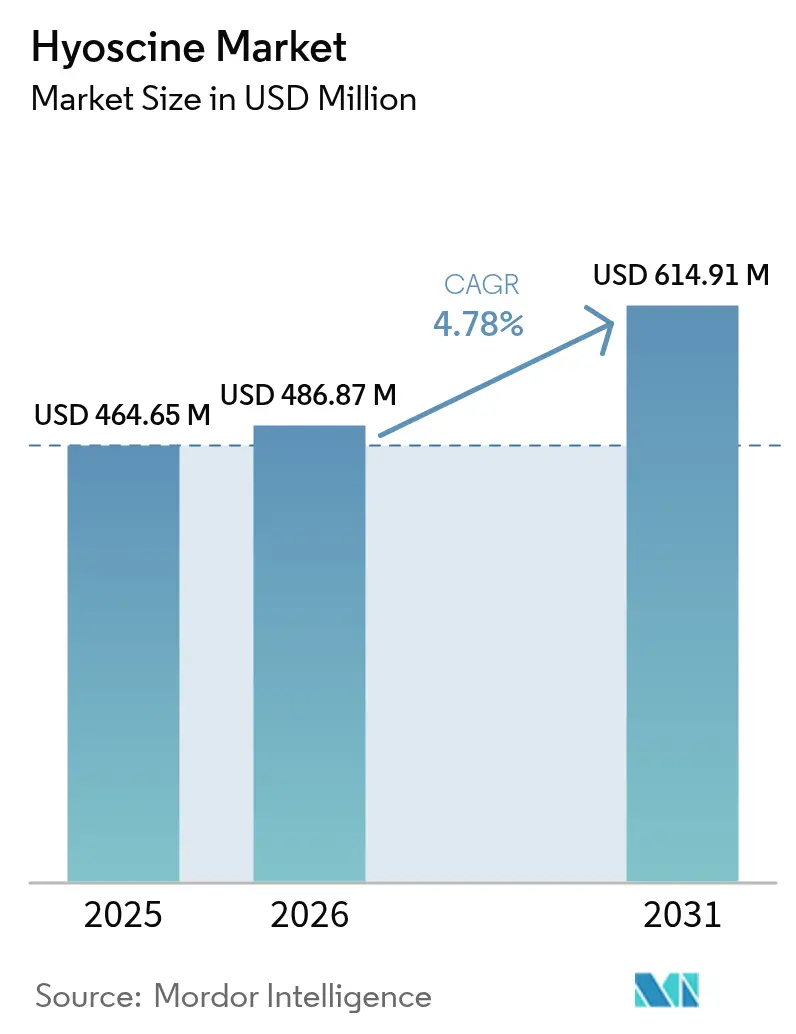
| Market Size (2026) | USD 486.87 Million |
| Market Size (2031) | USD 614.91 Million |
| Growth Rate (2026 - 2031) | 4.78 % |
| Fastest Growing Market | Asia Pacific |
| Largest Market | North America |
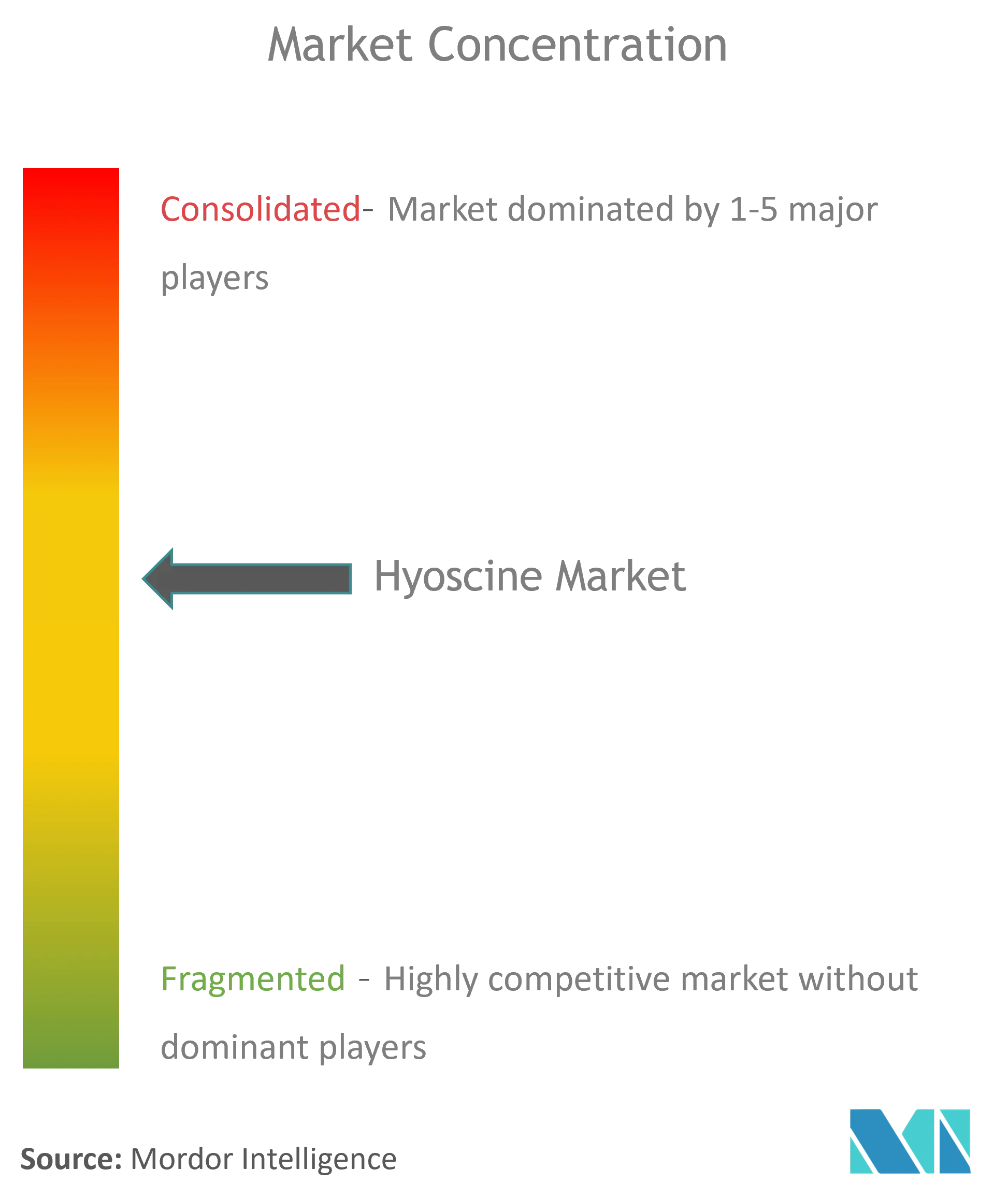
| Market Concentration | Low |
Major Players *Disclaimer: Major Players sorted in no particular order Image © Mordor Intelligence. Reuse requires attribution under CC BY 4.0. | |
Hyoscine Market Analysis by Mordor Intelligence
The hyoscine market size was valued at USD 464.65 million in 2025 and estimated to grow from USD 486.87 million in 2026 to reach USD 614.91 million by 2031, at a CAGR of 4.78% during the forecast period (2026-2031). Momentum comes from wider recognition of the drug’s anticholinergic versatility, a growing body of clinical evidence in postoperative nausea and vomiting (PONV) protocols, and sustained investment in advanced transdermal platforms. Rising surgical volumes, increased global travel, and heightened diagnosis of functional gastrointestinal disorders all reinforce demand. Competition centres on differentiated delivery technologies that promise steady plasma levels while mitigating anticholinergic burden. Meanwhile, supply-side pressures tied to Duboisia cultivation spur vertical integration and bio-engineered alkaloid initiatives in Australia and India.
Key Report Takeaways
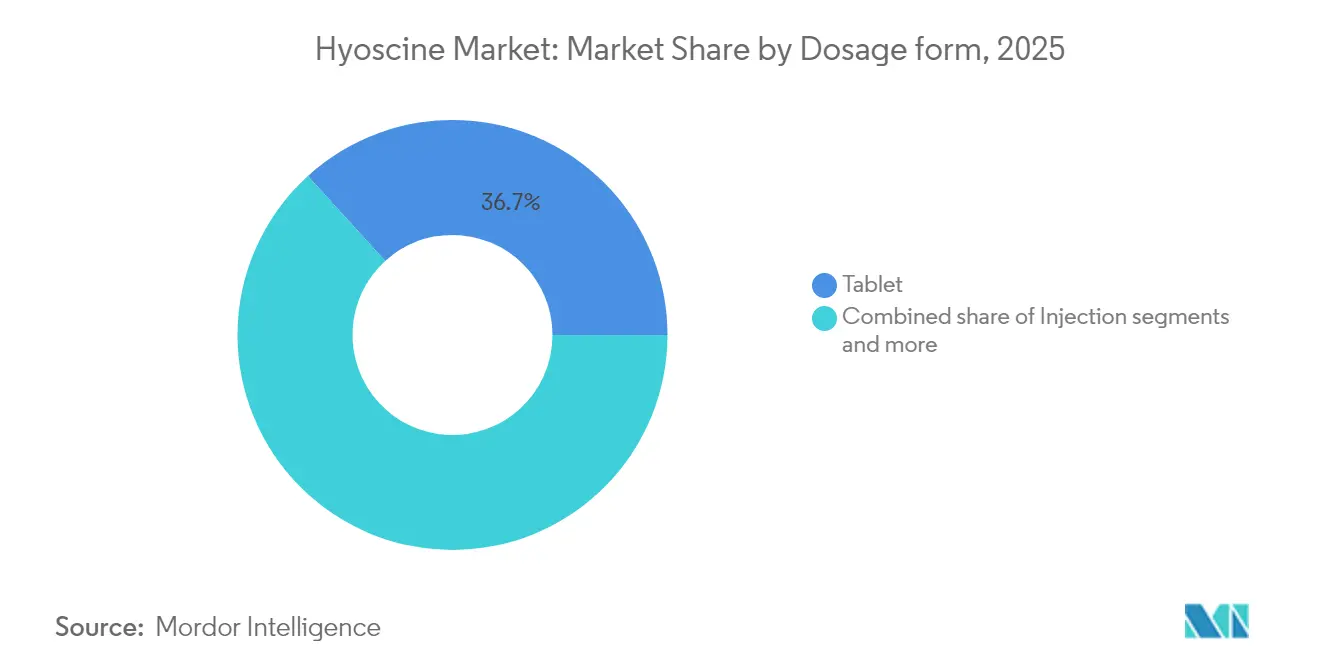
- By dosage form, tablets accounted for 36.74% of 2025 revenue, whereas transdermal patches are growing fastest at a 6.37% CAGR through 2031.
- By indication, motion sickness captured 38.35% of 2025 demand, while neurological disorders are projected to deliver the highest 6.8% CAGR to 2031.
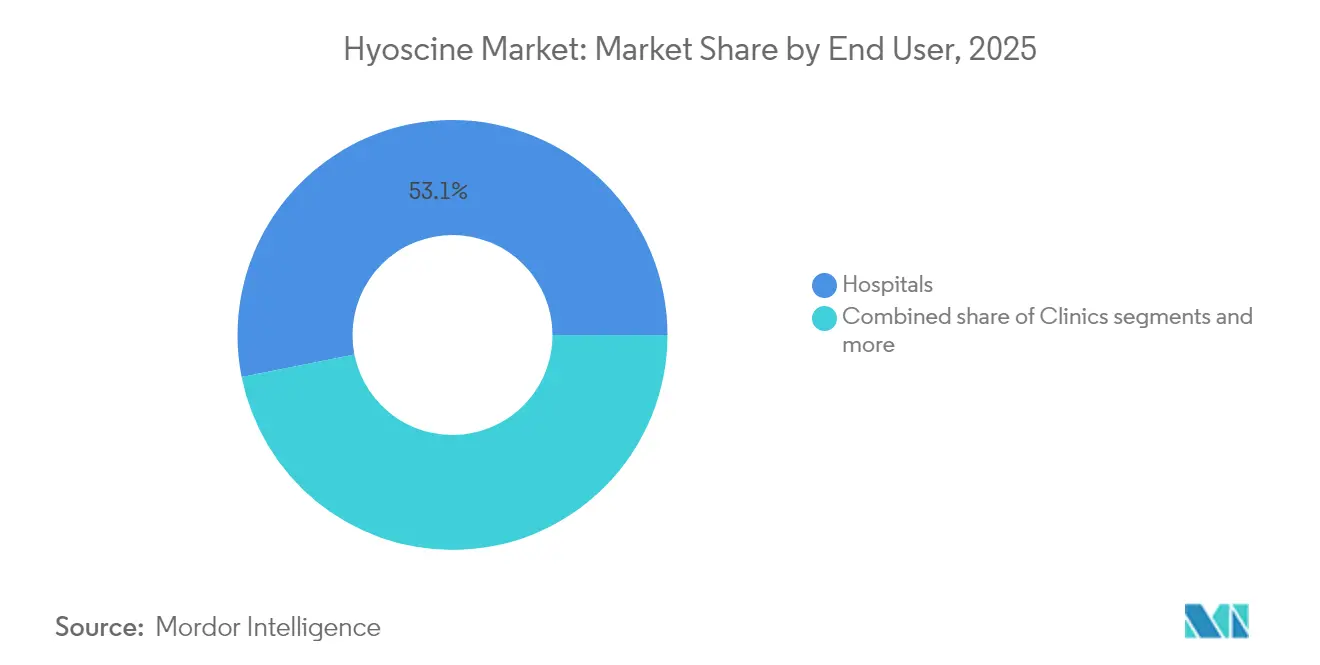
- By end user, hospitals held 53.12% of 2025 revenue, yet home-care settings are expanding at a 7.29% CAGR to 2031.
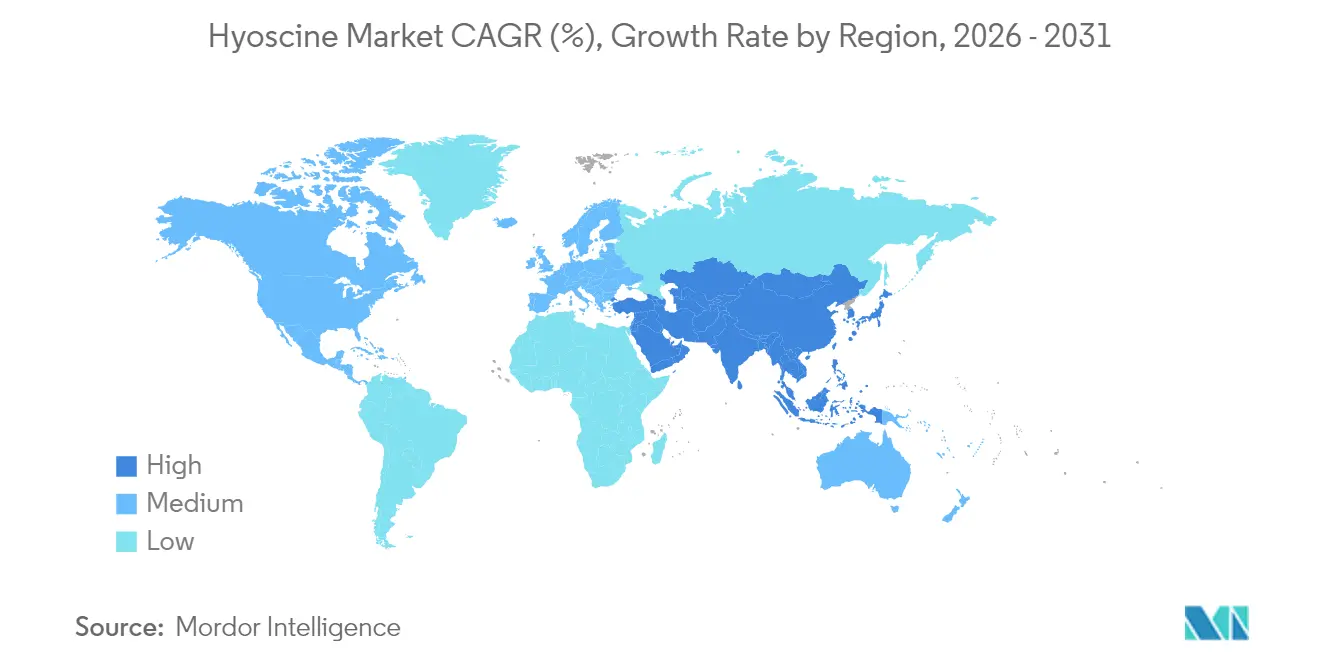
- By geography, North America commanded 41.68% of 2025 revenue; Asia-Pacific is on track for the quickest 7.81% CAGR through 2031.
Note: Market size and forecast figures in this report are generated using Mordor Intelligence’s proprietary estimation framework, updated with the latest available data and insights as of 2026.
Market Trends and Insights
Drivers Impact Analysis of Hyoscine Market*
| Driver | (~) % Impact on CAGR Forecast | Geographic Relevance | Impact Timeline |
|---|---|---|---|
| Rising incidence of motion sickness | +0.8% | Global, with concentration in North America & Europe | Medium term (2-4 years) |
| Growing prevalence of gastrointestinal disorders | +1.2% | Global, particularly Asia-Pacific emerging markets | Long term (≥ 4 years) |
| Surge in surgical procedures leading to PONV | +1.0% | North America & EU, expanding to APAC | Medium term (2-4 years) |
| Adoption of advanced transdermal delivery systems | +0.9% | Developed markets, spill-over to emerging economies | Long term (≥ 4 years) |
| Experimental use in neuro-psychiatric disorders | +0.7% | North America & EU research centers | Long term (≥ 4 years) |
| Bio-engineered Duboisia cultivation boosting supply | +0.4% | Australia, with technology transfer to India | Long term (≥ 4 years) |
| Source: Mordor Intelligence | |||
Rising Incidence of Motion Sickness
Growing passenger kilometres by air, sea, and autonomous vehicles heighten vestibular conflicts that precipitate motion sickness. Transdermal scopolamine delivers up to 72-hour prophylaxis, outperforming shorter-acting orals and supporting premium pricing in the hyoscine market. Military programs exploring intranasal formats underscore new mission-critical niches. With tourism rebounding and virtual reality headsets becoming mainstream, the addressable base widens further.
Growing Prevalence of Gastrointestinal Disorders
Irritable bowel syndrome rates are climbing on dietary shifts, urban stressors, and improved diagnostics in Asia-Pacific. Hyoscine butylbromide, a peripherally acting antispasmodic, increasingly features as first-line therapy in clinical guidelines. WHO’s essential-medicine listing shields demand from generic erosion, while paediatric safety reviews hint at label extensions that will augment the hyoscine market.
Surge in Surgical Procedures Leading to PONV
Minimally invasive and day-case surgeries are rising, yet PONV still affects up to 30% of general cases and over 50% of high-risk cohorts. Muscarinic blockade complements serotonin antagonists, delivering additive symptom control and shorter recovery stays. Evidence of safety in breastfeeding mothers following caesarean section broadens use in obstetric theatres.
Adoption of Advanced Transdermal Delivery Systems
Next-generation patches employ micro-reservoirs and stimulus-responsive polymers for predictable flux, addressing historical variability complaints. Real-time terahertz spectroscopy now validates in-vivo diffusion without biopsies, supporting quality-by-design manufacturing. Home-care uptake soars because patches reduce dosing frequency and caregiver oversight, a boon for the hyoscine market in ageing societies.
Restraints Impact Analysis of Hyoscine Market*
| Restraint | (~) % Impact on CAGR Forecast | Geographic Relevance | Impact Timeline |
|---|---|---|---|
| Anticholinergic side-effect profile | -0.8% | Global, particularly affecting geriatric populations | Short term (≤ 2 years) |
| Stringent prescription & regulatory controls | -0.6% | North America & EU, expanding to emerging markets | Medium term (2-4 years) |
| Duboisia crop volatility due to climate change | -0.4% | Australia & India cultivation regions | Long term (≥ 4 years) |
| Geriatric formulary exclusion trends | -0.3% | Developed markets with aging populations | Medium term (2-4 years) |
| Source: Mordor Intelligence | |||
Anticholinergic Side-Effect Profile
Dry mouth, blurred vision, delirium, and urinary retention limit dose escalation, especially in patients above 60 years where pneumonia and mortality risks rise. Recent FDA warnings on heat-related complications when patches interact with external warming sources accentuate caution[1]Source: U.S. Food and Drug Administration, “FDA Adds Warning About Serious Risk of Heat-Related Complications,” fda.gov. Hospitals now deploy stricter monitoring and risk-stratification algorithms, which may constrain near-term gains for the hyoscine market.
Stringent Prescription & Regulatory Controls
Misuse in criminal assaults and concerns over paediatric toxicity have tightened scheduling in several jurisdictions. Complete response letters for novel intranasal submissions underline lengthy approval cycles and elevated compliance costs[2]Source: Defender Pharmaceuticals, “Complete Response Letter for Intranasal Scopolamine,” defenderpharma.com . Smaller manufacturers struggle to fund the pharmacovigilance infrastructure now required, heightening entry barriers.
*Our forecasts treat driver/restraint impacts as directional, not additive. The impact forecasts reflect baseline growth, mix effects, and variable interactions.
Hyoscine Market Segment Analysis
By Dosage Form:
Transdermal Innovation Drives GrowthTablets led 2025 revenue with 36.74% hyoscine market share following decades of physician familiarity and low unit cost. However, transdermal patches are projected to clock 6.37% CAGR and could capture a larger slice of the hyoscine market size as sustained-release formats gain favour among travellers and elderly users.
Injection formats retain relevance in emergency departments that value rapid onset, yet adoption outside hospital walls remains modest due to administration complexity. Oral solutions serve paediatric and dysphagic cohorts, while pipeline nasal gels target military and spaceflight settings. Overall, patch technology is propelling differentiation within the hyoscine market through longer dwell times and adherence-friendly designs.



By Indication:
Neurological Applications Gain MomentumMotion sickness prevailed with 38.35% of 2025 revenue, a testament to post-pandemic travel recovery. Nonetheless, neurological disorders are poised for the highest 6.8% CAGR as rapid-acting antidepressant trials progress. Early data show meaningful mood improvements within hours, positioning scopolamine toward unmet psychiatric needs.
Gastrointestinal use cases remain stable, anchored by rising IBS diagnostics in Asia-Pacific. PONV demand mirrors global surgical volumes, especially in laparoscopic and obstetric theatres. Respiratory indications represent a smaller but durable niche. The diversification of use cases reinforces the resilience of the hyoscine market.
By End User:
Home Care Settings AccelerateHospitals controlled 53.12% of 2025 consumption because formulary inclusion and perioperative protocols rely on hyoscine for multimodal antiemesis. Yet home-care settings will expand fastest at 7.29% CAGR through 2031, thanks to telehealth supervision and user-friendly patches that limit dosing errors.
Clinics bridge acute hospital services and at-home therapy, benefiting from growth in day-case procedures. The COVID-19 hangover continues to push healthcare toward decentralised delivery, an environment in which hyoscine market participants offering tamper-evident packaging and e-label guidance stand to win share.
Geography Analysis
North America and Europe Hyoscine Market
North America generated 41.68% of 2025 revenue due to entrenched reimbursement and early adoption of controlled-release formats. Europe follows closely, buoyed by older demographics and stringent PONV guidelines that specify anticholinergic combinations. North American suppliers also benefit from captive Duboisia plantations that buffer botanical supply risk.
APAC and India Hyoscine Market
Asia-Pacific is forecast to post the highest 7.81% CAGR, lifted by improving diagnostic penetration, rising medical tourism, and government drives to localise active pharmaceutical ingredient production. India’s regulatory overhauls, including fast-track plant clearances and pharmacovigilance digitisation, are fostering capacity additions and scale that can reshape the hyoscine market.
LATAM and MEA Hyoscine Market
Latin America and Middle East & Africa offer longer-term optionality but remain sensitive to price ceilings and patch import tariffs. Multinationals leverage partnered distribution and tiered-pricing to maintain presence, yet supply interruptions from climatic Duboisia shocks can impede service levels. Geographic diversification of plantations is therefore a strategic hedge for the hyoscine market.

Regulatory Landscape
Hyoscine (scopolamine) products and APIs are governed through established pharmacopeial quality frameworks, notably the European Pharmacopoeia (Ph. Eur.), the United States Pharmacopeia (USP), and the British Pharmacopoeia (BP), which define release specifications and impurity limits used across registrations and procurement. For active substances, ICH Q7 GMP expectations underpin global API compliance and inspection readiness, with PIC/S alignment frequently used as a cross-border benchmark for audits and supplier qualification.
In the European Union, Commission Delegated Regulation (EU) No 1252/2014 sets GMP principles for active substances manufactured in the Union, shaping qualification requirements for hyoscine API suppliers and distributors. In the United States, the FDA regulates hyoscine drug products through NDA/ANDA pathways under CGMP expectations, and recent label-risk communications for transdermal scopolamine (for example, heat-related complications referenced in 2025 safety updates) reinforce post-market vigilance requirements that affect hospital protocols and manufacturer pharmacovigilance workloads.
Value Chain Analysis
The hyoscine value chain begins with agricultural inputs and botanical feedstock, most commonly Duboisia cultivation and harvesting, followed by extraction of tropane alkaloids, intermediate processing, and purification to GMP-grade APIs such as hyoscine hydrobromide and hyoscine butylbromide. API output then moves to formulation (tablets, injections, oral solutions, and transdermal patches), packaging and serialization where applicable, and distribution through wholesalers, hospital procurement, and retail and home-care channels depending on local scheduling and prescription rules.
Control of upstream Duboisia supply is a differentiator because crop variability can tighten availability and raise costs, encouraging backward integration and contracted farming, including Australia-centered cultivation footprints cited by multiple producers. On the downstream side, transdermal patch manufacturing adds specialized steps, including adhesive systems and rate-controlling membranes, plus in-process flux consistency controls that raise technical barriers. This also increases the importance of qualified excipient and converting suppliers. Across the chain, global market access depends on maintaining GMP documentation and filings (for example, DMFs and regional quality dossiers) that support regulated-market exports and stable tender participation.
Competitive Landscape
The hyoscine market is moderately fragmented. Leading firms pair vertically integrated alkaloid farming with proprietary patch technologies that command premium margins. Recent consolidation talk—including Alkem Laboratories’ USD 3 billion pursuit of JB Chemicals—reflects a push for scale-based cost leverage.
Developers of electronic-enabled patches capable of personalised dose modulation have tightened their hold on high-value home-care channels. Generic manufacturers focus on tablets and injectables, banking on formulary price wins in emerging markets. Supply reliability remains a key differentiator: companies with diversified Duboisia farms in Australia and India mitigate climatic shocks, while others source alkaloids on the spot market and risk cost volatility.
Strategic moves include Baxter’s 2025 bundle-pricing initiative that tied Scopoderm with infusion pumps for ambulatory surgery centres, and Amneal’s payor agreements that widened neurological product coverage beyond 50% of US lives. Quality lapses, such as Viatris’ 2024 warning letter, highlight ongoing compliance challenges and reinforce the premium on cGMP track records for the hyoscine market.
Hyoscine Industry Leaders
Caleb Pharmaceuticals, Inc
Baxter International
Alchem International Pvt. Ltd
Perrigo
GSK plc
- *Disclaimer: Major Players sorted in no particular order
Hyoscine Market Companies Covered in this Report
- Perrigo Company
- Alchem International Pvt Ltd
- Alkaloids of Australia Pty Ltd
- Alvogen Group
- Myungmoon Pharmaceutical Co., Ltd.
- Boehringer Ingelheim
- Alkem Laboratories Ltd.
- Ruwex Pharma BV
- Sinochem Ningbo Ltd.
- Phyto Myco Research Corp.
- Indena S.p.A.
- Zydus Group
- MYLAN TECHNOLOGIES
- ZYDUS PHARMS
- AMNEALS PHARMS
- Baxter

Market Opportunities and Future Outlook
Regulatory approvals and line extensions in transdermal scopolamine create whitespace for differentiated, adherence-friendly delivery in travel and perioperative use, where long-duration prophylaxis is valued and dosing simplicity supports home-care adoption. A concrete signal of this pathway is Zydus Pharmaceuticals receiving US FDA approval (August 2024) to market a scopolamine transdermal system, which reinforces competitive intensity around patch-based formats and strengthens the case for payor, formulary, and channel strategies that favor controlled-release delivery.
Opportunities also extend to compliant, high-purity API supply for global formulation partners as procurement tightens around pharmacopeial conformance and traceable quality systems. UK MHRA national marketing authorisations (February 2024) for hyoscine butylbromide 10 mg film-coated tablets indicate continued generic registration activity in mature markets, while manufacturer focus on pharmacopeia-aligned, high-purity hyoscine hydrobromide API, including Indian suppliers such as Prism Industries Pvt. Ltd., supports cross-border sourcing for tablets, injectables, and patch programs. At the same time, heightened scrutiny of upstream pricing behavior, particularly for hyoscine butylbromide APIs, increases the value of transparent contracting and diversified, audit-ready supplier networks.
Recent Industry Developments in Hyoscine Market
- June 2026: The US FDA updated its approved drug product listings, reflecting ongoing maintenance of hydrobromide-based drug product records used by manufacturers and downstream partners for reference and compliance. This type of update supports lifecycle management activities, including label, quality, and supply-chain documentation alignment used in regulated-market distribution.
- July 2025: The European Commission fined Alchem International Pvt. Ltd. and its subsidiary Alchem International (H.K.) Limited for participating in a cartel involving the active pharmaceutical ingredient N-Butylbromide Scopolamine/Hyoscine within the EEA, linked to coordinated pricing and quota allocation over a multi-year period ending in 2018. The action heightened scrutiny on upstream API contracting and reinforced the emphasis on compliant, transparent procurement and supplier qualification in hyoscine butylbromide supply chains.
- August 2024: Zydus Pharmaceuticals received US FDA approval to market its scopolamine transdermal system. The approval adds a new competitive option in transdermal delivery, intensifying focus on patch manufacturing capability, bioequivalence and quality controls, and channel access in motion sickness and perioperative nausea use cases.


Hyoscine Market Report Scope and Research Methodology
Market Definition and Coverage
This market covers the sales value of hyoscine medicines used for prevention and treatment of conditions such as motion sickness, gastrointestinal spasms, and nausea, across the main dosage forms and administration routes. We count revenues generated from hyoscine products sold through healthcare and retail channels in the covered geographies.
Scope exclusions: We exclude non-hyoscine substitutes, combination therapies where hyoscine is not the active driver, and unrelated supportive care products.
Segments Covered in This Report
- By Dosage Form (Value)
- Tablets
- Injection
- Transdermal Patch
- Oral Solutions
- Others
- By Indication (Value)
- Motion Sickness
- Gastrointestinal Disorders
- Post-operative Nausea & Vomiting (PONV)
- Neurological Disorders
- Respiratory Disorders
- Others
- By End User (Value)
- Hospitals
- Clinics
- Home-care Settings
- Others
- By Geography (Value)
- North America
- United States
- Canada
- Mexico
- Europe
- Germany
- United Kingdom
- France
- Italy
- Spain
- Rest of Europe
- Asia-Pacific
- China
- India
- Japan
- South Korea
- Australia
- Rest of Asia-Pacific
- South America
- Brazil
- Argentina
- Rest of South America
- Middle East and Africa
- GCC
- South Africa
- Rest of Middle East and Africa
- North America
Data Sources, Market Sizing, and Validation
Desk Research
Desk research began with checking how hyoscine is regulated, prescribed, and used clinically, which helps keep the market boundary consistent across regions. We referenced public sources such as the World Health Organization, the US FDA, the European Medicines Agency, national health ministry publications, and clinical literature indexed on PubMed to understand indications, dosing forms, and route preferences.
To shape the demand and supply context, we also reviewed company annual reports and investor presentations, reputable press coverage on drug supply and shortages, and trade statistics where relevant to key raw materials and intermediate chemicals. Select paid subscriptions were used only for company financial intelligence, patent lookups, and shipment-level trade signals so assumptions could be cross-checked against observable activity. The sources listed here are illustrative, and many other public references were used for data collection, validation, and clarification.
Primary Interviews and Surveys
Primary interviews were used to pressure-test desk assumptions on product mix, route adoption (oral, injections, and patches), and realistic price movement by geography. We spoke with stakeholders across manufacturing, distribution, and care delivery to confirm usage patterns in motion sickness and hospital protocols, then completed follow-up checks across APAC, EMEA, and the Americas to align regional splits and growth drivers.
Distribution of primary research fieldwork respondents
| Company type | Respondent position | Region |
|---|---|---|
| Top tier: 31% | CXOs: 16% | APAC: 43% |
| Mid tier: 47% | Functional/Unit leaders: 36% | EMEA: 35% |
| Smaller Players: 22% | Managers: 48% | Americas: 22% |
Market-Sizing & Forecasting
The sizing model starts from a top-down build where treated demand pools and usage intensity are reconstructed using healthcare activity signals, and then translated into value using typical dosing and price levels. In practice, we map demand to key use cases such as motion sickness prophylaxis and gastrointestinal spasm management, and then distribute it by route based on adoption patterns and care setting.
To keep totals realistic, results are corroborated with selective bottom-up approximations like sampled average selling price (ASP) times estimated volume by dosage form, and channel checks on patch versus oral penetration. The inputs that most shaped the model included surgical and anesthesia procedure volumes linked to nausea prevention protocols, travel volume trends tied to motion sickness demand, the share shift between oral and transdermal formats, observed availability constraints related to botanical sourcing, and regional pricing corridors by pack and strength. When gaps show up in smaller countries where public signals are thin, we used proxy indicators from similar markets and adjusted them after expert feedback.
For forecasting, scenario analysis was used so price movement and route adoption could be varied separately from volume growth, then held consistent with what interviewees expect on clinical practice and supply stability over the next few years.
Data Validation & Update Cycle
Validation is done by comparing model outputs against independent signals such as regional shares implied by usage settings, route mix expectations, and the pace of patch adoption, then checking whether year-to-year changes look explainable. When large variances appear, the assumptions are re-opened, a second analyst reviews the logic, and targeted re-contacts are triggered to confirm what changed and why.
Reports are refreshed annually, and interim updates are made when material events occur, such as supply disruptions, major regulatory actions, or meaningful shifts in care protocols. Before delivery, a fresh final review is completed so clients receive the most current view available at that time.
Mordor Intelligence's Hyoscine Market Size Compared Against Other Published Estimates
Published hyoscine market numbers can differ even when they look like they are talking about the same drug, because the cut of the market is not always the same. Differences usually come from what is included in the revenue scope, which years are used as the starting point, and how route mix and pricing are carried forward.
The table shows a spread largely because some studies blend prescription and over-the-counter sales and apply broader distribution channel coverage, then carry slower or faster price trends into the forecast period. In Mordor Intelligence's model, the 2026 value is anchored to a route-based view across oral, patches, and injections with region splits validated through primary checks, which tends to land differently than estimates built mainly from purchase-mode assumptions and older base years.
Benchmark comparison
| Source | Market Size | Gaps in Research Methodology |
|---|---|---|
| Mordor Intelligence | USD 486.87 M (2026) | |
| Industry Research Publisher A | USD 429.03 M (2024) | Uses an earlier base year and explicitly mixes prescription and OTC purchase modes with channel based sizing, which can pull the starting value down and smooth route level variation. |
| Industry Research Publisher B | USD 424.30 M (2024) | Relies on a narrower segment framing and a lower implied growth path through 2030, with less visibility on route mix assumptions that can shift value between oral and transdermal products. |
Reading the three figures together, most of the difference is explained by base year choice and how routes and selling channels are treated when building the demand pool. Our approach stays traceable to clear use cases, route adoption, and pricing corridors, which makes the final number easier to reproduce and adjust when new evidence appears.


Key Questions Answered in the Report
What is the projected value of the hyoscine market by 2031?
The hyoscine market is forecast to reach USD 614.91 million by 2031, growing at a 4.78% CAGR.
Which dosage form is expanding fastest?
Transdermal patches are on course for a 6.37% CAGR, the quickest among all formats.
Why is Asia-Pacific viewed as the growth engine?
Better healthcare access, rising disposable income, and local API capacity are driving a 7.81% CAGR in Asia-Pacific.
What are the main restraints facing the hyoscine market?
Dose-limiting anticholinergic effects and increasingly strict global prescription controls are the primary brakes on growth.
Page last updated on:


 Your data is secure and never sold or shared.


