
Household Beauty Appliances Market Size and Share
Market Overview
| Study Period | 2021 - 2031 |
|---|---|
| Market Size (2026) | USD 8.26 Billion |
| Market Size (2031) | USD 11.35 Billion |
| Growth Rate (2026 - 2031) | 6.56 % |
| Fastest Growing Market | Asia Pacific |
| Largest Market | North America |
| Market Concentration | Low |
Major Players *Disclaimer: Major Players sorted in no particular order Image © Mordor Intelligence. Reuse requires attribution under CC BY 4.0. | |
Household Beauty Appliances Market Analysis by Mordor Intelligence
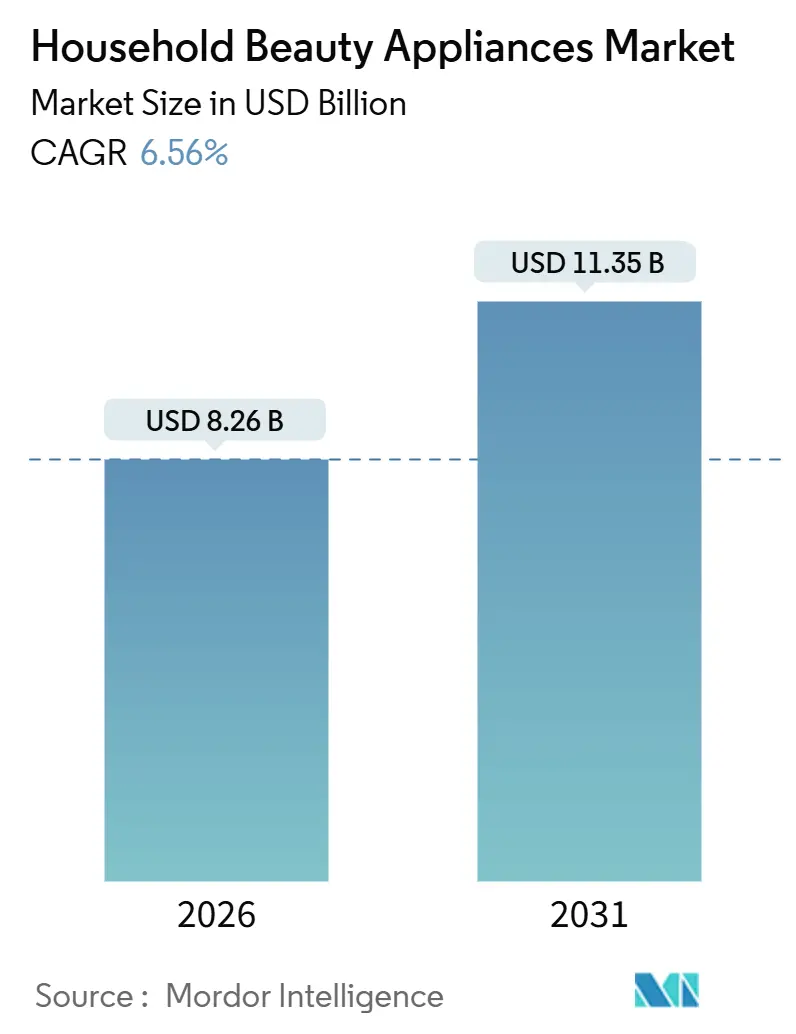
The household beauty appliances market size is USD 8.26 billion in 2026 and is projected to reach USD 11.35 billion by 2031 at a 6.56% CAGR. The household beauty appliances market is experiencing strong growth as consumer demand shifts from traditional hair tools to advanced, skin-focused technologies. Devices that use LED wavelengths, microcurrents, and other professional-grade techniques for at-home results are increasingly popular, offering efficacy comparable to salon treatments. Regulatory alignment in key markets enhances consumer confidence, with updated safety standards for lasers and intense light devices ensuring trustworthy and reliable use. Innovation in product design featuring precision light, cooling systems, and adaptive sensors expands functionality and boosts perceived effectiveness for anti-aging and hair-care applications. Geographic trends further support growth, with established markets providing steady demand while emerging regions benefit from manufacturing advantages, digital adoption, and omnichannel retail strategies that increase accessibility and conversion.
Key Report Takeaways
- By product type, Haircare Appliances led with 36.91% of the household beauty appliances market share in 2025, while Skincare and Facial Devices recorded the highest projected growth at a 6.83% CAGR through 2031.
- By distribution channel, Supermarkets and Hypermarkets held 41.62% of the household beauty appliances market share in 2025, and Online Retail posted the fastest projected growth at a 7.35% CAGR through 2031.
- By price tier, the Mass and Value Tier accounted for 45.91% of the household beauty appliances market share in 2025, while the Premium and Prestige Tier is set to expand at a 6.91% CAGR through 2031.
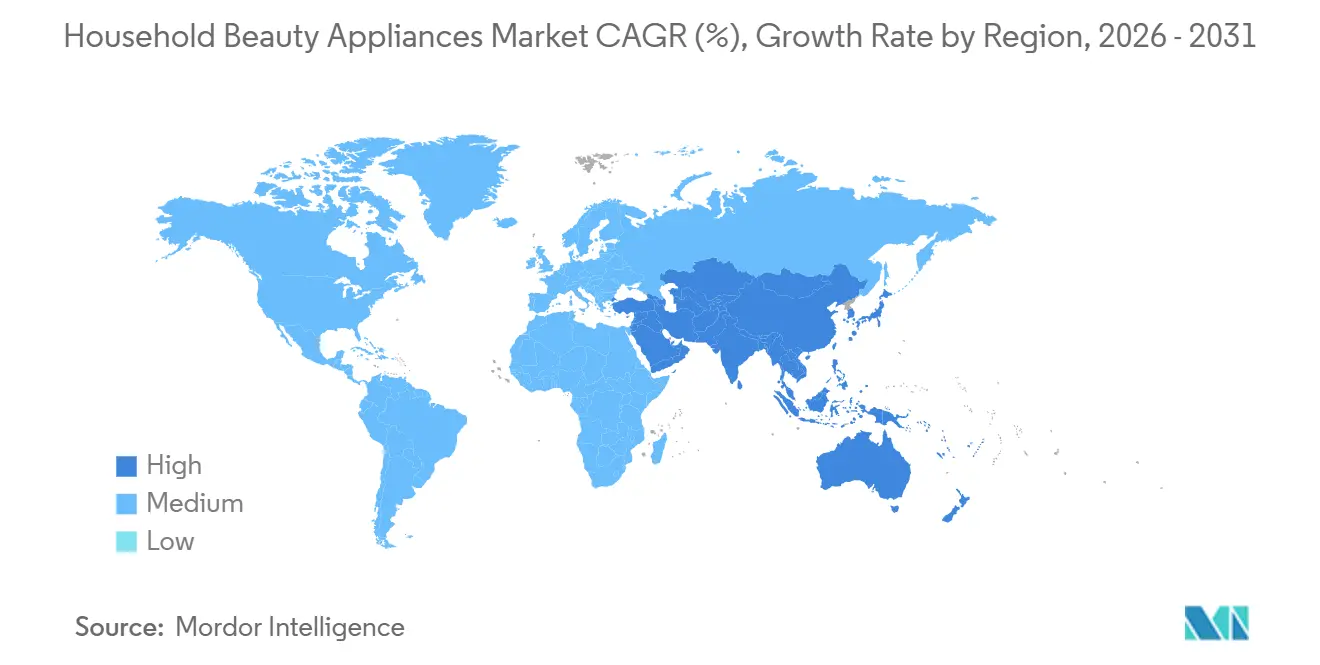
- By geography, North America held 32.82% of the household beauty appliances market share in 2025, and Asia Pacific is forecast to be the fastest-growing region at a 7.25% CAGR through 2031.
Note: Market size and forecast figures in this report are generated using Mordor Intelligence’s proprietary estimation framework, updated with the latest available data and insights as of January 2026.
Market Trends and Insights
Drivers Impact Analysis of Household Beauty Appliances Market*
| Driver | (~) % Impact on CAGR Forecast | Geographic Relevance | Impact Timeline |
|---|---|---|---|
| Rising preference for convenient at-home treatments | +1.8% | Global, early gains in North America, Western Europe, and urban Asia-Pacific | Medium term (2-4 years) |
| Technological advances in LED/IPL/AI personalization | +1.5% | Global core, spill-over to Middle East and Africa and Latin America as price points decline | Long term (≥ 4 years) |
| E-commerce and influencer-led visibility boom | +1.3% | North America and Europe lead, Asia-Pacific accelerating | Short term (≤ 2 years) |
| Subscription-based device ecosystems | +0.7% | North America, Western Europe | Medium term (2-4 years) |
| Asian export incentives lowering price points | +0.9% | Asia-Pacific manufacturing hubs exporting globally | Short term (≤ 2 years) |
| Growing male-grooming demand | +0.4% | North America, Middle East and Africa, Asia-Pacific | Medium term (2-4 years) |
| Source: Mordor Intelligence | |||
Rising Preference For Convenient At-Home Treatments Accelerates Device Adoption
Home-based beauty routines have become a lasting habit, with many consumers seeking near-professional results without visiting clinics or salons. Leading brands continue to expand their at-home product lines, introducing new grooming, oral-care, and hair-removal devices that reinforce the appeal and convenience of in-home solutions. The rollout of popular IPL and similar platforms in major markets has broadened the addressable consumer base and extended strong regional franchises into more regulated retail environments. Cost-effectiveness encourages adoption, as a single device can replace repeated in-office treatments, reducing ongoing expenses over time. Regulatory clarity further boosts consumer confidence, with updated guidance such as the U.S. Modernization of Cosmetics Regulation Act (MoCRA) enhancing FDA oversight of cosmetics and personal care products through improved safety substantiation, facility registration, product listing, and adverse event reporting[1]U.S. Food and Drug Administration, Cosmetics & U.S. Law, FDA.gov/cosmetics/cosmetics-laws-regulations/cosmetics-us-law. These factors collectively support steady growth in the household beauty appliances market, as consumers increasingly invest in multifunctional devices for regular use.
Technological Advances In LED/IPL/AI Personalization Unlock New Efficacy Benchmarks
Advances in light delivery, thermal control, and sensor feedback are moving outcomes closer to clinical benchmarks while retaining safe use at home. L’Oréal introduced the Light Straight + Multi-styler with near-infrared capabilities that reshape hydrogen bonds at temperatures capped at 320°F, and also previewed a flexible LED Face Mask that delivers 630 nm red and 830 nm near-infrared in 10-minute sessions for firming and smoothing[2]L’Oréal Groupe, “L’Oréal Advances Leadership in Beauty Tech at CES 2026,” L’Oréal Groupe, loreal.com. Cooling and comfort features have also matured, with new LED face masks integrating targeted thermal management to reduce heat discomfort while maintaining consistent irradiance across treatment zones. AI-linked experiences are now embedded into apps and connected devices to guide protocols, track adherence, and tailor intensity, which helps new users build confidence with precise routines. Microcurrent platforms now include adaptive sensors and boost features for brows, cheek contours, and jawline toning, and app-based coaching to increase consistency and deliver visible results. These product improvements increase perceived value and raise willingness to trade up, which sustains premium-tier momentum within the household beauty appliances market.
E-Commerce And Influencer-Led Visibility Boom Reshapes Discovery And Conversion
Digital channels compress the journey from discovery to purchase, which favors devices that benefit from demonstrations, before-after content, and tutorial-led education. Marketplace storefronts and brand-owned shops allow efficient assortment expansion and rapid iteration on creative and copy, while affiliate and influencer content provides social proof for fit, feel, and visible results. Brands that localized livestreams and festival promotions in Asia saw high-intensity bursts of volume. A larger share of direct-to-consumer sales also allows manufacturers to gather usage and satisfaction feedback and test run subscription programs for gels, attachments, or content. As discovery fragments across social platforms and retail sites, omnichannel presence still matters for large launches, but the core growth engine continues to be digital storytelling that decodes new technologies for mass audiences. This channel mix supports broader reach for the household beauty appliances market while enabling precise performance messaging and rapid response to consumer questions.
Subscription-Based Device Ecosystems Create Recurring Revenue Streams
Leading manufacturers are redesigning offerings as platforms with attachments, consumables, and app content that extend the product life and raise lifetime value. Dyson’s multi-year investment in beauty emphasizes attachment-based ecosystems, turning high-velocity launches into ongoing attachment sales and service revenue. Conair’s Style Chemistry system illustrates a modular design for mass audiences, with a core handle and multiple styling heads to build personalized kits over time[3]Conair Corporation, “Style Chemistry,” Conair, conair.com. Panasonic funded partnerships with skincare data and diagnostic platforms to connect appliances with online treatment services, which lay the groundwork for companion experiences and recurring digital services. App-enabled subscriptions for guided routines and advanced protocols further embed devices into weekly habits and create predictable revenue for brands that invest in content and support. These models help offset component cost volatility, enhance retention, and support premium positioning in the household beauty appliances market.
Restraints Impact Analysis of Household Beauty Appliances Market*
| Restraint | (~) % Impact on CAGR Forecast | Geographic Relevance | Impact Timeline |
|---|---|---|---|
| High upfront device cost | -1.2% | Global, most acute in Latin America, Southeast Asia, and Africa | Short term (≤ 2 years) |
| Tightening safety and laser regulations | -0.8% | North America, Europe, Japan | Medium term (2-4 years) |
| Chip and specialty-LED supply bottlenecks | -0.6% | Global supply chains with concentration in East Asia | Short term (≤ 2 years) |
| Counterfeit and grey-market devices eroding trust | -0.5% | Asia-Pacific, Middle East, Latin America | Medium term (2-4 years) |
| Source: Mordor Intelligence | |||
High Upfront Device Cost Limits Penetration In Price-Sensitive Segments
Premium devices compete for discretionary budgets, which narrows immediate reach in lower-income regions and within younger cohorts with limited spending power. Flagship tools in hair and skin categories often carry prices that match or exceed monthly income in emerging markets, creating friction without installment or wallet support. The mass and value tier helps bridge this gap with sub-USD 150 devices, although reduced LED counts, shorter flash lifespans, and lower power can affect outcomes and repeat intent. BNPL and similar financing help some consumers distribute payments, while warranty support and clear replacement-part pricing reduce perceived risk. Regulatory compliance and testing add development costs that brands must amortize across units, which can sustain higher price points for features like safety interlocks and medical-grade components. These realities temper the speed of adoption, even as ecosystem models, content guidance, and entry SKUs encourage trial in the household beauty appliances market.
Tightening Safety And Laser Regulations Increase Compliance Burden
Regulatory updates in the United States shifted laser product certifications to align with IEC 60825-1 Edition 3, and this change affects device design, labeling, and safety validation[4]U.S. Food and Drug Administration, “Overview of Device Regulation,” U.S. Food and Drug Administration, fda.gov. Additional standards related to surface temperature limits and optical radiation assessments further reinforce safe use for home devices that employ lasers or intense light. Compliance requires detailed documentation, updated testing, and structured reporting, which adds time and cost to new product development cycles. In parallel, European requirements for marking and conformity documentation continue to raise the bar on technical files and clinical or performance evidence for claims. Heightened enforcement also increases the risk profile for non-compliant imports, online sellers, or improperly labeled devices. The net effect is a steeper curve for new entrants and a stronger moat for compliant brands in the household beauty appliances market.
*Our forecasts treat driver/restraint impacts as directional, not additive. The impact forecasts reflect baseline growth, mix effects, and variable interactions.
Household Beauty Appliances Market Segment Analysis
By Product Type:
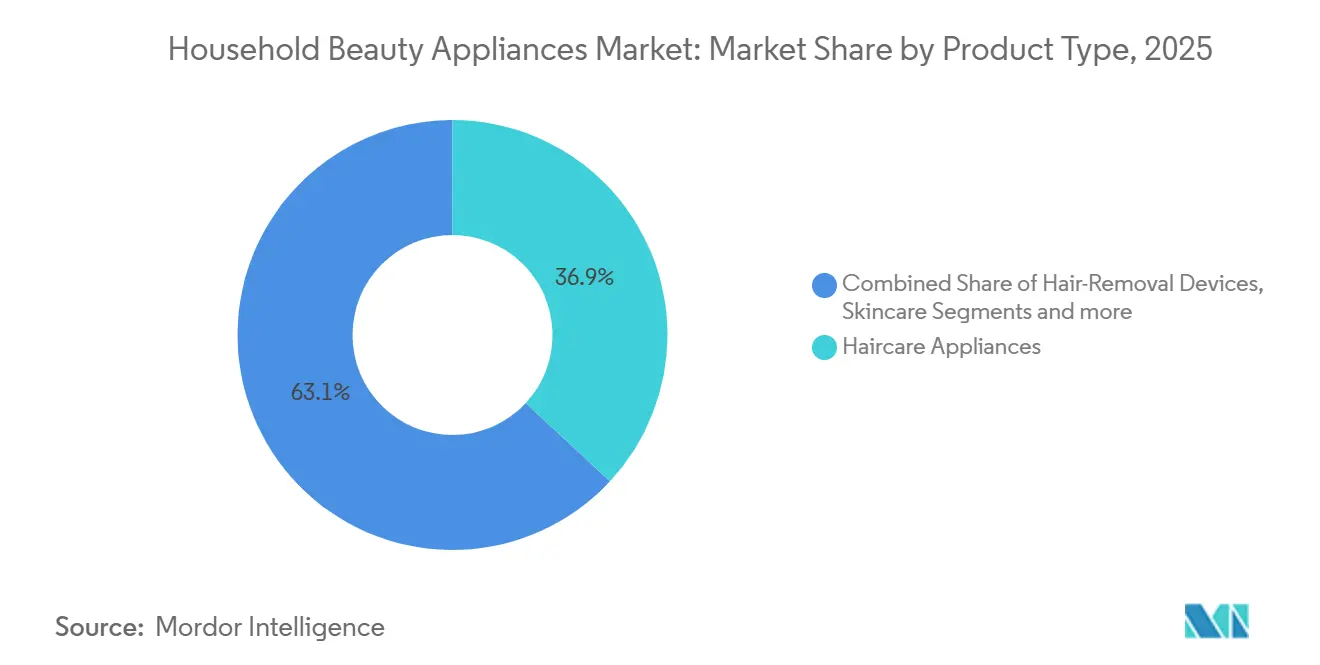
Skincare/Facial Devices lead efficacy-driven premiumizationHaircare Appliances hold the largest share at 36.91% in 2025, reflecting deep household penetration for dryers, straighteners, and curlers across income bands. Skincare and facial devices post the fastest projected expansion at a 6.83% CAGR through 2031 as consumers prioritize anti-aging outcomes and routine consolidation. The household beauty appliances market benefits as flexible LED designs, near-infrared wavelengths, and smart intensity control produce visible results at safer temperatures. Flagship launches now emphasize protective heat management with sensor-driven precision in hair tools and clinically aligned wavelengths in facial masks. As home-use efficacy improves, consumers increasingly treat premium devices as long-term care investments rather than single-function gadgets.
The household beauty appliances market is also shaped by advanced cooling and comfort integrations that address earlier-generation heat discomfort. LED masks that combine red and near-infrared light with targeted thermal control increase session tolerance while maintaining uniform light delivery. Hair tools using near-infrared to reshape bonds at lower temperatures now offer faster results and smoother finishes without the high heat that causes damage over time. Multi-mode devices that blend microcurrent, LED, and RF in streamlined routines expand perceived value at higher price points as they replace multiple single-function purchases. Regulatory alignment for lasers and light-based consumer products under IEC 60335-2-113, combined with FDA device and labeling requirements, guides safer designs and improves user instructions, which supports category trust within the household beauty appliances industry.



By Distribution Channel:
Online Retail’s ascent reshapes competitive moatsSupermarkets and hypermarkets held a 41.62% share in 2025, supported by in-aisle visibility and the convenience of bundling appliances with adjacent beauty purchases. Online Retail is the fastest-growing channel at a 7.35% projected CAGR as video demos, before-and-after content, and creator partnerships increase conversion. The household beauty appliances market share for large-format stores remains durable, where shoppers prefer in-person trials before committing to a USD 300 or higher device. Digital storefronts offer brand-controlled storytelling and rapid assortment expansion, while omnichannel strategies pair retail displays with online bundles and accessories. This blend of tactile trial and rich content improves overall category engagement and shortens the learning curve for complex devices.
E-commerce also amplifies promotion windows, search-driven discovery, and app-based education that improve adherence and outcomes. Leading brands used seasonal festivals and livestreams to bring new lines to broader audiences, and events in China elevated brand rankings for grooming and oral-care categories in 2025. Attachments, replacement heads, gels, and content subscriptions sell efficiently online, which increases lifetime value for connected devices. Specialty stores keep relevance through curated assortments, trained staff, and loyalty programs that accommodate replenishment and premium upgrades. This channel interplay supports the household beauty appliances market as consumers compare features, verify safety credentials, and choose their preferred path to purchase.
By Price Tier:
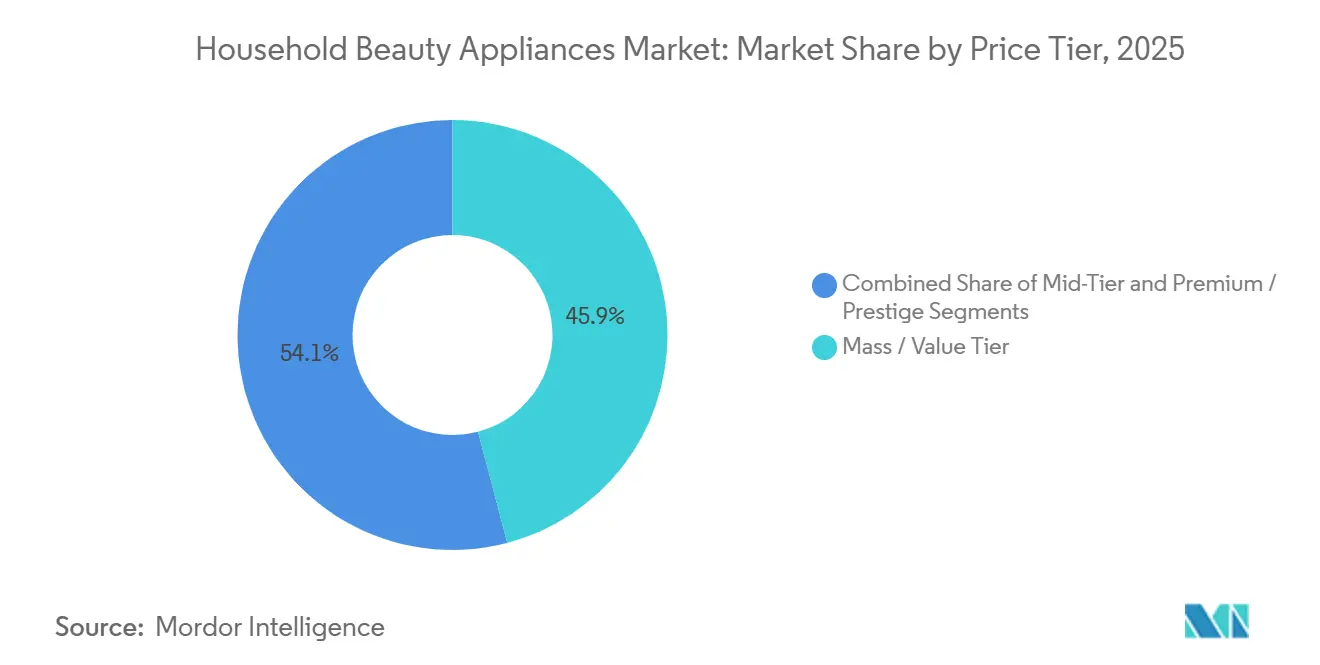
Premium segment captures value as consumers trade upThe Mass and Value Tier captured 45.91% of 2025 volume as shoppers balanced price and performance in haircare and entry-level facial devices. The Premium and Prestige tier is projected to grow at a 6.91% CAGR as willingness to pay rises for devices that combine safety credentials, clinical alignment, and robust warranties. Mid-tier devices compete with multi-mode functionality and smart guidance that elevate outcomes without reaching luxury price points. Premium leaders invest in motor, airflow, and heat-control breakthroughs in hair as well as wavelength precision and comfort engineering in skin devices. These investments differentiate performance with repeatable results and strengthen upgrade paths across ownership cycles in the household beauty appliances market.
Attachment ecosystems and content subscriptions reinforce value, since buyers can personalize routines and extend product lifespans with mix-and-match components. Dyson’s multi-year commitment to beauty expands the pipeline for high-performance hair tools and modular attachments that deepen engagement beyond the initial purchase. Conair’s modular handle-and-head system brings customization to mass audiences, creating a budget-friendly pathway into more techniques. Panasonic’s investments in diagnostic partners set the stage for companion services that bundle devices with intelligent recommendations and recurring care. This premiumization and ecosystem strategy supports a health-and-results narrative that resonates in the household beauty appliances industry as consumers seek practical, at-home maintenance with credible safety and outcomes.
Geography Analysis
North America Household Beauty Appliances Market
North America held 32.82% of global revenues in 2025, as high disposable incomes, established specialty retail, and regulatory clarity underpin demand for certified devices. Consumers prioritize safety, efficacy, and reliable warranties, which favors brands with FDA device experience and mature service networks. The household beauty appliances market benefits from strong digital retail adoption that brings LED, IPL, and microcurrent education to a broad audience. Tariff volatility continues to influence component sourcing and bill-of-materials choices for hair and skin devices. Enforcement actions against unapproved imports and misbranded online listings create a safer environment for compliant offerings and strengthen trust across channels.
APAC Household Beauty Appliances Market
Asia-Pacific is the fastest-growing region with a 7.25% projected CAGR to 2031, propelled by middle-class expansion, e-commerce-led discovery, and robust manufacturing infrastructure. China, India, Japan, and South Korea anchor scale, while Vietnam and other Southeast Asian nations support assembly and packaging to navigate tariffs and shorten lead times. Japanese innovators broadened device portfolios and IP positions while expanding into new geographies, tapping luxury retail and premium malls that emphasize experiential education. Foreo’s expansion in the region supports nearshoring and flexible production that serve broad price tiers and multiple markets. These development patterns support rising adoption and a strong funnel of device trial among a growing base of digital-first consumers in the household beauty appliances market size trajectory for Asia-Pacific.
Europe Household Beauty Appliances Market
Europe accounts for a sizable share with balanced growth and a strong specialty retail footprint in key countries. Regulatory frameworks embed rigorous safety, labeling, and documentation requirements that influence product design, claims, and user instructions across LEDs, IPLs, and microcurrent devices. The publication of IEC 60335-2-113 in 2025 created a harmonized reference for beauty care appliances with lasers and intense light sources, supporting consistent safety guardrails for home use. CE marking requirements further formalize device conformity and documentation standards for distribution across the bloc. This environment supports steady adoption of advanced devices and aligns incentives for compliant innovation in the household beauty appliances market.

Regulatory Landscape
Regulation in household beauty appliances is tightening around electrical safety, optical radiation exposure, labeling, and conformity documentation, especially for at-home devices using lasers or intense light. IEC safety standards remain a core anchor for design validation. IEC 60335-2-113:2025 (published October 23, 2025) covers beauty care appliances incorporating lasers and intense light sources, while IEC 60335-2-23:2026 (published February 16, 2026) updates particular safety requirements for hair care and similar appliances, which reinforces more consistent test and documentation expectations for global manufacturers.
Country-level enforcement and market-access rules are also shaping go-to-market decisions. In the United States, the U.S. Consumer Product Safety Commission (CPSC) issued safety warnings in May 2026 for certain hair dryers tied to shock and electrocution hazards, highlighting the risk of non-compliant imports and online listings. In India, the Safety of Household, Commercial and Similar Electrical Appliances (Quality Control) Order, 2026 requires BIS certification for a wide set of electrical appliances, including personal care and beauty devices, effective October 1, 2026, making certification readiness a prerequisite for shipments and retail distribution planning.
Value Chain Analysis
The value chain begins with specialty inputs and electronics that shape both performance and compliance outcomes. High-grade silicones and medical-grade polymers for skin-contact parts, high-performance resins for heat resistance, and electronic components such as microcontrollers, LED arrays, batteries, and precision sensors are central to meeting functional and safety requirements. Component and sub-assembly supply tends to cluster in established manufacturing ecosystems, with Southern China (for example, Shenzhen, Dongguan, and Huizhou) supporting integrated sourcing across PCB fabrication, injection molding, and battery pack assembly, while Japan remains strong in certain specialized intermediate materials for durability and safety-critical parts.
Midstream, OEM/ODM contract manufacturers and component specialists build to brand specifications, after which brand owners handle industrial design, app and content layers (where applicable), packaging, and claims substantiation. Testing and certification run as a parallel gate across development and pre-shipment, anchored by IEC 60335-1 and product-specific standards such as IEC 60335-2-113:2025 (lasers and intense light sources) and IEC 60335-2-23:2026 (hair care appliances). Regional requirements, including India BIS certification under the Quality Control Order, 2026 (effective October 1, 2026), add an extra compliance step for market entry. Downstream distribution spans supermarkets and hypermarkets, specialty retail, and online retail, where D2C storefronts also support attachment, consumable, and accessory replenishment that extends lifetime value for device ecosystems.
Competitive Landscape
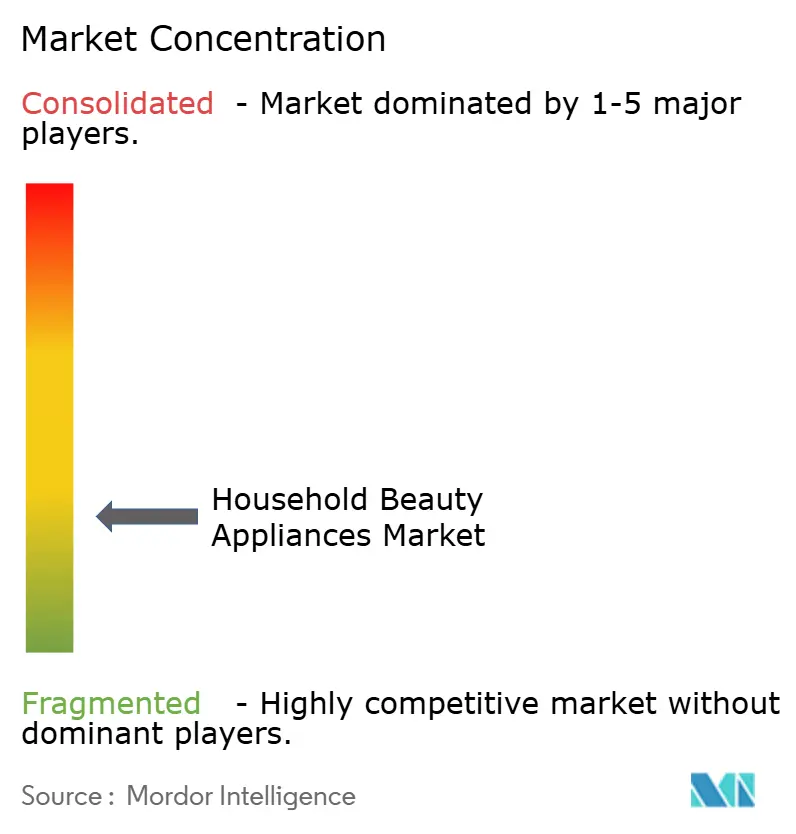
The household beauty appliances market remains moderately fragmented, with leading players leveraging brand recognition, safety credentials, and global service networks to maintain their positions. Companies are increasingly pursuing strategies such as vertical integration and partnerships to enhance product categories and create connected ecosystems. These ecosystems often link devices with attachments, gels, and digital content, improving user engagement and loyalty. Brands are also focusing on local regulatory expertise, which helps streamline approvals and ensures high-quality labeling and instructions across markets. This combination of capabilities supports a steady pace of innovation and facilitates scalable growth across geographies and retail channels.
Portfolio renewal continues to be a key strategy for market leaders. Some brands are expanding distribution in new regions to build on existing strengths and broaden reach through trusted retail networks. Others are investing in technology platforms that connect devices with companion services, enabling ongoing engagement beyond the hardware itself. Device innovation, ecosystem development, and service integration are central to maintaining leadership positions and driving consumer interest. These efforts demonstrate a comprehensive approach that blends product performance with long-term brand value.
Consolidation and strategic partnerships are creating additional momentum in the market. Companies are acquiring specialized technology to enhance their offerings and expand their product catalogs. Large-scale alliances between major brands signal continued investment in premium positioning and global strategies. Innovation in device design, precision, and user guidance remains critical, with a focus on safety and measurable results. By emphasizing adaptive control and guided routines, brands are making home beauty treatments more effective and easier for consumers to adopt over time.
Household Beauty Appliances Industry Leaders
Koninklijke Philips N.V.
Panasonic Corporation
Conair Corporation
L’Oréal S.A.
Home Skinovations Ltd.
- *Disclaimer: Major Players sorted in no particular order
Household Beauty Appliances Market Companies Covered in this Report
- Koninklijke Philips N.V.
- Panasonic Corporation
- Conair Corporation
- L’Oréal S.A.
- Home Skinovations Ltd.
- Carol Cole Company (NuFACE)
- Dyson Ltd.
- Tria Beauty Inc.
- YA-MAN Ltd.
- Silk’n (Syneron Beauty)
- ReFa (MTG Co.)
- FOREO AB
- Nu Skin Enterprises
- Braun GmbH (P&G)
- Remington (Spectrum Brands)
- Beurer GmbH
- Vega Industries
- Syska
- Helen of Troy Ltd.
- Medicube (APR Corp.)

Market Opportunities and Future Outlook
Opportunity is concentrating around higher-efficacy, safety-aligned home treatments that translate professional techniques into guided, repeatable routines. L'Oréal Groupe used CES 2026 to show a shift beyond conventional heat styling and basic LED, with the Light Straight + Multi-styler using near-infrared to cap temperatures at 320 F, and a flexible LED face mask prototype delivering 630 nm red and 830 nm near-infrared wavelengths in short sessions. Hardware roadmaps like this create room for clinically aligned wavelength precision, comfort engineering (thermal management and fit), and clearer instruction and labeling packages that help consumers self-administer more advanced regimens at home.
A second whitespace is building diagnostics-led ecosystems that connect devices, software, and personalized routines, which expands cross-sell into attachments, gels, and service layers. Public demonstrations of AI-driven personalization, such as Amorepacific and MIT presenting an electronic skin platform with an AI engine trained on over 450,000 cases (May 2026), indicate continued investment in decision-support experiences that can be bundled with home-use devices and replenishment programs. At the same time, tightening market-access requirements, including India BIS certification effective October 1, 2026, favors brands that build certification readiness, safety testing, and documentation into early R&D, which supports broader omnichannel distribution while reducing exposure to enforcement actions tied to non-compliant listings.
Recent Industry Developments in Household Beauty Appliances Market
- June 2026: Philips products in key household beauty-adjacent categories, including the Lumea IPL 9000 Series, were recognized in the Good Housekeeping 2026 Beauty Awards, reinforcing retailer-friendly validation for regulated, claims-sensitive devices. The visibility supports premium positioning for at-home hair removal platforms that rely on consumer trust in safety and efficacy credentials.
- October 2025: Panasonic Corporation invested in SISI Co., Ltd. through the Panasonic Kurashi Visionary Fund and signed an MoU to collaborate on new beauty products by combining SISI LAB skin-analysis data with Panasonic's beauty appliance manufacturing and R&D. The move strengthens Panasonic's pathway to data-informed skincare appliances and companion product ecosystems rather than standalone devices.
- August 2025: ReFa launched the EPI CX IPL hair removal device exclusively in China, extending its premium device cadence in Asia-Pacific. The China-first strategy uses a large, digitally driven beauty market to scale high-ticket IPL adoption and build brand pull that can support later regional rollouts.


Household Beauty Appliances Market Report Scope and Research Methodology
Market Definition and Coverage
This market covers household beauty appliances that consumers buy for at-home personal grooming and routine beauty care, with value counted from device sales in retail and online channels across major regions.
Scope exclusions: we exclude salon-only professional equipment, consumables and skincare products without a device, and standalone service revenue from treatments.
Segments Covered in This Report
- By Product Type
- Haircare Appliances
- Hair-Removal Devices
- Skincare / Facial Devices
- Multi-functional Beauty Devices
- Others (Nail, Massage, Body Care)
- By Distribution Channel (Value)
- Supermarkets / Hypermarkets
- Specialty Stores
- Online Retail
- Convenience Stores
- Others
- By Price Tier
- Mass / Value Tier
- Mid-Tier
- Premium / Prestige
- By Geography (Value)
- North America
- Canada
- United States
- Mexico
- South America
- Brazil
- Peru
- Chile
- Argentina
- Rest of South America
- Europe
- United Kingdom
- Germany
- France
- Spain
- Italy
- BENELUX (Belgium, Netherlands, and Luxembourg)
- NORDICS (Denmark, Finland, Iceland, Norway, and Sweden)
- Rest of Europe
- Asia-Pacific
- India
- China
- Japan
- Australia
- South Korea
- South East Asia (Singapore, Malaysia, Thailand, Indonesia, Vietnam, and Philippines)
- Rest of Asia-Pacific
- Middle East And Africa
- United Arab Emirates
- Saudi Arabia
- South Africa
- Nigeria
- Rest of Middle East And Africa
- North America
Data Sources, Market Sizing, and Validation
Desk Research
Desk research was used to build the starting structure for the model and to sanity check demand signals by region. We relied on public sources such as the US International Trade Commission trade statistics, UN Comtrade, the World Bank macro indicators, and consumer price index series from national statistics offices to understand import dependence, spending capacity, and pricing pressure.
To connect category trends with shipment movement, we reviewed public company annual reports and investor decks for appliance and beauty device suppliers, alongside industry association updates and product safety notices from regulators such as the US Consumer Product Safety Commission and comparable agencies in Europe. Select paid subscriptions for company financials and news were used to track ownership changes and product launches, and a patent database helped flag technology themes like IPL, LED, and microcurrent. These examples are not exhaustive, and we also checked other public and paid sources for data collection, validation, and clarification.
Primary Interviews and Surveys
Primary interviews and structured surveys were completed with manufacturers, brand owners, distributors, retailers, and category specialists to confirm what is counted as household beauty appliances and how pricing changes across tiers. We also cross-checked adoption patterns for home-use devices, shifts in online share, and the role of promotions across APAC, EMEA, and the Americas, so inputs were not driven by a single region.
Distribution of primary research fieldwork respondents
| Company type | Respondent position | Region |
|---|---|---|
| Top tier: 35% | CXOs: 15% | APAC: 51% |
| Mid tier: 50% | Functional/Unit leaders: 41% | EMEA: 31% |
| Smaller Players: 15% | Managers: 44% | Americas: 18% |
Market-Sizing & Forecasting
Sizing starts with a top-down demand pool assessment, where household beauty appliance revenue is reconstructed from category-level device sales patterns, trade flows for key device types, and regional consumption capacity indicators. Once that structure is set, totals are corroborated using selective bottom-up approximations, including sampled supplier revenue splits, channel checks on online versus offline mix, and volume plus average selling price logic for common devices.
Key inputs used in the model include the mix shift between haircare appliances, hair-removal devices, and skincare or facial devices, the share of sales moving to online retail, and price-tier movement between mass/value, mid-tier, and premium/prestige devices. We also track promotional intensity, replacement cycles for frequently used items like dryers and straighteners, and the spread of newer technologies such as IPL and LED, which tends to affect both penetration and pricing. Where bottom-up coverage is incomplete for smaller brands or unreported channels, gaps are handled through calibrated shares based on retailer assortment checks and interview-backed distribution coverage.
Forecasts are built using scenario analysis supported by short trend models, where growth is tied to disposable income and consumer spending direction, expected e-commerce expansion, and category-specific innovation cadence discussed in interviews. Assumptions are reviewed for reasonableness at the regional level, then rolled up so the final forecast remains consistent with the demand story described by the market.
Data Validation & Update Cycle
Outputs are checked through triangulation against independent signals, such as trade values for relevant device categories, public financial disclosures, and observed retail pricing ranges, before figures are finalized. If variances are unusually large by region, the drivers are revisited, and targeted re-contacts are triggered to confirm whether the change came from volume, pricing, or channel mix.
A multi-step internal review is applied, where assumptions, calculations, and year-on-year movements are checked by another analyst before sign-off. Reports are refreshed annually, and interim updates are made when material events occur, including major regulatory changes, product recalls, or sharp pricing swings. Before delivery, the dataset is re-checked so the most current view available at that time is reflected in the final numbers.
Mordor Intelligence's Household Beauty Appliances Market Sizing Compared With Other Published Estimates
Published market sizes for household beauty appliances often do not match, even when the topic sounds the same, because each publisher applies slightly different rules for what is included. Differences usually come from product inclusions, the starting year used, and how pricing is treated across mass, mid-tier, and premium devices.
The main gap comes from whether adjacent personal care categories are folded in, and how quickly average selling prices are assumed to rise with premiumization. In the Mordor Intelligence model, we count only home-use beauty devices and apply price-tier checks by channel before rolling values up. Currency conversion timing and refresh cadence also matter, since older models can miss recent online mix changes and technology-led price resets.
Benchmark comparison
| Source | Market Size | Gaps in Research Methodology |
|---|---|---|
| Mordor Intelligence | USD 8.26 B (2026) | |
| Global Consultancy A | USD 8.86 B (2025) | Uses a different base year and forecast window, and the pricing curve is presented as a single blended ASP, which can overstate value when premium devices are growing faster than mass volumes. |
| Regional Consultancy B | USD 8.40 B (2024) | Starts from earlier-year sizing and applies a lower growth track, with lighter adjustment for channel shift to online retail and fewer cross-checks on technology-driven price lifts in hair removal and facial devices. |
The spread in the table is mostly explained by start-year choice and how closely the model separates household beauty devices from nearby personal care categories. By keeping inputs tied to clear demand signals like channel mix, price tiers, and device-type adoption, we end up with a number that can be traced back to practical checks and repeated year after year.


Key Questions Answered in the Report
What is the current size and growth outlook for the household beauty appliances market?
The household beauty appliances market size is USD 8.26 billion in 2026 and is projected to reach USD 11.35 billion by 2031 at a 6.56% CAGR, reflecting ongoing premiumization and broader at-home adoption.
Which product categories are gaining the most momentum within household devices?
Haircare remains the largest, while skincare and facial devices post the fastest growth as LED, microcurrent, and temperature-control advances deliver more reliable at-home results.
How are online channels changing category performance for home-use beauty devices?
E-commerce raises visibility through tutorials and before-after content, while brand-owned stores and marketplaces improve conversion and attachment sales that extend device lifecycles.
Which region has the biggest share in Household Beauty Appliances Market?
In 2025, North America accounted for the largest market share in the Household Beauty Appliances Market.
What regulatory themes matter most for at-home lasers, IPL, and LED devices?
Safety standards for lasers and intense light, labeling requirements, and CE or FDA conformity frameworks guide design, claims, and instructions and support user confidence.
Page last updated on:


 Your data is secure and never sold or shared.


