
Hot And Cold Therapy Packs Market Size and Share
Market Overview
| Study Period | 2020 - 2031 |
|---|---|
| Market Size (2026) | USD 1.68 Billion |
| Market Size (2031) | USD 2.21 Billion |
| Growth Rate (2026 - 2031) | 5.64% CAGR |
| Fastest Growing Market | Asia Pacific |
| Largest Market | North America |
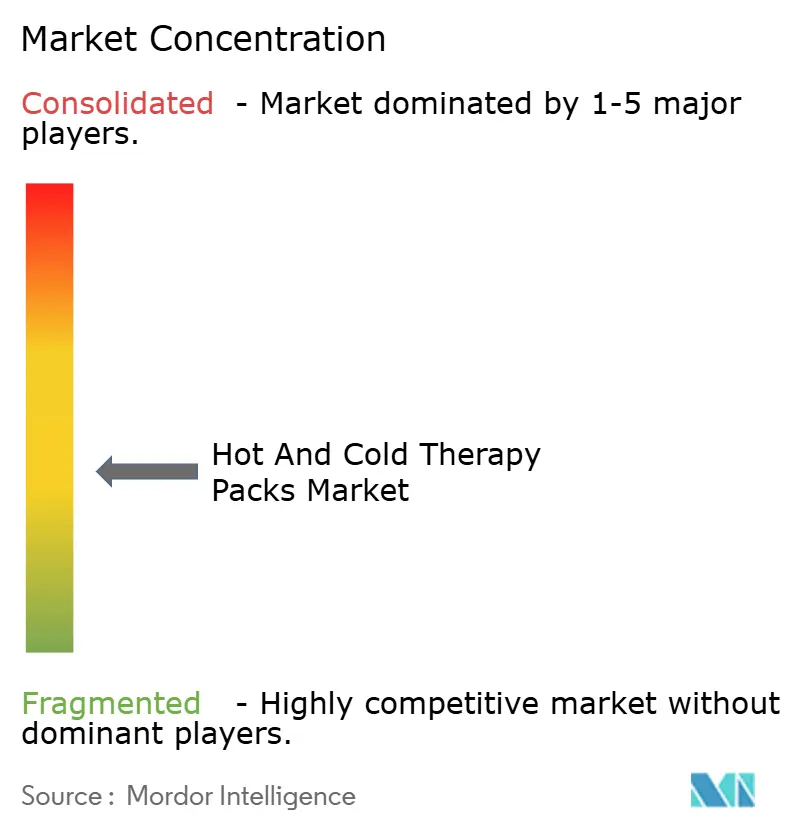
| Market Concentration | Medium |
Major Players *Disclaimer: Major Players sorted in no particular order Image © Mordor Intelligence. Reuse requires attribution under CC BY 4.0. | |
Hot And Cold Therapy Packs Market Analysis by Mordor Intelligence
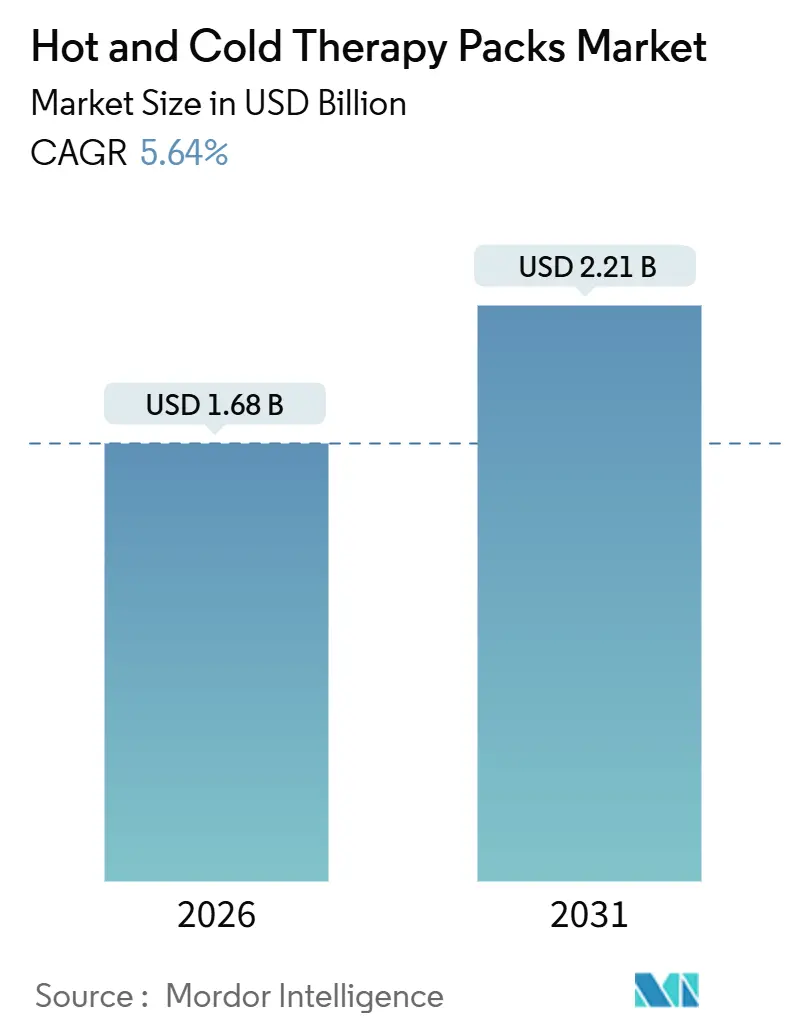
The Hot And Cold Therapy Packs Market size is estimated at USD 1.68 billion in 2026, and is expected to reach USD 2.21 billion by 2031, at a CAGR of 5.64% during the forecast period (2026-2031).
Demand momentum is anchored in global shifts toward non-pharmacological pain relief, stricter opioid-stewardship rules, and the growing weight of chronic musculoskeletal disorders. Instant electric packs still dominate hospital purchasing; yet, hybrid compression systems are scaling quickly because surgeons incorporate cryotherapy and intermittent compression into enhanced recovery pathways. Home-based care models, femtech applications, and connected devices that feed data to tele-rehab platforms are widening the user base. While North America currently generates the most significant revenues, Asia Pacific is adding the most incremental volume as public spending boosts device penetration in mid-tier cities.
Key Report Takeaways
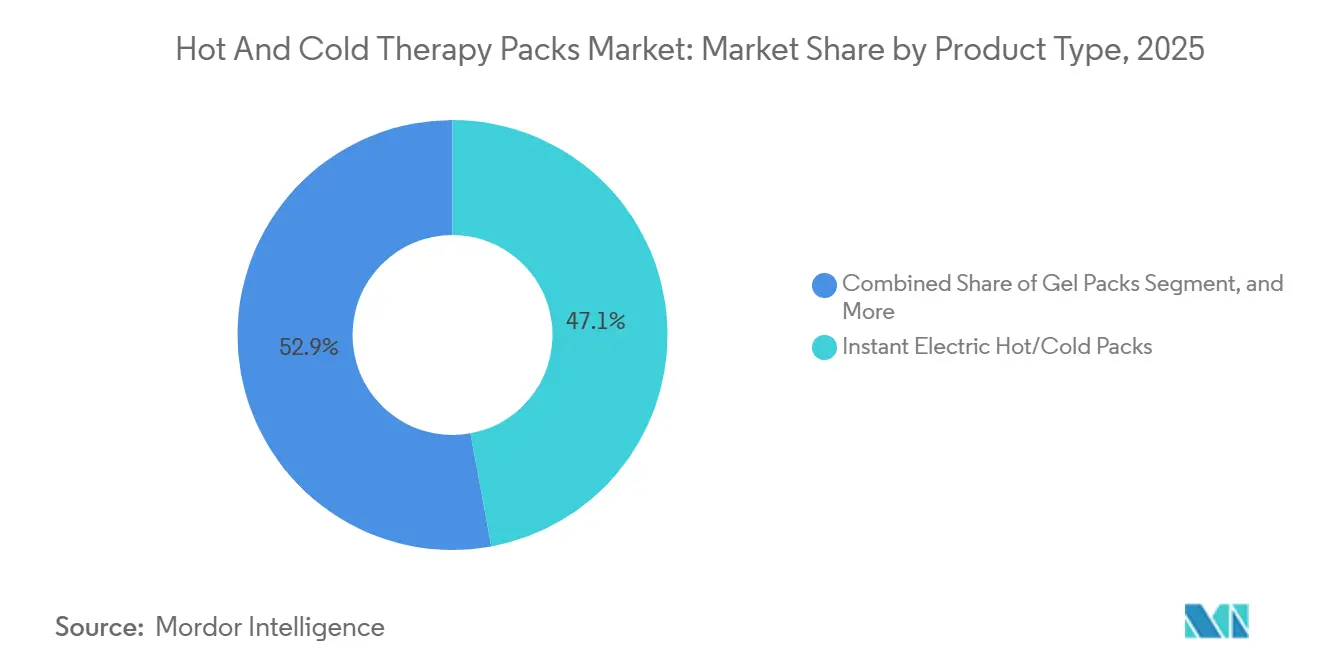
- By product type, instant electric packs led with 47.11% of the hot and cold therapy packs market share in 2025, whereas hybrid compression therapy packs are projected to expand at a 7.36% CAGR through 2031.
- By application, sports injuries accounted for a 35.93% share of the hot and cold therapy packs market size in 2025, while neuropathic pain is expected to advance at an 8.49% CAGR through 2031.
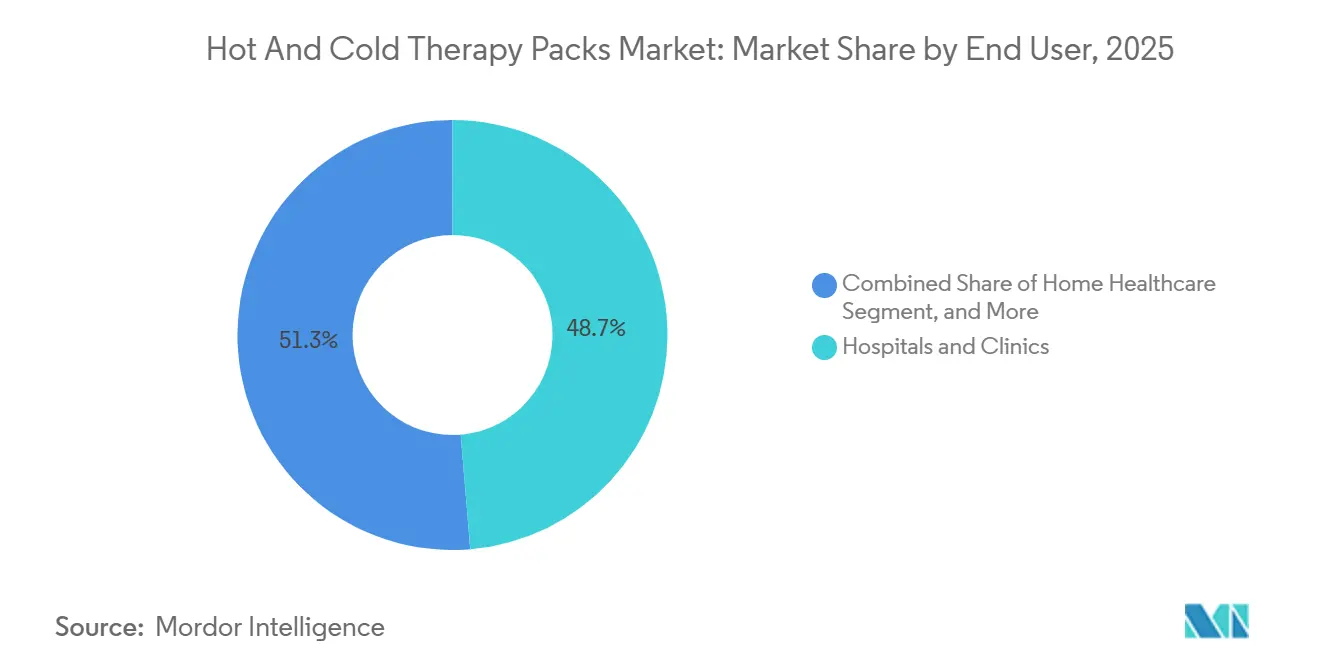
- By end user, hospitals and clinics captured 48.68% revenue in 2025; home healthcare is forecast to grow at a 6.97% CAGR over the same horizon.
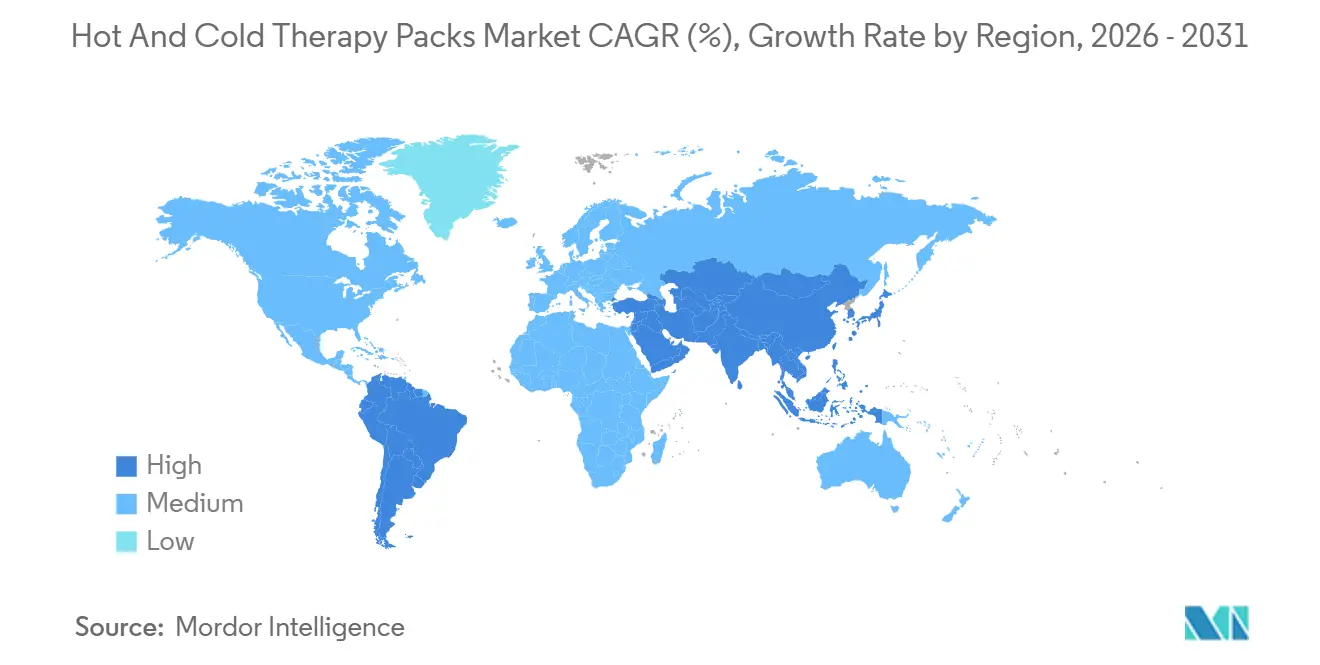
- By geography, North America accounted for 37.46% of 2025 revenues, while Asia Pacific is projected to grow at an 8.22% CAGR to 2031.
Note: Market size and forecast figures in this report are generated using Mordor Intelligence’s proprietary estimation framework, updated with the latest available data and insights as of January 2026.
Global Hot And Cold Therapy Packs Market Trends and Insights
Drivers Impact Analysis*
| Driver | (~) % Impact on CAGR Forecast | Geographic Relevance | Impact Timeline |
|---|---|---|---|
| Rising Prevalence of Musculoskeletal Disorders & Chronic Pain | +1.2% | Global, acute in aging OECD economies and emerging in APAC | Long term (≥ 4 years) |
| Increasing Sports Injuries and Fitness Participation | +0.9% | North America and Europe core, spill-over to urban APAC and Latin America | Medium term (2-4 years) |
| Growing Home-Based, Non-Pharmacological Pain Management | +1.1% | North America and EU leading, rapid uptake in Australia and GCC states | Medium term (2-4 years) |
| Femtech-Oriented Packs for Menstrual Pain & Women’s Wellness | +0.6% | Global, concentrated demand in North America, Western Europe, urban India | Short term (≤ 2 years) |
| Smart, Connected Packs Enabling Data-Driven Tele-Rehab | +0.8% | North America, EU, and tech-forward APAC hubs | Long term (≥ 4 years) |
| Technological Advances in Gels & PCM Materials | +0.5% | Global, with R&D clusters in North America and Germany | Long term (≥ 4 years) |
| Source: Mordor Intelligence | |||
Rising Prevalence of Musculoskeletal Disorders & Chronic Pain
Musculoskeletal conditions affected 1.71 billion people, with low back pain alone responsible for 70.2 million years lived with disability. The Lancet projects osteoarthritis cases to more than double by 2050, a trend tied to obesity and longevity.[1]The Lancet Rheumatology, “Global Burden of Osteoarthritis Projections to 2050,” lancet.com Thermal packs provide vasodilation or vasoconstriction without systemic side effects, making them first-line adjuncts in rehabilitation. As payers shift to bundled payments, reusable devices that lower per-episode costs are favored. This structural demand underpins the steady expansion of the hot and cold therapy packs market.
Increasing Sports Injuries and Fitness Participation
The United States recorded 8.6 million sports injuries in 2023, including 3.5 million among youths under 14 years.[2]Stanford Medicine, “Sports Injuries Prevention and Statistics,” med.stanford.edu Cold packs remain embedded in RICE protocols for acute trauma, while heat aids chronic overuse recovery. The sports medicine sector’s trajectory bolsters the uptake of accessory products. Wearable technology encourages self-directed recovery, boosting sales of retail gel packs. Rising participation in organized athletics worldwide expands the addressable consumer pool, fueling the market for hot and cold therapy packs.
Growing Home-Based, Non-Pharmacological Pain Management Adoption
Remote therapeutic monitoring codes, finalized in 2024 by U.S. regulators, enable clinicians to bill for the oversight of connected thermal devices.[3]Centers for Medicare & Medicaid Services, “CY 2024 Medicare Physician Fee Schedule Final Rule,” cms.gov Bluetooth-enabled packs transmit compliance data to electronic records, thereby reducing the need for in-person visits. WHO notes an accelerating global pivot toward home health as populations age and workforce shortages intensify. Low-skill application and high safety profiles make thermal packs staples in care-at-home kits, further scaling the hot and cold therapy packs market.
Femtech-Oriented Packs for Menstrual Pain & Women’s Wellness
Up to 90% of menstruating women experience dysmenorrhea, generating repeat demand for portable heat solutions. Start-ups are marketing thin, adhesive packs through subscription channels, converting episodic purchases into predictable revenue. Academic studies highlight the adoption of wearable pain-relief devices in femtech, broadening the competitive benchmarks. Open discussion of menstrual wellness on social media normalizes usage, adding a fresh demographic to the hot and cold therapy packs market.
Restraints Impact Analysis*
| Restraint | (~) % Impact on CAGR Forecast | Geographic Relevance | Impact Timeline |
|---|---|---|---|
| Competition From Low-Cost Analgesics & Alternative Therapies | -0.7% | Global, acute in price-sensitive emerging markets | Medium term (2-4 years) |
| Limited Awareness & Correct Usage in Low-Income Regions | -0.4% | Sub-Saharan Africa, South Asia, rural Latin America | Long term (≥ 4 years) |
| Regulatory Pressure on Pack Recyclability & Eco-Compliance | -0.3% | EU core, spreading to UK, Canada, selected APAC markets | Long term (≥ 4 years) |
| Regulatory Recalls of Faulty Electric Heating Pads | -0.5% | North America and EU, reputational spill-over to APAC | Short term (≤ 2 years) |
| Source: Mordor Intelligence | |||
Competition From Low-Cost Analgesics & Alternative Therapies
Topical NSAID gels retail for USD 5-15, undercutting reusable packs priced at USD 20–50. TENS devices and ultrasound therapy offer additional alternatives. Price gaps are most damaging in regions where out-of-pocket spending is the primary concern. Manufacturers counter by emphasizing the importance of safety for patients with NSAID contraindications. Still, competitive pressure tempers the overall growth of the hot and cold therapy packs market.
Limited Awareness & Correct Usage in Low-Income Regions
The WHO estimates a shortage of 18 million health workers by 2030 in low-income countries, which will curtail patient education on the proper use of thermal packs. Misapplication can cause burns or frostbite, undermining trust. Literacy barriers and weak distribution networks hinder penetration. Pilot programs that train community health workers and provide pictorial guides aim to bridge gaps, but returns remain long-dated for producers.
*Our forecasts treat driver/restraint impacts as directional, not additive. The impact forecasts reflect baseline growth, mix effects, and variable interactions.
Segment Analysis
By Product Type: Hybrid Systems Gain Clinical Traction
Hybrid compression therapy packs are projected to lead segment growth at a 7.36% CAGR through 2031. These systems bundle cryotherapy with intermittent compression to curb post-operative edema, complementing enhanced recovery protocols in orthopedic surgery. Instant electric packs, despite a 47.11% share in 2025, face scrutiny after multiple recalls, prompting purchasers to diversify their suppliers. Gel packs utilize PCM upgrades that extend the effective temperature window to 60 minutes, enabling physiotherapy sessions without mid-treatment adjustments.
Electric packs still anchor the hot and cold therapy packs market because hospitals value on-demand heating. Yet rising utility costs and sustainability mandates favor passive alternatives. Moist heat variants, which enable deeper tissue penetration, are finding traction in chronic pain clinics. Collectively, the product landscape is diversifying, setting the stage for iterative innovation that will widen the hot and cold therapy packs market size over the forecast period.



By Application: Neuropathic Pain Emerges as Growth Frontier
Sports injury therapy dominated 2025 revenues with a 35.93% share as 8.6 million U.S. athletes sought acute-injury care. However, neuropathic pain is outpacing all other indications with an 8.49% CAGR to 2031, reflecting diabetes prevalence expected to reach 783 million adults by 2045. Thermal modalities complement pharmacological regimens by offering localized relief without systemic load.
Post-surgical kits bundled at discharge strengthen recurring demand, while femtech solutions add menstrual and post-partum niches. The convergence of aging, diabetes, and opioid-stewardship initiatives repositions thermal therapy as a frontline modality, enabling the hot and cold therapy packs market share of chronic applications to edge upward through 2031.
By End User: Home Healthcare Accelerates on Reimbursement Tailwinds
Hospitals and clinics retained 48.68% of the revenue in 2025, owing to multi-year procurement contracts and strict quality requirements. Yet home healthcare is projected to show the fastest growth at 6.97% CAGR, supported by remote monitoring codes that reimburse connected devices. Manufacturers are rolling out Bluetooth-enabled packs that sync usage data to clinician dashboards, fostering adherence.
Physiotherapy centers, underpinned by a global rehabilitation push, continue to absorb durable electric units designed for high-cycle workloads. Direct-to-consumer e-commerce widens access, diversifying revenue streams and expanding the retail footprint of the hot and cold therapy packs industry. This pluralistic channel mix underpins resilient expansion across the forecast period.
Geography Analysis
North America accounted for 37.46% of the 2025 revenue, a position supported by Medicare coverage of durable medical equipment and the presence of over 6,100 ambulatory surgery centers that incorporate thermal therapy into standardized protocols. Canada’s publicly funded system favors reusable gel packs to drive cost savings, while Mexico’s expanding private insurance boosts interest in premium electric units.
Asia Pacific is projected to register an 8.22% CAGR through 2031, the fastest growth rate worldwide. China’s Healthy China 2030 plan, India’s Ayushman Bharat insurance expansion, and Japan’s super-aged population collectively fuel volume growth. Connected packs gain early traction in South Korea and Singapore, where 5G infrastructure and tele-health reimbursement are mature. The hot and cold therapy packs market size in the region is therefore set to expand rapidly, especially in tier-2 cities that demand cost-effective gel solutions.
Europe’s adoption trajectory is shaped by the Medical Device Regulation 2017/745, which is encouraging suppliers to adopt recyclable materials. Germany and the United Kingdom lead in per-capita consumption, while Southern Europe remains price-sensitive. Emerging markets in the Middle East, notably Saudi Arabia and the United Arab Emirates, mirror North American preferences. In contrast, much of sub-Saharan Africa contends with distribution gaps that slow uptake.

Regulatory Landscape
In the United States, hot and cold therapy packs are regulated under the FDA physical medicine device framework, with many common pack types falling into lower-risk classifications. Hot or cold disposable packs are generally treated as Class I and 510(k)-exempt under 21 CFR 890.5710 (product code IMD), while reusable hot/cold packs are also Class I (product code IME); more complex water-circulating packs are regulated as Class II under 21 CFR 890.5720 (product code ILO), which shapes documentation and labeling requirements by intended use.
Across major markets, compliance is closely tied to quality systems and claim substantiation, especially when suppliers pursue hospital tenders or position products for post-surgical recovery. ISO 13485:2016 remains a common quality management anchor for medical-device-grade manufacturing and supplier controls, while Europe operates under EU MDR 2017/745 conformity expectations for medical claims. In Canada, pathway selection commonly hinges on whether products make therapeutic claims, with Health Canada Medical Devices Regulations (SOR/98-282) applying to medical claims and general wellness products more often aligning to consumer product safety oversight. Trade policy has also become a practical compliance and sourcing variable, since US tariff dynamics influence supplier qualification, country-of-origin planning, and cost pass-through discussions for polymer- and gel-heavy products.
Value Chain Analysis
The value chain starts with raw materials such as polymer films (including nylon- and neoprene-type substrates), sealing components, and gel or phase-change fillers, then moves through formulation, pouching/encapsulation, lamination and welding, and final assembly into reusable sleeves, straps, or integrated compression systems. Bulk manufacturing remains concentrated in high-volume Asian hubs (notably China), while North American and European production tends to focus on higher-value, medical-grade SKUs where compliance, traceability, and tighter process controls support hospital and clinic channels.
Distribution typically splits between institutional procurement (hospitals, ambulatory surgery centers, physiotherapy networks) and retail/DTC routes (pharmacies, sporting goods, and e-commerce), with aftermarket replacement and accessory sales supporting recurring revenue for reusable systems. Key bottlenecks center on maintaining stable supply and consistent performance of gels and films, along with meeting country-specific labeling and quality documentation when products are marketed with medical claims. Tariff and logistics sensitivity is elevated because packs are relatively bulky and materials-heavy, which encourages some suppliers to dual-source components and position finishing or kitting closer to demand centers to improve service levels and reduce landed-cost volatility.
Competitive Landscape
The top five suppliers, 3M, Johnson & Johnson, Cardinal Health, Medline Industries, and DJO (Enovis), control a significant portion of global revenue, indicating moderate market concentration. Their regulatory portfolios, anchored in FDA 510(k) clearances and ISO 13485 certifications, create entry barriers around hospital tenders. Portfolio breadth allows cross-selling with wound care and orthopedic braces, reinforcing stickiness.
Innovation is split between connected devices and sustainable materials. Start-ups winning femtech niches stress discreet designs and subscription models. Larger incumbents focus on connected sensors that qualify for tele-health reimbursement, lengthening product life cycles. M&A activity remains selective; Enovis’ USD 3.2 billion purchase of DJO exemplified the drive to aggregate rehab assets and leverage common distribution.
Patent filings surpassed 120 in 2024, with claims centering on PCM formulations and leak-proof encapsulation. Quality recalls, such as the Sunbeam incident, underscore the reputational risks associated with outsourcing manufacturing without stringent oversight. Overall, the hot and cold therapy packs market favors players that can blend compliance, innovation, and omnichannel reach.
Hot And Cold Therapy Packs Industry Leaders
3M
Caldera International Inc.
Cardinal Health Inc.
Breg Inc.
Beurer GmbH
- *Disclaimer: Major Players sorted in no particular order

Market Opportunities and Future Outlook
Opportunity is concentrating around higher-function thermal therapy that fits care-at-home workflows and reimbursable monitoring, rather than standalone commodity packs. The 2024 finalization of US remote therapeutic monitoring codes supports a commercialization pathway for connected thermal devices that can transmit adherence and session data to clinician dashboards, giving pack makers and rehab brands room to pair heating/cooling with sensors, companion apps, and tele-rehab integrations.
A second opportunity is the shift from passive gel packs toward more precise, wearable heat generation and control, supported by active R&D signals in advanced heater materials. In April 2026, peer-reviewed research highlighted flexible thin-film heater concepts (for example, carbon-nanotube-based far-infrared heater structures) that align with the market move toward anatomically fitted, portable devices used in physiotherapy and recovery routines. While these concepts do not replace standard gel packs, they strengthen a technology roadmap where premium SKUs differentiate on controllability, wearability, and safety features, complementing the existing hybrid compression direction gaining clinical traction in post-operative pathways.
Recent Industry Developments
- June 2026: Cardinal Health updated US FDA GUDID device listings for Kendall branded hot and cold therapy pack products. The refresh strengthens product traceability and supports procurement workflows that rely on standardized device identifiers across hospital and distribution systems, reinforcing the role of large medical-supply platforms in institutional channels.
- January 2026: ICE-OLATE PLUS announced availability of its dual-layer compression sleeves for hot and cold therapy via Target.com. The company expands mass-market access for wearable hot/cold formats and reflects the channel shift toward consumer retail and e-commerce for recovery products that blend thermal therapy with compression.
- August 2025: Hyperice launched the X2 Knee and X2 Shoulder devices featuring integrated compression and contrast therapy with controlled temperature ranges. The launch sets new competitive benchmarks for premium recovery devices by combining hot/cold functionality with anatomy-specific wearability, accelerating category convergence with hybrid compression systems used in sports and rehab settings.


Research Methodology Framework and Report Scope
Market Definition and Coverage
This market covers revenue generated from hot and cold therapy packs that deliver localized temperature therapy to help manage pain, swelling, and recovery in home and clinical settings.
Scope exclusions: We exclude prescription drugs, invasive pain procedures, and broader physical therapy services that are not sold as hot or cold therapy pack products.
Segmentation Overview
- By Product Type
- Instant Electric Hot/Cold Packs
- Dry & Moist Hot and Cold Packs
- Gel Packs
- Hybrid Compression Therapy Packs
- By Application
- Sports Injury
- Neuropathic Pain
- Post-Surgical Recovery
- Chronic Musculoskeletal Disorders
- Other Applications
- By End User
- Hospitals & Clinics
- Physiotherapy & Rehabilitation Centers
- Home Healthcare
- Other End Users
- By Geography
- North America
- United States
- Canada
- Mexico
- Europe
- Germany
- United Kingdom
- France
- Italy
- Spain
- Rest of Europe
- Asia-Pacific
- China
- Japan
- India
- Australia
- South Korea
- Rest of Asia-Pacific
- Middle East & Africa
- GCC
- South Africa
- Rest of Middle East & Africa
- South America
- Brazil
- Argentina
- Rest of South America
- North America
Data Sources, Market Sizing, and Validation
Desk Research
Desk research was used to set the foundation for demand drivers and to align product definitions used across countries. We leaned on public sources such as the US FDA device and recall databases, the US Census Bureau and Bureau of Labor Statistics for relevant consumer and health spending context, the OECD health statistics series, and World Bank population and aging indicators. Where trade flows were needed to sanity check supply availability, we referred to national customs statistics and UN Comtrade style summaries, and we also reviewed peer reviewed journals on cryotherapy and thermotherapy use patterns.
On top of that, we used company filings, annual reports, investor presentations, and reputable press coverage to understand product mix shifts like reusable gel packs versus instant packs and electric variants. Patent databases helped us track whether new materials and wrap formats were moving from development into commercial products, and a paid subscription for company financials and news was used to cross check revenue direction and corporate actions. These desk sources are not exhaustive, and many other public references were reviewed for data collection, validation, and clarification.
Primary Interviews and Surveys
Primary work focused on confirming what is actually counted as a therapy pack sale, and how prices and channel mix vary by region. We spoke with a mix of manufacturers, distributors, retailers, and clinical users across APAC, EMEA, and the Americas so assumptions on reusable versus disposable usage, electric penetration, and sports versus post surgical demand could be checked and then tightened.
Distribution of primary research fieldwork respondents
| Company type | Respondent position | Region |
|---|---|---|
| Top tier: 26% | CXOs: 14% | APAC: 46% |
| Mid tier: 58% | Functional/Unit leaders: 42% | EMEA: 30% |
| Smaller Players: 16% | Managers: 44% | Americas: 24% |
Market-Sizing & Forecasting
For sizing, the main model uses a top down approach where population, aging share, sports and injury incidence signals, and procedure recovery volumes are translated into an addressable user pool and expected purchase frequency for hot and cold packs. Average selling prices were then applied by pack type and reuse pattern, followed by a channel mix split that reflects how much moves through pharmacies, general retail, and online.
To make sure the totals stayed realistic, selective bottom-up checks were run using sampled supplier revenue ranges, distributor feedback on category turnover, and price band checks observed in public retail listings. If a country had limited visibility, we used proxy indicators such as health spend per capita, internet retail maturity, and sports participation trends, and then the result was adjusted during expert follow ups.
Forecasting was built using scenario analysis supported by multivariate regression on a few stable inputs, including demographic shifts, consumer health spending direction, elective surgery volumes, and online share expansion. The final growth path was stress tested so the forecast did not assume unrealistically fast price inflation or sudden adoption jumps without a matching trigger.
Data Validation & Update Cycle
Outputs were validated through multiple checks, starting with unit and price sanity tests across pack types and regions, and then moving to variance checks against independent signals like import direction, category activity in retail, and changes in injury and recovery related demand. When an outlier appeared, we revisited the input assumption, rechecked the desk evidence, and if needed we re contacted a relevant expert to confirm the direction.
Before sign off, the model and notes go through stepwise analyst reviews so definitions, currency timing, and growth logic remain consistent across sections. Reports are refreshed annually, and interim updates are made when a material event changes pricing, availability, or demand patterns. Prior to delivery, a fresh pass is completed so the numbers reflect the latest validated view.
Mordor Intelligence's Hot and Cold Therapy Packs Market Size Versus Other Published Estimates
Published market numbers for hot and cold therapy packs can look far apart, even when the product theme sounds the same. This usually happens because firms include different product families, treat reusable versus disposable sales differently, and pick different base years and currency timing.
A common gap driver is scope creep into adjacent categories like heat therapy devices, larger therapy pads, or general pain management accessories, which can inflate totals. Some estimates also push faster growth by assuming quick adoption of premium electric packs and steady price increases, even when channel checks show heavy promotion and private label pressure. In Mordor Intelligence sizing, only dedicated hot and cold therapy pack products are counted, and adjacent pain therapy devices and broader heat therapy equipment are left out so the revenue line stays tied to pack sales.
Benchmark comparison
| Source | Market Size | Gaps in Research Methodology |
|---|---|---|
| Mordor Intelligence | USD 1.68 B (2026) | |
| Global Consultancy A | USD 1.30 B (2024) | Uses an earlier base year and a wider type list that can mix therapy packs with related wraps and patches, and the pricing is often averaged without separating reusable packs from single use packs. |
| Industry Publisher B | USD 3.01 B (2024) | Likely includes a broader pain relief accessory set and higher assumed penetration in home care, and it can overstate value if premium electric formats and long forecast horizons are applied without tight retail price normalization. |
The spread in the table is mainly explained by how narrowly products are defined and how prices are carried forward over time. By keeping pack categories explicit, checking ASPs by format, and re validating assumptions with channel and end user feedback, we end up with a market value that is easier to trace and repeat across countries.


Key Questions Answered in the Report
What is the size of the hot and cold therapy packs market in 2026?
The hot and cold therapy packs market size is valued at USD 1.68 billion in 2026.
What is the projected CAGR for hot and cold therapy packs between 2026 and 2031?
The market is expected to grow at a 5.64% CAGR during the 2026–2031 period.
Which product type is growing the fastest?
Hybrid compression therapy packs are forecast to expand at a 7.36% CAGR through 2031.
Which application segment will see the highest growth?
Neuropathic pain is advancing at an 8.49% CAGR, the fastest among all applications.
Which region is expected to lead growth rates?
Asia Pacific is projected to post the highest regional CAGR at 8.22% through 2031.
Page last updated on:






