
Market Overview
| Study Period | 2020 - 2031 |
|---|---|
| Forecast Data Period | 2026 - 2031 |
| Base Year Market Size (2025) | USD 7.66 Billion |
| Market Size (2026) | USD 7.94 Billion |
| Market Size (2031) | USD 9.48 Billion |
| Growth Rate (2026 - 2031) | 3.62 % |
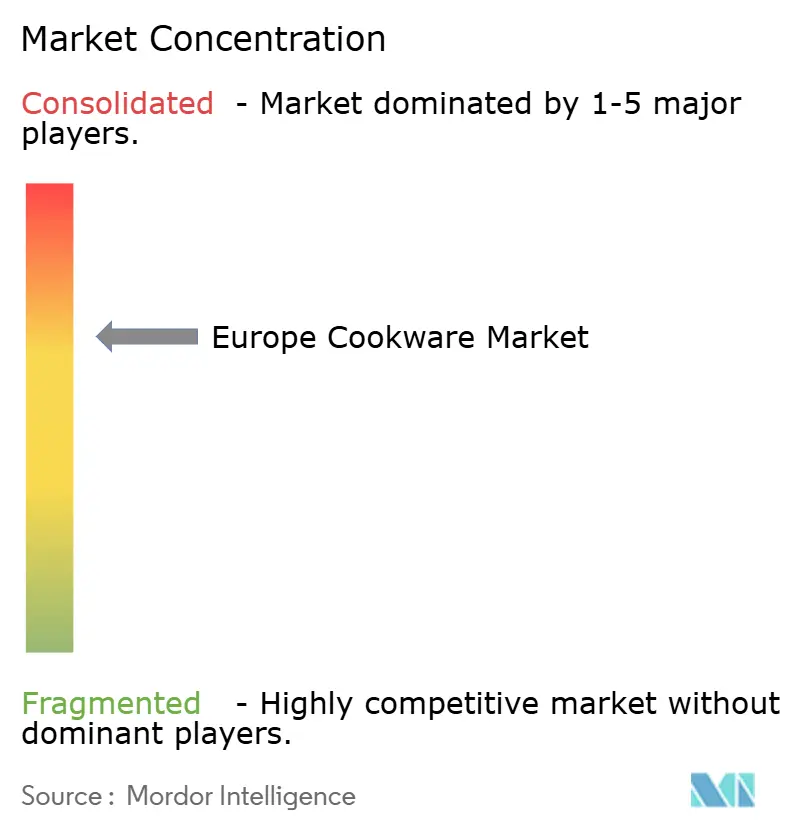
| Market Concentration | Medium |
Major Players *Disclaimer: Major Players sorted in no particular order Image © Mordor Intelligence. Reuse requires attribution under CC BY 4.0. | |
Europe Cookware Market Analysis by Mordor Intelligence
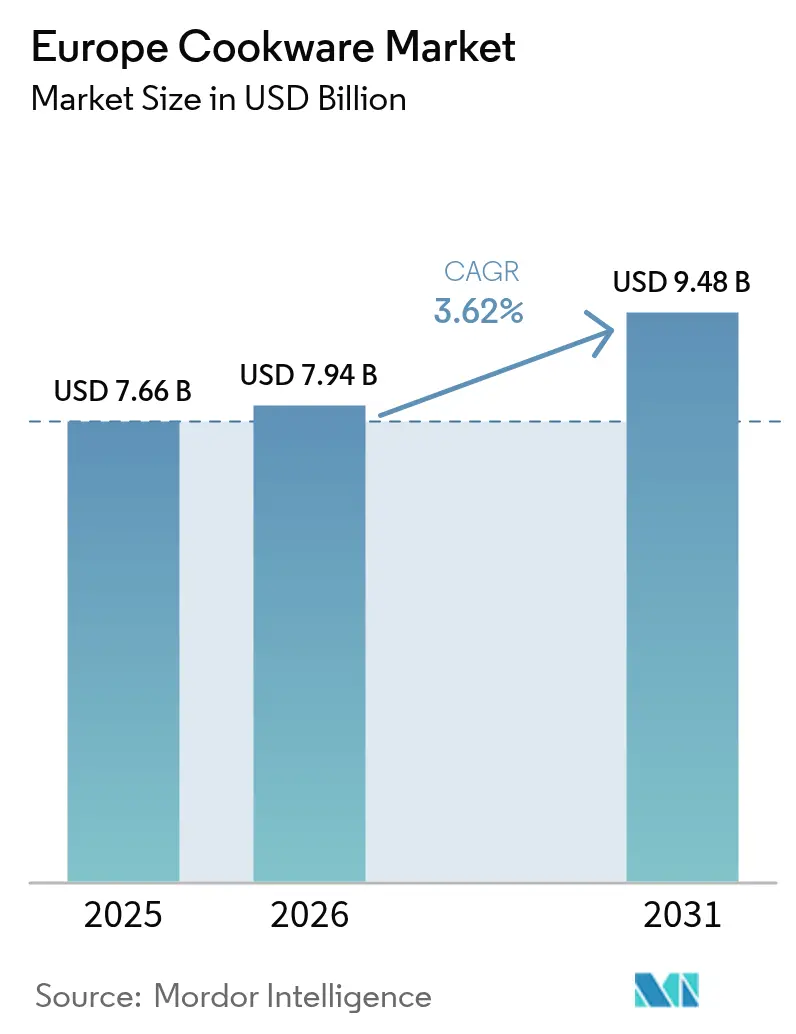
The European cookware market size is expected to grow from USD 7.66 billion in 2025 to USD 7.94 billion in 2026 and is forecast to reach USD 9.48 billion by 2031 at 3.62% CAGR over 2026-2031. Sustained home-cooking engagement that began during pandemic lockdowns, accelerating premium purchases in Western Europe, and policy-driven demand for eco-designed, induction-ready products together keep revenue expanding even as unit volumes mature. Price-sensitive households still stretch replacement cycles yet rising disposable incomes in Central and Eastern Europe enable first-time buyers to trade up rather than trade down. Rapid e-commerce adoption, especially where augmented-reality tools let shoppers “feel” weight and finish online, lowers entry barriers for niche brands while preserving premium price bands in stores. Raw-material volatility clouds margins but simultaneously pushes manufacturers toward recycled inputs that satisfy both cost-control and sustainability mandates.
Key Report Takeaways
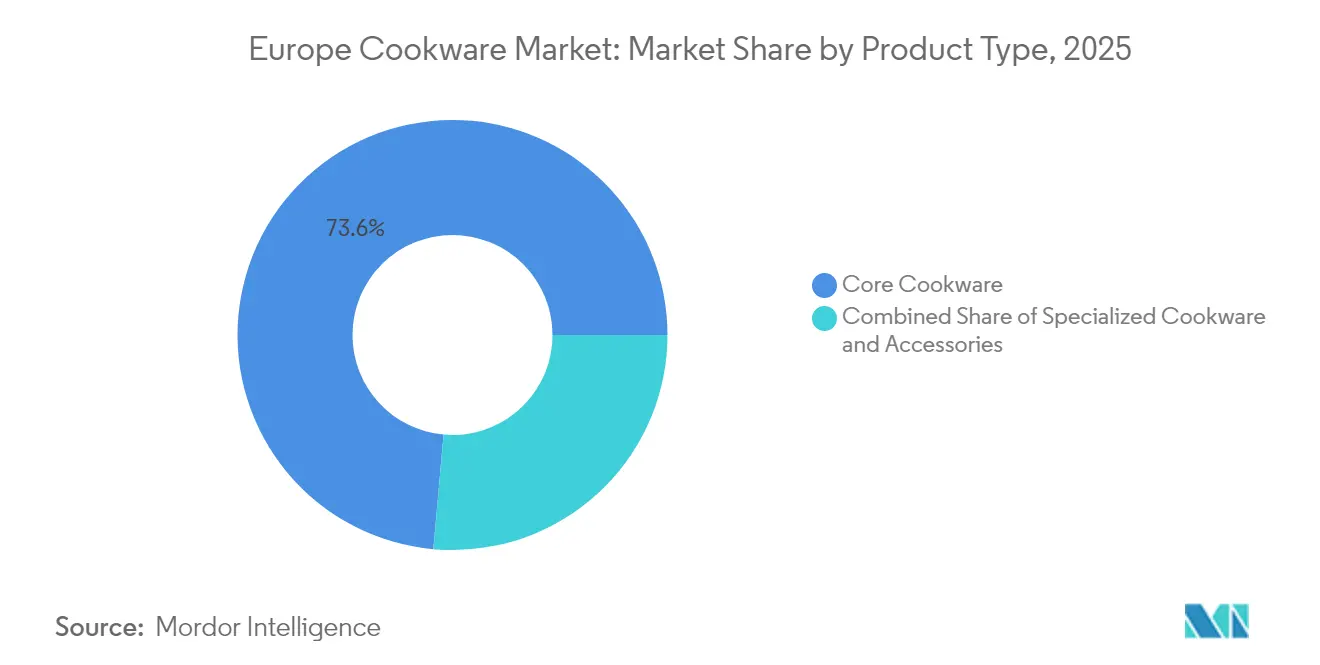
- By product type, core cookware held 73.58% of the European cookware market share in 2025, whereas specialized pieces are forecast to log a 4.85% CAGR through 2031.
- By material, stainless-steel products commanded 34.92% share of the European cookware market size in 2025; ceramic and glass are projected to rise at a 3.68% CAGR to 2031.
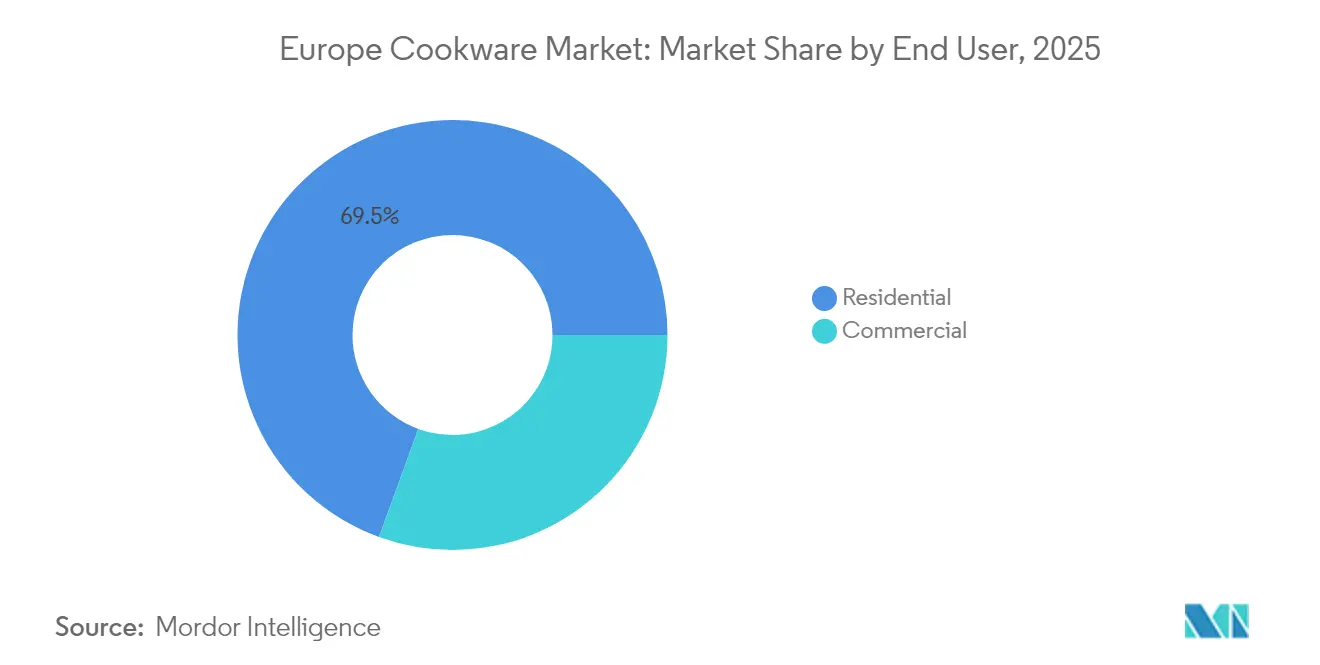
- By end user, residential demand accounted for 69.45% of 2025 revenue, while the commercial segment is expected to post the fastest 4.11% CAGR during 2026-2031.
- By distribution, offline retail captured 66.58% of sales in 2025 even as online channels are set to expand at a 4.46% CAGR.
- By geography, Germany led with 22.84% revenue share in 2025; Poland is on track for the quickest 5.12% CAGR through 2031.
Note: Market size and forecast figures in this report are generated using Mordor Intelligence’s proprietary estimation framework, updated with the latest available data and insights as of 2026.
Europe Cookware Market Trends and Insights
Drivers Impact Analysis*
| Driver | (~) % Impact on CAGR Forecast | Geographic Relevance | Impact Timeline |
|---|---|---|---|
| Rising popularity of ceramic & PTFE-free non-stick cookware | +0.8% | EU-wide, strongest in Germany, France, Nordics | Medium term (2-4 years) |
| Home-cooking boom sustained post-COVID | +0.6% | Global, particularly strong in Western Europe | Short term (≤ 2 years) |
| Expansion of e-commerce kitchenware retail | +0.5% | EU-wide, accelerated in BENELUX, UK | Medium term (2-4 years) |
| Premiumisation fuelled by rising disposable incomes | +0.4% | Western Europe, emerging in CEE markets | Long term (≥ 4 years) |
| EU eco-design push for induction-ready cookware | +0.3% | EU-wide, strongest compliance in Germany, Netherlands | Long term (≥ 4 years) |
| Residential electrification programmes boosting all-electric cookware sets | +0.2% | Nordic countries, Germany, France | Long term (≥ 4 years) |
| Source: Mordor Intelligence | |||
Rising popularity of ceramic & PTFE-free non-stick cookware
Manufacturers race to bring fluorine-free coatings to market as the European Chemicals Agency evaluates a potential PFAS phase-out that could reach cookware in the next regulatory wave[1]. Fraunhofer IFAM’s PLASLON® process shows that cold-plasma ceramic layers can replicate PTFE slipperiness while surviving dishwashers, giving brand owners a ready alternative. Groupe SEB already commercializes the RENEW line featuring 100% recycled aluminum bodies and bio-sourced Inoceram® surfaces to capture health-conscious households willing to pay pricing premiums. Consumer confusion persists after France opted to exempt cookware from its own PFAS ban, yet that carve-out merely delays rather than removes demand for safer chemistries. As a result, premium suppliers gain margin headroom, whereas low-cost importers scramble to validate coating safety claims under stricter “green-claim” rules.
Home-cooking boom sustained post-COVID
Hybrid work models keep Europeans in their kitchens for lunch and early-evening meals even after restaurants fully reopened in 2024. McKinsey reports that food inflation slowed to 2.4% in 2024, freeing household budgets for durable upgrades rather than emergency pantry stocking. Specialized pieces such as Dutch ovens or fermentation crocks therefore outsell expectations because social-media tutorials nudge amateur chefs toward category-specific gear that promises professional results. Brands bundle multi-piece starter sets to catch these upgrade cycles without forcing shoppers into ultra-premium price tiers. Nevertheless, bifurcation remains: high-income consumers embrace €500 cast-iron sets, but price-sensitive segments stretch legacy aluminum pans until performance visibly dips.
Expansion of e-commerce kitchenware retail
Digital penetration is forecast to top 60% of European household-appliance purchases by 2027, and cookware is tracking ahead of that curve. High-definition spin images and augmented-reality apps let shoppers test pan diameters on their actual stovetops, mitigating one of the last tactile barriers to online conversion. Direct-to-consumer webshops permit mid-sized European labels to reach Polish or Spanish cooks without paying department-store slotting fees, compressing the go-to-market timeline from seasons to weeks. However, logistics expenses for a 3 kg cast-iron braiser remain steep; “click-and-collect” models therefore flourish, blending digital browsing with brick-and-mortar pickup. Cross-border price arbitrage also forces brands to harmonize EU-wide MSRP lists, narrowing gray-import gaps exploited by third-party resellers.
Premiumisation fuelled by rising disposable incomes
Poland’s EUR 25.3 billion allocation from the EU Recovery and Resilience Plan funds energy upgrades and urban redevelopment that lift consumer confidence and discretionary spend. Rising salaries motivate middle-class households to migrate from single-wall aluminum skillets to tri-ply stainless steel lines that promise even heating and longer life. Premium storytelling around European heritage—such as Solingen steel craftsmanship—justifies retail tags that exceed EUR 150 per frying pan. Le Creuset’s continued success with USD 650 Dutch ovens demonstrates ceiling-less willingness to pay when the product symbolizes lifestyle aspiration. Yet authenticity is critical; digital natives rigorously fact-check sustainability claims before committing to high-ticket cookware.
Restraints Impact Analysis*
| Restraint | (~) % Impact on CAGR Forecast | Geographic Relevance | Impact Timeline |
|---|---|---|---|
| Volatility in aluminium & stainless-steel prices | -0.7% | EU-wide, particularly affecting Germany, Italy production | Short term (≤ 2 years) |
| Mature replacement market limiting unit growth | -0.5% | Western Europe, particularly Germany, France, UK | Long term (≥ 4 years) |
| Price pressure from Asian private-label imports | -0.4% | EU-wide, strongest impact in price-sensitive segments | Medium term (2-4 years) |
| Stricter EU "green-claims" rules on PFAS coatings | -0.2% | EU-wide, immediate compliance requirements | Short term (≤ 2 years) |
| Source: Mordor Intelligence | |||
Volatility in aluminium & stainless-steel prices
Euro-area aluminum producer-price indices slid from 140.2 in May 2022 to 114.4 in April 2024 but still swing quarter-to-quarter, complicating margin forecasting for pot manufacturers that lock tooling schedules six months ahead[2]. Stainless markets add a geopolitical overlay: Scandinavian demand firms while Central European auto slowdowns crimp mill orderbooks, whipsawing surcharge formulas. Energy cost spikes—electricity futures rose 38% in Italy during 2024—further inflate smelter overheads and roll through to billet pricing. The 2026 Carbon Border Adjustment Mechanism will assign CO₂ costs to imported metals, raising landed prices for Asian inputs and potentially favoring intra-EU sourcing. Firms hedge exposure via long-term supply contracts and sharpen product-mix toward high-margin specialty lines where raw-material cost share is lower.
Mature replacement market limiting unit growth
In Western Europe, nearly every household already owns multiple pans, meaning growth relies on replacement or upgrading rather than first-time adoption. Durable stainless and enameled cast-iron lines last decades; owners report sentimental reluctance to discard well-seasoned pieces even when cosmetics fade. Ecodesign durability rules tighten further in 2025, mandating repair-friendly construction that could lengthen lifecycles beyond current 6-8-year replacement norms, capping unit demand. Brands therefore prioritize service subscriptions, accessory parts, and modular handles to monetize installed bases without accelerating waste streams. Simultaneously, marketing pivots toward efficiency benefits—faster induction boil, lower energy bills—to motivate voluntary turnover rooted in function rather than planned obsolescence.
*Our forecasts treat driver/restraint impacts as directional, not additive. The impact forecasts reflect baseline growth, mix effects, and variable interactions.
Segment Analysis
By Product Type: Specialized pieces elevate cooking ambitions
Specialized items accounted for only 26.42% of 2025 sales but will add USD 668 million by 2031 as home chefs seek tools that mirror restaurant technique. The European cookware market recognizes that a Japanese carbon-steel wok or a French madeleine tin solves a distinct culinary challenge unmet by generic pots, so manufacturers fill shelves with purpose-built forms in multiple diameters. Social-media creators broadcast sourdough timelines and tataki searing tips, each post quietly prescribing new hardware and raising category awareness. Retailers curate seasonal “theme corners”-Nordic baking in December, Mediterranean grilling in June-to cross-sell spice mixes and small electrics alongside niche pans. As a result, specialized lines grow volume 1.3 times faster than core sets, cushioning overall revenue when base-level replacements flatten.
Core cookware still posts the lion’s share, yet differentiation shifts from count of pieces to ergonomic refinements such as rivetless interiors that simplify cleanup or stay-cool composite handles rated for 250 °C oven use. Tri-ply stainless variants suppress hot spots on induction tops, justifying price points 40% above mono-material rivals. Stackable set designs reduce cabinet footprint, answering the urban-living pain point common in Paris or Amsterdam apartments. Energy labeling gains relevance: hangtags now display time-to-boil metrics validated under EU test protocol EN 12983, guiding eco-minded shoppers. Together, these features preserve pricing power even as base volumes mature, ensuring the European cookware market continues monetizing core lines.

By Material: Ceramic innovation challenges stainless dominance
Stainless products hold 34.92% revenue share due to scratch resistance, dishwasher safety, and aesthetic fit with modern appliances. Multi-layer clad builds marry stainless durability with aluminum heat diffusion, appealing to cooks upgrading from thin-gauge entry pieces. The European cookware market size for ceramic-coated aluminum, however, is forecast to grow 3.68% annually, spotlighting health-first shoppers and regulators targeting fluoropolymer risk. Technology convergence helps: sol-gel ceramic top-coats now achieve 50,000 abrasion cycles, extending lifespan closer to PTFE norms. Manufacturers combine recycled post-consumer beverage-can alloy with these coatings, checking both sustainability and safety boxes.
Cast iron enjoys a renaissance among hobby bakers chasing perfect crust or steakhouse-style sear. Enamel layers remove seasoning effort, making the category friendlier for first-time buyers. Carbon steel travels the opposite direction-lighter than cast iron yet still pan-to-oven capable-winning favor in professional kitchens and spilling into prosumer channels. Glass roaster sales rise where consumers trust visibility to manage browning without lid lifts, a small but growing niche. Meanwhile, copper settles into ultra-premium status, buoyed by television chefs but limited by maintenance and price; a 28 cm tin-lined pan can top USD 400, confining demand to enthusiasts.
By End User: Foodservice rebound lifts commercial lines
The commercial channel’s 4.11% CAGR reflects restaurants re-opening and refurbishing after pandemic-era cash preservation. European cookware market suppliers equip cloud-kitchen networks scaling across urban nodes that favor induction due to ventilation savings. Chain operators standardize supplier lists, guaranteeing repeat orders for compliant SKUs across 50-plus outlets, smoothing revenue profiles for manufacturers. Catering tender documents increasingly require proof of PFAS-free coatings and dishwasher endurance beyond 1,000 cycles, ratcheting specification complexity that favors established players. Institutional users like hospitals and schools prioritize stainless stockpots sized for 100-portion batches, a volume niche unserved by consumer brands yet lucrative for firms with deep-draw presses.
Residential demand remains the bedrock, delivering 69.45% of sales alongside emotional branding opportunities unavailable in the utilitarian B2B arena. Gift registries and holiday-season promotions anchor volume spikes, while influencer tie-ins foster year-round engagement. “Kitchen hack” viral clips reveal how a single sauté pan can function as grill-press or pizza steel, stretching perceived value and reinforcing manufacturer claims of versatility. Post-pandemic nesting translates into weekend recipe experimentation that often triggers mid-tier upgrades rather than luxury splurges, keeping the middle of the price pyramid well-populated. Finally, repair-oriented programs such as lifetime handle replacement maintain brand loyalty and extend revenue per unit beyond initial sale.
By Distribution Channel: Omnichannel maturity defines sales paths
Offline retail controlled 66.58% of 2025 sales because buyers still lift pans to judge heft before swiping a card. Department stores dedicate demonstration corners where chefs cook lunch-hour samples, linking aroma with purchase intent. Yet online baskets grow bigger: European cookware market shoppers who start on a brand’s website convert at 3.4% rates when 360-degree photos accompany technical specs, double the rate of static listings. Live-stream events mimic in-store demos, with chat-led Q&A that overcomes last-mile hesitation. Freight innovations such as lightweight nested packaging shave 18% off parcel weight, narrowing cost gaps to apparel shipping.
Marketplace giants remain price battlegrounds, prompting brands to open direct-to-consumer portals that offer color exclusives or engraving services unavailable through third parties. Click-and-collect hubs inside hypermarkets address return anxiety while boosting impulse add-on sales in adjacent aisles. B2B portals streamline specification purchase; a hotel group can reorder 120 identical sauté pans in three clicks, feeding ERP systems without phone calls. Omnichannel loyalty programs stitch data: scanning a receipt in-store credits points in the same wallet used online, reinforcing brand echo across touchpoints. Europe’s Digital Services Act intensifies policing of counterfeit listings, offering legitimate manufacturers cleaner marketplace real estate.
Geography Analysis
Germany’s 22.84% revenue share springs from entrenched manufacturing clusters in Baden-Württemberg and Bavaria that export engineering credibility onto shop floors nationwide. Domestic brands such as WMF and Fissler hold household recognition topping 90%, allowing them to command premium shelf space even during consumer-confidence dips. Induction adoption tops 60% of new residential builds, shortening replacement cycles as incompatible pans retire early. Federal climate incentives co-fund kitchen electrification, further propelling high-spec tri-ply sets. Supply-chain near-shoring under the Carbon Border Adjustment Mechanism could enhance home-grown cost advantages once CO₂ tariffs apply to Asian metal inputs in 2026.
Poland’s 5.12% forecast CAGR outpaces the European cookware market average as EU resilience funds increase household disposable income by EUR 640 per capita between 2023 and 2025. Retail modernization substitutes Soviet-era bazaars with hypermarkets and e-commerce lockers that showcase branded cookware previously inaccessible outside Warsaw. Foodservice expansion follows tourism rebounds-2024 visitor numbers climbed 12% year on year-boosting commercial stock-pot and bakeware orders for hotel kitchens. Local aluminum foundries in Podkarpackie province begin contract casting for Western European labels, anchoring value-chain jobs regionally. Government apprenticeship programs fortify metalworking skills pipelines, lowering production costs that feed back into competitive retail prices.
France, Spain, Italy, BENELUX, and the Nordics together form a mature yet premium-oriented bloc where upgrades hinge on style, sustainability, and kitchen fashion cycles. France’s decision to exclude cookware from its 2024 PFAS restriction offers a regulatory breather, yet leading suppliers still advance ceramic lines to pre-empt future scope expansion. Spain’s energy-efficiency tax rebates cover induction cooktop purchases and implicitly stimulate compatible pan replacements, while Italy’s artisan cast-iron workshops differentiate via localized enameling hues tied to regional cuisine narratives. BENELUX households, characterized by compact kitchens, gravitate toward space-saving stackables that command margins rivaling full-size sets elsewhere. Nordic consumers display the highest willingness to pay for recycled-content claims, making the region a test bed for circular-economy pilots such as lifetime trade-in vouchers.
Regulatory Landscape
Cookware placed on the EU market must comply with the food contact materials framework under Regulation (EC) No 1935/2004, which requires that materials do not transfer constituents to food at levels that could endanger health or alter food composition or taste. Manufacturing and handling are also governed by Commission Regulation (EC) No 2023/2006 on Good Manufacturing Practice for food contact materials, pushing brands and importers to maintain documented process controls, traceability, and supplier declarations across coatings, substrates, and packaging.
Material- and performance-specific expectations add another compliance layer. Ceramic articles are regulated for lead and cadmium release under the ceramics regime (Directive 84/500/EEC as amended by Directive 2005/31/EC), reinforcing the need for Declarations of Compliance and supporting analytical records for ovenware and ceramic-coated items. On the safety and performance side, EN 12983-1:2023 is a key reference standard for domestic cookware, covering stability, mechanical strength, thermal resistance, and suitability across hob types. EFSA also continues to provide scientific risk assessments that feed into how the European Commission updates substance evaluations for food contact applications.
Value Chain Analysis
The European cookware value chain begins with metals and coating inputs (aluminium, stainless steel, cast iron, enamels, and non-stick or sol-gel ceramic systems), then moves through forming and finishing steps such as deep drawing, casting, cladding, surface treatment or coating, handle assembly, and packaging. High-end and heritage production clusters remain concentrated in continental Europe, notably Germany, Italy, and France, for premium stainless, cast iron, and design-led lines, while unit-volume supply relies more heavily on imports for entry and mid-tier SKUs. This creates a two-speed sourcing model where brands balance margin, lead time, and compliance documentation.
Downstream, distribution spans brand-owned webshops and marketplaces, traditional offline retail, and B2B or direct sales into HoReCa and institutions. Industry coordination bodies such as the Federation of the European Cookware, Cutlery, and Houseware Industry (FEC) shape how suppliers and brand owners interpret and operationalize requirements linked to packaging and circularity, complementing product compliance obligations tied to food contact and chemical rules. Given the bulk and weight of many items, warehousing and logistics act as material cost drivers, favoring consolidated regional fulfillment and omnichannel models, including click-and-collect, to reduce reverse-logistics friction for heavy cookware categories.
Competitive Landscape
Market concentration sits in a moderate band where the top five brands control major market share in 2024, leaving space for challenging labels to flourish in niches like specialty bakeware or carbon-steel woks. Groupe SEB couple’s broad portfolio depth—Tefal, WMF, All-Clad—with pan-European distribution agreements, allowing simultaneous positioning from entry-level aluminum to high-end copper. Meyer Group leverages Asian manufacturing scale yet fronts European design centers in Belgium to reassure retailers on quality stewardship. Fissler and Zwilling stress Solingen heritage and lifetime-repair guarantees, winning loyalty among eco-minded consumers wary of disposability culture.
Strategic consolidation continued in 2025, notably Kartesia’s acquisition of International Cookware Group, guardian of the Pyrex brand, which extends the buyer’s reach into heat-resistant glass and unlocks cross-category bundling with metal lids. Ardian’s pursuit of Robot-Coupe and Magimix aligns small-appliance platforms with cookware ecosystems, enabling countertop-to-cooktop upsell flows[4]. On the innovation front, Tefal’s 2025 “pan-take-back” program promises to recycle 20 million units by 2027, a headline that establishes sustainability credentials while feeding secondary aluminum supply loops. Fiskars, after splitting tableware from cutting tools, dedicates new capital to smart-sensor-embedded pans that relay exact surface temperature to mobile apps, bridging cookware with IoT kitchens.
Asian challengers exploit private-label contracts, shipping container loads of low-cost pans that European hypermarkets badge under house names. Their share inches upward yet faces headwinds from forthcoming CO₂ levies on imported metal and EU enforcement of supply-chain due-diligence rules. European mid-caps retaliate by localizing limited-edition colorways and seasonal shapes that mass OEMs cannot emulate quickly. Start-ups tackle single-pain-point innovation—detachable walnut handles, graphene composite cores—securing crowdfunding millions before scaling via contract production. Overall, sustained brand investment in manufacturing transparency, coating safety, and circular logistics defines the durable moat in a market where cost pressure alone no longer decides.
Europe Cookware Industry Leaders
-
Groupe SEB
-
Meyer Group Ltd.
-
Fiskars Group
-
Zwilling J.A. Henckels AG
-
Le Creuset Group AG
- *Disclaimer: Major Players sorted in no particular order
Market Opportunities and Future Outlook
There is headroom for compliance-led product and packaging redesign that companies can convert into consumer-facing differentiation. The Packaging and Packaging Waste Regulation (PPWR) has moved into industry implementation, with FEC running member guidance activity in 2026, which supports opportunities for cookware brands to standardize packaging specifications, improve recyclability claims, and reduce the cost of compliance across multi-country assortments. Separately, the EU Ecodesign for Sustainable Products Regulation (ESPR) and its 2025-2030 working plan emphasize upstream materials such as iron, steel, and aluminium, aligning with cookware makers efforts to increase recycled content and tighten supplier documentation for substrates and coatings.
Induction readiness and energy-efficient cooking performance also remain a monetizable angle as electrification changes cooking behavior, especially in markets with high induction penetration. PFAS scrutiny and stricter green-claims enforcement further expand the room for ceramic and other PTFE-free non-stick systems, building on launches from major brand owners already commercializing eco-designed lines and take-back concepts. At the same time, continued build-out of online and omnichannel retail tools, including richer product visualization and streamlined cross-border fulfillment, keeps the route-to-market open for niche specialist cookware and accessory offerings, particularly where modular parts and repairability extend customer lifetime value beyond faster replacement cycles.
Recent Industry Developments
- May 2026: ZWILLING launched the ZWILLING Milano ceramic-coated cookware collection featuring CERAFORCE Titanium coating produced without PFAS. The launch reinforces the competitive pivot toward PFAS-free non-stick positioning as brands rework assortments to align with tightening chemical scrutiny and green-claims discipline across Europe.
- June 2025: Tefal launched a large-scale pan recycling program with French retailers, targeting 20 million utensil collections by 2027. The initiative strengthens circular supply loops for aluminum and supports brand differentiation around eco-design, while also creating a repeat-touchpoint that can lift replacement and upgrade conversion.
- July 2024: Ardian opened exclusive talks to acquire a majority stake in Robot-Coupe and Magimix. The contemplated consolidation highlights ongoing portfolio building across kitchen categories, with potential to intensify cross-selling between countertop appliances and cookware ecosystems in European retail channels.
Research Methodology Framework and Report Scope
Market Definition and Coverage
For this study, we define the Europe cookware market as the value of cookware products sold for cooking and heat-based food preparation across European countries, covering household and commercial buying through offline and online channels.
Scope exclusions: We exclude small kitchen appliances, tableware, and non-cooking kitchen accessories that do not function as cookware.
Segmentation Overview
- By Product Type (Value)
- Core Cookware
- Pans (Fry/Saute, Grill, Wok/Kadhai, Crepe)
- Pots (Sauce, Stock, Dutch Oven)
- Pressure Cookers & Steamers
- Cookware Sets
- Specialized Cookware
- Dutch Ovens & Casseroles
- Specialty Cookware (Idli, Appam, BBQ Grill Pan, etc.)
- Bakeware (Ovenware, Muffin trays, Cake tins, etc.)
- Accessories (Lids, Handles)
- Core Cookware
- By Material (Value)
- Stainless Steel
- Aluminium
- Cast Iron
- Carbon Steel
- Copper
- Ceramic/Glass
- Silicone
- Other Coated Substrates
- By End User (Value)
- Residential
- Commercial (HoReCa, Institutional, Catering)
- By Distribution Channel (Value)
- Offline Retail
- Super/Hypermarkets
- Department Stores
- Specialty Stores
- Online
- E-commerce Marketplaces
- Brand Webshops
- B2B / Direct Sales
- Offline Retail
- By Country
- United Kingdom
- Germany
- France
- Spain
- Italy
- BENELUX (Belgium, Netherlands, and Luxembourg)
- NORDICS (Denmark, Finland, Iceland, Norway, and Sweden)
- Rest of Europe
Data Sources, Market Sizing, and Validation
Desk Research
We first built a fact base around demand, supply, and pricing direction so our model starts with measurable signals, not just broad assumptions. Public sources that help here include Eurostat trade and price series, UN Comtrade import and export tables, national statistics offices (such as Germany Destatis, INSEE, and ISTAT), and EU policy and safety references on food contact materials from the European Commission. We also reviewed customs and tariff classifications relevant to cookware, along with sustainability and circular economy documents that influence material choices.
On the commercial side, we used annual reports, investor presentations, and public filings of cookware manufacturers and large home and kitchen retailers to understand category mix, channel shifts, and pricing actions. Reputed press and association websites were used to track product launches, coating and material trends, and retail promotions that can distort short-term pricing.
Where country coverage was fragmented, we complemented it with paid database subscriptions for company financials and intelligence, news and financials, and a shipment-level import and export database to sanity check country flows. The desk sources mentioned above are illustrative, and we also referred to many other public documents for data collection, validation, and research clarification.
Primary Interviews and Surveys
To close gaps that desk sources cannot answer cleanly, we ran expert interviews and structured surveys with manufacturers, distributors, retailers, and category managers who track cookware sell-through and pricing. Respondent input was used to confirm channel splits and the shift in material mix, and to map how promotions, regulation, and replacement cycles translate into observed buying patterns across major European markets and the rest of Europe.
Distribution of primary research fieldwork respondents
| Company type | Respondent position |
|---|---|
| Top tier: 28% | CXOs: 15% |
| Mid tier: 54% | Functional/Unit leaders: 29% |
| Smaller Players: 18% | Managers: 56% |
Market-Sizing & Forecasting
Market sizing was built using a top-down and bottom-up approach, where Europe consumption was reconstructed from a country view of cookware demand and then reconciled with supply-side signals. For the top-down build, we used country weights tied to household formation and home cooking behavior, retail channel structure, and trade movement patterns, and then applied category-level price and mix logic to arrive at value.
Those totals were then corroborated through selective bottom-up checks, such as rolling up a sample of manufacturer and retailer category revenues, and validating implied average selling prices against observed price bands in key channels. To keep the model grounded, a few practical variables were treated as core inputs, including replacement cycles for pots and pans, the shift toward induction-compatible materials, nonstick and ceramic coating adoption, the online share of cookware sales, and near-term price movement linked to metal input costs and promotions. When direct company splits were not available, we used informed allocation rules from primary feedback and then stress-tested the outputs so no single assumption could swing the final market size unrealistically.
For forecasting, we used scenario analysis anchored to expected inflation and real consumption trends, followed by a smoothing step to avoid overreacting to one-off promotion years. Growth paths for materials and channels were adjusted based on what experts expect in the next few years, especially around nonstick regulation discussions and the continued shift toward premium and durable cookware.
Data Validation & Update Cycle
Before final sign-off, outputs were checked against independent signals such as trade values, retail category commentary, and the implied price and volume trends by country. Any large jumps were reviewed, and the assumptions driving them were re-tested, followed by another round of calls when numbers still did not reconcile. A second analyst review is also used to verify calculations, definitions, and the logic behind key splits.
Reports are refreshed annually, and interim updates are made when material events occur, such as major pricing shifts, regulatory announcements affecting coatings or food-contact rules, or sudden trade disruptions. Right before delivery, we do a final pass on the latest public updates so clients receive an up-to-date view of the market.
Mordor Intelligence's Europe Cookware Market Sizing Compared With Other Published Estimates
It is common to see different market sizes published for Europe cookware, even when the topic sounds identical at first glance. In most cases, the gap comes from what product list is counted as cookware, how countries are grouped into Europe, and how pricing is handled when promotions and inflation move quickly.
Trade-value checks by cookware-related product codes, combined with retail category signals and interview validation on typical selling price bands, are the evidence used to keep Mordor Intelligence tied to a defined demand pool that counts cookware items like pots and pans, cooking racks, cooking tools, microwave cookware, and pressure cookers. Differences usually show up when another estimate folds in broader kitchenware, applies faster premiumization-driven ASP increases, or reports a different year as the starting point.
Benchmark comparison
| Source | Market Size | Gaps in Research Methodology |
|---|---|---|
| Mordor Intelligence | USD 7.66 B (2025) | |
| Industry Publisher A | USD 11.17 B (2025) | Often uses a wider product boundary that can blend cookware with adjacent kitchen categories and sets, which lifts the addressable value even if country coverage is similar. |
| Market Publisher B | USD 7.97 B (2026) | Uses a different start year and growth curve, and may apply higher near-term ASP progression assumptions tied to premium materials and channel mix, which changes the reported current value. |
Overall, the spread is mostly explained by scope and timing choices rather than a disagreement that demand exists. Since our totals are cross-checked against trade signals and realistic pricing bands, the final number remains easy to follow and repeat across refreshes.
Key Questions Answered in the Report
What is the current value of the European cookware market?
The market is valued at USD 7.94 billion in 2026 and is forecast to reach USD 9.48 billion by 2031.
Which country leads cookware sales in Europe?
Germany tops revenue with 22.84% share owing to manufacturing heritage and high induction-cooktop adoption.
Which segment is growing fastest?
Specialized cookware pieces such as Dutch ovens and niche bakeware are projected to expand at a 4.85% CAGR through 2031.
How quickly are online cookware sales rising?
E-commerce is set to grow at a 4.46% CAGR, benefiting from augmented-reality visualization and direct-to-consumer strategies.
What regulatory trend will affect future material choices?
EU initiatives targeting PFAS and mandating eco-design durability are steering manufacturers toward ceramic and recycled-metal solutions.