
Market Overview
| Study Period | 2020 - 2031 |
|---|---|
| Forecast Data Period | 2026 - 2031 |
| Base Year Market Size (2025) | USD 15.23 Billion |
| Market Size (2026) | USD 15.95 Billion |
| Market Size (2031) | USD 20.1 Billion |
| Growth Rate (2026 - 2031) | 4.74 % |
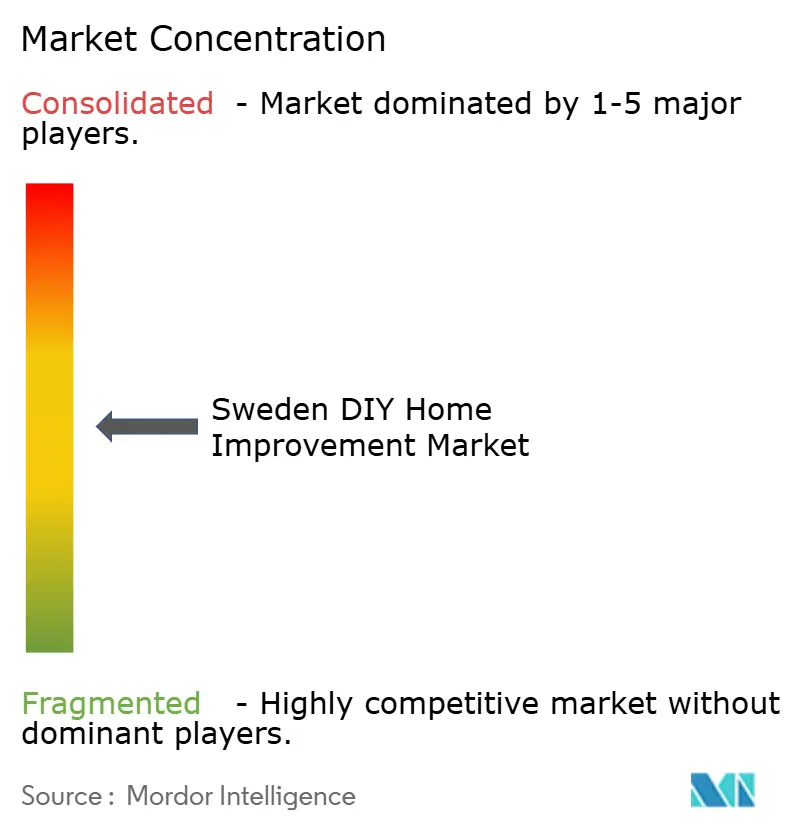
| Market Concentration | Medium |
Major Players *Disclaimer: Major Players sorted in no particular order Image © Mordor Intelligence. Reuse requires attribution under CC BY 4.0. | |
Sweden DIY Home Improvement Market Analysis by Mordor Intelligence
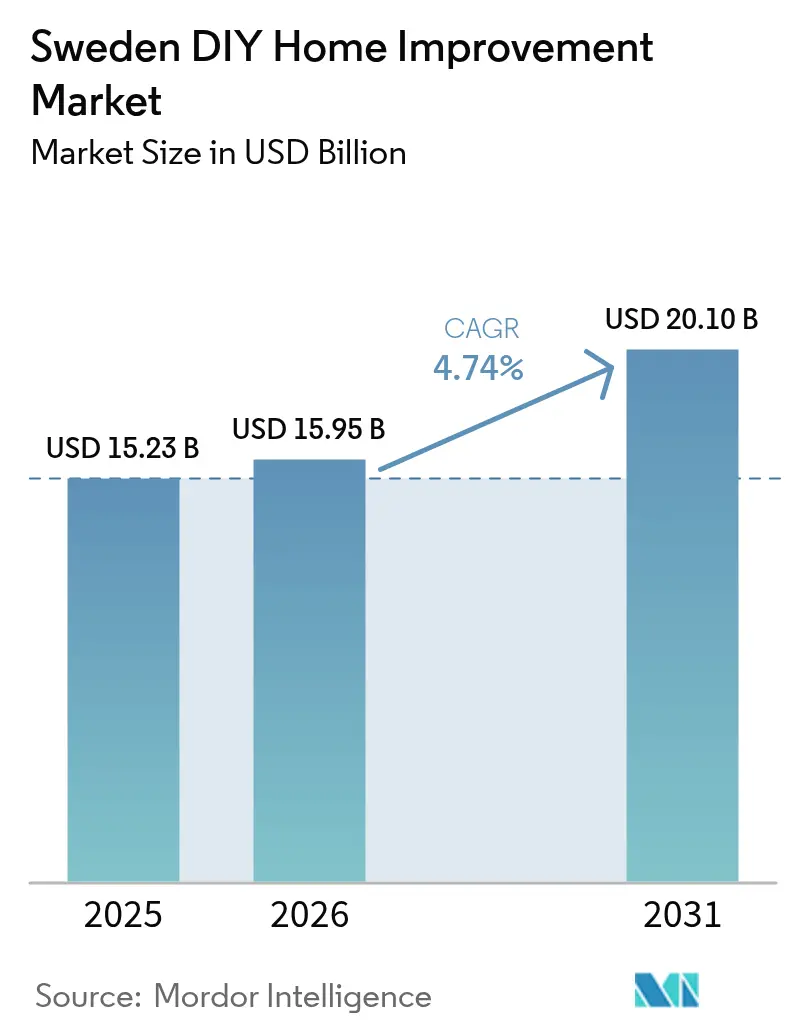
The Swedish DIY home improvement market size is expected to grow from USD 15.23 billion in 2025 to USD 15.95 billion in 2026 and is forecast to reach USD 20.1 billion by 2031 at 4.74% CAGR over 2026-2031. This trajectory reflects a resilient consumer base benefiting from generous tax deductions, high digital literacy, and strong environmental policy signals. Demand concentrates on energy-saving retrofits, aesthetic upgrades, and smart-home integrations as households navigate volatile utility costs and a maturing housing stock. Retailers continue to balance large-format stores with sophisticated online platforms, while material cost swings push do-it-yourself consumers toward flexible, lower-budget projects. Competitive intensity remains moderate, presenting scope for niche specialists in eco-friendly products and simplified installation solutions.
Key Report Takeaways
- By product type, painting & wallpaper led with 21.05% of Sweden DIY home improvement market share in 2025; lighting is projected to expand at a 7.21% CAGR through 2031.
- By distribution channel, DIY home-improvement stores held 61.62% of the Sweden DIY home improvement market size in 2025, while online channels are set to grow at 12.45% CAGR.
- By project type, maintenance & repair accounted for 36.25% share of the Sweden DIY home improvement market size in 2025, whereas energy-efficiency retrofits are rising at an 7.92% CAGR to 2031.
- By geography, Götaland contributed 45.12% revenue share in 2025; Norrland is on track for the fastest 7.32% CAGR in the Sweden DIY home improvement market.
- Bauhaus Sverige, Byggmax Group, Clas Ohlson, Hornbach, Beijer, and other top players collectively command a major share in the Sweden DIY home improvement market.
Note: Market size and forecast figures in this report are generated using Mordor Intelligence’s proprietary estimation framework, updated with the latest available data and insights as of 2026.
Sweden DIY Home Improvement Market Trends and Insights
Drivers Impact Analysis*
| Driver | (~) % Impact on CAGR Forecast | Geographic Relevance | Impact Timeline |
|---|---|---|---|
| Rising interest in home renovation and personalization | 1.2% | National, strongest in Götaland and Svealand | Medium term (2-4 years) |
| Expansion of DIY retail chains and omnichannel presence | 0.8% | National, with urban concentration | Short term (≤ 2 years) |
| Growth of e-commerce for home-improvement SKUs | 1.5% | National, accelerated in metropolitan areas | Short term (≤ 2 years) |
| Government ROT-avdrag tax incentive spurring semi-DIY renovations | 1.8% | National | Long term (≥ 4 years) |
| Energy-efficiency retrofit push amid high power prices | 2.1% | National, particularly Norrland | Medium term (2-4 years) |
| Source: Mordor Intelligence | |||
Rising Interest in Home Renovation and Personalization
Remote-work lifestyles and shifting household priorities are lifting renovation intent. In 2024, 49% of Swedes planned DIY projects over summer, and 23% budgeted for specialist help, underscoring a hybrid execution model. Improved finances for nearly 1 in 5 respondents translated into broader project scopes. The rise of remote work has intensified focus on home office spaces, storage solutions, and indoor air quality improvements, creating new product categories and driving demand for multifunctional furniture and smart home technologies. With housing absorbing 21.9% of consumer outlays in 2021, homeowners channel disposable income toward storage, indoor-air upgrades, and multifunctional furnishings [1].
Expansion of DIY Retail Chains and Omnichannel Presence
Chains such as Hornbach invest in compact city stores—e.g., a USD 4.37 million unit in Trollhättan—to meet urban convenience expectations. Clas Ohlson grew to 241 stores and posted 4% sales growth in April 2025 despite FX headwinds, signaling appetite for deeper market penetration. IKEA’s micro-mobility delivery pilots using e-bikes and cargo trailers trim last-mile emissions and customer effort.
Growth of E-commerce for Home-Improvement SKUs
Sweden’s high broadband coverage and digital trust accelerate online DIY transactions. Ninety-two percent of IKEA customers combine web and store visits, illustrating omnichannel complementarity. Retailers respond with AR visualization, live video consults, and click-and-collect logistics that align with complex product decision cycles. The complexity of home improvement products requires sophisticated online-to-offline integration, with retailers investing heavily in augmented reality tools, virtual consultation services, and improved product visualization technologies.
Government ROT-avdrag Tax Incentive Spurring Semi-DIY Renovations
The ROT-avdrag system represents one of Europe's most generous home improvement tax incentives, fundamentally altering project economics and consumer behavior patterns while supporting employment in the construction and renovation sectors. Card-based payment rules formalize contractor activity, while a combined ceiling of USD 7,000 for ROT+RUT offsets encourages larger project packages. The deduction applies only to labor costs, not materials, creating price sensitivity around product selection and driving demand for premium DIY-friendly materials that reduce installation complexity.
Energy-Efficiency Retrofit Push Amid High Power Prices
Solar panels, batteries, and EV chargers qualify for tax rebates of 20–50% on equipment, triggering a bundled energy-saving upgrade. Electricity costs jumped 44.1% in October 2022, reinforcing payback economics for insulation, heat-pump, and smart-lighting installs. Boverket earmarked USD 74.4 million for rentals and proposes USD 93 million annually through 2025, catalyzing spill-over demand in owner-occupied housing[2].
Restraints Impact Analysis*
| Restraint | (~) % Impact on CAGR Forecast | Geographic Relevance | Impact Timeline |
|---|---|---|---|
| Ageing population and DIY skill shortage | -1.4% | National, acute in rural areas | Long term (≥ 4 years) |
| Lumber and material price volatility | -0.9% | National, supply chain dependent | Short term (≤ 2 years) |
| Strict building-permit rules for small projects | -0.7% | National, stricter in urban municipalities | Medium term (2-4 years) |
| Insurance limits on homeowner electrical / plumbing work | -0.5% | National, standardized regulations | Long term (≥ 4 years) |
| Source: Mordor Intelligence | |||
Ageing Population and DIY Skill Shortage
An older median age and fading vocational skills limit complex project execution. Research shows seniors lean toward cosmetic fixes, while younger, sustainability-minded owners lack hands-on know-how, widening a capability gap. Roughly 27,000 DIY injuries a year, mainly among middle-aged men, raise safety concerns that retailers must address with training workshops and intuitive product kits [3].
Lumber and Material Price Volatility
Material cost instability represents a persistent challenge for Swedish DIY market growth, with price fluctuations creating planning difficulties for both consumers and retailers while affecting project timing and scope decisions. Retailers hedge by diversifying suppliers and adopting dynamic shelf pricing. The price swings create consumer hesitation around project timing and scope, with many homeowners delaying renovations during peak cost periods or substituting materials based on price rather than performance characteristics.
*Our forecasts treat driver/restraint impacts as directional, not additive. The impact forecasts reflect baseline growth, mix effects, and variable interactions.
Segment Analysis
By Product Type: Painting Drives Volume, Lighting Powers Growth
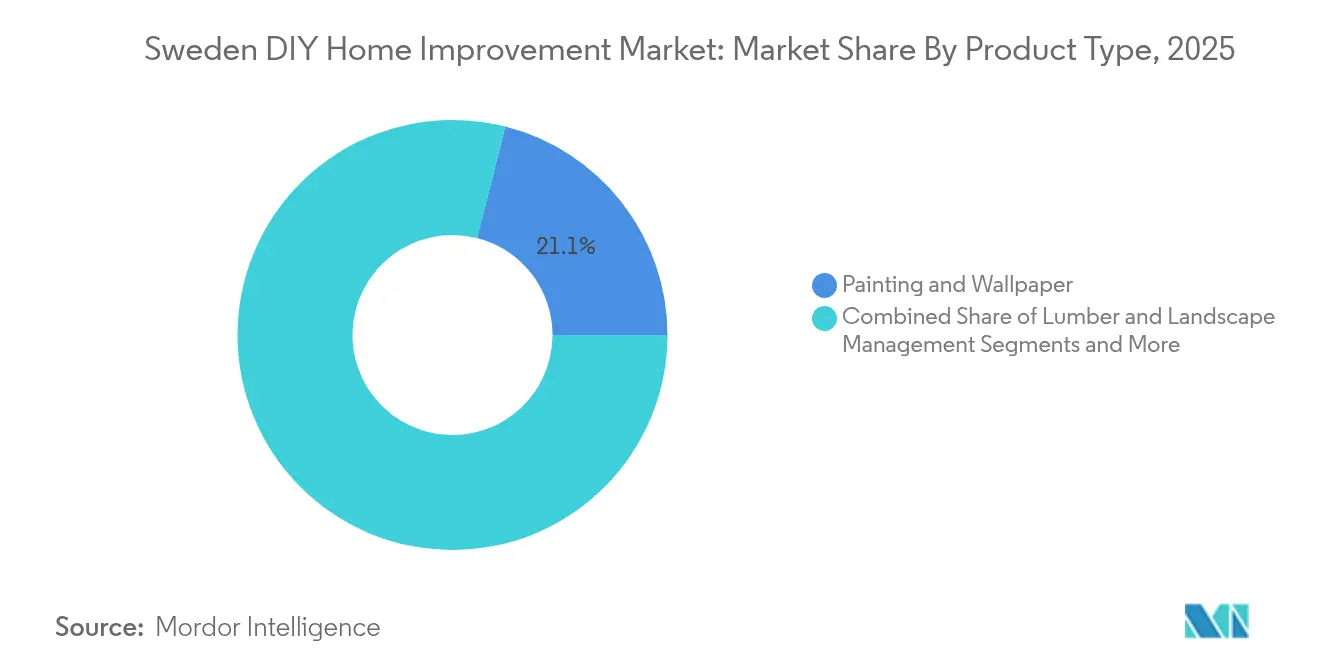
Painting & Wallpaper accounted for 21.05% of Sweden DIY home improvement market share in 2025, benefitting from ROT-eligible labor and affordable supplies. The segment’s accessible skill requirements and immediate visual payoff sustain repeat purchases. Tools, building materials, and kitchens follow, while flooring and electrical jobs skew toward hybrid install models requiring certified specialists for compliance.
Lighting grows fastest at a 7.21% CAGR because LEDs, smart switches, and motion sensors dovetail with tax-supported energy packages. The green-tech deduction covering 50% of storage batteries creates cross-category pull-through for integrated lighting-energy systems[3]. Plumbing lags under strict insurance rules mandating professional touchpoints, and lumber faces cyclical swings tied to commodity markets.

By Distribution Channel: Traditional Stores Dominate, Digital Disruption Accelerates
DIY home-improvement stores delivered 61.62% of the Sweden DIY home improvement market size in 2025, anchored by wide assortments, consultative sales, and same-day pickup for urgent fixes. These outlets optimize project baskets by clustering materials under one roof.
Online platforms, expanding at 12.45% CAGR, capture research-savvy consumers who compare prices and book delivery in a single session. IKEA’s user data confirm that shoppers fluidly navigate between mobile apps, 3-D room planners, and showrooms. Specialty outlets retain value among electricians and trades requiring niche SKUs, while small rural hardware shops pivot to just-in-time community supply roles.
By Project Type: Maintenance Leads Market, Energy Retrofits Drive Future Growth
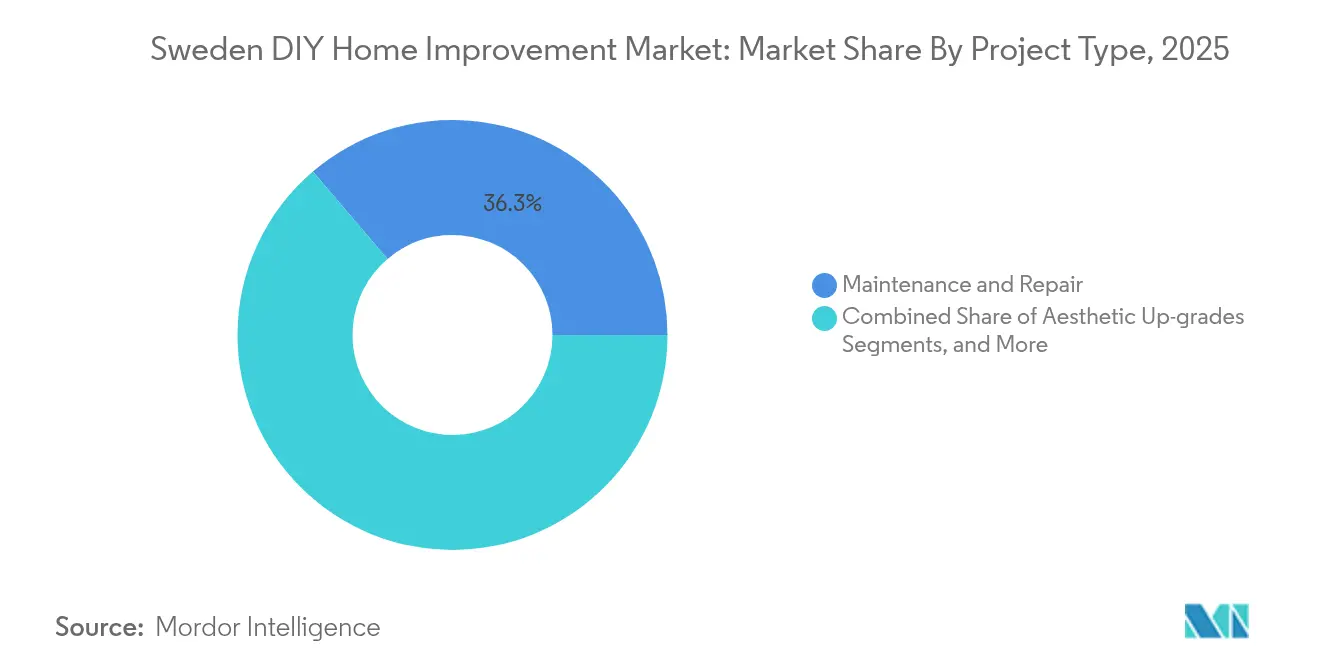
Maintenance & Repair represented 36.25% of the Sweden DIY home improvement market size in 2025, reflecting the country’s aging Million Homes Programme stock and severe winters. The ROT-avdrag lowers barriers for preventative upkeep, shifting behavior from reactive to scheduled interventions.
Energy-Efficiency Retrofits, climbing at an 7.92% CAGR, reshape priorities as households chase lower utility bills and carbon targets. Boverket’s rule demanding at least 20% performance gain propels comprehensive packages—insulation, heat pumps, and triple-glazed windows—rather than piecemeal fixes. Garden and outdoor works flourish every summer but remain weather-sensitive.
By End-User: Houses Lead Market, Apartments Show Growth Potential
Owner-occupied houses held 47.15% share in 2025 owing to larger floorplates, exterior access, and fewer co-operative restrictions. Detached homes typically combine decking, façade, and landscape jobs, raising basket sizes and cross-selling ratios for retailers.
Owner-occupied apartments are set for 6.05% CAGR through 2031 as urban professionals channel earnings into interior makeovers and space-saving solutions. Sweden’s bostadsrätt model lets units upgrade kitchens or bathrooms individually, spurring demand for modular systems that avoid structural alteration. Rented dwellings lag, but new efficiency standards push landlords toward professional retrofits that still pull DIY-grade materials through trade counters.
Geography Analysis
Götaland generated 45.12% of 2025 revenue, underpinned by Stockholm’s USD 63,612 GRDP per capita and USD 24,738 household disposable income. Mature dwellings drive steady renovation cycles, while dense retail networks hold prices in check. Forestry-rich Skåne, with land at USD 18,600 per hectare, mirrors strong property wealth that feeds remodeling budgets.
Svealand balances urban Stockholm apartment work with rural cabin upkeep, sustaining diverse product demand. Uppsala’s 4% GRDP growth underscores economic momentum that filters into improvement spending. Construction investment remains elevated, encouraging retailers to deepen omnichannel penetration across the region’s mixed topography.
Norrland posts the swiftest 7.32% CAGR as mining booms entice a skilled workforce northward. Cold winters amplify the payoff from insulation and window upgrades, while sparse settlement patterns boost e-commerce penetration. Logistics hurdles persist, but seasonal bulk ordering and regional warehouses mitigate availability gaps.
Regulatory Landscape
Sweden’s DIY home improvement activity is governed by the Planning and Building Act (PBL 2010:900) and the Planning and Building Ordinance (PBF 2011:338), with Boverket issuing national building regulations that set technical requirements and determine when permits or notifications apply to homeowner projects. A key 2026 compliance milestone is Boverket’s transition to its new building regulations that replaced older frameworks (BBR/EKS), with the option to apply older regulations ending on 1 July 2026, tightening how requirements are interpreted for energy, fire safety, and documentation in renovation work.
Construction products used in DIY projects, such as insulation systems, windows, and certain building materials, also fall under Sweden’s alignment with the EU Construction Products Regulation framework. National legislative adjustments connected to CPR-2024 entered into force on 1 March 2026 following Riksdag action, increasing the importance of compliant product documentation and declarations across retail assortments and private-label sourcing. On the consumer side, Konsumenttjanstlagen (1985:716) sets mandatory standards for trader-provided home improvement services, shaping semi-DIY models where households buy materials but rely on paid labor for regulated or complex tasks.
Value Chain Analysis
The value chain starts with domestic and imported inputs (timber-based products, metals, chemicals for paints and adhesives, and electrical components) and moves through manufacturers and brand owners into national wholesalers and buying groups that supply large-format DIY chains, specialty outlets, and e-commerce fulfillment. Distribution is anchored by large retailers and merchant networks, including building materials distributors such as Beijer Byggmaterial and XL-BYGG, alongside omnichannel operators that combine store pickup with home delivery, which is particularly relevant for bulky building materials and for servicing longer routes into northern Sweden.
Midstream and downstream dynamics are shaped by compliance and availability. Industry bodies such as SVEFF (paint and adhesive suppliers) flagged a raw-material and price-pressure situation in June 2026 tied to geopolitical disruption, which can transmit quickly into high-turnover categories like painting, sealants, and installation chemicals. At the execution layer, project completion relies on a hybrid mix of DIY consumers, certified trades for regulated electrical and plumbing touchpoints, and service intermediaries. Sector associations and networks, including BFB and other building-industry organizations, also contribute to standardization, guidance, and capability building across the renovation supply chain.
Competitive Landscape
The Sweden DIY home improvement market features mid-level concentration with top national chains and regional cooperatives sharing shelves. Bauhaus, Byggmax, Clas Ohlson, Hornbach, Beijer, and Jula vie through price, assortment breadth, and loyalty ecosystems. None exceeds a double-digit share, leaving room for agile newcomers tackling smart-home niches or circular-economy ranges.
Most incumbents pursue omnichannel parity: click-reserve-collect services, AR-guided store navigation, and delivery slot selection synced with installation windows. Clas Ohlson’s USD 26 million stake in online grocer Mathem exemplifies adjacency bets that extend last-mile reach and data capture. Investments lean toward back-end efficiency—RFID inventory, AI demand forecasting—rather than disruptive store closures, preserving the tactile shopping element critical for color, texture, and fit decisions.
White-space lies in elderly-friendly kits, pre-configured solar-battery-EV bundles, and bio-based building materials. Retailers experimenting with subscription tool rentals and on-site coaching aim to bridge the skills gap among younger urban dwellers while capturing recurring revenue.
Sweden DIY Home Improvement Industry Leaders
-
Bauhaus Sverige
-
Byggmax Group
-
Clas Ohlson
-
Beijer Byggmaterial
-
Hornbach Sverige
- *Disclaimer: Major Players sorted in no particular order
Market Opportunities and Future Outlook
Energy renovation represents a concrete whitespace for DIY retailers and brands, supported by active policy work and compliance requirements that increase demand for easy-to-install, documented products. In June 2026, the Swedish Government published a draft National Building Renovation Plan under the recast Energy Performance of Buildings Directive (Directive (EU) 2024/1275), and in March 2026 it submitted Proposition 2025/26:159 to implement elements of the directive. Together, these steps establish a clearer framework around renovation pathways and performance documentation. Retailers can therefore build assortments that bundle insulation, air sealing, controls, and smart lighting with guidance and compatible accessory kits, backed by in-store advisory and online configurators.
A second opportunity lies in scaling omnichannel distribution and trade-adjacent services for a market that spans both fully DIY and semi-DIY households. Byggmaterialhandlarna includes ten large chains and around thirty independent traders, employs about 21,000 people, and supports sector turnover of SEK 120 billion, indicating room for coordinated digitalization, standardized product information, and compliance-ready merchandising. With households facing periods of high electricity prices, including the government’s high-cost protection mechanism introduced in 2026 and effective from November 2025 through 2026, retailers that make energy and comfort upgrade scoping and total-cost visibility easier can expand basket size while reflecting consumer budget sensitivity.
Recent Industry Developments
- July 2026: Byggmax Group published its Q2 2026 interim report, reporting stronger profitability driven by higher gross margins and strict cost control. The update highlights the focus on efficiency and margin management across core categories, shaping pricing and inventory discipline strategy across the network.
- June 2026: Byggmax Group completed targeted retail upgrades, including reopening its Stenungsund store with an updated assortment and adding a Skanska Byggvaror showroom in Gothenburg. These moves improve local availability and project-basket merchandising, helping capture maintenance and renovation demand through an enhanced in-store experience and assortment relevance.
- November 2024: Beijer Byggmaterial Group announced the acquisition of a regional logistics facility to accelerate omnichannel delivery and broaden its footprint in northern Sweden. The move supports faster replenishment for big-box and online channels and aligns with a broader push toward integrated project-based merchandising, with capacity expansion that can affect product assortment and customer service in DIY channels.
Research Methodology Framework and Report Scope
Market Definition and Coverage
For this study, the Sweden DIY home improvement market is defined as consumer spending on products used to repair, refresh, or upgrade homes when the work is done by the homeowner or tenant, whether bought in-store or online.
Scope exclusions: We exclude professional contractor purchases, pure furniture-only spend, and renovation activity tied mainly to commercial or public buildings.
Segmentation Overview
- By Product Type
- Lumber & Landscape Management
- Decor & Indoor Garden
- Kitchen
- Painting & Wallpaper
- Tools & Hardware
- Building Materials
- Lighting
- Plumbing & Equipment
- Flooring Repair & Replacement
- Electrical Work
- By Distribution Channel
- DIY Home-Improvement Stores
- Specialty Stores
- Online
- Others
- By Project Type
- Aesthetic Up-grades
- Energy-Efficiency Retrofits
- Maintenance and Repair
- Garden and Outdoor Projects
- By End-User
- Owner-Occupied Houses
- Owner-Occupied Apartments
- Rented Dwellings
- By Region (Sweden)
- Gotaland
- Svealand
- Norrland
Data Sources, Market Sizing, and Validation
Desk Research
Desk work started by mapping the demand environment in Sweden and the retail channels that typically serve DIY shoppers. We used public statistics and industry sources, including Statistics Sweden (SCB) retail trade series, Eurostat construction and price indicators, and building and housing datasets from the Swedish National Board of Housing, Building and Planning (Boverket) to understand renovation activity and seasonality.
To pressure-test what this activity implies for sell-through, we also reviewed sources such as Swedish Customs trade data for key DIY categories, plus association and retailer communications that describe pricing, assortment shifts, and online share trends. Company annual reports, investor decks, and reputable business press helped anchor recent performance statements to a realistic market context, and we used paid subscriptions selectively for company financials, news, and shipment-level trade checks where applicable. These examples are not exhaustive, and we also referred to additional public and paid sources for data collection, validation, and clarification.
Primary Interviews and Surveys
Primary discussions were used to translate broad activity indicators into DIY-specific sell-in and sell-out assumptions, particularly where public data is indexed or not split cleanly by DIY versus professional demand. We spoke with a mix of retailers, distributors, brand-side category teams, and installer-adjacent experts across Sweden to confirm what counts as DIY purchasing, how baskets change with housing turnover, and where e-commerce is taking share.
Distribution of primary research fieldwork respondents
| Company type | Respondent position |
|---|---|
| Top tier: 27% | CXOs: 15% |
| Mid tier: 55% | Functional/Unit leaders: 25% |
| Smaller Players: 18% | Managers: 60% |
Market-Sizing & Forecasting
Sizing was built using a top-down model where home improvement demand is reconstructed from Sweden housing stock signals and repair and renovation activity, then filtered to the DIY portion based on primary feedback. We treated the market as retail value, so price and mix shifts were explicitly modeled rather than assuming volume alone explains growth.
Key inputs included indicators such as housing completions and moves, household disposable income trends, renovation and maintenance intensity, and category-level price movements for building materials and tools. We also tracked practical market fingerprints such as winter-spring seasonality in project starts, the shift toward online fulfillment, and changes in average basket size for typical DIY missions (paint, small fixtures, and light plumbing and electrical kits). Results were corroborated with selective bottom-up approximations, using sampled category volumes and average selling price ranges, retailer channel checks, and supplier shipment patterns to adjust totals when gaps appeared.
For forecasting, scenario analysis was used so macro drivers like interest rates, housing transaction volume, and construction confidence could be represented in a base case, with narrower upside and downside cases. Where category data was incomplete, we back-filled using proxy series from retail indices and trade flows, then normalized the mix using interview-led splits before finalizing year-by-year projections.
Data Validation & Update Cycle
Validation was done through multiple checks so that single-source bias did not drive the final number. We compared outputs against independent signals such as retail turnover indices, construction input price movements, and observed changes in channel mix, then flagged variances that fell outside expected ranges.
Before sign-off, assumptions and formulas were reviewed in steps, first by the lead analyst and then by an additional reviewer who stress-tested sensitivities, including DIY share and price progression. If a large mismatch shows up, experts are re-contacted to confirm whether a market event, a category reclassification, or a timing issue is the driver. Reports are refreshed annually, with interim updates for material events, and a final pre-delivery pass is completed so the view reflects the latest available data.
Mordor Intelligence's Sweden Diy Home Improvement Market Size Versus Other Published Estimates
Published market sizes for DIY home improvement in Sweden often vary because the boundary between DIY and professional spend is not consistent, and because some sources report only retail trade while others include broader renovation services. Currency timing and whether values are stated in current or constant prices can also change the reported total.
The table shows a noticeable spread, and in Mordor Intelligence's model the value is counted as consumer retail spend for DIY projects while explicitly removing contractor-led purchases and furniture-only sales. This treatment tends to pull the number away from estimates that blend B2B store turnover or wider home improvement retail baskets.
Benchmark comparison
| Source | Market Size | Gaps in Research Methodology |
|---|---|---|
| Mordor Intelligence | USD 15.95 B (2026) | |
| Global Consultancy A | USD 16.86 B (2026) | Uses a broader home improvement scope that can blend DIY and pro demand, and it is less explicit about removing contractor purchases from large-format store sales. |
| Retail Analytics Group B | USD 1.57 B (2025) | Tracks only the e-commerce portion of Sweden DIY spending, so it represents online sales rather than the total DIY home improvement market across all channels. |
Looking across the three figures, most of the gap can be explained by what is included in the basket (DIY-only versus DIY plus professional) and whether the view is total retail or only online. By keeping the scope rules and input drivers traceable to housing activity, pricing, and channel mix, we can keep the estimate repeatable and easier to reconcile as new data is released.
Key Questions Answered in the Report
What is the current Sweden DIY home improvement market size?
The Sweden DIY home improvement market size stands at USD 15.95 billion in 2026 and is projected to reach USD 20.1 billion by 2031.
How fast is the Sweden DIY home improvement market growing?
The market is expanding at a 4.74% CAGR through 2031, supported by tax incentives and energy-efficiency mandates.
Which product segment holds the largest share?
Painting & Wallpaper leads with 21.05% Sweden DIY home improvement market share in 2025.
Why are energy-efficiency retrofits important in Sweden?
High power prices and government rebates drive an 7.92% CAGR for energy-saving upgrades, outpacing other project types.
How significant is e-commerce in Swedish DIY retail?
Online channels are growing at 12.45% CAGR as tech-savvy consumers integrate digital research with store visits.
Who are the key players in the Sweden DIY home improvement industry?
Bauhaus Sverige, Byggmax, Clas Ohlson, Hornbach, Beijer, and Jula headline a fragmented market where no single player exceeds a double-digit share.