
Healthcare Patent Filing Outsourcing Market Size and Share
Market Overview
| Study Period | 2019 - 2030 |
|---|---|
| Market Size (2025) | USD 1.64 Billion |
| Market Size (2030) | USD 2.77 Billion |
| Growth Rate (2025 - 2030) | 11.30 % |
| Fastest Growing Market | Asia Pacific |
| Largest Market | North America |
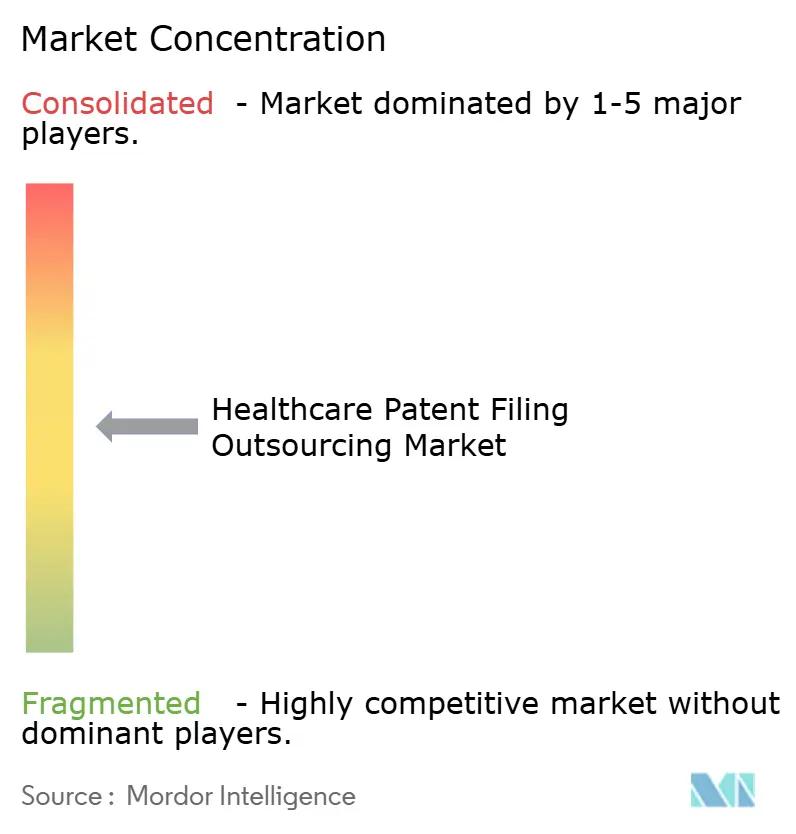
| Market Concentration | Medium |
Major Players *Disclaimer: Major Players sorted in no particular order Image © Mordor Intelligence. Reuse requires attribution under CC BY 4.0. | |
Healthcare Patent Filing Outsourcing Market Analysis by Mordor Intelligence
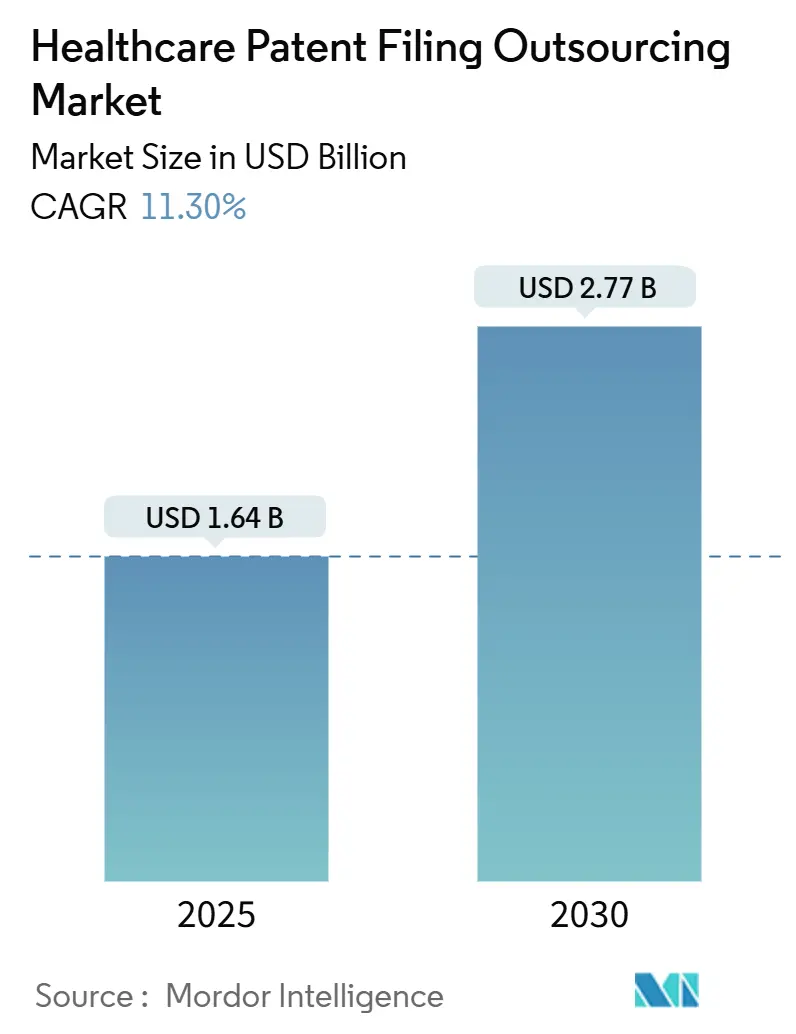
The healthcare patent filing outsourcing market size stood at USD 1.64 billion in 2025 and is forecast to reach USD 2.77 billion by 2030 on an 11.3% CAGR trajectory, underscoring the sector’s pivotal role in protecting life-science inventions while containing rising IP costs. Demand is fueled by biopharma companies trimming in-house legal expense, med-tech innovators grappling with patent cliffs, and a surge in AI-enabled diagnostics that require specialized drafting capabilities. Providers that combine deep domain expertise with multilingual capacity benefit most as over 70% of global patent disclosures appear in non-English languages. Regionally, the United States dominates filing volume, yet Asia Pacific’s regulatory harmonization and lower service costs drive the fastest growth. Technology adoption—especially AI-assisted prior-art searches—continues to compress turnaround times and strengthen provider differentiation. Mid-sized and emerging vendors are closing capability gaps through partnerships and selective acquisitions, accelerating service standardization across jurisdictions.
Key Report Takeaways
- By service type, Patent Drafting & Filing captured 37.9% of Healthcare Patent Filing Outsourcing market share in 2024, while Patent Analytics & Portfolio Management is advancing at a 13.2% CAGR through 2030.
- By the outsourcing model, offshore vendors held 48.7% of the Healthcare Patent Filing Outsourcing market size in 2024; hybrid configurations are projected to expand at 12.5% CAGR to 2030.
- y client type, healthcare corporations commanded a 51.3% share of the Healthcare Patent Filing Outsourcing market in 2024, and start-ups and SMEs are progressing at a 15.1% CAGR through 2030.
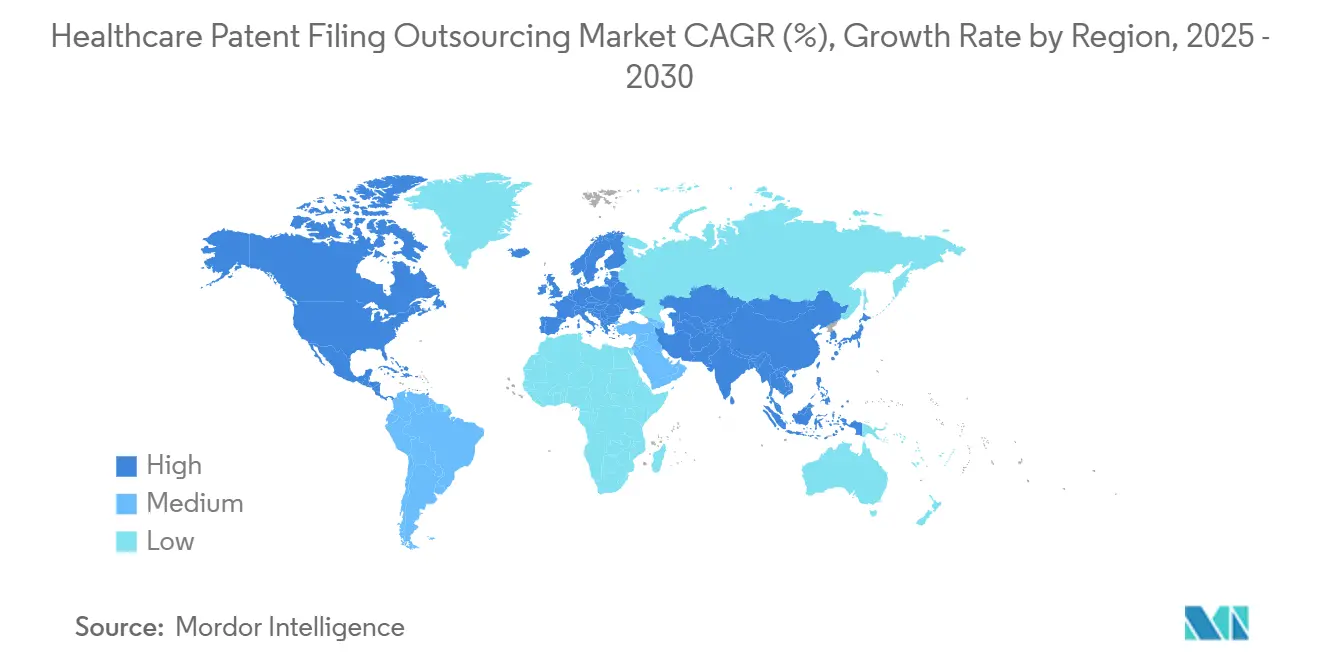
- By geography, North America led with a 38.9% revenue share in 2024, whereas Asia Pacific is set to grow at an 11.2% CAGR between 2025 and 2030.
Note: Market size and forecast figures in this report are generated using Mordor Intelligence’s proprietary estimation framework, updated with the latest available data and insights as of January 2026.
Market Trends and Insights
Drivers Impact Analysis of Healthcare Patent Filing Outsourcing Market*
| Driver | (~) % Impact on CAGR Forecast | Geographic Relevance | Impact Timeline |
|---|---|---|---|
| Escalating Biopharma R&D Costs Driving IP Cost-Savings Needs | +2.10% | Global, with concentration in North America & Europe | Medium term (2-4 years) |
| Surge In Global Healthcare Patent Volumes | +1.80% | Global, led by US (45% share) and China (30% share) | Short term (≤ 2 years) |
| Shortage Of In-House Patent Attorneys Among Med-Tech SMEs | +1.50% | APAC core, spill-over to North America | Long term (≥ 4 years) |
| AI-Powered Drafting Tools Expanding Outsourcing Scope | +1.30% | North America & EU, early adoption in APAC | Medium term (2-4 years) |
| Stringent & Evolving Patent Regulations/Compliance | +1.20% | Global, with regulatory harmonization in APAC | Medium term (2-4 years) |
| Rising Multilingual Filing Needs In Emerging Markets | +1.10% | APAC and Latin America, expanding to MEA | Long term (≥ 4 years) |
| Source: Mordor Intelligence | |||
Escalating Biopharma R&D Costs Driving IP Cost-Savings Needs
Life-science companies routinely allocate 15-20% of revenue to R&D, with patent budgets absorbing 8-12% of that outlay.[1]Gibson Dunn, “2025 Life Sciences Industry Outlook,” gibsondunn.com As blockbuster expiries threaten USD 300 billion in revenue by 2030, executives prioritize external patent drafting that trims internal overhead by up to 60%. Outsourcing partners supply seasoned agents versed in FDA guidelines and emerging technologies, ensuring filings remain compliant as the agency encourages AI-enabled manufacturing. The practice helps large drug makers re-deploy scarce capital toward advanced clinical programs without jeopardizing patent quality or timing.
Surge in Global Healthcare Patent Volumes
AI-related healthcare patents have risen 34% annually since 2015, splitting roughly 40% toward drug discovery and 60% toward diagnostics.[2]PatentPC, “AI-Powered Healthcare Patents: The Numbers Behind AI in Drug Discovery & Diagnosis,” patentpc.com The United States accounts for 45% of this activity, trailed by China at 30%, triggering a wave of cross-border filing mandates that benefit multilingual service providers. Average examination spans 22 months for AI patents, compelling early, strategic filings to secure priority. Multilanguage prior-art screening is now standard practice as a majority of new disclosures appear outside English. Providers that align local counsel with WIPO PCT procedure shorten grant cycles and bolster global portfolio strength.
Shortage of In-House Patent Attorneys Among Med-Tech SMEs
Surveys indicate 65% of med-tech SMEs lack dedicated IP staff, impeding timely protection of device algorithms and software claims.[3]WIPO, “Unlocking the Power of Intellectual Property in Medical Technology,” wipo.int Governments respond with targeted incentives: the UAE’s 50% fee cut for SMEs and academic institutes and India’s expedited reviews at reduced cost. Such measures spur early-stage firms to engage specialist outsourcers that bundle drafting, prosecution, and portfolio strategy. Vendors differentiate by offering flexible retainers and regulatory updates, enabling smaller innovators to manage escalating compliance without hiring full-time counsel.
AI-Powered Drafting Tools Expanding Outsourcing Scope
Patent agents increasingly deploy NLP and machine-learning platforms that map claims to prior art in seconds, compressing manual search time by 70%. The USPTO’s own AI pilots enhance examiner consistency, pressuring service providers to match or exceed internal quality benchmarks. Seamless translation modules extend coverage across Japanese, Korean, and simplified Chinese, eliminating procedural delays from language bottlenecks. Yet AI outputs require human refinement to meet enablement and written-description standards, preserving demand for experienced patent attorneys who understand both the algorithms and the law.
Restraints Impact Analysis of Healthcare Patent Filing Outsourcing Market*
| Restraint | (~) % Impact on CAGR Forecast | Geographic Relevance | Impact Timeline |
|---|---|---|---|
| Data-Confidentiality & Cyber-Security Concerns | -1.20% | Global, heightened in regulated markets | Short term (≤ 2 years) |
| Export-Control Restrictions On Cross-Border Drafting | -0.90% | US-China corridors, expanding to EU-China | Medium term (2-4 years) |
| AI Commoditisation Squeezing Vendor Margins | -0.80% | Global, with early impact in North America & Europe | Medium term (2-4 years) |
| Growing In-House IP Automation Platforms | -0.70% | North America & Europe, gradual APAC adoption | Long term (≥ 4 years) |
| Source: Mordor Intelligence | |||
Data-Confidentiality & Cyber-Security Concerns
Drug formulations and diagnostic algorithms embedded in draft applications hold commercial value well before launch, making breaches costly. GDPR obligations in Europe and HIPAA considerations in the United States push clients to impose stringent vendor audits, encrypted data rooms, and real-time access logs. Hybrid outsourcing—where sensitive invention disclosures stay on-shore while commoditized tasks move offshore—gains traction, even though it may reduce short-term cost savings. Providers that secure ISO 27001 certification and maintain region-specific storage gain a competitive edge.
Export-Control Restrictions on Cross-Border Drafting
Filing rules now intersect with national-security policies. China requires a security review before foreign filings of inventions made domestically; non-compliance can void patent rights. In the United States, the proposed BIOSECURE Act tightens collaborations with specific Chinese CROs, complicating freedom-to-operate analyses. These hurdles elevate compliance costs and lengthen timelines, nudging companies toward near-shore hubs with shared legal frameworks. Service providers add compliance officers and jurisdiction-specific checklists to preserve cross-border efficiency.
*Our forecasts treat driver/restraint impacts as directional, not additive. The impact forecasts reflect baseline growth, mix effects, and variable interactions.
Healthcare Patent Filing Outsourcing Market Segment Analysis
By Service Type:
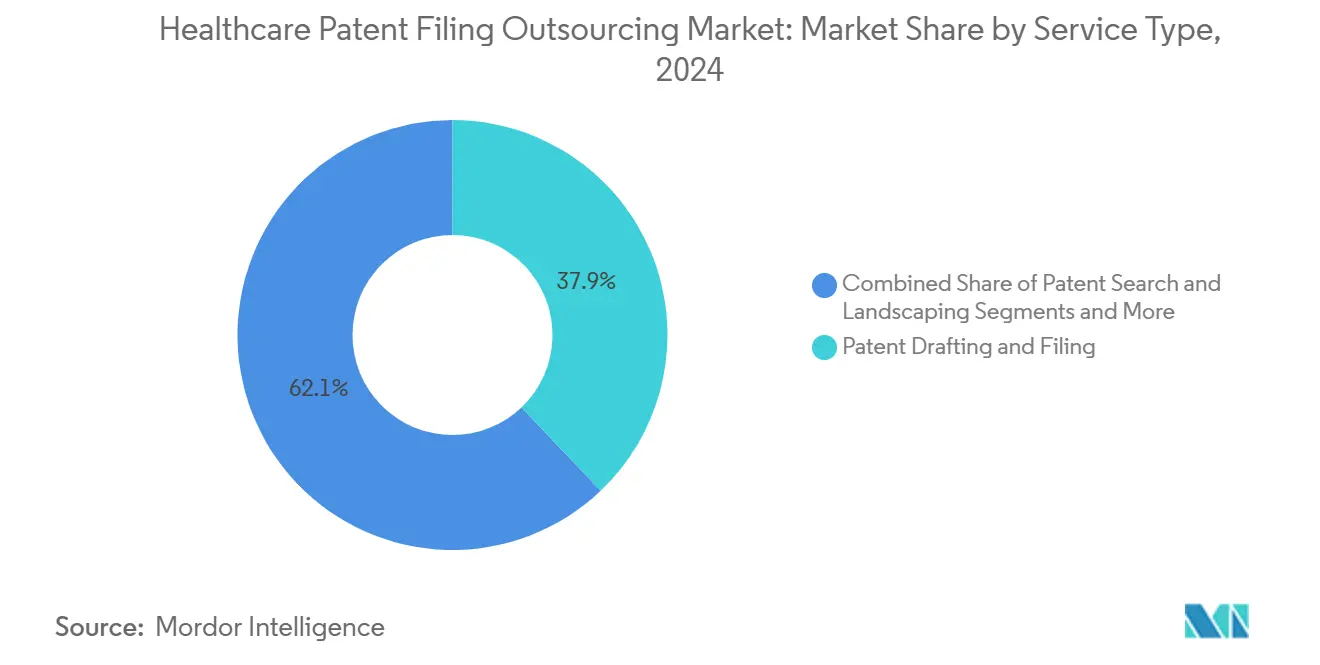
Patent Drafting Dominates Amid AI IntegrationPatent Drafting & Filing held a 37.9% share of the healthcare patent filing outsourcing market in 2024, reflecting the centrality of meticulously crafted claims to life-science exclusivity. Rising AI and biologics pipelines require niche technical vocabulary and cross-disciplinary expertise, sustaining premium pricing for seasoned drafters. The Healthcare Patent Filing Outsourcing market size allocated to Patent Analytics & Portfolio Management is projected to expand at a 13.2% CAGR through 2030 as companies rationalize large portfolios ahead of patent-cliff expiries.
Demand for Patent Search & Landscaping grows alongside multilingual filings; WIPO data show English now represents less than one-third of new patent literature, pushing providers to deploy multilingual analysts. Prosecution support surges in India after 2024 rule amendments cut examination requests from 48 to 31 months. Renewal & maintenance specialists attract clients by automating annuity reminders and consolidating global payments, cutting overhead and late-fee risk.



By Outsourcing Model:
Off-Shore Leadership Faces Hybrid ChallengeOff-shore vendors captured 48.7% of the healthcare patent filing outsourcing market size in 2024, leveraging labor arbitrage and deep talent pools in India and the Philippines. Cost pressure and extended time-zone coverage favor this model for high-volume drafting and search work.
Hybrid configurations, blending on-shore document intake with off-shore production, are advancing at a 12.5% CAGR to 2030 as clients weigh data-sovereignty rules and export-control risk. Near-shoring into Canada, Mexico, and Eastern Europe gains interest where tight turnaround intersects with common legal systems. On-shore specialist boutiques, while more expensive, retain niche advantages for sensitive biologics or dual-use technologies subject to rigorous security audits.
By Client Type:
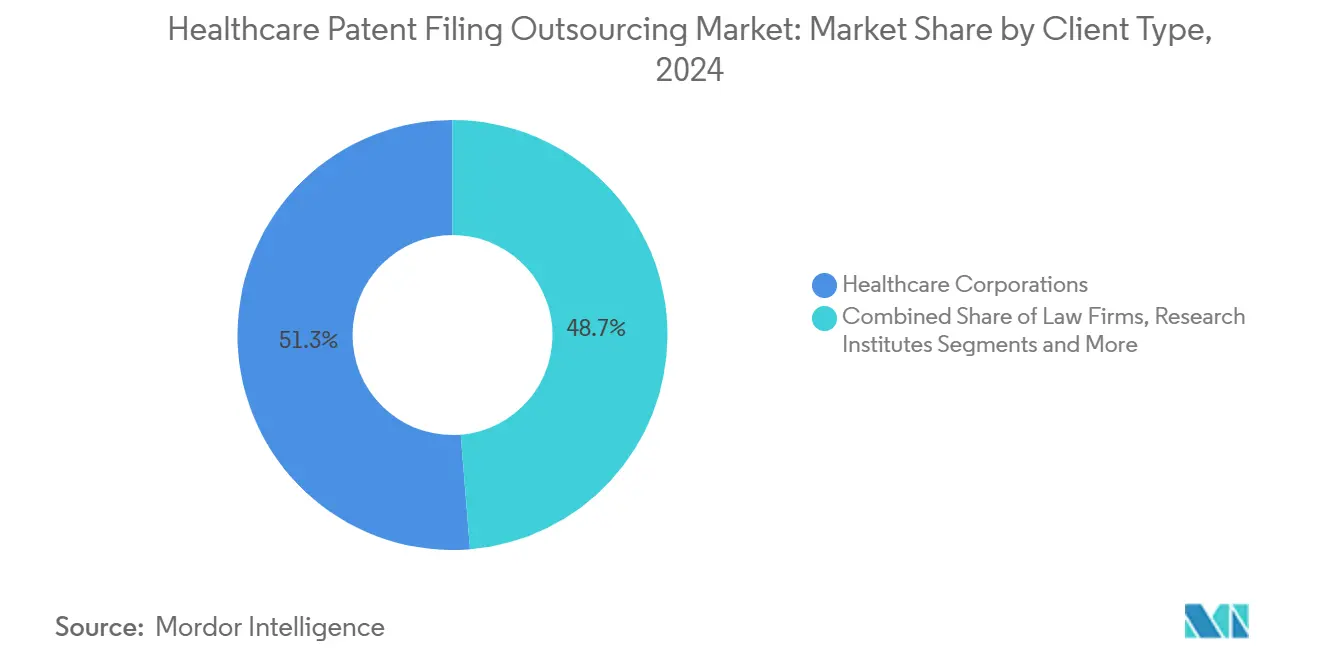
Healthcare Corporations Lead While SMEs AccelerateLarge healthcare corporations accounted for 51.3% of the healthcare patent filing outsourcing market share in 2024, sustaining year-round drafting workloads and multi-jurisdiction portfolios. Their strategic alliances with global vendors enable volume discounts and bespoke regulatory updates across the FDA, EMA, and USPTO channels.
Start-ups & SMEs, supported by fee abatements such as the UAE’s 50% reduction, are expanding at 15.1% CAGR through 2030. Outsourcing levels the playing field by providing access to seasoned patent counsel without full-time hires. Law firms continue to outsource routine tasks like IDS preparation and legal research to preserve partner bandwidth for complex opinions. Academic institutes and technology-transfer offices employ external agents to convert grant-funded discoveries into enforceable assets, especially in gene-editing and regenerative-medicine fields.
Geography Analysis
North America Healthcare Patent Filing Outsourcing Market
North America controlled 38.9% of 2024 revenue as the largest source of pharmaceutical R&D and AI healthcare patent filings. January 2025 USPTO fee increases of 10-27% are nudging even Fortune 500 drug makers toward budget-friendly outsourcing, reinforcing vendor pipelines. Canada’s new patent-term-adjustment framework, effective 2025, adds procedural complexity that multiplies demand for docketing and timeline management services.
APAC Healthcare Patent Filing Outsourcing Market
Asia Pacific posts the fastest 11.2% CAGR across 2025-2030, amplified by India’s accelerated examination reforms and China’s large patent output that requires nuanced local counsel. Japanese life-science filings remain sophisticated, incorporating substance patents, method claims, and term extensions that necessitate specialized translation and prosecution expertise.
Europe, Middle East and South America Healthcare Patent Filing Outsourcing Market
Europe delivers steady growth, aided by the Unitary Patent system and EMA’s evolving data-exclusivity periods. The Middle East’s SME incentives, notably the UAE scheme, position the region as a budding hub for med-tech filings. South America, while smaller, witnesses incremental uptake as Brazil improves examination speed and local companies target FDA pathways.

Competitive Landscape
The healthcare patent filing outsourcing industry is moderately fragmented. Global platforms such as Clarivate and Questel deliver end-to-end software plus human expertise, while boutique firms like Sagacious IP emphasize tailored drafting in oncology and digital therapeutics. AI-embedded search engines and instant claim-chart generators increasingly define table stakes, prompting midsized vendors to partner with or acquire SaaS providers to secure competitive parity.
Regional specialists differentiate through statutory insight; for example, India-based firms tout proficiency in Section 3(d) exclusions, whereas Chinese agents navigate foreign-filing license requirements. Hybrid providers integrate encrypted U.S. review centers with offshore drafting teams to reconcile cost targets with tightened data-export controls.
Vendor selection criteria pivot on quality metrics—office-action reversal rates, average grant time, and docket accuracy—as well as ISO 27001 certification and conflict-management protocols. Given the top five players jointly command roughly 35-40% of global revenue, pricing remains competitive and innovation cycles rapid.
Healthcare Patent Filing Outsourcing Industry Leaders
Clarivate (incl. CPA Global)
Questel
Dennemeyer
Evalueserve
Sagacious IP
- *Disclaimer: Major Players sorted in no particular order
Healthcare Patent Filing Outsourcing Market Companies Covered in this Report
- Clarivate
- Questel
- Dennemeyer
- CPA Global
- Evalueserve
- Sagacious IP
- Aranca
- MaxVal Group
- LexisNexis IP (PatentSight)
- WNS Global Services
- Cognizant
- HCL Technologies
- Infosys BPM
- Accenture
- Genpact
- EXL Service Holdings
- Parexel International
- Innodata
- PatentTrans
- RWS Group

Recent Industry Developments in Healthcare Patent Filing Outsourcing Market
- January 2025: USPTO implemented 10-27% fee increases, pushing healthcare applicants toward external drafting and cost-management solutions.
- January 2025: Canada introduced patent-term adjustments for grants delayed past statutory thresholds, increasing prosecution-support workloads.
- October 2024: AI-powered healthcare patent filings continued to grow 34% annually, intensifying demand for specialized AI-savvy drafting expertise.


Global Healthcare Patent Filing Outsourcing Market Report Scope
| Patent Search & Landscaping |
| Patent Drafting & Filing |
| Patent Prosecution Support |
| Patent Analytics & Portfolio Management |
| Patent Renewal & Maintenance |
| On-shore |
| Near-shore |
| Off-shore |
| Hybrid (Shared-service) |
| Healthcare Corporations |
| Law Firms |
| Research Institutes |
| Start-ups & SMEs |
| Others |
| North America | United States |
| Canada | |
| Mexico | |
| Europe | Germany |
| United Kingdom | |
| France | |
| Italy | |
| Spain | |
| Rest of Europe | |
| Asia Pacific | China |
| Japan | |
| India | |
| South Korea | |
| Australia | |
| Rest of Asia Pacific | |
| Middle East & Africa | GCC |
| South Africa | |
| Rest of Middle East & Africa | |
| South America | Brazil |
| Argentina | |
| Rest of South America |
| By Service Type | Patent Search & Landscaping | |
| Patent Drafting & Filing | ||
| Patent Prosecution Support | ||
| Patent Analytics & Portfolio Management | ||
| Patent Renewal & Maintenance | ||
| By Outsourcing Model | On-shore | |
| Near-shore | ||
| Off-shore | ||
| Hybrid (Shared-service) | ||
| By Client Type | Healthcare Corporations | |
| Law Firms | ||
| Research Institutes | ||
| Start-ups & SMEs | ||
| Others | ||
| By Geography | North America | United States |
| Canada | ||
| Mexico | ||
| Europe | Germany | |
| United Kingdom | ||
| France | ||
| Italy | ||
| Spain | ||
| Rest of Europe | ||
| Asia Pacific | China | |
| Japan | ||
| India | ||
| South Korea | ||
| Australia | ||
| Rest of Asia Pacific | ||
| Middle East & Africa | GCC | |
| South Africa | ||
| Rest of Middle East & Africa | ||
| South America | Brazil | |
| Argentina | ||
| Rest of South America | ||


Key Questions Answered in the Report
What is the projected value of the Healthcare Patent Filing Outsourcing market by 2030?
Forecasts place the sector at USD 2.77 billion by 2030, expanding on an 11.3% CAGR.
Which service leads in revenue today?
Patent Drafting & Filing contributes 37.9% of 2024 revenue, reflecting its core importance for life-science IP protection.
Why are hybrid outsourcing models gaining traction?
Companies blend on-shore intake with off-shore production to align data-security rules with the lower costs of offshore labor.
Which region is growing fastest through 2030?
Asia Pacific shows an 11.2% CAGR, propelled by India's faster examinations and China's high patent volume.
How do AI tools influence patent outsourcing?
NLP and machine-learning engines cut search time, improve claim consistency, and require vendors who can merge technical and legal skill sets.
What factors drive SME participation in outsourcing?
Fee rebates such as the UAE's 50% discount and the need for specialized expertise allow SMEs to secure patents without maintaining in-house counsel.
Page last updated on:





