
Grape Seed Extract In Pet Food Application Market Size and Share
Market Overview
| Study Period | 2021 - 2031 |
|---|---|
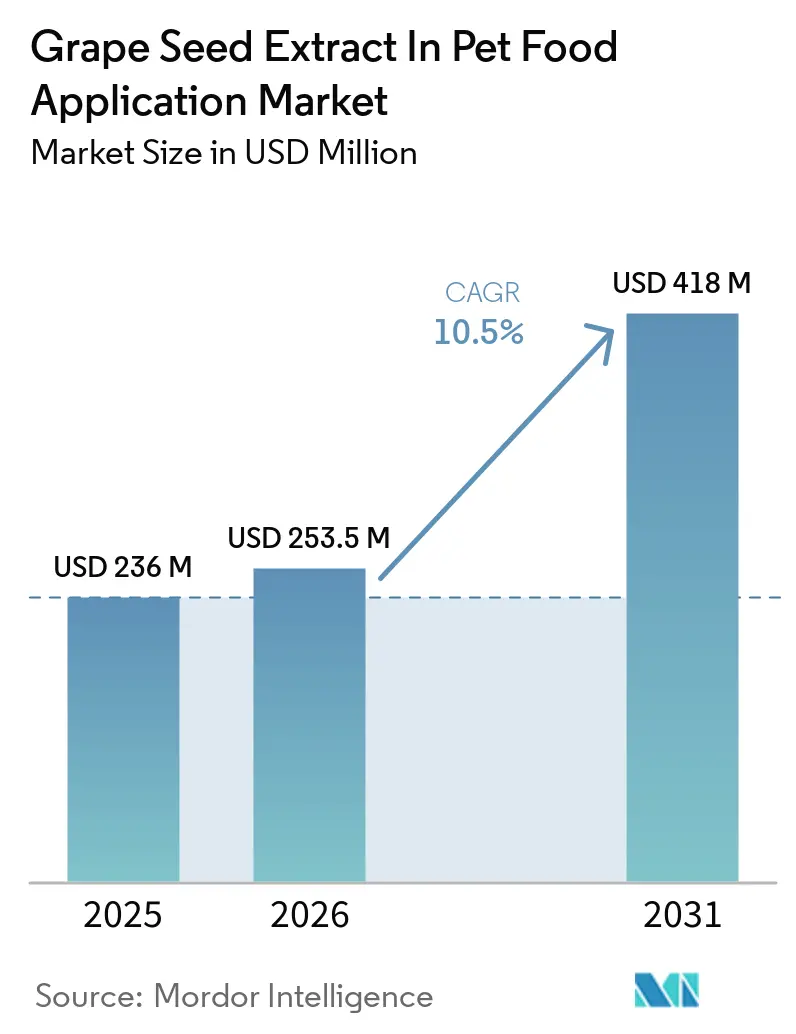
| Market Size (2026) | USD 253.5 Million |
| Market Size (2031) | USD 418 Million |
| Growth Rate (2026 - 2031) | 10.50 % |
| Fastest Growing Market | Asia-Pacific |
| Largest Market | North America |
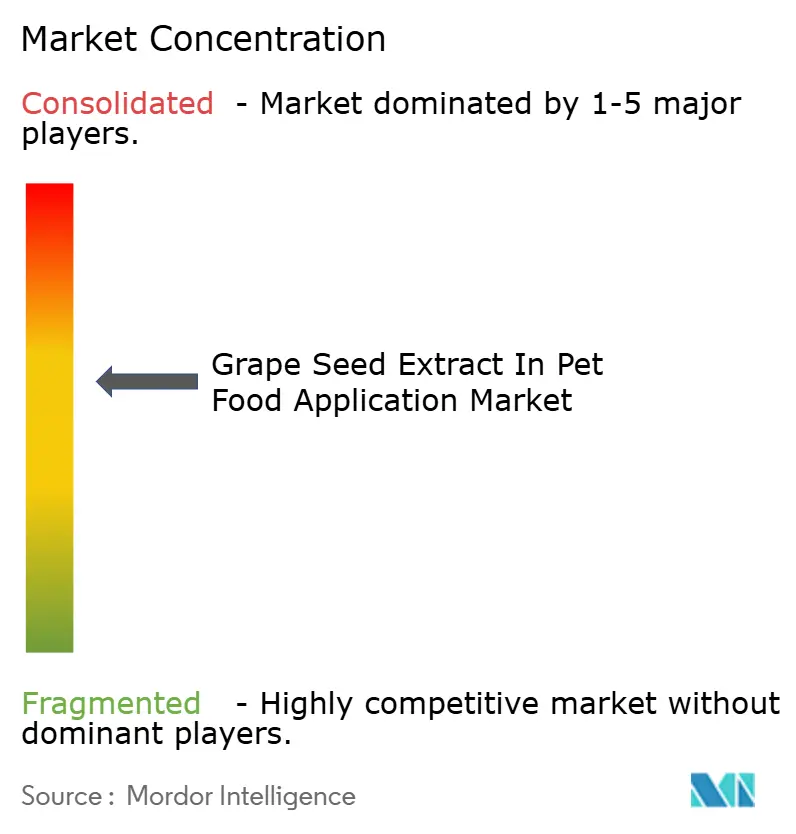
| Market Concentration | Medium |
Major Players *Disclaimer: Major Players sorted in no particular order Image © Mordor Intelligence. Reuse requires attribution under CC BY 4.0. | |
Grape Seed Extract In Pet Food Application Market Analysis by Mordor Intelligence
The grape seed extract in pet food application market size is anticipated to increase from USD 236.0 million in 2025 to USD 253.5 million in 2026 and reach USD 418.0 million by 2031, growing at a CAGR of 10.5% over 2026-2031. Regulatory momentum on both sides of the Atlantic now favors botanical antioxidants, while shrinking global wine volumes tighten supplies of grape-derived co-products, pushing ingredient prices higher yet widening margins for suppliers able to secure long-term pomace contracts. As per the American Pet Products Association, pet humanization keeps premium food penetration above 55% of United States dog food sales, and according to the International Trade Administration, similar trajectories are now visible in urban Asia, where e-commerce channels are accelerating the adoption of clinically substantiated functional ingredients. Ingredient makers respond with vertical integration, precision extraction, and targeted mergers that stabilize raw-material availability and bring down formulation risk for brand owners. Collectively, these forces position the grape seed extract in pet food application market as a structurally advantaged niche within the broader companion animal nutrition landscape.
Key Report Takeaways
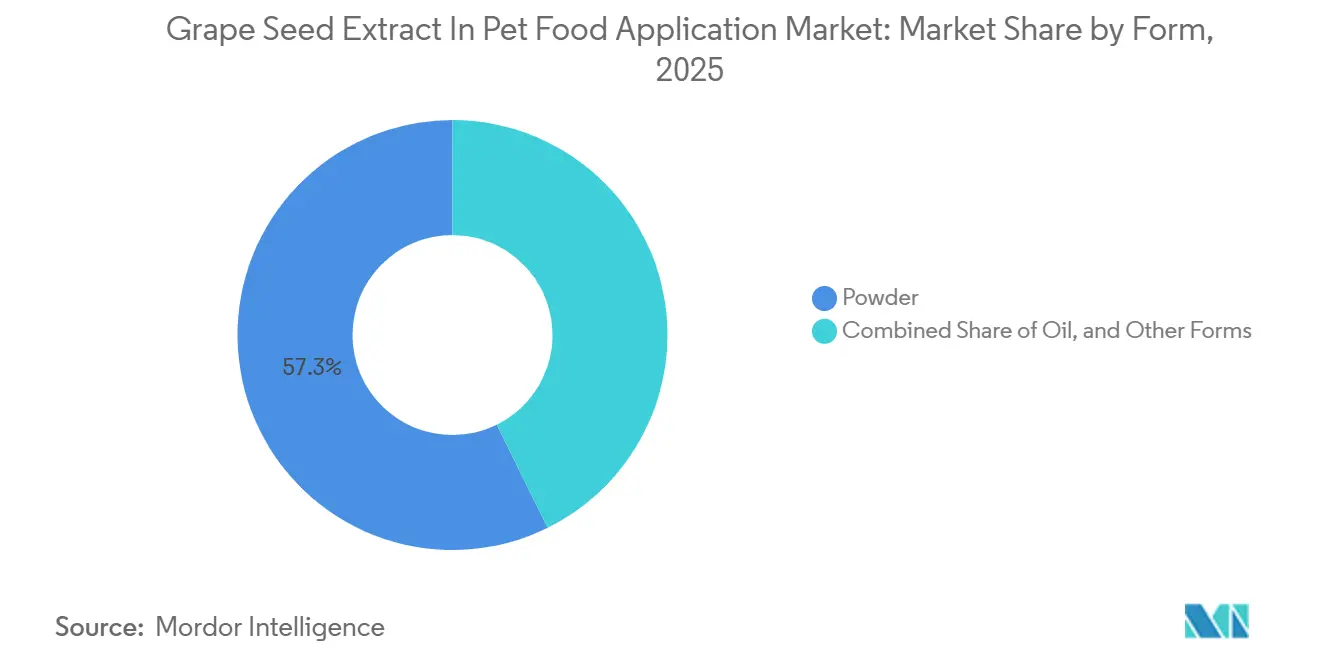
- By form, powder held the largest 57.3% of the grape seed extract in pet food application market share in 2025, while oil-based formats are projected to expand at the fastest 9.8% CAGR over 2026-2031.
- By pet type, dogs led with the largest share, accounting for 64.1% of the grape seed extract in pet food application market in 2025, whereas cats are set to grow at the fastest 10.9% CAGR through 2031.
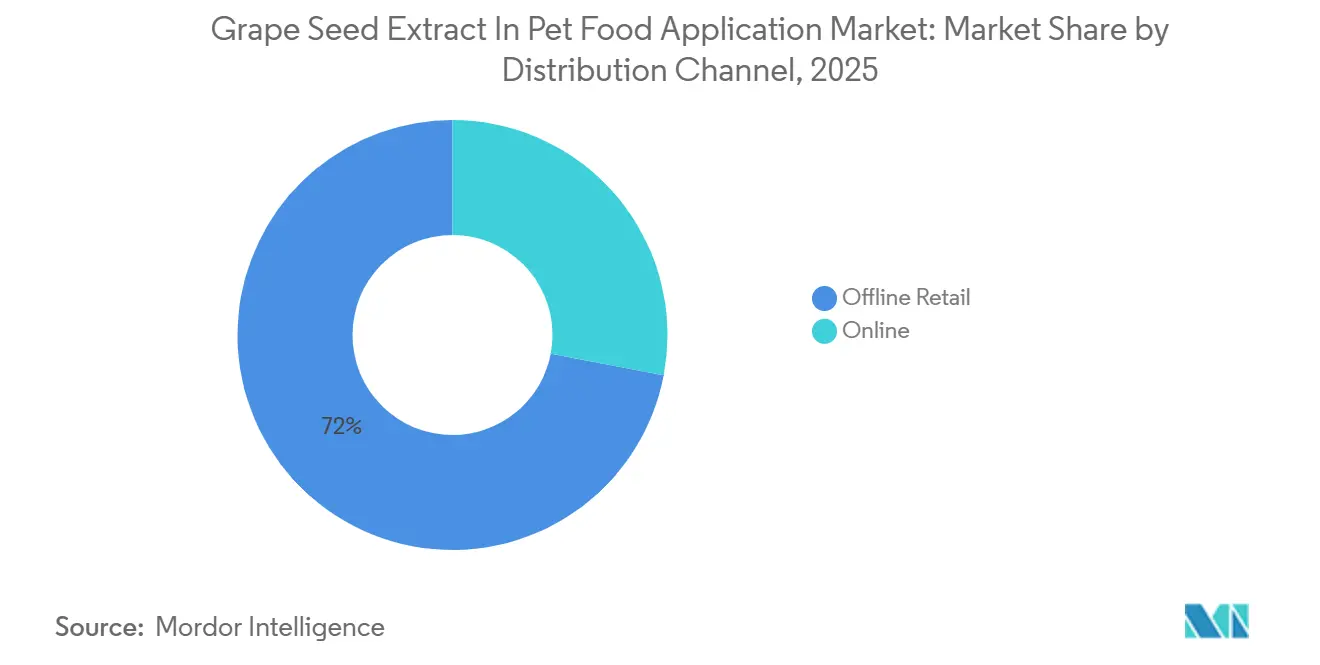
- By distribution channel, offline retail accounted for the largest 72.0% share of the grape seed extract in pet food application market size in 2025, whereas online sales are forecast to post the fastest 12.1% CAGR during 2026-2031.
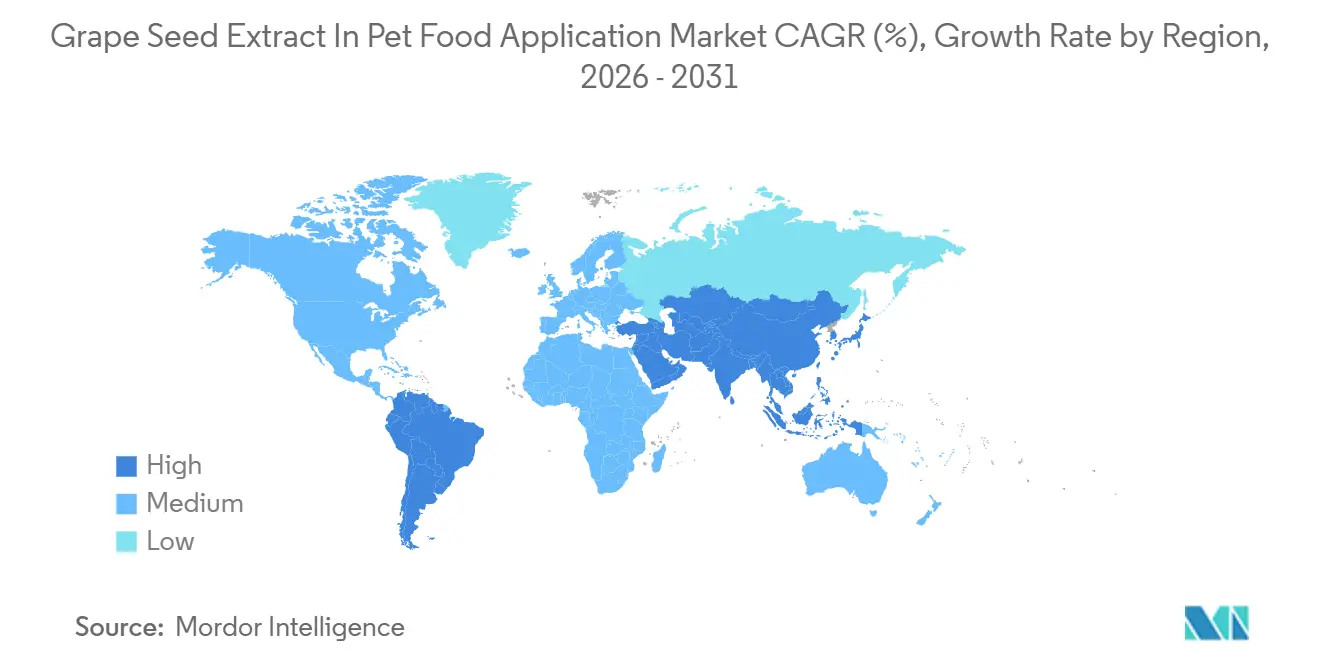
- By geography, North America captured the largest 34.8% share of the pet food grape seed extract in pet food application market in 2025, and Asia-Pacific is projected to register the fastest 11.4% CAGR to 2031.
Note: Market size and forecast figures in this report are generated using Mordor Intelligence’s proprietary estimation framework, updated with the latest available data and insights as of January 2026.
Market Trends and Insights
Drivers Impact Analysis of Grape Seed Extract In Pet Food Application Market*
| Driver | (~) % Impact on CAGR Forecast | Geographic Relevance | Impact Timeline |
|---|---|---|---|
| Rising demand for natural antioxidants in premium pet food | +2.8% | North America and Western Europe | Medium term (2-4 years) |
| Humanization of pets boosting functional ingredient adoption | +3.1% | Global, strongest in urban Asia and North America | Long term (≥ 4 years) |
| Regulatory push for clean-label additives in North America and Europe | +1.9% | United States, European Union, Australia, and New Zealand | Short term (≤ 2 years) |
| Supply-chain integration by large ingredient suppliers | +1.2% | North America and Europe, emerging in Asia-Pacific | Medium term (2-4 years) |
| Growing use of grape pomace up-cycling in wineries | +0.9% | Europe, South America, and California | Long term (≥ 4 years) |
| Expansion of veterinary nutraceutical recommendations | +1.4% | North America, Western Europe, and affluent Asia-Pacific | Medium term (2-4 years) |
| Source: Mordor Intelligence | |||
Rising Demand for Natural Antioxidants in Premium Pet Food
Premium food accounted for the majority share of United States dog kibble sales in 2025, and the American Pet Products Association projects the pet food and treats category to grow from USD 68.3 billion in 2024 to USD 69.7 billion in 2026[1]. Formulators are replacing butylated hydroxyanisole and butylated hydroxytoluene with tocopherols and polyphenols, a shift supported by Kemin Industries, Inc. data showing botanical systems match synthetic oxidation control without bioaccumulation risks. Higher omega-3 inclusion rates in modern recipes increase the oxidative burden, underscoring the need for synergistic botanical blends that stabilize lipids at extrusion temperatures above 120 degrees Celsius. Recent studies and surveys of consumers in 2025 found that the majority are willing to pay more for supplements backed by clinical evidence, owing to rising safety concerns. As a result, the grape seed extract market in pet food applications gains volume and pricing power despite grape price volatility.
Humanization of Pets Boosting Functional Ingredient Adoption
As per American Pet Products Association, Pet ownership reached 95 million households in the United States in 2025, with Millennials and Generation Z accounting for the steepest growth in spending on functional nutrition. As per the International Trade Administration, online pet food sales in China has shown a rapid growth in 2025. In addition, South Africa reported a significant rise in pet food turnover between 2021 and 2025, even amid macroeconomic headwinds, indicating that emotionally driven categories are less prone to cyclical slowdowns. Across markets, consumers value clinically validated claims that translate human health concepts, such as antioxidant defense and microbiome support, into companion animal diets. This social shift elevates the entire grape seed extract market for pet food applications, which aligns closely with perceptions of naturalness and functional efficacy.
Regulatory Push for Clean-Label Additives in North America and Europe
The United States Food and Drug Administration (FDA) published Guidance for Industry 293 in October 2024, stating that it would exercise enforcement discretion for Association of American Feed Control Officials (AAFCO)- defined ingredients, effectively granting a fast lane to established botanicals. California's Assembly Bill 418, effective January 1, 2027, bans four additives, including Red Dye No. 3. Similar legislation in New York and Illinois has prompted brands like JM Smucker and Conagra to reformulate portfolios by 2027 to meet clean-label standards. This momentum led to a 2025 FDA decision to phase out eight petroleum-based dyes nationwide by the end of 2026. In Europe, the Commission approved rosemary extract as a feed antioxidant in April 2024, signaling a regulatory preference for plant-derived preservatives[2]. Retailers reinforce the policy push, for instance in 2025, Petco Health and Wellness Company, Inc. pledgedto make 50% of its pet products sustainable. These changes narrow the available toolbox to natural sources, amplifying demand for grape seed extract in pet food applications.
Supply-Chain Integration by Large Ingredient Suppliers
MartinBauer Group merged its botanical units in March 2026 and bought American Botanicals in October 2025, securing 33,000 acres of Appalachian supply and lowering raw-material risk. The International Organization of Vine and Wine (OIV) estimates a 1% contraction in global vineyard area in 2024, a dynamic that favors firms with locked-in harvest offtake[3]. Integrated players can smooth price spikes by hedging against grape pomace price spikes across hemispheres, giving brand owners a predictable cost of goods. Such structural advantages accelerate scale and reinforce grape seed extract's competitive position in the pet food application market.
Restraints Impact Analysis of Grape Seed Extract In Pet Food Application Market*
| Restraint | (~) % Impact on CAGR Forecast | Geographic Relevance | Impact Timeline |
|---|---|---|---|
| Cost volatility due to seasonal grape yield fluctuation | -1.6% | Southern Hemisphere and Mediterranean Europe | Short term (≤ 2 years) |
| Limited clinical evidence on long-term efficacy in felines | -0.8% | North America and Europe | Medium term (2-4 years) |
| Competition from synthetic antioxidants such as BHA/BHT | -1.3% | Price-sensitive South America, Southeast Asia, and Eastern Europe | Short term (≤ 2 years) |
| Allergenicity concerns in niche pet segments | -0.4% | North America and Europe | Long term (≥ 4 years) |
| Source: Mordor Intelligence | |||
Cost Volatility Due to Seasonal Grape Yield Fluctuation
The International Organisation of Vine and Wine (OIV) pegged 2024 world wine output between 227 and 235 million hectoliters, roughly 13% below the ten-year average and possibly the lowest since 1961. France fell 23% to 36.9 million hectoliters due to compounded climate stress, whereas Argentina bounced 23% to 10.9 million hectoliters following frost recovery, amplifying global supply swings. Turkey’s average dried-grape export price climbed 24.7% year over year to EUR 1.96 (USD 2.14) per kilogram in 2024, according to data from the International Organisation of Vine and Wine, reflecting tighter by-product streams. Ingredient buyers often renegotiate contracts annually, so sudden price jumps compress manufacturer margins until reformulation or pass-through catches up. These gyrations introduce earnings volatility for companies operating in the grape seed extract in pet food application market.
Limited Clinical Evidence on Long-Term Efficacy in Felines
Cats have lower glucuronidation capacity than dogs, leaving metabolic pathways for polyphenols less understood. A 2025 trial showed that resveratrol improved glucose handling in obese cats, but the study covered only several weeks and did not examine long-term safety endpoints. The European Food Safety Authority flagged dose-dependent concerns for canine applications in opinions released in 2016 and 2020. Without comparable feline data, regulators may require post-market surveillance or conservative inclusion caps, slowing brand adoption. These gaps temper the otherwise robust growth outlook for the grape seed extract in pet food application market.
*Our forecasts treat driver/restraint impacts as directional, not additive. The impact forecasts reflect baseline growth, mix effects, and variable interactions.
Grape Seed Extract In Pet Food Application Market Segment Analysis
By Form:
Powder Dominates Extrusion EconomicsPowder captured the largest 57.3% share of the grape seed extract in pet food application market size in 2025 because legacy extrusion systems integrate dry blends more easily than liquids. Contract manufacturers appreciate powders for long ambient shelf life and straightforward inclusion in vitamin-mineral premixes. Research on weaned lambs in 2024 confirmed that powder-based grape seed extract elevates antioxidant status when processed into pellets, reinforcing its efficacy during high-temperature feed manufacturing. Cost efficiency and plant hygiene further entrench powder as the incumbent format, though particle size control remains critical to minimize segregation in bulk silos. With most regional co-packers yet to invest in liquid dosing, the powder segment will retain scale advantages through at least the medium term, 2026-2031.
Still, oil-based formulations are the fastest-growing, with a 9.8% CAGR over 2026-2031, and will steadily chip away at the powder lead. Liquid suspensions protect polyphenols from degradation during extrusion at temperatures above 120 degrees Celsius while reducing workplace dust. Upgraded equipment also enables precision with micro-ingredients, aligning with personalized nutrition trends in subscription services. Encapsulated formats occupy a niche for freeze-dried raw diets and soft chews where targeted release justifies higher costs. As the market for grape seed extract in pet food applications grows, suppliers will diversify formats, yet robust powder economics ensure the segment retains the largest volume through 2031.

By Pet Type:
Canine Loyalty Meets Feline OpportunityDogs generated the largest 64.1% share of the grape seed extract in pet food application market size in 2025, reflecting higher daily feed volumes and a mature market for senior joint and cognitive support formulas. Veterinary guidelines for age-related oxidative stress management routinely specify botanical antioxidants for large breeds, sustaining baseline demand. Extensive canine safety dossiers submitted to the Food and Drug Administration (FDA) via the Animal Food Ingredient Consultation pathway in 2025 further de-risk formulation choices for brand owners. Combined, these factors stabilize the canine revenue base, ensuring predictable cash flow for suppliers.
Conversely, the cat category is the fastest-growing, advancing at a 10.9% CAGR through 2026-2031 as obesity drives uptake of metabolic supplements. According to the International Trade Administration, China’s e-commerce channels grew by 20.3% annually, with pet supplements driving 2025 sales to CNY 3.69 billion (USD 0.54 billion). This growth is linked to precision health trends, with cat-focused treats using antioxidants like polyphenols for cardiovascular and immune health. Veterinarians increasingly recommend antioxidant blends for urinary and metabolic health, although long-term efficacy research remains limited. This evidence gap leads to cautious inclusion rates, yet early-adopting brands gain competitive differentiation in a segment historically underserved by functional ingredients. Consequently, the grape seed extract in pet food application market finds a sizeable new frontier in feline nutrition without cannibalizing its established canine portfolio.
By Distribution Channel:
Offline Anchors Bulk, Online Captures SubscriptionOffline retail secured the largest 72.0% of the grape seed extract market share in pet food application in 2025 because breeders, kennels, and agricultural clients favor 20-40 kilogram sacks that minimize unit cost. Drive-through yards at stores such as Agrimark simplify handling heavy loads, and immediate product availability remains decisive for time-pressed rural customers. Brick-and-mortar outlets also provide tactile assurance to first-time buyers evaluating specialty antioxidant claims. Retailers, including Petco, reinforce channel relevance by cleansing ingredient decks of artificial additives in 2025, nudging shoppers toward naturally preserved brands. These dynamics secure offline leadership for the near term.
Online sales are the fastest growing, with a 12.1% CAGR projected for 2026-2031, underpinned by subscription models that tailor recipes by breed, age, and lifestyle. E-commerce ecosystems squeeze distributor margins, allowing direct-to-consumer brands to allocate more budget to premium botanical inputs like grape seed extract. Transparent product pages embed clinical studies and customer reviews, bolstering consumer confidence in functional claims. Cross-border digital trade further expands the addressable demand, as evidenced by Brazil’s USD 100 million in pet food exports in 2023, which moved through online aggregators. Over time, digital penetration will diversify suppliers' geographic reach and improve inventory forecasting accuracy across the grape seed extract in pet food application market.
Geography Analysis
North America Grape Seed Extract in Pet Food Application Market
North America held the largest 34.8% of the grape seed extract in pet food application market size in 2025, anchored by the United States pet industry, as according to the American Pet Products Association, the United States pet industry has reached USD 158 billion in 2025 and is tracking toward USD 165 billion in 2026. Premium food penetration above 55% and FDA regulatory clarity following Guidance 293 and 294 ease botanical approvals, making the region a natural launchpad for new antioxidant systems. California’s 2025 ban on select dyes accelerates nationwide reformulation despite resistance from price-sensitive segments. Canada’s January 2025 recognition of grape seed extract as a human supplement with antioxidant claims signals convergence that simplifies North American cross-border ingredient logistics. Mexico leverages its proximity to United States manufacturing clusters, yet faces consumer affordability constraints that limit super-premium penetration, capping near-term growth.
APAC Grape Seed Extract in Pet Food Application Market
Asia-Pacific is the fastest-growing region at an 11.4% CAGR for 2026-2031, propelled by China’s USD 6.2 billion online pet food channel and India’s double-digit category expansion. E-commerce accounts for more than 25% of organized Indian pet food sales, enabling premium brands to overcome brick-and-mortar limitations in tier-two cities. Japan’s labeling trends away from synthetic preservatives and toward “no additives” validate regional consumer readiness for botanical solutions. South Korea and Australia enforce strict feed safety codes that prioritize documented natural antioxidants, positioning the grape seed extract in pet food application market for steady premiumization. Rising disposable incomes, urban pet lifestyles, and mobile commerce ecosystems converge to replicate the North American premium trajectory in a compressed timeframe.
Europe Grape Seed Extract in Pet Food Application Market
Europe will grow at a significant CAGR during 2026-2031, as the European Commission’s April 2024 authorization of rosemary extract underscores institutional support for plant-based preservation. Mature Western markets already feature high clean-label awareness, yet Eastern Europe offers incremental upside as disposable income climbs. Wine output across the European Union totaled 139 million hectoliters in 2024, down 3% from the year before, ensuring ongoing pomace availability despite localized droughts. France’s output tumble underscores sourcing risk, advantaging suppliers diversifying harvest origins. Combined with stringent European Food Safety Authority reviews, these factors create a regulatory-driven yet stable growth runway for the grape seed extract in pet food application market.
Competitive Landscape
The market concentration is medium, with the five largest suppliers together commanding a significant share of 2025 revenue. Kemin Industries, Inc. sits at the forefront and uses 3 decades of tocopherol expertise, along with its global laboratory network, to simplify the switch from synthetic to botanical antioxidants for mass brands. Naturex SA (Givaudan SA) closely follows and is channeling new research funding and targeted mergers into precision extraction platforms that boost phenolic yield and consistency. The combined scale, technical support, and regulatory know-how of these two leaders shape ingredient standards that smaller firms must match on stability, safety, and throughput.
Beyond the top tier, Symrise Pet Food (Symrise AG) is hedging agricultural risk by backing precision fermentation startup platforms, while Archer Daniels Midland Company leverages its global oilseed footprint to integrate grape pomace streams into existing specialty-ingredient channels. Indena S.p.A. and Silvateam S.p.A. emphasize enzyme-assisted and subcritical-water extraction to secure solvent-free certifications that premium brands demand. Grap’Sud SCA and Prinova US LLC (Nagase and Co., Ltd.) exploit regional winery alliances to guarantee traceable supply, whereas Alltech, Inc. and Nexira SAS continue to widen distribution through feed-mill partnerships in price-sensitive markets. Indena S.p.A., Bio-Botanica, Inc., Martin Bauer Group GmbH & Co. KG, Sabinsa Corporation (Sami-Sabinsa Group Ltd.), and Phytosynthese SAS (Adisseo France SAS) specialize in high-purity polyphenol fractions for therapeutic and veterinary diets.
Strategic priorities now focus on vertical integration, sustainable extraction, and clinical validation, which together are projected to expand the overall market value. Several players are commissioning supercritical CO₂ and enzyme-assisted plants that cut solvent residues and lower carbon footprints, positioning them for retailer audits that favor low-impact processing. Joint developments, such as Indena S.p.A.’s Phytosome delivery work feeding into companion-animal trials, aim to lift bioavailability and justify premium pricing across new feline and senior-pet formulas. As wineries seek additional revenue from pomace upcycling and ingredient firms secure multi-year offtake contracts, the supplier base is poised to scale capacity and accelerate the adoption of grape seed extract in pet food worldwide.
Grape Seed Extract In Pet Food Application Industry Leaders
-
Naturex SA (Givaudan SA)
-
Symrise Pet Food (Symrise AG)
-
Archer Daniels Midland Company
-
Indena S.p.A.
-
Kemin Industries, Inc.
- *Disclaimer: Major Players sorted in no particular order
Grape Seed Extract In Pet Food Application Market Companies Covered in this Report
- Kemin Industries, Inc.
- Naturex SA (Givaudan SA)
- Symrise Pet Food (Symrise AG)
- Archer Daniels Midland Company
- Silvateam S.p.A.
- Grap’Sud SCA
- Prinova US LLC (Nagase and Co., Ltd.)
- Alltech, Inc.
- Nexira SAS
- Indena S.p.A.
- Bio-Botanica, Inc.
- Martin Bauer Group GmbH and Co. KG
- Sabinsa Corporation (Sami-Sabinsa Group Ltd.)
- Phytosynthese SAS (Adisseo France SAS)
Recent Industry Developments in Grape Seed Extract In Pet Food Application Market
- January 2025: The United States Food and Drug Administration issued Guidance 294, establishing the Animal Food Ingredient Consultation pathway for pre-market review of novel botanical additives. The clearer route to approval shortens development cycles for grape seed extract solutions, which should accelerate market growth during 2026-2031.
- October 2024: The United States Food and Drug Administration finalized Guidance 293, confirming enforcement discretion for Association of American Feed Control Officials-listed ingredients and giving established botanicals a compliance safe harbor. Lower regulatory risk encourages manufacturers to reformulate with grape seed extract, expanding demand and supporting overall market expansion.
- April 2024: The European Commission approved rosemary extract as a feed antioxidant under Regulation 2024/1068, formally endorsing plant-based preservatives in animal nutrition. This precedent boosts confidence that other botanicals, including grape seed extract, will receive similar authorizations, propelling adoption and driving market growth across the European Union.
Global Grape Seed Extract In Pet Food Application Market Report Scope
Grape Seed Extract (GSE) in pet food is a natural antioxidant derived from grape seeds, which are rich in polyphenols, including proanthocyanidins. It is utilized to enhance antioxidant levels, reduce inflammation, and support gut health.
The Grape Seed Extract in Pet Food Application Market Report is Segmented by Form (Powder, Oil, and Other Forms), by Pet Type (Dogs, Cats, Birds, and Other Companion Animals), by Distribution Channel (Offline Retail, and Online), and by Geography (North America, South America, Europe, Asia-Pacific, Middle East, and Africa). The Market Forecasts are Provided in Terms of Value (USD).
Segmentation Overview
| Powder |
| Oil |
| Other Forms |
| Dogs |
| Cats |
| Birds |
| Other Companion Animals |
| Offline Retail |
| Online |
| North America | United States |
| Canada | |
| Mexico | |
| Rest of North America | |
| South America | Brazil |
| Argentina | |
| Rest of South America | |
| Europe | Germany |
| United Kingdom | |
| France | |
| Italy | |
| Spain | |
| Russia | |
| Rest of Europe | |
| Asia-Pacific | China |
| Japan | |
| India | |
| Australia | |
| New Zealand | |
| South Korea | |
| Rest of Asia-Pacific | |
| Middle East | Saudi Arabia |
| United Arab Emirates | |
| Rest of Middle East | |
| Africa | South Africa |
| Egypt | |
| Rest of Africa |
| By Form | Powder | |
| Oil | ||
| Other Forms | ||
| By Pet Type | Dogs | |
| Cats | ||
| Birds | ||
| Other Companion Animals | ||
| By Distribution Channel | Offline Retail | |
| Online | ||
| By Geography | North America | United States |
| Canada | ||
| Mexico | ||
| Rest of North America | ||
| South America | Brazil | |
| Argentina | ||
| Rest of South America | ||
| Europe | Germany | |
| United Kingdom | ||
| France | ||
| Italy | ||
| Spain | ||
| Russia | ||
| Rest of Europe | ||
| Asia-Pacific | China | |
| Japan | ||
| India | ||
| Australia | ||
| New Zealand | ||
| South Korea | ||
| Rest of Asia-Pacific | ||
| Middle East | Saudi Arabia | |
| United Arab Emirates | ||
| Rest of Middle East | ||
| Africa | South Africa | |
| Egypt | ||
| Rest of Africa | ||
Key Questions Answered in the Report
How large will the grape seed extract in pet food application market be by 2031?
The grape seed extract in pet food application market size is forecast to reach USD 418.0 million by 2031, expanding at a 10.5% CAGR over 2026-2031.
Which format is largest in the market?
Powder is the largest format, accounting for 57.3% of the 2025 grade seed extract market share in the pet food application market share, because most existing extrusion lines handle dry blends more efficiently than liquids.
Which region is the fastest growing?
Asia-Pacific is the fastest-growing regional segment, with a 11.4% CAGR projected for 2026-2031, driven by rapid e-commerce adoption and rising premium pet food demand.
What is the main restraint on long-term growth?
Seasonal grape yield volatility introduces raw-material cost swings that can compress supplier margins by up to 1.6 percentage points on forecast CAGR 2026-2031.
Who leads the competitive landscape?
Kemin Industries, Inc. leads the market with a prominent share in 2025, leveraging decades of tocopherol expertise and a global laboratory network that supports brand reformulation.
Which pet type offers the fastest growth opportunity?
Cat nutrition is the fastest-expanding segment, advancing at a 10.9% CAGR through 2026-2031, as obesity management drives demand for antioxidant supplements.