
Golf Equipment Market Size and Share
Golf Equipment Market Analysis by Mordor Intelligence
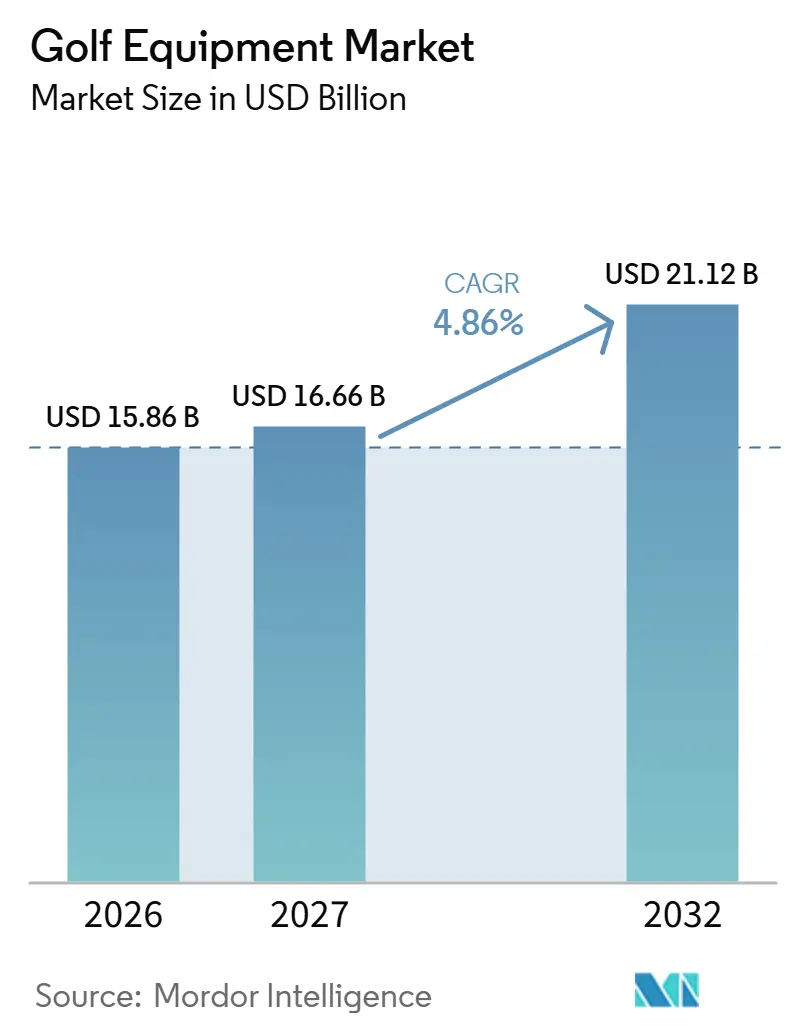
The golf equipment market size is expected to increase from USD 15.86 billion in 2026 to USD 16.66 billion in 2027 and reach USD 21.12 billion by 2032, growing at a CAGR of 4.86% over 2027-2032.
China’s expanding junior competition creates more occasions for first sets, while fitting-led club offers give established players a reason to consider specialized equipment. Equipment makers can combine product renewal with fitting services, although launch timing affects when new ranges contribute to sales. Upfront equipment costs in the United Kingdom and difficult beginner access to Indian courses can slow the conversion of interest into purchases. Fitting-led upgrades for established players and junior ranges tied to China’s competition calendar give makers earlier routes to club and ball demand than starter-set sales in the United Kingdom or India.
Key Report Takeaways
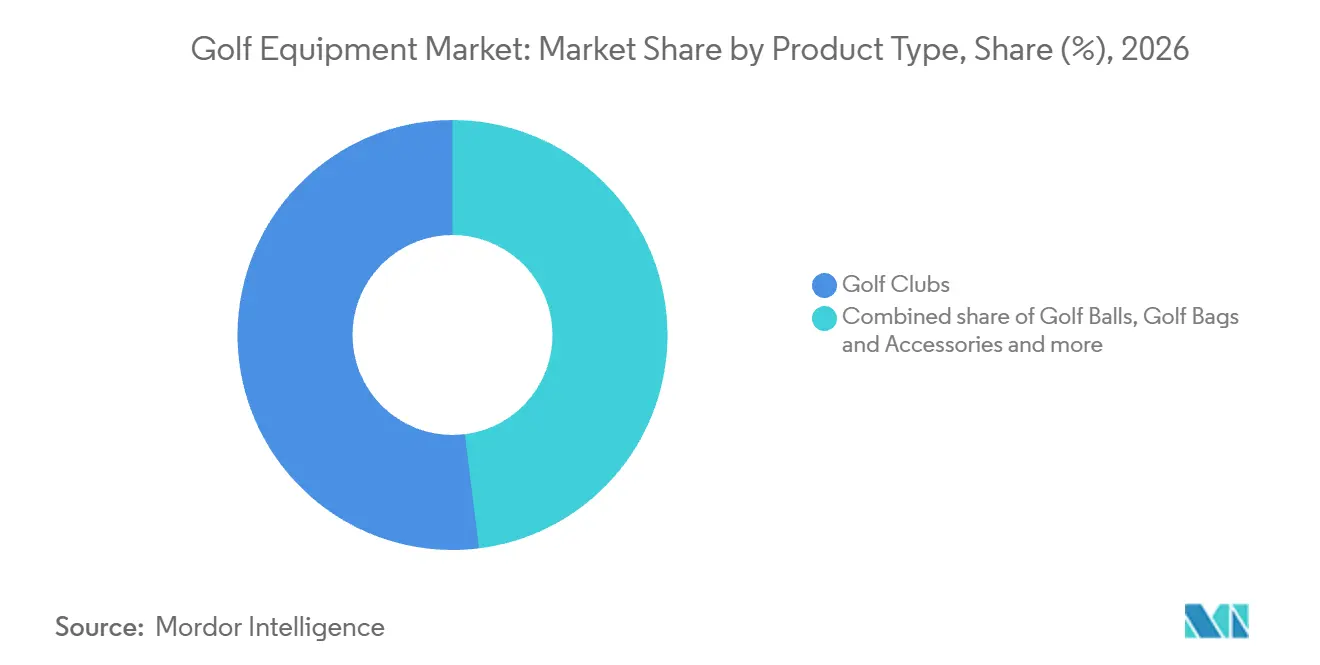
- By product type, golf clubs held a 51.97% golf equipment market share in 2026, while golf balls are forecast to grow fastest at a CAGR of 5.22% over 2027-2032.
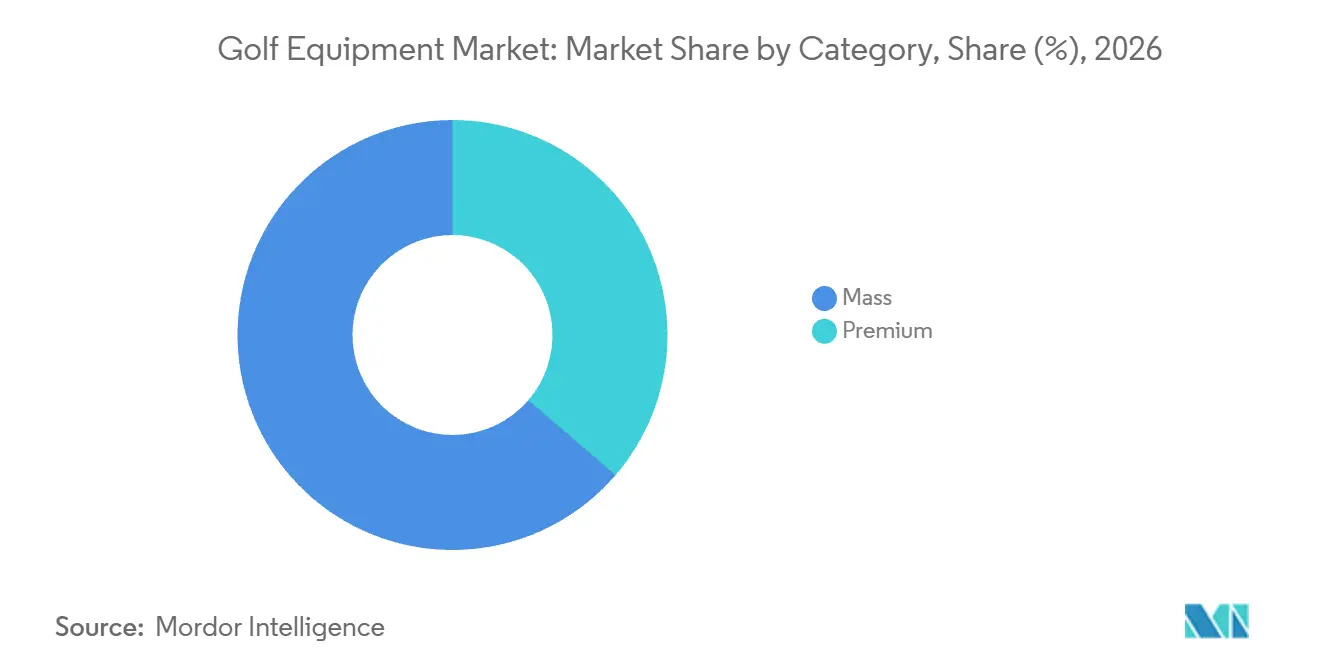
- By category, mass equipment accounted for a 63.7% share of the golf equipment market size in 2026, while premium equipment is forecast to grow fastest at a CAGR of 5.4% over 2027-2032.
- Adult end users accounted for 85.59% of equipment revenue in 2026, while equipment for children is forecast to grow fastest at a CAGR of 5.31% over 2027-2032.
- Offline retail stores led distribution channels with 75.56% of equipment revenue in 2026, while online retail stores are forecast to grow fastest at a CAGR of 5.95% over 2027-2032.
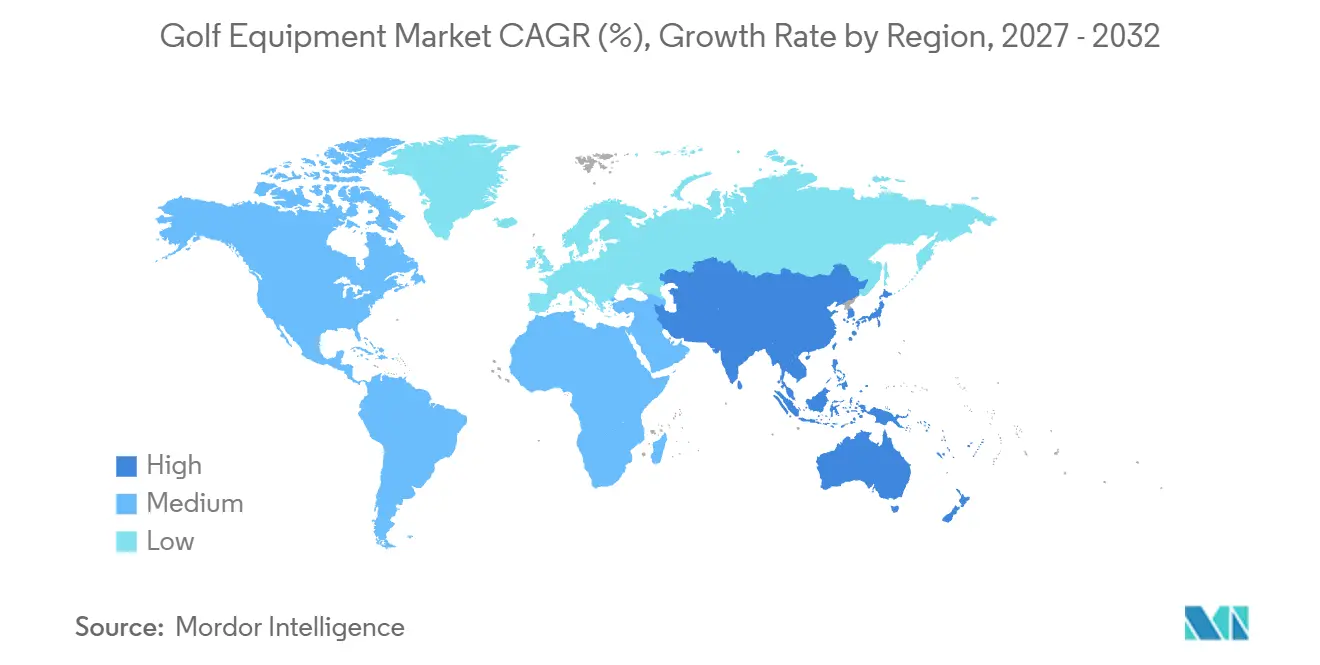
- Geographically, North America held 47.72% of equipment revenue in 2026, while Asia-Pacific is forecast to grow fastest at a CAGR of 5.2% over 2027-2032.
Note: Market numbers in this report are based on Mordor Intelligence's proprietary estimation framework, which combines nine months of actuals with Q4 projections for base year 2026.
Market Trends and Insights
Drivers Impact Analysis of Golf Equipment Market*
| Driver | (~) % Impact on CAGR Forecast | Geographic Relevance | Impact Timeline |
|---|---|---|---|
| Growing participation in golf across emerging markets | +1.5% | China and Brazil | Medium term (2-4 years) |
| Increasing investment in golf course development and expansion | +1.4% | The United States | Long term (≥ 4 years) |
| Rising demand for technologically advanced golf clubs | +1.6% | North America, Europe and Asia-Pacific | Short term (≤ 2 years) |
| Growing popularity of custom-fitted golf equipment | +1.1% | North America, Europe and Asia-Pacific | Medium term (2-4 years) |
| Expansion of indoor golf simulators driving equipment purchases | +0.9% | Japan, United Kingdom and Spain | Short term (≤ 2 years) |
| Increasing number of junior golf development programs | +0.7% | Canada and the United Kingdom | Long term (≥ 4 years) |
| Source: Mordor Intelligence | |||
Growing participation in golf across emerging markets
Emerging-market participation can create equipment opportunities through organized competitive play as well as initial registration. China’s 2025 youth golf report recorded 13,173 newly registered youth golfers. The country also hosted 753 junior golf tournaments in 2025, 60 more than in 2024. By December 31, 2025, 1,200 players in the China Golf Association junior ranking had obtained competition handicap indexes from scores in association ranking events played at handicap-rated courses. Registration, tournament availability and documented competitive play give equipment suppliers different occasions to address the junior audience. Tournament-linked equipment offers can address an identifiable playing occasion, creating a more specific commercial route than an undifferentiated recruitment proposition.
Increasing investment in golf course development and expansion
Course development supports equipment demand by expanding the places where golfers can use clubs and balls. In June 2026, the National Golf Foundation reported nearly 150 United States course projects in active planning or construction, with more than half private. That composition concentrates the opportunity around private-club participation rather than creating equivalent access for every prospective golfer. Escalante Golf broke ground in 2026 on a second Kingsley Club course in Michigan within a USD 40 million, multi-phase expansion. Such construction creates a future playing venue, while its equipment opportunity depends on the transition from development to actual use. Course openings determine when the construction pipeline can support equipment demand, with the commercial contribution arriving in stages as new playing venues enter use.
Rising demand for technologically advanced golf clubs
Club innovation supports replacement demand when a new design gives golfers a reason to reconsider an existing set. Titleist’s T-Series irons were designed for distance, forgiveness, shot control and feel. Acushnet reported higher 2025 sales volumes for T-Series irons launched in the third quarter and GT hybrids launched in the first quarter. Lower volumes of second-model-year drivers, wedges and performance-model golf balls more than offset those increases in its comparison.[1] The gains on newly launched irons and hybrids show a commercial response to new designs within a mixed equipment portfolio. Technological renewal gives club makers a route to replacement demand by refreshing specific playing functions, with new-model volumes demonstrating that opportunity even when mature products weaken.
Growing popularity of custom-fitted golf equipment
Custom fitting creates an equipment sale around a golfer’s individual requirements rather than a standard set configuration. Acushnet reported that a significant portion of its worldwide Titleist iron sales were custom fit. That established sales mix makes fitting capability commercially relevant beyond specialist experimentation or a single promotional launch. In September 2025, Titleist and Pinehurst opened the Titleist Shop at Pinehurst in North Carolina, offering golf-ball and golf-club fitting.[2] Combining fitting with a retail destination gives the supplier a direct opportunity to translate specifications into an equipment purchase. Advice quality gives fitting-led sellers a competitive dimension alongside the branded range, because the recommended specification becomes part of the equipment proposition.
Restraints Impact Analysis of Golf Equipment Market*
| Restraint | (~) % Impact on CAGR Forecast | Geographic Relevance | Impact Timeline |
|---|---|---|---|
| High cost of premium golf clubs and equipment | -1% | The United Kingdom | Short term (≤ 2 years) |
| Limited accessibility to golf courses in many regions | -0.8% | India and Ethiopia | Long term (≥ 4 years) |
| High maintenance and storage requirements for equipment | -0.2% | The Canadian market | Medium term (2-4 years) |
| Economic downturns reducing discretionary spending on golf gear | -0.4% | United States, Europe, Japan and South Korea | Short term (≤ 2 years) |
| Source: Mordor Intelligence | |||
High cost of premium golf clubs and equipment
Upfront equipment costs can delay a prospective golfer’s entry into the sport. In a UK survey conducted from August 28 to September 2, 2026, 55% of aspiring golfers said equipment costs that were too high had personally delayed getting into golf. Censuswide surveyed 2,001 UK adults, including 210 aspiring golfers, with the affordability finding concerning basic equipment. Separately, 57% of respondents who had played golf said they had borrowed equipment rather than buying their own. Borrowing provides equipment access without requiring purchase of that item, creating a different commercial decision from taking up the sport. Entry delays and access to borrowed items separate participation from an immediate purchase, leaving equipment sellers with a conversion hurdle among people interested in playing.
Limited accessibility to golf courses in many regions
An equipment supplier cannot turn interest into regular course use when playing access is difficult. In its 2025 assessment, the Golf Industry Association of India said most Indian golf courses were membership-based and private, making access difficult for beginners. The R&A listed 2 courses of 9 or 18 holes in Ethiopia for a reported population of 132.1 million in 2025. The examples separate membership restrictions from a sparse conventional-course base, with different consequences for prospective golfers. Where beginners cannot readily secure course access, a first set offers less usable playing value, weakening the incentive to commit to an equipment purchase.
*Our forecasts treat driver/restraint impacts as directional, not additive. The impact forecasts reflect baseline growth, mix effects, and variable interactions.
Golf Equipment Market Segment Analysis
By Product Type:
Club Sales Span Multiple Equipment DecisionsGolf clubs accounted for a 51.97% share of the golf equipment market size in 2026, making them the largest segment. In South Korea, TaylorMade ranked first by golf-club brand unit sales across the full club range in 2025, based on NIQ Korea retail-index data covering online and offline channels. Callaway Golf Company reported USD 697.1 million in golf-club net sales for the 6 months ended June 30, 2026, up 6.8% from the comparable 2025 period. That half-year expansion gives established club suppliers an example of additional revenue within the largest equipment category, keeping competition for club spending relevant beyond protecting existing sales.
Golf balls are the fastest-growing segment, with a forecast CAGR of 5.22% over 2027-2032. Acushnet reported Titleist golf-ball revenue growth of 6% in the first half of 2026, led by Pro V1 against challenging prior-year launch volumes. NGF’s 2025 midyear update placed United States golf-ball shipments 59% above recent pre-COVID levels, noting possible contributions from retailer stocking, tariff concerns, newer golfers losing balls and stockpiling. Replenishment execution matters alongside model appeal when ball-use demand and retailer stocking produce different shipment patterns, making channel demand distinct from the appeal of a new model.

By Category:
Mass Access Coexists With Premium Launch ExecutionMass equipment represented a 63.7% golf equipment market share in 2026, making it the largest segment. At GOLFZON Market’s offline stores in South Korea, Srixon 25 Soft Feel accounted for 4.7% of golf-ball dozen sales by unit volume in September 2026. The model ranked fifth in those stores’ September dozen sales, while its official U.S. list price of USD 24.99 identifies its value tier in the United States. Mass suppliers can therefore compete on the cost of each replenishment purchase, extending their affordability proposition to golfers who already own equipment.
Premium is the fastest-growing segment, with a forecast CAGR of 5.4% over 2027-2032. Acushnet reported that Titleist Golf Equipment sales grew 14% in the first half of 2026, including 24% growth in golf-club sales. Management said the GTS launch moved from the third quarter into the seasonal peak of the second quarter, contributing to the period’s results. Acushnet also attributed part of its 2025 Titleist equipment growth to higher average selling prices in golf clubs, demonstrating a revenue contribution from value per club. Higher selling prices give premium club makers a second revenue lever alongside model launches, so the category’s growth case extends beyond moving sales between quarters.
By End User:
Adult Scale and Growing Junior ParticipationAdults were the largest segment, accounting for 85.59% of equipment revenue in 2026. The R&A reported 65 million adults participating in all forms of golf across its affiliated markets outside the United States and Mexico in 2025.[3] Because that audience spans golf formats, manufacturers can address adult participation through different levels of equipment commitment and specialization. Adult marketing focused solely on conventional course play can therefore leave other playing formats outside the proposition, limiting how much of that audience the message addresses.
Equipment for children is the fastest-growing segment, with a forecast CAGR of 5.31% over 2027-2032. Just under 4 million juniors ages 6 to 17 in the United States played golf on a course in 2025, up 58% from 2019. That on-course audience gives suppliers a specific junior customer group for equipment intended for regular course play, alongside the wider task of encouraging participation. For brands, the expanding playing base can justify a junior range in its own right, with commercial relevance during childhood as well as the prospect of serving those golfers later in adulthood.
By Distribution Channel:
Physical Reach Meets Online Buyer CommunitiesOffline retail stores were the largest segment, accounting for 75.56% of equipment revenue in 2026. PGA TOUR Superstore reported in 2026 that its physical store count had grown from 27 to 80 since 2016. A larger specialty-store network creates more local points of contact between equipment brands and golfers, supporting opportunities for discovery and product selection through a physical setting. The strategic value of offline retail lies in that distributed customer interface, which requires brands to support a network of selling locations as well as the equipment offered through it.
Online retail stores are the fastest-growing segment, with a forecast CAGR of 5.95% over 2027-2032. In a March 2025 Censuswide survey commissioned by Whatnot, 43% of 2,000 golf enthusiasts in the United States said they bought golf gear online. The proportion was 59% among Gen Z respondents. Whatnot also reported an 80% increase in golf buyers on its live-shopping platform over the 6 months preceding May 2025. This combination makes acquiring and retaining specific buyer communities a commercial priority for digital equipment sellers, with a distinct opportunity to shape the purchasing experience around younger golfers and specialist online audiences.
Geography Analysis
North America Golf Equipment Market
North America accounted for a 47.72% share of the golf equipment market size in 2026, making it the largest geography. In 2025, 48.1 million Americans age 6 and older played on-course or off-course golf, including 29.1 million on-course golfers and others using traditional or technology-enabled ranges, indoor simulators or golf entertainment venues. Golf courses in the United States also recorded more than 500 million rounds in each year from 2020 through 2025. Another 19 million Americans played only off-course in 2025, extending the potential buyer pool beyond course golfers alongside the active on-course base.
Asia-Pacific Golf Equipment Market
Asia-Pacific is the fastest-growing geography, with a forecast CAGR of 5.2% over 2027-2032. Oceania’s registered and unregistered 9- and 18-hole golfer population reached an estimated 2.69 million in 2025, up 5% from 2024. Asia provided a larger established base of an estimated 20.3 million golfers on the same participation basis in 2025, unchanged from 2024. China’s expansion of junior tournaments that year added competitive playing opportunities within this established regional audience. Expanding course participation in Oceania and junior competition in China create demand opportunities for first sets and age-appropriate clubs alongside replacements for established Asian golfers.
Europe’s established playing base included an estimated 13.97 million registered and unregistered 9- and 18-hole golfers in 2025. France recorded 446,547 license holders that year, giving suppliers an identifiable organized-golf audience within the wider European opportunity. In South America, Brazil had 9,800 registered golfers alongside an estimated 16,000 registered and unregistered 9- and 18-hole players in 2025. Middle East and Africa includes South Africa, where the corresponding 2025 populations were 145,835 and an estimated 489,000, creating a wider gap between affiliation and participation. Reaching South Africa’s wider playing population requires looking beyond registered golfers, because the estimated on-course audience is more than 3 times its affiliated base.
Regulatory Framework and Outlook
This comparison examines selected jurisdictions from the perspective of a golf-ball manufacturer seeking consumer sales and equipment-rule conformance. The Overall Distance Standard (ODS), the European Union’s General Product Safety Regulation (GPSR) and product-tax rules create different design and compliance decisions. South Africa’s suitability and quality exception requires express disclosure of the goods’ specific condition plus express acceptance or knowing conduct consistent with acceptance. Sports-rule conformance does not settle a ball’s consumer-product obligations, since Brazil’s design-sensitive classification and Germany’s premarket safety documentation create separate commercial requirements.
Regulatory Table of Golf Equipment Market
| Decision factor | United States | Germany | China | Brazil | South Africa |
|---|---|---|---|---|---|
| Primary authority | USGA and The R&A for equipment-rule conformance | State-designated market-surveillance authorities, or the responsible sectoral authority where GPSR supplements sectoral law | State Taxation Administration | Inmetro | National Consumer Commission |
| Key instruments or direction | Equipment Rules, Part 4; January 2026 ODS statement | GPSR safety, risk-analysis and technical-documentation duties where more specific EU rules do not cover the risk | Excise-tax framework includes golf equipment and generally domestic production, commissioned processing and imports | Ordinance No. 302/2021 excludes official sports balls meeting official material, construction, dimension and weight standards, except child-oriented playful designs | Consumer Protection Act section 55(2), subject to section 55(6), excluding auction purchases covered by section 45 |
| Commercial effect | Testing establishes ball conformance under the equipment rules | Risk analysis and technical documentation before market placement | Product-tax administration for covered manufacturers, processors and importers | Qualifying official sports balls avoid toy certification and registration, while child-oriented playful designs enter toy requirements | Consumer rights to suitable, good-quality, defect-free and reasonably durable goods meeting applicable public standards, subject to the statutory conditions |
| Current policy attractiveness | High | Medium | Medium | High | Medium |
| Future direction of policy attractiveness | No change | No change | No change | No change | No change |
| Source: Mordor Intelligence | |||||
The June 2026 USGA and The R&A statement left elite-level distance options under review and ODS testing unchanged before January 2030, giving U.S. manufacturers a defined period for using the existing test. The European Commission’s evaluation of the GPSR recall-notice provisions, due by December 13, 2029, does not amend manufacturers’ general safety duties in Germany, while Brazil’s official-sports-ball exclusion reduces toy-certification work only for qualifying designs. China’s golf-equipment category imposes 10% tax on domestic producers, commissioned processors and importers, while its 2026 reform agenda names no golf-specific action or timetable. Defined testing dates in the United States and China’s product-specific tax duty support near-term continuity, alongside South Africa’s established, conditional requirements for suitable, good-quality and reasonably durable goods.
Value Chain Stages
Production, wholesale channel supply and consumer retail capture equipment revenue at different points in bringing clubs and balls to golfers. Callaway Golf Company designs, manufactures and sells both product groups, while Worldwide Golf Shops combines physical and online retail. Callaway’s labor-intensive club assembly and global input coordination illustrate why product availability begins with manufacturing execution, before channel breadth can influence a sale.
Value Chain Analysis Table of Golf Equipment Market
| Primary activity | Key participants | Value capture | Bottleneck | Resilience response |
|---|---|---|---|---|
| Equipment production | Club and ball manufacturers such as Callaway Golf Company and Acushnet Holdings Corp. | Equipment sales | Coordinating labor-intensive club assembly and globally sourced inputs | Qualify alternative sources and balance assembly workloads |
| Wholesale channel supply | Equipment-brand sales operations such as Callaway Golf Company | Wholesale equipment sales | Coordinating coverage across pro shops, retailers and distributors | Align account coverage with each channel’s selling role |
| Consumer retail | Physical and online golf retailers such as Worldwide Golf Shops | Retail equipment sales | Matching product choice to individual playing requirements | Connect personal advice with store and online ordering |
| Source: Mordor Intelligence | ||||
Acushnet adapted sourcing strategies and explored alternatives in 2025 after new United States tariff policies affected key sourcing markets for its manufacturing network. Its response illustrates how a flexible production footprint can protect a supplier’s commercial options when sourcing conditions change. Downstream, retail and wholesale access influence how equipment reaches buyers, so production capability and selling reach capture value through different capabilities within the same product journey.
Competitive Landscape
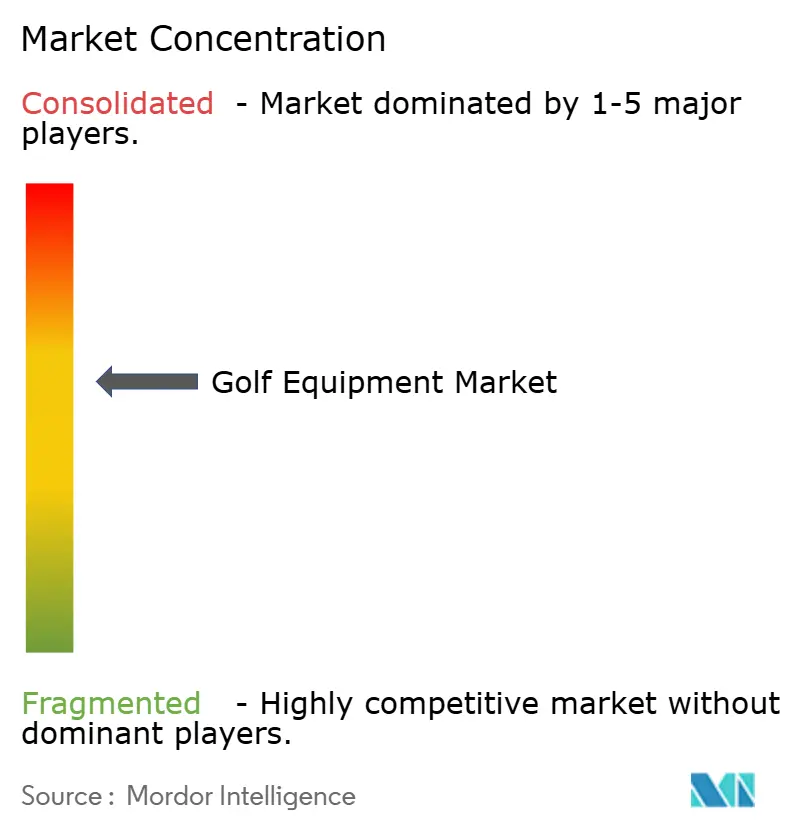
The industry comprises several substantial equipment businesses, including Callaway Golf Company, Acushnet Holdings Corp., Sumitomo Rubber Industries, Ltd., Taylor Made Golf Company, Inc., and Mizuno Corporation. Callaway’s 2025 global Golf Equipment sales were USD 1.38 billion, down 0.5% from 2024, while Sumitomo’s first-half 2026 Sports segment included clubs, balls and other golf goods. As of September 23, 2026, Centroid held TaylorMade’s management-control equity, and negotiations to sell the stake had not reached a definitive agreement. Acquiring TaylorMade would transfer existing club capability, giving a buyer a different entry route from building a product range against established multi-product groups.
On July 14, 2026, Titleist announced its GTS300 mini driver, scheduling worldwide golf-shop availability from July 23, 2026. Callaway’s January 16, 2026, Quantum announcement described Tri-Force construction as a first for driver faces, scheduling U.S. retail from February 13 for drivers, fairway woods and hybrids and February 27 for irons. Acushnet reported consolidated net sales of USD 820 million in the second quarter of 2026, up 13.8% year over year, alongside strong Titleist equipment sales. Mizuno reported increased sales in its core Americas Golf business in the fiscal year ended March 31, 2026. The moves give club buyers 2 distinct comparison points, access to a specialized club format and the construction of the driver face.
Regulatory exposure adds a separate financial dimension to competition alongside the commercial appeal of equipment designs. Acushnet reported an approximately USD 38 million adjusted EBITDA benefit from tariff refunds under the International Emergency Economic Powers Act (IEEPA) in the second quarter of 2026, net of incentive-compensation effects. Fitting technology is a separate point of differentiation. On December 23, 2025, Mizuno introduced SET OPTIMIZER in Japan, describing its single-device driver, iron and wedge measurement as unique worldwide, with a patent application pending. Because driver and wedge fitting is limited to designated shops, access to the complete service becomes a location-specific competitive distinction for buyers.
Golf Equipment Industry Leaders
-
Callaway Golf Company
-
Acushnet Holdings Corp.
-
Sumitomo Rubber Industries, Ltd.
-
Taylor Made Golf Company, Inc.
-
Mizuno Corporation
- *Disclaimer: Major Players sorted in no particular order
Golf Equipment Market Companies Covered in this Report
- Callaway Golf Company
- Acushnet Holdings Corp.
- Taylor Made Golf Company, Inc.
- Sumitomo Rubber Industries, Ltd.
- Mizuno Corporation
- PING, Inc.
- Bridgestone Sports Co., Ltd.
- Parsons Xtreme Golf, LLC
- Cobra Golf Incorporated
- Honma Golf Limited
- YONEX CO., LTD.
- Wilson Sporting Goods Co.
- Tour Edge Golf Manufacturing, Inc.
- FILA Golf Co., Ltd.
- MAJESTY GOLF CO., LTD.
- Fourteen Co., Ltd.
- Epon Golf Co., Ltd.
- Miura Golf Inc.
- Roger Cleveland Golf Company, Inc.
- Bettinardi Golf, LLC
Key Opportunities for Market Participants
This comparison examines fitting-led club upgrades, individualized ball selection and combined equipment retail for golfers seeking specialist advice. Titleist opened its first brand store in Bangkok, Thailand, on September 4, 2026, combining golf-ball and club fitting with product retail. PGA TOUR Superstore’s June 11, 2026, simulator-showroom introduction offered a separate advisory setting for systems selected around performance, space, budget and intended use. Retail formats that combine fitting with product sales put the equipment decision within the service itself, creating a direct commercial setting for club and ball recommendations.
Market Opportunities Table of Golf Equipment Market
| Opportunity | Why now | Buyer / lead segment | Recommended play | Main barrier | Likely beneficiaries |
|---|---|---|---|---|---|
| Entry-level club cross-selling | Showrooms enable comparison of entry-level nets and mats | Residential practice buyers | Offer a limited club set alongside entry-level practice consultations | Combined equipment budget and available space | Club brands and specialty retailers |
| Performance-led club upgrades | Buyers can compare launch-monitor technologies side by side | Golfers considering higher-performance home systems | Pair individualized club consultations with system demonstrations | Demonstrating enough playing value within the buyer’s budget | Club brands and equipment advisers |
| Commercial practice equipment accounts | Showroom options include packages for commercial spaces | Commercial golf practice operators | Develop club and golf-ball supply proposals around the intended practice use | Matching the equipment proposal to space and intended use | Equipment manufacturers and specialist retailers |
| Source: Mordor Intelligence | |||||
Specialist fitting offers the clearest opening by grounding a club or ball recommendation in a golfer’s individual requirements. An equipment seller can use the combined retail-and-fitting setting to connect individual assessment with a defined product choice. Club upgrades, ball selection and a combined consultation address different purchase decisions, making the scope and quality of fitting advice central to earning the equipment sale.
Recent Industry Developments in Golf Equipment Market
- Sep 2026: Titleist opened its first brand store in Thailand, offering golf balls, clubs, bags and accessories for retail sale alongside fitting services.
- Jul 2026: Titleist announced its GTS300 mini driver on July 14 and said worldwide golf-shop availability would begin July 23, 2026.
- Jan 2026: Callaway Golf announced its Quantum drivers, fairway woods, irons and hybrids, scheduling United States retail availability for February 13, 2026, for drivers, woods and hybrids and February 27 for irons.
Golf Equipment Market Report Scope and Research Methodology
Market Definition and Coverage
The Golf equipment market measures annual retail sales value of golf equipment designed for playing and practicing golf in the global market. It covers purchases across all accepted product types, price categories, end users and retail channels.
Scope exclusions: Golf apparel and footwear, golf courses, indoor golf simulators and related facility infrastructure, and separately charged golf instruction, equipment rental, fitting or repair services are excluded.
Segments Covered in This Report
- By Product Type
- Golf Clubs
- Golf Balls
- Golf Bags and Accessories
- By Category
- Mass
- Premium
- By End User
- Adults
- Kids/Children
- By Distribution Channel
- Offline Retail Stores
- Online Retail Stores
- By Geography
- North America
- United States
- Canada
- Mexico
- Rest of North America
- Europe
- United Kingdom
- Germany
- Spain
- France
- Italy
- Sweden
- Ireland
- Austria
- Rest of Europe
- Asia-Pacific
- China
- Japan
- South Korea
- New Zealand
- Australia
- Rest of Asia-Pacific
- South America
- Brazil
- Argentina
- Rest of South America
- Middle East and Africa
- United Arab Emirates
- South Africa
- Rest of Middle East and Africa
- North America
Data Sources, Market Sizing, and Validation
Desk Research
Illustrative public sources such as the National Golf Foundation's industry facts provide participation, rounds and course-supply indicators, The R&A's 2025 Global Golf Participation Report summarizes adult and junior participation across affiliated markets, and the China Golf Association's industry report describes golf participation and playing-round trends in China. The R&A's Equipment Rules explain product-conformance requirements that can affect equipment design and launches.
Company filings, investor materials and reputable press reports can cross-check product scope, channel mix, prices, launch timing and company-specific sales statements. The named sources are not exhaustive and further sources inform collection, validation and clarification.
Primary Interviews and Surveys
Interviews and structured surveys with golf-equipment manufacturers, retail and e-commerce buyers, product leaders and golf-industry analysts can test secondary evidence on retail pricing, replacement behavior, product mix and channel movement. Respondents can check the assumptions behind forecast variables, identify gaps in public data and help reconcile conflicting evidence, with estimates triangulated against filings, association indicators and retail signals before changes are accepted.
Distribution of primary research fieldwork respondents
| Company type | Respondent position | Region |
|---|---|---|
| Top tier: 30% | CXOs: 20% | APAC: 38% |
| Mid tier: 50% | Functional/Unit leaders: 35% | EMEA: 27% |
| Smaller Players: 20% | Managers: 45% | Americas: 35% |
Market-Sizing & Forecasting
The model estimates global annual consumer retail revenue from golf clubs, balls, bags and accessories, then allocates that total across product, mass and premium category, adult and child buyers, offline and online channels, and regions. A top-down estimate starts with the accepted global retail-sales boundary and reconciles category shares to the total, while selective bottom-up checks compare supplier or channel roll-ups and sampled retail price times unit volume, with any gaps investigated before use. Participation, rounds played, course supply, retail-channel trends and equipment prices or replacement cycles inform the relevant segment shares and forecast paths. Multivariate regression can relate market value to these indicators where comparable annual observations exist. Scenario analysis handles sparse or conflicting series, and primary specialists can test whether variable-level forecasts reflect product launches, fitting demand, online sales and regional playing patterns. Analysts document unresolved input gaps, use the strongest comparable public indicator, and carry uncertainty into scenarios rather than fill missing observations with unsupported values.
Data Validation & Update Cycle
Analysts triangulate retail and company evidence with independent participation, rounds and course-supply signals, then investigate outliers, inconsistent units and material variances against earlier periods and adjacent segments. A second review checks source dates, scope, calculations and segment totals, with analyst re-contact triggered when an input conflicts with source definitions or a material gap cannot be reconciled. The model is refreshed annually, revisited between cycles after material market events, and checked in a fresh pre-delivery pass.
Mordor Intelligence's Golf Equipment Market Sizing Compared With Other Published Estimates
Published estimates can differ in the transactions and products they count and the inputs used to model demand. The Golf equipment market measures annual retail sales value of golf equipment designed for playing and practicing golf in the global market.
Key Gap Drivers include the study's defined coverage and market-specific modeling choices. Scenario analysis handles sparse or conflicting series, and primary specialists can test whether variable-level forecasts reflect product launches, fitting demand, online sales and regional playing patterns.
Benchmark comparison
| Source | Market Size | Gaps in Research Methodology |
|---|---|---|
| Mordor Intelligence | USD 16.66 B (2027) | |
| Global Consultancy A | USD 20.17 B (2026) | At its 2026 base, this estimate is 21.1% above this report's 2027 value of USD 16.66 B, 1 year later. The estimate includes apparel and footwear in addition to golf equipment, adding products outside this report's market boundary. |
| Global Market Research Firm B | USD 9.6 B (2025) | At its 2025 base, this estimate is 42.4% below this report's 2027 value of USD 16.66 B, 2 years later. The estimate values equipment units at an average manufacturer price, rather than consumer retail selling prices. |
Mordor Intelligence's analysts triangulate retail and company evidence with independent participation, rounds and course-supply signals, then investigate outliers, inconsistent units and material variances against earlier periods and adjacent segments.
Key Questions Answered in the Report
What is the golf equipment market size and growth outlook?
The market is expected to reach USD 16.66 billion in 2027 and USD 21.12 billion by 2032, with a CAGR of 4.86% over 2027-2032.
What is driving demand for golf clubs and balls?
Organized junior play in China, course development and custom fitting support equipment demand.
Which golf product type accounts for the largest equipment revenue share?
Golf clubs accounted for 51.97% of equipment revenue in 2026.
Which companies are major golf equipment suppliers?
Major participants include Callaway Golf Company, Acushnet Holdings Corp., Sumitomo Rubber Industries, Ltd., Taylor Made Golf Company, Inc., and Mizuno Corporation.
What could limit new golfers’ equipment purchases?
In a 2026 Censuswide survey of UK adults, 55% of the 210 aspiring golfers reported delaying entry into golf because equipment costs were too high.
Which region leads golf equipment revenue and which grows fastest?
North America held 47.72% of equipment revenue in 2026, while Asia-Pacific is forecast to grow fastest at a CAGR of 5.2% over 2027-2032.