
Poppy Seeds Market Size and Share
Poppy Seeds Market Analysis by Mordor Intelligence
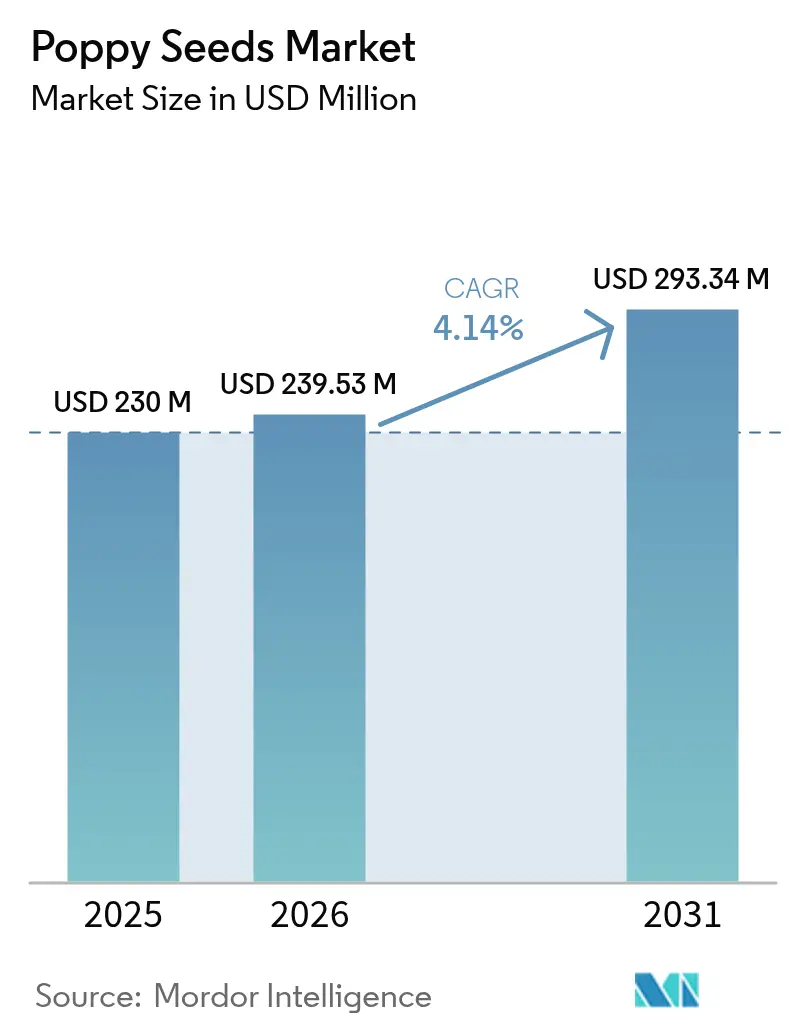
The Poppy Seeds Market size was valued at USD 230 million in 2025 and estimated to grow from USD 239.53 million in 2026 to reach USD 293.34 million by 2031, at a CAGR of 4.14% during the forecast period (2026-2031). Momentum comes from gluten-free, vegan, and functional food launches that elevate protein and calcium content while satisfying clean-label expectations. Tightening oversight of opiate alkaloids, highlighted by the United States Food and Drug Administration’s 2025 Request for Information, spurs extra testing and documentation, pushing suppliers toward upgraded cleaning lines and blockchain traceability that justify premium prices. Turkey keeps its top-producer status, India leads consumption growth, and the Czech Republic captures premium blue-seed exports, but all growers face climate-linked yield swings and shifting narcotics rules that dictate market access. Fragmented supply, with small regional processors specializing in low-morphine cultivars, enables agile players to win shelf space as global buyers demand documented compliance.
Key Report Takeaways
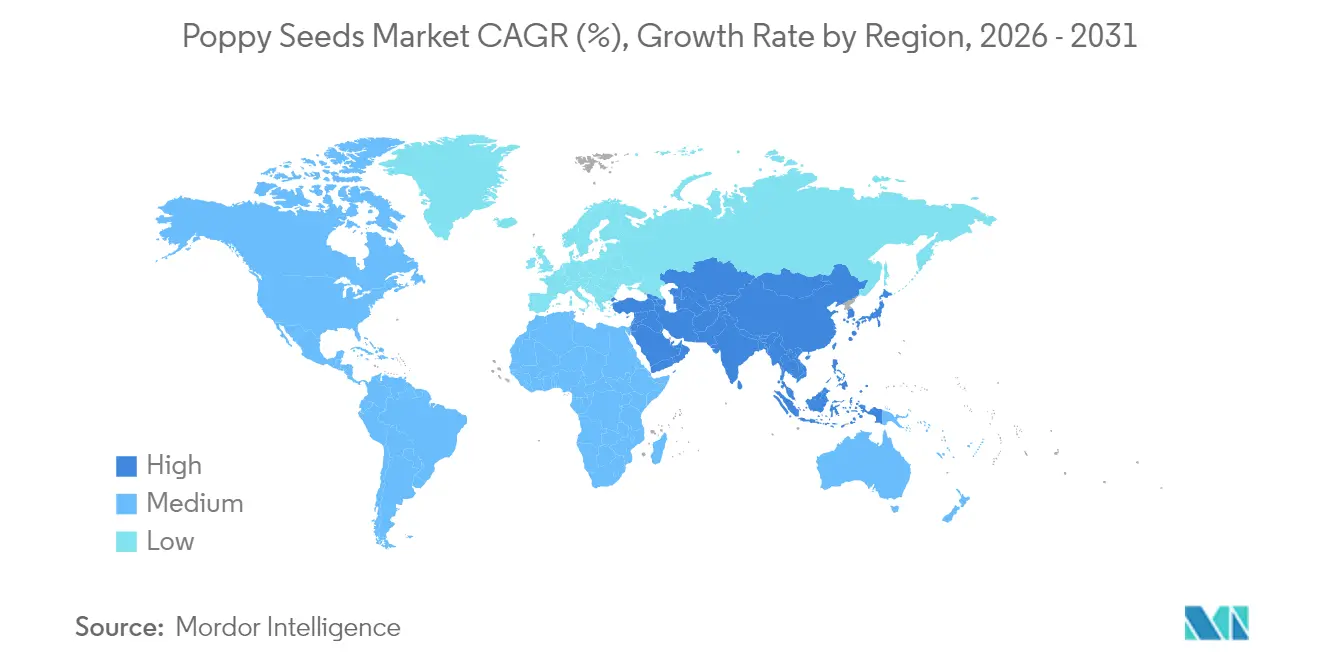
- By geography, Europe led with 51.73% of global poppy seed consumption share in 2025, underscoring the region’s dominance in both traditional bakery demand and premium blue-seed exports, and Asia-Pacific is the fastest-growing geography at 4.94% CAGR between 2026-2031.
Note: Market size and forecast figures in this report are generated using Mordor Intelligence’s proprietary estimation framework, updated with the latest available data and insights as of 2026.
Market Trends and Insights
Drivers Impact Analysis of Poppy Seeds Market*
| Driver | (~) % Impact on CAGR Forecast | Geographic Relevance | Impact Timeline |
|---|---|---|---|
| Growth in functional bakery launches | +0.8% | Global, strongest in North America and Europe | Medium term (2-4 years) |
| Rising vegan and plant-based protein adoption | +0.7% | Global, led by Asia-Pacific cities | Long term (≥4 years) |
| Natural oil demand in cosmetics | +0.5% | Europe and North America are premium markets | Medium term (2-4 years) |
| Expansion of gluten-free flour blends | +0.4% | North America and Europe specialty channels | Short term (≤2 years) |
| Cultivar improvements boosting farm yields | +0.3% | Asia-Pacific and Europe production zones | Long term (≥4 years) |
| Blockchain-enabled traceability premiums | +0.2% | Global export lanes, EU compliance focus | Medium term (2-4 years) |
| Source: Mordor Intelligence | |||
Growth in Functional Bakery Launches
Clean-label bakers fold poppy seeds into breads and pastries to raise protein to 18% and calcium to 1,438 mg/100 g, meeting consumer calls for natural fortification. European artisans promote heritage blue-seed loaves, while U.S. brands rely on the seeds for structure in gluten-free batters. Cold grinding and modified-atmosphere packs limit lipid oxidation, letting manufacturers support higher retail prices that offset raw-material costs.
Rising Vegan and Plant-Based Protein Adoption
Recipe developers turn to poppy seeds’ 20.9% protein and complete amino acid lineup to diversify beyond soy and pea inputs. Urban Asia-Pacific markets, especially India, fold the seeds into energy bars, plant milks, and regional dishes tailored to modern tastes[1]Source: Ministry of Agriculture and Farmers Welfare, “Indian Agriculture Statistics Portal,” indiagri.gov.in. Sports nutrition researchers list poppy seeds among 52 botanical protein sources suited to athletic performance foods, widening the addressable market. Commercial interest now extends to isolates that lift bite and nutrition in meat analogs.
Natural Oil Demand in Cosmetics
The cold-pressed poppy seed oil contains 76.3% linoleic acid plus tocopherols that appeal to clean-beauty shoppers seeking lightweight, fast-absorbing moisturizers. European brands spotlight sustainable sourcing stories and antioxidant verification, replacing synthetic emollients in anti-aging serums. Research confirming oxidative stress mitigation strengthens claims, yet suppliers must deploy nitrogen flushing and amber glass to avoid rancidity that undermines premium positioning.
Expansion of Gluten-Free Flour Blends
Specialty millers grind defatted poppy seed flour for gluten-free mixes, where it improves crumb structure and flavor complexity without excess starch. North American and European consumers, willing to pay for quality, respond to the seed’s binding capacity and nutty taste. Moisture retention extends shelf life, easing retailer spoilage losses and supporting higher unit prices. Consistency demands precision milling to keep particle size tight and curb oil bleed during storage.
Restraints Impact Analysis of Poppy Seeds Market*
| Restraint | (~) % Impact on CAGR Forecast | Geographic Relevance | Impact Timeline |
|---|---|---|---|
| Volatile farm-gate prices | -0.6% | Global; most acute in emerging regions | Short term (≤2 years) |
| Stringent narcotics-related regulations | -0.9% | Global; toughest in North America and Europe | Medium term (2-4 years) |
| Climate-change-driven yield variability | -0.5% | Mediterranean and Central Asia | Long term (≥4 years) |
| Limited mechanization in key producing countries | -0.4% | Asia-Pacific and Middle East farms | Long term (≥4 years) |
| Source: Mordor Intelligence | |||
Volatile Farm-Gate Prices
Weather shocks and shifting opiate policies can swing Turkish grower prices by 35-40% within a single season, deterring new plantings and complicating processor procurement plans. Forward contracts reduce some risk but often transfer downside exposure to smallholders lacking storage. The crop’s annual cycle hampers quick supply responses, creating boom-bust patterns that undermine long-term acreage commitments.
Stringent Narcotics-Related Regulations
The FDA’s 2025 request for data on alkaloid controls follows detections of morphine at 520 mg/kg in commercial seeds, far above EU benchmarks[2]Source: European Parliament Research Service, “Opiate alkaloids in food,” europarl.europa.eu . Every export lot now needs USD 500-1,500 for laboratory testing, squeezing smaller firms. Divergent national limits force multinationals either to segregate supply by market or conform to the strictest global rule, inflating logistics complexity. Retailers increasingly adopt zero-tolerance policies, demanding documentation below detection thresholds rather than regulatory maximums.
*Our forecasts treat driver/restraint impacts as directional, not additive. The impact forecasts reflect baseline growth, mix effects, and variable interactions.
Geography Analysis
Europe Poppy Seeds Market
Europe retains the largest regional stake, accounting for 51.73% of global consumption in 2025, driven by Germany’s 16.22% share, Russia’s 12.65%, and a combined 22.86% from Poland, France, and the Czech Republic. The region’s 2.56% CAGR through 2031 reflects maturity, yet premium segments grow as clean-label bakeries and organic retailers require low-morphine documentation. EU farm subsidies support on-farm drying, optical sorting, and blockchain pilots that solidify Europe’s quality edge. Eastern producers such as Hungary and Poland expand acreage to serve Western bakeries, while geopolitical risks and droughts keep supply tight and prices firm.
APAC Poppy Seeds Market
Asia-Pacific is the fastest-growing geography at 4.94% CAGR, anchored by India’s urbanization wave and mounting consumer interest in plant proteins. The poppy seed market benefits as packaged-food makers infuse traditional flavors into contemporary snacks, boosting average unit prices. China, though historically niche, accelerates consumption via fortified cereal drinks that tout calcium density to aging populations. Australia’s export ambitions complement regional demand by assuring year-round supply through counter-seasonal harvests.
The Americas and MEA Poppy Seeds Market
North America grows at 3.74% CAGR despite regulatory headwinds. U.S. importers navigate the FDA’s investigation by tightening supplier vetting and adding alkaloid tests, which raise landed costs yet also reinforce premium positioning that justifies higher shelf prices. The Middle East posts 3.95% CAGR, aided by Turkey’s proximity and culinary heritage linking poppy seeds to traditional desserts. South America and Africa remain small but record 4.02% annual growth on rising disposable incomes and exposure to global cuisines.


Regulatory Landscape
Regulation for food-grade poppy seeds centers on limiting opiate alkaloids (morphine and codeine) and demonstrating compliant handling from farm to pack. In the United States, the FDA raised the topic through its January 2025 Request for Information on industry practices related to opiate alkaloids and listed the development of an action level for opiate alkaloids on poppy seeds in its 2025 Human Foods Program Guidance Agenda. That framing pushed importers and processors toward tighter supplier qualification and residue documentation.
In the European Union, maximum levels for opiate alkaloids in poppy seeds and relevant foods set the primary market-access bar, reinforced by EU good-practice guidance focused on contamination reduction from poppy straw and capsule dust during harvest and processing. Beyond food safety limits, dual-use crop controls influence trade flows: India regulates poppy seed imports through contract registration and verification tied to the Turkish Grain Board (TMO) portal via the Central Bureau of Narcotics. UN frameworks, including ECOSOC Resolution 1999/32, also call on member states to prevent food poppy seeds from being derived from illicit cultivation.
Value Chain Analysis
The value chain begins with licensed cultivation in key producing origins, notably Central and Eastern Europe and Turkey, followed by harvest and primary aggregation. Processing is the main value-add stage and includes multi-step cleaning (sieving, aspiration, gravity separation, and optical sorting), optional washing or heat treatment to reduce alkaloid-bearing dust, and lot-level laboratory testing for morphine and codeine before export or domestic sale.
Compliance tasks increasingly move into routine operations, since buyers in regulated markets require auditable documentation aligned with EU guidance and national food-safety expectations. Downstream, bulk traders and importers supply industrial bakeries, snack and ingredient manufacturers, and retail packers, with segmentation that distinguishes commodity-grade lots from premium low-alkaloid lots that meet stricter customer specifications. Bottlenecks concentrate on testing capacity, segregation by destination, and the capital needed for upgraded cleaning and stabilization lines, which raises barriers for smaller regional processors while creating service opportunities for specialist laboratories and traceability providers.
Market Opportunities and Future Outlook
Opportunities center on compliance-led differentiation and process upgrades rather than pure volume expansion, since edible seed availability is structurally tied to tightly licensed opium poppy systems in several origins. The FDA signaling in 2025 around establishing action levels for opiate alkaloids increases the value of validated mitigation steps, including improved harvesting practices, dust removal, washing or thermal steps, and consistent alkaloid testing. This creates room for suppliers that can deliver repeatable low-alkaloid lots with full documentation.
Mechanization and agronomy improvements address a supply constraint, particularly in small-plot production where labor intensity and capsule losses limit efficiency. For example, academic work published in February 2026 on a prototype Papaver somniferum harvesting machine highlights ongoing efforts to reduce losses and labor dependence. Trade dynamics also point to price pull for compliant supply, with elevated Indian prices during the 2025-26 rabi season (reported in April 2026) underscoring how rigid licensing and constrained imports translate into premiums for reliable, documented lots and for exporters that can contract and deliver against tight specifications.
Recent Industry Developments in Poppy Seeds Market
- July 2026: The US Food and Drug Administration confirmed plans to publish a draft guidance establishing action levels for opiate alkaloids on poppy seeds. The move elevates compliance requirements across import and processing steps, increasing the importance of validated cleaning, segregation, and testing programs to maintain access to the US market.
- May 2025: The FDA extended the public comment deadline for its poppy seed Request for Information to June 16, 2025, and issued a Federal Register correction clarifying docket details. The extension gave growers, processors, and importers more time to submit data that can influence how future US action levels and best practices are defined.
- November 2024: UNODC reported Afghan opium cultivation rose 19% to 12,800 hectares in the second season after the Taliban ban, although output remained far below 2022 levels. The update underscored ongoing uncertainty around illicit-origin dynamics in adjacent regions, reinforcing why regulated, documented sourcing remains central for food-grade poppy seed supply chains.


Poppy Seeds Market Report Scope and Research Methodology
Market Definition and Coverage
The market is defined as the global trade and sale of poppy seeds intended for consumption and ingredient use, counted in value terms at the point they enter commercial channels through processors, packers, and importers.
Scope exclusions: Pharmaceutical opiate alkaloid extraction, ornamental seed lots, and processed derivatives like poppy oil or defatted flour are not counted.
Segments Covered in This Report
- By Geography (Production Analysis (Volume), Consumption Analysis (Volume and Value), Import Analysis (Volume and Value), Export Analysis (Volume and Value), and Price Trend Analysis)
- North America
- United States
- Canada
- Europe
- Czech Republic
- Spain
- Hungary
- France
- Russia
- Asia-Pacific
- Australia
- India
- China
- South America
- Argentina
- Middle East
- Turkey
- Palestine
- Africa
- Egypt
- South Africa
- North America
Data Sources, Market Sizing, and Validation
Desk Research
Desk work starts with mapping where supply originates, how it moves across borders, and what typical pricing looks like through the year. We reference public agriculture and trade sources such as FAOSTAT, UN Comtrade, ITC Trade Map, national agriculture ministries and statistical offices, and customs tariff schedules that define HS codes used for seed trade.
Once the backbone is set, the data is cross-checked using company annual reports, investor presentations, product specification sheets, association websites, and reputed news coverage that flags crop issues or compliance changes. Where helpful, paid subscriptions for company financials and for shipment-level import and export records are used as sanity checks on importer activity and pricing direction. The sources listed above are illustrative rather than exhaustive, and many other public references were also used for data collection, validation, and clarification.
Primary Interviews and Surveys
Primary inputs were collected through expert interviews and structured surveys with growers, processors, bulk traders, ingredient buyers, and food manufacturers, which helped confirm traded volumes, grade splits, and typical contract terms. Because this is a global market, discussions were spread across key producing and importing regions so assumptions on seasonality, pricing spreads, and compliance costs could be checked and adjusted.
Distribution of primary research fieldwork respondents
| Company type | Respondent position | Region |
|---|---|---|
| Top tier: 33% | CXOs: 14% | APAC: 43% |
| Mid tier: 53% | Functional/Unit leaders: 27% | EMEA: 36% |
| Smaller Players: 14% | Managers: 59% | Americas: 21% |
Market-Sizing & Forecasting
Sizing is built using a top-down logic where production and trade data reconstruct the addressable seed flow, and then average pricing is applied to convert volumes into market value. The model is anchored on practical inputs such as export and import volumes by major trading corridors, farm and wholesale price trends, cleaning and grading yield losses, the share of seed entering food ingredient channels, and the seasonality pattern around harvest months.
To keep results grounded, totals are corroborated with selective bottom-up approximations such as sampled importer and processor revenue signals, channel checks on bulk pack sizes and typical price points, and a few volume times ASP checks for high-traffic import markets. When company-level information is missing, gaps are handled by using peer benchmarks from similar operators and by applying conservative ranges that are then narrowed during interviews.
For forecasting, scenario analysis is used so demand and pricing can move differently under realistic conditions, including crop swings, compliance tightening on alkaloid limits, and changes in bakery and processed food consumption. The final path is chosen after primary respondents review the direction of these drivers and confirm which ones are most likely to matter over the next few years.
Data Validation & Update Cycle
Validation is done through multiple checks, not just one comparison. We test model outputs against independent signals such as reported trade totals, observed price bands in key ports, and whether implied consumption looks reasonable versus population and food manufacturing activity.
If an outlier appears, it is traced back to the assumption that caused it, and the related inputs are rechecked before sign-off. Another analyst review step is completed so calculation logic, unit conversions, and currency handling are consistent. Reports are refreshed annually, and interim updates are triggered when material events occur, such as a major crop shortfall, a trade restriction, or a notable regulatory shift, followed by a final pre-delivery update pass.
Mordor Intelligence's Global Poppy Seed Market Size Compared Against Other Published Estimates
Published market numbers for poppy seed often do not match because each study draws the line differently on what counts as the market, which year is treated as the starting point, and how prices are converted across regions. Differences also come from how analysts handle trade re-exports, quality grades, and whether value is counted at farm gate, wholesale, or after cleaning and grading.
In this study, the main gap drivers are whether processed derivatives like oil and powder are added into the total, and whether pricing is built from retail packs versus bulk trade values that better align with cross-border flows. Some estimates also apply faster price escalation without tying it back to observed import price trends and seasonal supply swings, which is why the spread is visible when compared year by year.
Benchmark comparison
| Source | Market Size | Gaps in Research Methodology |
|---|---|---|
| Mordor Intelligence | USD 239.53 M (2026) | |
| Industry Data Provider A | USD 230.76 M (2025) | Uses a different base year and a longer forecast window, and it also groups multiple forms (including oil and powder) under one umbrella, which can shift the value away from seed-only trade pricing. |
| Market Publisher B | USD 390.63 M (2025) | A wider product scope is implied because powders and other forms are counted alongside seeds, and the value appears closer to packaged product pricing than bulk import and processor-level valuation. |
The table shows that scope and pricing level are the two biggest reasons totals move apart, especially when derivatives and packaged formats get folded into the same number. When the count is kept to food-grade seeds moving through bulk channels and trade-linked price points are used, the market value stays closer to observable flows, which is how the scope is treated by Mordor Intelligence.


Key Questions Answered in the Report
What is the forecasted value of the poopy seeds market by 2031?
The Poppy Seeds Market size is projected to reach USD 293.34 million by 2031 and grow at a CAGR of 4.14%.
What is the current poppy seeds market size?
The Poppy Seeds Market size stands at USD 239.53 million in 2026.
Which is the fastest growing region in the poppy seeds market?
Asia-Pacific is anticipated to grow at 4.94% CAGR over the forecast period (2026-2031).
Which region has the biggest share in the poppy seeds market?
In 2025, the Europe led with 51.73% of poppy seeds share in the market.
Page last updated on:


 Your data is secure and never sold or shared.


