
Canary Seeds Market Size and Share
Canary Seeds Market Analysis by Mordor Intelligence
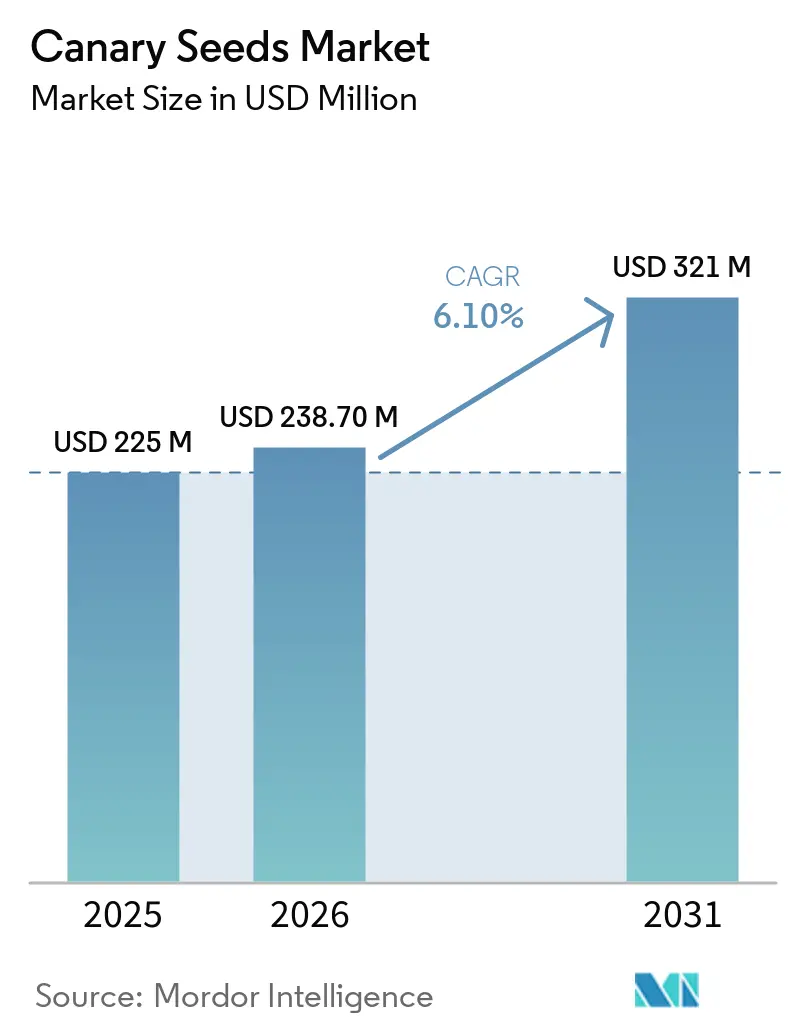
The canary seeds market size is projected to grow from USD 225 million in 2025 to USD 238.7 million in 2026, and USD 321.0 million by 2031, with at a CAGR of 6.1% during the period from 2026 to 2031. The market is expanding as demand grows beyond traditional bird feed into human food applications, driven by rising interest in gluten-free and functional ingredients. Regulatory approvals have been instrumental in establishing canary seeds as a viable food-grade crop, promoting broader adoption within the food processing industry. Market dynamics are heavily influenced by supply concentration in key producing regions, where climatic conditions and logistical factors affect pricing and availability. Additionally, the emergence of new producing countries is gradually diversifying the supply base and enhancing global trade opportunities. Advances in processing technologies, such as improved sorting and oil extraction methods, are enabling value addition through nutraceutical oils and specialty flours, supporting product differentiation.
Key Report Takeaways
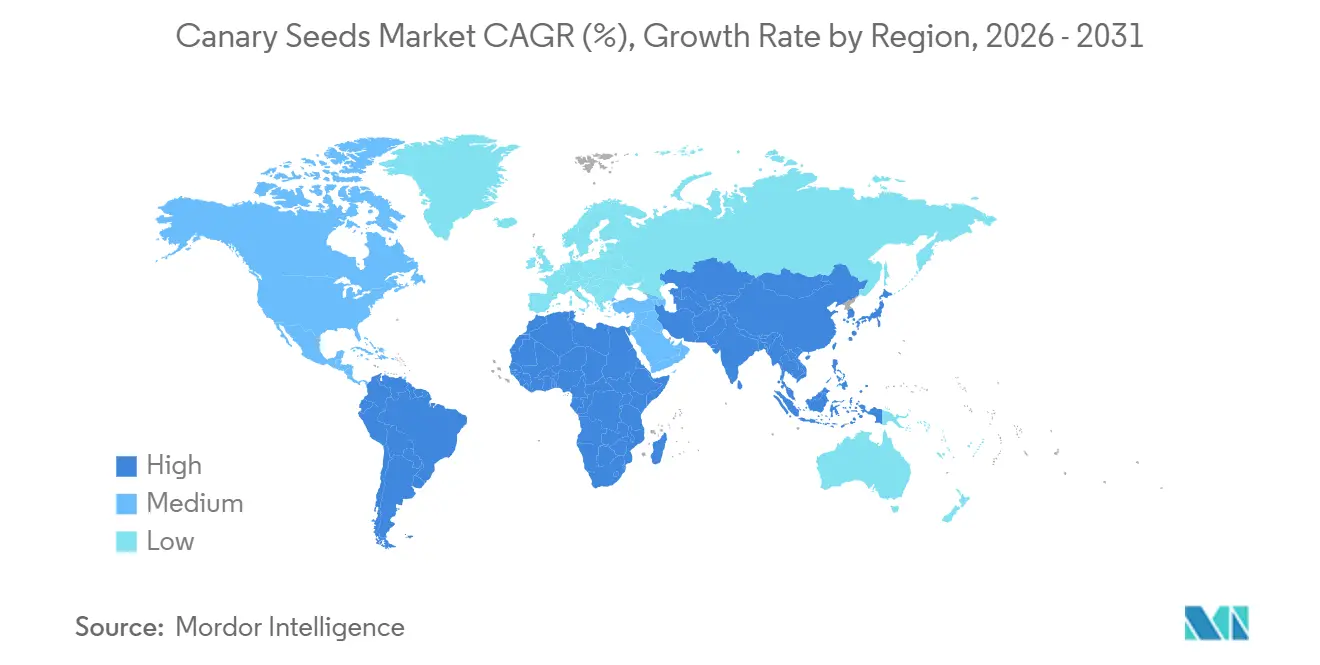
- By geography, North America led with the largest 55% of the canary seeds market share in 2025, while the Asia-Pacific market size is forecast to expand at the fastest 9.7% CAGR from 2026 to 2031.
Note: Market size and forecast figures in this report are generated using Mordor Intelligence’s proprietary estimation framework, updated with the latest available data and insights as of January 2026.
Market Trends and Insights
Drivers Impact Analysis of Canary Seeds Market*
| Driver | (~) % Impact on CAGR Forecast | Geographic Relevance | Impact Timeline |
|---|---|---|---|
| Canada dominance in global exportable supply | +1.2% | Global, core in North America | Long term (≥ 4 years) |
| Rising demand for premium bird feed blends | +0.9% | North America, Europe, and Asia-Pacific | Medium term (2-4 years) |
| Approval of glabrous canary seed for human consumption | +1.5% | North America, South America, and Europe | Medium term (2-4 years) |
| Growth in plant-based protein and gluten-free bakery | +1.1% | North America, Europe, and Asia-Pacific | Long term (≥ 4 years) |
| Adoption of precision grading and color sorting technologies | +0.7% | Canada and Belgium | Short term (≤ 2 years) |
| Corporate sustainability goals favoring low-input specialty grains | +0.6% | Global, early in North America and Europe | Long term (≥ 4 years) |
| Source: Mordor Intelligence | |||
Canada Dominance in Global Exportable Supply
Canada continues to be a major global supplier of exportable canary seed, largely due to its concentrated production in Saskatchewan. This regional focus makes global supply highly dependent on local planting conditions and weather, which significantly impact international pricing and procurement strategies. Recent improvements in production and higher harvest outputs have further solidified Canada’s position in the global canary seed trade. According to Statistics Canada, canary seed production rose from 185,253 metric tons in 2024 to 234,949 metric tons in 2025[1]. This increase in production is enhancing export availability and reinforcing Canada’s role as the leading supplier in the global canary seed market.
Rising Demand for Premium Bird Feed Blends
The demand for premium bird feed blends is growing as urban consumers increasingly prioritize nutritionally balanced and high-quality formulations. Canary seed is a key ingredient in these blends due to its palatability and nutritional benefits. This trend is driving the growth of value-added product segments and encouraging exporters to uphold consistent quality standards. According to Trade Map Data, Mexico remains a significant importer, with imports projected to reach 50,092 metric tons in 2025, indicating strong consumption of bird feed products[2].
Approval of Glabrous Canary Seed for Human Consumption
The growing demand for gluten-free and plant-based ingredients is driving the increased use of glabrous canary seed in human food applications, particularly in North America. Unlike traditional canary seed varieties, glabrous types lack the sharp silica fibers that previously limited their use in food, making them suitable for products such as flour, cereals, baked goods, snacks, and pasta. In recent years, food manufacturers and ingredient developers have increasingly utilized canary seed for its protein content and nutritional properties in health-focused formulations. This expanding commercial adoption is broadening canary seed applications beyond traditional bird feed markets and establishing it as a niche functional grain ingredient in the food industry.
Growth in Plant-Based Protein and Gluten-Free Bakery
The increasing demand for gluten-free bakery products and plant-based protein ingredients is driving the adoption of canary seed flour in functional food applications. This is attributed to its high protein content and allergen-friendly properties. According to a 2025 study by researchers from the University of Alberta and the University of Manitoba, hydrothermally treated hairless canary seed flour contains approximately 20.0% protein and demonstrates improved dough-forming and functional properties for bakery applications. The study also demonstrated its enhanced dough-forming and functional properties for bakery applications. Additionally, the research emphasized the flour's effectiveness as a gluten-free alternative, offering improved protein digestibility and processing characteristics, which supports its expanding use in plant-based and specialty food product formulations.
Restraints Impact Analysis of Canary Seeds Market*
| Restraint | (~) % Impact on CAGR Forecast | Geographic Relevance | Impact Timeline |
|---|---|---|---|
| High production concentration in drought-prone Saskatchewan | -0.8% | Global, acute in North America | Medium term (2-4 years) |
| Limited dehulling capacity for food-grade applications | -0.6% | Canada and Argentina | Short term (≤ 2 years) |
| Allergen cross-reactivity labeling limiting retail adoption | -0.5% | North America and Europe | Medium term (2-4 years) |
| Volatile freight rates for bulk specialty grains | -0.4% | Global, strong in Asia-Pacific and Middle East | Short term (≤ 2 years) |
| Source: Mordor Intelligence | |||
High Production Concentration in Drought-Prone Saskatchewan
Canary seed production is predominantly concentrated in Saskatchewan, which heightens the market's vulnerability to climatic risks and weather-related supply disruptions. Variability in moisture conditions across the Canadian Prairies continues to impact planting decisions and production stability. According to Statistics Canada, the seeded area for canary seed in Canada decreased from 319,400 acres in 2025 to 300,800 acres in 2026, indicating fluctuations in cultivation within the country’s primary growing region[3]. This reliance on a concentrated production base can limit export availability during adverse weather events, increase price volatility, and create procurement challenges for importing countries, thereby affecting the stability of the global canary seed market.
Limited Dehulling Capacity for Food-Grade Applications
The lack of adequate processing infrastructure continues to hinder the expansion of food-grade canary seed applications. Efficient dehulling requires specialized equipment and technical processes, as canary seed for human consumption must undergo abrasive dehulling and aspiration to separate the seed coat from the groat prior to further processing. This complexity limits the number of processors capable of producing food-grade products. Consequently, the insufficient processing infrastructure restricts supply growth and slows the adoption of canary seed in human food applications, despite increasing demand.
*Our forecasts treat driver/restraint impacts as directional, not additive. The impact forecasts reflect baseline growth, mix effects, and variable interactions.
Geography Analysis
North America Canary Seeds Market
North America led with the largest 55% of the canary seeds market share in 2025, driven by Canada’s dominant production base and well-established export infrastructure. Saskatchewan remains the primary growing region, with supply decisions significantly influencing global availability and pricing trends. The United States complements this position through re-export activities and strong demand from premium bird-feed channels. Regulatory measures, such as Directive D-14-01, have tightened weed-seed tolerance levels for export shipments, increasing compliance costs while enhancing product quality standards.
APAC Canary Seeds Market
The Asia-Pacific market size is forecast to expand at the fastest 9.7% CAGR from 2026 to 2031, driven by increasing pet ownership and demand for premium feed products. Countries like Thailand and Japan contribute to diversified demand through a mix of domestic production and imports of higher-quality seeds. Australia adds to this growth through its niche health-food retail segment, where canary seed is gaining recognition as a specialty ingredient. However, limited processing infrastructure, particularly in dehulling capacity, restricts local value addition and increases reliance on imports from Canada and Europe. This dependence raises procurement costs but ensures consistent quality, shaping trade flows and emphasizing the importance of established global suppliers.
EMEA Canary Seeds Market
Europe plays a significant role as a processing and redistribution hub in the canary seed market, with countries like Belgium focusing on cleaning, grading, and re-exporting to regional markets. According to the Observatory of Economic Complexity (OEC), Belgium was the second-largest global importer of canary seed in 2024, facilitating intra-European trade for birdseed and specialty food applications. The Middle East and Africa remain heavily reliant on imports, making them more vulnerable to supply disruptions and price fluctuations from major producers such as Canada and Argentina.
Competitive Landscape
The market structure is segmented into the bird-feed segment, characterized by numerous regional players, and the food-grade segment, which is dominated by fewer specialized processors with advanced capabilities. Regional feed mills primarily compete on factors such as blend quality, pricing, and distribution reach. In contrast, food-grade players emphasize higher-value applications and adherence to stricter quality standards. Companies investing in integrated operations, including processing and value-added products, are gaining a competitive advantage. Expansion efforts in Canada are enhancing processing capacity and supporting diversification into oil and food-grade segments, reflecting a trend toward differentiation based on quality, technology, and end-use specialization.
Key players are increasingly prioritizing food-grade applications, targeting niche markets such as gluten-free and plant-based products. Companies like InfraReady Products and Above Food are advancing retail-ready flour offerings, driven by growing consumer demand for alternative grains. Seed developers, such as Canterra Seeds, are aligning cultivar innovation with processing requirements to ensure a consistent supply of glabrous varieties. European processors are utilizing advanced sorting technologies to comply with strict import regulations, while Argentine exporters are expanding into regional bakery markets. This alignment of genetics, processing, and end-use demand is reshaping competitive dynamics across the value chain.
Competitive intensity in the canary seed market is rising as exporters and processors enhance grain-cleaning and food-grade processing capabilities to improve access to international markets. In June 2025, Argentina incorporated canary seed into the Argentine Food Code for human consumption, allowing companies to expand into gluten-free flour and plant-based food applications beyond the traditional birdseed market. This regulatory approval is driving processors to develop value-added, food-grade canary seed products while improving traceability and quality-control systems to compete with established Canadian suppliers. Companies with integrated processing and export infrastructure are anticipated to strengthen their position in premium food and specialty grain markets.
Recent Industry Developments in Canary Seeds Market
- September 2025: The Canadian Food Inspection Agency (CFIA) has updated and digitized the D-14-01 Canary Seed Export Program. The updated program requires that all canary seed exported to Mexico be processed in CFIA-approved facilities, with certified sampling and laboratory testing.
- June 2025: Argentina has officially included canary seed in the Argentine Food Code, setting regulatory standards for the production, processing, and commercialization of brown and glabrous canary seed varieties for human consumption. This regulation is anticipated to facilitate the use of canary seed flour in gluten-free and plant-based food products within the food industry.
- June 2024: The Crop Development Centre (CDC) at the University of Saskatchewan has introduced two new high-yielding glabrous canary seed breeding lines, C21021 and C21104, for potential commercial variety registration. These lines demonstrated higher yields than CDC Lumio in multi-environment trials, advancing enhanced food- and feed-grade canary seed varieties.
Global Canary Seeds Market Report Scope
Canary seed is a small cereal grain that is primarily utilized as a key component in bird feed due to its high energy content and palatability. Additionally, it is increasingly being used in human food applications, particularly in gluten-free flour and plant-based protein products, owing to its high protein content and nutritional benefits. The canary seeds market report is segmented by geography (North America, South America, Europe, Asia-Pacific, Middle East, and Africa). The report includes production analysis (volume), consumption analysis (value and volume), import analysis (value and volume), export analysis (value and volume), wholesale price trend analysis and forecast, regulatory framework, list of key players, logistics and infrastructure, and seasonality analysis. The market forecasts are provided in terms of value (USD) and volume (metric tons).
Segmentation Overview
| North America | United States | Production Analysis (Area Harvested, Yield, and Production Volume) |
| Consumption Analysis (Consumption Value and Volume) | ||
| Import Market Analysis (Import Value, Volume, and Key Supplying Markets) | ||
| Export Market Analysis (Export Value, Volume, and Key Destination Markets) | ||
| Wholesale Price Trend Analysis and Forecast | ||
| Regulatory Framework | ||
| List of Key Players | ||
| Logistics and Infrastructure | ||
| Seasonality Analysis | ||
| Canada | Production Analysis (Area Harvested, Yield, and Production Volume) | |
| Consumption Analysis (Consumption Value and Volume) | ||
| Import Market Analysis (Import Value, Volume, and Key Supplying Markets) | ||
| Export Market Analysis (Export Value, Volume, and Key Destination Markets) | ||
| Wholesale Price Trend Analysis and Forecast | ||
| Regulatory Framework | ||
| List of Key Players | ||
| Logistics and Infrastructure | ||
| Seasonality Analysis | ||
| Mexico | Production Analysis (Area Harvested, Yield, and Production Volume) | |
| Consumption Analysis (Consumption Value and Volume) | ||
| Import Market Analysis (Import Value, Volume, and Key Supplying Markets) | ||
| Export Market Analysis (Export Value, Volume, and Key Destination Markets) | ||
| Wholesale Price Trend Analysis and Forecast | ||
| Regulatory Framework | ||
| List of Key Players | ||
| Logistics and Infrastructure | ||
| Seasonality Analysis | ||
| South America | Brazil | Production Analysis (Area Harvested, Yield, and Production Volume) |
| Consumption Analysis (Consumption Value and Volume) | ||
| Import Market Analysis (Import Value, Volume, and Key Supplying Markets) | ||
| Export Market Analysis (Export Value, Volume, and Key Destination Markets) | ||
| Wholesale Price Trend Analysis and Forecast | ||
| Regulatory Framework | ||
| List of Key Players | ||
| Logistics and Infrastructure | ||
| Seasonality Analysis | ||
| Argentina | Production Analysis (Area Harvested, Yield, and Production Volume) | |
| Consumption Analysis (Consumption Value and Volume) | ||
| Import Market Analysis (Import Value, Volume, and Key Supplying Markets) | ||
| Export Market Analysis (Export Value, Volume, and Key Destination Markets) | ||
| Wholesale Price Trend Analysis and Forecast | ||
| Regulatory Framework | ||
| List of Key Players | ||
| Logistics and Infrastructure | ||
| Seasonality Analysis | ||
| Europe | Spain | Production Analysis (Area Harvested, Yield, and Production Volume) |
| Consumption Analysis (Consumption Value and Volume) | ||
| Import Market Analysis (Import Value, Volume, and Key Supplying Markets) | ||
| Export Market Analysis (Export Value, Volume, and Key Destination Markets) | ||
| Wholesale Price Trend Analysis and Forecast | ||
| Regulatory Framework | ||
| List of Key Players | ||
| Logistics and Infrastructure | ||
| Seasonality Analysis | ||
| Hungary | Production Analysis (Area Harvested, Yield, and Production Volume) | |
| Consumption Analysis (Consumption Value and Volume) | ||
| Import Market Analysis (Import Value, Volume, and Key Supplying Markets) | ||
| Export Market Analysis (Export Value, Volume, and Key Destination Markets) | ||
| Wholesale Price Trend Analysis and Forecast | ||
| Regulatory Framework | ||
| List of Key Players | ||
| Logistics and Infrastructure | ||
| Seasonality Analysis | ||
| Netherlands | Production Analysis (Area Harvested, Yield, and Production Volume) | |
| Consumption Analysis (Consumption Value and Volume) | ||
| Import Market Analysis (Import Value, Volume, and Key Supplying Markets) | ||
| Export Market Analysis (Export Value, Volume, and Key Destination Markets) | ||
| Wholesale Price Trend Analysis and Forecast | ||
| Regulatory Framework | ||
| List of Key Players | ||
| Logistics and Infrastructure | ||
| Seasonality Analysis | ||
| Belgium | Production Analysis (Area Harvested, Yield, and Production Volume) | |
| Consumption Analysis (Consumption Value and Volume) | ||
| Import Market Analysis (Import Value, Volume, and Key Supplying Markets) | ||
| Export Market Analysis (Export Value, Volume, and Key Destination Markets) | ||
| Wholesale Price Trend Analysis and Forecast | ||
| Regulatory Framework | ||
| List of Key Players | ||
| Logistics and Infrastructure | ||
| Seasonality Analysis | ||
| Asia-Pacific | Thailand | Production Analysis (Area Harvested, Yield, and Production Volume) |
| Consumption Analysis (Consumption Value and Volume) | ||
| Import Market Analysis (Import Value, Volume, and Key Supplying Markets) | ||
| Export Market Analysis (Export Value, Volume, and Key Destination Markets) | ||
| Wholesale Price Trend Analysis and Forecast | ||
| Regulatory Framework | ||
| List of Key Players | ||
| Logistics and Infrastructure | ||
| Seasonality Analysis | ||
| Japan | Production Analysis (Area Harvested, Yield, and Production Volume) | |
| Consumption Analysis (Consumption Value and Volume) | ||
| Import Market Analysis (Import Value, Volume, and Key Supplying Markets) | ||
| Export Market Analysis (Export Value, Volume, and Key Destination Markets) | ||
| Wholesale Price Trend Analysis and Forecast | ||
| Regulatory Framework | ||
| List of Key Players | ||
| Logistics and Infrastructure | ||
| Seasonality Analysis | ||
| Australia | Production Analysis (Area Harvested, Yield, and Production Volume) | |
| Consumption Analysis (Consumption Value and Volume) | ||
| Import Market Analysis (Import Value, Volume, and Key Supplying Markets) | ||
| Export Market Analysis (Export Value, Volume, and Key Destination Markets) | ||
| Wholesale Price Trend Analysis and Forecast | ||
| Regulatory Framework | ||
| List of Key Players | ||
| Logistics and Infrastructure | ||
| Seasonality Analysis | ||
| Middle East | Saudi Arabia | Production Analysis (Area Harvested, Yield, and Production Volume) |
| Consumption Analysis (Consumption Value and Volume) | ||
| Import Market Analysis (Import Value, Volume, and Key Supplying Markets) | ||
| Export Market Analysis (Export Value, Volume, and Key Destination Markets) | ||
| Wholesale Price Trend Analysis and Forecast | ||
| Regulatory Framework | ||
| List of Key Players | ||
| Logistics and Infrastructure | ||
| Seasonality Analysis | ||
| United Arab Emirates | Production Analysis (Area Harvested, Yield, and Production Volume) | |
| Consumption Analysis (Consumption Value and Volume) | ||
| Import Market Analysis (Import Value, Volume, and Key Supplying Markets) | ||
| Export Market Analysis (Export Value, Volume, and Key Destination Markets) | ||
| Wholesale Price Trend Analysis and Forecast | ||
| Regulatory Framework | ||
| List of Key Players | ||
| Logistics and Infrastructure | ||
| Seasonality Analysis | ||
| Africa | South Africa | Production Analysis (Area Harvested, Yield, and Production Volume) |
| Consumption Analysis (Consumption Value and Volume) | ||
| Import Market Analysis (Import Value, Volume, and Key Supplying Markets) | ||
| Export Market Analysis (Export Value, Volume, and Key Destination Markets) | ||
| Wholesale Price Trend Analysis and Forecast | ||
| Regulatory Framework | ||
| List of Key Players | ||
| Logistics and Infrastructure | ||
| Seasonality Analysis | ||
| Egypt | Production Analysis (Area Harvested, Yield, and Production Volume) | |
| Consumption Analysis (Consumption Value and Volume) | ||
| Import Market Analysis (Import Value, Volume, and Key Supplying Markets) | ||
| Export Market Analysis (Export Value, Volume, and Key Destination Markets) | ||
| Wholesale Price Trend Analysis and Forecast | ||
| Regulatory Framework | ||
| List of Key Players | ||
| Logistics and Infrastructure | ||
| Seasonality Analysis | ||
| By Geography | North America | United States | Production Analysis (Area Harvested, Yield, and Production Volume) |
| Consumption Analysis (Consumption Value and Volume) | |||
| Import Market Analysis (Import Value, Volume, and Key Supplying Markets) | |||
| Export Market Analysis (Export Value, Volume, and Key Destination Markets) | |||
| Wholesale Price Trend Analysis and Forecast | |||
| Regulatory Framework | |||
| List of Key Players | |||
| Logistics and Infrastructure | |||
| Seasonality Analysis | |||
| Canada | Production Analysis (Area Harvested, Yield, and Production Volume) | ||
| Consumption Analysis (Consumption Value and Volume) | |||
| Import Market Analysis (Import Value, Volume, and Key Supplying Markets) | |||
| Export Market Analysis (Export Value, Volume, and Key Destination Markets) | |||
| Wholesale Price Trend Analysis and Forecast | |||
| Regulatory Framework | |||
| List of Key Players | |||
| Logistics and Infrastructure | |||
| Seasonality Analysis | |||
| Mexico | Production Analysis (Area Harvested, Yield, and Production Volume) | ||
| Consumption Analysis (Consumption Value and Volume) | |||
| Import Market Analysis (Import Value, Volume, and Key Supplying Markets) | |||
| Export Market Analysis (Export Value, Volume, and Key Destination Markets) | |||
| Wholesale Price Trend Analysis and Forecast | |||
| Regulatory Framework | |||
| List of Key Players | |||
| Logistics and Infrastructure | |||
| Seasonality Analysis | |||
| South America | Brazil | Production Analysis (Area Harvested, Yield, and Production Volume) | |
| Consumption Analysis (Consumption Value and Volume) | |||
| Import Market Analysis (Import Value, Volume, and Key Supplying Markets) | |||
| Export Market Analysis (Export Value, Volume, and Key Destination Markets) | |||
| Wholesale Price Trend Analysis and Forecast | |||
| Regulatory Framework | |||
| List of Key Players | |||
| Logistics and Infrastructure | |||
| Seasonality Analysis | |||
| Argentina | Production Analysis (Area Harvested, Yield, and Production Volume) | ||
| Consumption Analysis (Consumption Value and Volume) | |||
| Import Market Analysis (Import Value, Volume, and Key Supplying Markets) | |||
| Export Market Analysis (Export Value, Volume, and Key Destination Markets) | |||
| Wholesale Price Trend Analysis and Forecast | |||
| Regulatory Framework | |||
| List of Key Players | |||
| Logistics and Infrastructure | |||
| Seasonality Analysis | |||
| Europe | Spain | Production Analysis (Area Harvested, Yield, and Production Volume) | |
| Consumption Analysis (Consumption Value and Volume) | |||
| Import Market Analysis (Import Value, Volume, and Key Supplying Markets) | |||
| Export Market Analysis (Export Value, Volume, and Key Destination Markets) | |||
| Wholesale Price Trend Analysis and Forecast | |||
| Regulatory Framework | |||
| List of Key Players | |||
| Logistics and Infrastructure | |||
| Seasonality Analysis | |||
| Hungary | Production Analysis (Area Harvested, Yield, and Production Volume) | ||
| Consumption Analysis (Consumption Value and Volume) | |||
| Import Market Analysis (Import Value, Volume, and Key Supplying Markets) | |||
| Export Market Analysis (Export Value, Volume, and Key Destination Markets) | |||
| Wholesale Price Trend Analysis and Forecast | |||
| Regulatory Framework | |||
| List of Key Players | |||
| Logistics and Infrastructure | |||
| Seasonality Analysis | |||
| Netherlands | Production Analysis (Area Harvested, Yield, and Production Volume) | ||
| Consumption Analysis (Consumption Value and Volume) | |||
| Import Market Analysis (Import Value, Volume, and Key Supplying Markets) | |||
| Export Market Analysis (Export Value, Volume, and Key Destination Markets) | |||
| Wholesale Price Trend Analysis and Forecast | |||
| Regulatory Framework | |||
| List of Key Players | |||
| Logistics and Infrastructure | |||
| Seasonality Analysis | |||
| Belgium | Production Analysis (Area Harvested, Yield, and Production Volume) | ||
| Consumption Analysis (Consumption Value and Volume) | |||
| Import Market Analysis (Import Value, Volume, and Key Supplying Markets) | |||
| Export Market Analysis (Export Value, Volume, and Key Destination Markets) | |||
| Wholesale Price Trend Analysis and Forecast | |||
| Regulatory Framework | |||
| List of Key Players | |||
| Logistics and Infrastructure | |||
| Seasonality Analysis | |||
| Asia-Pacific | Thailand | Production Analysis (Area Harvested, Yield, and Production Volume) | |
| Consumption Analysis (Consumption Value and Volume) | |||
| Import Market Analysis (Import Value, Volume, and Key Supplying Markets) | |||
| Export Market Analysis (Export Value, Volume, and Key Destination Markets) | |||
| Wholesale Price Trend Analysis and Forecast | |||
| Regulatory Framework | |||
| List of Key Players | |||
| Logistics and Infrastructure | |||
| Seasonality Analysis | |||
| Japan | Production Analysis (Area Harvested, Yield, and Production Volume) | ||
| Consumption Analysis (Consumption Value and Volume) | |||
| Import Market Analysis (Import Value, Volume, and Key Supplying Markets) | |||
| Export Market Analysis (Export Value, Volume, and Key Destination Markets) | |||
| Wholesale Price Trend Analysis and Forecast | |||
| Regulatory Framework | |||
| List of Key Players | |||
| Logistics and Infrastructure | |||
| Seasonality Analysis | |||
| Australia | Production Analysis (Area Harvested, Yield, and Production Volume) | ||
| Consumption Analysis (Consumption Value and Volume) | |||
| Import Market Analysis (Import Value, Volume, and Key Supplying Markets) | |||
| Export Market Analysis (Export Value, Volume, and Key Destination Markets) | |||
| Wholesale Price Trend Analysis and Forecast | |||
| Regulatory Framework | |||
| List of Key Players | |||
| Logistics and Infrastructure | |||
| Seasonality Analysis | |||
| Middle East | Saudi Arabia | Production Analysis (Area Harvested, Yield, and Production Volume) | |
| Consumption Analysis (Consumption Value and Volume) | |||
| Import Market Analysis (Import Value, Volume, and Key Supplying Markets) | |||
| Export Market Analysis (Export Value, Volume, and Key Destination Markets) | |||
| Wholesale Price Trend Analysis and Forecast | |||
| Regulatory Framework | |||
| List of Key Players | |||
| Logistics and Infrastructure | |||
| Seasonality Analysis | |||
| United Arab Emirates | Production Analysis (Area Harvested, Yield, and Production Volume) | ||
| Consumption Analysis (Consumption Value and Volume) | |||
| Import Market Analysis (Import Value, Volume, and Key Supplying Markets) | |||
| Export Market Analysis (Export Value, Volume, and Key Destination Markets) | |||
| Wholesale Price Trend Analysis and Forecast | |||
| Regulatory Framework | |||
| List of Key Players | |||
| Logistics and Infrastructure | |||
| Seasonality Analysis | |||
| Africa | South Africa | Production Analysis (Area Harvested, Yield, and Production Volume) | |
| Consumption Analysis (Consumption Value and Volume) | |||
| Import Market Analysis (Import Value, Volume, and Key Supplying Markets) | |||
| Export Market Analysis (Export Value, Volume, and Key Destination Markets) | |||
| Wholesale Price Trend Analysis and Forecast | |||
| Regulatory Framework | |||
| List of Key Players | |||
| Logistics and Infrastructure | |||
| Seasonality Analysis | |||
| Egypt | Production Analysis (Area Harvested, Yield, and Production Volume) | ||
| Consumption Analysis (Consumption Value and Volume) | |||
| Import Market Analysis (Import Value, Volume, and Key Supplying Markets) | |||
| Export Market Analysis (Export Value, Volume, and Key Destination Markets) | |||
| Wholesale Price Trend Analysis and Forecast | |||
| Regulatory Framework | |||
| List of Key Players | |||
| Logistics and Infrastructure | |||
| Seasonality Analysis | |||
Key Questions Answered in the Report
What is the projected value of the canary seeds market by 2031?
The canary seeds market size is forecast to reach USD 321.0 million by 2031, expanding at a 6.1% CAGR from 2026 to 2031.
Which region holds the largest share today?
North America commanded the largest 55% of canary seed market share in 2025.
Which region is expanding fastest?
Asia-Pacific is projected to grow at the fastest 9.7% CAGR through from 2026 to 2031.
What key regulation governs Mexican imports?
Canadian exports to Mexico must comply with CFIA Directive D-14-01, limiting weed seeds to ≤15 per kilogram and requiring annual facility audits