
Personal Care Contract Manufacturing Market Size and Share
Market Overview
| Study Period | 2020 - 2031 |
|---|---|
| Market Size (2026) | USD 27.01 Billion |
| Market Size (2031) | USD 40.09 Billion |
| Growth Rate (2026 - 2031) | 8.22 % |
| Fastest Growing Market | Asia Pacific |
| Largest Market | Asia Pacific |
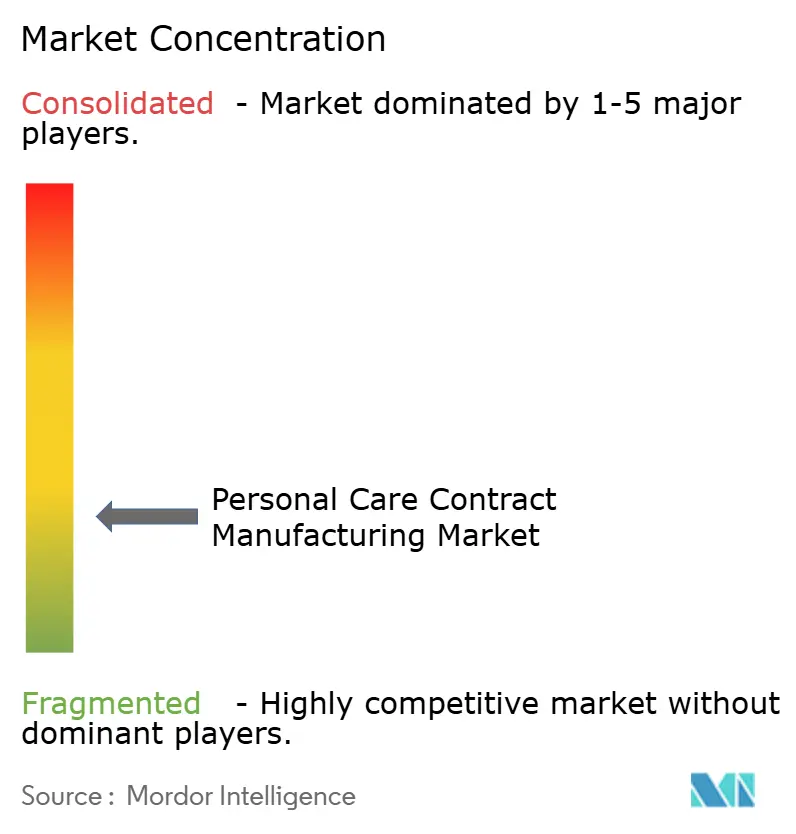
| Market Concentration | Low |
Major Players *Disclaimer: Major Players sorted in no particular order Image © Mordor Intelligence. Reuse requires attribution under CC BY 4.0. | |
Personal Care Contract Manufacturing Market Analysis by Mordor Intelligence
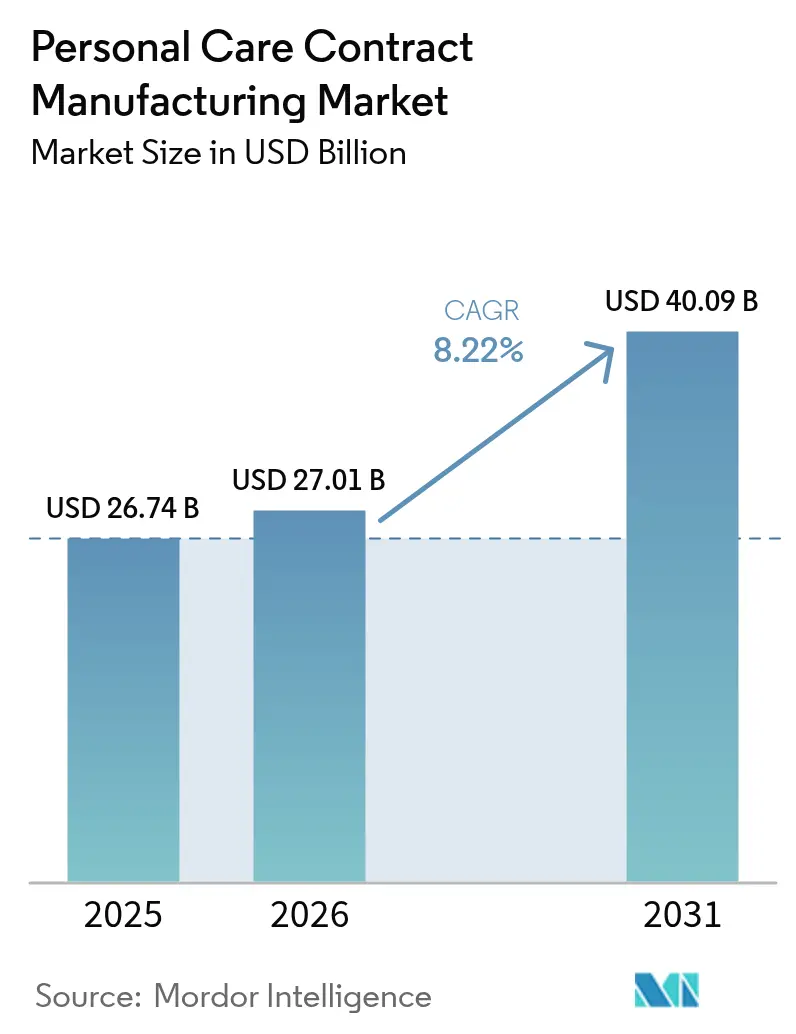
The personal care contract manufacturing market size is projected to expand from USD 26.74 billion in 2025 and USD 27.01 billion in 2026 to USD 40.09 billion by 2031, registering a CAGR of 8.22% between 2026 and 2031. Brand owners are scaling back capital-intensive plants and leaning on external partners for formulation know-how, faster compliance, and speedier product rollouts. Manufacturing services still generate most revenue, yet full-service and turnkey engagements are accelerating as venture-backed direct-to-consumer labels demand bundled solutions. Asia-Pacific anchors capacity expansion because South Korean and Chinese vendors marry low labor costs with vast ingredient ecosystems, allowing them to quote aggressive lead times. Simultaneously, regulatory shifts in Europe on refillable packaging are steering brands toward contract manufacturers that can redesign both formula and primary pack in one engagement.
Key Report Takeaways
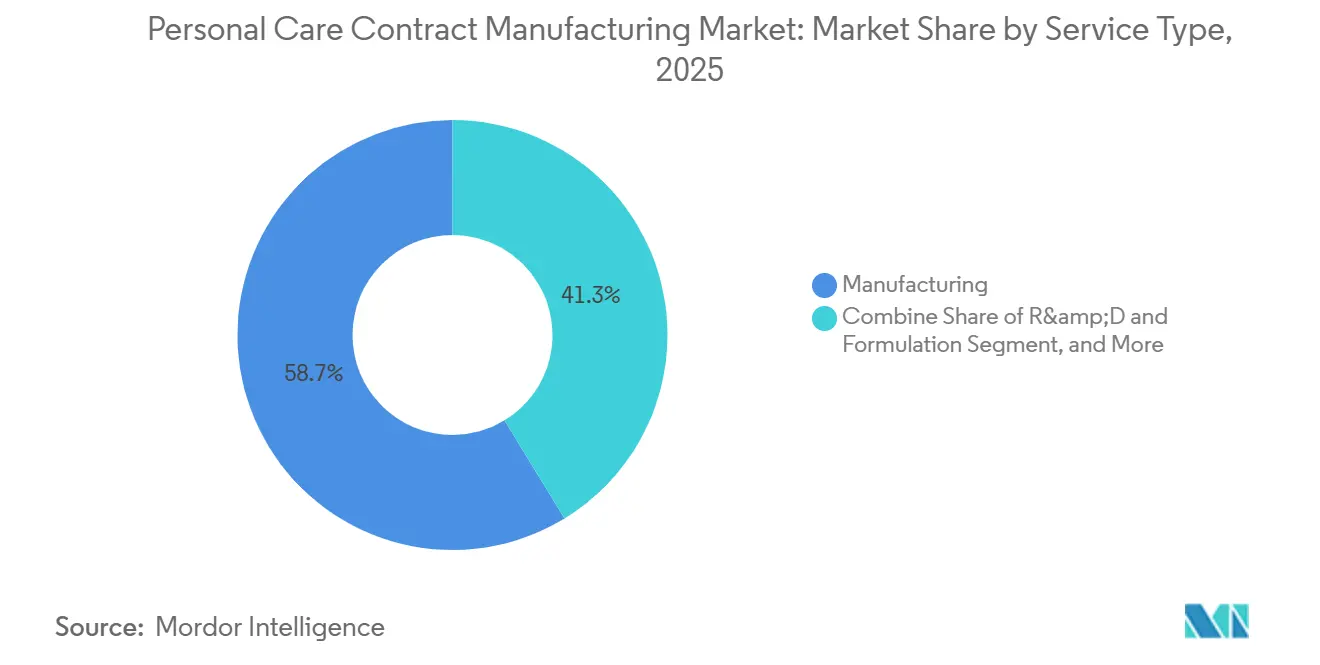
- By service type, manufacturing services led with 58.72% of personal care contract manufacturing market share in 2025, while turnkey and full-service contracts are forecast to rise at an 8.52% CAGR through 2031.
- By product type, skin care commanded 38.18% revenue share in 2025; hair care is projected to grow at an 8.76% CAGR through 2031.
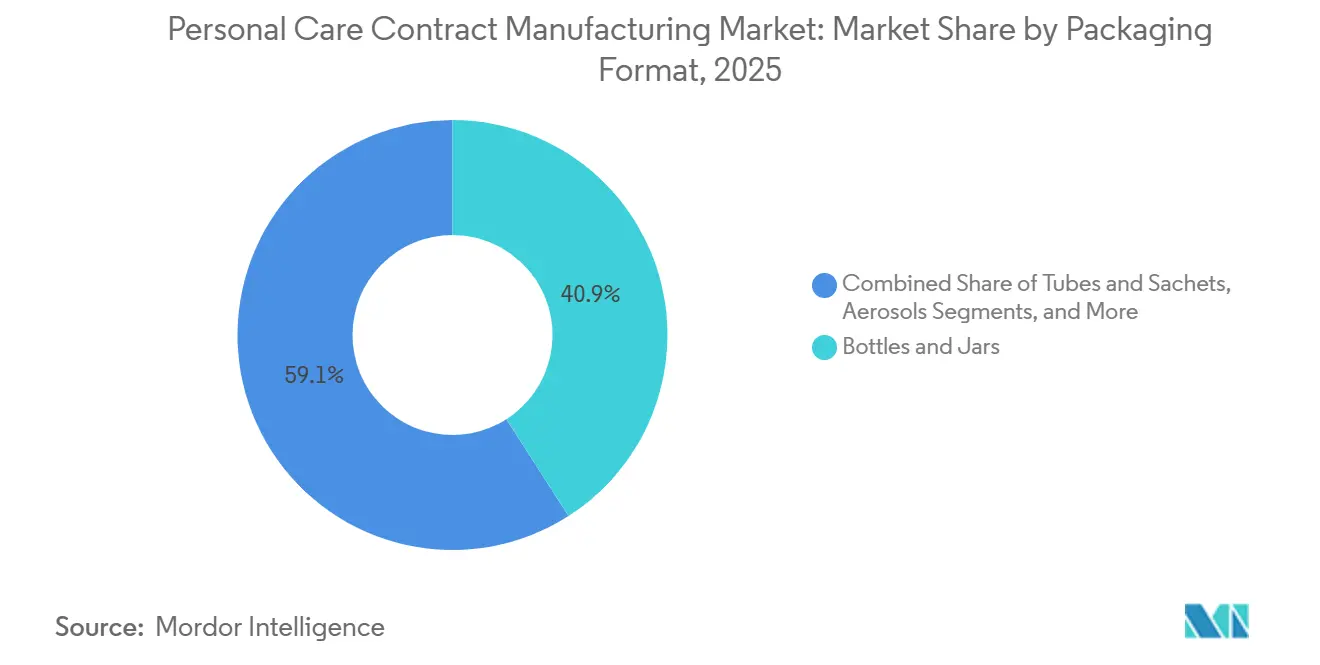
- By packaging format, bottles and jars held 40.93% share in 2025, yet tubes and sachets will deliver the fastest growth at an 8.93% CAGR under European refillability rules.
- By contract manufacturing model, OEM captured 55.64% share in 2025, whereas ODM is expected to expand at an 8.41% CAGR as indie brands license ready-made recipes.
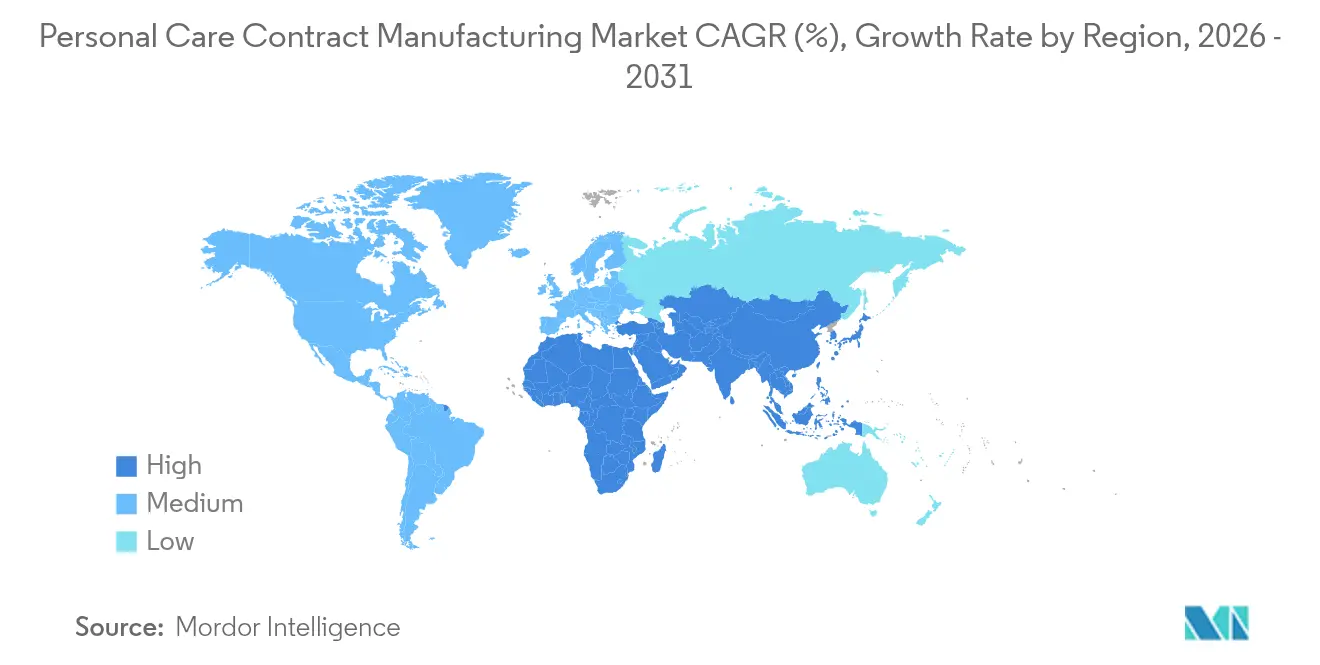
- By geography, Asia-Pacific accounted for 36.91% of personal care contract manufacturing market share in 2025 and should advance at a 9.11% CAGR through 2031 on the back of South Korean and Chinese capacity build-outs.
Note: Market size and forecast figures in this report are generated using Mordor Intelligence’s proprietary estimation framework, updated with the latest available data and insights as of 2026.
Market Trends and Insights
Drivers Impact Analysis of Personal Care Contract Manufacturing Market*
| Driver | (~) % Impact on CAGR Forecast | Geographic Relevance | Impact Timeline |
|---|---|---|---|
| Evolution of service offerings enables outsourcing focus | +1.8% | Global, with concentration in North America and Europe | Medium term (2-4 years) |
| Localization of manufacturing for lead-time and cost advantage | +1.5% | APAC core, spill-over to North America and Europe | Medium term (2-4 years) |
| Surge of indie/DTC brands outsourcing production | +1.6% | North America and Europe, expanding to APAC | Short term (≤ 2 years) |
| Demand for organic and natural formulations | +1.2% | Global, strongest in Europe and North America | Long term (≥ 4 years) |
| AI-driven rapid formulation platforms | +1.4% | North America, Europe, South Korea, Japan | Medium term (2-4 years) |
| Refillable-packaging mandates requiring specialised CM | +1.0% | Europe (primary), North America (emerging) | Long term (≥ 4 years) |
| Source: Mordor Intelligence | |||


Evolution of Service Offerings Enables Outsourcing Focus
Contract manufacturers now provide R&D, regulatory filing, and packaging under one roof, freeing brands to invest in marketing instead of fixed assets. The turnkey model compresses launch cycles from a year to only months and transfers working-capital risk to the supplier. Maesa’s Magic Incubator illustrates the appeal, granting USD 35,000 plus lab access to startup brands that have since crossed USD 100 million in annual sales.[1]Maesa, “Magic Incubator 2026 Cohort Announcement,” maesagroup.com ISO 22716 certification and FDA MoCRA registration handled by the vendor shield young labels from compliance pitfalls. As a result, full-service contracts are pacing 8.52% CAGR, well above standalone toll manufacturing.
Surge of Indie and DTC Brands Outsourcing Production
Thousands of venture-funded cosmetic labels launched during the e-commerce boom now hit volume thresholds where outsourcing beats building captive lines. Minimum runs of 5,000–10,000 units align neatly with contract manufacturers’ pilot facilities, sparing founders multimillion-dollar capex. KDC/ONE’s purchase of Maesa’s EMEA arm broadened its small-batch and clean-beauty toolkit, luring digitally native brands that iterate rapidly. The ODM pathway, with a 8.41% CAGR, lets new entrants license proven recipes and swap fragrances or actives to differentiate, shrinking concept-to-shelf times to 6 months.
Localization of Manufacturing for Lead-Time and Cost Advantage
Tariffs, freight hikes, and pandemic-era shipping chaos persuaded brands to nearshore. Kolmar Korea opened a 17,805-square-meter Pennsylvania plant in 2025, cutting U.S. replenishment cycles from 90 to 30 days and dodging 25% tariffs on China-made goods. COSMAX broke ground in Thailand to serve Southeast Asia, aiming to reach 230 million units annually by 2026. Boston Consulting Group calculated that localized production reduces landed cosmetic costs by 8%-15% once freight, tariffs, and inventory carrying charges are factored in.
AI-Enabled Rapid Formulation Platforms
L’Oréal and IBM unveiled a generative-AI engine in 2025 that predicts ingredient interactions and regulatory flags, slicing development timelines from 18 months to under six.[2]L’Oréal, “L’Oréal and IBM Launch AI Platform for Beauty Innovation,” loreal.com Contract manufacturers adopting similar systems win briefs from prestige houses seeking speed without sacrificing safety. Nouryon followed with its BeautyCreations simulator, letting brands model sensorial profiles before lab batches. The result is shorter innovation cycles and lower R&D spend, nudging more projects toward external partners.
Restraints Impact Analysis of Personal Care Contract Manufacturing Market*
| Restraint | (~) % Impact on CAGR Forecast | Geographic Relevance | Impact Timeline |
|---|---|---|---|
| Stringent regulatory and counterfeit concerns | -1.1% | Global, most acute in North America and Europe | Short term (≤ 2 years) |
| Raw-material price and supply-chain volatility | -1.3% | Global, with acute pressure in APAC and Europe | Short term (≤ 2 years) |
| In-house capacity expansion by mega beauty brands | -0.9% | North America and Europe | Medium term (2-4 years) |
| Blockchain-based traceability and disclosure pressures | -0.6% | Europe (primary), North America (emerging) | Long term (≥ 4 years) |
| Source: Mordor Intelligence | |||
Stringent Regulatory and Counterfeit Concerns
The FDA’s 2026 draft guidance demands real-time electronic batch records, a heavy IT lift for small and midsize vendors.[3]U.S. Food and Drug Administration, “Draft Guidance for Industry: Access to Records,” fda.gov The agency’s new recall authority, finalized in 2025, further increases liability, nudging some suppliers out of sunscreens and eye-area products. Parallel reforms in Europe banned 23 additional CMR substances, forcing costly reformulations. Counterfeits muddy trust: the WHO estimated that fake cosmetics accounted for 10% of global trade in 2024, and when packaging is copied, legitimate contract manufacturers bear the reputational fallout.
Raw-Material Price and Supply-Chain Volatility
Feedstock swings-exemplified by Dow’s USD 0.05 per pound glycol-ether increase effective January 2025-compress margins and complicate quotation validity. Contract manufacturers must hedge solvent and surfactant exposure or accept periodic re-pricing clauses, a shift that strains downstream relationships. Port congestion and political tensions are creating spot shortages of fragrance oils, palm-derived fatty acids, and glass droppers. Factories without multiple approved vendors risk line stoppages, prompting a strategic pivot toward dual sourcing, buffer inventories, and vendor-managed stocking agreements across the personal care contract manufacturing market.
*Our forecasts treat driver/restraint impacts as directional, not additive. The impact forecasts reflect baseline growth, mix effects, and variable interactions.
Personal Care Contract Manufacturing Market Segment Analysis
By Service Type – Turnkey Models Capture Outsourcing Momentum
Manufacturing services contributed 58.72% of personal care contract manufacturing market share in 2025. However, turnkey contracts are scaling fastest, indexing to an 8.52% CAGR as brands off-load formulation, regulatory, and packaging in a single deal. This reallocation lightens working-capital pressure for labels that prioritize influencer campaigns over capital equipment. R&D outsourcing is also up as clean-beauty claims demand sophisticated preservative systems. Platforms such as Nouryon’s BeautyCreations AI demonstrate how predictive modeling trims bench work, a capability that is pulling mid-tier brands toward external labs.
Turnkey suppliers exploit scale by bundling bottles, pumps, and secondary packaging with liquid filling, which enlarges average order values and broadens margin. The personal care contract manufacturing market size derived from full-service contracts is set to widen each year through 2031 as startups and multinational innovation teams alike pivot to variable-cost supply chains. In contrast, pure toll manufacturing grows slowly because it offers limited differentiation and places inventory liability on the brand. ISO and cGMP compliance costs continue to tilt small clients toward partners that already maintain validated systems.


By Product Type:
Skin Care Leadership Meets Hair Care InnovationSkin care dominated revenue with 38.18% in 2025, anchored by prestige serums using encapsulated actives. Hair care is expected to post an 8.76% CAGR, the quickest clip among categories, on the back of sulfate-free cleansers and scalp-serum launches. Unilever, for instance, shifted several shampoo lines to Asian ODMs specializing in coconut-derived surfactants to meet clean-label pledges. Color cosmetics lag due to minimalist makeup trends, yet specialized contract manufacturers still book seasonal palettes for luxury houses.
The personal care contract manufacturing market for hair care is set to expand as peptide-rich scalp tonics cross over from skin care technologies. Contract partners with micro-biome testing labs stand to win those programs. Fragrance and deodorants remain steady but mature; growth skews toward aluminum-free sticks, which require new wax-gel chemistries. Oral care outsourcing stays niche because giants like Colgate-Palmolive largely self-manufacture at scale.
By Packaging Format:
Tubes and Sachets Lead Sustainability TransitionBottles and jars held 40.93% of shipments in 2025, yet tubes and sachets are tracking an 8.93% CAGR through 2031 as European and Californian laws push refill systems. France’s AGEC statute and the EU Packaging and Packaging Waste Regulation obligate 10% reusable cosmetic packs by 2030. Contract manufacturers with in-house extrusion and lamination capabilities land those projects because brands prefer a single partner for both formula and pack engineering.
The personal care contract manufacturing market share expected from tubes and sachets therefore rises in tandem with mandates. Airless pumps grow among preservative-free serums needing oxygen barriers, though their cost keeps them skewed to premium. Aerosols confront propellant and recycling scrutiny but stay essential for dry shampoos. New paperboard sticks debut in solid perfumes and deodorants, calling for filling lines that handle lower-heat substrates.
By Contract Manufacturing Model – ODM Gains Favor With Speed-First Brands
OEMs still accounted for 55.64% of contracts in 2025 because heritage brands control their IP and outsource only production. ODM is growing 8.41% because celebrity labels and influencer startups value six-month launch cycles and pre-validated stability data. Kolmar Korea disclosed that ODM exceeded 60% of its total sales in 2024. COSMAX posted similar ratios, allowing clients to tweak active levels rather than build new emulsions from scratch.
As ODM expands, personal care contract manufacturing market size linked to royalty-bearing formulations becomes more predictable for vendors, allowing better capacity planning. OBM and private-label programs with retailers offer volume but thinner margins. Toll manufacturing remains a fallback for brands undergoing plant shutdowns, yet its strategic value declines because it delivers neither speed nor R&D leverage.
Geography Analysis
APAC Personal Care Contract Manufacturing Market
Asia-Pacific accounted for 36.91% of the personal care contract manufacturing market share in 2025 and is forecast to grow at a 9.11% CAGR through 2031. South Korea’s COSMAX recorded KRW 319.8 billion (USD 240 million) Q3 2024 revenue, up 15.1% year over year, leveraging libraries that cut development times to six months. Chinese ODM specialists ride domestic demand from Perfect Diary and Florasis, while India attracts new factories to serve the Middle East and Africa. Japan remains niche but premium, focusing on probiotic skin care, whereas Australia emphasizes botanicals native to its biomes.
North America and Europe Personal Care Contract Manufacturing Market
North America and Europe together generated roughly half of global turnover in 2025. The United States heads revenue, but growth moderates as brands consolidate their vendor footprint. Kolmar Korea’s Pennsylvania plant added 120 million-unit capacity in 2025, slicing replenishment times for East Coast labels. Europe tightens the regulatory screws with refillable-packaging quotas and ingredient bans, nudging contract manufacturers toward investment in mold engineering and high-barrier mono-material packs. Germany leads in natural cosmetics, France in prestige fragrance, and Italy in color-cosmetic compacts.
MEA and South America Personal Care Contract Manufacturing Market
South America, the Middle East, and Africa remain smaller but rising. Brazil’s domestic houses rely on local fillers for lotions suited to humid climates, while multinationals eye Gulf Cooperation Council hubs for fragrance blending. South Africa’s market is dominated by ethnic hair care lines produced at contract sites near Johannesburg. Nigeria’s potential is sizable, though import dependencies and uneven power infrastructure temper growth.

Regulatory Landscape
In the United States, the FDA is tightening cosmetics oversight under the Modernization of Cosmetics Regulation Act of 2022 (MoCRA), shifting more compliance work upstream to manufacturers that can run validated quality systems and maintain inspection-ready documentation. In February 2026, the FDA updated its Cosmetics Direct electronic submission portal with new fields tied to the biennial facility registration renewal cycle, and the first major wave of renewals hit a key milestone around July 1, 2026, for facilities that registered in early 2024. This increases the operational burden for contract manufacturers supplying into the US market.
In Europe, Regulation (EC) No 1223/2009 continues to evolve through annex updates, which raises reformulation and supplier-qualification workload for ODM and turnkey providers. The European Commission published Regulation (EU) 2026/909 in April 2026, restricting or prohibiting multiple cosmetic ingredients, and the Packaging and Packaging Waste Regulation (EU) 2025/40 enters full application on August 12, 2026. These requirements place packaging design, labeling, and circularity demands at the center of contracts, favoring providers that can co-engineer the formula, primary pack, and compliance documentation within a single engagement.
Value Chain Analysis
The value chain begins with upstream chemical inputs (surfactants, emollients, polymers, fragrances, and actives) and primary packaging components (plastics, glass, pumps, and dispensers). It then moves through formulation and R&D, scale-up, bulk manufacturing, filling and assembly, secondary packaging, and distribution to brand owners and retail or e-commerce channels. Full-service contract manufacturers sit in the middle, coordinating quality and testing (stability, microbiology), regulatory documentation, and pack compatibility, while logistics providers handle more complex lanes for ingredients and packaging that can be sourced across regions.
In 2026, operational friction is concentrated around petrochemical-linked inputs and packaging availability, along with longer transit times from route reconfigurations that extend lead times for critical materials. As a result, brands are pushing more dual-sourcing, safety stock, and regionalized supply chains. Recent moves also show how the chain is being reshaped: Naturis Cosmetics raised INR 100 crore in July 2026 to build a new 225,000 sq ft facility in Vapi, alongside expanded R&D and customer-facing infrastructure, while PharmaResearch completed its acquisition of California-based Cosmetic Group USA (CG USA) in July 2026. Together, these steps reinforce nearshored manufacturing nodes and reduce dependency on long-distance imports for select formats.
Competitive Landscape
Innovation and Adaptability Drive Future Success
The top 10 vendors account for about 40% of global revenue, indicating moderate fragmentation. Scale advantages hinge on three assets: a broad formulation catalog, vertical integration into packaging or ingredients, and deep regulatory teams versed in FDA MoCRA and EU CMR lists. Intercos pursued a USD 100-200 million acquisition in 2025 to deepen its hair and skin competencies. KDC/ONE integrated Maesa’s EMEA division, gaining access to clean-beauty test rooms and agile filling lines for influencer launches.
Technology capabilities increasingly split winners from also-rans. L’Oréal’s generative-AI formulation tool sets a new clock speed that contract partners must match or risk losing briefs. COSMAX hired a new vice chairman in 2025 with a remit to scale AI labs and Southeast Asian plants, underscoring the pivot to data-driven innovation.
Mid-tier firms without proprietary tech or ingredient verticality face squeezed margins as mega brands intermittently insource to balance capacity. White-space opportunities persist in scalp health, refillable formats, and Indian nearshoring, arenas where regulatory barriers are still settling and incumbent share is low.
Personal Care Contract Manufacturing Industry Leaders
Fareva Group
COSMAX Inc.
Intercos S.p.A
Kolmar Korea Co., Ltd.
kdc/one
- *Disclaimer: Major Players sorted in no particular order
Personal Care Contract Manufacturing Market Companies Covered in this Report
- Fareva Group
- KDC/ONE (Knowlton Development Corporation)
- COSMAX Inc.
- Intercos S.p.A
- Kolmar Korea Co., Ltd.
- McBride plc
- Albea Services S.A.S
- PLZ Corp
- Voyant Beauty LLC
- Maesa Inc.
- Cosmetic Solutions LLC
- Colep Consumer Products
- Powerpack Cosmetics
- H.S.A. S.p.A
- Clarion Cosmetics
- CoValence Laboratories
- Ancorotti Cosmetics
- Tropical Products Inc.
- Virospack Inc.
- HCT Group
- Vistta Cosmetics

Market Opportunities and Future Outlook
EU packaging rules are creating near-term whitespace for contract manufacturers that can deliver compliant packaging engineering alongside filling, labeling, and documentation. With the EU Packaging and Packaging Waste Regulation (EU) 2025/40 applying from August 12, 2026, demand is moving toward recyclable, refillable, and higher-performance primary packs. This is reinforced by packaging-side consolidation and capability build-out, including Novvia Group acquiring APC Packaging in May 2026 to add strength in refillable systems and recyclable materials. Providers that can qualify new mono-material components, validate pack-product interactions, and execute change-control quickly should have an edge in winning turnkey briefs tied to regulatory deadlines.
A second opportunity is capacity and vertical integration in high-throughput formats (for example wipes and liquid-fill) and in ingredient availability for reformulation-heavy programs. Investments and expansions provide a clearer signal of where brand owners are allocating capital and where contract partners can cover gaps: Pierre Fabre announced a EUR 50 million modernization and expansion of its Avene, France site in May 2026, including new automated packaging lines, and BASF inaugurated a new specialty emollients plant in Dusseldorf in July 2026 to strengthen supply of key skin care inputs. These moves elevate the value of partners that can secure feedstocks, qualify alternates during shortages, and scale packaging automation for short cycle-time launches without relying on brand-owned plants.
Recent Industry Developments in Personal Care Contract Manufacturing Market
- July 2026: Naturis Cosmetics raised INR 100 crore in its first external funding round led by Sharrp Ventures to expand its contract manufacturing footprint. The plan includes a new 225,000 sq ft facility in Vapi plus a Mumbai R&D center and a Delhi-NCR experience center, strengthening India-based capacity for outsourced formulation and production programs.
- December 2025: Ashland agreed to acquire Pharmachem Laboratories for USD 660 million to expand its specialty ingredients platform, including actives used in hair care and personal care. The deal tightens the linkage between upstream actives supply and contract manufacturers that need consistent, compliant ingredient availability for fast reformulation cycles.
- September 2024: Kolmar Korea disclosed that ODM activities accounted for more than 60% of its total sales in 2024, underscoring how library-based, ready-to-customize formulations have become central to major Asian suppliers. The shift supports faster concept-to-shelf timelines and increases competitive pressure on pure-play toll manufacturers that lack differentiated IP.


Personal Care Contract Manufacturing Market Report Scope and Research Methodology
Market Definition and Coverage
This market covers revenue earned by third-party manufacturers that produce personal care products for brand owners under contract. The scope includes related services such as formulation support and packaging assistance, as long as the brand does not own the manufacturing operation.
Scope exclusions: In-house manufacturing done inside brand-owned plants is excluded, even when the output is later sold under the same brand portfolio.
Segments Covered in This Report
- By Service Type
- R&D and Formulation
- Manufacturing
- Packaging and Allied Services
- Turnkey / Full-Service Manufacturing
- By Product Type
- Skin Care
- Hair Care
- Color Cosmetics
- Fragrance and Deodorants
- Oral Care
- Other Product Type
- By Packaging Format
- Aerosols
- Bottles and Jars
- Tubes and Sachets
- Pumps and Dispensers
- Sticks and Roll-ons
- Other Packaging Format
- By Contract Manufacturing Model
- OEM
- ODM
- OBM / Private Label
- Toll Manufacturing
- By Geography
- North America
- United States
- Canada
- Mexico
- Europe
- Germany
- United Kingdom
- France
- Italy
- Spain
- Russia
- Rest of Europe
- South America
- Brazil
- Argentina
- Rest of South America
- Asia-Pacific
- China
- India
- Japan
- South Korea
- Australia and New Zealand
- Rest of Asia-Pacific
- Middle East
- Saudi Arabia
- United Arab Emirates
- Turkey
- Rest of Middle East
- Africa
- South Africa
- Nigeria
- Rest of Africa
- North America
Data Sources, Market Sizing, and Validation
Desk Research
Desk work starts by mapping what products and processes sit inside personal care manufacturing, then aligning that with what can be tracked consistently by region. We use public sources such as the US FDA (cosmetics guidance and recalls), the European Commission (Cosmetics Regulation), the Personal Care Products Council, Cosmetics Europe, and UN Comtrade trade statistics to understand category activity and packaging flow.
To support the revenue numbers, we also review company annual reports, investor presentations, and credible press coverage that mentions capacity additions, outsourcing intensity, and geographic footprint. Select paid databases are used for company financials and intelligence, patent activity in formulations, and shipment-level trade checks where public data is too aggregated. The desk sources listed here are illustrative, and we also consult other public and paid references for data collection, cross-checks, and clarification.
Primary Interviews and Surveys
Primary work is used to validate what is actually outsourced versus kept in-house, and how pricing moves by product type and packaging format. We speak with contract manufacturers, packaging partners, raw material participants, and brand-side sourcing and operations teams across APAC, EMEA, and the Americas. Inputs from these interviews are then used to test assumptions that are hard to infer from public documents alone.
Distribution of primary research fieldwork respondents
| Company type | Respondent position | Region |
|---|---|---|
| Top tier: 25% | CXOs: 13% | APAC: 51% |
| Mid tier: 57% | Functional/Unit leaders: 35% | EMEA: 29% |
| Smaller Players: 18% | Managers: 52% | Americas: 20% |
Market-Sizing & Forecasting
Our sizing starts with a top-down build where personal care category output and outsourcing penetration are used to reconstruct the spend pool that can realistically flow to contract manufacturers. We then filter that pool by the service mix that is typically billed externally, including manufacturing, formulation support, packaging and allied services, and turnkey engagements. To ensure totals do not drift, we corroborate with selective bottom-up checks, such as sampling plant-level capacity and utilization commentary, rolling up supplier revenues where disclosures exist, and validating typical price-per-unit ranges by product format.
Key inputs used in the model include outsourced share by product type (skin care, hair care, color cosmetics, fragrances and deodorants, oral care), packaging format intensity (aerosols, tubes and sachets, bottles and jars, pumps and dispensers, sticks and roll-ons), average order size and changeover frequency that influence service bundling, and the pace of regulatory and quality requirements that can shift work toward specialized partners. Where a variable is hard to observe, such as private-label volumes routed through intermediaries, we fill gaps using interview-led ranges and then cap them with independent signals such as trade movement of filled packs and contract manufacturing capacity additions.
For forecasting, we run scenario analysis to reflect how outsourcing intensity and mix can change under different brand strategies. The scenarios are anchored to expert consensus on growth drivers, including new product launch cadence and packaging shifts. The final forecast is expressed in current USD using consistent currency timing assumptions across regions so year-to-year movement is comparable.
Data Validation & Update Cycle
Validation is done through multiple checks before results are finalized. Model outputs are compared against independent signals, including personal care category growth, packaging activity indicators, and reported utilization or expansion commentary from manufacturers. When there are large variances, we investigate at the country and category level.
If an assumption looks unstable, we re-contact relevant respondents and re-test the ranges, especially for outsourcing share, service mix, and pricing progression. A second analyst review is completed to check for arithmetic errors, inconsistent definitions, and trend breaks that do not match known market events. Reports are refreshed annually, with interim updates when a material event occurs, and a final pre-delivery pass is completed so clients receive the latest updated view.
Mordor Intelligence's Global Personal Care Contract Manufacturing Market Size Compared Against Other Published Estimates
Published market sizes for personal care contract manufacturing can differ even when they appear to cover the same space. Differences often come from how the service boundary is defined, and the year used for the starting point. Other gaps come from how firms treat private label versus brand-owned production, and whether packaging and formulation services are counted in contract manufacturing revenue.
Home care contract manufacturing is included as an add-on in some publications, and that category sits outside Mordor Intelligence's scope for this market. This keeps the value tied to personal care only and avoids mixing two demand cycles. Another recurring difference is whether the estimate is anchored to a later start year with a faster run-rate, or to an earlier year where outsourcing penetration was lower, which can shift the reported number even if the long-term CAGR looks similar.
Benchmark comparison
| Source | Market Size | Gaps in Research Methodology |
|---|---|---|
| Mordor Intelligence | USD 27.01 B (2026) | |
| Trade Journal A | USD 21.11 B (2025) | Uses an earlier base year and does not clearly show whether packaging and allied services are counted, which can reduce the captured revenue pool for full-service contracts. |
| Industry Publisher B | USD 25.51 B (2025) | Keeps scope description high level, and the service boundary is not transparent, so parts of formulation support or turnkey engagements may be treated inconsistently across regions. |
Overall, the spread is mostly explained by base-year alignment and what is counted as contract manufacturing revenue beyond pure production. By tying the model to visible demand indicators, service mix checks, and interview-tested outsourcing shares, we keep the number traceable to repeatable inputs instead of relying on a single assumed run-rate.


Key Questions Answered in the Report
How fast is the personal care contract manufacturing market expected to grow through 2031?
It is projected to register an 8.22% CAGR from 2026 to 2031, climbing to USD 40.09 billion by the end of the period.
Which segment is expanding quickest within outsourced services?
Turnkey and full-service contracts, advancing at an 8.52% CAGR as brands favor end-to-end solutions.
Why are tubes and sachets gaining popularity in beauty packaging?
European and Californian reuse mandates push brands toward refillable and single-dose packs, driving tubes and sachets at an 8.93% CAGR.
What drives the surge in outsourcing by indie beauty labels?
Indie and direct-to-consumer brands outsource to save capex and because ODM libraries let them launch new products in six months.
Which region leads growth in contract manufacturing capacity?
Asia-Pacific, projected to rise at a 9.11% CAGR, powered by South Korean and Chinese suppliers scaling ODM lines.
Page last updated on:





