
Marine Port Services Market Size and Share
Market Overview
| Study Period | 2020 - 2031 |
|---|---|
| Market Size (2026) | USD 98.36 Billion |
| Market Size (2031) | USD 120.47 Billion |
| Growth Rate (2026 - 2031) | 4.14 % |
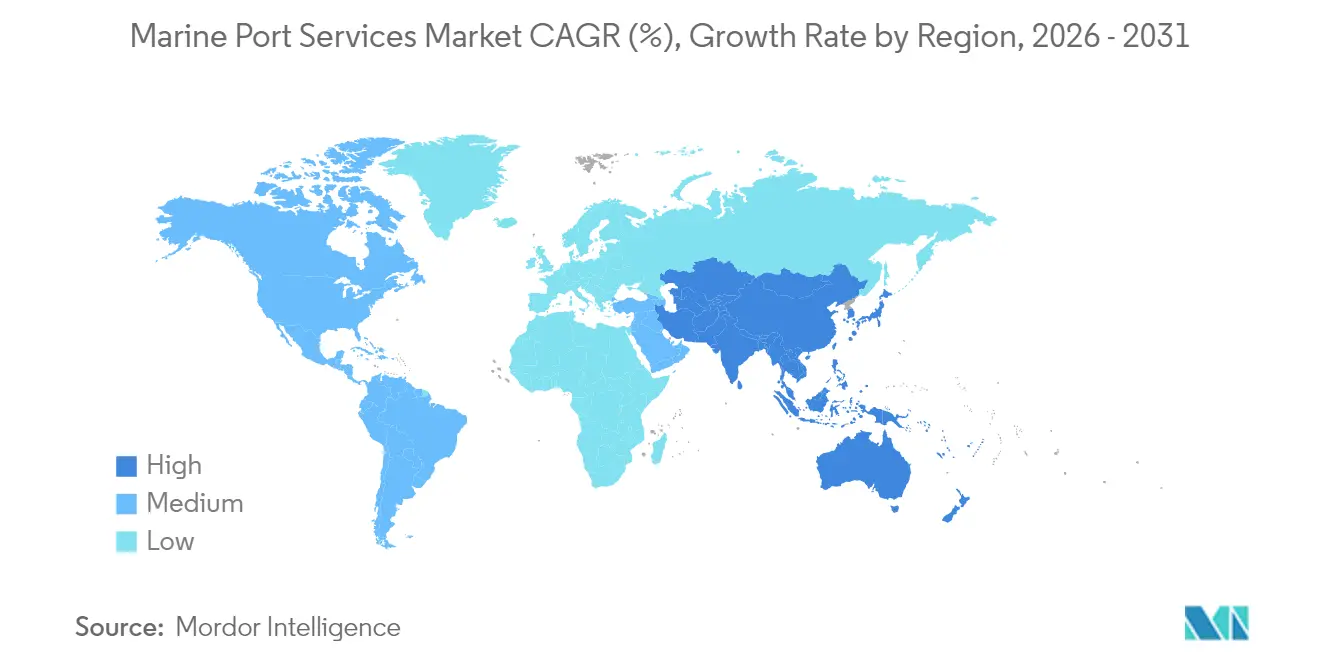
| Fastest Growing Market | Asia Pacific |
| Largest Market | Asia-Pacific |
| Market Concentration | Low |
Major Players *Disclaimer: Major Players sorted in no particular order Image © Mordor Intelligence. Reuse requires attribution under CC BY 4.0. | |
Marine Port Services Market Analysis by Mordor Intelligence
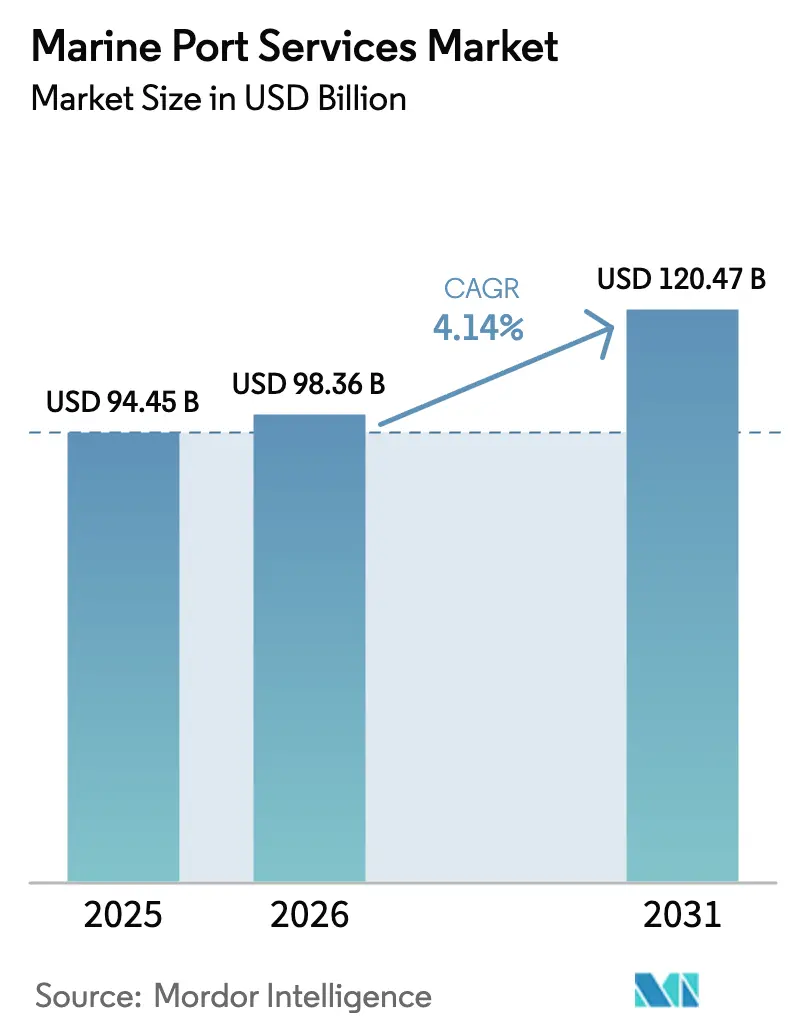
The Marine Port Services Market size was valued at USD 94.45 billion in 2025 and estimated to grow from USD 98.36 billion in 2026 to reach USD 120.47 billion by 2031, at a CAGR of 4.14% during the forecast period (2026-2031).
The steady trajectory is underpinned by a 6% rebound in global container volumes in 2024, with 183.2 million TEUs shipped worldwide. Year-to-date through October 2025, global volumes stand 4% higher than the same period in 2024, with the industry on track for a record-breaking year. Government infrastructure programs inject more than USD 200 billion into port modernization, and the United States alone directs sizable federal funding through comprehensive legislation. Asia-Pacific extends its leadership as both a demand hub and a supply base, while technology adoption improves throughput and creates resilience against geopolitical chokepoints. Environmental regulation accelerates capital spending on shore-power systems, driving new procurement cycles despite near-term cost pressure. Consolidation unfolds by way of alliances rather than outright mergers, enabling operators to scale digital platforms without diluting regional autonomy.
Key Report Takeaways
- By geography, Asia-Pacific held 40.70% of marine port services market share in 2025 while posting the fastest CAGR at 4.67% through 2031.
- By service, container handling commanded 68.40% share of the marine port services market size in 2025, whereas supply-chain and logistics solutions are projected to expand at a 4.18% CAGR to 2031.
- By ownership, state-owned facilities retained 52.30% share of the marine port services market size in 2025, but PPP/concession ports exhibit the highest forecast CAGR at 3.74% to 2031.
Note: Market size and forecast figures in this report are generated using Mordor Intelligence’s proprietary estimation framework, updated with the latest available data and insights as of 2026.
Market Trends and Insights
Drivers Impact Analysis of Marine Port Services Market*
| Driver | % Impact on CAGR Forecast | Geographic Relevance | Impact Timeline |
|---|---|---|---|
| Surge in global containerized trade volumes | +1.2% | Global, with APAC and North America leading | Short term (≤ 2 years) |
| Government-backed port infrastructure investments | +0.8% | Global, concentrated in US, EU, India, China | Medium term (2-4 years) |
| Rapid digitalization & automation of port operations | +0.6% | APAC core, spill-over to Europe and North America | Medium term (2-4 years) |
| Near-shoring-driven secondary-port demand | +0.4% | North America and Latin America primarily | Long term (≥ 4 years) |
| Offshore-wind logistics support services | +0.3% | Europe, North America East Coast, APAC selective markets | Long term (≥ 4 years) |
| Arctic shipping lane emergence | +0.2% | Northern Europe, Russia, Arctic nations | Long term (≥ 4 years) |
| Source: Mordor Intelligence | |||
Surge in Global Containerized Trade Volumes
In 2024, global container volumes rebounded by 6%, reaching a total of 183.2 million TEUs shipped worldwide. As of October 2025, global volumes have already surpassed the previous year's figures by 4%, positioning the industry for a potential record-breaking year. [1]. Leading carriers increased port calls per rotation by 18%, channeling more revenue toward stevedoring and ancillary services. Automated terminals benefited most, registering 25-30% higher productivity and securing price premiums despite larger upfront costs. Port authorities reacted by approving USD 45 billion in expansion projects slated for completion by 2027. The sustained volume pipeline encourages operators to maintain berth utilization above 80%, reinforcing confidence in the marine port services market.
Government-Backed Port Infrastructure Investments
Public funding accelerates modernization, with the EU allocating EUR 12.4 billion (USD 13.68 billion) under TEN-T for maritime corridors[2]. In India, the Sagarmala program coordinates multipurpose terminals and rail connectivity to boost hinterland reach. Around 60% of approved budgets are dedicated to electrification, shore-power, and renewable energy integration, creating long-term demand for engineering, procurement, and construction expertise. Improved infrastructure attracts private concessionaires who pledge performance guarantees, expanding the addressable base of the marine port services market
Rapid Digitalization and Automation of Port Operations
Asia-Pacific ports pioneer automated guided vehicles, digital twins, and AI-based scheduling tools that raise crane productivity by double digits. Predictive systems lower unplanned downtime and shrink vessel turnaround windows, supporting higher berth utilization. Compliance frameworks such as ISO 28000 elevate demand for secure data interchange platforms, positioning ports as logistics orchestrators rather than passive nodes. Lessons from Malaysia’s automation playbook provide emerging markets with proven pathways to replicate gains[3].
Near-Shoring-Driven Secondary-Port Demand
Manufacturers shifting production closer to consumers reroute cargo to secondary U.S. Gulf Coast terminals that reported record volumes in 2024[4]. Automotive and electronics flows from Mexico prefer ports offering direct rail access to Midwest distribution centers, shortening door-to-door transit times. Private equity funneled USD 2.3 billion into these facilities in 2024, financing cranes, yard equipment, and warehouse space. Ports with resilient intermodal links now compete head-to-head with traditional hub gateways, reshaping the revenue mix of the marine port services market.
Restraints Impact Analysis of Marine Port Services Market*
| Restraint | % Impact on CAGR Forecast | Geographic Relevance | Impact Timeline |
|---|---|---|---|
| High capital intensity & long payback cycles | -0.7% | Global, particularly acute in emerging markets | Medium term (2-4 years) |
| Stringent environmental & decarbonization mandates | -0.5% | Europe and North America primarily, expanding globally | Short term (≤ 2 years) |
| Geopolitical chokepoint disruptions | -0.4% | Global, concentrated in Middle East, Asia-Europe routes | Short term (≤ 2 years) |
| Competition from inland dry-ports & land corridors | -0.3% | Europe, North America, China primarily | Long term (≥ 4 years) |
| Source: Mordor Intelligence | |||
High Capital Intensity and Long Payback Cycles
Automated container yards require USD 150-200 million upfront, and payback often extends beyond a decade, limiting participation by smaller authorities. Private operators demand minimum-volume clauses that shift demand risk onto port owners, challenging liquidity management. Currency depreciation in several African economies caused port project costs to overrun by up to 30%, underscoring exchange-rate exposure. Elevated interest rates amplify financing hurdles, slowing expansion of the marine port services market.
Stringent Environmental and Decarbonization Mandates
FuelEU Maritime rules coming into force in 2025 compel container berths handling vessels above 5,000 GT to provide shore-power. Installation budgets of USD 15-25 million per berth intensify capital pressure. Inclusion of shipping in the EU ETS adds USD 80-120 per TEU, squeezing margins for carriers and ports alike. Smaller terminals risk cargo diversion if they cannot meet emission standards quickly, tempering growth prospects for the marine port services market.
*Our forecasts treat driver/restraint impacts as directional, not additive. The impact forecasts reflect baseline growth, mix effects, and variable interactions.
Marine Port Services Market Segment Analysis
By Service:
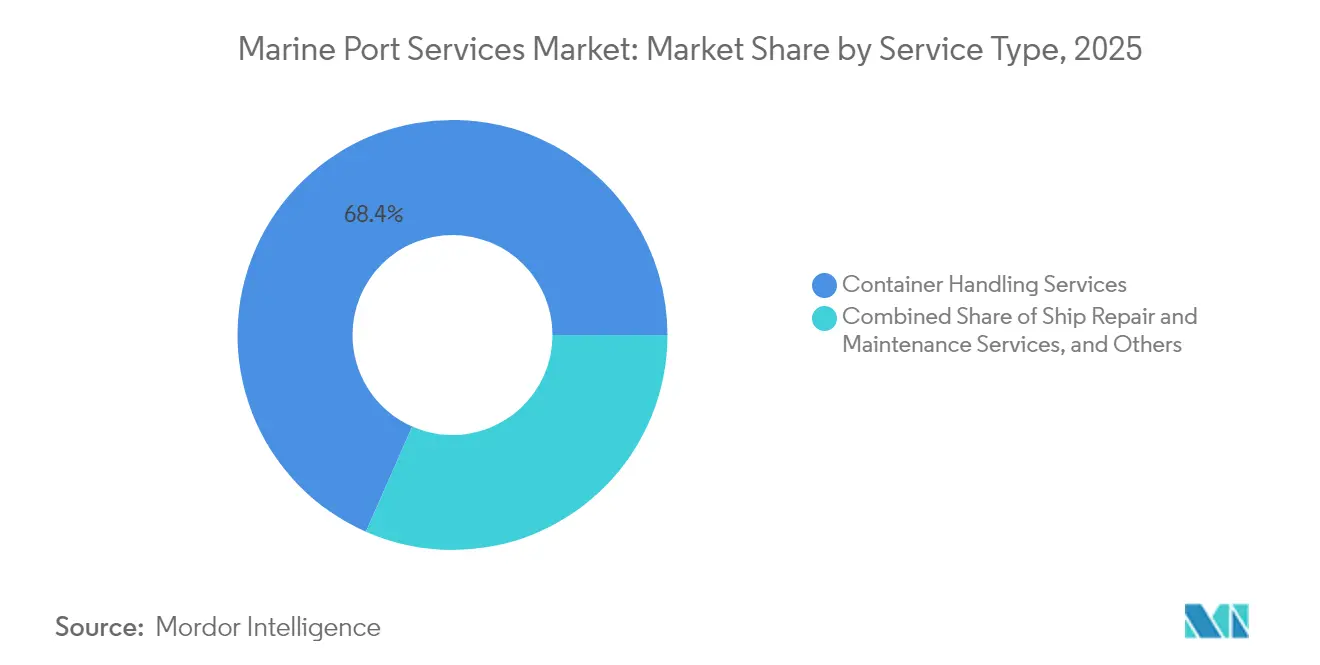
Container Handling Dominates Revenue StreamsContainer handling accounted for 68.40% of the marine port services market share in 2025, validating the structural shift toward containerized trade. The segment benefits from high switching costs and scale advantages, keeping throughput fees firm even in volatile demand cycles. Supply-chain and logistics solutions represent the fastest-growing opportunity, rising at a 4.18% CAGR as ports transform into integrated distribution hubs. Technology-enabled visibility platforms further monetize cargo data streams, supplementing traditional handling revenues.
Real-time analytics have lowered dwell times and reduced the need for buffer stock, allowing shippers to adopt just-in-time models without sacrificing reliability. Automated cranes and stackers require 40% fewer personnel, boosting margins while creating room for performance-based contracting. As multimodal offerings expand, supply-chain services could narrow the revenue gap with core handling functions, reinforcing diversification across the marine port services market.

By Ownership and Governance:
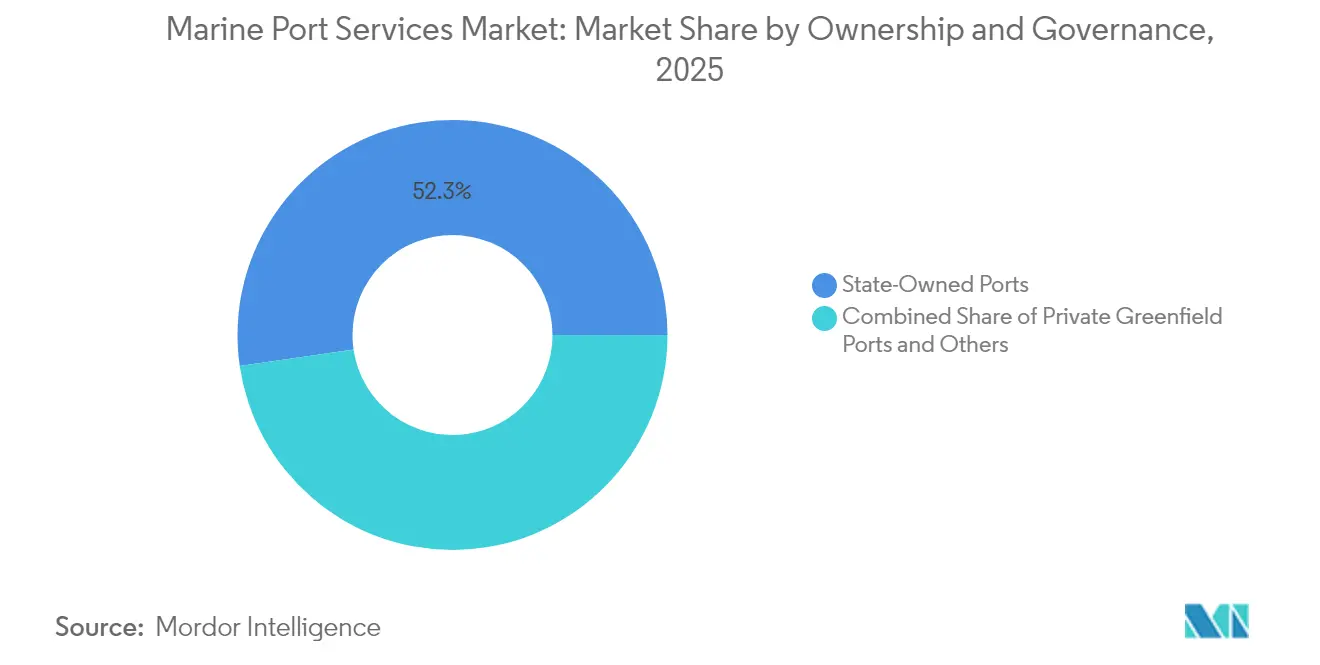
Private Capital Accelerates EfficiencyState-controlled entities still command 52.30% of the marine port services market size, but PPP and concession formats are scaling faster with a 3.74% CAGR. Governments leverage private sector know-how to accelerate automation and unlock efficiencies, illustrated by Brazil’s USD 1.2 billion terminal awards in 2024. Private greenfield ports, though currently the smallest slice, achieve crane moves per hour 20-25% above state averages and roll out new technology several years earlier.
ISO 28000 certification has become table stakes for winning long-term concessions because carriers emphasize secure, traceable supply chains. Private sponsors often embed performance clauses tied to yard throughput, encouraging continuous improvement. This alignment positions concessionaires to outpace legacy facilities, heightening competitive intensity in the marine port services market.
Geography Analysis
APAC Marine Port Services Market
Asia-Pacific retained 40.70% of overall revenue in 2025 and is forecast to grow at 4.67% CAGR through 2031, bolstered by China’s automation roadmap and India’s Sagarmala corridors. Belt and Road investments totaling USD 62 billion across 34 foreign projects extend Chinese terminal influence, diverting cargo toward preferred routes. Southeast Asian facilities gained 12% volume in 2024, aided by electronics and apparel manufacturing shifts to Vietnam, Thailand, and Indonesia. Port planners emphasize dual-fuel equipment and renewable energy, keeping environmental compliance on track while optimizing operating expenditure.
Europe Marine Port Services Market
Europe focuses on decarbonization and digital twins. Rotterdam’s EUR 850 million (USD 938.09 million) green-bond program targets shore-power across 25 berths, aiming for carbon-neutral operations by 2030. Hamburg reduced equipment downtime by 22% after adopting predictive models, freeing berth capacity for higher-margin services. Integrated rail and river networks extend port hinterlands deep into Central Europe, mitigating congestion risk and stabilizing the marine port services market.
North America Marine Port Services Market
North America leverages near-shoring to Mexico and infrastructure funding to modernize East and Gulf Coast terminals. Federal support complements private investment, raising crane density and on-dock rail capacity at Houston, New Orleans, and Mobile. Canadian Arctic gateways prepare for seasonal cargo via the Northern Sea Route, positioning for niche grains and minerals trades as ice-free periods lengthen. Competition now hinges on reliability and integrated customs processing rather than solely on vessel size accommodation, reshaping regional dynamics of the marine port services market.
Regulatory Landscape
Marine port services operate under a layered governance model anchored by International Maritime Organization (IMO) conventions on safety, security, and pollution prevention, including MARPOL Annex VI requirements that influence emissions-related port investments and service specifications. Compliance is reinforced through Port State Control (PSC) regimes, coordinated via nine regional Memoranda of Understanding that standardize ship inspection approaches across major trading lanes.
In Europe, Regulation (EU) 2017/352 provides a formal framework for port service provision and financial transparency, shaping how port authorities set charges and manage access to services across TEN-T ports. In the United States, governance is shared across federal and international interfaces, with coordination mechanisms such as the Committee on the Marine Transportation System (CMTS) supporting alignment across agencies and port stakeholders on operational and environmental priorities.
Value Chain Analysis
The marine port services value chain begins with ocean carriers and cargo owners generating demand, followed by port authorities and landlords that provide concessions, marine access, and infrastructure. Terminal operators and stevedores then deliver core services such as berthing support, container handling, and yard operations. Marine services providers (pilots, towage, mooring), equipment OEMs and integrators (cranes, automated guided vehicles, electrified yard equipment), and IT and cybersecurity vendors support execution, while customs and border agencies shape clearance times that affect berth productivity and dwell time.
Downstream, intermodal rail and trucking operators, freight forwarders, and warehouse and logistics providers extend port competitiveness into hinterlands, enabling higher-margin add-ons such as packaging, assembly, and export processing. As vertical integration increases, terminal operations are being linked to end-to-end logistics offerings, including digital corridors that connect customs, trucking, and warehousing. Ports also increasingly adopt standardized security and data-management frameworks such as ISO 28000 to support secure information exchange across the chain.
Competitive Landscape
Global operators remain fragmented yet cooperative. DP World, APM Terminals, and PSA build digital corridors that integrate customs, trucking, and warehousing under single platforms. Strategic partnerships allow sharing of predictive analytics without full asset consolidation, preserving regional control while scaling technology. AI-based maintenance cuts troubleshooting hours and reduces spare-parts inventory, trimming operational overhead and widening margins.
Niche entrants capture opportunities in offshore wind logistics and Arctic support, areas overlooked by mainstream players. Specialized fleets and heavy-lift cranes differentiate service capability and attract project cargo. ISO-certified environmental management systems are now prerequisites for long-term carrier contracts, raising the qualification bar for new entrants. The moderate concentration leaves room for further clustering, yet capital barriers deter rapid newcomer entry, maintaining balance within the marine port services market.
Mergers have been limited; instead, operators acquire minority stakes or sign long-term management contracts. Hutchison Ports’ USD 580 million entry into Barcelona enhances Mediterranean reach without full-scale consolidation risk. DP World’s extra capacity at Jebel Ali raises its throughput to secure rerouted Asia-Europe flows, further anchoring its role as a transshipment hub between the two regions. Competitive positioning increasingly revolves around carbon-management credentials and data transparency, not only berth length or draft depth.
Marine Port Services Industry Leaders
-
APM Terminals
-
MAN-TESS group
-
Schulte & Bruns GmbH & Co. KG
-
American President Lines (APL) (Subsdiary of CMA CGM)
-
Ports America
- *Disclaimer: Major Players sorted in no particular order

Marine Port Services Market Companies Covered in this Report
- APM Terminals
- Ports America
- American President Lines (APL) (Subsdiary of CMA CGM)
- MAN-TESS group
- Schulte and Bruns GmbH and Co. KG
- Irish Continental Group
- Velogic
- Supermaritime Group
- Pacific Cargo Services (Division of NKW Group)
- Klaipeda stevedoring company BEGA
- Port Stevedoring (PS)
- Inchcape Shipping Services
- Finnsteve Oy Ab
- Buss Port Services
- Streamline Shipping Group
- Taurus Global Marine
- Rogers Shipping Ltd.
- Celtic Shipping Agencies LTD
- Broekman Logistics
- Jenkins Shipping
Market Opportunities and Future Outlook
Electrification and shore-power buildouts are creating an observable procurement cycle for engineering, equipment, and operations services, reinforced by FuelEU Maritime coming into force in 2025 and the associated shore-power requirement at qualifying container berths. Financing structures are also being used to unlock these projects, including the Port of Rotterdam Authority's EUR 850 million green bond program to install shore-power across 25 berths, which expands the services addressable for port electrification and long-term maintenance.
Concession-led capacity creation and operator-led platform scaling continue to open whitespace in developing and secondary gateways, especially where cargo is being re-routed or diversified. Evidence includes major PPP and investment moves such as APM Terminals and Hateco Group's agreement with Da Nang City to develop and operate the Lien Chieu Container Port, and MSC Group subsidiary Terminal Investment Limited acquiring a 49% interest in Vizhinjam Port Private Limited in a deal valued at USD 2.85 billion (July 2026). At the same time, the share of global container volume handled by global terminal operators reached 49.9% in 2025, indicating that ports and terminal operators with integrated digital and logistics offerings have room to expand beyond basic handling into supply-chain and logistics solutions, particularly in corridors where customs, inland connectivity, and data visibility are being bundled into single-port propositions.
Recent Industry Developments in Marine Port Services Market
- April 2026: APM Terminals and Hateco Group signed an agreement with Da Nang City to develop and operate the Lien Chieu Container Port in Vietnam, involving a USD 1.7 billion investment for a terminal with capacity exceeding 5.7 million TEU annually. The project expands Vietnam's port capacity and strengthens regional logistics connectivity. The investment signals a long-term PPP style commitment to port infrastructure.
- March 2026: APM Terminals Suape reached its final construction phase in Brazil, with the arrival of 28 electrified equipment units from SANY as part of a USD 350 million facility project. Electrification improves throughput and supports decarbonization at a major Brazilian port, strengthening the gateway capacity to Brazil and adjacent markets.
- March 2026: APM Terminals Liberia and GLS Group announced a partnership to launch Liberia's first dedicated Export Processing Center at the Freeport of Monrovia. The partnership aims to streamline export flows and expands West Africa's footprint, reinforcing regional trade facilitation and logistics resilience.
Marine Port Services Market Report Scope and Research Methodology
Market Definition and Coverage
This market covers the revenue earned from services delivered inside marine ports to support vessel calls and cargo movement, including terminal handling, marine support activities, and related port-side service delivery.
Scope exclusions: It excludes ocean freight rates, inland trucking or rail beyond the port gate, shipbuilding, and pure port construction capital spending that is not billed as an operating service.
Segments Covered in This Report
- By Service
- Container Handling Services
- Ship Repair and Maintenance Services
- Supply-Chain and Logistics Solutions
- Other Services
- By Ownership and Governance
- State-Owned Ports
- PPP / Concession Ports
- Private Greenfield Ports
- By Geography (Value, USD billion)
- North America
- United States
- Canada
- Mexico
- South America
- Brazil
- Peru
- Chile
- Argentina
- Rest of South America
- Asia-Pacific
- India
- China
- Japan
- Australia
- South Korea
- South East Asia (Singapore, Malaysia, Thailand, Indonesia, Vietnam, and Philippines)
- Rest of Asia-Pacific
- Europe
- United Kingdom
- Germany
- France
- Spain
- Italy
- BENELUX (Belgium, Netherlands, and Luxembourg)
- NORDICS (Denmark, Finland, Iceland, Norway, and Sweden)
- Rest of Europe
- Middle East and Africa
- United Arab of Emirates
- Saudi Arabia
- South Africa
- Nigeria
- Rest of Middle East And Africa
- North America
Data Sources, Market Sizing, and Validation
Desk Research
Desk research was used to set the market boundary, identify the main service lines, and anchor demand using port activity data. We referred to public trade and port statistics and shipping indicators, including UNCTAD maritime transport publications, International Maritime Organization references, World Bank logistics and trade datasets, and materials from the International Association of Ports and Harbors.
Alongside these, we reviewed port authority annual reports, operator presentations, audited financial filings where available, and reputed press coverage to capture pricing cues, service-mix changes, and investment-driven capacity additions. A limited set of paid subscriptions was also used for company financial intelligence, shipment and trade signal checks, and patent or technology scanning when it helped validate automation and equipment trends. These sources are illustrative only, and we also used other public and paid references to collect data, validate assumptions, and clarify open questions.
Primary Interviews and Surveys
Primary work focused on validating how port services are actually billed and bundled, and how pricing moves with utilization, congestion, and contract terms. We spoke with port operators and terminal service providers, and also with shipping and agency stakeholders plus logistics buyers across major trading regions. Their input helped confirm which activities were counted in the port-side service bucket and where desk research could not resolve differences in packaging and fee structures.
Distribution of primary research fieldwork respondents
| Company type | Respondent position | Region |
|---|---|---|
| Top tier: 37% | CXOs: 13% | APAC: 40% |
| Mid tier: 48% | Functional/Unit leaders: 43% | EMEA: 37% |
| Smaller Players: 15% | Managers: 44% | Americas: 23% |
Market-Sizing & Forecasting
Sizing started from a top-down build that reconstructs the addressable revenue pool using port throughput and vessel-call activity, then translates this into service demand and pricing by service type. Because ports are not uniform, we used region-level splits and then adjusted for trade lane intensity and port specialization before finalizing totals.
To keep the model practical, we tracked a small set of market fingerprints and updated them over time, including container throughput (TEUs), total cargo volumes (dry bulk and liquid bulk), port call counts, berth productivity and congestion proxy indicators, and the typical share of outsourced services in terminal operations. Pricing was handled using blended average service revenue per unit (ASP logic by cargo and service mix), and where price points were missing we used bounded ranges from interviews and public disclosures.
Forecasts were built using scenario analysis so trade growth, rerouting, and capacity additions could be reflected without overfitting. The scenario outputs were checked against expert expectations for utilization, tariff revisions, and contract resets, and then selectively corroborated with bottom-up approximations such as sampled port or operator revenue roll-ups and volume times ASP cross-checks to correct any drift.
Data Validation & Update Cycle
Outputs were validated through triangulation across three layers, activity signals (throughput and port calls), financial signals (service revenue disclosures), and pricing signals (tariffs and contract feedback). When a region-level result looked unusual, we re-checked unit conversions, currency timing, and service mix assumptions, then followed up with additional expert input if the variance remained.
Before sign-off, the model goes through multi-step analyst reviews focused on trend continuity, step-change events, and sensitivity of the largest drivers. Reports are refreshed annually, with interim updates triggered when material events occur, such as major tariff changes, sustained congestion shifts, or large capacity commissioning. Right before delivery, a final analyst pass is completed so clients receive the latest updated view.
Mordor Intelligence's Global Marine Port Services Market Estimate Compared With Other Published Estimates
Published values for marine port services often vary because firms do not count the same revenue lines, and they also differ on how they convert volumes into revenue when pricing is bundled under terminal contracts. Differences also appear when one estimate uses older exchange rates or mixes base-year pricing with forward-year volumes, which can inflate or compress the implied ASP.
In our build, the refresh cadence is tied to the latest available port activity series and tariff updates, and currency conversion is kept consistent to the stated year so the implied revenue per TEU or per ton stays realistic. This discipline also helps separate the service scope cleanly from nearby logistics revenues in the Mordor Intelligence estimate.
Benchmark comparison
| Source | Market Size | Gaps in Research Methodology |
|---|---|---|
| Mordor Intelligence | USD 94.45 B (2025) | |
| Industry Publisher A | USD 88.92 B (2023) | Uses an earlier base year and can reflect pre-reset tariffs and different FX timing, which tends to shift the blended service ASP when converted into USD. |
| Global Consultancy B | USD 152.28 B (2024) | Appears to use a broader port service boundary that can fold in adjacent agency, bunkering, and off-port logistics services, which expands the counted revenue pool beyond port-side operations. |
The spread in the table is mainly explained by scope boundaries and the year used for currency and pricing assumptions. By tying volumes, tariffs, and service mix to a consistent year and then checking the implied ASP against interview ranges, the final number stays traceable to clear drivers and can be repeated as the market updates.
Key Questions Answered in the Report
How fast is container handling revenue expected to grow through 2031?
It is projected to advance at a 4.14% CAGR, keeping pace with overall market expansion documented in this report.
Which region adds the greatest absolute value between 2026 and 2031?
Asia-Pacific contributes the largest incremental revenue due to high trade volumes and sustained 4.67% CAGR, supported by automation and infrastructure funding.
What drives interest in secondary U.S. Gulf Coast ports?
Supply-chain near-shoring from Mexico, combined with federal modernization grants, has lifted Gulf Coast throughput to record levels in 2024.
How do FuelEU Maritime rules influence capital spending?
Each qualifying berth must install shore-power at a cost of USD 15-25 million, prompting ports to raise green-bond financing or seek concessionaire funding.
Why are PPP models gaining momentum in emerging markets?
Private capital accelerates technology deployment and reduces public debt burdens, leading to productivity rates 20-25% above comparable state-owned facilities.