
Insect Protein Market Size and Share
Market Overview
| Study Period | 2021 - 2031 |
|---|---|
| Market Size (2026) | USD 323.84 Million |
| Market Size (2031) | USD 410.56 Million |
| Growth Rate (2026 - 2031) | 4.86 % |
| Fastest Growing Market | Asia Pacific |
| Largest Market | Asia Pacific |
| Market Concentration | Low |
Major Players *Disclaimer: Major Players sorted in no particular order Image © Mordor Intelligence. Reuse requires attribution under CC BY 4.0. | |
Insect Protein Market Analysis by Mordor Intelligence
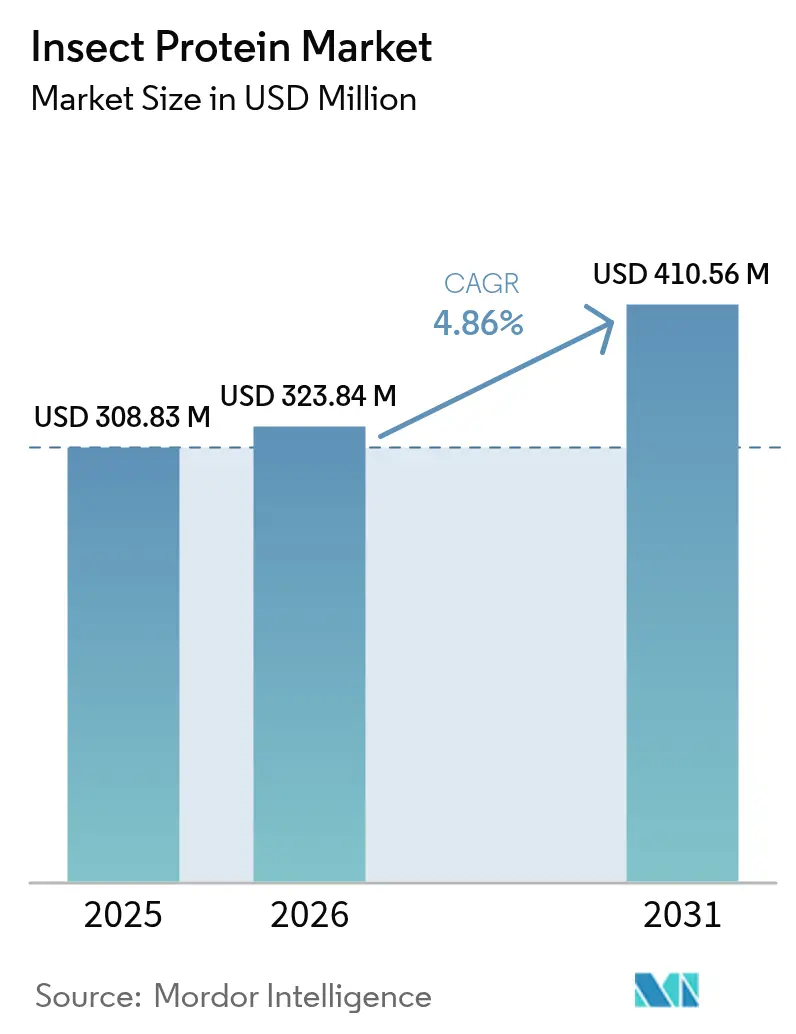
The insect protein market size in 2026 is estimated at USD 323.84 million, growing from the 2025 value of USD 308.83 million, with 2031 projections showing USD 410.56 million, growing at 4.86% CAGR over 2026-2031.
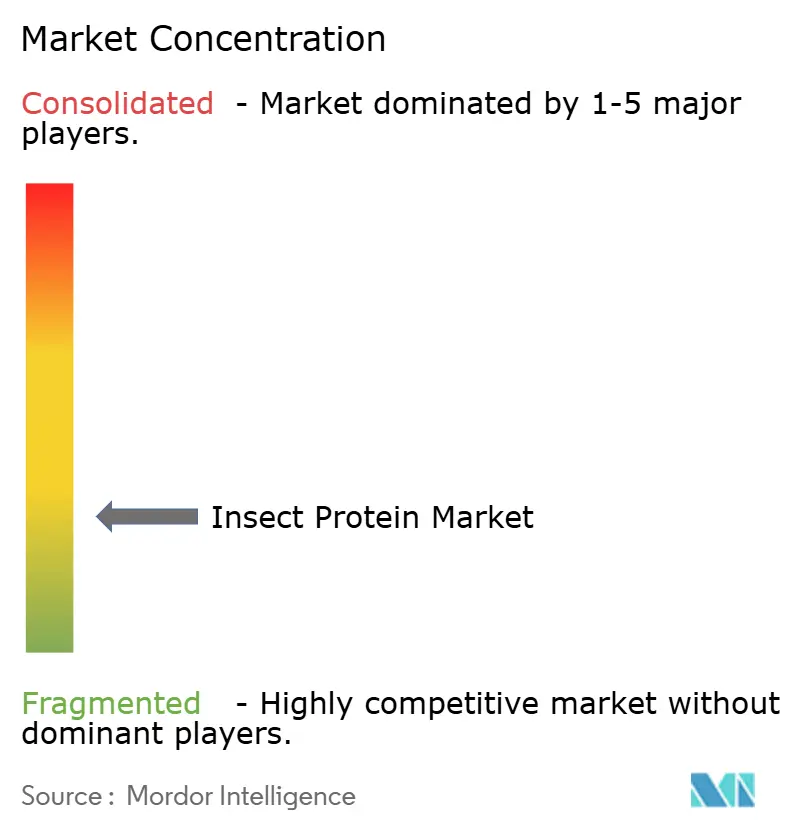
The Asia-Pacific region demonstrates significant growth potential in the insect protein market due to established cultural acceptance and the integration of advanced farming technologies, particularly AI-driven automation systems that optimize breeding conditions and resource efficiency. In Europe, recent regulatory developments in the insect protein market, including European Union novel-food approvals for four insect species, create opportunities for market expansion and investment, with companies developing innovative processing methods and product applications. North American market growth in the insect protein sector is propelled by strategic collaborations between established agricultural corporations and specialized insect protein producers, with a shared focus on scaling production capacity and enhancing cost efficiency. South America and Africa exhibit potential growth through the adoption of waste-conversion protein solutions, supported by government initiatives promoting sustainable protein alternatives.
The market remains fragmented, enabling new companies to establish positions in animal feed, human food, and specialty nutrition segments, with opportunities for differentiation through product innovation and sustainable production practices.
Key Report Takeaways
- By insect species, orthoptera held a 33.28% insect protein market share in 2025 and diptera is projected to expand at a 5.12% CAGR between 2026-2031.
- By end-use application, animal feed commanded 82.03% of the insect protein market size in 2025, and is advancing at the segment’s quickest 4.92% CAGR through 2031.
- By geography, Asia-Pacific led with 31.74% revenue share in 2025 and is forecast to grow at a 6.28% CAGR to 2031.
Note: Market size and forecast figures in this report are generated using Mordor Intelligence’s proprietary estimation framework, updated with the latest available data and insights as of 2026.
Market Trends and Insights
Drivers Impact Analysis of Insect Protein Market*
| Driver | (~) % Impact on CAGR Forecast | Geographic Relevance | Impact Timeline |
|---|---|---|---|
| Regulatory acceptance of insect-based protein | +1.2% | Europe, United Kingdom, North America | Medium term (2-4 years) |
| Rising demand for sustainable protein sources | +1.8% | Global, with emphasis on Europe and North America | Long term (≥ 4 years) |
| Growth in animal feed and pet food applications | +1.3% | Global, with emphasis on Asia-Pacific and Europe | Short term (≤ 2 years) |
| High nutritional value and functional properties | +0.9% | Global | Medium term (2-4 years) |
| Insect protein as a viable allergen-free option | +0.7% | Global, with emphasis on North America and Europe | Medium term (2-4 years) |
| Technological advances enabling scalable insect farming | +1.0% | Global, with emphasis on Asia-Pacific and Europe | Short term (≤ 2 years) |
| Source: Mordor Intelligence | |||
Regulatory Acceptance of Insect-based Protein
The regulatory framework for edible insects is evolving across the insect protein market through the establishment of safety standards and market access across regions. The European Union has approved four insect species for human consumption as of 2025: yellow mealworm, house cricket, and banded cricket, with additional species under review [1]Source: European Commission, “Approval of another insect/insect-derived food as a Novel Food,” food.ec.europa.eu. The approval process incorporates scientific evaluation and safety assessments for consumer protection. In January 2025, the European Commission authorized UV-treated powder from Tenebrio molitor larvae as a novel food ingredient, following evaluation by the European Food Safety Authority. The alignment of regulations with sustainability goals creates a stable environment for investment and product development. However, approval timelines vary across regions, giving advantages to companies operating in markets with established regulations. These regulatory differences influence market entry strategies and product launch timelines across the insect protein market for insect-based food manufacturers.
Rising Demand for Sustainable Protein Sources
The growing focus on environmental sustainability increases consumer and industry interest in alternative proteins within the insect protein market, particularly insects, which offer environmental benefits compared to traditional livestock farming. Black soldier fly larvae demonstrate strong circular economy potential by converting organic waste into protein while addressing waste management challenges. The larvae efficiently process various types of organic waste, including food scraps, agricultural residues, and industrial by-products, transforming them into high-quality protein sources. This dual benefit of waste reduction and protein production attracts investments across the insect protein market from both sustainability-focused venture capital firms and established agricultural companies seeking to diversify their protein offerings. The investment landscape includes early-stage funding rounds, strategic partnerships, and research collaborations aimed at scaling production capabilities and improving processing technologies. These investments support market expansion in the insect protein market despite current consumer acceptance limitations, particularly in Western markets where cultural barriers to insect consumption persist.
Growth in Animal Feed and Pet Food Applications
The insect protein market for animal feed continues to grow as regulations become less restrictive for feed applications compared to human consumption. This regulatory shift reflects increasing acceptance of insect-based ingredients in the animal feed industry. The European Union's authorization of processed insect protein for poultry and pig feed has created new market opportunities, particularly in aquaculture, where insect meal provides a sustainable alternative to fishmeal. The aquaculture sector's adoption of insect protein helps address environmental concerns while maintaining nutritional quality. The pet food segment shows significant promise within the insect protein market, with research from Kansas State University indicating that U.S. dog owners understand the nutritional benefits of insect protein and are willing to pay an additional USD 2.70 for an 18-pound bag compared to plant-based options. This consumer acceptance demonstrates the growing recognition of insect protein as a viable and sustainable ingredient in pet nutrition.
High Nutritional Value and Functional Properties
The nutritional profile of edible insects serves as a significant market driver for the insect protein market, owing to their substantial protein content (40-60%), complete amino acid profiles, and micronutrient composition. These insects contain essential nutrients, including iron, zinc, vitamin B12, and omega-3 fatty acids, making them valuable for human nutrition. Moreover, the insect protein demonstrate their effectiveness in meeting specific nutritional requirements, particularly in elderly nutrition where protein needs range from 1.2 to 1.7 g/kg/day to prevent muscle loss. The proteins found in insects are highly digestible and bioavailable, comparable to conventional protein sources like beef and fish. Insect proteins also offer functional benefits across the insect protein market in food applications; for instance, cricket protein concentrates derived from legs and antennae have a potential foaming capacity of 75.3%, making them suitable for aerated food products. Additionally, these proteins exhibit excellent emulsifying properties and water-holding capacity, enhancing their versatility in various food formulations.
Restraints Impact Analysis of Insect Protein Market*
| Restraint | (~) % Impact on CAGR Forecast | Geographic Relevance | Impact Timeline |
|---|---|---|---|
| Consumer acceptance and cultural barriers | -1.5% | North America, Europe | Medium term (2-4 years) |
| Limited scale of production | -0.8% | Global | Short term (≤ 2 years) |
| Sensory off-notes in insect protein curbing mainstream food and beverage adoption | -1.1% | Global, with emphasis on Western markets | Medium term (2-4 years) |
| High production and processing costs | -0.9% | Global | Medium term (2-4 years) |
| Source: Mordor Intelligence | |||
Consumer Acceptance and Cultural Barriers
Consumer resistance to insect consumption, particularly in Western markets, remains a key challenge for the insect protein market, primarily stemming from psychological barriers, including food neophobia and disgust responses. For instance, consumers exhibit strong aversions to insects as food due to cultural conditioning and unfamiliarity. Consumer acceptance of insect-based products depends on product presentation. Consumers demonstrate higher acceptance of insect protein when it is processed into flours or powders, compared to visible whole insects. This consumer preference has led manufacturers to develop processing methods that incorporate insect protein into conventional food formats to address cultural barriers and increase market adoption. Incorporating these processed insect ingredients into familiar food products offers a pathway for market expansion in the insect protein market. Educational programs focused on the nutritional and environmental advantages of insect consumption can gradually shift cultural perceptions. These initiatives often emphasize insects' high protein content, minimal environmental footprint, and role in sustainable food systems to overcome existing prejudices.
Sensory off-notes in Insect Protein Curbing Mainstream Food and Beverage Adoption
The sensory attributes of insect-based foods remain a primary barrier to widespread adoption in the insect protein market and consumer acceptance. A 2025 study identified distinct flavor profiles in insect flours, including protein/meat, cereal/bread, and stale food notes, which resulted in poor consumer ratings, especially in meat alternatives [2]Source: Royal Society of Chemistry, “Sensory Profile and Consumer Acceptance of Edible Insects and Insect-based Foods,” books.rsc.org. In comparative analyses of cricket-based crispbreads, products containing Tenebrio molitor (yellow mealworm) received higher consumer acceptance scores compared to those with Acheta domesticus (house cricket), which exhibited earthy and pet food-like characteristics. While ingredient combinations and flavor-masking methods continue to improve the taste profile of insect-based products, achieving comparable sensory qualities to traditional protein sources remains a challenge.
*Our forecasts treat driver/restraint impacts as directional, not additive. The impact forecasts reflect baseline growth, mix effects, and variable interactions.
Insect Protein Market Segment Analysis
By Insect Species:
Diptera Disrupts Orthoptera DominanceOrthoptera (crickets, grasshoppers, locusts) maintains the largest insect protein market share at 33.28% in 2025, driven by established farming practices and widespread use in food and feed sectors. Diptera (black soldier fly larvae) demonstrates the highest growth rate with a projected CAGR of 5.12% from 2026-2031, primarily due to its efficient organic waste-to-protein conversion capabilities. Coleoptera (mealworms) maintains a significant market position, supported by its mild flavor and regulatory approvals, including the European Commission's authorization of UV-treated powder from whole Tenebrio molitor larvae as a novel food in January 2025. Hymenoptera (ants, bees, wasps) and Hemiptera (cicadas, leafhoppers) represent smaller market segments with specialized applications.
In February 2025, Japan's National Agriculture and Food Research Organization enhanced the nutritional profile of black soldier fly larvae through biotechnology. The suppression of the HiNATt gene, which controls amino acid excretion, increased amino acid retention by 1.8-fold, with histidine and methionine levels rising by more than 2.5 times. This advancement addressed nutritional limitations and increased black soldier fly protein applications in premium feed products. The competition within the insect protein market among insect species depends on regulatory approvals, as novel food authorizations enable broader applications and improve consumer acceptance.




By End-Use Application:
Animal Feed Dominates While Food and Beverage InnovatesThe animal feed segment accounts for 82.03% of the insect protein market share in 2025 and is projected to grow at a CAGR of 4.92% during 2026-2031. The industry prioritizes introducing insect proteins in livestock applications before human consumption. Broilers fed with insect-based meals derived from termites, African palm weevil, and grasshoppers demonstrate higher weight gain and better carcass quality compared to broilers fed conventional diets. The food and beverages segment is expanding through bakery and snack applications, where insect flours integrate into products without affecting taste and texture. controlled fermentation of bread containing insect ingredients improves both its nutritional value and consumer acceptance.
The fermentation process helps break down proteins and enhances the bioavailability of nutrients within the insect protein market while reducing potential off-flavors associated with insect-based ingredients. This method of preparation has proven effective in increasing protein content, essential amino acids, and mineral absorption, making the bread more nutritionally beneficial while simultaneously improving its taste and texture for consumers. The elderly and medical nutrition segment presents growth opportunities, as insect proteins meet the higher protein requirements of older adults (1.2 to 1.7 g/kg/day) and help prevent muscle loss through protein synthesis in sarcopenia.

Geography Analysis
APAC Insect Protein Market
Asia-Pacific holds 31.74% of the global insect protein market in 2025 and is expected to grow at 6.28% through 2031. The region's market leadership is rooted in established consumption patterns and cultural acceptance, with Thailand, China, and South Korea emerging as key markets. These countries have implemented supportive government policies and adopted advanced farming technologies to expand insect production. The integration of modern farming methods with traditional practices has strengthened the region's position in the global market. Advanced production techniques, coupled with increasing consumer awareness about sustainable protein sources, have created favorable conditions for market expansion in the Asia-Pacific region.
Europe and North America Insect Protein Market
Europe and North America are established markets for insect protein, with growth driven by regulatory changes and increased focus on sustainable food production. The European Food Safety Authority's (EFSA) approval of insect species for human consumption has increased product launches in snacks and bakery products. The Netherlands, France, and Belgium lead in large-scale insect farming, supported by research capabilities and regulatory frameworks. In North America, consumer acceptance is increasing due to interest in protein alternatives and the nutritional benefits of insect-based ingredients. The region shows continued investment growth in pet food and aquaculture feed applications.
MEA and South America Insect Protein Market
South America, Middle East, and Africa are developing markets with unique regional characteristics. Brazil spearheads South American market development through research initiatives focused on indigenous insect species and their commercial uses. In the Middle East and Africa, the market combines traditional consumption practices with new commercial insect farming operations, particularly in South Africa, where black soldier fly cultivation has gained investment interest.

Competitive Landscape
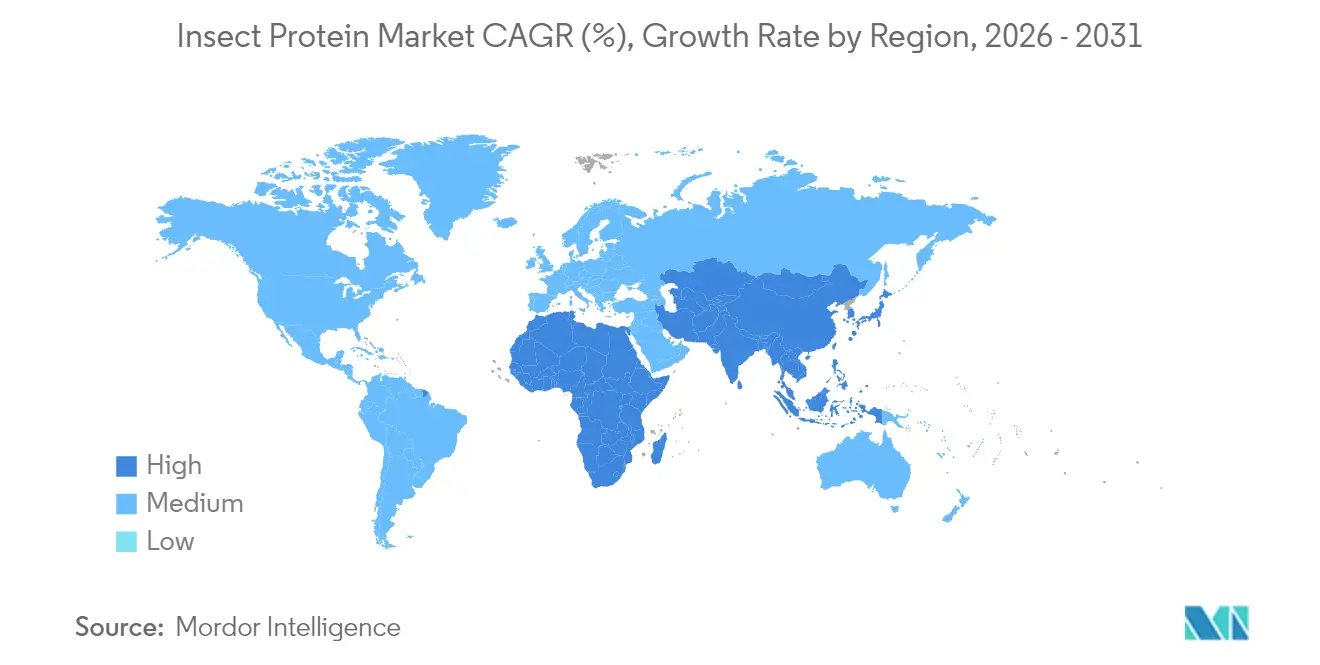
The global insect protein market has a fragmented competitive structure, indicating significant opportunities for new entrants and strategic consolidation. The market comprises specialized insect protein producers and traditional food companies that enter through strategic partnerships and investments. This fragmentation allows for diverse market approaches and creates space for innovative business models in the insect protein sector. Some of the major players in the market include Protix B.V., Ynsect NL B.V., Protenga, and Darling Ingredients Inc.
The market's low concentration drives innovation as companies differentiate themselves through proprietary production technologies, species selection, and application development. Strategic partnerships between established food companies and insect protein specialists are reshaping the competitive landscape. These collaborations facilitate knowledge transfer and accelerate market development through combined expertise and resources.
Companies like Nasekomo are implementing automated insect rearing beds that achieve a 25% feed conversion ratio (March 2025), enhancing scalability and efficiency in black soldier fly production. The adoption of such technological advancements in automation and precision farming enables companies to reduce operational costs and strengthen their position in the expanding market. The market presents opportunities in specialized segments, including elderly nutrition and medical foods, where insects' high-quality protein and bioactive compounds address specific health requirements with lower consumer resistance compared to mainstream food applications. These specialized applications demonstrate the versatility and potential of insect-based products in various market segments.
Insect Protein Industry Leaders
Ynsect NL B.V. (Spryng)
Protenga
Darling Ingredients Inc.
nextProtein
Protix B.V.
- *Disclaimer: Major Players sorted in no particular order
Insect Protein Market Companies Covered in this Report
- Ynsect NL B.V. (Spryng)
- Protenga
- Darling Ingredients Inc.
- nextProtein
- Protix B.V.
- Innovafeed
- Sentara Group (Nutrition Technologies)
- Entobel Holding Pte. Ltd
- Hexafly
- EAP Group (Agronutris)
- Divaks Food, UAB
- JR Unique Foods Ltd
- Beta Hatch
- Keetup
- Inseco
- Mukka Proteins Limited (Ento proteins)
- Enorm Biofactory A/S
- Nasekomo B.V. (Nasekomo EAD)
- Cricket One
- Chapul

Recent Industry Developments in Insect Protein Market
- February 2025: Insectika Biotech introduced an insect protein-based fish feed in Odisha, formulated for Asian sea bass and aquarium species. The company developed the feed in collaboration with the Central Institute of Brackishwater Aquaculture (CIBA) and presented it at the Shrimp Farmers' Conclave 2025, which drew more than 500 advanced farmers and hatchery owners.
- April 2024: Innovafeed, a global producer of insect ingredients, established its North American Insect Innovation Center (NAIIC) in Decatur, Illinois. The pilot facility, located in the corn belt region, represents Innovafeed's first industrial expansion in North America and focuses on increasing insect protein production and commercialization in the United States. The NAIIC, operating in collaboration with ADM, specializes in black soldier fly breeding and transforms agricultural byproducts into insect meal, oil, and soil amendment.
- January 2024: Ÿnsect obtained authorization from the Association of American Feed Control Officials (AAFCO) to commercialize defatted mealworm proteins (Protein70) for dog food in the United States, becoming the first company to receive such approval. This authorization allows Ÿnsect to enter the US pet food market with its protein alternative. The mealworm-based protein provides pet food manufacturers with a nutritious ingredient option.
- October 2023: Tyson Foods, one of the world's largest protein producers, made a partnership/two-part investment in Protix, a Dutch insect ingredients company. The investment includes a minority equity stake in Protix and a joint venture to construct and operate the first large-scale insect ingredient facility in the continental United States. The facility will process food manufacturing byproducts into black soldier fly protein and lipids, intended for pet food, aquaculture, livestock, and plant feed markets.


Global Insect Protein Market Report Scope
Insect protein can be defined as the protein sourced from edible insects like ants, crickets, mealworms, grasshoppers, etc.
The global insect protein market is segmented by insect species, end-use application, and geography. By insect species, the market studied is segmented into Coleoptera (Mealworms), Diptera (Black Soldier Fly Larvae), Orthoptera (Crickets, Grasshoppers, Locusts), Hymenoptera (Ants, Bees, Wasps), and Hemiptera (Cicadas, Leafhoppers). By end-use application, the market studied is segmented into animal feed (aquaculture, poultry, pet food and livestock) and food & beverages (bakery, snacks, beverages, RTE/RTC products and condiments & sauces) and elderly and medical nutrition. The report also provides an analysis of the emerging and established geographical regions by covering regions, such as North America, Europe, Asia-Pacific, South America, and Middle East & Africa.
The market sizing has been done in value terms in USD and for volume terms in volume in tons for all the abovementioned segments.
| Coleoptera (Mealworms) |
| Diptera (Black Soldier Fly Larvae) |
| Orthoptera (Crickets, Grasshoppers, Locusts) |
| Hymenoptera (Ants, Bees, Wasps) |
| Hemiptera (Cicadas, Leafhoppers) |
| Animal Feed | Aquaculture |
| Poultry | |
| Pet Food | |
| Livestock (Swine, Cattle) | |
| Food and Beverages | Bakery |
| Snacks | |
| Beverages | |
| RTE/RTC Products | |
| Condiments and Sauces | |
| Elderly and Medical Nutrition |
| North America | United States |
| Canada | |
| Mexico | |
| Rest of North America | |
| Europe | Germany |
| United Kingdom | |
| France | |
| Spain | |
| Italy | |
| Netherlands | |
| Rest of Europe | |
| Asia-Pacific | China |
| India | |
| Japan | |
| South Korea | |
| Australia | |
| Thailand | |
| Vietnam | |
| Indonesia | |
| Malaysia | |
| Rest of Asia-Pacific | |
| South America | Brazil |
| Argentina | |
| Rest of South America | |
| Middle East and Africa | United Arab Emirates |
| Saudi Arabia | |
| South Africa | |
| Rest of Middle East and Africa |
| By Insect Species | Coleoptera (Mealworms) | |
| Diptera (Black Soldier Fly Larvae) | ||
| Orthoptera (Crickets, Grasshoppers, Locusts) | ||
| Hymenoptera (Ants, Bees, Wasps) | ||
| Hemiptera (Cicadas, Leafhoppers) | ||
| By End-Use Application | Animal Feed | Aquaculture |
| Poultry | ||
| Pet Food | ||
| Livestock (Swine, Cattle) | ||
| Food and Beverages | Bakery | |
| Snacks | ||
| Beverages | ||
| RTE/RTC Products | ||
| Condiments and Sauces | ||
| Elderly and Medical Nutrition | ||
| By Geography | North America | United States |
| Canada | ||
| Mexico | ||
| Rest of North America | ||
| Europe | Germany | |
| United Kingdom | ||
| France | ||
| Spain | ||
| Italy | ||
| Netherlands | ||
| Rest of Europe | ||
| Asia-Pacific | China | |
| India | ||
| Japan | ||
| South Korea | ||
| Australia | ||
| Thailand | ||
| Vietnam | ||
| Indonesia | ||
| Malaysia | ||
| Rest of Asia-Pacific | ||
| South America | Brazil | |
| Argentina | ||
| Rest of South America | ||
| Middle East and Africa | United Arab Emirates | |
| Saudi Arabia | ||
| South Africa | ||
| Rest of Middle East and Africa | ||


Key Questions Answered in the Report
What is the current size of the insect protein market?
The insect protein market is valued at USD 323.84 million in 2026.
How fast will the insect protein market grow?
It is projected to grow at a 4.86% CAGR, reaching USD 410.56 million by 2031.
Which region leads the insect protein market?
Asia-Pacific accounts for 31.74% of 2025 revenues and is set to expand at a 6.28% CAGR to 2031.
Which insect species segment is growing the fastest?
Diptera (black soldier fly larvae) is forecast to register the highest 5.12% CAGR between 2026-2031.
Why is animal feed the dominant application?
Regulator acceptance and performance parity with fishmeal allow insect meal to integrate quickly into aquafeed, poultry, and pet-food formulas, giving animal feed 82.03% share in 2025.
Page last updated on:


 Your data is secure and never sold or shared.


