
Additive Manufacturing And Materials Market Size and Share
Market Overview
| Study Period | 2020 - 2031 |
|---|---|
| Market Size (2026) | USD 110.63 Billion |
| Market Size (2031) | USD 233.58 Billion |
| Growth Rate (2026 - 2031) | 16.12 % |
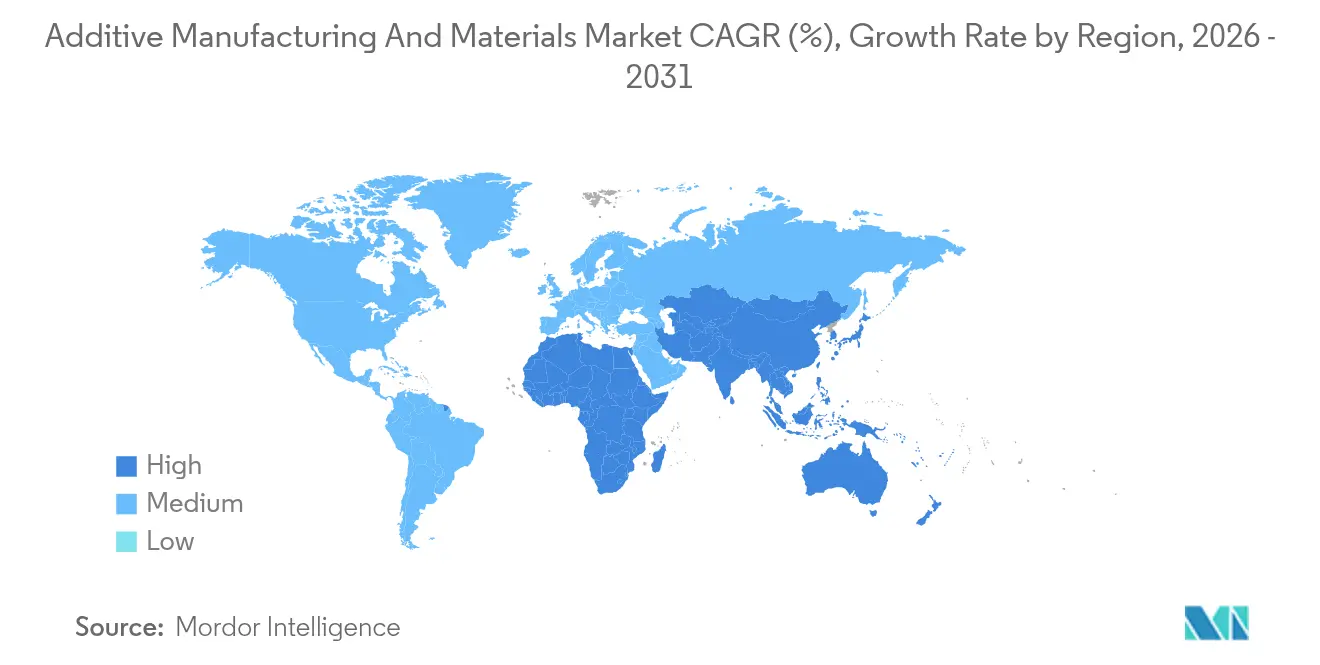
| Fastest Growing Market | Asia Pacific |
| Largest Market | North America |
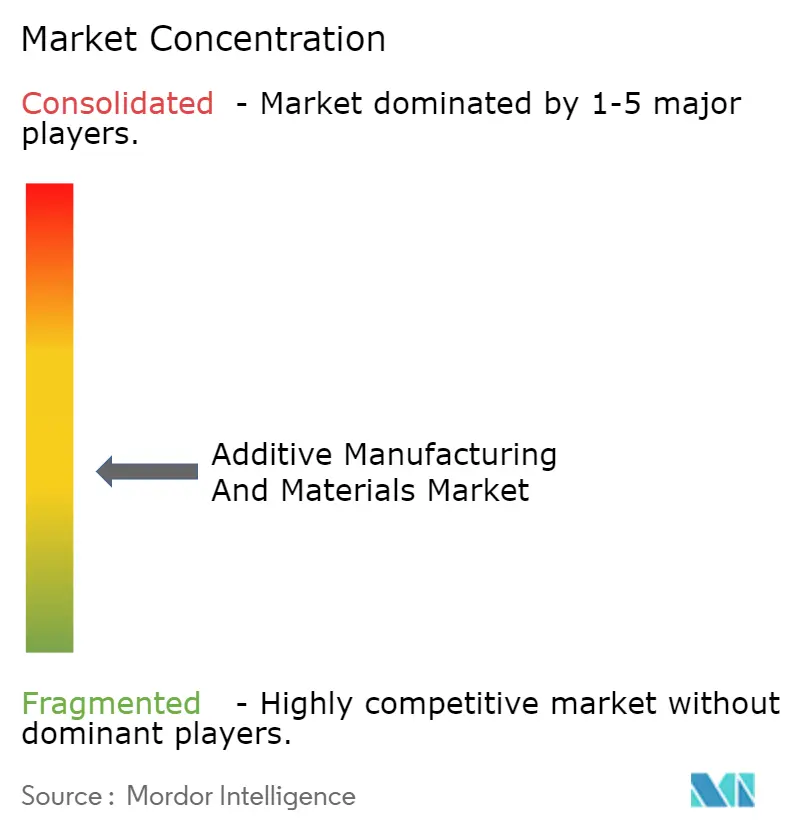
| Market Concentration | Medium |
Major Players *Disclaimer: Major Players sorted in no particular order Image © Mordor Intelligence. Reuse requires attribution under CC BY 4.0. | |
Additive Manufacturing And Materials Market Analysis by Mordor Intelligence
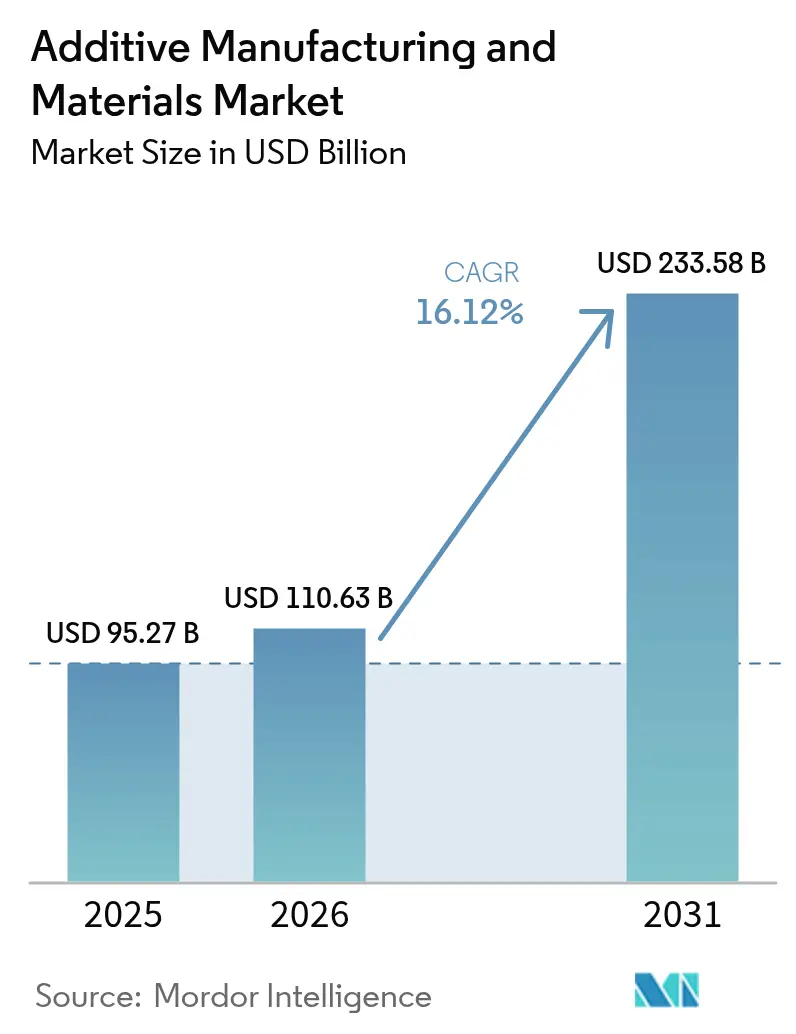
The additive manufacturing and materials market size is expected to grow from USD 95.27 billion in 2025 to USD 110.63 billion in 2026 and is forecast to reach USD 233.58 billion by 2031 at 16.12% CAGR over 2026-2031. Falling material prices, aerospace demand for lightweight parts, and rapid healthcare adoption shift the additive manufacturing and materials market away from prototyping and into volume production. Standardization programs at NIST and ASTM provide unified qualification pathways that lower certification costs, while government incentives in North America, Europe, and Asia Pacific accelerate factory-level deployment.[1]Competitive intensity rises as vendors integrate software, printers, and qualified powders to deliver turnkey production lines that meet industrial uptime requirements. Simultaneously, circular-economy policies motivate producers to qualify recycled polymer and metal feedstocks, creating cost and sustainability advantages for regions with established waste-processing capacity. Space agencies validate in-orbit metal printing, opening a long-term frontier for on-site micro-production that removes costly launch mass.
Key Report Takeaways
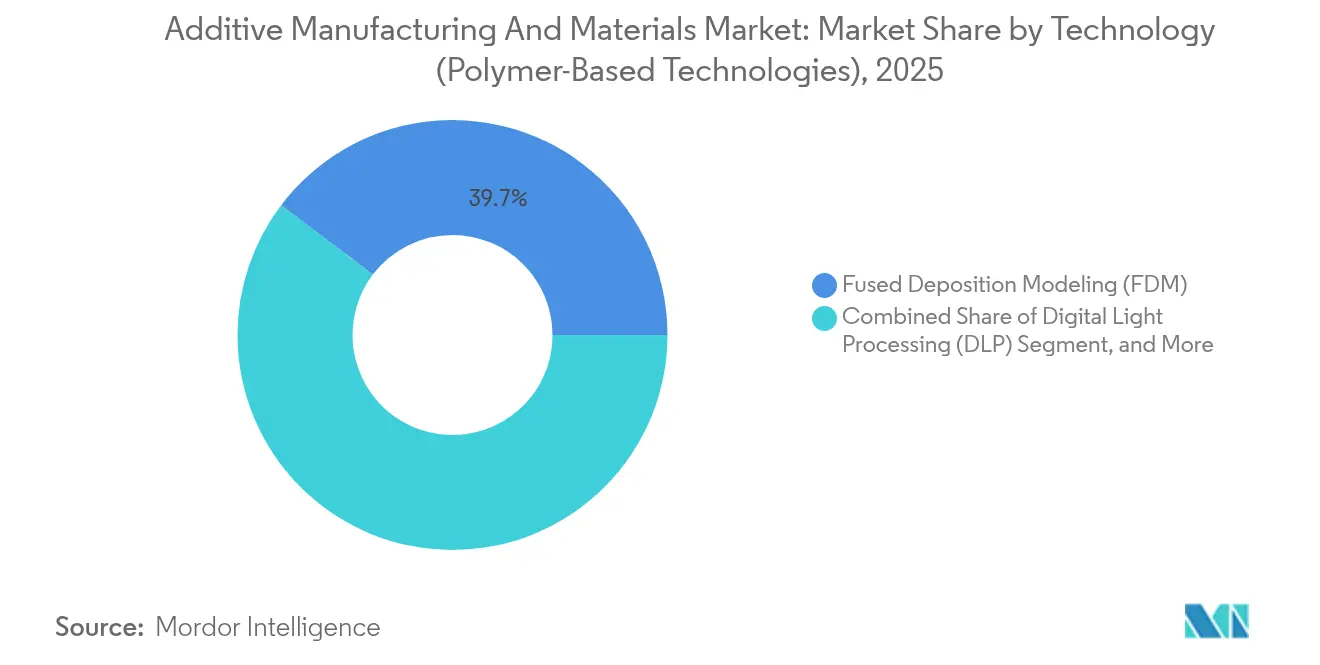
- By technology, Fused Deposition Modeling held 39.68% of additive manufacturing and materials market share in 2025, while Directed Energy Deposition is expected to expand at a 16.98% CAGR through 2031.
- By material type, plastics captured 55.12% share of the additive manufacturing and materials market size in 2025; high-performance thermoplastics are advancing at an 17.62% CAGR to 2031.
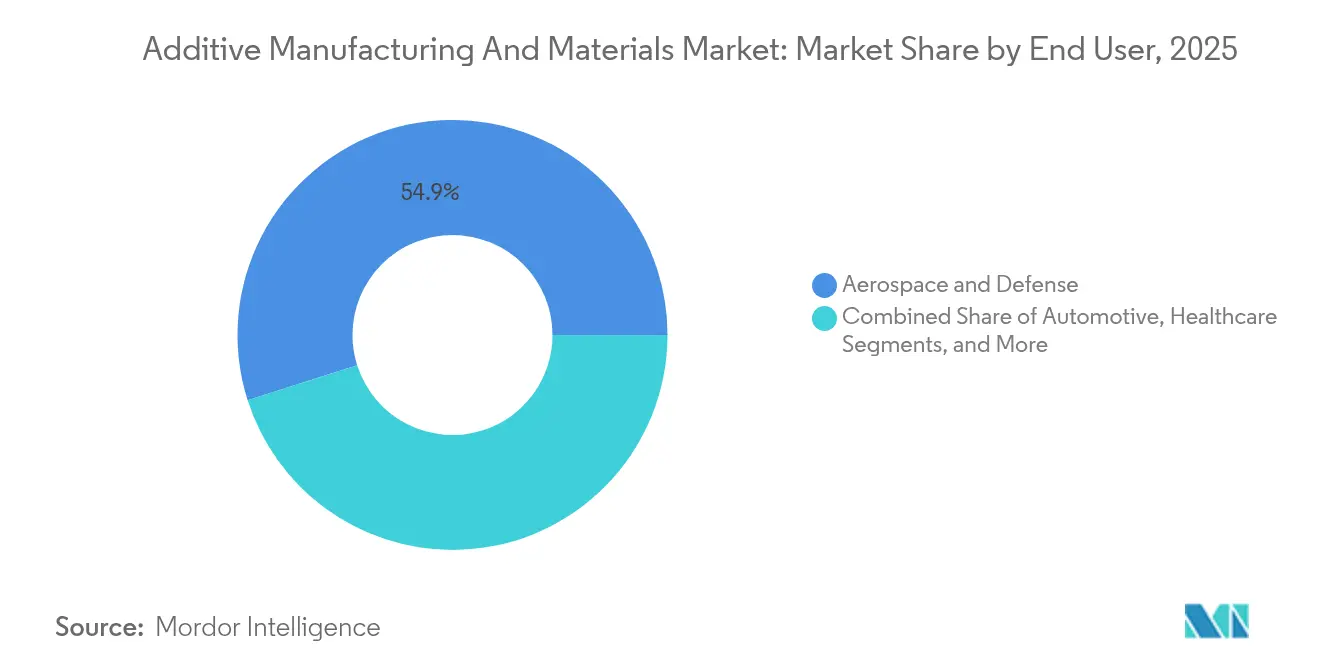
- By end user, aerospace and defense led with 54.90% revenue share in 2025, whereas healthcare is projected to log the highest CAGR at 16.91% through 2031.
- By geography, North America commanded 36.45% share of the additive manufacturing and materials market in 2025, while Asia Pacific is forecast to post a 16.55% CAGR during the outlook period.
Note: Market size and forecast figures in this report are generated using Mordor Intelligence’s proprietary estimation framework, updated with the latest available data and insights as of 2026.
Market Trends and Insights
Drivers Impact Analysis of Additive Manufacturing And Materials Market*
| Driver | (~) % Impact on CAGR Forecast | Geographic Relevance | Impact Timeline |
|---|---|---|---|
| Aerospace & automotive weight reduction | +3.2% | North America, Europe | Medium term (2–4 years) |
| Patient-specific healthcare implants | +2.8% | North America, Europe | Short term (≤ 2 years) |
| Falling polymer and metal powder prices | +2.1% | Global | Short term (≤ 2 years) |
| Government funding and standards alignment | +2.5% | North America, Europe, Asia Pacific | Long term (≥ 4 years) |
| Circular-economy recycled feedstocks | +1.9% | Europe, North America | Medium term (2–4 years) |
| On-site micro-production for space missions | +1.4% | North America, Europe | Long term (≥ 4 years) |
| Source: Mordor Intelligence | |||
Demand for lightweight components in automotive and aerospace
Aerospace OEMs condense multi-part assemblies into single printed geometries to trim aircraft weight and maintenance. GE Aviation’s printed fuel nozzle replaces twenty components and saves carriers USD 1.6 million in lifetime operating costs per aircraft.[2]Boeing integrates titanium lattice brackets on the 787 that cut part cost by USD 2–3 million while meeting structural standards. Automotive firms replicate this consolidation in battery housings and brake systems to extend electric-vehicle range. Topology-optimization software unlocks organic shapes unattainable with machining, giving early adopters a performance edge. ASTM F2792 definitions standardize terminology and testing, helping certifiers approve flight-critical parts faster.
Rapid adoption of patient-specific healthcare implants
Powder-bed fusion enables porous titanium implants that match individual anatomy, improving osseointegration and cutting failure rates. Stryker has produced over 2 million such devices, proving the scalability of hospital-grade additive workflows.[3]The U.S. FDA’s point-of-care guidance lets certified hospitals print surgical guides onsite, reducing lead times and inventory costs. Distributed production shifts value from centralized factories to clinical settings, shrinking logistics footprints. Premium demand pushes cobalt-chrome and titanium powder suppliers to scale atomization capacity despite tight aerospace allocation.
Government funding and standards harmonization
NIST funds metrology projects that quantify porosity, residual stress, and dimensional accuracy across disparate printer platforms. America Makes funnels federal grants into industry–academia teams that qualify new steel and nickel alloys for flight hardware. Coordinated ASTM and ISO committees publish common parameter sets so parts certified in one region gain reciprocal acceptance. Such harmonisation lowers compliance costs for suppliers entering new verticals, especially in medical and defense.
Evonik’s Structured Polymers line processes shredded consumer plastics into uniform powders between 0.1 µm and 400 µm, retaining mechanical performance equal to virgin resins. European regulations monetise recycled inputs through tax credits, converting waste streams into revenue. Laser-powder-bed systems already recycle up to 75% of unused metal powder during recoating cycles, trimming material spend. Brands leverage sustainability labeling to justify premium pricing and meet Scope 3 carbon targets, turning environmental compliance into a sales lever.
Restraints Impact Analysis of Additive Manufacturing And Materials Market*
| Restraint | (~) % Impact on CAGR Forecast | Geographic Relevance | Impact Timeline |
|---|---|---|---|
| High cost of high-performance metals & polymers | -2.7% | Global | Short term (≤ 2 years) |
| Intellectual-property leakage risks | -1.8% | North America, Europe | Medium term (2-4 years) |
| Strict EHS rules for nano-powder handling | -1.5% | Europe, North America | Long term (≥ 4 years) |
| Critical-alloy supply volatility | -2.1% | Global | Medium term (2-4 years) |
| Source: Mordor Intelligence | |||
High cost of high-performance metals and polymers
PEEK, PEKK, and aerospace-grade titanium powders trade at premiums that smaller job shops struggle to absorb. Limited atomizer capacity and energy-intensive plasma processes elevate raw-material costs just as buyers push for volume pricing. Suppliers face a squeeze between customers requesting discounts and investors demanding R&D spending, delaying next-generation material rollouts. Automotive and consumer sectors therefore confine purchases to prototypes or high-margin components until cost curves fall.
Supply-chain volatility in critical alloying elements
Titanium sponge production remains concentrated in a handful of nations, exposing powder makers to geopolitical shock. Rare earths for superalloys face similar concentration risk, prompting OEMs to dual-source and pre-qualify substitute chemistries. Qualifying a new alloy for flight or implant use adds years of fatigue testing, so any disruption ripples across production schedules. Strategic stockpiles and forward contracts help, but cash-flow burdens rise in a capital-tight environment.
*Our forecasts treat driver/restraint impacts as directional, not additive. The impact forecasts reflect baseline growth, mix effects, and variable interactions.
Additive Manufacturing And Materials Market Segment Analysis
By Technology:
Metal processes lead premium growthDirected Energy Deposition posts a 16.98% CAGR, underpinned by aerospace engine repair where meter-scale parts eclipse powder-bed build volumes. This segment benefits from wire feedstock that costs 30-50% less than powder and recoups material unused in other systems. Fused Deposition Modeling, however, retains 39.68% additive manufacturing and materials market share due to its ubiquity in education, design, and low-stress industrial fixtures. Hybrid CNC-additive platforms merge laser cladding with five-axis milling to meet tolerance and surface roughness targets in a single setup.
Powder Bed Fusion remains the benchmark for lattice-rich implants and rocket turbopump components requiring sub-80 µm layer heights. Binder Jetting evolves for steel pump housings and sand casting molds, offering throughput advantages when sintering bottlenecks are solved. Emerging microwave volumetric systems promise order-of-magnitude speed gains, foreshadowing a future where build time no longer dictates unit economics.

By Material Type:
Performance polymers acceleratePlastics maintain 55.12% share of additive manufacturing and materials market size in 2025, driven by ABS and PLA prototyping demand. High-performance thermoplastics log an 17.62% CAGR as aerospace cabins, rail interiors, and EV battery covers require flame-smoke-toxicity compliance at elevated temperatures.Additive manufacturing and materials market share tilts toward metal feedstocks in engines, landing gear, and orthopedic stems where titanium alloys deliver optimal strength-to-weight ratios. Carbon-fiber-reinforced PA12 filaments provide directional stiffness for drone frames and sporting goods, blurring the line between polymer and composite classes.
Recycled PET-G filaments satisfy consumer electronics brands pursuing closed-loop packaging targets, while copper powders with >95% conductivity unlock motor windings and heat exchangers. Material suppliers bundle digital process parameters with every batch, ensuring first-time-right builds that cut trial-and-error costs for end users.
By End User:
Healthcare rises fastestAerospace and defense represented 54.90% of additive manufacturing and materials market share in 2025, anchored by flight-qualified fuel nozzles, satellite brackets, and hypersonic inlet liners. Healthcare delivers the fastest 16.91% CAGR as hospitals print patient-matched cranial plates, spinal cages, and surgical models directly from CT scans. Dental labs adopt intra-oral scanners and resin printers to ship same-day crowns, lifting throughput tenfold over milling. Automakers escalate deployment for lightweight brake calipers and topology-optimized brackets that extend EV range by several kilometers per charge.Industrial machinery OEMs embrace on-demand spare parts to minimize warehouse overhead and field downtime.
Geography Analysis
North America Additive Manufacturing and Materials Market
North America commands 36.45% additive manufacturing and materials market size in 2025, supported by defense budgets, NASA deep-space initiatives, and a mature supplier ecosystem. Federal tax incentives and Section 174 R&D expensing rules reward capital investment in new production lines. FDA 510(k) guidance for 3D-printed implants accelerates time-to-market for device OEMs, reinforcing domestic powder consumption.
APAC Additive Manufacturing and Materials Market
Asia Pacific is the fastest-growing region at a 16.55% CAGR as China funds domestic printer champions to lessen dependence on imported engine parts. Singapore’s National Additive Manufacturing cluster certifies aerospace alloys and trains technicians, turning the island into a regional export hub.India’s Production-Linked Incentive program subsidizes metal-printer purchases for automotive and energy verticals, while Australia’s Cooperative Research Centre advances titanium powder atomization from local ore.
Europe Additive Manufacturing and Materials Market
Europe focuses on sustainability; the EU’s Fit-for-55 package spurs OEMs to print lightweight brackets that reduce vehicle emissions. The European Space Agency demonstrates the first stainless-steel part fabricated aboard the ISS, validating micro-gravity printing for lunar infrastructure. German carmakers co-develop aluminum-silicon alloys that weld seamlessly without hot-crack defects, setting a benchmark for crash-relevant applications.
Regulatory Landscape
Regulation for additive manufacturing (AM) continues to center on safety, qualification, and conformity assessment, with standards bodies providing the primary compliance anchors across industries. ISO advances machine-safety and process-capability frameworks, including publication of ISO/ASTM 52938-1:2025 covering safety requirements for laser-based powder bed fusion (PBF-LB) metal machines, and progress on ISO/ASTM DIS 52966 moving toward a qualification framework for categorizing AM process capabilities. In the United States, NIST and ASTM-led standardization and measurement programs remain key pathways that reduce certification friction across aerospace and medical applications.
In 2026, policy activity also focused on speeding qualification for safety-critical parts and clarifying trade exposure. The U.S. Department of Transportation released its CM4QC strategy to accelerate qualification and certification of process-intensive metal AM components for aviation, reinforcing computational materials and digital evidence in acceptance workflows. Separately, a U.S. Congressional Research Service update noted that the USTR proposed no additional tariffs on AM equipment for 2026, with potential adjustments deferred to June 2027, which reduces near-term uncertainty for capital-equipment sourcing and multi-year production planning.
Value Chain Analysis
The AM value chain spans feedstock production (polymer filaments, photopolymer resins, and gas-atomized metal powders), printer OEMs (polymer and metal platforms), process and build-prep software, post-processing (depowdering, heat treatment, HIP, machining, surface finishing), qualification and inspection (metrology, CT, mechanical testing), and distribution models ranging from service bureaus to in-house production cells. For industrial end users such as aerospace, defense, and healthcare, qualification data packages and repeatable parameter sets increasingly function as core value-chain assets alongside hardware. They shape material selection, supplier approval, and the ability to port designs across machine fleets.
Bottlenecks remain concentrated around standardized qualification protocols, fragmented data ownership, and long lead times for aerospace-grade raw materials, which slow scaling from prototype to serial production. In 2026, industry collaboration and digital inventory models became more prominent. The Additive Manufacturing Alliance formed around major ecosystem participants (including Ansys, EOS, HP, Materialise, Nikon SLM Solutions, Renishaw, and Stratasys) to support industrial adoption through shared standards and communication, while partnerships such as Würth Additive Group with B9Creations pushed on-demand spare-parts workflows through Digital Inventory Services. Public-private initiatives such as ARC and Oak Ridge National Laboratory's Exascale Foundry also signal tighter coupling of distributed manufacturing platforms with high-performance computing to compress qualification and production cycles for mission-critical parts.
Competitive Landscape
Market fragmentation prevails, yet mounting losses push OEMs to consolidate. The top four public vendors collectively booked USD 986.2 million in net losses over the last fiscal year, sparking mergers that seek cost synergies rather than revenue growth. Nano Dimension’s USD 183 million acquisition of Desktop Metal unites polymer and metal platforms to offer an end-to-end production suite. Stratasys buys Arevo’s composite IP, adding continuous-fiber deposition that meets aerospace strength targets while lowering mass.
Suppliers diversify into certified powders and post-processing equipment to capture recurring margins as hardware prices slide. ISO 9001 and AS9100 registrations become prerequisites for aerospace purchase orders, weeding out under-capitalized entrants. Hybrid machining firms such as United Grinding integrate laser cladding modules into five-axis mills, collapsing workflows for turbine blades and tool inserts. Forward integration extends to software; build-simulation codes leverage multi-physics models to predict distortion, reducing scrap rates and shortening design loops.
Additive Manufacturing And Materials Industry Leaders
-
3D Systems Corporation
-
Stratasys Ltd
-
EnvisionTEC GmbH
-
Exone Company
-
General Electric Company (GE Additive)
- *Disclaimer: Major Players sorted in no particular order
Additive Manufacturing And Materials Market Companies Covered in this Report
- BASF 3D Printing Solutions GmbH
- Evonik Industries AG
- Arkema S.A.
- Sandvik AB
- Höganäs AB
- Stratasys Ltd.
- 3D Systems Corporation
- General Electric Company (GE Additive)
- EOS GmbH
- Materialise NV
- Desktop Metal Inc.
- Markforged Holding Corporation
- Carpenter Technology Corporation
- Heraeus Holding GmbH
- GKN Powder Metallurgy Holdings GmbH
- HP Inc.
- Prodways Group SA
- SLM Solutions Group AG
- Henkel AG and Co. KGaA
- DSM-Covestro Additive Manufacturing (Covestro AG)
- ExOne Company (Desktop Metal)
Read Analysis of Additive Manufacturing And Materials Companies
Market Opportunities and Future Outlook
Material availability and qualification-ready feedstocks represent a visible whitespace as end users move from prototyping toward higher-volume production, particularly in metal powders for defense, aerospace, and energy applications. Recent investments and public funding highlight this direction. In April 2026, 6K Additive broke ground on a 45-acre expansion in Burgettstown, Pennsylvania, supported by a USD 23.4 million DPA Title III grant, targeting a step-up in powder capacity (from 200 to 1,000 metric tons annually). In Europe, SSAB announced a June 2026 expansion of steel powder production capacity in Oxelosund, Sweden, signaling increased attention to broader alloy portfolios and regional supply resilience.
A second opportunity area is production-scale industrialization supported by certified workflows, where software, factory integration, and application-specific materials are becoming differentiators alongside printer throughput. Company actions in 2026 reinforce this shift: Velo3D announced a large production campus in Livermore, California, to support serial metal AM, and IperionX raised capital in July 2026 to expand its U.S. titanium operations and advance its Camden Titanium Project, directly addressing critical alloy-supply concerns noted by OEMs. Parallel programs in aerospace, including Safran's emphasis on additive manufacturing within the CFM RISE engine program, keep qualification standards (ASTM/ISO and aviation certification expectations) closely linked to commercial scaling. That creates openings for suppliers that can bundle certified materials, validated parameters, and traceable digital quality records.
Recent Industry Developments in Additive Manufacturing And Materials Market
- June 2026: Stratasys introduced FDM PA6/66-GF30-FR, a flame-retardant composite for Fortus 450mc and F900 systems, with compliance references including EN 45545-2 HL2 and FMVSS 302. The release expands addressable transportation and rail applications where material compliance gates purchasing decisions and shortens qualification cycles for production parts.
- May 2026: Stratasys signed a definitive agreement to acquire Markforged, Inc. (a Nano Dimension subsidiary) for USD 42.5 million in cash, excluding the Metal Binder Jetting product line. The transaction advances consolidation among platform vendors and strengthens Stratasys positioning across aerospace, defense, and industrial workflows by adding complementary assets and installed-base reach.
- November 2024: United Grinding Group acquired GF Machining Solutions, combining grinding, EDM, and additive modules under one umbrella for hybrid manufacturing workflows. The move supports tighter integration of additive build steps with precision finishing, which is critical for meeting surface and tolerance requirements in aerospace and industrial tooling.
Additive Manufacturing And Materials Market Report Scope and Research Methodology
Market Definition and Coverage
This market is defined as the total revenue generated from additive manufacturing, covering printers and related hardware, software and services, and the materials used to print parts, across major end-use industries worldwide.
Scope exclusions: We exclude traditional subtractive machining and conventional molding revenue unless it is bundled and billed as part of an additive manufacturing project.
Segments Covered in This Report
- By Technology
- Polymer-based Technologies
- Fused Deposition Modeling (FDM)
- Stereolithography (SLA)
- Digital Light Processing (DLP)
- Material Jetting (PolyJet)
- Binder Jetting - Polymers
- Metal-based Technologies
- Powder Bed Fusion (SLM, EBM)
- Directed Energy Deposition
- Ceramic-based Technologies
- Ceramic SLA
- Ceramic Binder Jetting
- Other Technologies
- Polymer-based Technologies
- By Material Type
- Polymers
- Commodity Thermoplastics (ABS, PLA)
- Engineering Plastics (PA, PEEK)
- Photopolymer Resins
- High-performance Thermoplastics (ULTEM, PEKK)
- Metals
- Titanium Alloys
- Aluminum Alloys
- Stainless Steels
- Nickel Super-alloys
- Precious Metals
- Ceramics
- Alumina
- Zirconia
- Silicon Carbide
- Composite and Other Emerging Material Feedstocks
- Polymers
- By End User
- Aerospace and Defense
- Automotive
- Healthcare
- Medical Devices
- Dental
- Industrial Machinery
- Consumer Products
- Construction
- Education and Research
- Other End Users
- By Geography
- North America
- United States
- Canada
- Mexico
- South America
- Brazil
- Argentina
- Rest of South America
- Europe
- United Kingdom
- Germany
- France
- Italy
- Spain
- Russia
- Rest of Europe
- Asia Pacific
- China
- Japan
- India
- South Korea
- Australia and New Zealand
- Southeast Asia
- Rest of Asia Pacific
- Middle East
- United Arab Emirates
- Saudi Arabia
- Turkey
- Rest of Middle East
- Africa
- South Africa
- Nigeria
- Egypt
- Rest of Africa
- North America
Data Sources, Market Sizing, and Validation
Desk Research
Desk research starts with building a simple fact base around where additive manufacturing is being adopted and how demand is shifting between polymers and metals. For this, we rely on public sources such as the US Census Bureau (industry output and shipments), Eurostat (industrial production and trade), UN Comtrade (cross-border trade flows for relevant materials and equipment categories), and the USGS (metals and mineral supply indicators that influence powder availability). We also use sources such as ISO and ASTM publications to capture standardization signals, along with peer-reviewed journals that track process readiness and material qualification trends.
Alongside these, we review company annual reports, investor presentations, earnings call transcripts, and trusted industry press to map product scope, pricing narratives, and capacity expansion statements. Where helpful, paid subscriptions for company financials and intelligence, patent databases, and import and export shipment-level databases are used to sanity-check growth signals and identify the timing of new launches. The desk sources listed here are not exhaustive, and many other public and paid references were used for data collection, validation, and clarification during the study.
Primary Interviews and Surveys
Primary work is used to confirm what is actually being bought and how it is billed in the market, since many offerings are sold as bundles (hardware plus service contracts, or materials tied to printer platforms). We speak with a mix of equipment and materials stakeholders, channel partners, and large end users across APAC, EMEA, and the Americas, and then use these inputs to validate adoption rates, average selling price movement, and the pace of production-use deployments versus prototyping demand.
Distribution of primary research fieldwork respondents
| Company type | Respondent position | Region |
|---|---|---|
| Top tier: 34% | CXOs: 12% | APAC: 44% |
| Mid tier: 48% | Functional/Unit leaders: 41% | EMEA: 29% |
| Smaller Players: 18% | Managers: 47% | Americas: 27% |
Market-Sizing & Forecasting
Sizing starts with a top-down build where installed base signals, production and trade indicators, and end-use demand adoption are converted into a realistic spending pool for additive manufacturing across regions. The model is then corroborated with selective bottom-up approximations, such as sampling representative suppliers and channels to convert reported shipment momentum into implied revenue, followed by price times volume checks for materials where data is clearer.
Key inputs used to keep the math grounded include the mix shift between polymer and metal printing, average selling price trends for printers and qualified powders, utilization rates for production machines, the share of printing moving from prototyping to serial production, and industry-specific adoption signals in aerospace and defense, healthcare, automotive, and industrial applications. Where gaps exist in publicly visible volumes, we apply conservative ranges informed by interviews, and then narrow the range through cross-checks like import and export movement, patenting intensity, and disclosed capacity expansions. Forecasting is primarily done using scenario analysis supported by a small set of drivers that experts can validate, which helps separate one-time demand spikes from more durable adoption.
Data Validation & Update Cycle
Validation is done through triangulation across independent signals, followed by variance checks at region, technology, and end-use levels so totals do not grow faster than the underlying adoption logic allows. When a number looks off, it is traced back to the specific assumption, such as price progression, utilization, or the bundled share of services, and then reworked before it moves to review.
A multi-step analyst review is followed, where outliers are challenged and assumptions are compared against fresh secondary releases and interview feedback. Reports are refreshed annually, and interim updates are made when there are material events like major pricing shifts, policy changes, or step-change capacity additions. Before delivery, a final pass is completed so the market view reflects the latest available developments.
Mordor Intelligence's Global Additive Manufacturing and Material Market Market Size Measured Against Other Published Estimates
Published numbers for additive manufacturing and related materials often vary because the market can be counted as materials-only, hardware-only, or as a bundled ecosystem that includes services and software. Differences also show up when one source anchors on shipment-led supplier views while another leans more on end-use adoption curves, which can shift the base-year level and the implied growth path.
The largest gap drivers in this market are what gets included in revenue (especially service contracts and software tied to printer platforms), how metal powder pricing is handled as volumes scale, and whether prototyping-heavy demand is mixed with production-use deployments in the same way across regions. Another common source of spread is refresh timing, because announcements on new production lines or qualification wins can change near-term assumptions quickly, and those changes do not land at the same time in every model.
Benchmark comparison
| Source | Market Size | Gaps in Research Methodology |
|---|---|---|
| Mordor Intelligence | USD 95.27 B (2025) | |
| Industry Publisher A | USD 47.20 B (2025) | This figure typically applies a tighter interpretation of what is counted, which can undercount bundled revenues where hardware, materials, and services are contracted together, and it may also apply more conservative near-term pricing for industrial systems. |
| Industry Publisher B | USD 38.77 B (2025) | This estimate is focused on materials, so equipment, software, and service revenues are not included, and the total stays lower even if adoption is rising in the same end-use industries. |
The table shows that most of the spread comes from whether the number is materials-only or an ecosystem total, and then from how bundled contracts are treated in the math. By counting the full additive manufacturing value chain only when it is clearly tied to additive workflows (including services and software sold alongside hardware), the 2025 total is higher in a way that remains traceable to adoption and pricing checks, a modeling choice applied by Mordor Intelligence.
Key Questions Answered in the Report
How fast is revenue growing in the additive manufacturing and materials market?
Global sales are projected to rise from USD 110.63 billion in 2026 to USD 233.58 billion by 2031, equating to a 16.12% CAGR.
Which technology leads unit shipments today?
Fused Deposition Modeling remains the volume leader, holding 39.68% market share in 2025.
What segment is expanding the quickest?
Directed Energy Deposition is the fastest technology segment, expected to post a 16.98% CAGR through 2031.
Why is healthcare adoption accelerating now?
FDA guidance and proven implants such as Stryker's porous titanium devices enable hospitals to print patient-specific parts, driving a 16.91% CAGR in the segment.
Which region offers the highest growth runway?
Asia Pacific is forecast to grow at 16.55% CAGR, backed by government incentives, expanding manufacturing bases, and aggressive aerospace ambitions.
How is sustainability influencing material choices?
Recycled polymer and metal powders reduce cost and carbon footprint, aligning with EU circular-economy policies and growing demand for low-impact supply chains.