
Market Overview
| Study Period | 2020 - 2031 |
|---|---|
| Forecast Data Period | 2026 - 2031 |
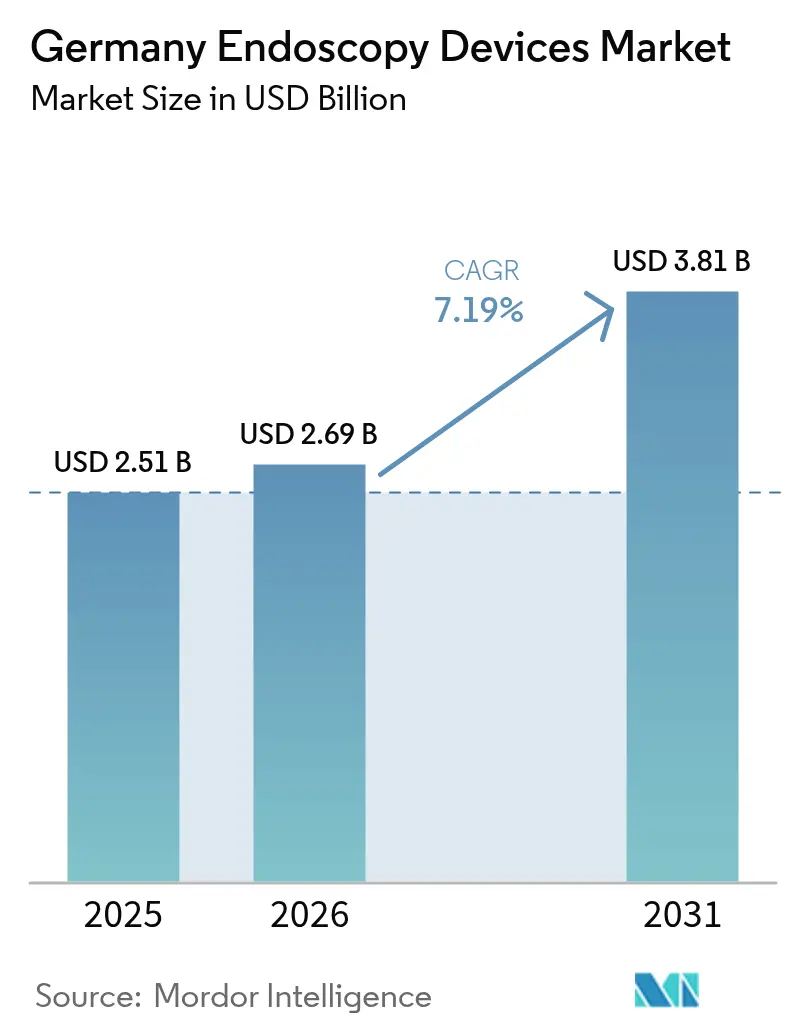
| Base Year Market Size (2025) | USD 2.51 Billion |
| Market Size (2026) | USD 2.69 Billion |
| Market Size (2031) | USD 3.81 Billion |
| Growth Rate (2026 - 2031) | 7.19 % |
| Market Concentration | Medium |
Major Players *Disclaimer: Major Players sorted in no particular order Image © Mordor Intelligence. Reuse requires attribution under CC BY 4.0. | |
Germany Endoscopy Devices Market Analysis by Mordor Intelligence
The Germany endoscopy devices market size is expected to grow from USD 2.51 billion in 2025 to USD 2.69 billion in 2026 and is forecast to reach USD 3.81 billion by 2031 at 7.19% CAGR over 2026-2031. Demographic pressures from an aging population, rapid AI-assisted visualization upgrades, and centralized procurement under the Hospital Reform 2025 are the primary forces behind this trajectory. Hospitals are focusing on 4K and AI imaging to curb adenoma miss rates that stand at 34% under white-light colonoscopy, while outpatient tele-endoscopy networks unlock procedure volumes in metropolitan hubs. The reform’s Leistungsgruppen framework pools purchasing power, enabling volume-based contracts that compress unit prices and standardize quality benchmarks, which in turn accelerates equipment refresh cycles. Meanwhile, pending EU PFAS restrictions are prompting supply-chain overhauls for fluoropolymer substitutes, sharpening vendor competition around sustainable components. These combined trends keep the Germany endoscopy devices market on a clear upswing through 2030.
Key Report Takeaways
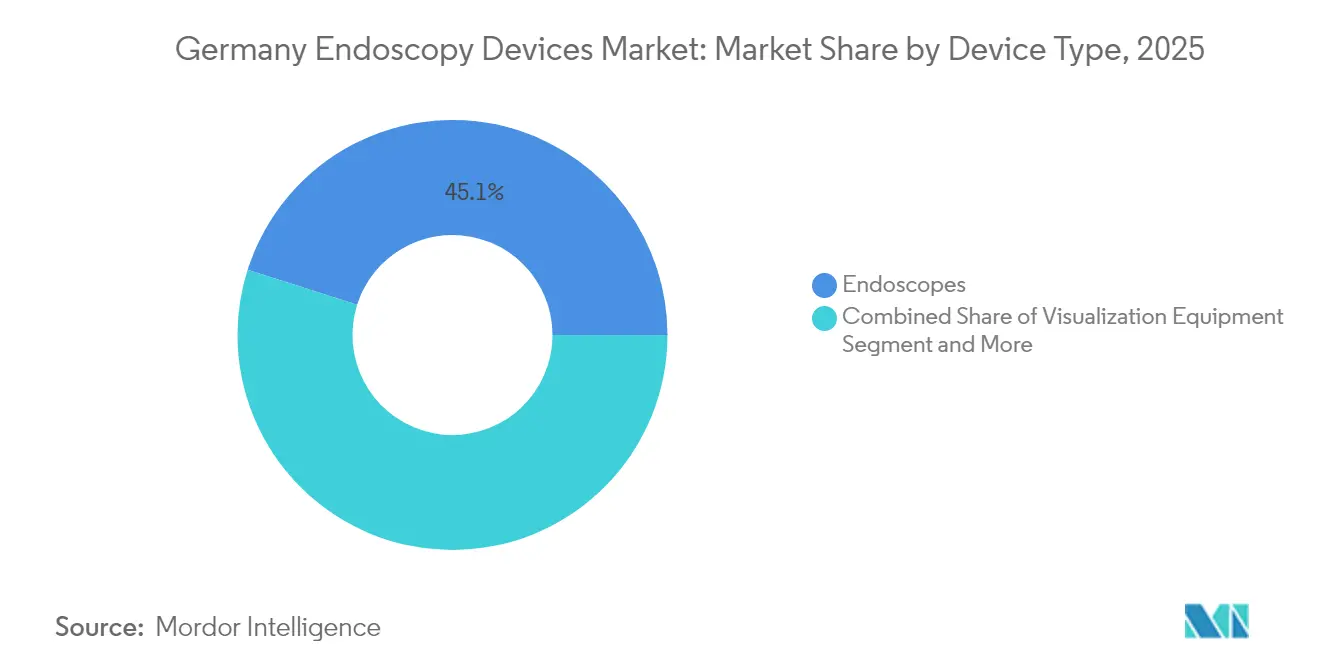
- By device type, endoscopes led with 45.10% of Germany endoscopy devices market share in 2025, while visualization equipment is projected to expand at an 11.02% CAGR to 2031.
- By application, gastroenterology occupied 48.05% of Germany endoscopy devices market size in 2025, and cardiology is advancing at a 9.62% CAGR through 2031.
- By end user, hospitals accounted for 69.10% share of the Germany endoscopy devices market in 2025, whereas ambulatory surgery centers are forecast to grow at 9.61% CAGR to 2031.
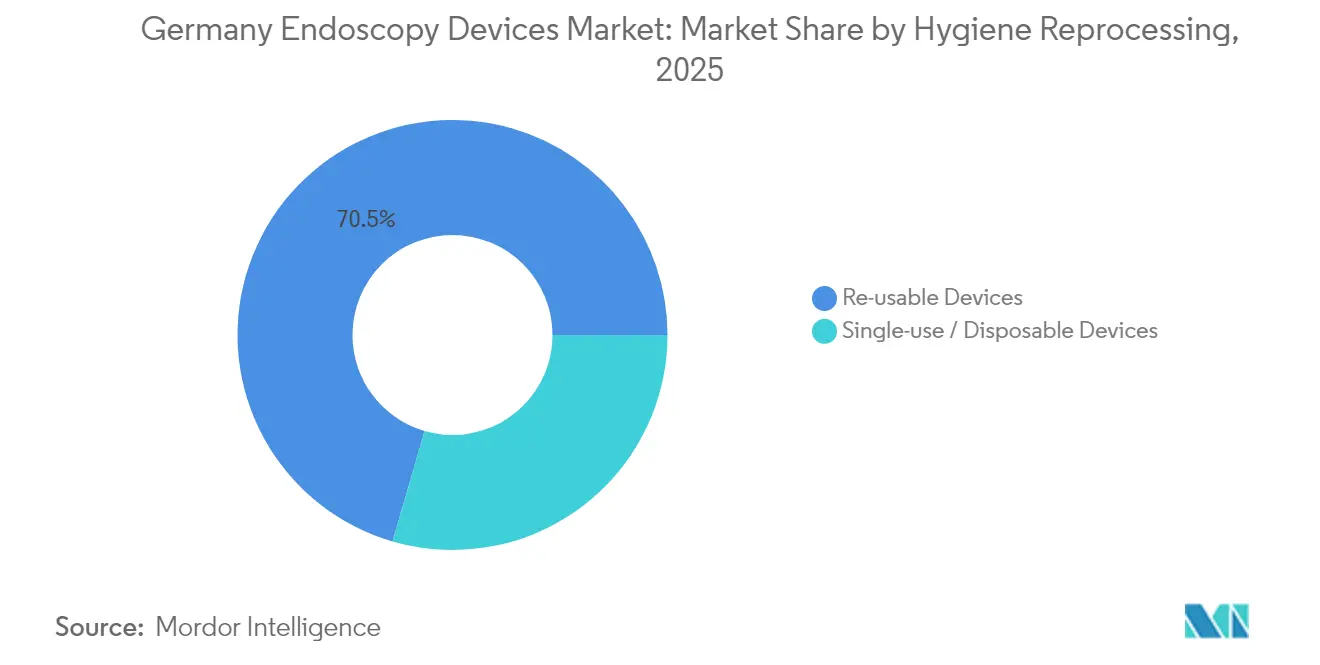
- By hygiene practice, reusable platforms retained 70.50% share in 2025, yet single-use systems are set to accelerate at 12.26% CAGR to 2031.
Note: Market size and forecast figures in this report are generated using Mordor Intelligence’s proprietary estimation framework, updated with the latest available data and insights as of 2026.
Germany Endoscopy Devices Market Trends and Insights
Drivers Impact Analysis*
| Driver | (~) % Impact on CAGR Forecast | Geographic Relevance | Impact Timeline |
|---|---|---|---|
| Technological advancements enabling AI-assisted imaging | +1.8% | National university hospitals | Medium term (2-4 years) |
| Growing preference for minimally invasive surgeries | +1.5% | Urban medical centers | Long term (≥ 4 years) |
| Aging population & rising GI disorder prevalence | +2.1% | Eastern states | Long term (≥ 4 years) |
| German Hospital Reform 2025 centralizing procurement | +1.2% | Public hospitals | Short term (≤ 2 years) |
| EU MDR-driven replacement of aging endoscopes | +0.9% | All regions | Medium term (2-4 years) |
| Surge in outpatient tele-endoscopy networks | +0.8% | Metropolitan areas | Medium term (2-4 years) |
| Source: Mordor Intelligence | |||
Technological Advancements Enabling AI-Assisted Imaging
AI platforms are steadily transforming the Germany endoscopy devices market. Olympus launched its cloud-based ENDO-AID suite, CADDIE, CADU, and SMARTIBD, in Q1 2025 to tackle high adenoma miss rates that reach 34% under conventional white-light screening. Government-funded GI-Insight research at the University of Würzburg adds local algorithm refinement, while MHz-OCT projects in Schleswig-Holstein bring real-time 3D tissue mapping into routine workflows. EVIS X1 upgrade kits let hospitals embed AI without replacing entire towers, a cost advantage under the Leistungsgruppen budget ceilings. Regulatory amendments to the Medical Devices Operator Ordinance effective February 2025 mandate robust cybersecurity, giving established vendors with secure cloud infrastructure a clear competitive edge in the Germany endoscopy devices market.
Growing Preference for Minimally Invasive Surgeries
Hospitals are embracing laparoscopic and endoluminal techniques that shorten stays and cut DRG expenditures, fueling the Germany endoscopy devices market. Uptake of 4K scopes, Narrow Band Imaging, and Texture and Color Enhancement Imaging supports complex interventions such as endoscopic submucosal dissection, documented in more than 1,000 German cases with favorable outcomes[1]Ulrike Denzer, “Neue Endoskopische Verfahren,” Thieme, thieme-connect.de. Demand for multi-energy devices like THUNDERBEAT grows as surgeons value single-instrument vessel sealing up to 7 mm. Interventional cardiology mirrors this shift; transesophageal and structural procedures propel a 9.85% CAGR in cardiology applications, broadening equipment portfolios and contributing to sustained equipment renewals in the Germany endoscopy devices market.
Aging Population & Rising GI Disorder Prevalence
Older demographics guarantee a high procedure baseline. Individuals aged 65 and older reached 22% of the population in 2024 and will exceed 25% by 2050, sustaining Germany endoscopy devices market demand. Claims data covering 25 million insured persons show 80% of women and 69% of men aged 55-64 underwent colorectal exams within a decade. Organized screening raises colonoscopy volumes while therapeutic endoscopy manages detected lesions, ensuring recurring equipment cycles and consistent utilization rates across the Germany endoscopy devices market.
German Hospital Reform 2025 Centralizing Procurement
The Krankenhausversorgungsverbesserungsgesetz pools purchasing decisions into Leistungsgruppen, increasing leverage over vendors and compressing price points in the Germany endoscopy devices market. The Transformationsfonds finances digital systems that integrate with advanced endoscopic platforms, while Vorhaltevergütung compensates hospitals for maintaining complex services, lowering investment risk. Coordinated tenders now favor suppliers offering nationwide service capabilities, accelerating market consolidation and reinforcing technology standardization.
Restraints Impact Analysis*
| Restraint | (~) % Impact on CAGR Forecast | Geographic Relevance | Impact Timeline |
|---|---|---|---|
| Shortage of skilled endoscopy technicians | -1.4% | Rural hospitals | Long term (≥ 4 years) |
| High capital cost of advanced equipment | -1.1% | Smaller hospitals | Medium term (2-4 years) |
| EU PFAS restrictions on fluoropolymer components | -0.7% | National manufacturers | Medium term (2-4 years) |
| MDR recertification backlog & temporary shortages | -0.5% | All regions | Short term (≤ 2 years) |
| Source: Mordor Intelligence | |||
Shortage of Skilled Endoscopy Technicians
Germany faces a workforce shortfall that limits utilization despite adequate hardware. Part-time trends, constrained training slots, and migration to urban centers leave rural facilities understaffed. Advanced therapeutic procedures require specialized skills, delaying deployment of AI-enabled systems and dampening near-term growth in the Germany endoscopy devices market. Service consolidation into larger centers partially offsets this gap but raises patient-travel barriers.
High Capital Cost of Advanced Equipment
4K towers and AI modules carry steep price tags. Hospitals operating under DRG margins delay purchases and rely on NUB financing, yet approval uncertainty complicates multi-year planning. Ambulatory centers feel the pinch most, as volume thresholds for cost recovery remain high. Bundled-service contracts and pay-per-use models emerge but adoption is gradual, restraining speed of technology penetration in the Germany endoscopy devices market.
*Our forecasts treat driver/restraint impacts as directional, not additive. The impact forecasts reflect baseline growth, mix effects, and variable interactions.
Segment Analysis
By Device Type: AI Integration Drives Visualization Growth
Visualization equipment recorded the fastest 11.02% CAGR from 2026 to 2031, while endoscopes still anchor 45.10% of the 2025 Germany endoscopy devices market. Hospitals increasingly direct capital to 4K processors, OLED monitors, and AI overlay modules that raise mucosal detection accuracy without necessitating full tower replacements. Flexible scopes dominate the endoscope subset thanks to broad GI and pulmonary reach, whereas rigid systems cater to ENT and orthopedic niches. Capsule endoscopes, though reimbursed sparingly, offer non-invasive small-bowel views and keep incremental sales alive.
Adoption of single-use bronchoscopes and ureteroscopes accelerates as infection-control protocols tighten post-pandemic. EU MDR traceability favors disposable form factors, pushing vendors to refine biodegradable materials. Meanwhile, multi-energy hand instruments supporting advanced therapeutic procedures remain indispensable, ensuring balanced growth across the Germany endoscopy devices market. Enhanced imaging and AI analytics together re-shape hospital wish lists, firmly positioning visualization equipment at the investment forefront.



By Application: Cardiology Interventions Accelerate Growth
Gastroenterology held 48.05% of Germany endoscopy devices market size in 2025, sustained by nationwide colonoscopy programs and rising therapeutic ESD volumes. Cardiology, though smaller, posts the highest 9.62% CAGR as endoscopic ultrasound converges with structural heart interventions, creating hybrid workflows that rely on high-resolution probes. Pulmonology keeps steady momentum with AI-assisted nodule detection, while orthopedics and gynecology enlarge scope portfolios through minimally invasive arthroscopy and hysteroscopic procedures.
Cross-disciplinary innovation blurs boundaries: Olympus Aplio i800 EUS system extends from hepato-pancreato-biliary to cardiac imaging, illustrating platform convergence. Procedure complexity elevates demand for multi-modal devices and real-time analytics, which in turn solidify long-term procurement pipelines across clinical departments of the Germany endoscopy devices industry.
By End User: Ambulatory Centers Drive Outpatient Shift
Hospitals captured 69.10% of Germany endoscopy devices market share in 2025 due to concentration of complex therapeutic interventions. Ambulatory surgery centers, benefiting from the AOP reimbursement expansion, post a 9.61% CAGR on the back of cost-efficient, high-throughput colonoscopy programs. Office-based practices leverage mobile towers and tele-consult links, widening screening access in suburban belts.
Hospitals retain dominance for advanced interventions requiring anesthesia back-up and immediate surgical conversion pathways. However, portable visualization stacks tailored for ambulatory centers, and soon integrating AI SaaS modules, lower entry barriers, redistributing capital budgets within the Germany endoscopy devices market. Vendor service models now segment between 24/7 in-hospital support and lean field coverage for office clinics, ensuring target-specific value propositions.
By Hygiene & Reprocessing: Single-Use Adoption Accelerates
Reusable platforms accounted for 70.50% of 2025 sales, yet single-use scopes pace ahead at 12.26% CAGR through 2031. MDR traceability demands, stricter BfArM reprocessing rules, and residual infection risk collectively favor disposables. Comparative cost models reveal near-parity when factoring labor, detergent, sterilizer depreciation, and unplanned downtime. Vendors counter environmental critiques by piloting plant-based polymers and closed-loop recycling programs.
Hospitals hedge risk by combining reusable high-definition colonoscopes for routine screening with single-use duodenoscopes for high-contamination ERCPs. This blended fleet approach balances cost and safety, ensuring sustained growth across both product lines in the Germany endoscopy devices market.
Geography Analysis
Southern states, Bavaria, Baden-Württemberg, and North Rhine-Westphalia, anchor equipment demand due to dense networks of university hospitals and med-tech manufacturers. These regions adopt AI modules early, leveraging local vendor support and research partnerships that shorten validation cycles. Munich’s cluster of academic centers and start-ups acts as a living laboratory, accelerating clinical deployment and feedback loops.
Eastern states such as Saxony and Brandenburg display lower baseline utilization yet exhibit above-average growth rates as modernization grants target infrastructure gaps. Colonoscopy uptake in Saxony reached only 18%, compared with 23% in southern counterparts, highlighting untapped potential. Federal funding under the Hospital Future Act directs digital and imaging upgrades into these underserved areas, thereby lifting long-term prospects for the Germany endoscopy devices market.
Metropolitan hubs, Berlin, Hamburg, Frankfurt, pioneer tele-endoscopy networks that link suburban clinics with urban specialists. Portable towers shipped to satellite sites feed live video back to central reading centers, broadening access. Logistics proximity to manufacturing plants in Tuttlingen and Hamburg ensures rapid maintenance turnaround, which further cements vendor relationships in these high-volume locales. Regional procurement consortia under Leistungsgruppen unify specifications, thereby leveling purchase terms across Germany.
Regulatory Landscape
Endoscopy devices in Germany are regulated under the EU Medical Device Regulation (MDR), with national implementation and market surveillance led by the Federal Institute for Drugs and Medical Devices (BfArM). A key 2026 compliance change is the migration of device and actor registration from the German national database (DMIDS) to the EU database EUDAMED. From May 28, 2026, new registrations are routed via EUDAMED, and products already placed on the market have a transition window until November 28, 2026. For invasive devices used in endoscopy (commonly Class IIa to III), clinical investigations and certain performance-related activities continue to require defined notifications and authorizations through BfArM pathways, which keeps notified-body capacity and MDR documentation readiness at the center of supplier planning for Germany.
Hygiene and reprocessing requirements remain a core operational constraint for reusable endoscopy fleets, guided by KRINKO recommendations and joint KRINKO/BfArM guidance on endoscope reprocessing. The revised KRINKO-Anlage 8 framework raises expectations around validated processes and qualified staff. At the same time, cybersecurity compliance is tightening across connected visualization and cloud-enabled AI modules, with NIS2-related requirements coming into force for larger manufacturers by October 2026 (based on company size thresholds). This adds to quality management and post-market vigilance for networked endoscopy ecosystems, increasing the value of vendors that offer traceability-ready, audit-friendly portfolios alongside MDR-aligned reprocessing guidance and service support that fits hospital IT security expectations.
Competitive Landscape
The Germany endoscopy devices market is moderately concentrated, with Olympus and KARL STORZ holding leading positions through broad product portfolios and embedded service networks. Olympus capitalizes on ENDO-AID cloud analytics launched in 2025, offering subscription models that bundle software updates with hardware leasing. KARL STORZ reinforced its supply chain by acquiring medi-G in February 2025, rebuilding the Meßkirch site with advanced assembly lines that secure laparoscopic component availability.
AI competency is the new competitive frontier. Start-ups partnering with university hospitals aim to inject niche algorithms into legacy towers, yet MDR certification hurdles impede rapid scaling. Established vendors leverage internal regulatory teams and existing notified-body relationships to fast-track approvals, maintaining their edge in the Germany endoscopy devices market. Collaboration with cloud-security providers ensures compliance with the Medical Devices Operator Ordinance, a differentiator for hospital CIOs under the Hospital Future Act mandates.
Opportunity whitespace lies in portable visualization solutions for ambulatory centers and single-use scope ecosystems. Multinational suppliers co-develop environmental recycling pathways with regional waste processors, addressing sustainability directives and bolstering brand equity. Outcome-based contracting gains traction as hospitals tie payments to adenoma detection or readmission reductions, altering traditional capex discussions. Vendors offering data analytics dashboards that prove quality gains strengthen their negotiating stance within centralized tenders.
Germany Endoscopy Devices Industry Leaders
B. Braun Melsungen AG
Stryker Corporation
Boston Scientific Corporation
KARL STORZ SE & Co. KG
Medtronic PLC
- *Disclaimer: Major Players sorted in no particular order


Market Opportunities and Future Outlook
KRINKO-Anlage 8 and related KRINKO/BfArM reprocessing guidance create specific room for solutions that reduce reprocessing complexity and the documentation burden, including sterile single-use scopes in high-risk workflows and reprocessing-friendly reusable designs with stronger traceability. The 2024 update for thermolabile endoscope reprocessing, including defined sampling approaches and staff qualification targets, supports demand for standardized, validated reprocessing pathways across decentralized endoscopy units. Suppliers that bundle scopes, washers and disinfectors compatibility, training, and digital logs that align with audit routines are positioned to benefit.
Germany-based capability build-out and integration strategies also point to near-term innovation and portfolio refresh activity across imaging, scopes, and operative endoscopy systems. In March 2026, Erbe Elektromedizin established the Erbe Vision GmbH competence center in Sexau to centralize imaging R&D for endoscopes and camera systems, supporting faster iteration on visualization and integration with therapeutic platforms. At the same time, SHS Capital backing an integrated endoscopy group (EMOS Technology, InnoView, ILO electronic, and Micon) underscores continuing investment aimed at securing optics and component supply while meeting MDR post-market expectations. Single-use product and platform development continues to mature, including KARL STORZ receiving FDA clearance in March 2026 for the FIVE S 6.5 sterile single-use bronchoscope designed for compatibility with existing visualization platforms, which can influence German hospital and ambulatory center procurement discussions around mixed fleets and total cost of ownership.
Recent Industry Developments
- June 2026: Medtronic and KARL STORZ announced a strategic collaboration to expand access to integrated ENT surgical solutions, combining Medtronic systems with KARL STORZ endoscopy instrumentation. The partnership reinforces the shift toward integrated procedure platforms where visualization, instrumentation, and workflow integration are co-developed, supporting more standardized offering bundles for hospital buyers.
- February 2025: KARL STORZ completed the business transfer of medi-G and advanced the rebuild of the Meßkirch factory with upgraded assembly capabilities. This update strengthens component availability for laparoscopy and other endoscopy-adjacent specialties and improves supply resilience and service continuity for German providers operating under centralized procurement frameworks.
- September 2024: Olympus introduced the CH-S700-08-LB 4K camera head for urological endoscopy in Europe, integrating true 4K sensors and Narrow Band Imaging. This release raised baseline visualization performance in routine procedures and supported upgrade cycles focused on image quality improvements without requiring full tower replacement.


Research Methodology Framework and Report Scope
Market Definition and Coverage
This market covers revenues from endoscopy devices sold and used in Germany for diagnostic and therapeutic minimally invasive procedures. It includes endoscopes, endoscopic operative tools, and visualization systems that support imaging and procedural access.
Scope exclusions: it does not count unrelated surgical capital equipment and general OR infrastructure that are not specific to endoscopy procedures.
Segmentation Overview
- By Device Type
- Endoscopes
- Flexible Endoscopes
- Rigid Endoscopes
- Capsule Endoscopes
- Disposable/Single-use Endoscopes
- Endoscopic Operative Devices
- Visualization Equipment
- Endoscopes
- By Application
- Gastroenterology
- Pulmonology
- Orthopaedic Surgery
- Cardiology
- Gynaecology & Urology
- Other Clinical Applications
- By End User
- Hospitals
- Ambulatory Surgery Centres
- Office-based / Out-patient Clinics
- By Hygiene & Reprocessing
- Re-usable Devices
- Single-use / Disposable Devices
Data Sources, Market Sizing, and Validation
Desk Research
Desk work starts by mapping what is being bought and used in Germany, then tying that to procedure demand and hospital purchasing patterns. We use public sources such as the German Federal Statistical Office (Destatis) for healthcare activity indicators, the Robert Koch Institute for disease burden context, and OECD Health Statistics for comparable utilization signals.
To keep assumptions realistic, clinical and regulatory context is cross-checked using sources such as the European Medicines Agency and the European Patent Office (for innovation intensity). This is followed by medical society publications and peer-reviewed journals that track endoscopy guideline changes and screening uptake. Company annual reports, investor presentations, and press releases help clarify product mix and pricing direction, while paid subscriptions for company financials and patent databases fill gaps where public disclosures are thin. These sources are illustrative, and many other public and proprietary references were also used for data collection, validation, and clarification.
Primary Interviews and Surveys
Primary inputs are gathered through interviews and structured surveys with hospital procurement teams, clinicians performing endoscopy, distributors, and service partners that support installation and maintenance. Because this is a Germany-only market, we focused on differences in public versus private hospital buying behavior and validated pricing and replacement cycles across major states where procedure volumes are concentrated.
Distribution of primary research fieldwork respondents
| Company type | Respondent position |
|---|---|
| Top tier: 35% | CXOs: 15% |
| Mid tier: 48% | Functional/Unit leaders: 31% |
| Smaller Players: 17% | Managers: 54% |
Market-Sizing & Forecasting
Sizing begins with a top-down build where procedure demand and care delivery capacity in Germany are used to reconstruct device spending, then aligned to the product groups that define endoscopy devices. To keep totals grounded, we corroborate the result with selective bottom-up approximations, such as sampled average selling prices times estimated unit placements for visualization towers and endoscopes. We also use channel checks on accessory and operative tool attach rates.
Key model inputs include endoscopy procedure volumes and screening participation, installed base replacement cycles for video processors and scopes, the split between reusable and single-use use cases where applicable, hospital capital budget signals, and expected price progression tied to imaging upgrades (HD to 4K) and reprocessing requirements. Where a direct bottom-up line cannot be completed, gaps are handled through range-based assumptions that are constrained by interview feedback and checked against public import and production signals.
For forecasting, scenario analysis is used so the outlook can reflect realistic swings in elective procedure throughput, hospital procurement timing, and technology refresh waves. The final path is selected based on the consensus direction we heard from practitioners and procurement respondents.
Data Validation & Update Cycle
Before numbers are finalized, outputs are compared against independent signals such as procedure trends, capital equipment replacement logic, and the implied per procedure spend. Large variances are reviewed and corrected, and outliers are flagged early. A second analyst review checks whether assumptions, currency handling, and growth drivers are applied consistently.
The model is refreshed each year so new procedure guidance, hospital funding changes, and technology shifts are captured. Interim updates are triggered when a material event could move pricing or demand. Right before publication, we run a final pass to ensure the latest public indicators and interview learnings are reflected in the market view clients receive.
Mordor Intelligence's Germany Endoscopy Devices Market Size Compared Against Other Published Estimates
Published market values for Germany endoscopy devices can differ even when the topic is framed the same, because teams may not count the same device buckets, base year, or buying channels. Differences can also come from whether one estimate relies more on shipment value while another relies more on procedure demand and installed base replacement.
In our comparison, the biggest gap drivers are whether operative devices are treated as the full market or only one component, and whether the current year is taken as 2023, 2025, or 2026, which affects currency timing and price progression. The spread also reflects how quickly imaging upgrades are assumed to move through hospitals and outpatient settings, and how often the forecast is refreshed when procurement plans shift. That is why the scope and update discipline used here can separate endoscopes, operative devices, and visualization equipment clearly, as done by Mordor Intelligence.
Benchmark comparison
| Source | Market Size | Gaps in Research Methodology |
|---|---|---|
| Mordor Intelligence | USD 2.51 B (2025) | |
| Market Research Publisher A | USD 2.34 B (2023) | Uses an earlier base year and a different forecast window, and the implied pricing curve is anchored closer to 2023 procurement conditions, which can understate later cycle upgrades and post base-year demand normalization. |
| Global Consultancy B | USD 0.53 B (2023) | Covers only endoscopy operative devices rather than the full endoscopy devices stack, so endoscopes and visualization systems are largely outside the counted scope, which naturally keeps the total smaller. |
The table shows that the widest differences come from scope, especially when a single device category is reported as the whole market, and from which year is chosen as the anchor for pricing and replacement timing. By keeping inputs traceable to procedure demand, replacement cycles, and realistic price movement, the final number stays balanced and can be repeated with the same steps when new data is added later on, without needing hidden assumptions to make it work again.


Key Questions Answered in the Report
How big is the Germany endoscopy devices market in 2026?
The market stands at USD 2.69 billion in 2026 and is forecast to reach USD 3.81 billion by 2031, expanding at a 7.19% CAGR.
Which device segment is growing fastest?
Visualization equipment, driven by AI integration and 4K resolution, is rising at an 11.02% CAGR through 2031.
What is driving single-use scope adoption?
Infection-control priorities, MDR traceability, and PFAS material restrictions push hospitals toward disposable endoscopes growing at 12.26% CAGR.
Why are ambulatory centers important for growth?
Reimbursements under the AOP framework favor outpatient procedures, enabling ambulatory surgery centers to grow at 9.61% CAGR.
How does the Hospital Reform 2025 affect purchasing?
The Leistungsgruppen structure centralizes procurement, securing volume discounts and standardizing quality benchmarks nationwide.
Which regions offer the most untapped potential?
Eastern states such as Saxony and Brandenburg, where colonoscopy utilization rates lag the national average, present higher growth opportunities.
Page last updated on:


 Your data is secure and never sold or shared.


