
3D Radar Market Size and Share
Market Overview
| Study Period | 2020 - 2031 |
|---|---|
| Market Size (2026) | USD 22.95 Billion |
| Market Size (2031) | USD 37.75 Billion |
| Growth Rate (2026 - 2031) | 10.11 % |
| Fastest Growing Market | Asia Pacific |
| Largest Market | North America |
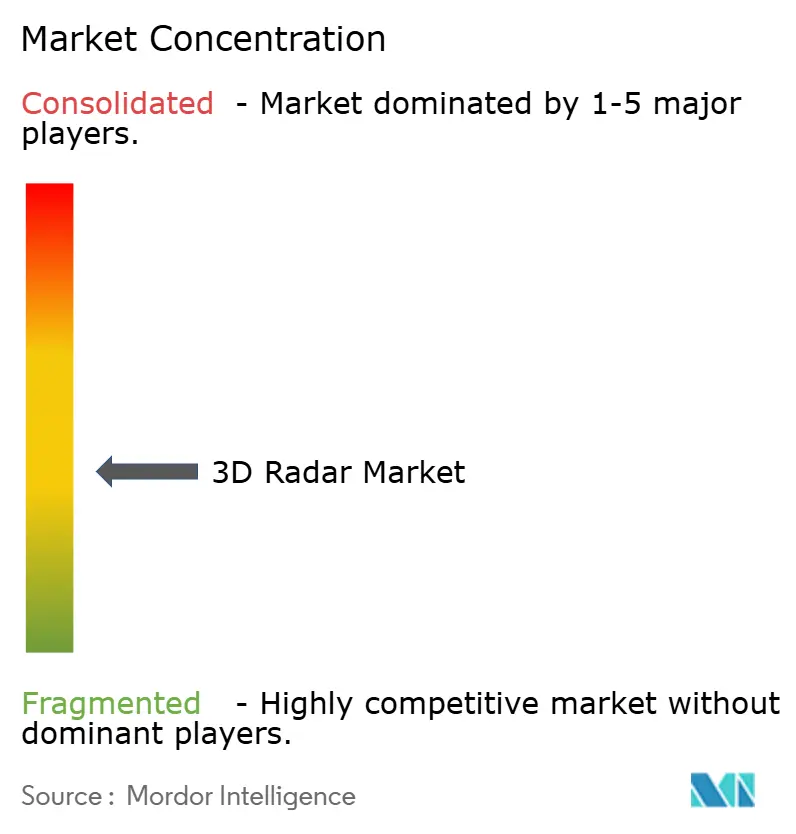
| Market Concentration | Medium |
Major Players *Disclaimer: Major Players sorted in no particular order Image © Mordor Intelligence. Reuse requires attribution under CC BY 4.0. | |
3D Radar Market Analysis by Mordor Intelligence
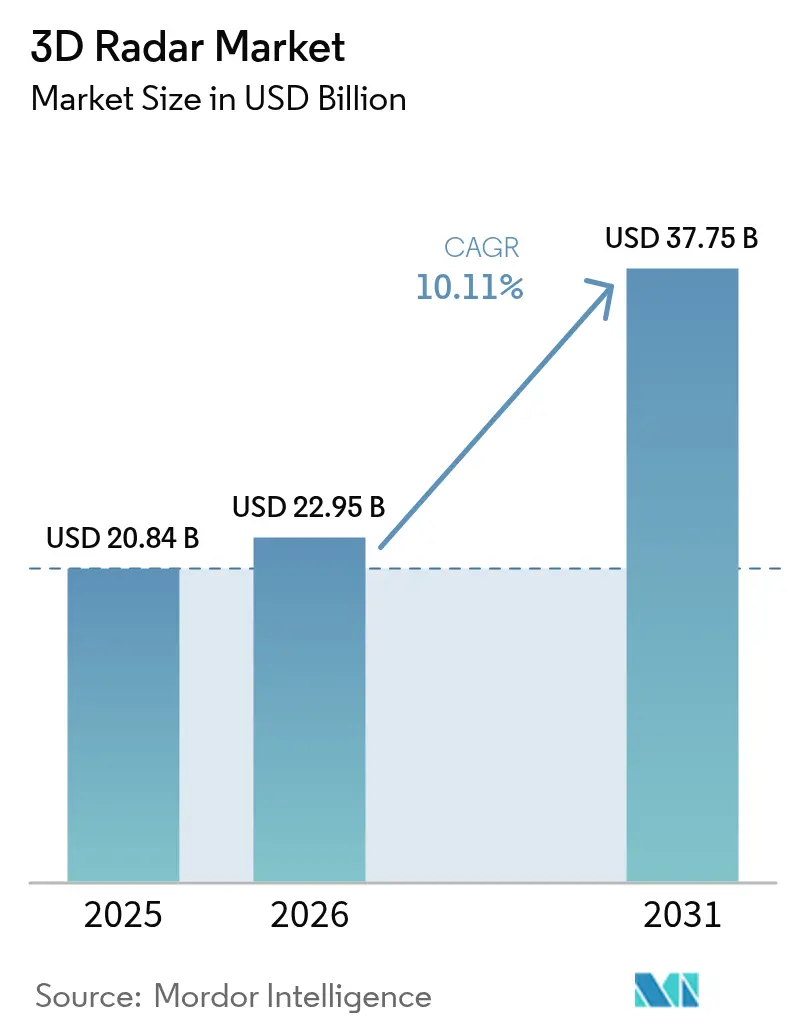
The 3D radar market size is expected to grow from USD 20.84 billion in 2025 to USD 22.95 billion in 2026 and is forecast to reach USD 37.75 billion by 2031 at 10.11% CAGR over 2026-2031. Expansion stems from rising defense modernization, wider automotive adoption of radar-based driver-assistance technologies, and strong investment in space-based surveillance. GaN-powered AESA architectures are extending detection ranges by nearly 25% in contested electromagnetic environments, while artificial intelligence is shortening target-classification cycles from minutes to seconds. Emerging requirements for low-Earth-orbit (LEO) satellite tracking, counter-unmanned-aircraft systems (C-UAS), and climate-resilience weather monitoring are widening the addressable opportunity set. Against this backdrop, manufacturers are prioritizing open-system architectures and software-defined upgrades to maximize lifecycle value and capture recurring revenue streams in the 3D radar market.
Key Report Takeaways
- By platform, ground-based systems led with 45.58% of 3D radar market share in 2025; airborne platforms are projected to grow at 12.23% CAGR through 2031.
- By range type, long-range radars held 40.52% share of the 3D radar market size in 2025, while short-range systems are set to advance at a 14.34% CAGR to 2031.
- By frequency band, S-band maintained 33.12% revenue share in 2025; Ku/Ka band solutions are forecast to post the fastest 15.31% CAGR between 2026-2031.
- By component, hardware accounted for 70.76% of the 3D radar market size in 2025; software is poised to expand at a 13.47% CAGR over the same period.
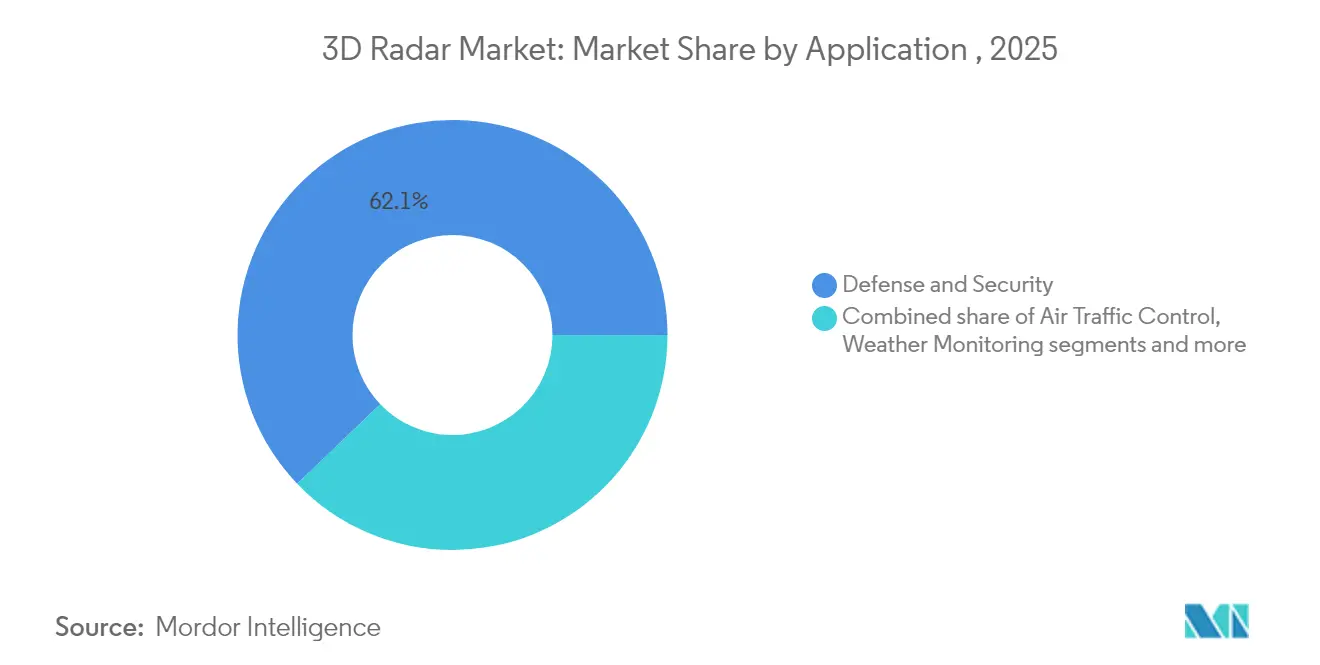
- By application, defense and security dominated with 62.15% share in 2025, whereas automotive and industrial uses are rising at a 16.88% CAGR to 2031.
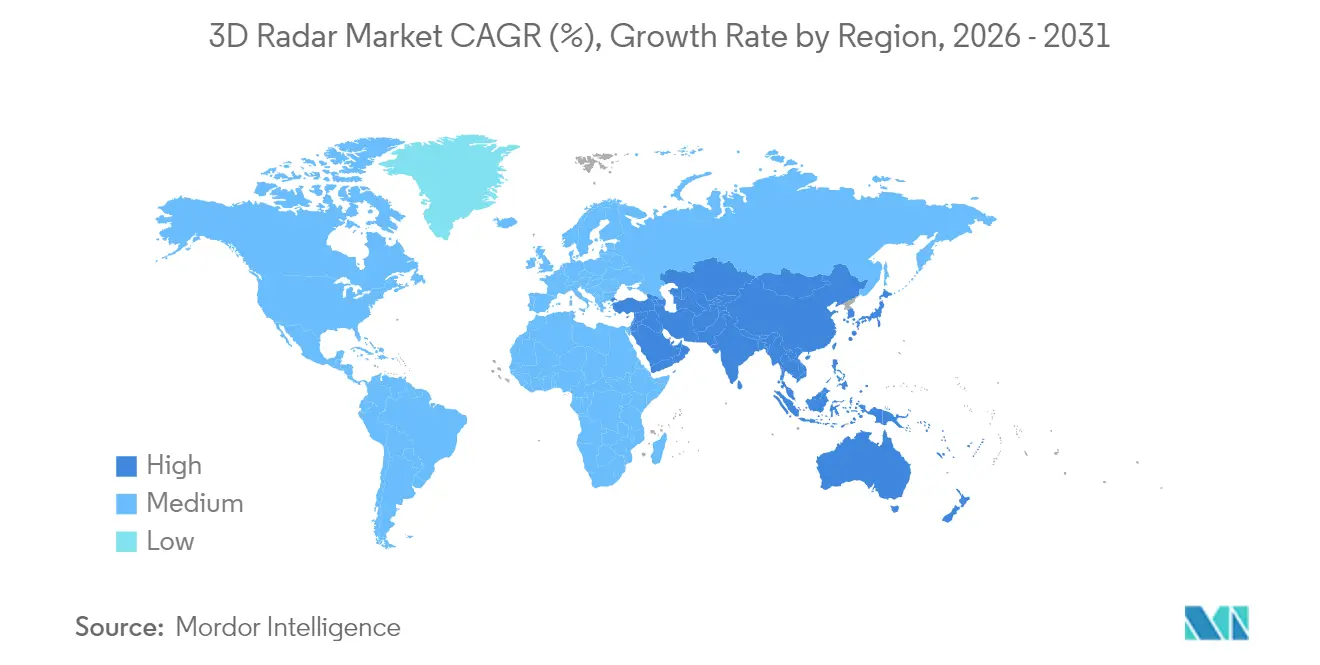
- By geography, North America commanded 38.22% of 3D radar market share in 2025; Asia-Pacific represents the fastest-growing region, progressing at a 12.35% CAGR through 2031.
Note: Market size and forecast figures in this report are generated using Mordor Intelligence’s proprietary estimation framework, updated with the latest available data and insights as of 2026.
Market Trends and Insights
Drivers Impact Analysis of 3D Radar Market*
| Driver | (~) % Impact on CAGR Forecast | Geographic Relevance | Impact Timeline |
|---|---|---|---|
| Rapid deployment of 3D multi-mission radars in NATO C-UAS programs | +2.1% | Europe, spillover to Middle East | Medium term (2-4 years) |
| Surge in LEO satellite constellations driving space-based 3D tracking radars | +1.8% | North America, global impact | Long term (≥ 4 years) |
| Automotive OEM shift toward 4D imaging radar for Level-3+ ADAS | +2.4% | Asia, Europe, North America | Medium term (2-4 years) |
| Adoption of GaN-based AESA 3D radars for integrated air-and-missile defense | +1.7% | Middle East, Asia-Pacific, Europe | Medium term (2-4 years) |
| Increased demand for meteorological 3D Doppler radars for climate resilience | +1.3% | Pacific Islands, Africa, South America | Long term (≥ 4 years) |
| Civil airport upgrades to digital 3D surveillance radars | +1.5% | US & EU, expanding to Asia-Pacific | Medium term (2-4 years) |
| Source: Mordor Intelligence | |||
Rapid deployment of 3D multi-mission radars in NATO counter-UAS programs
Across Europe, procurement authorities are funding multi-mission radars that can fuse air-surveillance, ground-surveillance, and coastal-surveillance roles within a single array. Italy’s EUR 73 million Skynex contract exemplifies this shift, pairing Rheinmetall cannons with a 50 km-range 3D radar that tracks rotary-wing drones at low altitude. These systems leverage machine learning for drone discrimination, enabling near-real-time threat assessment and reducing operator workload. Their modular architecture supports plug-and-fight integration into existing C-UAS command networks, accelerating fielding schedules. As NATO standardizes threat libraries and software updates, volume orders are driving cost curves lower, reinforcing demand in the 3D radar market. [1]
Surge in LEO satellite constellations demanding space-based 3D tracking radars
Commercial operators are launching hundreds of small satellites for broadband, Earth-observation, and in-orbit servicing. To manage the resulting traffic, governments are procuring precision 3D tracking radars capable of cataloguing objects below 1 cm at altitudes of 500-1,200 km. Lockheed Martin’s strategy for proliferated architectures illustrates how space surveillance now demands Ku/Ka band arrays linked to AI-driven ground segments. North America’s end-users are prioritizing shared civil-military space domain awareness platforms, bolstering the long-term outlook for the 3D radar market.
Automotive OEM shift toward 4D imaging radar for Level 3+ ADAS
Regulatory deadlines in Europe and the United States are accelerating rollout of blind-spot, automatic emergency braking, and driver-monitoring functions. Tier-1 suppliers are therefore upgrading 3D radar modules to 4D imaging capability, adding elevation data and micro-Doppler signatures. Test campaigns show detection of pedestrians at 200 m with 100° horizontal coverage, meeting Euro NCAP 2026 scenarios. Chipmakers are incorporating AI accelerators in mmWave radar SoCs, enhancing in-cab gesture recognition. This technology shift underpins the fastest-growing vertical in the 3D radar market. [2]
Adoption of GaN-based AESA 3D radars for integrated air & missile defense modernization
GaN power amplifiers increase transmitter efficiency and allow higher duty cycles, providing 25% range improvement versus gallium-arsenide. India’s Uttam radar for Tejas Mk2, fielding 900 T/R modules, demonstrates how domestic supply chains are scaling GaN production. Similar upgrades on Turkish F-16 fleets and Gulf-region ground stations illustrate global traction. As nations confront cruise-missile saturation, GaN-enabled 3D radar market demand is set to climb through mid-decade. [3]
Capital-intensive transition from legacy 2D to phased-array 3D radars in emerging nations
Many developing states still rely on coaxial-feed 2D radars commissioned in the 1990s. Upgrading to digital beam-forming arrays often requires new shelters, power conditioning, and fiber backhaul. Zimbabwe’s weather-radar renewal program illustrates the funding gap: five Doppler sites required external financing as well as operator upskilling. Similar financing hurdles slow defense deployments, tempering medium-term growth in segments of the 3D radar market.
Scarcity of RF spectrum in C & X bands limiting urban installations
Cellular backhaul, fixed satellite services, and broadband providers all compete for mid-band spectrum prized by primary-surveillance radars. Recent Federal Communications Commission rulings allocating E-band to satellite mega-constellations underscore growing congestion. Operators therefore experiment with K-band and Ka-band alternatives, but higher frequencies suffer rain fade. The regulatory bottleneck places a drag on urban 3D radar market projects until dynamic-spectrum-sharing mechanisms gain traction.
*Our forecasts treat driver/restraint impacts as directional, not additive. The impact forecasts reflect baseline growth, mix effects, and variable interactions.
3D Radar Market Segment Analysis
By Platform:
Ground-Based Systems Underpin Modern Air-and-Missile DefenseGround-based installations captured 45.58% of 3D radar market share in 2025, reflecting their pivotal role in border surveillance, early-warning, and C-UAS missions. Power-optimized GaN T/R modules enable transportable arrays that deploy within four hours and connect to tactical networks via software-defined radios. Ground-based radars are benefiting from AI algorithms that classify drones under 2 kg, improving decision-making for layered defense architectures.
The airborne segment is forecast to expand at 12.23% CAGR as fifth-generation fighters integrate indigenous AESA radars with over 900 modules, extending look-down detection against low-observable targets. Modular line-replaceable units cut maintenance turnaround by 30%, positioning airborne solutions as a premium slice of the 3D radar market. Naval platforms add growth momentum through lightweight solid-state rotating arrays designed for offshore patrol vessels guarding exclusive economic zones.


By Range Type:
Long-Range Arrays Safeguard National AirspaceLong-range systems commanded 40.52% of the 3D radar market size in 2025, protecting air-defense identification zones and strategic assets. Recent deployments achieve 600 km instrumented range while tracking 1,500 objects, enabled by digital waveform agility and edge processing. AI-assisted clutter maps improve low-RCS detection over mountainous terrain, vital for hypersonic-missile warning.
Short-range radars, expanding at a 14.34% CAGR, are integrated into vehicle-mounted C-UAS kits and perimeter-security towers. Coprime-sampling techniques reduce channel counts, shrinking antenna footprints for rooftop installation. Medium-range arrays address mobile-force protection, balancing 3 km minimum range with 120 km maximum reach, thereby filling doctrinal gaps in layered defense and broadening opportunities across the 3D radar market.
By Frequency Band:
S-Band Versatility Meets Ku/Ka InnovationS-band retained 33.12% revenue share in 2025 thanks to robust weather penetration, making it the workhorse for maritime and meteorological surveillance. Recent GaN-on-silicon breakthroughs permit 50 V operation with negligible power droop, boosting transmitter reliability and lifecycle economy.
Ku/Ka bands are advancing at a 15.31% CAGR on the back of LEO-tracking demand and high-resolution imaging missions. Assimilating Ku-band data into numerical-weather-prediction models proved to sharpen rainfall forecasts, underscoring dual-use value. X-band remains indispensable for naval fire control owing to narrow beams and fine range resolution, while L-band supports long-range line-of-sight with reduced attenuation, collectively enriching the 3D radar market.
By Application:
Defense Primacy Amid Automotive UpswingDefense and security applications held 62.15% share in 2025, anchored by missile-defeat investments of USD 28.4 billion in the latest United States budget cycle. Multi-mission fire-control radars now track ballistic, cruise, and hypersonic threats within a single array, reducing logistics footprints.
Automotive and industrial uses are registering a 16.88% CAGR as OEMs embed 4D imaging radars to meet Euro-NCAP 2026 standards. Warehouse automation and smart-city traffic management further diversify demand. Weather monitoring is gaining momentum through satellite constellations delivering hourly global scans. Space-surveillance and air-traffic-control segments continue to modernize as digital beam-forming upgrades roll out, expanding the overall 3D radar market.
By Component:
Hardware Dominance Supports Rapid Software UpsellHardware contributed 70.76% of 2025 revenue as countries invested in antenna arrays, RF front-ends, and ruggedized processors. Additive-manufactured waveguide components trim lead times by 40% and enable dual-band OMTs for multi-mission payloads. Meanwhile, miniaturized RF-system-on-chip modules are lowering size, weight, and power, broadening use in unmanned platforms.
Software is forecast to rise at 13.47% CAGR, reflecting demand for AI-enabled target recognition, cognitive electronic protection, and predictive maintenance. Digital twins allow operators to rehearse mission scenarios and deploy firmware patches over-the-air, increasing the recurring revenue slice of the 3D radar market. Service contracts round out the value chain, covering training, calibration, and lifecycle support in an increasingly complex threat environment.
Geography Analysis
North America 3D Radar Market
North America led with 38.22% of 3D radar market share in 2025, underpinned by USD 28.4 billion earmarked for missile-defeat systems and an additional USD 9.9 billion Pacific Deterrence Initiative allocation. Recent contracts for AN/TPY-4 expeditionary radars illustrate the push toward transportable long-range coverage. Regional suppliers emphasize open-system interfaces and AI-driven sensor fusion, strengthening inter-service interoperability.
APAC 3D Radar Market
Asia-Pacific is climbing at a 12.35% CAGR as indigenous programs close capability gaps. India’s self-sufficiency in long-range AESA radars bolsters border surveillance, while Japan’s plan to double defense outlays to 2% of GDP accelerates integrated air-and-missile defense spending. Local manufacturing initiatives such as the PULSE joint venture reflect the region’s appetite for sovereign production within the 3D radar market.
Europe 3D Radar Market
Europe maintains momentum through NATO counter-UAS requirements and rising defense budgets, with 23 member states on track to hit the 2% target. Italy’s Skynex, Poland’s 4.7% GDP ambition, and EDF funding for cognitive-radar research highlight the continent’s investment trajectory. Spectrum-management reforms will shape urban deployments, influencing long-term 3D radar market growth.
MEA and South America 3D Radar Market
The Middle East and Africa are upgrading layered air defenses amid drone incursions, often via offset agreements that spur local assembly. South American states prioritize weather-radar modernization for disaster resilience, working with multilateral financiers to secure phased-array technology. Collectively these regions contribute incremental demand, reinforcing the global expansion of the 3D radar market.
Regulatory Landscape
3D radar deployments are influenced by spectrum access, interference protection, and conformity requirements that vary by end market. In the United States, actions by the Federal Communications Commission (FCC) around mid-band sharing tightened coexistence requirements for RF devices operating near heavily used allocations. The February 2026 rules for geofenced variable power (GVP) devices in the 6 GHz band (U-NII-5 and U-NII-7) took effect April 27, 2026, which supports a shift toward location-aware interference controls.
In Europe, compliance often routes through ETSI Harmonised Standards under the Radio Equipment Directive (RED). Periodic harmonization updates and withdrawal cycles can require design and documentation refreshes. ETSI milestones in February 2026 included the withdrawal date for conflicting national standards tied to the Harmonised Standard covering ground-based synthetic aperture radar (GBSAR) and high-definition GBSAR, reinforcing the need for harmonized testing, power limits, and essential requirements alignment for specialized radar categories and mmWave sensing devices.
Value Chain Analysis
The 3D radar value chain begins with advanced RF semiconductors (notably GaN devices for transmit/receive power), then moves into antenna and AESA array fabrication, RF front-end and signal-processing electronics, and ends with system integration. Integration spans command-and-control, cybersecurity hardening, and field services such as installation, calibration, training, and lifecycle sustainment. Hardware still represents the largest delivered value block in many procurements, while software content is increasing through AI-enabled classification, waveform scheduling, and open-system interfaces that support continuous upgrades.
For primes and subsystem suppliers, supply assurance for GaN components and high-frequency modules is an important leverage point. In March 2026, HENSOLDT finalized a long-term supply agreement with United Monolithic Semiconductors (UMS) to secure 900,000 GaN semiconductor components for radar systems by 2030, reflecting how vendors contract upstream capacity to protect production schedules. Integration and delivery flows also depend on localization and industrial participation, as shown by Tata Advanced Systems commissioning the first India-built Lanza-N 3D-ASR naval air-surveillance radar on an Indian Navy warship in September 2025 after collaboration and local factory setup with Indra in Bengaluru.
Competitive Landscape
Incumbents such as Northrop Grumman, Raytheon, Thales, and Lockheed Martin anchor the high-end defense segment, leveraging decades of R&D and proprietary GaN foundries to safeguard margins. Recent strategies pivot toward modular open-system architecture, enabling software monetization long after hardware delivery. Localization partnerships—exemplified by the EDGE-Indra PULSE venture—help incumbents access protected markets and comply with offset rules.
Disruptive growth opportunities center on weather and automotive niches. Tomorrow.io’s miniaturized weather-radar constellation showcases a space-as-a-service model, while startups refine K-band collision-avoidance sensors for autonomous vehicles. Software specialists are emerging as critical partners, delivering AI toolchains and synthetic data sets that cut algorithm-training times by 60%. The 3D radar market thus rewards ecosystem orchestration over hardware specs alone.
Customer evaluations increasingly weigh cyber-hardening, lifecycle cost, and upgrade cadence. Vendors that integrate predictive-maintenance analytics and remote-update capabilities are winning service extensions, turning one-time sales into long-term annuities. Competitive intensity is expected to rise as regional manufacturers mature, yet first-mover advantages in GaN processes and AI-ready architectures continue to confer pricing power to established leaders.
3D Radar Industry Leaders
-
Raytheon Technologies Corporation
-
Northrop Grumman Corporation
-
Thales Group
-
Lockheed Martin Corporation
-
Saab AB
- *Disclaimer: Major Players sorted in no particular order
3D Radar Market Companies Covered in this Report
- Northrop Grumman Corporation
- Raytheon Technologies Corporation
- Thales Group
- BAE Systems plc
- Airbus Defence and Space
- Lockheed Martin Corporation
- Hensoldt AG
- Saab AB
- Israel Aerospace Industries Ltd. (ELTA Systems)
- Leonardo S.p.A.
- Rheinmetall AG
- Honeywell International Inc.
- Mitsubishi Electric Corporation
- Indra Sistemas S.A.
- Terma A/S
- Aselsan A.S.
- Cobham plc (Eaton)
- SRC, Inc.
- Echodyne Corp.
- Spartan Radar, Inc.
- Kelvin Hughes Ltd. (Hensoldt UK)
- Telephonics Corporation (TTM Technologies)
- Bharat Electronics Limited
- China Electronics Technology Group Corporation (CETC)
Market Opportunities and Future Outlook
Defense modernization continues to expand opportunities for mobile, software-upgradable 3D radars across integrated air-and-missile defense and counter-UAS layers. Procurement programs are also pulling local industrial participation deeper into the supply base. In 2026, Lockheed Martin secured a USD 2.9 billion US Army contract for Sentinel A4 radar production through June 2031, while Bulgaria approved a EUR 195 million investment project to procure seven 3D radars from Thales with local subcontractor Balkantel. Together, these actions point to demand for scalable production, in-country support, and interoperability-oriented architectures.
Outside defense, the addressable opportunity is widening where safety certification and centralized compute are becoming differentiators. In industrial automation, Sonair announced in June 2026 that its ADAR One 3D sensor received SIL 2 / PL d certification for human-robot interaction in AMRs/AGVs, and Aptiv stated in July 2026 that its Pulse radar sensor was selected by Robust.AI for Gen 3 Carter robot integration to support PL(d) safety compliance. This is creating a clearer basis for vendors to package radar perception into certifiable functional-safety toolchains. Capacity additions and modular manufacturing also support faster delivery cycles in security and perimeter sensing, as reflected by Echodyne opening a new manufacturing facility in July 2026 to increase production capacity for its MESA 3D radar systems.
Recent Industry Developments in 3D Radar Market
- July 2026: Lockheed Martin secured a USD 2.9 billion US Army contract for production of Sentinel A4 radars through June 2031. The award supports multi-year manufacturing continuity and extends the installed base for software upgrades and sustainment services across ground-based 3D air-surveillance missions.
- December 2025: Denmark selected Lockheed Martin to supply TPY-4 next-generation ground-based air surveillance radars. The decision expands TPY-4 adoption within NATO-aligned air-defense networks and strengthens demand for interoperable 3D radar architectures and associated integration services.
- September 2025: Raytheon (RTX) was awarded a USD 1.7 billion US Army contract for nine Lower Tier Air and Missile Defense Sensor (LTAMDS) radars, including units for Poland. The purchase accelerates fielding of 360-degree air-and-missile defense sensors and drives requirements for high-throughput AESA production and long-term logistics support.
3D Radar Market Report Scope and Research Methodology
Market Definition and Coverage
This market covers newly manufactured 3D radar systems that output target range, azimuth, and elevation, and it is valued as revenues earned from the radar system sale. We include the core radar hardware plus the integral software and services that ship with the system across airborne, naval, and ground platforms.
Scope exclusions: Legacy 2D radars and standalone post-processing software that is sold without a paired 3D radar sensor are excluded.
Segments Covered in This Report
- Ground
- Naval
- By Range Type
- Long Range
- Medium Range
- Short Range
- By Frequency Band
- L Band
- S Band
- C Band
- X Band
- Ku / Ka Band
- By Application
- Defense and Security
- Air Traffic Control
- Weather Monitoring
- Automotive and Industrial
- Space Surveillance
- By Component
- Hardware
- Software
- Service
- By Geography
- North America
- United States
- Canada
- Europe
- United Kingdom
- Germany
- France
- Italy
- Rest of Europe
- Asia-Pacific
- China
- Japan
- India
- South Korea
- Rest of Asia-Pacific
- Middle East
- Israel
- Saudi Arabia
- United Arab Emirates
- Turkey
- Rest of Middle East
- Africa
- South Africa
- Egypt
- Rest of Africa
- South America
- Brazil
- Argentina
- Rest of South America
- North America
Data Sources, Market Sizing, and Validation
Desk Research
Desk research was used to build the starting point for demand, budgets, and the platform pipeline where 3D radars are typically installed. We referenced public sources such as defense budget documents and procurement releases, air navigation service provider and civil aviation publications, and government trade statistics for radar-related equipment, along with standards and spectrum guidance from bodies such as the FCC and ITU.
We also reviewed company annual reports, investor decks, contract award announcements, and reputable aerospace and defense press to map program timing and typical radar configurations. To reduce missed coverage, our team cross-checked product families and patent activity using an approved paid patent database, and then sanity-checked supplier footprints using a paid company financials and intelligence subscription. These desk research sources are not exhaustive, and many other public documents were also used for data collection, validation, and clarification.
Primary Interviews and Surveys
Primary work focused on validating which platforms are actively buying 3D radars, how upgrades are budgeted, and how pricing changes by range class and antenna type. We spoke with a mix of radar OEM teams, subsystem suppliers, integrators, and end users across key buying regions so that unclear desk assumptions could be corrected and then triangulated back into the model.
Distribution of primary research fieldwork respondents
| Company type | Respondent position | Region |
|---|---|---|
| Top tier: 27% | CXOs: 14% | APAC: 44% |
| Mid tier: 58% | Functional/Unit leaders: 38% | EMEA: 30% |
| Smaller Players: 15% | Managers: 48% | Americas: 26% |
Market-Sizing & Forecasting
The core sizing uses a top-down approach where defense and civil platform pipelines, procurement cycles, and trade and production signals are used to reconstruct the annual addressable radar spend. Results are then corroborated with selective bottom-up approximations, such as sampled program counts by platform type multiplied by typical radar unit prices, followed by channel checks on upgrade and retrofit volumes.
In the model, we used inputs such as active air defense modernization timelines, air traffic surveillance upgrades, shipborne sensor refresh cycles, radar range class mix (short, medium, long), and adoption of AESA and solid-state architectures, since these shift unit value and replacement timing. Where direct unit information was missing for a country or platform, we filled gaps using proxy indicators like fleet size, planned procurement, and historical replacement intervals, and then adjusted through expert feedback. Forecasts were built using scenario analysis, where base, conservative, and accelerated cases were tied to budget visibility, program delays, and expected ASP movement over the period.
Data Validation & Update Cycle
Outputs are checked against independent signals, including public contract totals, platform delivery schedules, and import export movements for radar-related categories, and then variances are reviewed before sign-off. When a number looks out of line, we re-open the driver assumptions, revisit currency conversion timing, and re-contact sources if the gap is linked to a specific platform or region.
Reports are refreshed annually, and interim updates are made when material events occur, such as a major procurement award, a program cancellation, or a large change in defense funding. Before delivery, a final analyst pass is completed so clients receive the most current view that can be traced back to clear inputs and calculation steps.
Mordor Intelligence's 3d Radar Market Size Versus Other Published Estimates
Published market sizes for 3D radar do not always match because the included items and the timing assumptions can shift the total quickly. Differences usually come from what is counted as a 3D radar sale, whether adjacent radar categories are bundled in, and how pricing and procurement delays are treated in the base year.
Standalone radar analytics software that is sold without the 3D sensor sits outside Mordor Intelligence's scope, and that single exclusion can explain a noticeable share of the spread versus estimates that blend software suites and services into the same revenue pool. Gaps also show up when some sources assume faster AESA ASP declines, apply a different currency conversion month, or do not re-check the model against platform procurement signals after new contract awards are announced.
Benchmark comparison
| Source | Market Size | Gaps in Research Methodology |
|---|---|---|
| Mordor Intelligence | USD 20.84 B (2025) | |
| Global Research Publisher A | USD 14.20 B (2025) | Uses a narrower revenue pool that appears to emphasize selected defense and surveillance applications, and it does not clearly state how it treats bundled system software, services, or retrofit-heavy programs. |
| Industry Research Publisher B | USD 4.85 B (2025) | The reported scale suggests a tighter product definition that may lean toward specific components or limited end uses, with less visibility on platform coverage, unit pricing basis, and currency timing. |
The comparison shows that scope clarity and repeatable demand drivers matter more than a single growth rate. When the counted revenue stream is tied back to platforms, procurement cycles, and realistic ASP movement, the resulting total is easier to explain and simpler to update as new programs are awarded.
Key Questions Answered in the Report
What is driving the strong CAGR in the 3D radar market to 2031?
Rapid defense modernization, automotive adoption of 4D imaging radar, and demand for LEO satellite tracking systems underpin the double-digit CAGR.
Which platform holds the largest share of the 3D radar market?
Ground-based installations led with 45.58% share in 2025 due to their central role in air-and-missile defense networks.
Why are Ku/Ka band radars growing faster than other frequencies?
Ku/Ka bands enable high-resolution imaging and space-based tracking, supporting the surge in satellite constellations and advanced weather monitoring.
How does GaN technology improve 3D radar performance?
GaN amplifiers deliver higher power density and efficiency, extending detection ranges by about 25% and enhancing resistance to electronic counter-measures.
Which region is projected to grow fastest through 2031?
Asia-Pacific, expanding at a 12.35% CAGR, benefits from rising defense budgets, indigenous AESA programs, and expanding automotive radar production.
What role does artificial intelligence play in modern 3D radar systems?
AI accelerates target classification, optimizes waveform scheduling, and supports predictive maintenance, turning radar data into actionable insights in seconds.
How large is the 3D Radar market in 2026?
The 3D Radar Market size is expected to grow from USD 20.84 billion in 2025 to USD 22.95 billion in 2026 and is forecast to reach USD 37.75 billion by 2031 at 10.11% CAGR over 2026-2031.