
DC Circuit Breaker Market Size and Share
Market Overview
| Study Period | 2021 - 2031 |
|---|---|
| Market Size (2026) | USD 5.72 Billion |
| Market Size (2031) | USD 8.09 Billion |
| Growth Rate (2026 - 2031) | 7.19 % |
| Fastest Growing Market | Asia Pacific |
| Largest Market | Asia Pacific |
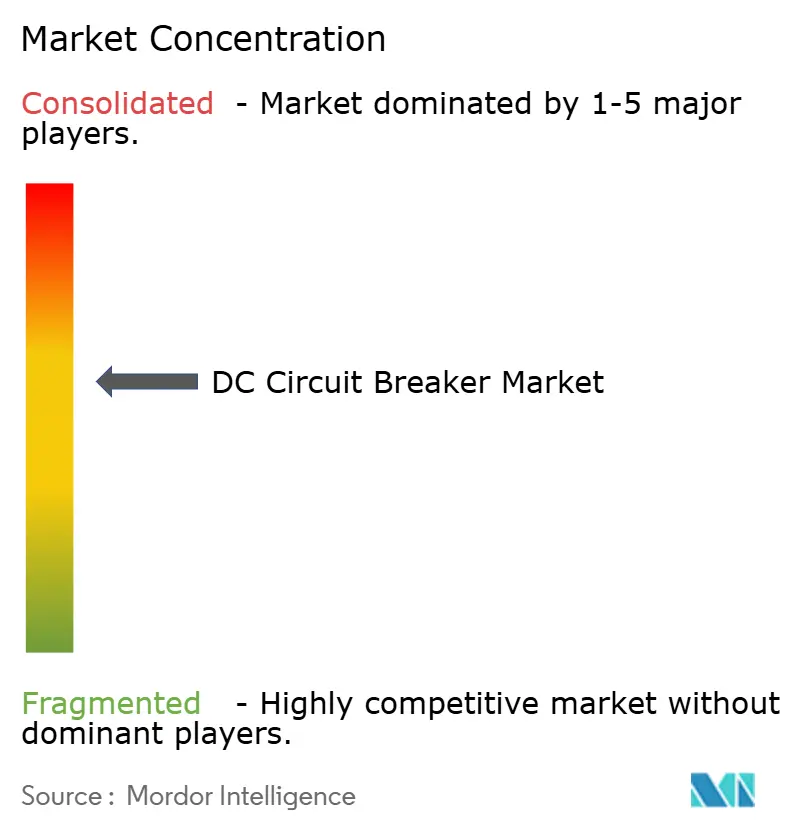
| Market Concentration | Medium |
Major Players *Disclaimer: Major Players sorted in no particular order Image © Mordor Intelligence. Reuse requires attribution under CC BY 4.0. | |
DC Circuit Breaker Market Analysis by Mordor Intelligence
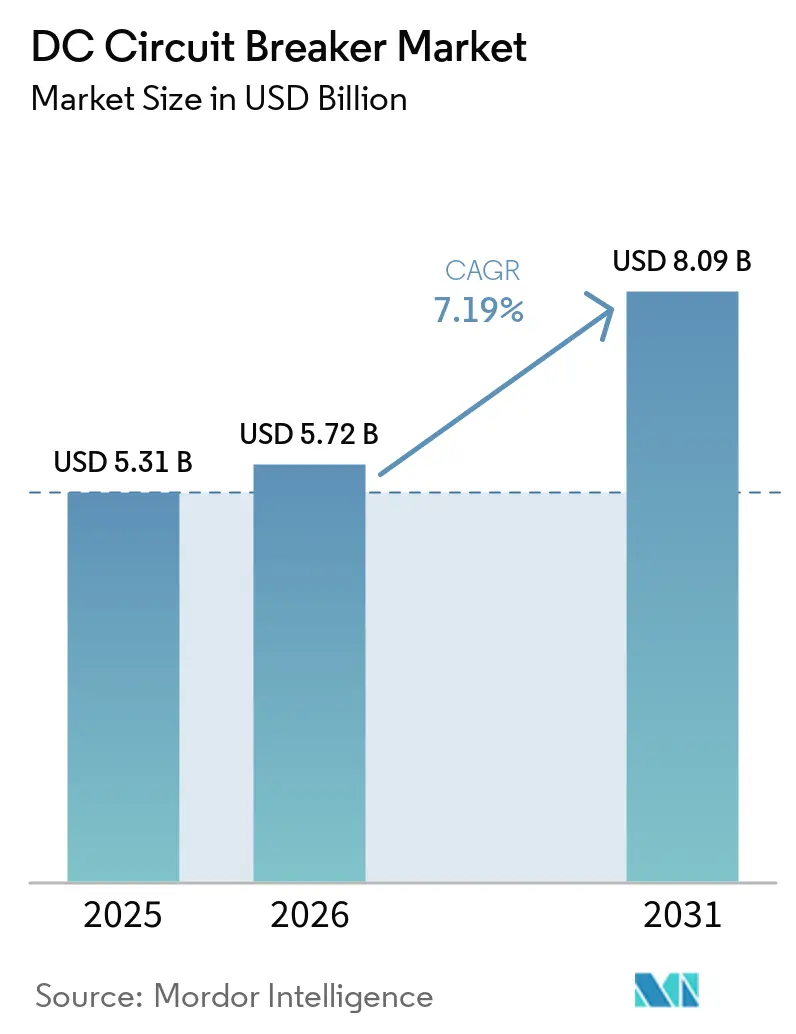
The DC Circuit Breaker Market size is projected to be USD 5.31 billion in 2025, USD 5.72 billion in 2026, and reach USD 8.09 billion by 2031, growing at a CAGR of 7.19% from 2026 to 2031.
Growth is propelled by ultra-high-voltage direct-current (HVDC) transmission corridors, rapid rail electrification, and the data-center pivot toward 800 VDC busways, each of which requires fault-clearing speeds unattainable with legacy alternating-current devices.[1]ABB, “SafeRing Fluoronitrile Switchgear,” abb.com The European Union’s phased ban on sulfur-hexafluoride (SF₆) insulation, effective January 2026 for equipment up to 24 kV, is accelerating the shift to vacuum and solid-state technologies.[2]European Commission, “Regulation (EU) 2024/573,” ec.europa.eu Asia-Pacific leads adoption as China, India, and Vietnam commission new HVDC links and metro lines, while North America and Europe see retrofit demand as utilities replace oil-filled switchgear. Competitive strategies now concentrate on securing silicon-carbide wafer supply, embedding proprietary breaker modules into converter stations, and achieving IEC 62271-100 certification for SF₆-free gases.[3]Siemens Energy, “blue GIS Portfolio,” siemens-energy.com
Key Report Takeaways
- By type, solid-state units held 76.3% revenue share in 2025, whereas hybrid designs are forecast to expand at an 8.8% CAGR through 2031.
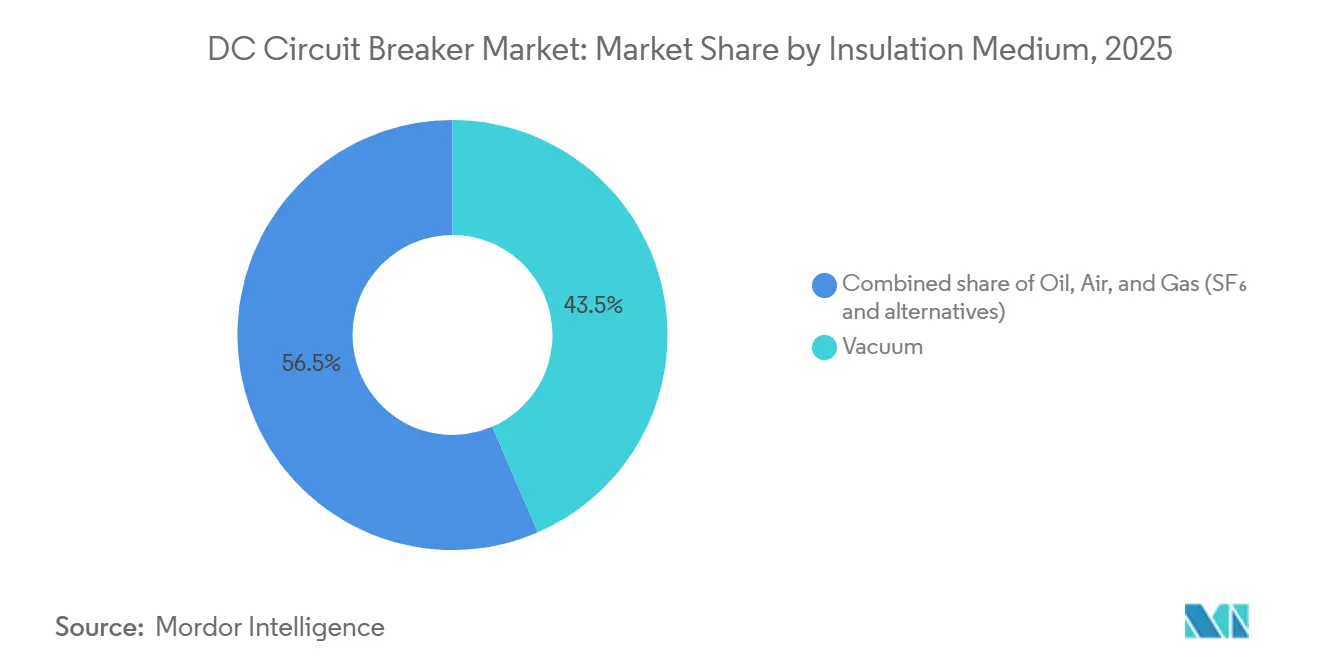
- By insulation medium, vacuum breakers captured 43.5% of the DC circuit breaker market share in 2025 and will grow at a 7.7% CAGR to 2031.
- By voltage rating, medium-voltage products led with 48.1% of the DC circuit breaker market size in 2025, while the high-voltage segment is advancing at a 10.5% CAGR through 2031.
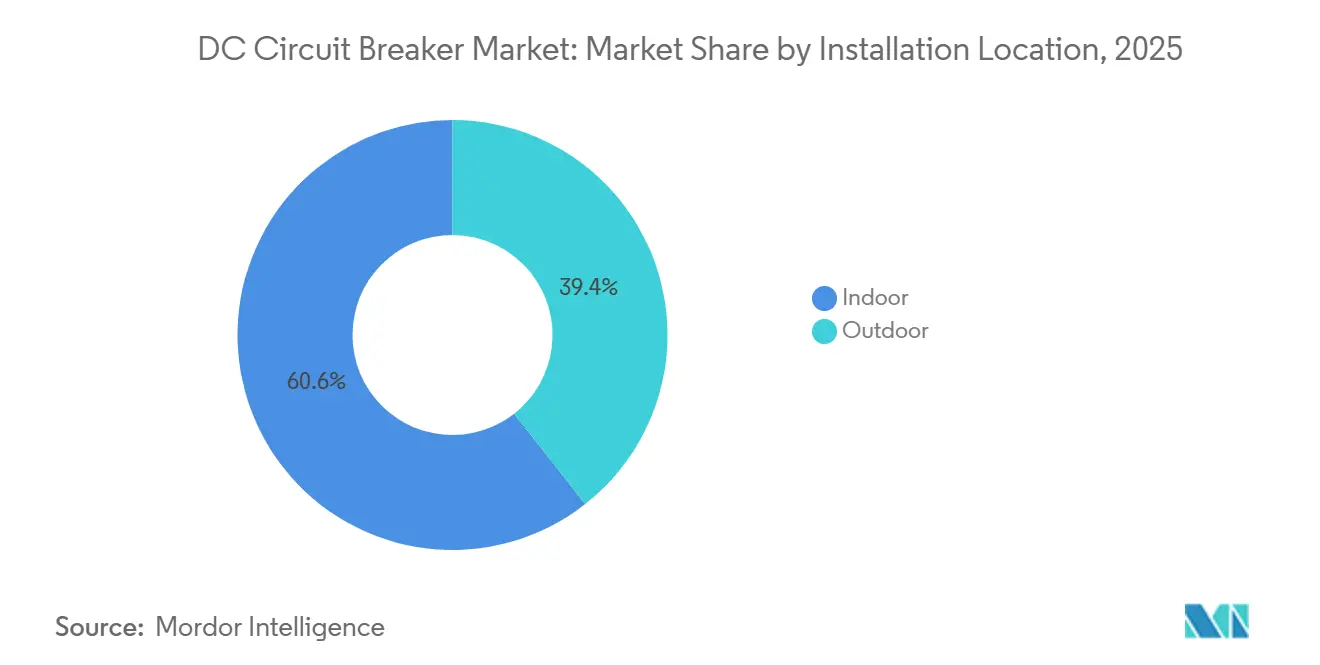
- By installation location, indoor units dominated with a 60.6% share in 2025; outdoor models are projected to grow the fastest at a 9.2% CAGR.
- By operating mechanism, mechanical designs controlled a 44.9% share in 2025, whereas solid-state-actuated breakers will register an 11.6% CAGR through 2031.
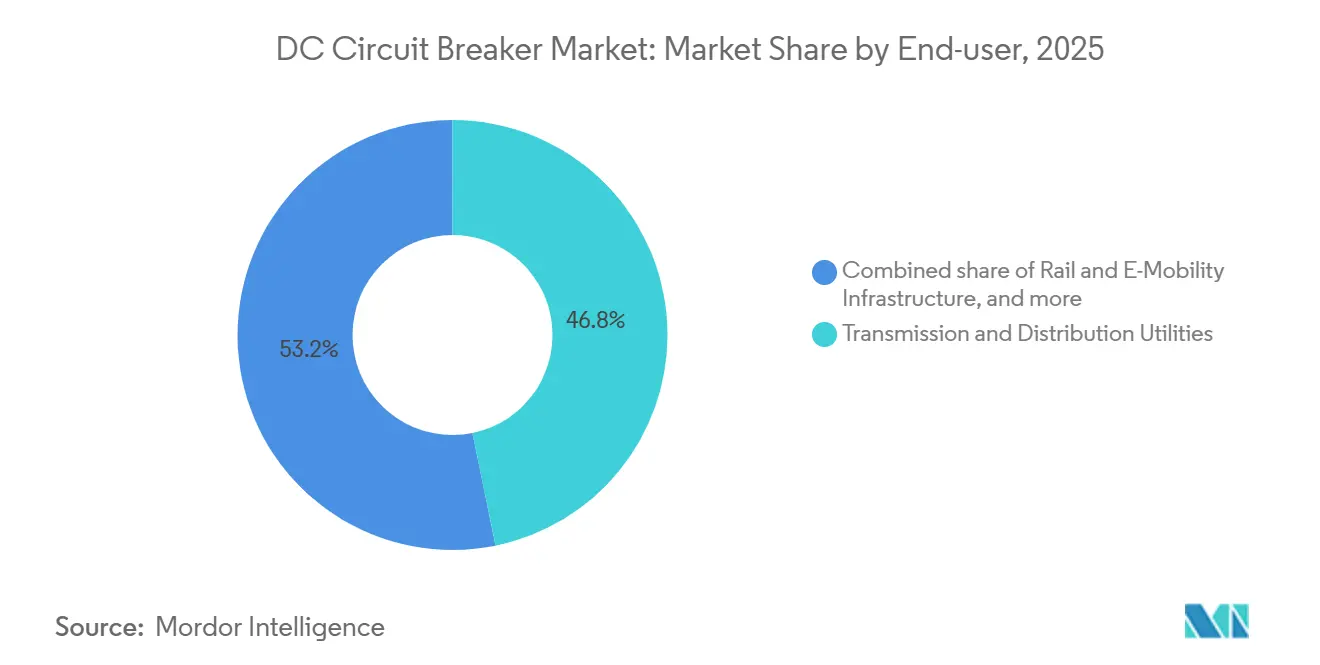
- By end-user, transmission and distribution utilities accounted for 46.8% of 2025 revenue, yet rail and e-mobility are the fastest-growing segments at an 11.1% CAGR.
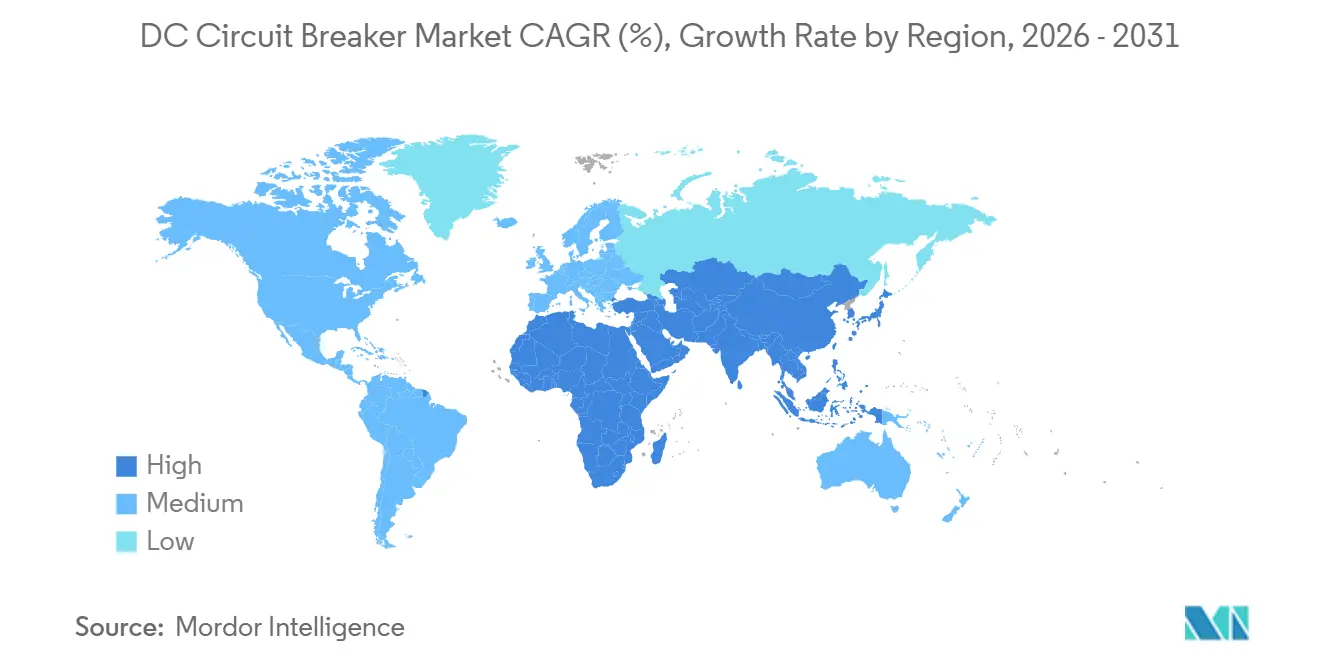
- By geography, Asia-Pacific commanded a 39.7% share in 2025 and is set to maintain the highest regional CAGR of 9.4% to 2031.
Note: Market size and forecast figures in this report are generated using Mordor Intelligence’s proprietary estimation framework, updated with the latest available data and insights as of January 2026.
Market Trends and Insights
Drivers Impact Analysis of DC Circuit Breaker Market*
| Driver | (~) % Impact on CAGR Forecast | Geographic Relevance | Impact Timeline |
|---|---|---|---|
| Surge in renewable-linked DC networks | 1.40% | China, India, EU offshore wind | Medium term (2-4 years) |
| Rapid build-out of HVDC transmission corridors | 1.60% | Asia-Pacific, Europe, Brazil | Long term (≥ 4 years) |
| Grid-modernization programs in ageing T&D fleets | 1.10% | North America, Europe | Medium term (2-4 years) |
| Rail & metro DC electrification pipelines | 0.80% | Vietnam, India, China, Europe | Medium term (2-4 years) |
| Data-center shift toward on-prem LVDC busways | 0.70% | United States, Europe, Singapore | Short term (≤ 2 years) |
| Policy bans on SF₆ insulation | 0.90% | EU-27, United Kingdom, Japan | Short term (≤ 2 years) |
| Source: Mordor Intelligence | |||
Surge in Renewable-Linked DC Networks
Utility-scale solar and offshore wind farms increasingly export power on DC collection grids, producing fault currents that exceed the capability of AC switchgear. China reported that 68% of solar farms commissioned in 2025 used 1,500 VDC string inverters with embedded breakers, trimming balance-of-system costs by 12%.[4]National Energy Administration China, “2025 Solar Deployment Statistics,” nea.gov.cn India tendered 15 GW of DC-coupled storage, requiring 3 kV vacuum breakers to secure lithium-ion arrays. North Sea developers now specify 320 kV collection platforms with hybrid breakers capable of 40 kA interruption in 2 milliseconds to avert cascade trips. The IEC draft amendment proposed in December 2025 will, once ratified, shorten certification cycles and spur broader uptake. Collectively, these investments strengthen the demand outlook for the DC circuit breaker market.
Rapid Build-Out of HVDC Transmission Corridors
HVDC lines are displacing long-distance AC corridors thanks to lower resistive losses. The Hami-Chongqing ±800 kV link, energized in 2024, uses 12 hybrid breakers at each terminal to isolate faults within 3 milliseconds. Hitachi Energy supplies breaker modules pairing a mechanical disconnect with silicon-carbide thyristors for 25 kA duties. Europe’s Celtic Interconnector began construction in March 2025 and specifies vacuum breakers at both ends to enable black-start capability. Brazil’s Madeira project will employ ±600 kV solid-state breakers to guard a 2,400 km corridor that exports 4 GW of hydropower. Such mega-projects underpin high-voltage revenue streams within the DC circuit breaker market.
Grid-Modernization Programs in Ageing T&D Fleets
North American and European utilities are phasing out oil-filled switchgear installed in the 1970s. The U.S. Department of Energy allocated USD 3.5 billion in 2024-2025 for distribution upgrades, earmarking 22% for DC microgrids. Germany now bans SF₆ gear above 10 kV in new substations, accelerating the replacement of 18,000 legacy breakers by 2028. ABB’s SafeRing, launched in April 2025, employs a fluoronitrile-CO₂ blend and captured 14% of Europe’s retrofit orders within nine months. Collectively, these programs refresh demand for medium-voltage solutions and reinforce long-term growth in the DC circuit breaker market.
Rail & Metro DC Electrification Pipelines
Urban transit authorities standardize on 750 VDC and 1,500 VDC systems that need breakers capable of clearing inductive loads without arc reignition. Vietnam approved USD 61 billion for metro expansion through 2035, specifying vacuum breakers in traction substations. India’s rail network electrification mandates 3 kV breakers, with a USD 180 million contract awarded in August 2024. East Japan Railway retrofitted 320 substations with solid-state breakers during 2025, recouping 9% energy via regenerative braking. On-board storage trams such as Alstom’s Citadis X05 impose 15 kA peaks, which only hybrid designs can interrupt. These projects support double-digit growth in rail applications inside the DC circuit breaker market.
Restraints Impact Analysis of DC Circuit Breaker Market*
| Restraint | (~) % Impact on CAGR Forecast | Geographic Relevance | Impact Timeline |
|---|---|---|---|
| Capital premium of solid-state & hybrid designs | -0.5% | Global, with acute sensitivity in price-competitive markets (India, Southeast Asia, Africa, Latin America) | Short term (≤ 2 years) |
| Complex fault-clearing in multi-terminal DC grids | -0.3% | Europe (North Sea wind hubs), China (provincial HVDC meshes), North America (planned offshore wind interconnectors) | Medium term (2-4 years) |
| Absence of universal DC-protection standards | -0.4% | Global, with pronounced impact in multi-vendor HVDC projects and cross-border interconnectors requiring interoperability | Medium term (2-4 years) |
| Wide-band-gap semiconductor supply bottlenecks | -0.3% | Global, with supply concentration in U.S. (Wolfspeed), Japan (Rohm, Mitsubishi), and Europe (Infineon, STMicroelectronics) | Short term (≤ 2 years) |
| Source: Mordor Intelligence | |||
Capital Premium of Solid-State & Hybrid Designs
Solid-state and hybrid breakers carry a 3-5× cost multiple versus mechanical vacuum units. A 52 kV hybrid pole can cost up to USD 580,000, stretching payback periods beyond 12 years for regulated utilities. India deferred solid-state deployment at three HVDC projects in 2025 due to capital constraints. Silicon-carbide wafer shortages pushed 2025 lead-times to 52 weeks and spot prices 35% above contract levels. Chinese suppliers now market mechanical-vacuum hybrids at USD 180,000-240,000, trading speed for affordability and winning 22% of Asia’s medium-voltage orders in 2025.
Complex Fault-Clearing in Multi-Terminal DC Grids
Meshes lack natural fault isolation, forcing protection to act within 2 milliseconds. The North Sea Wind Power Hub saw a 14-month delay as integrators refined algorithms for five-terminal coordination. IEC standards still cover only point-to-point links, inflating engineering costs by up to 40%. China’s Zhangbei four-terminal grid suffered three outages in 2025 due to mis-coordination, requiring USD 38 million in firmware retrofits. CIGRE simulations indicate stability requires sub-1.5-millisecond clearing, achievable only with poles costing USD 1.2-1.8 million.
*Our forecasts treat driver/restraint impacts as directional, not additive. The impact forecasts reflect baseline growth, mix effects, and variable interactions.
DC Circuit Breaker Market Segment Analysis
By Type:
Hybrid Designs Gain Traction Despite Solid-State DominanceSolid-state circuit breakers held 76.3% of the DC circuit breaker market in 2025, owing to sub-microsecond commutation paths that meet stringent HVDC grid requirements. The segment’s continuous 0.3-0.5% conduction loss, however, equates to USD 180,000-280,000 in annual energy waste for a 25 kA unit, encouraging utilities to evaluate alternatives. Hybrid products route steady-state current through a zero-resistance vacuum contact and invoke a semiconductor path only during faults, cutting losses to 0.08%. ABB’s installation along the Hami-Chongqing link in 2024 validated a 3-millisecond interruption time and demonstrated 15-year life expectancy.
Hybrid designs will expand at an 8.8% CAGR, 1.6 points above the overall DC circuit breaker market, as field-upgradeable modules lower first-cost barriers. Hitachi Energy’s cartridge concept, launched in March 2025, lets operators add silicon-carbide stacks later, deferring up to USD 450,000 in capital. Eaton’s wafer supply deal with Wolfspeed promises 22% cost reductions by 2027. Mechanical-only breakers remain relevant in low-voltage rail traction where 10-millisecond clearing suffices and pricing undercuts hybrids by 60%.
By Insulation Medium:
Vacuum Leads Amid SF₆ Phase-OutVacuum units controlled 43.5% of 2025 revenue and will grow at a 7.7% CAGR as regulators ban SF₆ in new installations. The DC circuit breaker market size tied to vacuum products is forecast to improve sharply once the EU restriction starts in 2026. Utilities value the vacuum’s maintenance-free design and rapid dielectric recovery. ABB’s SafeRing landed 1,800 orders within five months of its April 2025 debut.
Gas-insulated breakers, 24.5% of the mix in 2025, cling to high-voltage outdoor niches, but fluoronitrile-and-ketone blends now rival SF₆ performance. Siemens Energy’s blue GIS secured 12 converter-station contracts in 2025. Oil-filled designs declined to 18% share due to fire risk, and air-insulated units lost ground to vacuum units in data-center retrofits. Mitsubishi Electric’s 84 kV vacuum interrupter, undergoing trials at Tokyo Electric, signals vacuum’s upward voltage migration.



By Voltage Rating:
High-Voltage Segment Accelerates on HVDC DemandMedium-voltage devices up to 52 kV captured 48.1% share in 2025, yet high-voltage units above 52 kV will expand at a 10.5% CAGR, fuelled by ±800 kV corridors in China and offshore interconnectors in Europe. The high-voltage DC circuit breaker market size for multi-terminal grids is projected to rise fastest as fault energy scales with voltage. Interrupting 25 kA at ±800 kV dissipates 40 GJ in 3 milliseconds, a feat hybrid designs now achieve.
Low-voltage equipment to 1 kV enjoys a steady 6.8% CAGR through data-center LVDC adoption. Schneider Electric’s Premset switchgear posted 4,200 unit sales in 2025, 62% DC-rated, demonstrating medium-voltage resilience. High-voltage deployments such as the Zhangbei grid employ modules costing USD 1.4 million apiece, underscoring the premium potential of this tier.
By Installation Location:
Outdoor Breakers Surge on Renewable IntegrationIndoor models dominated with a 60.6% share in 2025, reflecting use in data centers, substations, and rail facilities. Outdoor installations, however, will grow at a 9.2% CAGR as wind farms and desert corridors expand. The Qinghai-Henan ±800 kV route employs outdoor hybrids with ceramic-composite insulators to survive high-altitude deserts. Offshore wind platforms demand weatherproof enclosures with pressurized nitrogen that adds 30% to cost but is indispensable for salt-fog resilience.
Indoor adoption remains strong where climate control lowers maintenance. Microsoft’s 180 indoor breakers at 800 VDC showcase compact footprints and high power density. East Japan Railway’s retrofit shrank equipment rooms by 40%, freeing urban real estate. Outdoor containerized systems like ABB’s PCS100 ESS, deployable in 72 hours, will widen addressable markets even in remote sites.
By Operating Mechanism:
Solid-State Actuated Breakers Outpace Mechanical DesignsMechanical actuators retained 44.9% revenue share in 2025 thanks to spring-charged reliability and low upfront pricing. Yet the solid-state-actuated sub-segment will climb at 11.6% CAGR as HVDC grids mandate sub-millisecond clearing. ABB’s hybrid HVDC breaker at Hami-Chongqing uses silicon-carbide devices that trigger within 500 microseconds. Eaton’s 800 VDC rack breaker interrupts 20 kA in 300 microseconds, protecting lithium-ion UPS banks.
Hybrid electromechanical mechanisms claim a 33% share, offering a balance between loss and speed. Hitachi Energy shipped 1,200 units in 2025 across HVDC and rail, proving scalability. Mechanical timelines of 8-12 milliseconds are impractical for emerging multi-terminal meshes, so migration toward semiconductor-assisted actuation is inevitable.
By End-User:
Rail & E-Mobility Infrastructure Leads GrowthTransmission and distribution utilities dominated 46.8% of 2025 revenue, underpinning the DC circuit breaker market with grid-scale orders. Rail and e-mobility infrastructure, however, will grow the fastest at 11.1% CAGR, driven by USD 61 billion in Vietnamese metro builds and India’s 45,000-km electrification target. ChargePoint deployed 2,400 U.S. fast-charging sites integrating 1,000 VDC solid-state breakers, signaling rising demand beyond rail.
Renewable and storage plants held a 22% share in 2025 as DC-coupled batteries gained traction. Commercial and industrial facilities captured an 18% share with a 7.9% CAGR by rolling out LVDC microgrids for energy savings. Marine and telecoms remain niche at 7% share but value sealed, maintenance-free designs for harsh settings.
Geography Analysis
APAC DC Circuit Breaker Market
Asia-Pacific led the DC circuit breaker market with 39.7% share in 2025 and is forecast to register a 9.4% CAGR through 2031. China energized three ±800 kV corridors in 2024, each requiring 25 kA hybrids and a cumulative equipment spend above USD 180 million. India’s 500 GW renewable target drives demand for 3 kV vacuum breakers at solar-storage nodes, while Vietnam’s metro expansion stipulates 1,500 VDC protection across two major cities. Japan’s 320-substation retrofit saved 9% traction energy and deferred USD 240 million in upgrades.
Europe DC Circuit Breaker Market
Europe secured a 28% share in 2025 and will rise at a 7.8% CAGR under SF₆ bans and offshore wind interconnectors. Regulation 2024/573 boosts vacuum orders by 34%, and Germany’s substation rule accelerates the removal of 18,000 legacy units. The Celtic Interconnector, valued at EUR 930 million, specifies vacuum breakers for black-start capability. Nordic HVDC links such as Hansa PowerBridge employ ±525 kV hybrids to stabilize continental flows.
The Americas and MEA DC Circuit Breaker Market
North America held a 19% share in 2025 and is expected to post a 6.9% CAGR. The U.S. Grid Resilience Partnership carved out USD 770 million for DC microgrids, while California’s SF₆ limits bring forward vacuum retrofits. Hyperscale clusters in Virginia and Oregon now standardize 800 VDC racks, lifting low-voltage demand. South America, the Middle East, and Africa together accounted for a 13.3% share and will grow at an 8.1% CAGR, supported by Brazil’s Madeira HVDC project and Saudi Arabia’s NEOM renewable hub.

Regulatory Landscape
Standardization and environmental policy are narrowing the technical and material choices for DC circuit breakers across voltage tiers. For high-voltage applications, the International Electrotechnical Commission (IEC) published IEC TS 62271-313:2025 (released in March 2025), which sets requirements for HVDC circuit breakers for direct voltages of 100 kV and above, giving utilities and EPCs a clearer procurement and qualification baseline for HVDC converter-station protection.
On the low-voltage side, IEC 60947-2:2024 (sixth edition, published September 2024) updates requirements for circuit breakers used in systems up to 1,500 V DC, supporting wider LVDC distribution in facilities such as data centers and battery storage. Separately, the EU phasing down of SF6 under Regulation (EU) 2024/573, effective January 2026 for equipment up to 24 kV, is accelerating SF6-free gas alternatives and vacuum insulation choices across medium-voltage switchgear portfolios from established suppliers.
Competitive Landscape
Innovation and Adaptability Drive Market Success
The top five suppliers, ABB, Siemens Energy, Hitachi Energy, Schneider Electric, and Eaton, controlled roughly 58% of DC circuit breaker revenue in 2025. Their integrated portfolios span power semiconductors, vacuum-interrupter fabrication, and HVDC engineering, enabling turnkey contracts that bundle breakers with converter stations. ABB’s 2024 acquisition of GE Industrial Solutions added 1,200 hybrid patents and boosted capacity 18%, helping secure China’s ±800 kV projects. Siemens Energy leverages its installed GIS base to cross-sell fluoroketone-insulated breakers compliant with EU regulations.
Cost pressure intensifies as wide-bandgap wafers remain scarce. Eaton’s five-year Wolfspeed deal locks 150 mm supply, promising 22% cost cuts and 1,200 hybrid units annually by 2027. Chinese challengers Chint and GEYA underprice low-voltage offerings by up to 40%, prompting incumbents to focus on high-margin outdoor and solid-state segments. Specialty vendors carve niches: Powell sells ruggedized breakers for offshore oil platforms rated for 25-year maintenance-free life. Technology leadership remains the decisive lever as suppliers race to certify SF₆-free gases and sub-2-millisecond hybrids under pending IEC amendments.
White-space opportunities include multi-terminal grid protection and 350 kW fast-charging stations that need 300 microsecond isolation. Early movers embed proprietary communication links that lock customers into multidecade service arrangements, raising switching costs. Market entrants must navigate the absence of harmonized standards, but successful pilot projects could reshape share allocation within the DC circuit breaker market.
DC Circuit Breaker Industry Leaders
ABB Ltd
Mitsubishi Electric Corporation
Fuji Electric Co Ltd
Siemens AG
Eaton Corporation PLC
- *Disclaimer: Major Players sorted in no particular order
DC Circuit Breaker Market Companies Covered in this Report
- ABB
- Siemens Energy
- Eaton
- Mitsubishi Electric
- Schneider Electric
- Hitachi Energy
- Toshiba Energy Systems
- Rockwell Automation
- Larsen & Toubro
- LS Electric
- Fuji Electric
- Hyundai Electric
- Powell Industries
- Nader Electric
- Entec Electric & Electronic
- GEYA Electrical
- Chint Group
- Hughes Power System
- ABB (Gerapid) Rail Solutions
- Siemens (DCB series)

Market Opportunities and Future Outlook
Near-term whitespace is emerging at the intersection of DC distribution and ultra-fast protection requirements in facilities and OEM-built power systems. The Open Compute Project ratified ORv3 in October 2025, tightening performance expectations for DC protection response in 800 VDC rack architectures and reinforcing demand for semiconductor-based protection devices and breaker modules designed for data centers and battery storage. Siemens Smart Infrastructure used Hannover Messe 2026 (April 2026) to launch its Sentron 3QD2 semiconductor circuit breaker and Sitius 3RF5 solid-state switching device for high-performance DC applications, indicating continued focus on microsecond-range interruption and integrated monitoring.
In high-voltage transmission, IEC TS 62271-313:2025 provides a clearer route for interoperable specifications in projects above 100 kV, supporting broader multi-vendor procurement and reducing reliance on bespoke designs in HVDC breaker packages. Multi-terminal and meshed HVDC protection remains an unmet need because fault coordination has to operate within milliseconds and engineering effort is high, leaving room for modular hybrid designs that balance interruption speed with lower continuous losses, as well as for turnkey suppliers that bundle breakers with converter-station engineering and digital protection schemes.
Recent Industry Developments in DC Circuit Breaker Market
- July 2026: Siemens launched the SENTRON ECPD electronic circuit protection device in the UK, using semiconductor-based technology to limit energy released during short circuits. This broadens Siemens reach in DC protection beyond traditional breakers into integrated, digitally enabled protection for DC panels used in data centers and industrial DC loads.
- October 2025: The Open Compute Project ratified ORv3, tightening requirements for DC protection performance in 800 VDC rack architectures. This shifts procurement toward faster-acting DC protection components and encourages suppliers to align LVDC breaker and protection device designs with hyperscale data-center specifications.
- August 2024: Mitsubishi Electric signed a contract with Siemens Energy Global GmbH & Co. KG to co-develop DC switching stations and define DC circuit breaker requirement specifications for multi-terminal HVDC systems. This collaboration targets an adoption barrier for HVDC, namely consistent requirements for protection equipment that can be engineered and qualified across multi-node DC grids.


DC Circuit Breaker Market Report Scope and Research Methodology
Market Definition and Coverage
For this report, the market is defined as revenue earned from DC circuit breakers used to interrupt, protect, and isolate direct current circuits across grid, industrial, transport, and commercial DC systems, covering both new installations and replacements.
Scope exclusions: We exclude DC fuses and disconnect switches that do not perform circuit breaking, and we also exclude purely AC-rated breakers even if used in mixed AC-DC panels.
Segments Covered in This Report
- By Type
- Solid-state
- Hybrid
- By Insulation Medium
- Oil
- Air
- Vacuum
- Gas (SF₆ & alternatives)
- By Voltage Rating
- Low Voltage (Up to 1 kV)
- Medium Voltage (1 to 52 kV)
- High Voltage (Above 52 kV)
- By Installation Location
- Indoor
- Outdoor
- By Operating Mechanism
- Mechanical
- Solid-State Actuated
- Hybrid Electromechanical
- By End-User
- Transmission and Distribution Utilities
- Renewable and Energy-Storage Plants
- Rail and E-Mobility Infrastructure
- Commercial and Industrial Facilities
- Others
- By Geography
- North America
- United States
- Canada
- Mexico
- Europe
- Germany
- United Kingdom
- France
- Italy
- NORDIC Countries
- Russia
- Rest of Europe
- Asia-Pacific
- China
- India
- Japan
- South Korea
- ASEAN Countries
- Rest of Asia-Pacific
- South America
- Brazil
- Argentina
- Colombia
- Rest of South America
- Middle East and Africa
- Saudi Arabia
- United Arab Emirates
- South Africa
- Egypt
- Rest of Middle East and Africa
- North America
Data Sources, Market Sizing, and Validation
Desk Research
Desk research was first used to map the demand pool for DC protection devices and to set realistic boundaries on what gets counted as a DC circuit breaker. We referenced public sources such as the International Energy Agency for power and renewables buildouts, the US Energy Information Administration for generation and grid indicators, and the International Renewable Energy Agency for storage and solar deployment context.
To ground the electrical and safety side, we reviewed standards and guidance from bodies such as IEC and IEEE, along with national electricity regulator and transmission operator publications where available. Trade flows and manufacturing signals were cross-checked using customs statistics sources like UN Comtrade, and patent databases were used to understand technology movement between mechanical, hybrid, and solid-state approaches. We also reviewed company filings, investor decks, and reputable industry press for product mix cues, capacity additions, and pricing movement, supported by paid subscriptions for company financials and shipment-level trade analytics. These sources are illustrative, and many other public documents were also used for data collection, validation, and clarification.
Primary Interviews and Surveys
Primary work focused on validating where DC breakers are being specified in practice and how pricing differs by voltage class, interruption technology, and use case. We spoke with a mix of manufacturers, distributors, EPCs, utilities, integrators, and large end users across major consuming regions. Their inputs were then used to confirm adoption timing, replacement cycles, and realistic ASP ranges.
Distribution of primary research fieldwork respondents
| Company type | Respondent position | Region |
|---|---|---|
| Top tier: 27% | CXOs: 14% | APAC: 38% |
| Mid tier: 59% | Functional/Unit leaders: 27% | EMEA: 37% |
| Smaller Players: 14% | Managers: 59% | Americas: 25% |
Market-Sizing & Forecasting
Sizing started with a top-down build that reconstructs demand from electrification indicators, then narrows it to DC-specific protection needs by end-use adoption patterns. In practice, we tied the model to measurable activity such as renewable and storage capacity additions, HVDC and MVDC project pipelines, rail electrification and charging infrastructure rollout, and the pace of DC retrofits in commercial and industrial power systems.
The totals were then checked with selective bottom-up approximations, using sampled price bands and shipment volumes discussed in interviews, plus channel checks on typical bill-of-materials content in DC switchgear lineups. Where data was thin, gaps were handled using conservative penetration assumptions and proxy relationships (for example, breaker count per project type and voltage level), which were later re-tested with experts before finalizing.
For forecasting, we used scenario analysis supported by a small set of leading inputs that most interviewees agreed on, including storage deployment pace, HVDC interconnection growth timing, and expected ASP progression as hybrid and solid-state designs scale. Each scenario was stress-tested against regional build rates and realistic replacement cycles so growth does not rely on one single assumption.
Data Validation & Update Cycle
Validation was done through multiple checks so the final number stays consistent with real-world demand signals. Analysts compared outputs against independent indicators like announced DC infrastructure projects, grid investment themes, and technology adoption rates by end use, and then reviewed any large variances before sign-off.
If the model produced an outlier in a region or technology type, we re-checked unit assumptions, currency timing, and ASP ladders, and then re-contacted sources when a mismatch could not be explained by publicly visible activity. Reports are refreshed annually, with interim updates when material events occur, and a final pre-delivery pass is performed so clients receive the latest updated view.
Mordor Intelligence's Dc Circuit Breaker Market Sizing Compared With Other Published Estimates
Published market values for DC circuit breakers can differ because the scope line is not always drawn the same way and the input evidence used for adoption can be inconsistent. Differences also show up when some studies rely more on optimistic project pipelines, or when pricing is assumed to fall faster than what current bids and product mix suggest.
Project-level signals such as HVDC links, storage commissioning plans, and rail and charging rollout pace are the checks that keep Mordor Intelligence's estimate tied to where DC interruption is actually being specified, rather than counting adjacent DC switchgear categories. Other estimates often widen the definition to include broader DC distribution hardware, use older currency timing, or do not re-validate ASP ranges by voltage class and operating mechanism close to the publication date.
Benchmark comparison
| Source | Market Size | Gaps in Research Methodology |
|---|---|---|
| Mordor Intelligence | USD 5.31 B (2025) | |
| Global Consultancy A | USD 4.42 B (2022) | Uses an earlier base year and often blends DC breakers with adjacent DC protection and distribution equipment, which can shift the counted revenue pool and currency conversion timing. |
| Industry Publisher B | USD 4.71 B (2025) | Applies a narrower demand pool that undercounts high-voltage and project-led use cases, and it relies on generalized CAGR assumptions with limited cross-checks on price bands by technology type. |
The spread in the table mainly comes from boundary choices and how closely assumptions are checked against near-term deployment activity. By keeping the counted product set specific to DC circuit breaking and by re-testing adoption and ASP inputs through interviews, the final market size stays easier to trace back to clear variables and repeatable steps.


Key Questions Answered in the Report
How large is the DC circuit breaker market in 2026?
The DC circuit breaker market size is estimated at about USD 5.72 billion in 2026.
Which region leads demand for DC breakers?
Asia-Pacific accounts for the largest share at 39.7% thanks to extensive HVDC and rail investments in China, India, and Vietnam.
What drives the shift toward vacuum insulation?
EU and state-level bans on SF₆ push utilities to adopt vacuum and fluoronitrile-gas alternatives that meet the same performance without greenhouse impact.
Why are hybrid breakers gaining popularity?
Hybrid designs cut continuous losses versus full solid-state units while still clearing faults in about 3 milliseconds, balancing performance with lifecycle cost.
How fast can solid-state DC breakers interrupt faults?
Data-center and HVDC units with silicon-carbide or gallium-nitride devices achieve isolation in under 500 microseconds, preventing equipment damage and outages.
What is the key challenge in multi-terminal DC grids?
Coordinating protection across several nodes in less than 2 milliseconds remains difficult due to the absence of unified IEC standards, driving up engineering costs.
Page last updated on:


 Your data is secure and never sold or shared.


