
GCC Packaging Market Size and Share
Market Overview
| Study Period | 2020 - 2031 |
|---|---|
| Forecast Data Period | 2026 - 2031 |
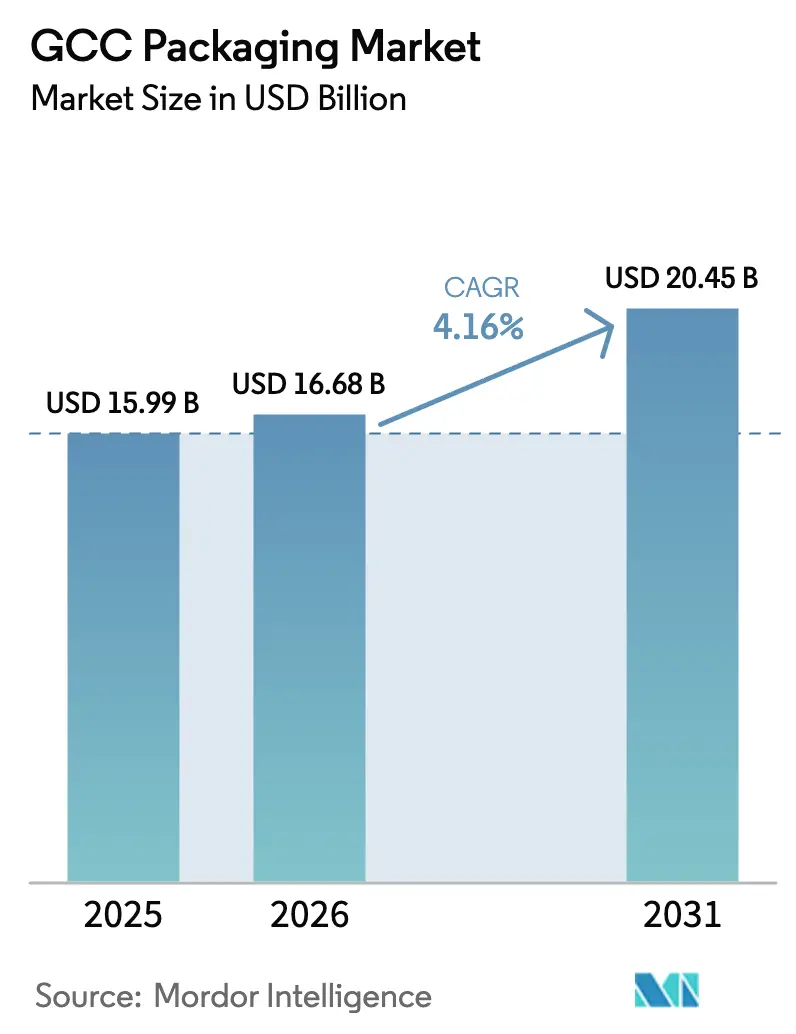
| Base Year Market Size (2025) | USD 15.99 Billion |
| Market Size (2026) | USD 16.68 Billion |
| Market Size (2031) | USD 20.45 Billion |
| Growth Rate (2026 - 2031) | 4.16 % |
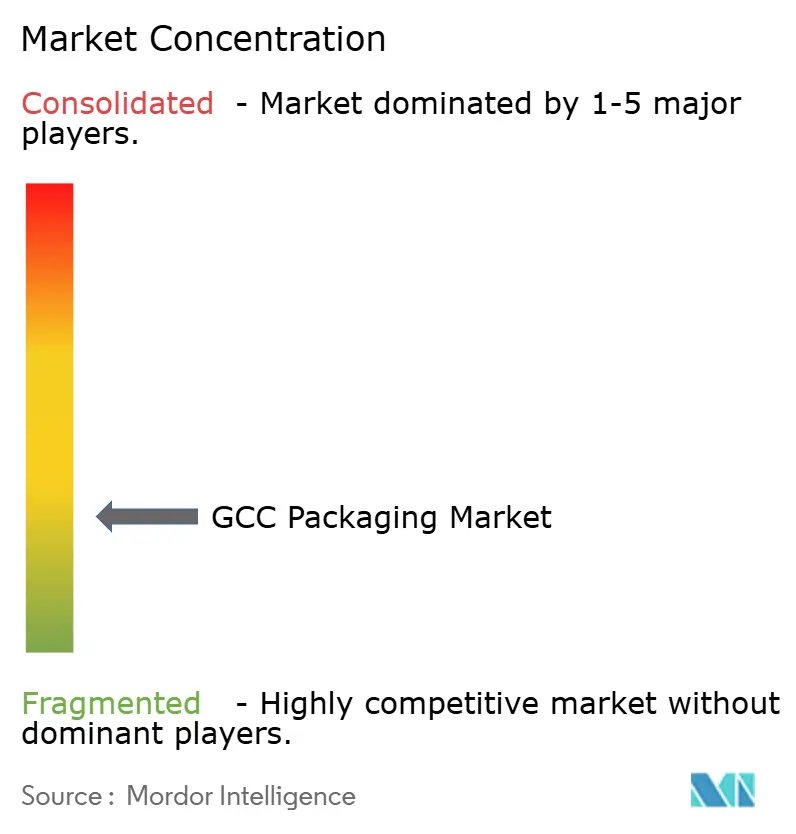
| Market Concentration | Low |
Major Players.webp) *Disclaimer: Major Players sorted in no particular order Image © Mordor Intelligence. Reuse requires attribution under CC BY 4.0. | |
GCC Packaging Market Analysis by Mordor Intelligence
The GCC packaging market size is expected to increase from USD 15.99 billion in 2025 to USD 16.68 billion in 2026 and reach USD 20.45 billion by 2031, growing at a CAGR of 4.16% over 2026-2031. Robust petrochemical integration provides the region long-term resin cost leadership, while non-oil diversification agendas channel fresh capital toward consumer goods, pharmaceuticals, and industrial exports, each of which relies on reliable, higher-performance packs. Brand owners are responding to single-use plastic bans, cold-chain food security targets, and e-commerce fulfilment pressures by demanding lighter, smarter, and easier-to-recycle formats, thereby lifting both volume and value intensity across the GCC packaging market. Rising utilities tariffs and adoption of Extended Producer Responsibility in the United Arab Emirates are nudging converters to invest in recycled-content capability, automation, and design-for-circularity, changes that will gradually narrow the cost gap between virgin plastic and alternative substrates. Competitive intensity remains moderate; multinationals supply high-speed carton and flexible-film systems, while regional rigid-plastic and corrugated converters leverage feedstock proximity and lower labour costs to defend margins.
Key Report Takeaways
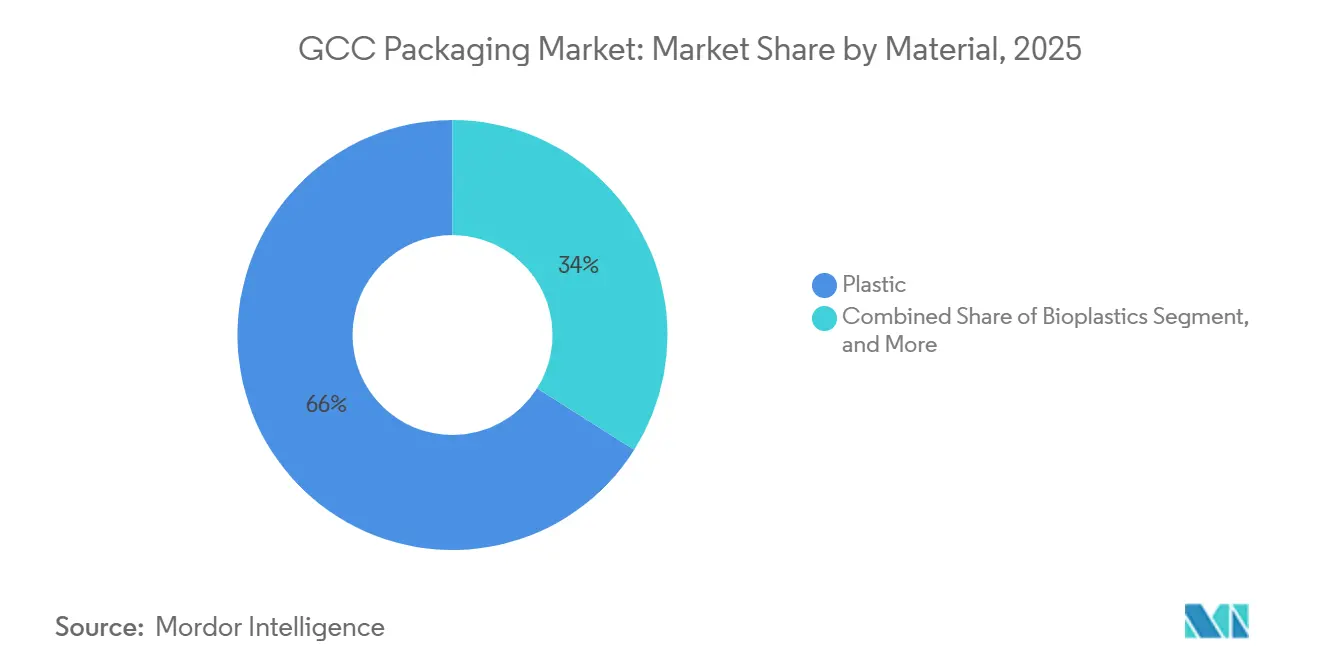
- Plastic captured 66.04% of GCC packaging market share in 2025, whereas bioplastics are projected to expand at a 4.98% CAGR through 2031.
- Rigid formats held 48.19% of the GCC packaging market in 2025, yet flexible packaging is forecast to advance at a 4.56% CAGR during 2026-2031.
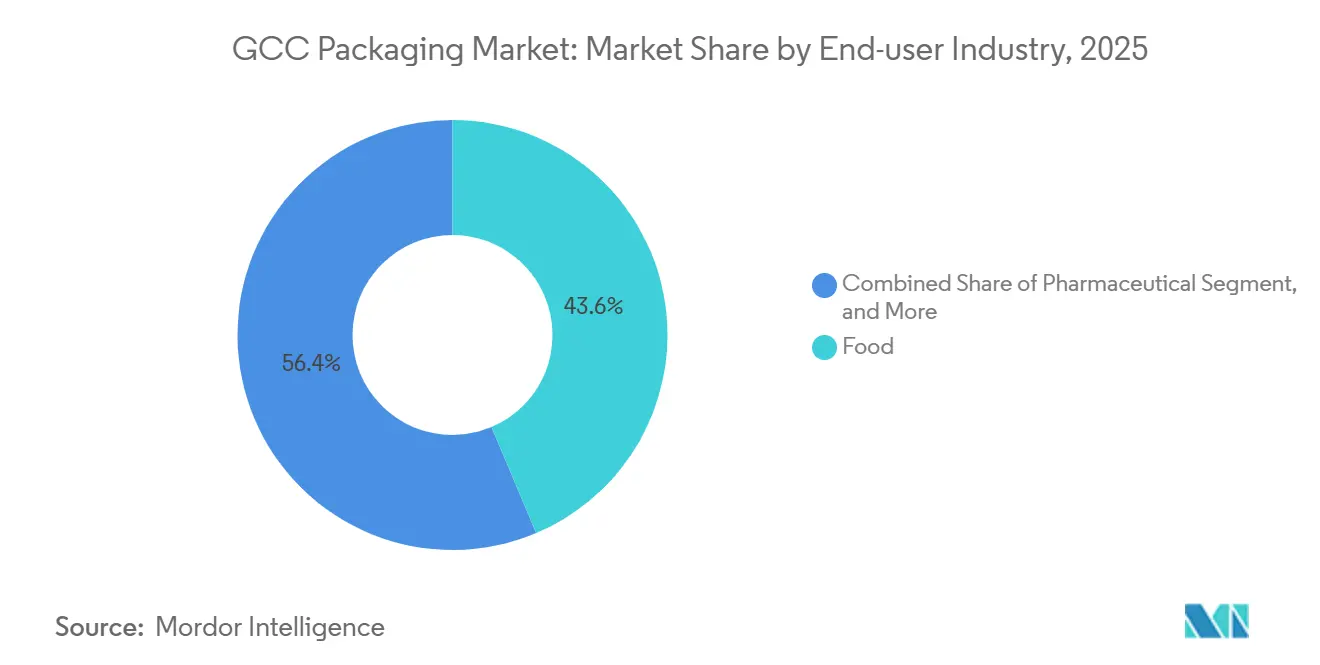
- Food applications accounted for 43.64% of GCC packaging demand in 2025, while pharmaceutical packaging is expected to grow at a 4.88% CAGR over the same period.
- Injection moulding commanded 46.93% of technology uptake in 2025, but injection stretch blow moulding is poised to grow at a 5.12% CAGR, the fastest among all methods.
- Saudi Arabia contributed 54.37% of GCC packaging demand in 2025, whereas Oman is projected to record the highest country-level CAGR at 4.93% through 2031.
Note: Market size and forecast figures in this report are generated using Mordor Intelligence’s proprietary estimation framework, updated with the latest available data and insights as of 2026.
GCC Packaging Market Trends and Insights
Drivers Impact Analysis*
| Driver | (~) % Impact on CAGR Forecast | Geographic Relevance | Impact Timeline |
|---|---|---|---|
| Rapid Growth in E-commerce Fulfilment Packaging | +0.90% | UAE and Saudi Arabia core; spillover to Qatar and Kuwait | Short term (≤ 2 years) |
| Government Bans on Single-use Plastics Spurring Alternative Materials | +0.70% | UAE leading; Saudi Arabia and Oman phased rollout | Medium term (2-4 years) |
| Food Security Investments Driving Cold-chain Packaging Demand | +0.60% | GCC-wide, with Saudi Arabia and UAE anchor investments | Medium term (2-4 years) |
| GCC Petrochemical Capacity Providing Low-cost Resin Advantage | +0.50% | Saudi Arabia and UAE production hubs; regional supply | Long term (≥ 4 years) |
| Mega-events Catalysing Retail Packaging Upgrades | +0.40% | Saudi Arabia (Vision 2030 events); Qatar (FIFA legacy); UAE (Expo continuation) | Short term (≤ 2 years) |
| AI-driven Packaging Automation Adoption at Converters | +0.30% | UAE and Saudi Arabia early adopters; gradual GCC diffusion | Medium term (2-4 years) |
| Source: Mordor Intelligence | |||
Rapid Growth in E-commerce Fulfilment Packaging
Double-digit growth in home delivery is reshaping secondary and tertiary packaging needs across the GCC packaging market. Online orders typically require corrugated outers, cushioning void fill, and tamper-evident seals, formats that carry greater material intensity than in-store retail.[1]Consultancy-me editorial team, “MENA’s consumer packaged goods industry in a high-growth phase,” Consultancy-me.com, consultancy-me.com Retail sales are projected to hit USD 390 billion by 2028, with omnichannel share continuing to climb, a shift that magnifies demand for printable graphics that enhance the unboxing experience and for carrier-optimized pack dimensions that lower last-mile costs.[2]Nivetha Dayanand, “UAE to build world’s largest PLA bioplastic plant,” Zawya, zawya.com Saudi Arabia’s large-scale investments in logistics zones and fulfilment robotics will compress delivery lead times, encouraging frequent but smaller basket sizes, further elevating packaging unit requirements. Converters that add digital printing, right-sized corrugation, and biodegradable cushioning stand to capture premium margins as brand owners seek cost-effective differentiation. E-commerce therefore injects sustained incremental volume into the GCC packaging market and accelerates innovation in structural design.
Government Bans on Single-Use Plastics Spurring Alternative Materials
Implementation of the UAE’s Executive Council Resolution No. 124 of 2023 eliminated single-use plastic bags, cups, plates, and cutlery beginning June 2024, triggering wholesale substrate swaps toward moulded fiber, coated paper, and certified-compostable biopolymers.[3]Government of Dubai, “Executive Council Resolution No. 124 of 2023,” dubai.gov.ae The policy horizon has widened, with Saudi Arabia and Oman unveiling phased bans that prompt regional fast-food chains and retailers to redesign disposable service ware well before the 2028 compliance deadlines. However, GCC paper and board capacity is constrained by water scarcity and high energy costs, creating short-term shortages that inflate import bills and extend lead times. Emirates Biotech aims to address supply gaps through its 160,000-tonne-per-annum polylactic-acid complex, slated for mechanical completion in 2028, thereby positioning the UAE as a renewable-polymer hub. Brand owners now routinely request ISO 14855 or ASTM D6400 certification, and failure to comply risks shelf delisting, making alternative-material agility a competitive prerequisite across the GCC packaging market.
Food Security Investments Driving Cold-Chain Packaging Demand
More than 85% of the region’s caloric intake arrives through imports, exposing governments to external shocks that were amplified during the 2020 pandemic. In response, public investment funds and sovereign vehicles in Saudi Arabia and the UAE are expanding refrigerated logistics corridors, vertical farms, and protein-processing plants, each of which raises adoption of barrier films, modified-atmosphere trays, and aseptic cartons that preserve freshness across long distances. New dairy, juice, and ready-meal lines rely on Tetra Pak’s Factory OS, whose predictive-maintenance suite reduces downtime and cuts material waste, supporting an estimated 6.5% CAGR for Gulf food and beverage output through 2031. Cold-chain expansion also accelerates demand for temperature-indicator labels and data-logging smart tags that verify compliance during cross-desert haulage. Consequently, cold-chain investments strengthen medium-term demand visibility for the GCC packaging market and reward converters capable of advanced multilayer and aseptic structures.
GCC Petrochemical Capacity Providing Low-Cost Resin Advantage
Saudi Arabia’s 800,000-tonne polypropylene addition and Borouge 4’s 1.4 million-tonne polyethylene increment, both commissioned in 2024, underscore the Gulf’s feedstock strength. Natural-gas-linked utilities confer durable cost advantages to film extruders, blow molders, and injection molders that secure long-term offtake agreements, allowing them to price finished goods below import-parity alternatives in Asia or Europe. Yet spot resin volatility remains a profit-risk for smaller converters that buy monthly; polypropylene rose SAR 60 per tonne while polyethylene declined SAR 37 per tonne during 2024-2025. Major producers now explore chemical recycling and bio-feedstock integration to meet future carbon-border-adjustment levies and brand sustainability pledges. Sustained resin competitiveness cements the GCC packaging market’s role as an export-ready supply base, although converters must keep upgrading formulations to align with evolving circularity frameworks.
Restraints Impact Analysis*
| Restraint | (~) % Impact on CAGR Forecast | Geographic Relevance | Impact Timeline |
|---|---|---|---|
| Persistent Volatility in Polymer Feedstock Prices | -0.60% | GCC-wide, with Saudi Arabia and UAE production volatility transmitting regionally | Short term (≤ 2 years) |
| Limited Post-consumer Recycling Infrastructure | -0.40% | GCC-wide, with UAE pilot EPR as early exception | Medium term (2-4 years) |
| Water Scarcity Increasing Paper and Board Processing Costs | -0.30% | Saudi Arabia, UAE, and Oman most exposed; Kuwait and Bahrain moderate impact | Long term (≥ 4 years) |
| Skills Gap for Industry 4.0 Packaging Operations | -0.20% | UAE and Saudi Arabia automation leaders; broader GCC lag | Medium term (2-4 years) |
| Source: Mordor Intelligence | |||
Persistent Volatility in Polymer Feedstock Prices
Crude-oil fluctuations, scheduled cracker turnarounds, and shifting Asian demand drove a SAR 60 per tonne rise in polypropylene while polyethylene dropped SAR 37 per tonne during 2024-2025, compressing gross margins for converters locked into quarterly price caps. Although recent capacity additions aim to smooth regional supply, global freight swings and arbitrage windows still transmit sharp resin price gyrations into the GCC packaging market. Smaller family-owned converters lack the hedging instruments that multinational peers wield, forcing them either to hold costly buffer stocks or accept spot-exposure risk. Emerging recycled-content mandates further destabilize price planning, because recycled PET and HDPE command premiums over virgin material in the Gulf due to tight local collection volumes. Without more transparent futures mechanisms or contract indexation, resin volatility will continue to temper near-term investment appetites.
Limited Post-Consumer Recycling Infrastructure
Current GCC recycling rates hover near 10%, well below the 40-50% performance achieved in the European Union and Japan, revealing an infrastructure gap valued between USD 12 billion and USD 25 billion for collection and re-processing capacity. The UAE’s 2025 pilot Extended Producer Responsibility scheme is the only mandatory program in the region, and its limited scope means most post-consumer packaging still lands in municipal dumps or is baled and shipped to Southeast Asia, a route threatened by tightening import restrictions. Lack of automated sorting hampers feedstock quality, making domestic recycled pellets costlier than imported alternatives and impeding brand commitments to 25-30% recycled content. Large beverage producers have funded pilot bottle-to-bottle projects, yet without deposit-return schemes or curb side pickup, volumes remain insufficient to reach scale. Converters therefore face a circularity paradox: customers ask for recycled content, but local supply does not yet exist at competitive prices, slowing sustainable packaging penetration in the GCC packaging market.
*Our forecasts treat driver/restraint impacts as directional, not additive. The impact forecasts reflect baseline growth, mix effects, and variable interactions.
Segment Analysis
By Material - Plastic Strength Prevails While Bioplastics Accelerate
Plastic controlled 66.04% of the GCC packaging market in 2025, and the segment’s absolute tonnage continues to climb even as light-weighting trims gram-per-pack intensity. The dominance reflects resin availability, integrated feedstock economics, and established conversion assets. Within this hierarchy, polyethylene grades feed most films and liners, polypropylene secures closures and rigid tubs, and PET leads beverage bottles, together underpinning a multi-billion-dollar plastics economy inside the broader GCC packaging market size benchmark.
Bioplastics, although holding a single-digit share, are forecast to expand at a 4.98% CAGR as policy bans and multinational sustainability scorecards sharpen substrate choices. Emirates Biotech’s coming PLA complex will anchor regional biopolymer supply, encouraging converters to retrofit extrusion and thermoforming lines for compostable goods. Glass remains niche in pharmaceuticals and premium beverages because of weight and breakage liability, while metal persists in canned drinks and aerosols, buoyed by near-perfect recycling loops. Paper and board growth is moderated by desalinated-water input costs, a structural issue that limits capex for new mills despite rising e-commerce corrugate demand. Overall, material substitution dynamics promise gradual diversification of the GCC packaging market, yet plastics will retain center stage through 2031.



By Packaging Type - Flexible Formats Gain Momentum
Rigid packaging captured 48.19% of spending in 2025, upheld by bottles, jars, and industrial drums that satisfy barrier, stacking, and regulatory demands. However, flexible structures are logging a 4.56% CAGR through 2031 as pouches, sachets, and stretch wraps unlock cost, freight, and shelf-space advantages across food, personal-care, and e-commerce channels. Vacuum pouches extend protein shelf lives, while stand-up spouted pouches replace HDPE bottles in detergents, each substitution elevating the GCC packaging market’s innovation cycle.
E-commerce imposes extra corrugated outers, but brand owners increasingly pair them with lightweight mailer films and molded-fiber inserts to minimize dimensional weight. Semi-rigid blister packs and tubes straddle both camps, finding traction in pharmaceutical dosing compliance and premium cosmetics presentation. SIG’s aluminium-free full-barrier carton further blurs lines by delivering 12-month oxygen protection at a fraction of aluminium’s carbon load, a pivotal lever as corporate climate targets tighten. The convergence of lightweighting economics and sustainability imperatives will keep flexible formats siphoning share from rigid incumbents inside the GCC packaging market.
By End-User Industry - Pharma Leads Growth, Food Holds Scale
Food applications supplied 43.64% of 2025 consumption, reflecting the Gulf’s import dependency and growing domestic processing footprint. Ready meals, confectionery, and bakery products intensify pack counts through single-serve portions calibrated for smaller family sizes and on-the-go lifestyles. Yet the pharmaceutical vertical, while starting from a lower base, is predicted to outpace all peers at a 4.88% CAGR, lifted by localization incentives under Vision 2030 and the UAE’s industrial strategy. The resulting demand stimulates bespoke blister films, desiccant-lined bottles, and serialized labels that meet stringent traceability mandates, thereby enlarging the value share of the GCC packaging market.
Beverage lines rely on aseptic cartons, lightweight PET bottles, and aluminium cans, and they maintain steady growth in tandem with hospitality and tourism rebounds. Personal and home-care packs capture premiumization upside, as consumers shift toward branded beauty and hygiene offerings that often opt for intricate closures and multi-layer tubes. Industrial chemical and lubricant drums are sensitive to oil-price cycles but still represent a sizeable niche that values product integrity over aesthetics. Differentiated growth trajectories among end users therefore diversify revenue streams for converters across the GCC packaging market.
By Packaging Technology - Lightweighting Drives ISBM Adoption
Injection moulding retained 46.93% of technology share in 2025 thanks to its precision and repeatability for closures, tubs, and technical parts. Nonetheless, injection stretch blow moulding is on course for a 5.12% CAGR to 2031 because it unlocks thinner-wall PET bottles that shave up to 25% of resin mass without compromising strength, an irresistible proposition amid resin cost fluctuations. Rigid ISBM capacity expansions in Saudi Arabia and the UAE align with brand owner mandates for 25-30% recycled PET, creating a twin pull for lightweight and circular bottles inside the GCC packaging market share narrative.
Thermoforming sustains demand for transparent produce trays and dual-oven-ready meal dishes, offering speed and moderate tooling costs, whereas extrusion blow moulding remains the workhorse for opaque HDPE jerrycans. Extrusion film lines meet ballooning e-commerce wrap volumes, and converters pursue in-line MDO (machine-direction orientation) upgrades that improve mono-material recyclability. Automation overlays such as AI-guided vision systems and predictive maintenance modules, already live in Tetra Pak’s Factory OS, are migrating across the machinery spectrum, improving OEE and lowering scrap. As capital goods import statistics confirm, the technology mix is trending toward faster, smarter, and lighter solutions that reinforce competitiveness of the GCC packaging market.
Geography Analysis
Saudi Arabia delivered 54.37% of 2025 demand, a scale underpinned by its USD 65 billion consumer-goods economy, integrated resin supply, and a population topping 35 million. Vision 2030’s localization targets stipulate minimum domestic content for every fast-moving consumer product, forcing multinational brand owners to partner with local converters or invest in greenfield assets. Capital goods imports validate this pivot, with machinery shipments climbing 44.2% to EUR 381 million (USD 407 million) in 2024. Mega-event spending on sports and entertainment further spikes single-serve beverage and food-service packaging, pulling forward demand for premium graphics and quick-turn digital print runs.
Oman, despite a smaller population, is projected to outpace its neighbours with a 4.93% CAGR. The Ladayn Polymer Park, backed by USD 155 million across 16 plants, positions the Sultanate as an export-oriented hub for corrugate, film, and caps, augmented by Duqm Port’s deep-water terminals and favourable tax regimes. Manufacturing GDP rose 8.6% in 2024 and foreign direct investment touched RO 2.489 billion (USD 6.5 billion) as firms tapped lower labour costs and proximity to East African trade lanes. Although domestic consumption is modest, outward shipments of industrial goods, seafood, and dates keep converting lines humming and diversify the GCC packaging market.
The United Arab Emirates commands technology leadership, evidenced by EUR 266 million (USD 284 million) in 2024 machinery imports, a 24.5% jump that funds automation, robotics, and circular-material upgrades. Dubai’s Gulfood 2026, spanning 280,000 square meters across two venues, cements the emirate as a trade and innovation node influencing substrate choices and print aesthetics across the broader GCC packaging market. Qatar, Kuwait, and Bahrain add niche pull factors: Qatar’s post-World-Cup retail network favours premium presentation; Kuwait’s 447-liter daily per-capita water use drives PET bottle demand; Bahrain’s re-export logistics hinge on durable corrugate and pallet wrap. Water scarcity, highlighted by the World Bank, pushes paper mills to optimize closed-loop systems, slightly curbing paper’s long-term growth yet unlocking opportunities for water-efficient plastics.
Regulatory Landscape
Packaging regulation across the GCC is shaped by regional standards from the GCC Standardization Organization (GSO), including GSO 193/2020, GSO 839/1997, and GSO 1863/2013 covering plastic food-contact materials, alongside mandatory bilingual (Arabic-English) labelling requirements. Oxo-degradable plastics are banned across GCC states, reinforcing the shift toward recyclable and certified alternative substrates for food service and retail packs.
Country enforcement and conformity pathways add compliance complexity for brand owners and converters. In Saudi Arabia, SASO technical regulations and SABER registration govern many imported products, while the SFDA oversees food-contact materials against SFDA.FD/GSO-aligned requirements. In the UAE, MoIAT administers ECAS and related conformity routes for regulated product categories. The market is also affected by sustainability policy measures, including the UAE pilot Extended Producer Responsibility (EPR) program introduced in 2025, which is pushing design-for-recycling, traceability, and documentation disciplines across packaging supply chains.
Competitive Landscape
Market structure is moderately concentrated, with global laminate-carton and aseptic-film giants coexisting beside agile regional converters. Tetra Pak shipped 178 billion packs worldwide in FY24, and SIG Combibloc booked EUR 3.3 billion (USD 3.53 billion) revenue that same year, together supplying most dairy, juice, and alternative-milk lines in the GCC. Local rigid-plastic suppliers benefit from feedstock proximity, translating to resin procurement spreads of USD 80-120 per tonne against Asian rivals, a delta that underwrites margins even during oil downturns. Corrugated specialists in Saudi Arabia cluster around Jubail and Dammam to serve petrochemical exports, while Emirati label and tube printers tap Dubai’s free-zone logistics for just-in-time shipments.
Sustainability differentiation is the current battleground. SIG’s Dry-Moulded-Fiber closure, co-developed with Pulpac, targets 90% paper content for full cartons by 2030 and reduces water inputs by up to 70% compared with injection-moulded HDPE caps. Tetra Pak has allocated USD 42 million globally for collection and recycling pilots and an additional USD 107 million for low-carbon material R&D, a commitment echoed in local partnerships with waste-management firms. Emirates Biotech’s forthcoming PLA complex introduces competitive tension in food-service disposables and supermarket produce trays, potentially displacing imports from Europe and Asia once commercial volumes flow.
Technology race momentum is clear. Tetra Pak’s Factory OS and SIG’s NEO filling machine integrate AI-driven predictive maintenance and energy dashboards that cut carbon per filled liter by up to 25%. Regional converters with access to subsidized energy but limited skilled labour are fast-tracking robotics and vision systems to maintain uptime and quality under tighter hygiene codes. Extended Producer Responsibility in the UAE adds compliance cost layers that will reward early adopters of design-for-recycling as fee schedules escalate. Overall, strategic moves indicate a gradual but decisive tilt toward circularity, automation, and lightweighting that will redefine competitive advantages inside the GCC packaging market.
GCC Packaging Industry Leaders
Tetra Pak International SA
Mondi plc
AptarGroup Inc.
Arabian Packaging LLC
Huhtamaki Oyj
- *Disclaimer: Major Players sorted in no particular order

Market Opportunities and Future Outlook
Circularity-driven compliance is creating opportunity gaps across collection, sorting, and recycled-resin supply in the GCC, where about 9 million tonnes of packaging waste is generated annually and recycling rates remain low (near 10% per the report context). With the UAE pilot EPR program launched in 2025 and broader frameworks referenced for 2026, converters and material suppliers face stronger commercial demand for verifiable recycled content, design-for-recycling formats, and documentation-ready packaging specifications aligned with ECAS and food-contact requirements.
Material substitution programs tied to single-use plastic restrictions also open pathways for alternative-material portfolios that meet certification demands (for example ISO 14855 or ASTM D6400, as cited in the report context). Emirates Biotech's planned 160,000-tonne-per-annum PLA complex (targeted for mechanical completion in 2028) points to an emerging local feedstock base for compostable packaging, which supports line retrofits for PLA-based films, trays, and food-service items. On the demand side, cold-chain investment and technology upgrades, including digital and automation platforms such as Tetra Pak Factory OS, lift requirements for higher-value packs such as barrier structures and smart labels to improve traceability over longer distribution routes.
Recent Industry Developments
- April 2026: Mondi plc reported that heightened geopolitical tensions in the Middle East necessitated pricing actions across its business units to counter increased energy, raw material, and logistics costs. This highlights how geopolitics feeds into cost pressure for the GCC packaging market and affects near-term profitability.
- November 2025: Tetra Pak launched its Tetra Pak Factory OS, an automation and digital solutions suite, at Gulfood Manufacturing 2025 in Dubai. The launch expands the company's automation capabilities and reinforces its technology position in the GCC packaging market.
- November 2024: Tetra Pak and Union Paper Mills (UPM) launched a carton package recycling line in the UAE with a capacity to process 10,000 tonnes of material annually, supported by a joint investment of AED 2.5 million. The recycling line expands local carton package recycling capacity.


Research Methodology Framework and Report Scope
Market Definition and Coverage
For this study, the GCC packaging market means the revenues earned from packaging materials and formats that are used to contain, protect, transport, and present products sold across GCC countries, counted at the packaging supply chain level and converted to USD for consistent comparison.
Scope exclusions: We exclude equipment sales (such as packaging machinery), non-packaging raw commodities not converted into packaging, and purely logistics services that do not change the packaging used.
Segmentation Overview
- By Material
- Plastic
- LDPE
- HDPE
- PET
- PP
- PS
- PVC
- Other Plastics
- Metal
- Aluminum
- Steel / Tinplate
- Glass
- Flint (Clear)
- Amber
- Green
- Paper and Paperboard
- Corrugated Board
- Folding Cartons
- Liquid Packaging Board
- Molded Fiber
- Bioplastics
- PLA
- PHA
- Starch-based
- Bio-PET / Bio-PE
- Plastic
- By Packaging Type
- Rigid
- Bottles and Jars
- Cans and Drums
- Trays and Containers
- Caps and Closures
- Flexible
- Pouches
- Bags and Sacks
- Films and Wraps
- Sachets and Stick Packs
- Lidding
- Semi-rigid
- Blister Packs
- Tubes
- Clamshells
- Cups and Bowls
- Rigid
- By End-user Industry
- Food
- Processed Food
- Fresh Produce
- Bakery and Confectionery
- Meat, Poultry and Seafood
- Ready Meals
- Beverage
- Bottled Water
- Carbonated Soft Drinks
- Dairy Beverages
- Juices and Nectars
- Alcoholic Beverages
- Pharmaceutical
- Prescription Drugs
- OTC Medicines
- Nutraceuticals
- Personal and Homecare
- Personal Care
- Home Care and Cleaning
- Cosmetics
- Industrial
- Chemicals and Lubricants
- Building and Construction
- Automotive Components
- Food
- By Packaging Technology
- Thermoforming
- Blow Molding
- Extrusion Blow Molding
- Injection Stretch Blow Molding
- Injection Blow Molding
- Injection Molding
- Vacuum Forming
- By Country
- United Arab Emirates
- Saudi Arabia
- Qatar
- Kuwait
- Oman
- Bahrain
Data Sources, Market Sizing, and Validation
Desk Research
Desk work starts with building the demand and supply context for packaging across the GCC, so the market model sits on real industry activity rather than simple growth multipliers. We pull direction and constraints from public sources such as national statistics offices and customs authorities in the GCC, UN Comtrade for trade flows, World Bank macro indicators, and sources like FAO and WHO where food and healthcare volumes help explain packaging usage.
We also review company annual reports, investor presentations, and press releases to understand capacity moves, price trends, and the pace of substitution between plastic, paper, metal, and glass in the region. Where helpful, paid subscriptions that track company financials, shipment level trade records, and patent activity are used to sharpen assumptions around expansion timing and material innovation. This desk source list is illustrative only, and many other public and paid references were used to collect, validate, and clarify data points.
Primary Interviews and Surveys
Primary work is used to pressure test the desk assumptions with people who see pricing, conversion volumes, and buyer requirements in real time. We speak with a mix of packaging producers, converters, distributors, and large end users in food, beverage, healthcare, and home care, which helps us confirm the split between rigid and flexible demand, typical price ranges, and how fast sustainability rules are changing material choices across the GCC.
Distribution of primary research fieldwork respondents
| Company type | Respondent position |
|---|---|
| Top tier: 38% | CXOs: 15% |
| Mid tier: 45% | Functional/Unit leaders: 25% |
| Smaller Players: 17% | Managers: 60% |
Market-Sizing & Forecasting
Sizing is built using a top-down and bottom-up logic, where regional production and trade indicators are first used to reconstruct the packaging demand pool across the GCC, and then checked using supplier and channel reality checks. The top-down path leans on market fingerprints such as packaged food and beverage output trends, retail and e-commerce activity, construction and industrial shipment movements (for secondary packaging), and the material shift driven by recycling and single use rules.
Once the total demand pool is formed, we corroborate it with selective bottom-up approximations, including sampled converter capacity utilization, sampled average selling prices by material and format, and cross checks against publicly discussed expansion projects and import dependence. If a bottom-up view is incomplete for a country or format, the gap is handled through proxy ratios that are validated in calls (for example, using end use mix and material intensity differences between Saudi Arabia and the UAE). Forecasting is then run using scenario analysis supported by short input-variable projections, so changes in resin and paper prices, local manufacturing investments, and regulation timing can be reflected without overfitting the model.
Data Validation & Update Cycle
Outputs are validated through multiple checks, starting with internal consistency tests across material totals, packaging formats, and end use demand signals, and then compared against independent indicators like trade direction, capacity announcements, and sector level production trends. When a data point pushes the model outside expected ranges, it is flagged for rework, and the assumption is rechecked through additional desk reads or a re-contact with a relevant interviewee before sign-off.
Every report is refreshed annually, and interim updates are made when material events occur, such as a large capacity start-up, a sudden policy change on packaging waste, or a sustained feedstock price shift. Before delivery, a final analyst pass is completed so clients receive the most current view that can still be traced back to clear inputs and repeatable steps.
Mordor Intelligence's Gcc Packaging Market Size Compared Against Other Published Estimates
Published market values for GCC packaging can look far apart because each publisher sets its own scope and counting point, and then makes different choices on pricing and how to treat imported versus locally converted packaging. Differences also come from the year used for currency conversion and inflation, and whether the update was made after large capacity and regulation news.
The biggest gap usually comes from what gets counted as packaging revenue versus adjacent activities, and from how fast price and mix are allowed to change during the forecast. Some estimates also lean heavily on a single end use proxy, which can miss shifts like flexible replacing rigid in certain food categories, or fiber gaining share where single use policies tighten.
Benchmark comparison
| Source | Market Size | Gaps in Research Methodology |
|---|---|---|
| Mordor Intelligence | USD 15.99 B (2025) | |
| Regional Consultancy A | USD 23.60 B (2025) | Likely counts a broader packaging value chain, which can blend in non-packaging items and services, and it may rely on a higher assumed price level across materials without consistent cross checks against trade and conversion indicators. |
| Trade Journal B | USD 12.50 B (2022) | Uses an older base year and may anchor the estimate to a narrower subset of packaging demand, which can undercount newer e-commerce and localization driven volume that accelerated after 2022. |
The spread is mainly explained by chain-of-value scope and by the year and pricing logic used, and not by one single demand assumption. The main gap comes from whether adjacent services and non-converted materials are blended into the total, where Mordor Intelligence counts only packaging revenues tied to converted packaging sold into GCC end markets and then stress-tests the total using trade signals, capacity moves, and interview-based price checks.


Key Questions Answered in the Report
How large is the GCC packaging market in 2026 and what is its projected growth?
It is valued at USD 16.68 billion in 2026 and is projected to reach USD 20.45 billion by 2031 at a 4.16% CAGR.
Which material dominates current demand across the Gulf?
Conventional plastics account for 66.04% of 2025 sales because of integrated petrochemical feedstock economics.
What segment is growing fastest within the GCC packaging market?
Injection stretch blow molding technology leads with a 5.12% CAGR due to demand for lightweight PET bottles.
Why is Oman forecast to outpace its neighbors in packaging demand?
Government-backed investments in Ladayn Polymer Park and rising industrial exports push Oman toward a 4.93% CAGR through 2031.
How are single-use plastic bans influencing material choices?
Retailers and food-service chains are pivoting to molded fiber, coated paper, and PLA bioplastics to comply with phased bans in the UAE, Saudi Arabia, and Oman.
What is the main challenge impeding recycled-content adoption?
Limited post-consumer collection and sorting capacity keeps local recycled resin scarce and costlier than virgin alternatives.
Page last updated on:


 Your data is secure and never sold or shared.


