
Future-proof Pharma Labels Market Size and Share
Market Overview
| Study Period | 2020 - 2031 |
|---|---|
| Market Size (2026) | USD 3.04 Billion |
| Market Size (2031) | USD 5.86 Billion |
| Growth Rate (2026 - 2031) | 14.02 % |
| Fastest Growing Market | Asia Pacific |
| Largest Market | North America |
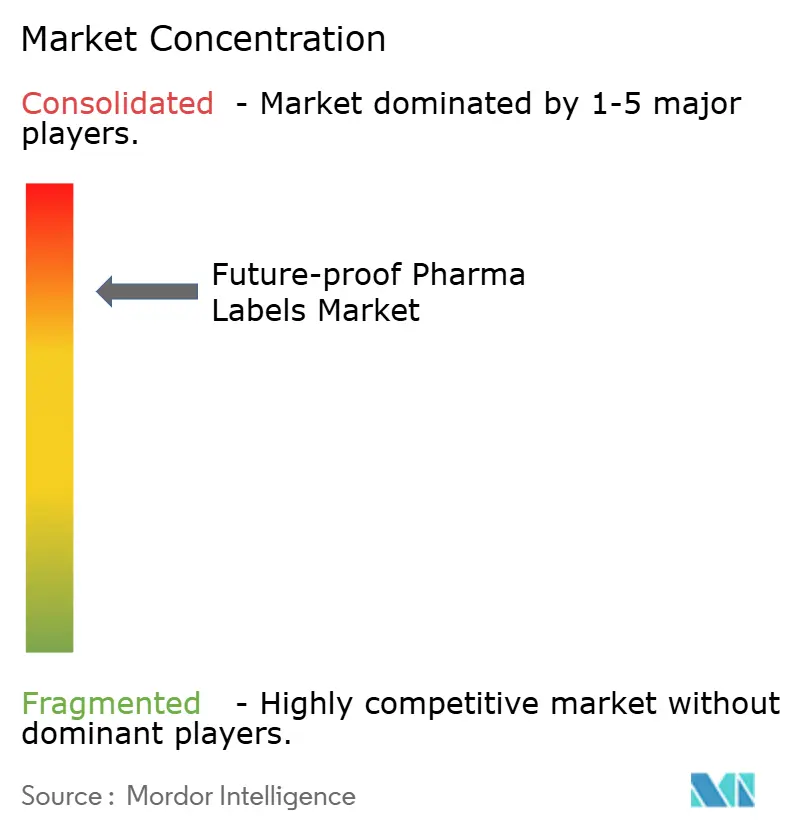
| Market Concentration | High |
Major Players *Disclaimer: Major Players sorted in no particular order Image © Mordor Intelligence. Reuse requires attribution under CC BY 4.0. | |
Future-proof Pharma Labels Market Analysis by Mordor Intelligence
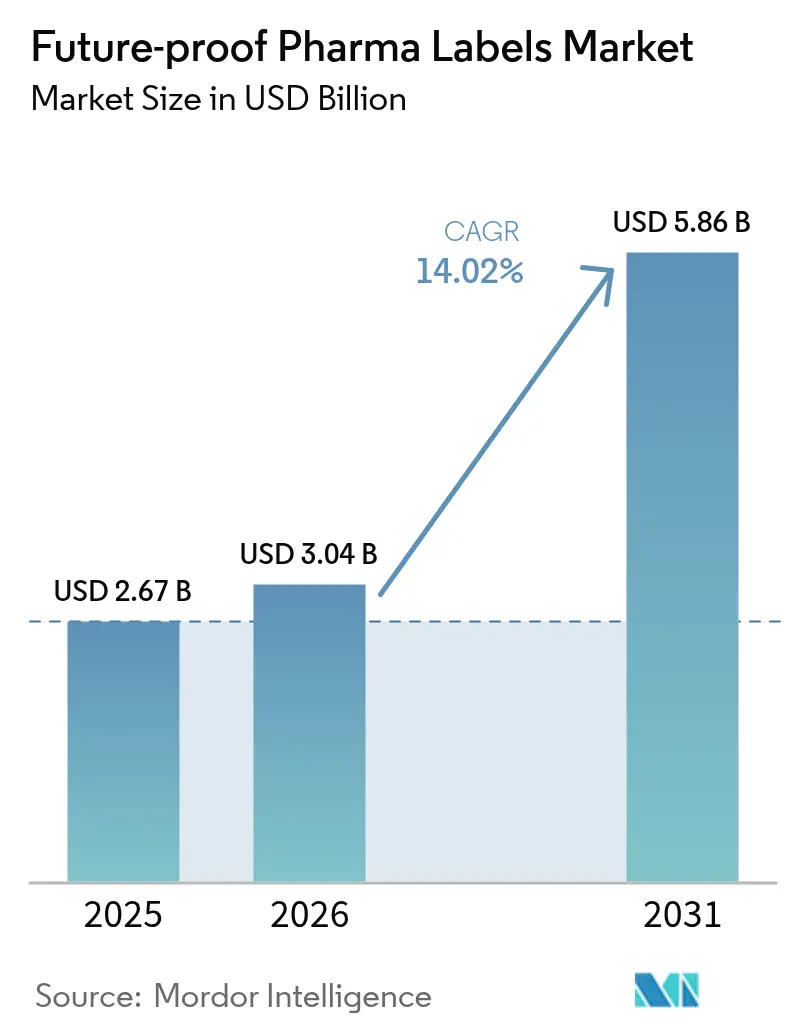
Future-proof Pharma Labels market size in 2026 is estimated at USD 3.04 billion, growing from 2025 value of USD 2.67 billion with 2031 projections showing USD 5.86 billion, growing at 14.02% CAGR over 2026-2031. This expansion is driven by serialization deadlines in major jurisdictions, surging e–commerce–driven counterfeiting risks, and the widening adoption of hospital automation platforms that rely on RFID-enabled primary packs. Heightened biologics output, especially temperature-sensitive mRNA vaccines and monoclonal antibodies, further elevates demand for sensor-embedded labels that verify cold-chain integrity. In parallel, falling unit costs for flexible NFC and ultra-thin RFID inlays are easing budget constraints that once limited the uptake of smart labels to premium therapies. Competitive intensity centers on suppliers who can blend material science know-how with electronics integration while navigating complex validation audits under FDA 21 CFR Part 820 and analogous EU quality rules.[1]U.S. Food and Drug Administration, “Drug Supply Chain Security Act (DSCSA),” FDA, fda.gov
Key Report Takeaways
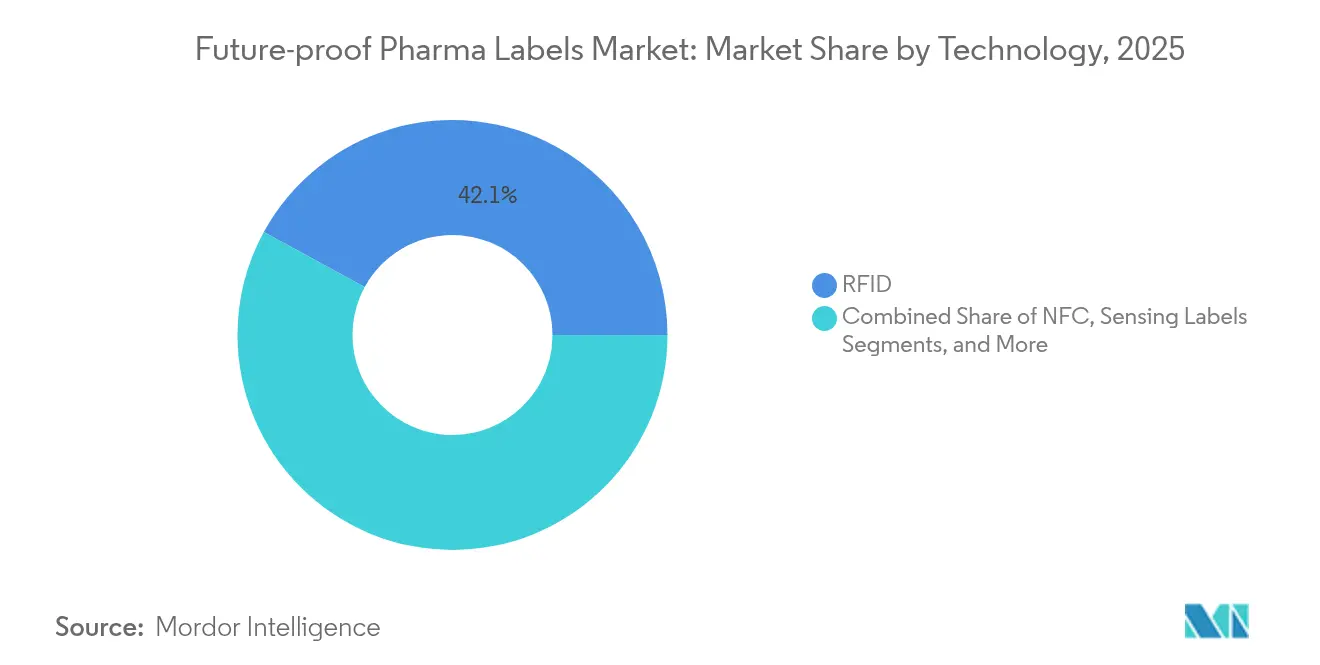
- By technology, RFID captured 42.05% of the Future-proof Pharma Labels market share in 2025, Sensing labels are advancing at a 15.08% CAGR between 2026-2031.
- By packaging type, blister packs held 32.10% revenue share in 2025; syringes and vials are forecast to expand at a 16.12% CAGR between 2026-2031.
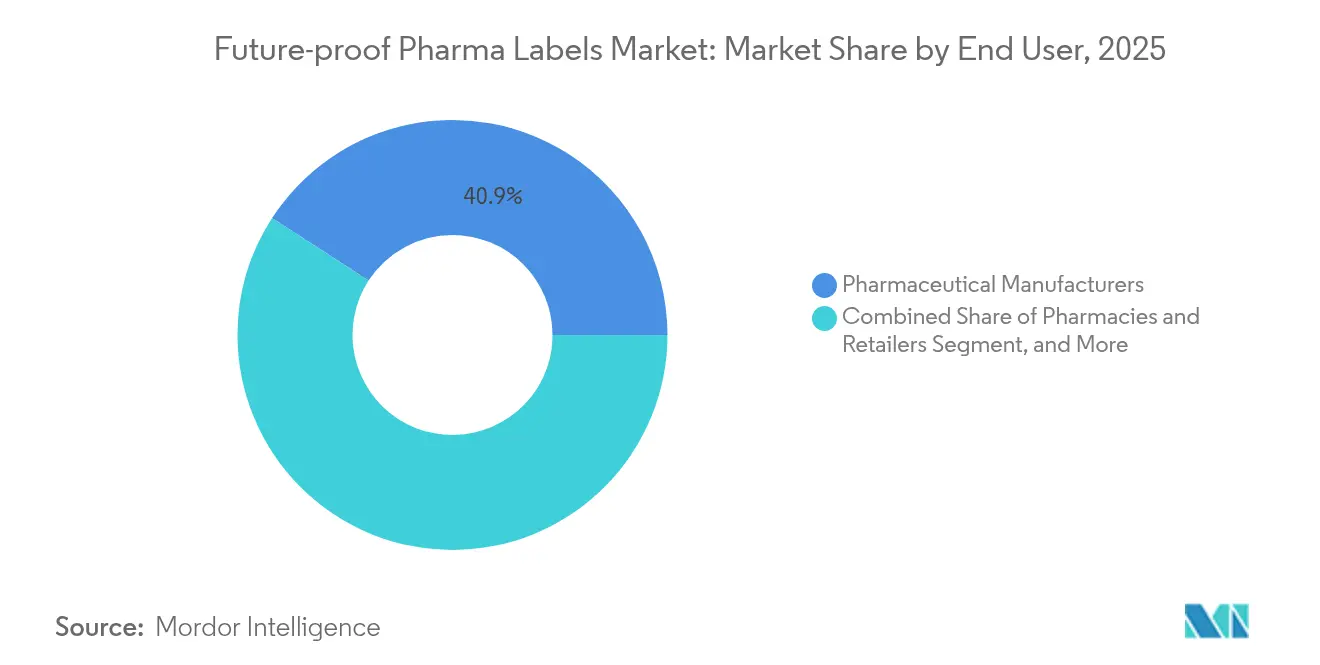
- By end user, pharmaceutical manufacturers captured 40.85% of the Future-proof Pharma Labels market size in 2025, while Contract Manufacturing Organizations (CMOs) are projected to record the highest CAGR at 16.35% through 2031.
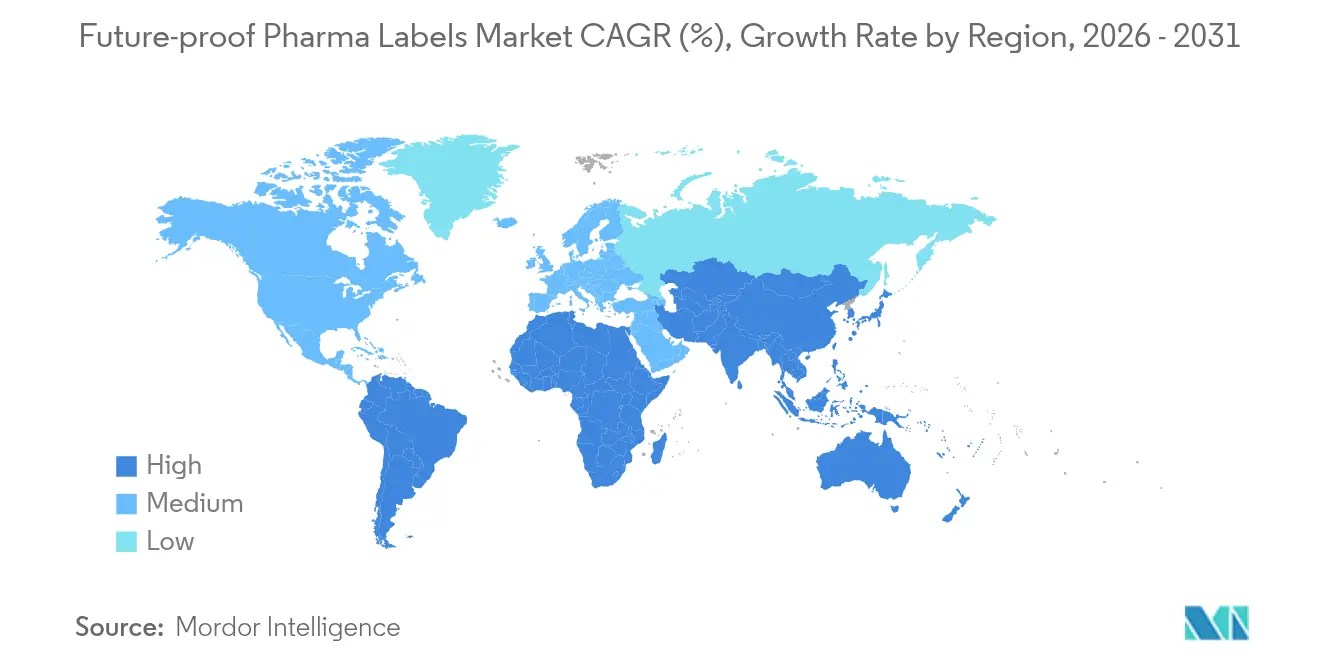
- By geography, North America led with 36.40% of the Future-proof Pharma Labels market share in 2025; Asia-Pacific is set to grow at a 15.02% CAGR between 2026-2031.
Note: Market size and forecast figures in this report are generated using Mordor Intelligence’s proprietary estimation framework, updated with the latest available data and insights as of 2026.
Market Trends and Insights
Drivers Impact Analysis of Future-proof Pharma Labels Market*
| Driver | (~) % Impact on CAGR Forecast | Geographic Relevance | Impact Timeline |
|---|---|---|---|
| Serialization mandates reaching final compliance 2027-30 | +4.2% | North America and EU; spill-over to APAC | Medium term (2-4 years) |
| E-commerce counterfeit escalation | +3.1% | Global; highest in emerging markets | Short term (≤2 years) |
| Hospital RFID automation for crash carts and med rooms | +2.8% | North America and EU core; growing APAC | Medium term (2-4 years) |
| Temperature-sensitive biologics need sensor labels | +2.4% | Global; led by North America and EU | Long term (≥4 years) |
| Low-cost flexible NFC ICs enable unit-level rollout | +1.1% | APAC fabs; global use | Long term (≥4 years) |
| Blockchain-linked digital birth certificates | +0.6% | North America and EU premium lines | Long term (≥4 years) |
| Source: Mordor Intelligence | |||
Serialization mandates reaching final compliance 2027-30
Unit-level serialization rules under the U.S. DSCSA move from lot-level requirements to mandatory unique product identifiers in November 2027, compelling every prescription drug package to carry a machine-readable code that supports verification, tracing, and electronic data exchange. The EU’s Falsified Medicines Directive follows a parallel path, with member-state extensions converging during the same horizon, leaving manufacturers no option but to retrofit or rebuild labeling lines on a global scale. Because wholesalers and dispensers must confirm codes before shipment or dispense, network effects accelerate adoption beyond the factory gate. Companies are consequently prioritizing “future-proof” platforms that also accommodate upcoming blockchain or IoT extensions, avoiding stranded investments.
Escalating pharma e-commerce counterfeits
Roughly 10% of medicines sold globally are estimated to be counterfeit, a risk magnified by direct-to-consumer web channels that bypass traditional visual inspection points. Smartphone-tappable NFC or dual-frequency labels enable patients to instantly confirm authenticity, shifting the verification responsibility to the end user. Emerging-market regulators are beginning to endorse such consumer-level authentication, propelling near-term demand in India, Southeast Asia, and parts of Africa.
Hospital demand for RFID-based crash-cart and med-room automation
North American hospitals are increasingly deploying RFID platforms, such as KitCheck, which has already processed more than 325 million injectable units across 900 sites, enabling real-time inventory and expiry management. Because these workflows require tags that survive sterilization, high-speed filling, and repeated handling, pharmaceutical suppliers are integrating RFID at the primary packaging stage rather than relying on downstream re-labeling. Compliance with 21 CFR Part 820 quality-system regulations extends to label-component validation, creating another layer of supplier qualification that advantages incumbents with established audit histories.
Rise of temperature-sensitive biologics requiring sensor labels
Messenger RNA vaccines, CAR-T cell therapies, and monoclonal antibodies must remain within narrow temperature windows; excursions can silently degrade efficacy. Smart labels embedding irreversible time-temperature indicators or digital sensors provide a verifiable chain-of-custody record, satisfying Good Distribution Practice logs and reducing costly product losses. Pharmaceutical companies view these labels as both a compliance tool and a brand-differentiation lever in competitive biologic segments.
Restraints Impact Analysis of Future-proof Pharma Labels Market*
| Restraint | (~) % Impact on CAGR Forecast | Geographic Relevance | Impact Timeline |
|---|---|---|---|
| Absence of dose-ID performance standards across NFC/RFID bands | -2.1% | Global multi-jurisdiction supply chains | Short term (≤2 years) |
| Unit-level tag cost > 1% of COGS for emerging-market generics | -1.8% | India, China, Southeast Asia | Medium term (2-4 years) |
| Read-range interference from metals and liquids in small vials | -1.3% | Global; primary packs | Medium term (2-4 years) |
| Skilled-labor shortage for label-data integration at CMOs | -0.9% | Major CMO hubs worldwide | Long term (≥4 years) |
| Source: Mordor Intelligence | |||
Absence of dose-ID performance standards across NFC/RFID bands
Interoperability hurdles arise because different regions allocate varying frequency windows for RFID and specify divergent data-format rules. Multinationals, therefore, juggle multiple tag designs, eroding economies of scale and complicating validation regimes. Pharma labeling struggles with interoperability and reliability due to inconsistent dose-identification standards across NFC and RFID frequency bands. The absence of unified benchmarks extends validation cycles, diminishes cross-vendor compatibility, and introduces regulatory hurdles in global deployments. Consequently, the adoption of smart labels, particularly for high-assurance real-time authentication, faces significant delays.
Unit-level tag cost > 1% of COGS for generics in emerging markets
In high-volume, low-margin generic segments, a single RFID or NFC inlay may still account for more than 1% of the finished-dose cost, limiting adoption to minimum-compliance tags rather than advanced sensor or blockchain-ready variants. Flexible, ultra-thin ICs from vendors such as PragmatIC are narrowing that gap but have yet to reach mass-production yields sufficient for price points below USD 0.03. When the cost of NFC/RFID tags surpasses 1% of the unit's cost of goods sold (COGS) for low-margin generics, adopting smart labels becomes economically unfeasible. Manufacturers in emerging markets face intense pricing pressures, making it challenging to justify the added costs of serialization technologies. This situation hinders scalability, limits the reach of digital traceability, and reinforces the reliance on traditional barcoding methods for compliance.
*Our forecasts treat driver/restraint impacts as directional, not additive. The impact forecasts reflect baseline growth, mix effects, and variable interactions.
Future-proof Pharma Labels Market Segment Analysis
By Technology:
RFID holds scale while sensor labels surgeRFID represented 42.05% of the Future-proof Pharma Labels market share in 2025, buoyed by legacy infrastructure inside hospital cabinets and wholesale depots. The tag’s proven read-rate in metallic crash carts and its compatibility with warehouse conveyors sustain its dominance. Sensing labels, however, are projected to post a 15.08% CAGR through 2031 as biologic makers request continuous temperature and humidity monitoring. Hybrid tags, which combine UHF for bulk reads and NFC for consumer taps, address omnichannel logistics while reducing SKUs. Schreiner Group’s collaboration with PragmatIC enabled the development of an ultra-thin RFID inlay that conforms to 6 mm-radius vials, thereby solving the historical antenna-coil challenge.
In practice, pharma clients want technology stacks that evolve with regulation, so suppliers are bundling firmware-updatable chips that can store blockchain pointers or IoT sensor payloads. Because North American hospitals often specify KitCheck-validated tags, global producers are standardizing on the same chip family to simplify validation audits, further reinforcing the Future-proof Pharma Labels market.



By Packaging Type:
Biologics propel syringe and vial innovationBlister packs retained 32.10% of the revenue in 2025, as oral solids still dominate prescription volume. Yet syringes and vials outpace every other format with a 16.12% CAGR as injectables expand in oncology, immunology, and vaccine portfolios. Smart-label fitment on curved glass requires flexible antenna substrates and pharmaceutical-grade adhesives. Suppliers now laminate 12-μm aluminum antennae between PET layers to survive lyophilization and gamma sterilization.
Secondary cartons are gradually incorporating dual-frequency tags that trigger e-leaflet downloads, aligning with EU eco-design proposals and reducing the use of paper inserts. The Future-proof Pharma Labels market size for syringe applications is forecast to surpass the blister value by 2029, illustrating how format-specific innovation reconfigures the revenue mix. Pharma cold-chain providers also apply pallet-level RFID tags to cryogenic shippers, enabling gate-reader confirmation when containers leave fill-finish sites. Such tertiary-unit adoption pushes the Future-proof Pharma Labels market beyond primary drug packs into broader logistics assets.
By End User:
CMOs accelerate fastest amid outsourcing boomPharmaceutical manufacturers controlled 40.85% of the Future-proof Pharma Labels market size in 2025, safeguarding critical IP and QA oversight for high-value brands. Nevertheless, CMOs are scaling fastest at a 16.35% CAGR because brand owners outsource the production of vaccines, biosimilars, and niche or orphan drugs that require flexible lines. To win contracts, CMOs embed configurable print-apply stations and cloud links that stream EPCIS events to sponsor dashboards. Hospitals and health systems add demand pull by mandating RFID-ready packs in tenders, particularly for crash cart injectables.
As a result, many CMOs reverse-integrate label-conversion shops to ensure available capacity during surge campaigns, a lesson learned from COVID-19 vaccine scale-ups, thereby expanding their footprint in the Future-proof Pharma Labels market. Retail pharmacies remain slower adopters; however, rising mail-order volumes prompt chains to pilot consumer-tap NFC programs for high-risk medicines. Clinical-trial sponsors leverage smart labels to monitor kit returns and reveal patient dosing adherence, using data to support adaptive-trial designs that shorten development cycles.
Geography Analysis
North America and Europe Future-proof Pharma Labels Market
North America retained 36.40% of the Future-proof Pharma Labels market share in 2025, buoyed by DSCSA enforcement checkpoints and widespread RFID hospital automation. State boards of pharmacy increasingly require machine-readable identifiers on narcotics, making compliance non-negotiable. Canada mirrors many U.S. protocols, so cross-border manufacturers often deploy a single North American label spec. Europe follows with sizable revenue but variable speed: Scandinavian states achieve near-full FMD digitalization, whereas Southern Europe still stabilizes data hub connections. The European Medicines Verification System nonetheless underpins steady orders for serialized 2D codes and, increasingly, dual-frequency smart tags that overlay on top of legacy DataMatrix squares.
APAC Future-proof Pharma Labels Market
The Asia-Pacific is the fastest-growing region, with a 15.02% CAGR through 2031, driven by the burgeoning contract-manufacturing ecosystems in India and China. Indian converters invest in automated linerless lines suited to smart-label lamination, while Chinese flexible-electronics fabs supply low-cost NFC chips to global packagers. Governments in South Korea and Japan ratify local track-and-trace mandates, extending regional pull. Southeast Asian health ministries are piloting smartphone-based authentication to combat rampant antibiotic counterfeiting, signaling future purchase orders that will broaden the Future-proof Pharma Labels market.
MEA and LATAM Future-proof Pharma Labels Market
The Middle East and Africa register lower absolute dollars but post vibrant pockets. Saudi Arabia’s track-and-trace portal, Tatmeen, drives RFID adoption among importers, and South Africa’s private hospital chains demand tamper-evident RFID labels on oncology injectables. Latin America exhibits a gradual adoption, led by Brazil’s SNCM serialization law, although currency volatility tempers immediate volume. Collectively, emerging-market regulatory momentum ensures that the Future-proof Pharma Labels market penetrates every continent before 2030.

Regulatory Landscape
In the United States, the Drug Supply Chain Security Act (DSCSA) continues to set backbone requirements for unit-level identification and interoperable traceability across the prescription-drug supply chain. It raises the compliance bar for label content, print quality, and data exchange. In March 2026, the US Food and Drug Administration issued a final rule revising 21 CFR Part 201 to standardize the National Drug Code (NDC) into a uniform 12-digit format (6-4-2 configuration). The rule also permits both linear and nonlinear barcode symbologies, including 2D DataMatrix, on drug labels, driving artwork updates and printer/encoder re-qualification for affected SKUs.
In Europe, labeling and package-information governance remains anchored in EMA product-information requirements and the checking process for mock-ups and specimens in the centralized procedure. This shapes how smart-label overlays, tamper evidence, and machine-readable elements are positioned on packs. In parallel, EU pharmaceutical legislation reform advanced in 2026 with Council-level texts published as part of the EU Pharmaceutical Package discussions, pointing to a forthcoming framework update that manufacturers and label suppliers are tracking for transition timing and implementation details across member states.
Competitive Landscape
The Future-proof Pharma Labels market remains moderately fragmented, with the five largest converters accounting for roughly 45% of global revenue. Avery Dennison leverages its global PET liner recycling program to attract environmentally driven pharmaceutical brands. CCL Industries scales its Checkpoint division’s RFID module into folded-leaflet labels for oncology vials, underscoring cross-business.
Zebra Technologies concentrates on printer-encoder ecosystems, bundling cloud firmware that supports electronic pedigree uploads. The Schreiner Group differentiates itself through ultra-high-speed digital late-stage customization, which programs EPCs hours before shipment, thereby shaving CMO lead times. Emerging players, such as PragmatIC, supply wafer-scale flexible ICs that reduce tag-inlay thickness to below 100 µm and trim antenna costs.[3]Labels & Labeling, “Schreiner MediPharm launches robust RFID labels,” Labels & Labeling, labelsandlabeling.com
Blockchain integrators, such as Chronicled, partner with label vendors to embed cryptographic hashes in NFC memory blocks, creating a digital birth certificate that remains intact throughout the product’s lifespan. Material-science expertise stays critical: converters must tune acrylic adhesives that pass USP <661.1> extractables limits and withstand autoclaves. Customers also award contracts based on FDA 21 CFR Part 820 audit histories, elevating incumbents with certified quality records. Consequently, suppliers able to fuse electronics, adhesives, and validation services stand to capture growing slices of the Future-proof Pharma Labels market.
Future-proof Pharma Labels Industry Leaders
Schreiner Group GmbH & Co. KG
Avery Dennison Corporation
CCL Industries Inc.
Zebra Technologies Corporation
UPM Adhesive Materials
- *Disclaimer: Major Players sorted in no particular order
Future-proof Pharma Labels Market Companies Covered in this Report
- Avery Dennison Corporation
- CCL Industries Inc.
- Zebra Technologies Corporation
- Schreiner Group GmbH & Co. KG
- UPM Adhesive Materials
- Sato Corporation
- Covectra, Inc.
- Loftware, Inc.
- Kit Check, Inc.
- Antares Vision S.p.A.
- OPTEL Group
- TraceLink Inc.

Market Opportunities and Future Outlook
A near-term whitespace is emerging around label rework and master-data normalization tied to the FDA's March 2026 final rule standardizing the NDC into a uniform 12-digit format and allowing broader barcode symbologies on drug labels. The resulting work goes beyond basic print-and-apply, extending into validated artwork change control, vision inspection upgrades, and printer-encoder ecosystems that keep 2D codes, human-readable fields, and serialized identifiers consistent across global SKUs, while aligning with FDA 21 CFR-focused quality expectations.
Another opportunity is the convergence of track-and-trace, cold-chain integrity, and sustainability-driven pack communication into single label architectures. Hospital RFID automation is already scaling, evidenced by KitCheck processing more than 325 million injectable units across about 900 sites, which pulls RFID-ready primary packs upstream into manufacturer and CMO lines rather than relying on downstream relabeling. In Europe, the Packaging and Packaging Waste Regulation (PPWR) applies from August 12, 2026, with harmonized labeling for material composition referenced for 2028 implementation, widening scope for converters to combine compliance graphics with QR/NFC-enabled digital leaflets and authentication. This also keeps focus on maintaining qualified adhesives and substrates for pharma use cases such as syringes and vials.
Recent Industry Developments in Future-proof Pharma Labels Market
- June 2026: CCL Industries Inc. completed the acquisition of Sleever International Company SA, adding shrink sleeve labels, extruded films, and related application equipment into its CCL Label and Innovia Films businesses. The acquisition expands CCL's packaging-format coverage and supports more integrated label-and-film solutions for regulated healthcare packaging programs.
- August 2025: Schreiner MediPharm released KitCheck-optimized RFID labels designed for hospital workflows. The launch aligns with KitCheck's large installed base that has processed more than 325 million injectable units across about 900 sites, supporting upstream adoption of RFID at the primary-pack stage.
- April 2024: Schreiner MediPharm began stocking semi-finished RFID labels for rapid personalization, shortening lead times for customers that need late-stage customization. This added availability supports CMOs and brand owners managing frequent SKU changes and validation-controlled rollout of smart labels across multiple packaging lines.


Future-proof Pharma Labels Market Report Scope and Research Methodology
Market Definition and Coverage
This market covers labeling solutions designed to keep pharmaceutical packs compliant, traceable, and readable through the product life cycle, including connected and sensor-enabled labels used on primary, secondary, and logistics units.
Scope exclusions: It excludes general paper labels used without track-and-trace, sensing, or anti-counterfeit functionality, and it also excludes standalone packaging components that are not part of labeling.
Segments Covered in This Report
- By Technology
- RFID
- NFC
- Sensing Labels
- Dual-Frequency / Hybrid
- Others
- By Packaging Type
- Blister Packs
- Syringes and Vials
- Bottles
- Cartons and Kits
- Secondary and Tertiary Logistics Units
- By End User
- Pharmaceutical Manufacturers
- Contract Manufacturing Organizations (CMOs)
- Hospitals and Health Systems
- Pharmacies and Retailers
- Clinical-Trial Sponsors
- By Geography
- North America
- United States
- Canada
- Mexico
- South America
- Brazil
- Argentina
- Chile
- Rest of South America
- Europe
- United Kingdom
- Germany
- France
- Italy
- Spain
- Russia
- Rest of Europe
- Asia-Pacific
- China
- India
- Japan
- South Korea
- Australia
- Rest of Asia-Pacific
- Middle East and Africa
- Middle East
- Saudi Arabia
- United Arab Emirates
- Turkey
- Rest of Middle East
- Africa
- South Africa
- Nigeria
- Rest of Africa
- Middle East
- North America
Data Sources, Market Sizing, and Validation
Desk Research
Desk work started with public regulatory and standards material that shapes adoption, such as FDA guidance pages, EU medicine safety and traceability updates, and GS1 specifications used for serialization and barcoding. We also reviewed customs and trade indicators that signal label and inlay movement, and we used patent databases to spot which sensing and connectivity features were moving from pilots to commercial use.
To anchor volumes and pricing logic, we referred to public manufacturing and supply chain signals, including annual reports and investor decks of packaging and labeling suppliers, press releases on new pharma lines, and association publications on packaging and RFID. Where needed, paid subscriptions were used for consistent company financials and for shipment-level trade reads to check unit flows. The desk sources listed here are illustrative, and we referenced other public and paid sources to compile data, validate numbers, and clear up open questions.
Primary Interviews and Surveys
Primary inputs were gathered through expert interviews and structured surveys with label converters, RFID and NFC component participants, pharmaceutical packaging teams, and quality and compliance stakeholders who influence labeling requirements. Because adoption depends on regulation and cold-chain needs, discussions were balanced across APAC, EMEA, and the Americas, and then used to confirm assumptions on penetration, pricing, and typical conversion timelines.
Distribution of primary research fieldwork respondents
| Company type | Respondent position | Region |
|---|---|---|
| Top tier: 36% | CXOs: 12% | APAC: 45% |
| Mid tier: 46% | Functional/Unit leaders: 33% | EMEA: 37% |
| Smaller Players: 18% | Managers: 55% | Americas: 18% |
Market-Sizing & Forecasting
Market totals were built using a top-down demand pool, where pharma pack volumes and the share under serialization, authentication, or monitoring requirements were translated into label attach rates and value. Once that frame was built, we checked it with selective bottom-up math using sampled ASP x unit ranges from channel checks, supplier revenue mix comments, and packaging line throughput discussions. We then adjusted the output when the implied price or penetration appeared inconsistent with observed market behavior.
Key model inputs included the installed base and rollout pace of track-and-trace programs, the mix shift toward cold-chain and specialty products that benefit from sensing labels, RFID and NFC inlay cost trends, the split of labeling needs by packaging format (such as blisters versus vials and syringes), and compliance-driven relabeling and rework rates. When data was missing for smaller countries, gaps were filled using proxy factors like pharma output indicators, export intensity, and a calibrated adoption curve from similar regulatory environments.
For forecasting, scenario analysis was used, with adoption and ASP paths agreed with interviewees as practical ranges rather than ideal-case targets. The base case reflects expected compliance deadlines, moderate cost deflation in electronics, and steady expansion of hospital and pharmacy scanning practices.
Data Validation & Update Cycle
Outputs were validated through repeated cross-checks against independent signals, such as implied label units per pharma pack, supplier capacity additions, and the timing of key regulatory milestones. If a country total or technology share created a sharp break from historic patterns, it was flagged, reworked, and reviewed again before sign-off.
Each report is refreshed annually, and interim updates are made when material events occur, such as new compliance requirements, large capacity expansions, or sudden pricing swings in inlays. Before delivery, we run a final review pass and, where needed, re-contact sources so clients receive an updated view aligned to current market conditions.
Mordor Intelligence's Future Proof Pharma Labels Market Size Measured Against Other Published Estimates
Published market sizes for future-proof pharma labels can look far apart because sources may not be measuring the same thing, even when the title sounds similar. The biggest swings usually come from how "future-proof" is interpreted, which years are used as the starting point, and whether values are reported at component, label, or packaging-solution level.
In practice, gaps show up when estimates fold in all pharmaceutical labeling revenue, or when they count broader smart packaging features that sit outside the label itself. The table also reflects differences in how fast adoption is assumed for RFID, NFC, and sensing labels, how quickly ASPs are expected to fall, and how often the model is refreshed after major regulatory or supply chain changes.
Benchmark comparison
| Source | Market Size | Gaps in Research Methodology |
|---|---|---|
| Mordor Intelligence | USD 3.04 B (2026) | |
| Packaging Intelligence Publisher A | USD 31.19 B (2024) | This figure appears to treat the market as broad pharmaceutical labels, which can include conventional label revenues and wider packaging scope, thereby inflating totals versus connected and sensing-focused definitions. |
| Syndicated Report Publisher B | USD 2.35 B (2025) | This estimate uses a slower adoption curve and a shorter definition of future-proof features, and it likely applies more conservative pricing progression for RFID and NFC enabled formats. |
The spread is largely explained by whether conventional pharma labels are counted and by how aggressively connected-label penetration is applied across packaging formats, which is why the sizing here is anchored to attach rates and ASP checks tied to the labeled unit, a discipline applied by Mordor Intelligence.


Key Questions Answered in the Report
What growth rate does the Future-proof Pharma Labels market expect between 2026 and 2031?
The market is forecast to expand at a 14.02% CAGR, rising from USD 3.04 billion in 2026 to USD 5.86 billion by 2031.
Why are syringes and vials adopting smart labels faster than blister packs?
Biologic injectables require cold-chain tracking and hospital RFID compatibility, pushing syringes and vials to a 16.12% CAGR versus slower growth for mature oral-solid blister packs.
How do serialization mandates influence purchasing decisions?
Imminent DSCSA and EU FMD deadlines make smart labels a compliance necessity, accelerating unit-level adoption across manufacturing and distribution.
Which region will see the fastest expansion of smart pharma labels?
Asia-Pacific leads with a 15.02% CAGR due to expanding CMO capacity and new country-level traceability rules.
What technology trend could lower tag costs for generics?
Flexible ultra-thin ICs produced on plastic substrates promise sub-USD 0.03 unit costs, enabling affordable RFID or NFC for high-volume generics.
How are hospitals driving demand for RFID labels?
Systems like KitCheck automate crash-cart inventory, so hospitals increasingly require RFID-ready primary packs to streamline replenishment and cut medication errors.
Page last updated on:


 Your data is secure and never sold or shared.


