
Fruit Fillings Market Size and Share
Market Overview
| Study Period | 2021 - 2031 |
|---|---|
| Market Size (2026) | USD 1.96 Billion |
| Market Size (2031) | USD 2.54 Billion |
| Growth Rate (2026 - 2031) | 5.32 % |
| Fastest Growing Market | Asia-Pacific |
| Largest Market | North America |
| Market Concentration | Medium |
Major Players *Disclaimer: Major Players sorted in no particular order Image © Mordor Intelligence. Reuse requires attribution under CC BY 4.0. | |
Fruit Fillings Market Analysis by Mordor Intelligence
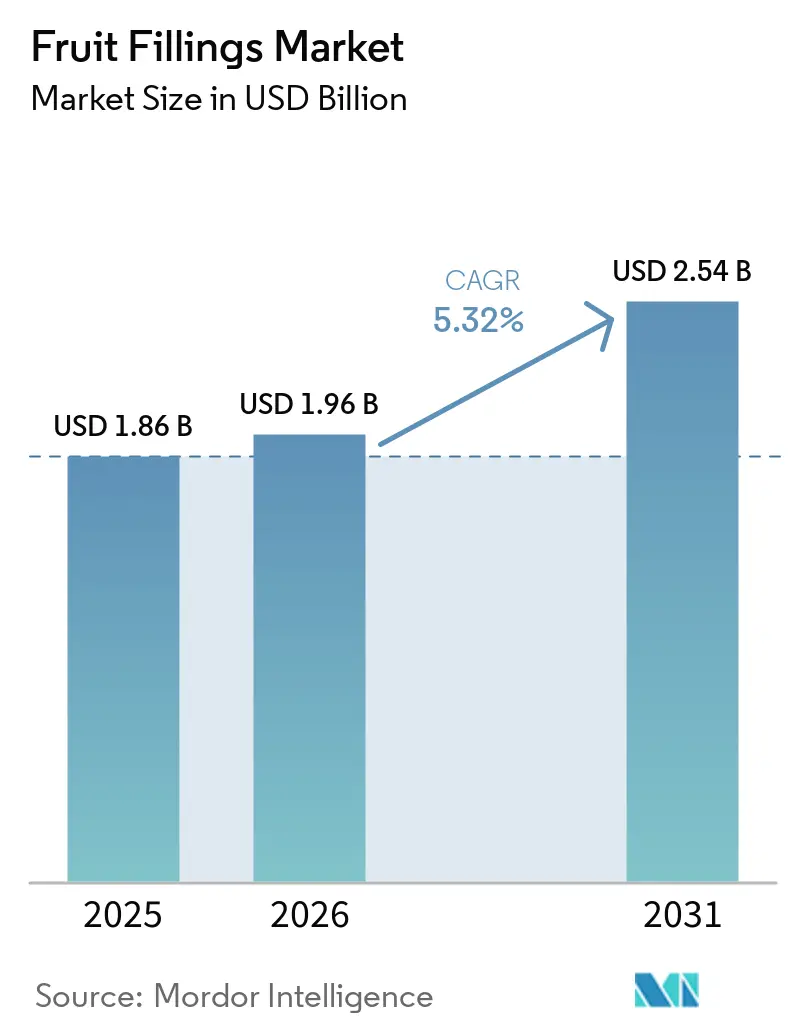
The fruit fillings market size is expected to grow from USD 1.86 billion in 2025 to USD 1.96 billion in 2026 and is forecast to reach USD 2.54 billion by 2031 at a 5.32% CAGR over 2026-2031. Growth is supported by broader use of fruit preparations across dairy, frozen desserts, and bakery applications, where buyers increasingly prefer ingredient systems that work across multiple applications. The market is further supported by steady growth in industrial and convenience bakery output, as large producers require stable viscosity, bake performance, and consistent texture across batches. Clean-label demand continues to shape the market, with manufacturers seeking natural colors and sweeteners that simplify labels while maintaining flavor and visual appeal. Cross-use between bakery and dairy applications is improving supplier economics, as the same base can serve croissants, pastries, yogurt inserts, and dessert toppings with minimal reformulation. The market offers opportunities for suppliers that can combine formulation capability, raw material control, and reliable service across industrial and foodservice accounts.
Key Report Takeaways
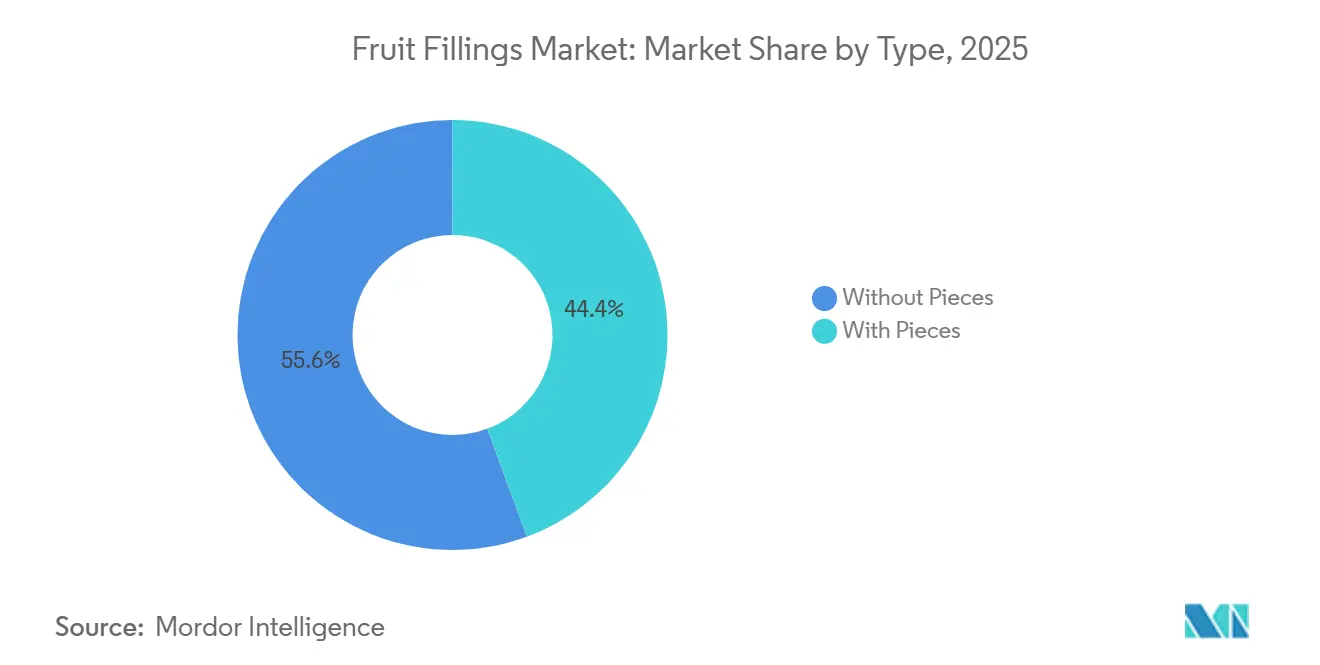
- By product type, without pieces held 55.64% share in 2025 in the global fruit fillings market, while with pieces will grow at a 5.93% CAGR through 2031.
- By fruit category, berries held 50.98% share in 2025 in the global fruit fillings market, while tropical fruits will grow at a 6.01% CAGR through 2031.
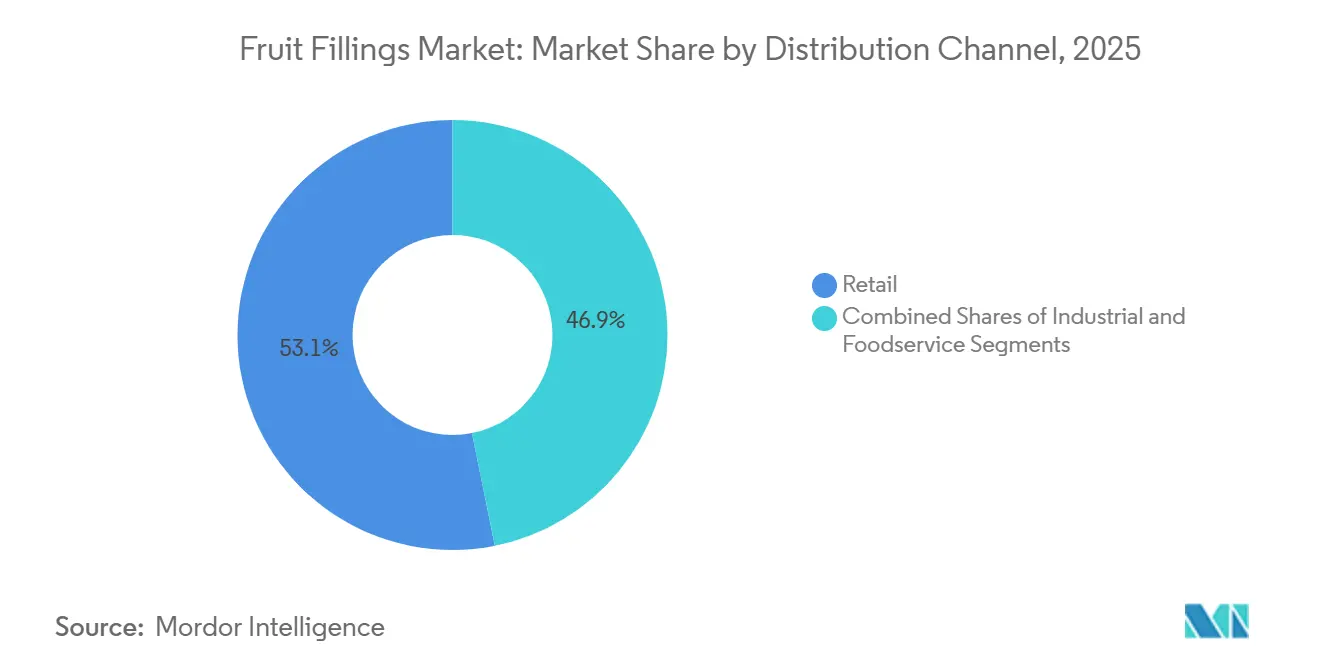
- By distribution channel, retail held 53.14% share in 2025 in the global fruit fillings market, while foodservice will grow at a 6.11% CAGR through 2031.
- By geography, North America held 37.08% share in 2025 in the fruit fillings market, while Asia-Pacific will grow at a 6.21% CAGR through 2031.
Note: Market size and forecast figures in this report are generated using Mordor Intelligence’s proprietary estimation framework, updated with the latest available data and insights as of January 2026.
Global Fruit Fillings Market Trends and Insights
Drivers Impact Analysis*
| Driver | (~) % Impact on CAGR Forecast | Geographic Relevance | Impact Timeline |
|---|---|---|---|
| Increasing use of fruit fillings in dairy and frozen desserts | +1.1% | Global | Medium term (2–4 years) |
| Expansion of industrial, convenience, and ready-to-eat bakery products | +0.9% | Global | Short term (≤ 2 years) |
| Premiumization of artisanal and gourmet bakery offerings | +0.8% | North America and Europe | Medium term (2–4 years) |
| Growing popularity of seasonal and exotic fruit flavors | +0.7% | Asia-Pacific core, spill-over to North America | Medium term (2–4 years) |
| Product innovation with new flavors, textures, and functional ingredients | +0.6% | Global | Short term (≤ 2 years) |
| Rising preference for natural colors and sweeteners | +0.5% | North America and Europe | Short term (≤ 2 years) |
| Source: Mordor Intelligence | |||
Increasing Use of Fruit Fillings in Dairy and Frozen Desserts
The growing use of fruit fillings in dairy and frozen dessert products is emerging as a major growth driver for the fruit fillings market. Consumers are increasingly seeking products that combine indulgence with natural ingredients, prompting manufacturers to use fruit fillings to enhance flavor, texture, visual appeal, and perceived nutritional value. Fruit fillings also enable product differentiation through seasonal, premium, and mixed-fruit variants while supporting clean-label positioning by emphasizing the use of real fruit. As demand for premium yogurts, frozen yogurts, ice creams, and dairy desserts continues to rise, the demand for high-quality fruit fillings is expanding in parallel. This is reflected in new product launches across the dairy industry. In April 2025, Lactalis Canada, in collaboration with Nestlé Canada, expanded the iÖGO and iÖGO nanö brands into the frozen yogurt category with a portfolio of bars, tubs, and pops featuring flavors such as strawberry cheesecake, blueberry swirl, cherry swirl, mixed berry, and peach. The products were made with real fruit and introduced multiple fruit-based flavor formats across the range, demonstrating how fruit inclusions and fillings have become central to innovation in frozen dairy desserts. Such launches reinforce demand for specialized fruit fillings that provide consistent taste, appearance, and stability throughout processing and frozen storage, thereby supporting sustained growth of the fruit fillings market.
Expansion of Industrial, Convenience, and Ready-To-Eat Bakery Products
The expansion of industrial bakery manufacturing and rising consumption of convenience and ready-to-eat (RTE) bakery products are driving demand for fruit fillings worldwide. Packaged cakes, muffins, croissants, Danish pastries, pies, donuts, and snack bars increasingly rely on fruit fillings to enhance flavor, texture, moisture retention, and visual appeal, while ensuring consistency in large-scale production. As consumers seek convenient, premium, and on-the-go bakery options, manufacturers are expanding production of fruit-filled baked goods, creating sustained demand for bake-stable and shelf-stable fruit fillings that can withstand industrial processing and extended distribution. The growing scale of commercial bakery operations further reinforces this inclination. According to a 2025 United States Department of Agriculture (USDA) Foreign Agricultural Service (FAS) report, China had more than 338,000 bakery outlets as of May 2025[1]Source: United States Department of Agriculture, “Baking Ingredients Market Update 2025,” usda.gov. It also had 68.4% of bakery consumption linked to breakfast occasions, reflecting the increasing role of convenient bakery products in daily diets[2]Source: United States Department of Agriculture, “Baking Ingredients Market Update 2025,” usda.gov. The report also highlights the rapid expansion of retail bakery chains, supermarket bakeries, and café formats, all of which continue to introduce fruit-filled pastries and baked goods to meet evolving consumer preferences. As industrial bakery production expands globally and manufacturers diversify their ready-to-eat product portfolios, demand for high-performance fruit fillings is expected to grow steadily.
Premiumization of Artisanal and Gourmet Bakery Offerings
Growing consumer preference for artisanal and premium bakery products is driving demand for high-quality fruit fillings that enhance flavor, texture, and visual appeal. Consumers are increasingly seeking pastries, Danishes, croissants, cakes, and other baked goods made with authentic fruit ingredients, clean-label formulations, and distinctive flavor combinations. In response, bakery manufacturers are expanding their portfolios with premium products that emphasize real fruit, indulgent taste, and differentiated eating experiences. This is increasing the use of fruit fillings that deliver consistent quality, vibrant appearance, and premium sensory attributes across both packaged and fresh bakery products. This trend is reflected in the continued introduction of premium and artisanal bakery products featuring fruit-based fillings. For instance, in May 2026, Sofitel launched its limited-edition La Haute Croissanterie "Fruit Kiss" collection, comprising ten fruit-filled croissants crafted with fresh fruit compotes and premium pastry techniques. The collection emphasizes high-quality ingredients, refined flavor profiles, and pastry craftsmanship, highlighting how gourmet bakery brands are increasingly utilizing premium fruit fillings to create differentiated products and enhance consumer appeal.
Growing Popularity of Seasonal and Exotic Fruit Flavors
The growing popularity of seasonal and exotic fruit flavors is driving innovation in the fruit fillings market, as manufacturers seek to differentiate products through unique taste profiles and globally inspired ingredients. Fruits such as mango, guava, dragon fruit, yuzu, tamarind, pandan, and pomegranate are increasingly being incorporated into bakery, dairy, confectionery, and dessert applications to enhance flavor, color, and premium appeal. This trend is encouraging ingredient manufacturers to expand their fruit filling portfolios with authentic flavor profiles, higher fruit content, and formulations that deliver consistent quality across a wide range of food applications.As consumer interest in globally inspired and premium food experiences grows, manufacturers are expanding their offerings with fruit fillings featuring distinctive seasonal and exotic fruit varieties. These ingredients support product differentiation while providing vibrant color, authentic taste, and desirable texture across bakery, dairy, confectionery, and frozen dessert applications. As a result, the increasing adoption of diverse fruit flavors is expected to drive continued innovation and demand for specialized fruit filling solutions.
Restraints Impact Analysis*
| Restraint | (~) % Impact on CAGR Forecast | Geographic Relevance | Impact Timeline |
|---|---|---|---|
| Seasonal volatility in fruit supply and crop quality | -0.8% | Global (Asia-Pacific and South America most exposed) | Long term (≥ 4 years) |
| Short shelf life and cold-chain dependence for premium formulations | -0.6% | Asia-Pacific and Middle East and Africa | Medium term (2–4 years) |
| Food safety, labeling, and export compliance burden | -0.5% | Global | Short to medium term (1–3 years) |
| Formulation complexity in maintaining texture stability under freeze-thaw and bake-stable conditions | -0.4% | Global | Long term (≥ 4 years) |
| Source: Mordor Intelligence | |||
Seasonal Volatility in Fruit Supply and Crop Quality
Seasonal volatility in fruit supply and crop quality is a significant restraint for the fruit fillings market. Manufacturers depend on a consistent supply of high-quality fruits to maintain standardized flavor, texture, color, and processing performance. Weather variability, irregular rainfall, droughts, heatwaves, and crop diseases can reduce fruit yields and affect quality, making procurement more challenging and increasing raw material price volatility. These fluctuations can disrupt production planning and limit the availability of fruits suitable for commercial processing. Post-harvest losses across the fruit supply chain further compound this challenge. According to the Food and Agriculture Organization (FAO), 13.2% of food produced globally was lost between harvest and retail in 2024, with fruits and vegetables among the commodities most vulnerable to spoilage due to their perishability[3]Source: Food and Agriculture Organisation of the United Nations, “Policy Support and Governance Gateway,” fao.org. Such losses reduce the availability of processing-grade fruits, increasing sourcing uncertainty and raw material costs for fruit filling manufacturers. As a result, producers may face supply constraints, inconsistent fruit quality, and pressure on operational efficiency and profit margins, particularly when relying on seasonal harvests and external supplier networks.
Short Shelf Life and Cold-Chain Dependence for Premium Formulations
The growing demand for premium fruit fillings with high fruit content and clean-label formulations presents a significant challenge due to their shorter shelf life and greater dependence on refrigerated storage and transportation. Unlike conventional formulations that rely on higher sugar content or preservatives for stability, premium fruit fillings are more susceptible to microbial spoilage and quality deterioration. Manufacturers must therefore maintain strict temperature control throughout storage, transportation, and distribution, which increases logistics complexity and operating costs. Dependence on robust cold-chain infrastructure limits the commercial expansion of premium fruit fillings, particularly in regions where refrigerated logistics remain underdeveloped or inconsistent. Additionally, evolving food safety, traceability, and refrigeration regulations require manufacturers to invest in advanced monitoring systems, digital recordkeeping, and modern cold-storage equipment to ensure compliance and product integrity. These higher infrastructure and compliance costs place a disproportionate burden on small and medium-sized manufacturers, limiting their market participation and slowing the adoption of premium fruit filling formulations across emerging markets.
*Our forecasts treat driver/restraint impacts as directional, not additive. The impact forecasts reflect baseline growth, mix effects, and variable interactions.
Segment Analysis
By Product Type: Without Pieces Formats Anchor Industrial Demand, Pieces Command Artisan Premiums
The without pieces segment accounted for the largest share of the fruit fillings market in 2025, capturing 55.64% of total revenue. Its dominance is driven by superior processing efficiency, consistent viscosity, and compatibility with high-speed depositing systems used in industrial bakery production. Homogeneous formulations ensure precise portion control and stable performance across applications such as croissants, doughnuts, confectionery centers, dairy products, and frozen desserts. Once integrated into commercial production lines, these formulations also benefit from high supplier retention due to stringent process validation requirements.
The with pieces segment is projected to register the fastest CAGR of 5.93% during 2026–2031, supported by rising demand for premium, artisanal, and visually differentiated food products. Bakers, cafés, and foodservice operators increasingly favor fillings containing visible fruit pieces to enhance product authenticity and consumer appeal. Manufacturers are responding by developing formulations that preserve fruit integrity while maintaining processing stability, including hybrid formats that combine a smooth fruit base with suspended fruit pieces. These innovations allow suppliers to address premium product demand without significantly increasing production complexity.


By Fruit Category: Tropical Surge Challenges Berry Dominance
The berries segment accounted for the largest share of the fruit fillings market in 2025, representing 50.98% of total revenue. Its leadership is supported by widespread use across yogurt, bakery, confectionery, and frozen dessert applications, where strawberry, raspberry, and blueberry remain among the most preferred fruit flavors. Strong consumer familiarity, broad retail acceptance, and year-round demand continue to reinforce the segment's market position. Manufacturers also benefit from well-established supply chains and extensive product portfolios centered on berry-based fillings.
The tropical fruits segment is projected to register the fastest CAGR of 6.01% during 2026–2031, driven by increasing consumer interest in exotic and premium flavor profiles. Fruits such as mango, passion fruit, and pineapple are gaining popularity across bakery, dairy, beverages, and desserts as manufacturers expand product innovation. Growing multicultural consumer bases and demand for differentiated products further support adoption. Although tropical fruits require more advanced formulation and preservation techniques due to their unique moisture and acidity characteristics, these technical capabilities provide opportunities for specialized ingredient suppliers.
By Distribution Channel: Retail Volume Subsidizes Foodservice Innovation
The retail segment accounted for the largest share of the fruit fillings market in 2025, capturing 53.14% of total revenue. This dominance is supported by the extensive reach of supermarkets, hypermarkets, and specialty food stores offering shelf-stable and chilled fruit fillings for home baking and dessert preparation. Growing consumer interest in premium baking ingredients has also strengthened online retail sales, enabling brands to reach home bakers with specialized, high-fruit-content products. Broad product availability and strong household demand continue to reinforce the retail channel's position.
The foodservice segment is projected to register the fastest CAGR of 6.11% during 2026–2031, driven by the expansion of cafés, quick-service restaurants, bakeries, and commercial kitchens. Foodservice operators increasingly rely on ready-to-use fruit fillings to reduce preparation time, maintain consistent product quality, and expand premium dessert offerings. The opening of new outlets and the addition of filled bakery and dessert items are generating recurring demand for standardized fruit filling products. Manufacturers are responding by launching premium formulations tailored to the operational needs of professional foodservice customers.
Geography Analysis
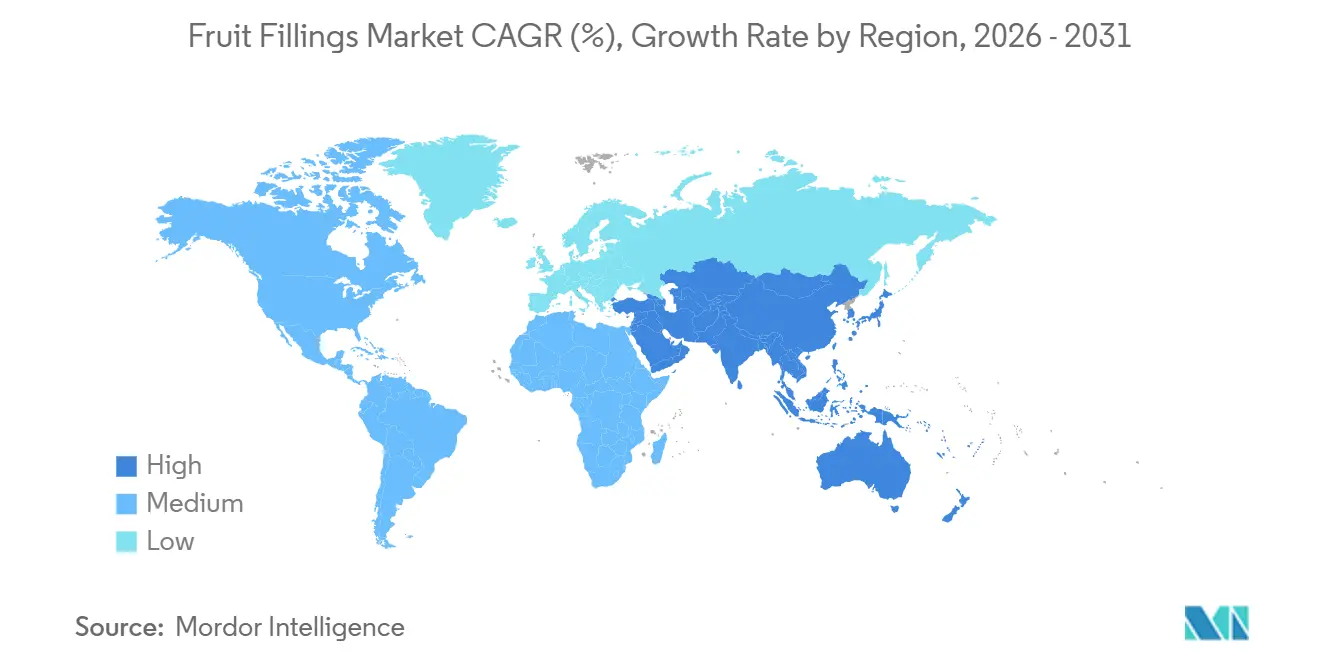
North America accounted for the largest share of the fruit fillings market in 2025, representing 37.08% of global revenue. The region's position is supported by a mature industrial bakery sector, extensive supermarket and foodservice networks, and well-developed cold-chain infrastructure that enables the distribution of premium fruit fillings. High consumption of bakery, dairy, and frozen dessert products, combined with strong demand for convenience foods, continues to sustain market growth across the United States, Canada, and Mexico.
Asia-Pacific is projected to register the fastest CAGR of 6.21% during 2026–2031, driven by rapid urbanization, rising disposable incomes, and expanding consumption of packaged bakery and confectionery products. Countries such as China, India, Indonesia, and other Southeast Asian markets are investing heavily in food processing capacity while benefiting from abundant domestic production of tropical fruits. Growing local demand and improved processing capabilities are strengthening the region's position as both a major producer and consumer of fruit fillings.
Europe remains a technologically advanced and highly competitive market, supported by the presence of established fruit filling manufacturers and continuous product innovation. South America benefits from abundant fruit production and expanding exports of berry and stone fruit ingredients, reinforcing its role in the global supply chain. The Middle East and Africa is emerging as a promising market, driven by the growth of organized retail, hospitality, and quick-service restaurants, with increasing demand for shelf-stable and reduced-sugar fruit filling formulations.

Competitive Landscape
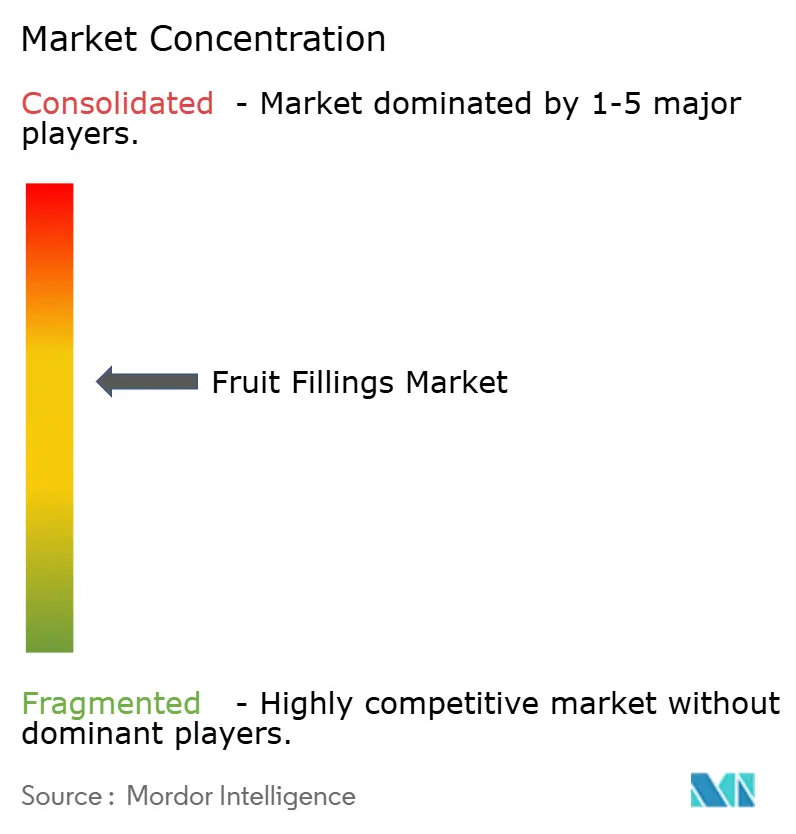
The fruit fillings market is moderately consolidated, with a handful of multinational manufacturers accounting for a significant share of global revenue. AGRANA, Puratos, Zentis, Dawn Foods, and Andros are among the key players, competing through extensive manufacturing footprints, strong research and development capabilities, long-standing relationships with industrial food manufacturers, and broad product portfolios serving bakery, dairy, confectionery, and foodservice applications. Product customization, global sourcing networks, and application-specific formulation expertise remain the primary competitive differentiators.
Key companies continue to strengthen their market positions through capacity expansion, product innovation, and strategic investments. AGRANA has expanded its food and beverage solutions network to strengthen its European presence, while Puratos continues to invest in clean-label and customer co-development initiatives through its bakery innovation centers. Zentis is expanding its value-added fruit ingredient portfolio with investments in advanced production technologies, while Dawn Foods and Andros continue to broaden their premium fruit filling offerings for professional bakery and foodservice customers, supporting growth across both developed and emerging markets.
Beyond the established market leaders, regional manufacturers are expanding by focusing on specialty fruit preparations, tropical fruit formulations, and clean-label solutions tailored to local consumer preferences. Emerging suppliers are increasingly targeting opportunities in Asia-Pacific, Latin America, and the Middle East through flexible manufacturing, export-oriented production, and aseptic or ambient-stable fruit fillings. As demand for premium, reduced-sugar, and plant-based compatible fruit fillings grows, niche manufacturers are expected to gain market share by serving application-specific and regional requirements that larger global companies do not fully address.
Fruit Fillings Industry Leaders
Puratos Group
Agrana Beteiligungs-AG
Dawn Food Products
Andros Group
Zentis Fruchtwelt GmbH & Co. KG
- *Disclaimer: Major Players sorted in no particular order

Recent Industry Developments
- May 2026: AGRANA highlighted the evolving role of its fruit preparations in dairy applications, emphasizing solutions that combine fruit with protein, fiber, and gut-health ingredients while supporting clean-label and reduced-sugar formulations. The company also outlined advances in aseptic processing and fruit inclusion technologies to improve flavor, texture, and product stability across dairy and food applications.
- March 2026: Puratos announced its planned acquisition of Dawn Foods to expand its global bakery ingredient portfolio. The combination is expected to strengthen the companies' manufacturing, R&D, and innovation capabilities across bakery and patisserie ingredients, including fruit filling and sweet bakery solutions.
- July 2025: Dawn Foods UK and Ireland expanded its Delifruit Fruit Fillings portfolio with five new varieties, including Pineapple, Mango, Forest Fruits, Apple & Cinnamon, and Blueberry. The new fillings feature high fruit content and visible fruit pieces and are designed for fresh and baked applications, with bake, freeze-thaw, and cut stability.


Global Fruit Fillings Market Report Scope
This report provides a comprehensive analysis of the fruit fillings market by product type, covering fruit fillings with pieces and without pieces. It evaluates market size, growth trends, demand patterns, and application-specific advantages of each product category across end-use industries.
The study further segments the market by fruit category, including berries, citrus fruits, stone fruits, tropical fruits, and other fruit categories. It assesses consumption trends, product innovation, and evolving demand for different fruit flavors across bakery, dairy, confectionery, and beverage applications.
The report also analyzes the market by distribution channel, covering industrial, foodservice, and retail sales. The industrial segment is further examined across bakery and pastry, dairy and frozen desserts, confectionery, beverages and smoothies, and other industrial applications. The retail segment includes supermarkets and hypermarkets, convenience stores, online retail, and other retail channels.
Geographically, the report covers North America, Europe, Asia-Pacific, South America, and the Middle East and Africa, with detailed country-level analysis within each region. It examines regional market dynamics, growth opportunities, competitive developments, and demand patterns to provide a comprehensive global outlook for the fruit fillings market.
| With Pieces |
| Without Pieces |
| Berries |
| Citrus Fruits |
| Stone Fruits |
| Tropical Fruits |
| Other Fruit Categories |
| Industrial | Bakery and Pastry |
| Dairy and Frozen Desserts | |
| Confectionery | |
| Beverages and Smoothies | |
| Other Industrial Applications | |
| Foodservice | |
| Retail | Supermarkets and Hypermarkets |
| Convenience Stores | |
| Online Retail | |
| Other Retail Channels |
| North America | United States |
| Canada | |
| Mexico | |
| Rest of North America | |
| Europe | Germany |
| United Kingdom | |
| Italy | |
| France | |
| Spain | |
| Netherlands | |
| Poland | |
| Belgium | |
| Sweden | |
| Rest of Europe | |
| Asia-Pacific | China |
| India | |
| Japan | |
| Australia | |
| Indonesia | |
| South Korea | |
| Thailand | |
| Singapore | |
| Rest of Asia-Pacific | |
| South America | Brazil |
| Argentina | |
| Colombia | |
| Chile | |
| Peru | |
| Rest of South America | |
| Middle East and Africa | South Africa |
| Saudi Arabia | |
| United Arab Emirates | |
| Nigeria | |
| Egypt | |
| Morocco | |
| Turkey | |
| Rest of Middle East and Africa |
| By Product Type | With Pieces | |
| Without Pieces | ||
| By Fruit Category | Berries | |
| Citrus Fruits | ||
| Stone Fruits | ||
| Tropical Fruits | ||
| Other Fruit Categories | ||
| By Distribution Channel | Industrial | Bakery and Pastry |
| Dairy and Frozen Desserts | ||
| Confectionery | ||
| Beverages and Smoothies | ||
| Other Industrial Applications | ||
| Foodservice | ||
| Retail | Supermarkets and Hypermarkets | |
| Convenience Stores | ||
| Online Retail | ||
| Other Retail Channels | ||
| By Geography | North America | United States |
| Canada | ||
| Mexico | ||
| Rest of North America | ||
| Europe | Germany | |
| United Kingdom | ||
| Italy | ||
| France | ||
| Spain | ||
| Netherlands | ||
| Poland | ||
| Belgium | ||
| Sweden | ||
| Rest of Europe | ||
| Asia-Pacific | China | |
| India | ||
| Japan | ||
| Australia | ||
| Indonesia | ||
| South Korea | ||
| Thailand | ||
| Singapore | ||
| Rest of Asia-Pacific | ||
| South America | Brazil | |
| Argentina | ||
| Colombia | ||
| Chile | ||
| Peru | ||
| Rest of South America | ||
| Middle East and Africa | South Africa | |
| Saudi Arabia | ||
| United Arab Emirates | ||
| Nigeria | ||
| Egypt | ||
| Morocco | ||
| Turkey | ||
| Rest of Middle East and Africa | ||


Key Questions Answered in the Report
What is the current size of the fruit fillings market?
The fruit fillings market was valued at USD 1.86 billion in 2025 and stands at USD 1.96 billion in 2026, with a projected value of USD 2.54 billion by 2031.
What is driving growth in fruit fillings demand through 2031?
Growth is being supported by wider use in dairy and frozen desserts, steady industrial bakery output, clean-label demand, and rising premiumization in bakery and foodservice channels.
Which region leads global demand for fruit fillings?
North America led with a 37.08% share in 2025 because of its mature industrial bakery base, strong retail reach, and dependable cold-chain infrastructure.
Which product and fruit categories are most important today?
Without pieces formats led product type demand with a 55.64% share in 2025, while berries led the fruit mix with a 50.98% share because of strong use across yogurt, pastry, and desserts.
Which channel offers the strongest growth opportunity for suppliers?
Retail remained the largest channel with a 53.14% share in 2025, but foodservice offers the strongest growth opportunity because it is projected to grow at a 6.11% CAGR through 2031.
Page last updated on:


 Your data is secure and never sold or shared.


