
Market Overview
| Study Period | 2021 - 2031 |
|---|---|
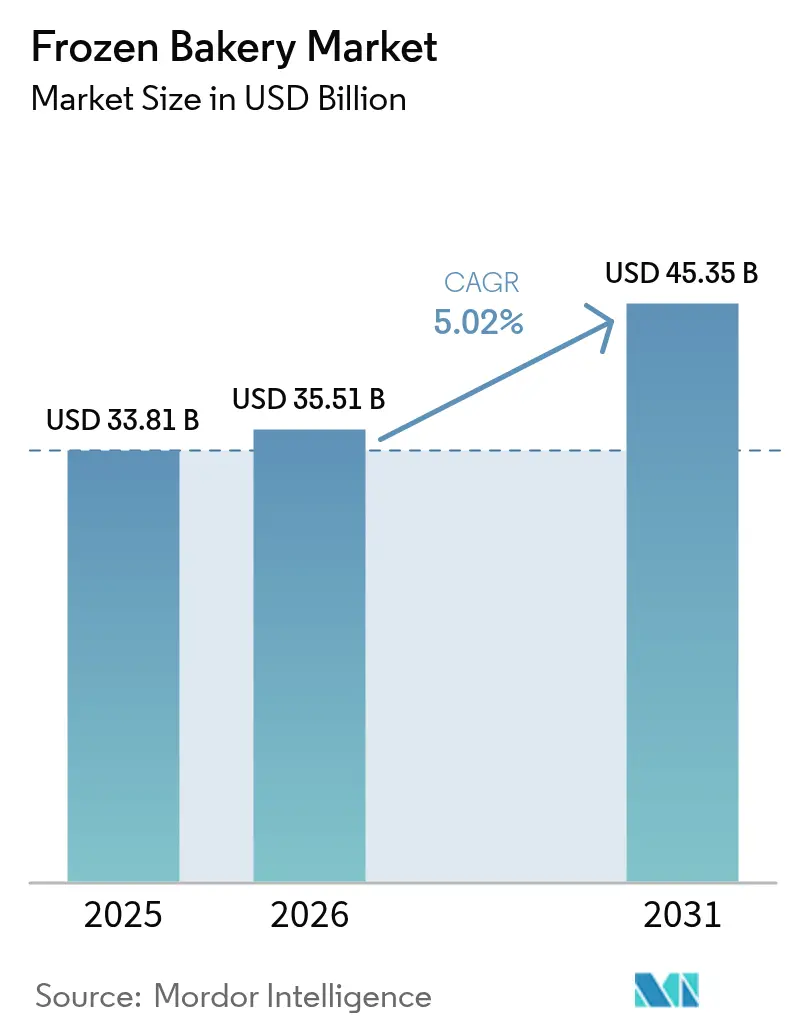
| Market Size (2026) | USD 35.51 Billion |
| Market Size (2031) | USD 45.35 Billion |
| Growth Rate (2026 - 2031) | 5.02 % |
| Fastest Growing Market | Asia Pacific |
| Largest Market | Europe |
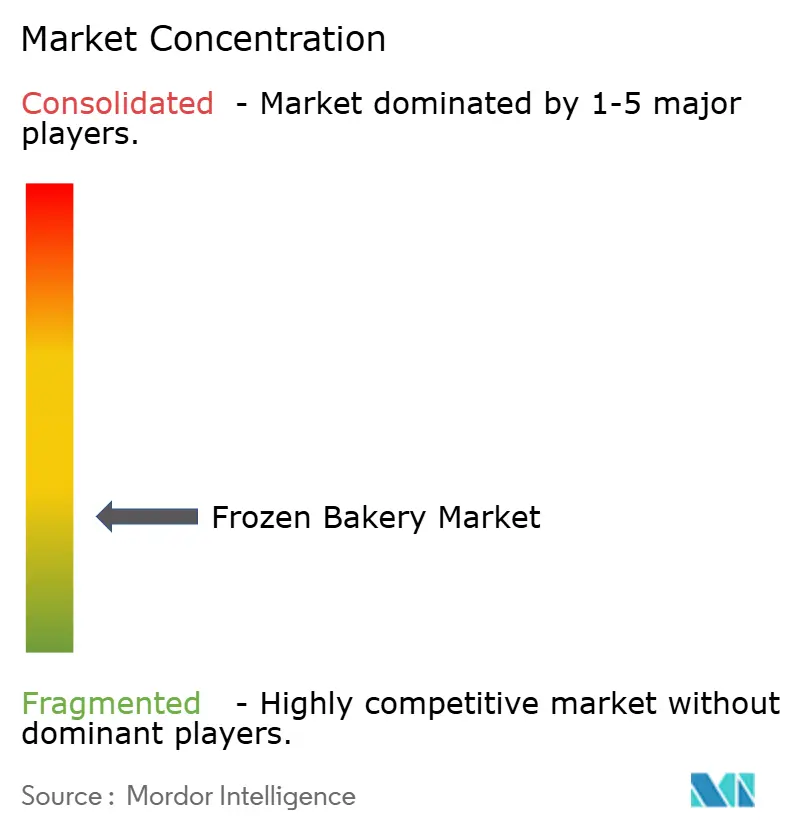
| Market Concentration | Low |
Major Players *Disclaimer: Major Players sorted in no particular order Image © Mordor Intelligence. Reuse requires attribution under CC BY 4.0. | |
Frozen Bakery Market Analysis by Mordor Intelligence
The frozen bakery market size was valued at USD 33.81 billion in 2025 and estimated to grow from USD 35.51 billion in 2026 to reach USD 45.35 billion by 2031, at a CAGR of 5.02% during the forecast period (2026-2031). As modern lifestyles accelerate, consumers are increasingly opting for the convenience of frozen bakery products for both home and foodservice use. This growth is supported by advancements in cold-chain systems, innovative product development, and rising demand for easy-to-prepare meals. Additionally, energy-efficient production technologies and improved e-commerce logistics are strengthening the industry's long-term competitiveness. Health-conscious trends are driving interest in frozen bakery products with healthier attributes, such as gluten-free, whole-grain, and low-fat options. Europe leads the frozen bakery market, supported by strong regulatory frameworks and artisanal baking traditions. Meanwhile, the Asia-Pacific region is experiencing the fastest growth, driven by rapid infrastructure development and changing dietary habits. Bread remains the largest product category, while pizza crusts are emerging as a premium growth segment. Off-trade retail channels dominate the market, although a recovery in foodservice is boosting on-trade demand. As competition intensifies, companies are focusing on portfolio optimization and sustainability initiatives, including strategic acquisitions and renewable energy adoption, to mitigate cost volatility.
Key Report Takeaways
- By product type, bread captured 41.72% of the frozen bakery market share in 2025, while pizza crust is forecast to expand at a 6.28% CAGR through 2031.
- By form, ready-to-bake products commanded 39.65% share of the frozen bakery market size in 2025, and ready-to-proof formats are projected to grow at 5.21% CAGR to 2031.
- By distribution channel, off-trade retail held 59.12% of the frozen bakery market share in 2025, whereas on-trade foodservice is advancing at a 5.73% CAGR through 2031.
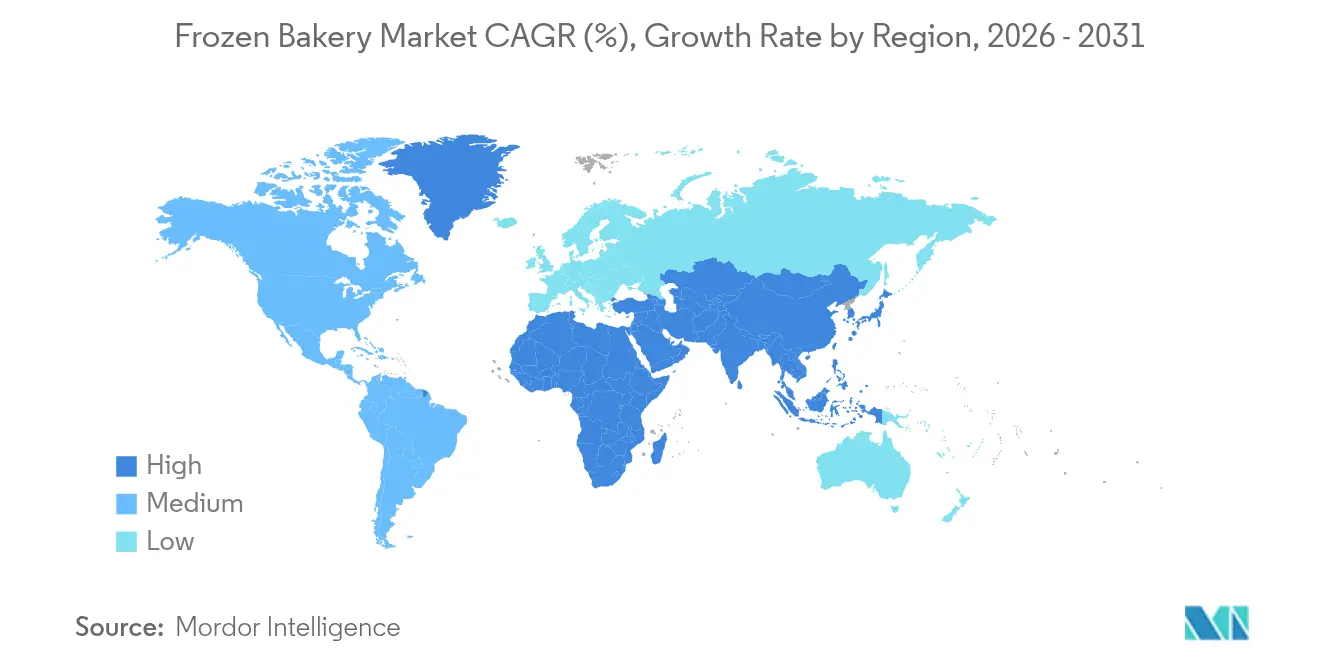
- By geography, Europe led with 36.20% revenue share in 2025; Asia-Pacific records the highest projected CAGR at 6.44% during 2026-2031.
Note: Market size and forecast figures in this report are generated using Mordor Intelligence’s proprietary estimation framework, updated with the latest available data and insights as of 2026.
Market Trends and Insights
Drivers Impact Analysis of Frozen Bakery Market*
| Driver | (~) % Impact on CAGR Forecast | Geographic Relevance | Impact Timeline |
|---|---|---|---|
| Convenient on-the-go frozen snacks | +1.2% | Global; stronger in North America and Asia-Pacific | Medium term (2-4 years) |
| Longer shelf life and lower retail waste | +0.8% | Emerging markets with limited cold storage | Long term (≥ 4 years) |
| Convenient bakery preparation | +1.1% | North America and Europe; spreading to Asia-Pacific | Medium term (2-4 years) |
| Cold-chain e-commerce | +0.9% | Asia-Pacific core; spill-over to Middle East and Africa, Latin America | Long term (≥ 4 years) |
| Product innovation and variety | +0.7% | Global; led by North America and Europe | Short term (≤ 2 years) |
| Premiumization of specialty breads and pastry | +0.6% | Europe and North America; selective Asia-Pacific markets | Medium term (2-4 years) |
| Source: Mordor Intelligence | |||
Demand for convenient On-the-Go frozen snacks
Consumer lifestyle shifts toward mobility and time-pressed meal solutions drive sustained demand for portable frozen bakery products, with breakfast sandwiches alone generating USD 2.3 billion in US sales according to Conagra Brands' 2024 frozen food trends analysis.This growth aligns with a broader consumer preference for mobility and time-saving meal solutions. Health-conscious consumers are also driving interest in bite-sized and mini formats, reflecting a growing focus on portion control. The segment's expansion is further supported by the rising popularity of air fryers, with many frozen food packages now including air-fryer cooking instructions for quick preparation while preserving texture quality. To address labor shortages, foodservice operators, particularly in convenience stores and quick-service restaurants, are incorporating frozen snack options to maintain menu variety. As eating habits shift from structured meals to more frequent, smaller eating occasions, demand for convenient, on-the-go frozen snacks continues to rise. According to the International Food Information Council, 31% of U.S. consumers were snacking twice a day in 2024[1]. This fusion of snacking culture with frozen technology creates opportunities for innovative formats that blend traditional bakery offerings with modern consumption patterns.
Rising demand for convenient bakery preparation
Professional kitchens and retail bakeries are increasingly adopting frozen solutions to address labor shortages and enhance operational efficiency. This shift allows smaller establishments to deliver artisanal-quality products without requiring specialized baking expertise, expanding access to premium bakery items across various retail formats. Advancements in low-temperature fermentation are driving innovations in ready-to-proof technologies, enabling bakeries to optimize production schedules and improve flavor profiles through extended fermentation periods. This trend is accelerating in healthcare and institutional food services, where the demand for consistent quality and food safety favors standardized frozen solutions over inconsistent fresh production. The strategic landscape highlights opportunities for vertical integration, enabling frozen bakery manufacturers to secure high-margin retail partnerships while mitigating the skilled baker shortage impacting traditional operations. Furthermore, the growing consumption of frozen baked goods reflects a rising demand for convenient bakery options, offering consumers easy access to high-quality products with minimal effort. In Germany, frozen baked goods consumption increased from 1,077,815 tons in 2023 to 1,102,606 tons in 2024, according to the German Frozen Food Institute[2]. This market transformation is primarily driven by modern lifestyles, technological advancements, and evolving consumer preferences.
Premiumisation of specialty breads and viennoiserie
Consumers who prioritize quality and value traditional recipes are increasingly attracted to premium bakery products, including specialty breads like sourdough and multigrain, as well as viennoiseries such as croissants and brioche. In September 2024, Europastry expanded its premium frozen offerings through strategic acquisitions. Notably, EUR 210 million from IPO proceeds has been allocated for brand development and production enhancement. This growth in premium offerings is driven by consumers' readiness to pay higher prices for authentic textures and flavors. Consequently, there is significant investment in adapting traditional techniques for frozen formats, particularly in croissants and Danish pastries. The segment also benefits from foodservice premiumization, as restaurants increasingly seek high-quality frozen bases to deliver fresh-baked experiences without requiring specialized pastry expertise. European manufacturers capitalize on their heritage positioning to secure price premiums in international markets, while North American players focus on clean label innovations and locally-sourced ingredients. These market dynamics demonstrate that premiumization not only establishes defensive barriers against private label competition but also delivers higher margins, supporting continued investments in innovation.
Cold-chain E-commerce in emerging markets
The development of digital commerce infrastructure in Asia-Pacific and Latin America is opening new distribution channels for frozen bakery products. This expansion is supported by government initiatives to modernize food supply chains and minimize post-harvest losses. For instance, as of December 2024, India has 399 cold chain projects, with 286 operational and 113 under development, according to the Ministry of Food Processing Industries[3]. Vietnam's cold chain market highlights this transformation, with rapid growth in warehouse capacity driven by modernization efforts and increased consumer awareness of safety. Innovations in last-mile delivery, such as temperature-controlled micro-fulfillment centers, are enabling frozen bakery products to penetrate urban and suburban areas that were previously inaccessible. This trend is further accelerated by partnerships between global frozen food companies and regional e-commerce platforms, creating scalable distribution models that overcome the limitations of traditional retail infrastructure. Strategically, companies that establish cold-chain partnerships in high-growth markets gain first-mover advantages, while investments in packaging and logistics technology provide opportunities for competitive differentiation.
Restraints Impact Analysis of Frozen Bakery Market*
| Restraint | (~) % Impact on CAGR Forecast | Geographic Relevance | Impact Timeline |
|---|---|---|---|
| Consumer preference for fresh products | -0.9% | Europe; mature Asia-Pacific markets | Long term (≥ 4 years) |
| Limited cold storage infrastructure | -1.1% | Emerging Asia-Pacific, Middle East and Africa, Latin America | Medium term (2-4 years) |
| Preference for traditional baking methods | -0.6% | Europe; select North American artisan niches | Long term (≥ 4 years) |
| Volatile flour and energy prices | -0.8% | Global; energy-intensive regions | Short term (≤ 2 years) |
| Source: Mordor Intelligence | |||
Consumer preference for fresh products
European markets, where artisanal baking is culturally significant and supported by regulatory frameworks favoring local production, exhibit strong resistance to frozen food products. Affluent consumers, who associate freshness with premium quality, further reinforce this preference. Consequently, frozen bakery manufacturers face difficulties in accessing these high-value market segments. This challenge is reflected in pricing pressures, as consumers often demand substantial discounts to choose frozen options over fresh ones. These factors compress profit margins and obstruct premium positioning strategies. However, advancements in freezing technologies and packaging innovations are gradually changing these perceptions, particularly among younger consumers who value convenience. To address this, industry players are implementing strategies such as transparency initiatives to emphasize quality preservation techniques and nutritional studies that highlight the benefits of frozen products in specific applications.
Limited cold storage infrastructure in emerging markets
Infrastructure deficits in developing economies hinder market penetration despite strong demand fundamentals. Aging facilities and insufficient capacity create distribution bottlenecks, driving up costs and limiting product availability. This issue is particularly acute in urban last-mile deliveries, where temperature control requirements clash with the needs of cost-sensitive consumers. While demand exists, accessibility remains a challenge. Developing cold chain infrastructure often requires investments beyond local capital capabilities, necessitating foreign direct investment or public-private partnerships, which carry regulatory and political risks. However, governments are increasingly recognizing the connection between food security and infrastructure, leading to policy support for modernization. National programs promoting cold storage development highlight this trend. Companies willing to invest in infrastructure partnerships can seize strategic opportunities, gaining competitive advantages and addressing market access challenges through vertical integration.
*Our forecasts treat driver/restraint impacts as directional, not additive. The impact forecasts reflect baseline growth, mix effects, and variable interactions.
Frozen Bakery Market Segment Analysis
By Product Type:
Bread Dominance, Faces Pizza InnovationIn 2025, bread products accounted for a significant 41.72% share of the frozen bakery market, driven by their widespread familiarity and adaptability across both retail and foodservice channels. The introduction of premium gluten-free options, such as Lancaster Colony’s New York Bakery line, has further strengthened the category’s appeal, particularly among health-conscious consumers seeking better-for-you alternatives. This trend underscores the enduring demand for bread products as a staple in the frozen bakery market. Simultaneously, the pizza crust segment is emerging as a key growth driver, registering an impressive 6.28% CAGR (2026-2031). This growth is fueled by the incorporation of upcycled ingredients, which align with sustainability trends, and the recovery of the foodservice sector. Quick-service restaurants are increasingly adopting par-baked and freezer-to-oven pizza crusts, which offer the dual benefits of labor optimization and the ability to deliver artisanal-quality textures, thereby expanding the market size for frozen pizza crusts.
Cakes and pastries continue to experience steady demand, particularly during seasonal celebrations, while morning goods gain traction due to their convenience for breakfast consumption. Viennoiserie and Danish products are capitalizing on the premiumization trend, especially in hotels and cafés that aim to provide an authentic European experience to their customers. The frozen bakery market is also witnessing accelerated consolidation, as evidenced by Furlani Foods’ acquisition of Cole’s Quality Foods in January 2025. This strategic move strengthens Furlani Foods’ leadership position in the frozen garlic bread segment. By diversifying their product portfolio, the company not only achieves greater scale efficiencies but also mitigates the impact of demand fluctuations across various categories, ensuring a more resilient market presence.

By Form:
Ready-to-Bake Leadership Meets Proof InnovationIn 2025, ready-to-bake products accounted for a significant 39.65% share of the frozen bakery market. These products effectively combine the convenience of pre-prepared items with the appeal of freshly baked goods, making them a popular choice among households and caterers. Features such as compatibility with air fryers and shorter baking times significantly enhance the overall consumer experience. Additionally, the use of standardized shapes in these products helps foodservice providers reduce labor requirements, improving operational efficiency. On the other hand, the ready-to-proof segment is experiencing steady growth, expanding at a compound annual growth rate (CAGR) of 5.21% (2026-2031). This growth is driven by advancements in low-temperature fermentation techniques, which not only enhance flavor complexity but also contribute to energy savings, making these products more appealing to both consumers and businesses.
The market for ready-to-proof products is expanding further as artisan cafés increasingly leverage these offerings to provide customized options without the need for onsite mixing. This approach enhances the perception of freshness, which is a key factor in attracting customers. In contrast, pizzerias benefit from ready-to-cook doughs that allow for custom shaping, enabling them to cater to diverse customer preferences. Convenience stores, on the other hand, address the growing demand for grab-and-go options by offering ready-to-eat frozen bakery items. To meet the evolving needs of the market, manufacturers are investing in flexible production lines capable of alternating between different product forms. This adaptability optimizes asset utilization and ensures efficient production processes. While ready-to-proof products are positioned as premium offerings due to their superior sensory attributes, ready-to-bake products maintain profitability through economies of scale achieved via high-volume production, ensuring their continued competitiveness in the market.
By Distribution Channel:
Off-Trade Dominance Challenged by Foodservice RecoveryIn 2025, off-trade retail maintained its dominance in the frozen bakery market, accounting for a significant 59.12% share. This stronghold can be attributed to supermarkets' advanced cold-storage capabilities, which ensure product freshness, and consumers' preference for stocking up on frozen bakery items for convenience. Convenience stores are also playing a pivotal role in driving incremental sales by offering single-serve packaging that caters to impulse purchases, making them an attractive option for on-the-go consumers. Additionally, online grocery platforms are expanding the reach of off-trade sales by utilizing insulated delivery totes to preserve product quality during transit and leveraging rapid-fulfillment networks to meet consumer demand efficiently.
On-trade outlets are anticipated to achieve a compound annual growth rate (CAGR) of 5.73% (2026-2031), reflecting a robust recovery in demand from restaurants and catering services. To address rising wage pressures, operators are increasingly adopting frozen bakery bases that require minimal skilled labor, enabling them to maintain menu consistency while optimizing operational efficiency. Specialty coffee chains are also contributing to this growth by baking frozen viennoiserie on-site, a strategy that enhances the in-store aroma and encourages customers to make additional purchases. Moreover, manufacturers are aligning their product offerings with channel-specific requirements by customizing product formats and case sizes. This approach not only meets the unique needs of different distribution channels but also streamlines SKU complexity, ensuring greater logistical efficiency.
Geography Analysis
Broader European Markets
Europe holds a 36.20% market share in 2025, driven by its advanced cold-chain infrastructure and supportive regulatory frameworks. These frameworks encourage frozen food innovations and include the EU's updated contaminant regulations, effective in 2025, which aim to improve food safety standards while maintaining production flexibility. Europe's strong artisanal baking traditions contribute to the premium positioning of its frozen products. Companies like Vandemoortele are leveraging this advantage through strategic acquisitions, such as Lizzi in Italy and Banneton Bakery in North America, to expand their geographic reach and product offerings. Germany and France lead consumption trends, supported by robust foodservice sectors and consumer acceptance of frozen convenience products. Meanwhile, the UK market remains resilient despite economic challenges. European manufacturers adhering to regulatory frameworks, such as ISO food safety standards, gain a competitive edge as they pursue international expansion opportunities.
APAC Frozen Bakery Market
Asia-Pacific is experiencing rapid growth, with the highest expansion rate at a 6.44% CAGR (2026-2031). This growth is driven by significant infrastructure investments and changing consumption patterns. In China, market growth is accelerating through strategic acquisitions. For example, in September 2024, Mondelez International acquired Evirth, a leading frozen cakes and pastries manufacturer, reflecting multinational confidence in China's long-term growth potential. In India, the market is advancing due to investments in cold-chain infrastructure and urbanization trends that favor convenient food solutions. Southeast Asian countries, including Thailand and Indonesia, are also showing strong growth potential, fueled by rising disposable incomes and the adoption of Western dietary habits.
The Americas and MEA Frozen Bakery Market
North America retains a strong market presence, supported by established distribution networks and widespread consumer acceptance of frozen convenience products. In Canada, the bakery sector is showing resilience, with double-digit nominal growth rates driven by inflation. Mexico benefits from its proximity to the US market and its robust manufacturing capabilities. Grupo Bimbo exemplifies this with its extensive operations and sustainability initiatives, such as renewable energy microgrids in its California facilities. In South America, Brazil and Argentina lead growth opportunities, driven by urbanization and rising incomes. Grupo Bimbo's acquisition of Wickbold brands in September 2024 highlights its multinational expansion strategy. Meanwhile, the Middle East and Africa regions show emerging potential, supported by infrastructure development and evolving dietary patterns. However, cold-chain limitations continue to constrain short-term growth prospects.
Regulatory Landscape
Frozen bakery products are shaped by broader food safety, labeling, and contaminant-control requirements that affect plant controls, ingredient sourcing, and cross-border trade. In the United States, the FDA has continued to operationalize FSMA traceability requirements, including Food Traceability Rule (Rule 204) draft guidance published in February 2026, and an agency framework for additional traceability records for covered foods. This is pushing manufacturers and co-packers toward audit-ready documentation and tighter supplier verification. Product-specific standardization has also loosened in some niches, including the FDA action in 2024 to revoke standards of identity and quality for frozen cherry pie, which reduces formulation constraints while keeping core safety obligations in place.
In Europe, compliance is anchored by EU food law and monitoring systems that influence category definitions and surveillance. EFSA maintains the FoodEx2 classification system for regulatory monitoring, and updates published in 2026 support harmonized data reporting across food categories relevant to bakery and composite products. Outside major markets, national rules add additional complexity for international brands, illustrated by Moldova's Government Decision No. HG741/2025 (December 2025) validating quality requirements for bakery products and pasta. This reinforces the need for country-specific product specifications and quality documentation when supplying public and retail channels.
Competitive Landscape
The global frozen bakery market is moderately fragmented, with established multinational players utilizing vertical integration and geographic diversification strategies to maintain their competitive position. Emerging disruptors, on the other hand, focus on specialized segments and innovative product formulations. Technology adoption, particularly investments in automation, distinguishes market leaders. Additionally, sustainability initiatives, such as renewable energy systems and innovative packaging, strengthen competitive advantages while ensuring regulatory compliance.
Opportunities are growing in premium artisanal segments and specialized dietary categories. Traditional players face difficulties in adapting their established production systems to meet niche demands, creating entry points for agile competitors with innovative formulations and flexible manufacturing capabilities. Patent activity in dough preparation and measurement technologies underscores a continued focus on innovation, though recent advancements primarily target process optimization rather than groundbreaking product developments.
Leading companies in the industry include Europastry SA, General Mills, Inc., Grupo Bimbo SAB de CV, Aryzta AG, and Lantmännen Unibake International. These major players prioritize product development and innovation to cater to diverse consumer preferences, offering a variety of tastes and maintaining a premium image. The competitive landscape has also been influenced by regulatory changes, such as the FDA's 2024 revocation of frozen cherry pie standards. This regulatory shift reduces barriers to product innovation while maintaining food safety requirements, favoring companies with strong research and development capabilities over those dependent on standardized formulations.
Frozen Bakery Industry Leaders
-
Europastry SA
-
General Mills, Inc.
-
Aryzta AG
-
Grupo Bimbo SAB de CV
-
Lantmännen Unibake International
- *Disclaimer: Major Players sorted in no particular order
Frozen Bakery Market Companies Covered in this Report
- Grupo Bimbo SAB de CV
- Aryzta AG
- Lantmannen Unibake International
- Europastry SA
- General Mills Inc.
- Associated British Foods PLC
- Conagra Brands Inc.
- Rich Products Corporation
- Vandemoortele NV
- Dawn Foods Global Inc.
- Tyson Foods Inc. (Sara Lee Frozen Bakery)
- Flowers Foods Inc.
- FGF Brands Inc.
- Alpha Baking Company Inc.
- Sunbulah Group
- Gonnella Frozen Products
- Fuji Baking Co. Ltd.
- Vandemoortele USA LLC
- Rotella's Italian Bakery Inc.
- Europastry USA
- Nestle SA (DiGiorno, Toll House cookie dough)
Market Opportunities and Future Outlook
Investment activity in 2026 points to gaps in capacity, automation, and premium formats, particularly for laminated doughs, viennoiserie, and labor-saving ready-to-bake and thaw-and-serve items used by foodservice and in-store bakery. In North America, BRIDOR completed a USD 200 million expansion at its Vineland, New Jersey baking site in January 2026, adding a Viennese pastries line and an automated bread line. The expansion highlights where scale players are channeling capital into premium and high-throughput production. BRIDOR also continues to pursue cross-regional route-to-market expansion through trade-focused portfolio moves, including its March 2026 agreement to acquire Panamar in Spain, which signals ongoing interest in established regional manufacturers and distribution networks.
Asia-Pacific and Latin America also offer opportunity tied to cold-chain build-out and new industrial lines that support consistent frozen dough supply for retail and foodservice. Samyang Corporation began full-scale production on an expanded frozen dough line at its Incheon Plant 2 in April 2026, with an annual capacity of 5,000 tons after a 52 billion won investment. This underscores growing local supply of frozen bakery inputs for fast-moving channels. In Brazil, Panfacil announced a facility expansion at Canoas in January 2026 to raise capacity by 150%, which supports continued localization of production to reduce logistics costs and improve service levels in large domestic markets. This aligns with the report's observed channel shift toward off-trade and e-commerce cold-chain models in emerging markets.
Recent Industry Developments in Frozen Bakery Market
- June 2026: Europastry reached an agreement to acquire Highland Baking Company in the United States, strengthening its footprint in premium bread manufacturing and expanding local capacity in North America. The move supports broader customer coverage across foodservice and retail while reducing reliance on transatlantic supply for select categories.
- June 2026: ARYZTA acquired a French distribution business, tightening control over route-to-market and improving service levels for frozen bakery deliveries. The deal supports quicker replenishment and deeper penetration in a core European consumption market where distribution capability can be a competitive differentiator.
- March 2025: Europastry commissioned a EUR 19 million carbon-neutral cookie plant in Oldenzaal, Netherlands, featuring an electric production oven. The project strengthens sustainability credentials and provides a template for lower-emission production upgrades that large buyers increasingly require across European supply chains.
Frozen Bakery Market Report Scope and Research Methodology
Market Definition and Coverage
The frozen bakery market, for this sizing work, covers bakery items that are manufactured, frozen, and sold through retail or foodservice for later baking, thawing, or serving, with value measured as revenue at the market level in USD.
Scope exclusions: The sizing excludes non-bakery frozen desserts and plain frozen dough ingredients that are not sold as bakery formats.
Segments Covered in This Report
- By Product Type
- Bread
- Pizza Crust
- Cakes and Pastries
- Morning Goods (Donuts, Muffins, Croissants)
- Viennoiserie and Danish
- Other Frozen Bakery
- By Form
- Ready to Cook
- Ready to Bake
- Ready to Proof
- Ready to Eat
- By Distribution Channel
- On-Trade (HoReCa)
- Off-Trade (Retail)
- Supermarkets/Hypermarkets
- Convenience Stores
- Specialty Stores
- Online Retail Stores
- Other Off-Trade Channels
- By Geography
- North America
- United States
- Canada
- Mexico
- Rest of North America
- South America
- Brazil
- Argentina
- Colombia
- Chile
- Rest of South America
- Europe
- United Kingdom
- Germany
- France
- Italy
- Spain
- Russia
- Sweden
- Belgium
- Poland
- Netherlands
- Rest of Europe
- Asia-Pacific
- China
- Japan
- India
- Thailand
- Singapore
- Indonesia
- South Korea
- Australia
- New Zealand
- Rest of Asia-Pacific
- Middle East and Africa
- United Arab Emirates
- South Africa
- Saudi Arabia
- Nigeria
- Egypt
- Morocco
- Turkey
- Rest of Middle East and Africa
- North America
Data Sources, Market Sizing, and Validation
Desk Research
Desk work starts by pulling the demand and supply signals that explain how frozen bakery moves across regions and channels. We rely on public sources such as USDA and Eurostat food statistics, UN Comtrade trade flows for bakery preparations, FAO food balance style indicators, and national customs portals where they are accessible.
To keep assumptions grounded, we also review company annual reports, investor presentations, and investor transcripts where frozen bakery is discussed under frozen foods or bakery lines. Trade association releases and reputable food industry news are used to confirm shifts in cold-chain capacity, foodservice recovery, and online grocery penetration. Where needed, paid subscriptions for company financials and news intelligence are used alongside a shipment-level import and export database to cross-check revenue ranges and movement trends. The sources named here are illustrative only, and other relevant public and paid references were also used for data collection, validation, and research clarification.
Primary Interviews and Surveys
Primary work focuses on validating what the desk sources cannot show clearly, especially pricing behavior and channel mix for frozen bakery across regions. We speak with a mix of manufacturers, ingredient and cold-chain participants, distributors, and large retail and foodservice buyers, and we ensure coverage across APAC, EMEA, and the Americas so the view is not shaped by one geography. Inputs gathered are used to confirm category inclusion, typical pack and case sizes, promotional intensity, and how ready-to-bake and par-baked formats are counted in revenue.
Distribution of primary research fieldwork respondents
| Company type | Respondent position | Region |
|---|---|---|
| Top tier: 25% | CXOs: 17% | APAC: 40% |
| Mid tier: 58% | Functional/Unit leaders: 40% | EMEA: 36% |
| Smaller Players: 17% | Managers: 43% | Americas: 24% |
Market-Sizing & Forecasting
Sizing is built using a top-down and bottom-up approach where production and trade signals, along with category penetration in retail and foodservice, are used to reconstruct the addressable revenue pool for frozen bakery by region. Once those totals are formed, we apply selective bottom-up checks, including supplier revenue roll-ups for key frozen bakery lines, sampled price per kilogram or per unit checks, and channel splits validated through distributor conversations, and then the model is adjusted where gaps appear.
A few inputs carry the most weight in this market, including frozen bakery consumption patterns by region, the share of bakery sold through off-trade versus HoReCa, freezer and cold-chain expansion trends, import reliance for specific bakery formats, and average selling price movements tied to wheat, fats, and energy costs. When product-level public data is thin, missing pieces are filled using proxy ratios from comparable bakery categories, and then challenged in expert calls so the final totals stay realistic.
Forecasting is driven mainly through scenario analysis supported by trend lines for the variables above, since shifts in foodservice volumes and retail promotions can change short-term growth. The scenarios are converted into a single base case after checking that implied per-capita and channel growth match what interviewees expect, and what recent trade and inflation signals indicate.
Data Validation & Update Cycle
Validation is done through cross-checks that compare the modeled revenue totals against independent indicators such as trade values for relevant bakery preparations, regional frozen food growth signals, and observed price inflation in key inputs. Outliers are reviewed and explained, and when a variance cannot be justified, assumptions are revisited and respondents are re-contacted to confirm the logic.
Before sign-off, the model and narrative are reviewed in multiple steps so arithmetic, scope, and year alignment issues do not pass through. The report is refreshed annually, and interim updates are made when material changes affect demand, pricing, or cold-chain availability. Right before delivery, a final pass is completed so clients receive the latest updated view.
Mordor Intelligence's Frozen Bakery Market Size Compared Against Other Published Estimates
Published market sizes for frozen bakery often look far apart, even when publishers are targeting the same consumer need. The gaps usually come from what items are counted as frozen bakery, which year is used for the headline value, and how pricing is carried through retail and foodservice channels.
The main gap comes from product scope, where Mordor Intelligence treats frozen bakery as frozen bread, pizza crust, cakes and pastries, morning goods, and related bakery formats, and it keeps non-bakery frozen desserts outside scope so totals are not inflated by adjacent categories. Another driver is year alignment, since some publishers mix base years and use currency conversions from different periods, which can shift the USD value even if volumes are similar.
Benchmark comparison
| Source | Market Size | Gaps in Research Methodology |
|---|---|---|
| Mordor Intelligence | USD 35.51 B (2026) | |
| Global Consultancy A | USD 70.63 B (2024) | Uses a broader category basket that appears to overlap with wider frozen food revenue and additional item sets, which increases the measured revenue pool versus a bakery-only definition. |
| Industry Publisher B | USD 55.00 B (2025) | Applies a wider inclusion set and different price and conversion timing, so higher inflation years and broader product coverage lift the value compared with a narrower frozen bakery basket. |
Overall, the spread in published values is mostly explained by what is included in the category and how base years and currency timing are handled. A model that sticks to a clear product list, keeps channels consistent, and re-checks totals against trade and demand signals is easier to audit and repeat over time.
Key Questions Answered in the Report
How large is the frozen bakery market in 2026?
The frozen bakery market size reached USD 35.51 billion in 2026 and is projected to climb to USD 45.35 billion by 2031.
Which product category leads sales?
Bread products hold the top position with 41.72% share of global revenue in 2025.
Which region grows the fastest through 2031?
Asia-Pacific displays the highest CAGR at 6.44% as cold-chain investment expands and consumer preferences shift toward convenience.
Why are ready-to-proof items gaining traction?
Low-temperature fermentation improves flavor and freshness perception, pushing ready-to-proof formats to a 5.21% CAGR forecast.