
Freelance Platforms Market Size and Share
Market Overview
| Study Period | 2020 - 2031 |
|---|---|
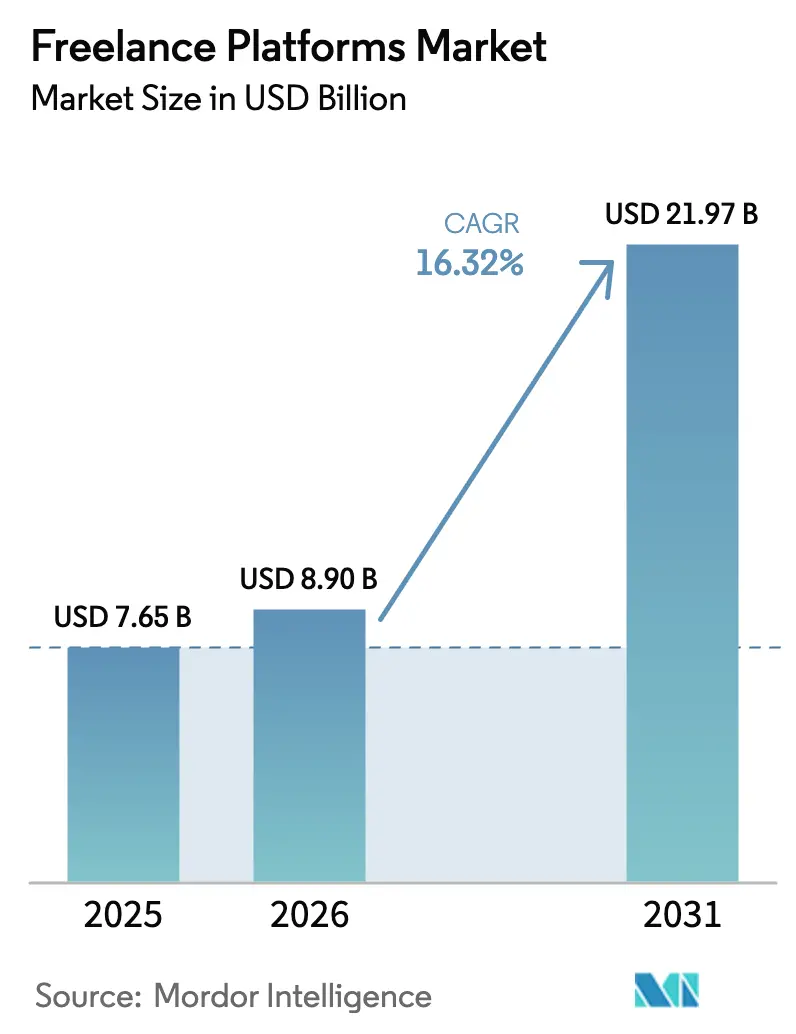
| Market Size (2026) | USD 8.9 Billion |
| Market Size (2031) | USD 21.97 Billion |
| Growth Rate (2026 - 2031) | 16.32 % |
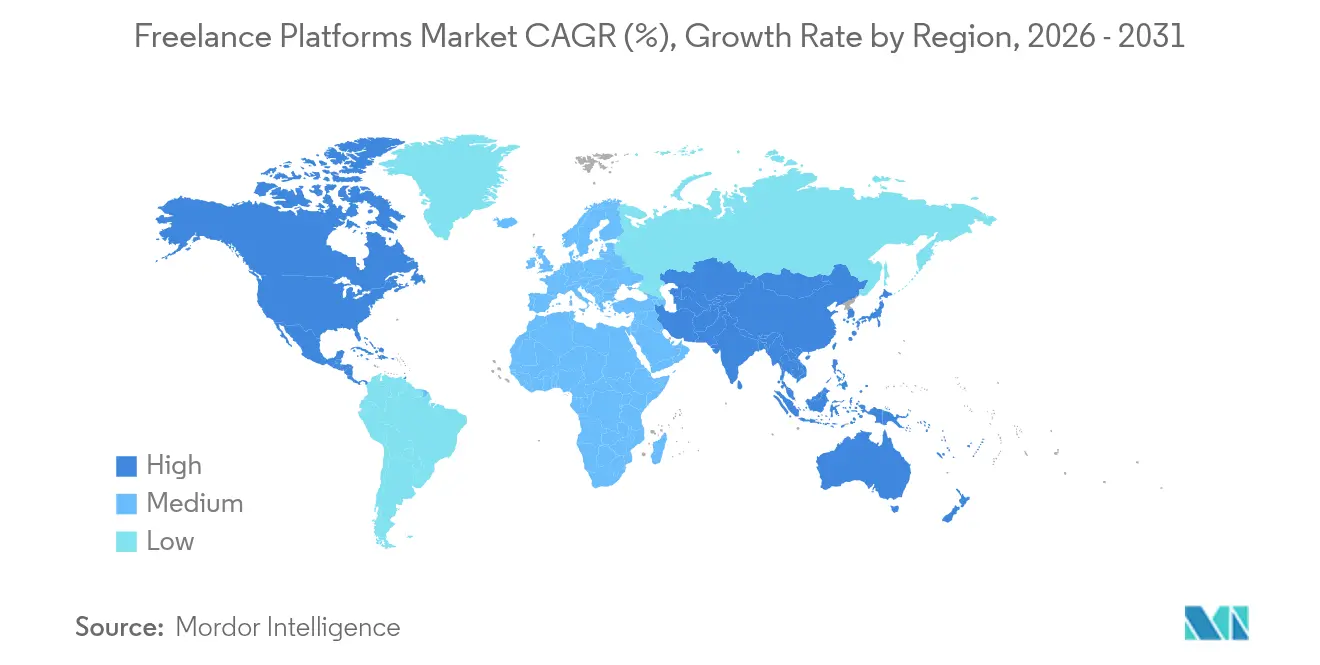
| Fastest Growing Market | North America |
| Largest Market | Asia Pacific |
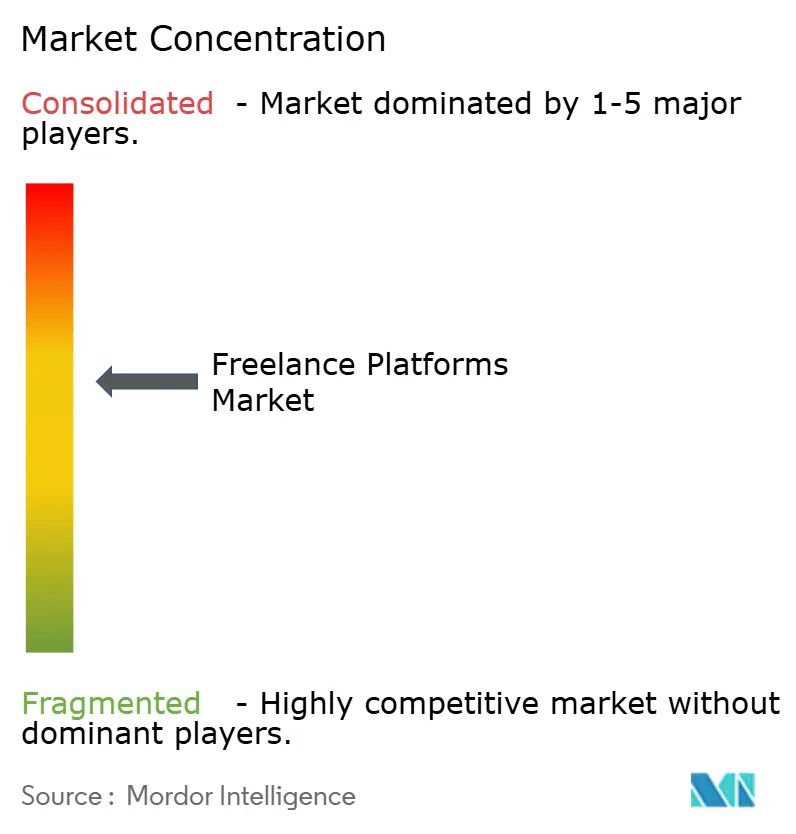
| Market Concentration | Medium |
Major Players *Disclaimer: Major Players sorted in no particular order Image © Mordor Intelligence. Reuse requires attribution under CC BY 4.0. | |
Freelance Platforms Market Analysis by Mordor Intelligence
Freelance platforms market size in 2026 is estimated at USD 8.9 billion, growing from 2025 value of USD 7.65 billion with 2031 projections showing USD 21.97 billion, growing at 16.32% CAGR over 2026-2031. Shifts toward hybrid work, rising demand for niche digital skills, and growing cost-optimization pressures keep the momentum strong for the freelance platforms market. Enterprise buyers increasingly favor platform-mediated talent engagement because it delivers compliance, variable cost structures, and rapid access to specialized capabilities. AI-powered matching and productivity tools now underpin most competitive differentiation, while emerging cross-border invoicing rules reduce friction in global payments. Geographically, North America retains leadership in penetration rates, yet Asia-Pacific is expanding fastest as enterprises in the region accelerate digital transformation plans.
Key Report Takeaways
- By component, platform models led with 59.72% of the freelance platforms market share in 2025; services are projected to grow at an 18.05% CAGR through 2031.
- By application, project management held 23.12% revenue share in 2025, while web and graphic design is forecast to advance at a 18.78% CAGR to 2031.
- By end user, freelancers accounted for 51.66% of the freelance platforms market size in 2025; employer adoption is rising at an 17.95% CAGR through 2031.
- By organization size, small and medium enterprises controlled 65.02% share of the freelance platforms market size in 2025, whereas large enterprises represent the fastest expansion at an 18.55% CAGR.
- By geography, North America commanded 32.64% revenue in 2025; Asia-Pacific is charting the highest regional CAGR at 18.22% through 2031.
Note: Market size and forecast figures in this report are generated using Mordor Intelligence’s proprietary estimation framework, updated with the latest available data and insights as of 2026.
Market Trends and Insights
Drivers Impact Analysis of Freelance Platforms Market*
| Driver | (~) % Impact on CAGR Forecast | Geographic Relevance | Impact Timeline |
|---|---|---|---|
| Hybrid and flexible workforce strategies | +4.2% | North America, Europe, Global spill-over | Medium term (2-4 years) |
| Rising demand for specialized digital skills | +3.8% | Asia-Pacific, North America | Long term (≥ 4 years) |
| Cost-optimization pressure on enterprises | +3.1% | North America, Europe | Short term (≤ 2 years) |
| Cross-border e-invoicing regulations | +2.4% | Europe, Asia-Pacific, North America | Medium term (2-4 years) |
| Generative-AI copilots for freelancers | +2.9% | North America, Europe, Asia-Pacific | Long term (≥ 4 years) |
| AI-powered matching algorithms improving hire speed | +2.7% | Global | Short term (≤ 2 years) |
| Source: Mordor Intelligence | |||


Shift toward hybrid and flexible workforce models.
Platform adoption accelerated after the U.S. Department of Labor’s 2024 rule clarified contractor classification, giving enterprises a compliant path to blend internal and external talent [1]U.S. Department of Labor, “Employee or Independent Contractor Classification Final Rule,” dol.gov . A global advertising group saved USD 9.6 million in one year by shifting consultant spend to a managed marketplace. Large corporations now bake contingent workforce planning into core strategy, using platforms to secure emerging skills faster than conventional hiring cycles allow. Surveyed firms report an 84% jump in non-employee talent use since the pandemic. The freelance platforms market, therefore, benefits from a structural rather than cyclical re-allocation of labor budgets.
Rising demand for specialized digital skills
Demand for AI, machine learning, and advanced programming skills rose 60% year-over-year, pushing freelance hourly rates up 44% above platform averages. Japanese data shows Go and Ruby specialists commanding monthly pay near JPY 852,000 (USD 5,680) and JPY 839,000 (USD 5,593), respectively. Enterprises prize cross-functional experts who can connect technology build-outs with business value, motivating platforms to refine AI-driven matching to surface niche talent. High pricing power and scarce supply combine to sustain premium fee structures, reinforcing growth prospects for the freelance platforms market.
Cost-optimization pressure on enterprises
Contingent workforce spend now touches 30% of large procurement budgets, prompting sharper focus on variable labor strategies. A leading U.K. service provider cut GBP 500,000 (USD 625,000) in six months by consolidating contractors through a compliance-ready platform. Savings extend to real estate and onboarding costs, while variable pricing improves budget predictability. Platforms that guarantee classification accuracy are rapidly gaining share with enterprise procurement teams seeking both savings and risk mitigation.
Generative-AI copilots boost platform worker productivity.
Fiverr’s “Fiverr Go” lets freelancers train AI models on their portfolios, freeing time for higher-value tasks. Upwork’s Uma assistant recommends proposals and automates mundane steps, supporting the company’s USD 769.3 million revenue in 2024. Productivity gains shorten delivery cycles and entice larger projects, shifting the freelance platforms market narrative from labor arbitrage toward capability enhancement.
Restraints Impact Analysis of Freelance Platforms Market*
| Restraint | (~) % Impact on CAGR Forecast | Geographic Relevance | Impact Timeline |
|---|---|---|---|
| Trust and payment-security concerns | -2.1% | Global; acute in emerging markets | Short term (≤ 2 years) |
| Regulatory ambiguity on worker classification | -1.8% | North America, Europe | Medium term (2-4 years) |
| Algorithm-bias lawsuits | -1.3% | North America, Europe | Medium term (2-4 years) |
| Escalating digital advertising costs | -1.6% | Global | Short term (≤ 2 years) |
| Source: Mordor Intelligence | |||
Trust and payment-security concerns
Escrow tools and two-factor identity verification now form baseline requirements for platforms expanding into geographies with weak payment rails. SafePay adoption on Guru and similar services shows improvement, yet fraud techniques continue to evolve, forcing ongoing investment in compliance and anti-money-laundering safeguards. Trust issues therefore remain a near-term drag on the freelance platforms market.
Algorithm-bias lawsuits are increasing compliance costs
New York City’s Local Law 144 demands annual bias audits for automated hiring tools, a standard other jurisdictions are adopting. Platform operators must document fairness across multiple demographic attributes, adding legal fees and sophisticated data-science oversight to operating costs. The freelance platforms market absorbs these expenses through higher take-rates or subscription fees, which may deter price-sensitive segments.
*Our forecasts treat driver/restraint impacts as directional, not additive. The impact forecasts reflect baseline growth, mix effects, and variable interactions.
Freelance Platforms Market Segment Analysis
By Component:
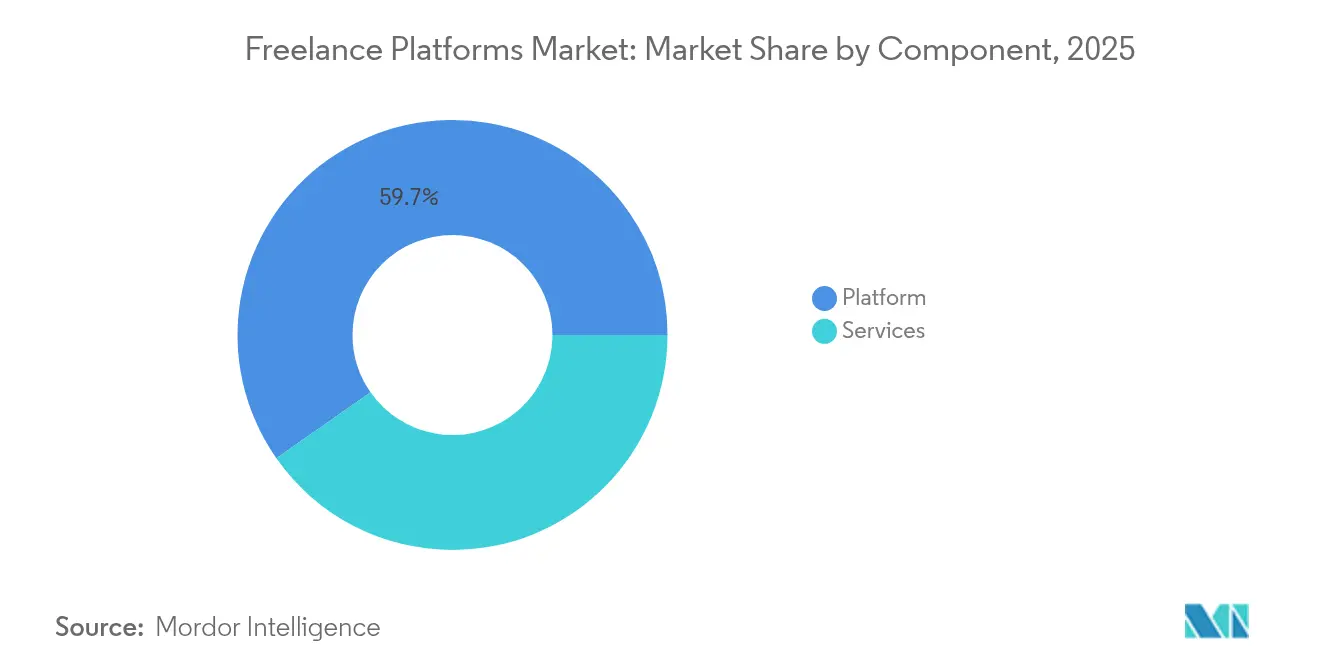
Platform dominance steers ecosystem expansionPlatform revenue streams captured 59.72% of the freelance platforms market share in 2025 on the strength of commission-based models that scale with transaction volume. Marketplaces such as Upwork and Freelancer rely on network effects, reinforcing their lead as user rolls deepen. The services component, however, is outpacing at an 18.05% CAGR, propelled by enterprise demand for managed solutions that guarantee compliance and project outcomes.
Managed service providers like CXC Global administer over 12,000 contractors monthly, showcasing an appetite for turnkey workforce orchestration. Hybrid models now blend marketplace agility with curated service layers, creating tiered offerings for large buyers. This evolution signals that the freelance platforms industry is widening its value capture along the full talent-management lifecycle.


By Application:
Design momentum challenges project management leadProject management tools held 23.12% of the freelance platforms market size in 2025, reflecting universal demand for agile execution across functions. Yet web and graphic design is expanding at 18.78% CAGR, fueled by AI-assisted creative workflows that lower entry barriers for SMEs seeking premium visuals.
Software development assignments continue to command premium budgets in emerging tech stacks, while sales and marketing freelancers gain ground as firms migrate to performance-linked contracts. Niche domains such as legal compliance and financial modeling surface within “other applications,” underscoring opportunities for vertical specialization. Platforms that deepen expertise within each application tier stand to capture higher wallet share and retention.
By End User:
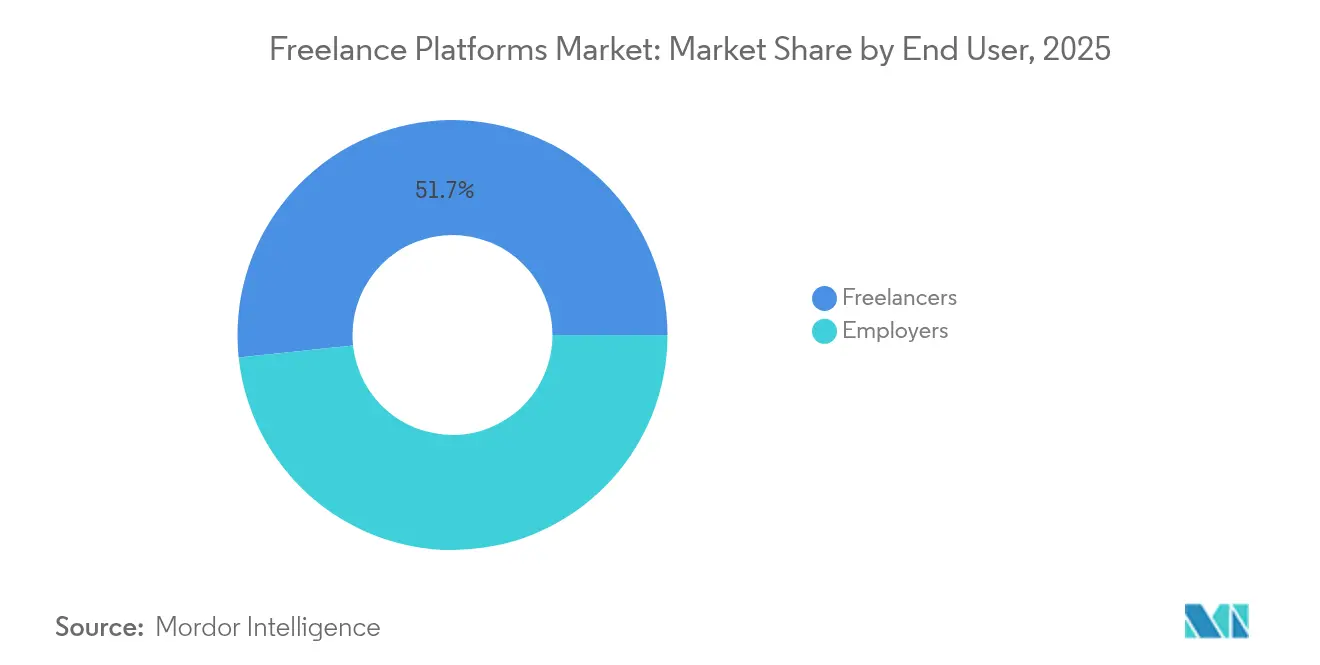
Employer demand reshapes two-sided marketplace dynamicsFreelancers remain the larger cohort at 51.66% of 2025 users, but employer onboarding is rising at an 17.95% CAGR as corporations operationalize external workforce programs. Compliance-ready portals appeal to regulated industries, ensuring taxes, benefits, and worker status are correctly handled.
On the supply side, freelancers benefit from AI-driven proposal tools that raise win rates and billing efficiency, anchoring them to the ecosystem. Marketplace success, therefore, hinges on balanced investment in employer UX and freelancer enablement, reinforcing liquidity on both sides of the freelance platforms market.
By Organization Size:
Enterprise integration shifts platform prioritiesSmall and medium enterprises still account for 65.02% of the freelance platforms market share in 2025, mirroring the channel’s early adoption roots. Large enterprises now grow fastest at 18.55% CAGR, demanding SOC 2-compliant infrastructure, audit trails, and ERP integration. An aerospace firm saved USD 3 million after embedding a vendor management module within its USD 800 million contractor program.
Enterprise penetration drives higher average deal sizes but raises service expectations around risk mitigation and data security. Platforms investing in single-sign-on, API interoperability, and global payroll are best placed to win these high-value contracts and reinforce the freelance platforms market trajectory.
Geography Analysis
APAC Freelance Platforms Market
Asia-Pacific posted the highest 18.22% CAGR outlook, underpinned by rapid digitalization and policy frameworks such as ViDA electronic invoicing that simplify cross-border transactions. Companies in Japan routinely pay skilled freelancers more than USD 5,000 monthly, signaling a robust willingness to pay for top talent . Growth in Southeast Asia is likewise accelerating as local firms leapfrog traditional hiring constraints.
North America Freelance Platforms Market
North America remains the revenue leader with a 32.64% share, supported by mature infrastructure and an early-adopter enterprise culture. The U.S. regulatory environment, though complex, offers clear federal frameworks that encourage compliant contractor engagement. Canada adds momentum with supportive provincial guidelines around remote work taxation.
EMEA and LATAM Freelance Platforms Market
Europe sustains steady expansion as GDPR-aligned data safeguards increase trust and as the forthcoming 2030 ViDA mandate ensures seamless intra-EU invoicing. In Latin America, currency volatility poses challenges, yet localized wallets prove effective at promoting freelance adoption. The Middle East and Africa present nascent but promising pockets, especially among tech hubs in the Gulf Cooperation Council, where government innovation agendas boost demand for specialized gig talent.

Regulatory Landscape
Regulation for freelance platforms is tightening around worker classification and the transparency of automated decision-making, increasing compliance demands for global operators. In the European Union, Directive (EU) 2024/2831 (Platform Work Directive) sets a December 2, 2026 transposition deadline for member states and introduces a rebuttable presumption of employment when direction and control indicators are present, along with obligations tied to algorithmic management and access to human review. Because the directive applies to digital labor platforms organizing work in the Union regardless of incorporation location, US-based platforms serving EU users must align their policies, data handling, and work-allocation practices with these requirements.
In the United States, classification guidance remains a key swing factor for enterprise adoption and platform operating models. The US Department of Labor published a proposed independent contractor rule in the Federal Register on February 27, 2026, signaling potential changes to the framework clarified in 2024 and putting renewed emphasis on tests centered on control and profit-or-loss opportunity. Platforms and their enterprise clients are prioritizing contract templates, compliance workflows, and audit trails that can withstand evolving federal and state interpretations while sustaining cross-border hiring and payments.
Value Chain Analysis
The freelance platforms value chain begins with supply creation and validation, including freelancer acquisition, identity checks, skill verification, and reputation building, then moves to demand generation through client acquisition and job intake. It then flows into the core orchestration layer, covering AI-enabled matching, scope definition, collaboration and project management, and price discovery. Transaction enablement and risk controls sit at the center of value capture through escrow or payment protection, milestone management, dispute resolution, and fraud prevention, which together reduce trust barriers and help keep work on-platform.
Monetization and retention are increasingly layered beyond take-rate commissions into membership tiers, advertising, and enterprise SaaS-style integrations that embed marketplaces into procurement and vendor-management workflows. Platform operators also invest in proprietary workflow tooling and compliance features to limit disintermediation by raising switching costs and improving governance for clients managing larger contractor programs. This end-to-end chain links talent liquidity with compliance and payment infrastructure, supporting both SMB self-serve use cases and managed enterprise engagements.
Competitive Landscape
The freelance platforms market shows moderate concentration anchored by Upwork, Fiverr, and Freelancer, yet vertical contenders and AI-native challengers chip away at category breadth. Upwork alone holds 61.25% of platform revenue, aided by 125 skill categories and enterprise integrations [3]Upwork Inc., “Strategic Partnership with Beeline,” upwork.com. Fiverr differentiates through AI-augmented creative services and freelancer equity incentives that deepen talent loyalty.
Strategic alliances intensify: Upwork partnered with Beeline to integrate marketplace talent into vendor management workflows, expanding reach to Fortune 500 procurement desks. Payoneer moved upstream by acquiring Skuad for USD 61 million, unifying payments with employer-of-record services that satisfy enterprise compliance demands.
Consolidation within Europe is visible as Freeland Group executes a seventh takeover, aiming to create an end-to-end, regionally compliant platform. Yet disruption looms from AI-native entrants like Lanceboard, which offers pre-screened talent pools and automated task assignment, targeting speed-sensitive use cases. Sustained leadership thus requires investment in vertical depth, AI transparency, and comprehensive compliance toolkits.
Freelance Platforms Industry Leaders
Upwork Global Inc.
Fiverr International Ltd.
Skyword, Inc.
Guru.com
Freelancer Limited
- *Disclaimer: Major Players sorted in no particular order
Freelance Platforms Market Companies Covered in this Report
- Upwork Inc.
- Fiverr International Ltd.
- Freelancer Limited
- Toptal LLC
- Guru.com LLC
- PeoplePerHour.com Ltd.
- DesignCrowd Pty Ltd.
- Contently Inc.
- WorkGenius GmbH
- WorkMarket, Inc.
- Catalant Technologies, Inc.
- 99designs by Vista
- Behance (Adobe Inc.)
- TaskRabbit, Inc.
- Amazon Mechanical Turk (Amazon.com, Inc.)
- UpStack Technologies, Inc.
- Workana Inc.
- Gigster LLC
- Aquent LLC
- FlexJobs Corporation

Market Opportunities and Future Outlook
A clear opportunity is productizing compliance and transparency as enterprise-grade features as new labor-platform rules take effect across regions. The EU Platform Work Directive (Directive (EU) 2024/2831) requires member-state implementation by December 2, 2026 and applies to platforms organizing work in the Union, creating whitespace for offerings that bundle worker-status risk controls, auditable decisioning, and human review pathways for automated decisions. In parallel, the US Department of Labor proposed a new independent contractor rule on February 27, 2026, reinforcing that classification frameworks can shift during the forecast window and increasing the value of platforms that help clients standardize engagement practices across jurisdictions.
Another opportunity is shifting mix toward durable, non-transactional revenue streams to reduce reliance on commissions and improve retention through embedded workflows. Marketplace monetization is already expanding via membership tiers, premium tools, and enterprise integrations, and 2026 product moves reinforce this direction. Upwork launched an app inside ChatGPT in April 2026 to compress job intake and talent discovery into a common AI workflow, and it introduced Spring 2026 AI-powered coordination and progress tracking features aimed at SMB execution. Verticalized AI-enabled offerings also broaden addressable spend, illustrated by Fiverr's March 2026 AI Video Hub, which connects brands with curated AI video directors for higher-value creative production use cases on freelance marketplaces.
Recent Industry Developments in Freelance Platforms Market
- May 2026: Upwork Global Inc. updates Spring 2026 with AI-powered capabilities for SMBs, including project coordination and progress tracking tools. The addition builds out the platform as an end-to-end contingent-work solution for enterprises and SMBs. The release expands AI-enabled productivity for small businesses and reinforces Upwork's role in enterprise workforce management.
- April 2026: Upwork Global Inc. launches an app within ChatGPT to describe project needs, discover talent, and draft job posts using the ChatGPT interface. The integration deepens AI-enabled talent discovery workflows and speeds hiring on the platform. The development strengthens ties with large language model ecosystems and accelerates hiring on the platform.
- March 2026: Fiverr International Ltd. launches AI Video Hub connecting brands with curated AI video directors for commercial and social content production. The service expands vertical depth for Fiverr and accelerates AI-assisted content creation capabilities for clients. The move strengthens Fiverr's market position by enabling AI-driven content production on the platform.


Freelance Platforms Market Report Scope and Research Methodology
Market Definition and Coverage
This market covers the revenue earned from online freelance platforms that connect clients with independent workers and support the transaction, including discovery, contracting workflows, and paid services tied to those engagements.
Scope exclusions: We exclude offline staffing and consulting that is not platform-mediated, and we also exclude internal HR systems used only for employee hiring.
Segments Covered in This Report
- By Component
- Platform
- Services
- By Application
- Project Management
- Sales and Marketing
- IT and Software
- Web and Graphic Design
- Other Applications
- By End User
- Employers (Enterprises and SMBs)
- Freelancers
- By Organization Size
- Large Enterprises
- Small and Medium Enterprises (SMEs)
- By Geography
- North America
- United States
- Canada
- Mexico
- South America
- Brazil
- Argentina
- Colombia
- Rest of South America
- Europe
- Germany
- United Kingdom
- France
- Italy
- Spain
- Russia
- Netherlands
- Rest of Europe
- Asia-Pacific
- China
- Japan
- South Korea
- India
- Australia
- Singapore
- Rest of Asia-Pacific
- Middle East and Africa
- Middle East
- Saudi Arabia
- United Arab Emirates
- Rest of Middle East
- Africa
- South Africa
- Egypt
- Rest of Africa
- Middle East
- North America
Data Sources, Market Sizing, and Validation
Desk Research
Desk research starts by grounding the model in public signals that describe how much independent work is being created and fulfilled across countries and industries. We typically rely on sources such as the International Labour Organization for labor force context, the World Bank for macro indicators, OECD labor and digital economy series, and the US Bureau of Labor Statistics for employment patterns and earnings benchmarks.
Next, we map those signals to platform activity and monetization logic using public company filings, investor presentations, app store rankings, reputable press coverage, and platform policy pages that describe fees and service packages. For cross-border dynamics, we also reference official trade and payments context from sources such as UNCTAD and central bank publications, and we may use paid subscriptions for company financials and news intelligence, patent lookups, and selective shipment-level trade checks where it helps validate payment and invoicing flows. The sources listed here are illustrative, and many other public and paid references were used to collect data, validate assumptions, and clarify open questions.
Primary Interviews and Surveys
Primary interviews focus on confirming what drives revenue on freelance platforms beyond user counts, including fee structures, buyer mix, and typical project values. We spoke with a mix of platform operators, enterprise and SMB buyers, and active freelancers across key geographies, so gaps from desk research could be closed and assumptions triangulated in a practical way.
Distribution of primary research fieldwork respondents
| Company type | Respondent position | Region |
|---|---|---|
| Top tier: 33% | CXOs: 18% | APAC: 39% |
| Mid tier: 48% | Functional/Unit leaders: 27% | EMEA: 37% |
| Smaller Players: 19% | Managers: 55% | Americas: 24% |
Market-Sizing & Forecasting
Sizing uses top-down and bottom-up approaches once each, so the model remains explainable and repeatable. The top-down path reconstructs the addressable spend pool by linking independent work intensity to platform adoption rates, then converting that demand into revenue using take-rate and service attach assumptions.
To keep the mechanics grounded, several market-specific inputs are tracked and refreshed, including active buyer trends (enterprise versus SMB), freelancer supply participation, average project values for common digital categories, platform fee models (commissions, subscriptions, and value-added services), and cross-border share where currency and payout friction can affect conversion. Results are corroborated with selective bottom-up approximations, including sampled platform revenue disclosures where available, channel checks on typical take rates, and ASP times volume reasonability tests by application category. When direct disclosures are missing, we handle gaps through proxies, such as peer-group monetization ranges and geography-weighted adoption splits validated in interviews.
For forecasting, we use scenario analysis supported by a light multivariate view, where growth is tied to digital services demand, remote work penetration, and enterprise procurement maturity. Assumptions are adjusted only after interview feedback confirms whether pricing, buyer conversion, and service attach are expected to shift over the forecast window.
Data Validation & Update Cycle
Validation is done through several passes so the totals do not depend on a single data stream. We compare model outputs against independent signals such as platform revenue disclosures, labor and digital economy indicators, and geography-level demand momentum, then review outliers before sign-off.
If variance is large, we re-contact respondents to confirm whether it is caused by scope, timing, currency conversion, or a change in fee structure. The report is refreshed annually, and interim updates are made when material events occur that can move adoption, pricing, or cross-border payments behavior. Before delivery, a final analyst pass is completed so clients receive the latest updated view.
Mordor Intelligence's Freelance Platforms Market Size Measured Against Other Published Estimates
Published market sizes for freelance platforms vary because the boundary between marketplace revenue, managed services, and adjacent contingent workforce tools is not defined the same way by every publisher. Timing also matters, since some sources use older fee assumptions or do not refresh cross-border conversion effects regularly.
The benchmark table shows a spread that largely comes from what is counted as platform revenue versus pass-through freelancer earnings, and how services are treated when bundled with platform subscriptions. In Mordor Intelligence's model, the value is built from platform-side revenues (commissions, subscriptions, and related services) rather than total gross transaction value, and the year inputs are refreshed using interview-backed take-rate ranges and buyer-mix shifts.
Benchmark comparison
| Source | Market Size | Gaps in Research Methodology |
|---|---|---|
| Mordor Intelligence | USD 8.90 B (2026) | |
| Industry Association A | USD 11.40 B (2026) | Often presented closer to gross transaction value, which can inflate totals when freelancer earnings and pass-through payments are mixed with platform revenue. |
| Global Consultancy B | USD 7.10 B (2025) | Uses an earlier base year and typically applies a conservative monetization rate, which can understate newer subscription tiers and service attach growth. |
Taken together, the differences point to three practical checks that matter most, which are revenue boundary, base-year timing, and fee progression logic. By linking the estimate to observable monetization mechanics and validating with buyer and operator feedback, the output stays traceable to clear inputs and can be re-run as conditions change.


Key Questions Answered in the Report
What is the current value of the freelance platforms market?
The global market is worth USD 8.9 billion in 2026.
How fast is the sector projected to grow?
It is expected to post a 16.32% CAGR and reach USD 21.97 billion by 2031.
Which component is expanding most quickly?
The services component is forecast to grow at an 18.05% CAGR as enterprises seek managed solutions.
Why are Asia-Pacific growth rates higher than North America?
Rapid digitalization, favorable invoicing regulations, and premium pricing for specialized skills drive APAC’s 18.22% CAGR outlook.
What technology trend most influences productivity on platforms?
Generative-AI copilots that automate routine tasks and improve matchmaking accuracy are boosting freelancer productivity and client satisfaction.
How are regulations shaping platform strategies?
Rules clarifying worker classification and mandating algorithm-bias audits compel platforms to invest in compliance tools, pushing them toward enterprise-grade services.
Page last updated on:




