
Market Overview
| Study Period | 2020 - 2031 |
|---|---|
| Forecast Data Period | 2026 - 2031 |
| Base Year Market Size (2025) | USD 82.58 Billion |
| Market Size (2026) | USD 85.66 Billion |
| Market Size (2031) | USD 102.85 Billion |
| Growth Rate (2026 - 2031) | 3.73 % |
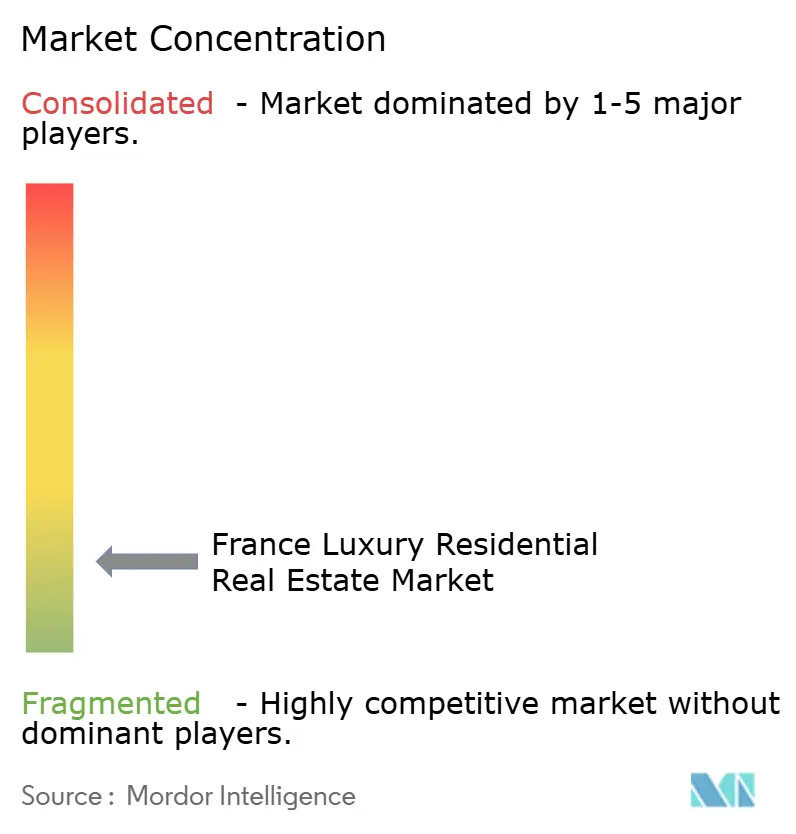
| Market Concentration | Low |
Major Players *Disclaimer: Major Players sorted in no particular order Image © Mordor Intelligence. Reuse requires attribution under CC BY 4.0. | |
France Luxury Residential Real Estate Market Analysis by Mordor Intelligence
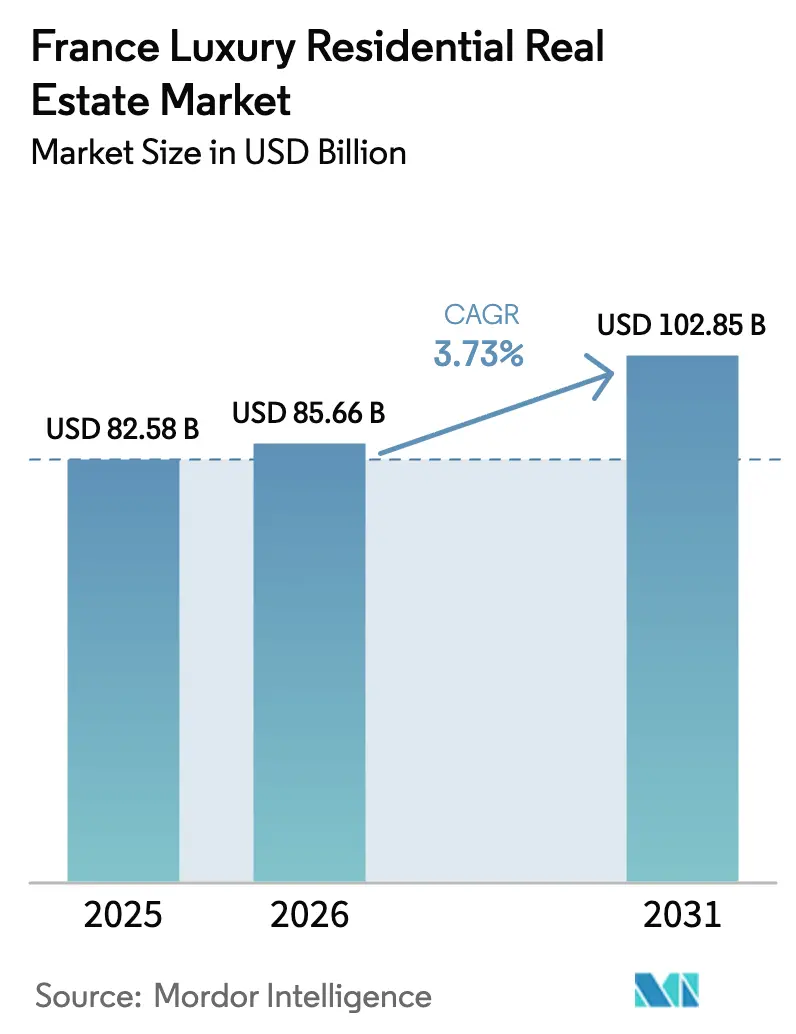
The France Luxury Residential Real Estate Market size was valued at USD 82.58 billion in 2025 and is estimated to grow from USD 85.66 billion in 2026 to reach USD 102.85 billion by 2031, at a CAGR of 3.73% during the forecast period (2026-2031).
Scarce ultra-prime inventory in Paris, the Riviera, and key Alpine resorts underpins price resilience, while rising wealth taxes, transaction costs, and energy-retrofit mandates curb short-term speculation. Rental demand is expanding more rapidly than sales as buyers deploy yield-seeking strategies in resort towns that sit outside Parisian short-let caps. A stable legal framework, deep cultural capital, and elite educational institutions sustain inflows from global high-net-worth households even when euro volatility erodes headline returns. Brokerage competition remains moderate because off-market sourcing and heritage expertise still outweigh scale-driven marketing efficiencies.
Key Report Takeaways
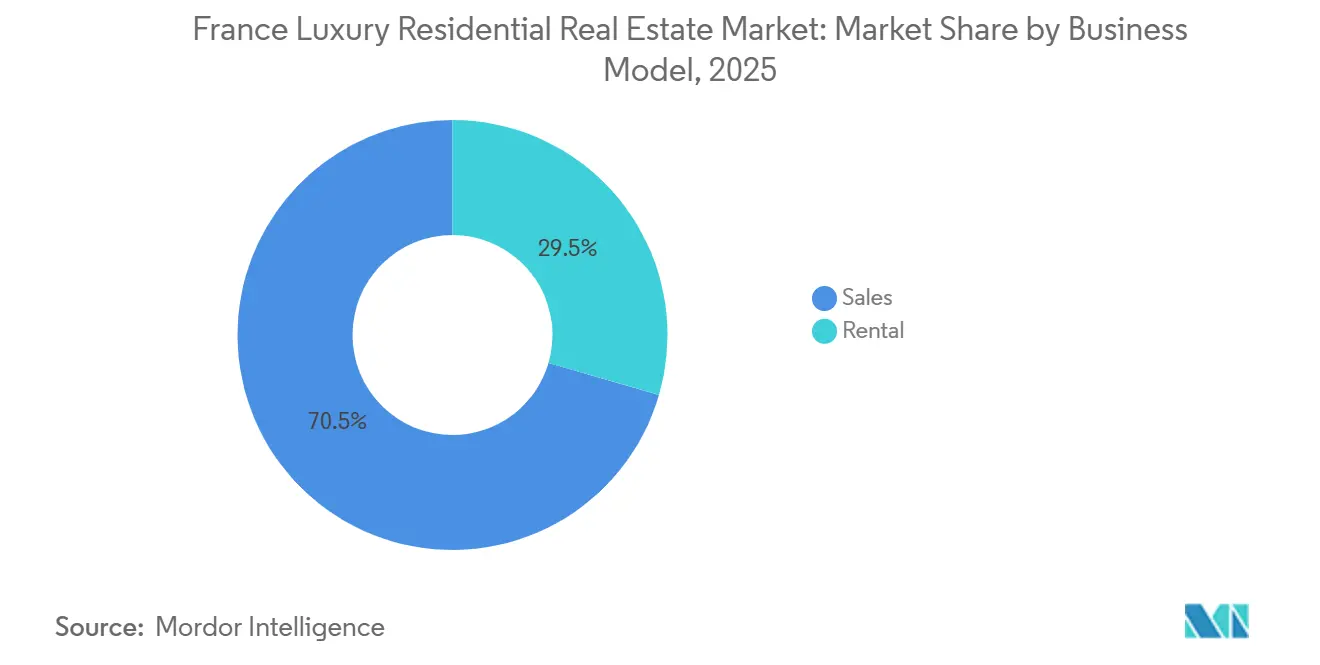
- By business model, sales transactions captured 71.2% of France luxury residential real estate market share in 2025; rental activity is projected to post a 4.80% CAGR through 2031.
- By property type, apartments accounted for 66.1% of France luxury residential real estate market size in 2025, while villas are forecast to grow at a 5.05% CAGR through 2031.
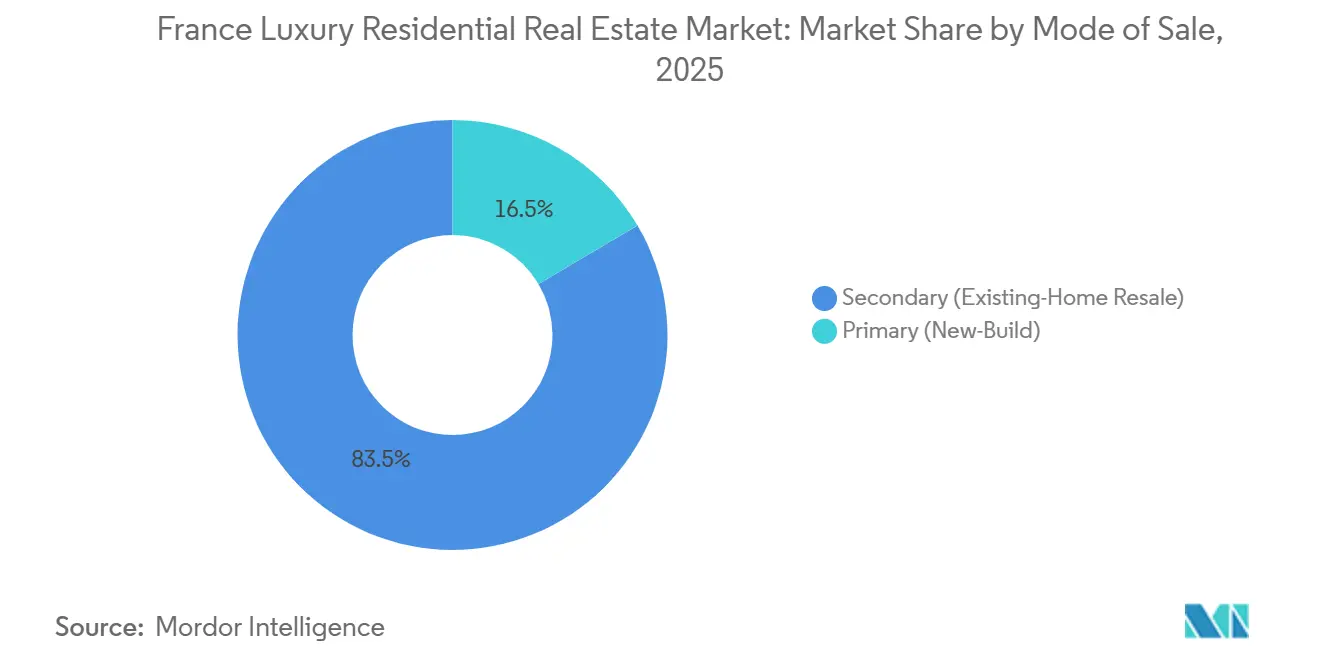
- By mode of sale, the secondary segment held 83.5% of France luxury residential real estate market share in 2025; primary supply is advancing at a 5.21% CAGR to 2031.
- By city, Paris retained 45.3% of France luxury residential real estate market size in 2025, whereas Marseille is expanding at the fastest 5.56% CAGR through 2031.
Note: Market size and forecast figures in this report are generated using Mordor Intelligence’s proprietary estimation framework, updated with the latest available data and insights as of January 2026.
France Luxury Residential Real Estate Market Trends and Insights
Drivers Impact Analysis*
| Drivers | (~) % IMPACT ON CAGR FORECAST | Geographic Relevance | Impact Timeline |
|---|---|---|---|
| Global HNW demand underpinned by rule-of-law and top schools | +1.0% | Paris, Lyon, Riviera gateway cities | Long term (≥ 4 years) |
| Extreme scarcity of ultra-prime assets in top arrondissements | +0.8% | Paris 1st, 6th, 7th, 8th, 16th; Neuilly-sur-Seine | Long term (≥ 4 years) |
| Riviera and Alpine second-home markets with rental upside | +0.6% | Provence-Alpes-Côte d’Azur; Courchevel, Val d’Isère, Megève | Medium term (2-4 years) |
| Periodic euro weakness that lifts USD/GBP purchasing power | +0.5% | National, strongest in Paris and Riviera | Short term (≤ 2 years) |
| Value-add premiums from heritage renovations and green upgrades | +0.4% | Paris historic districts, Lyon Presqu’île, Bordeaux | Medium term (2-4 years) |
| Source: Mordor Intelligence | |||
Extreme Scarcity of Ultra-Prime Assets in Paris Golden Triangle
Annual supply of apartments above 300 m² in Paris’s 1st, 6th, 7th, 8th, and 16th arrondissements has stayed below 50 units since 2024, creating a structural shortage that fuels double-digit bidding premiums.[1]“Paris Property Prices Hit Record High as Luxury Buyers Return,” Financial Times, ft.com Branded conversions such as Maybourne Riviera illustrate the valuation gap, with 2024 launch prices near USD 58,300 per m², almost twice nearby non-branded stock. Heritage-protection rules prohibit demolition and vertical expansion, permanently capping new inventory. Knight Frank ranked Paris fourth worldwide for ultra-high-net-worth density, yet logged a 12% drop in EUR 10 million-plus trades in 2025 as scarcity outpaced liquidity. Sellers able to wait for the right match now achieve sub-60-day closings, while secondary stock lingers several months longer, reinforcing the scarcity premium.
Global HNW Demand Anchored by Rule-of-Law, Culture, and Schools
France’s clear property title regime, absence of capital controls, and concentration of elite schools keep it at the top of relocation shortlists for American, Gulf, and Asian families. Notarial data show 8% average price growth in 2025 around the Musée d’Orsay and Opéra Garnier catchments as remote-work professionals sought cultural proximity[2]Chambre des Notaires de Paris, “Notarial Real Estate Statistics 2025,” notaires.fr . GCC buyer volume rose 15% during the year despite tougher European AML checks. Post-Olympics branding in 2024 raised Paris’s global visibility, but the enduring magnet remains eurozone legal certainty and European Court of Justice oversight. Institutional landlords accept 2-3% gross yields because wealth preservation, rather than income, drives allocations at the top end.
Riviera and Alpine Second-Home Markets with Rental Upside
Lifestyle migration and yield-seeking capital are increasingly directed toward Côte d’Azur villas and Alpine chalets. Courchevel’s 2024-25 season closed at USD 33,500 per m², while fractional-ownership models generated 4-6% gross yields during peak weeks[3]“Courchevel Ski Property Prices Surge 12% Year-on-Year,” Les Echos, lesechos.fr . The extended Loi Montagne now restricts new Alpine construction, making renovation the only path to fresh supply and embedding scarcity into future pricing. Saint-Tropez and Cannes benefit from year-round tourism and the absence of Paris’s 120-day short-let limit, letting owners defray carrying costs through Airbnb Luxe. Savills found French Alpine resorts outperformed Swiss and Austrian peers on 2025 price appreciation, a trend supported by EUR 106 billion of recovery-plan infrastructure upgrades.
Euro Weakness Boosts USD/GBP Purchasing Power
The euro’s slide to parity in mid-2024 discounted French luxury assets by 14% in dollar terms, spurring 38% of American clients surveyed by Knight Frank to accelerate Paris closings. Sterling strength also lifted British participation on the Riviera by nine percentage points year-over-year. While the euro rebounded to USD 1.06 in early 2026, monetary-policy divergence suggests further softness if U.S. rate cuts outpace the ECB. Yet buyers still face 7-8% deal fees that require at least 18 months’ hold to break even, tempering speculative flips.
Restraints Impact Analysis*
| Restraints | (~) % IMPACT ON CAGR FORECAST | Geographic Relevance | Impact Timeline |
|---|---|---|---|
| High transaction and ownership taxes (IFI and levies) | −0.9% | National, strongest in Paris and Riviera ultra-prime markets | Long term (≥ 4 years) |
| Strict planning rules and energy mandates that lift capex | −0.7% | Paris historic districts, Lyon, Bordeaux, Provence classified communes | Medium term (2-4 years) |
| Tighter financing, AML checks, and thin liquidity at top end | −0.5% | National, concentrated in deals above USD 5.3 million | Short term (≤ 2 years) |
| Source: Mordor Intelligence | |||
High Transaction and Ownership Taxes Erode Net Returns
The Impôt sur la Fortune Immobilière imposes a 0.5-1% annual tax on net real-estate wealth above USD 1.38 million, shrinking income streams for non-resident landlords. Buyers also pay 7-8% in notary, registration, and agent fees, equating to USD 371,000-424,000 in upfront costs on a USD 5.3 million Paris purchase. These frictions compress already thin 2-3% gross yields, steering yield-focused capital toward equities or credit markets instead. Senate proposals to ease thresholds stalled in 2025, keeping the levy an enduring drag on market velocity and France luxury residential real estate market growth.
Strict Planning Rules and Energy Mandates Raise Capex and Timelines
Any façade change or roof extension in protected quarters needs approval from the Architectes des Bâtiments de France, with a permit lasting as long as 24 months. Retrofit obligations ban leasing of G-rated homes from 2025 and F-rated from 2028, forcing USD 31,800-106,000 retrofits per unit. Owners of monuments historiques must hire certified artisans, potentially tripling renovation budgets. Unrenovated stock trades at 15-20% discounts, while B-rated assets achieve quick sales at premium prices. Consequently, some investors pivot to new-build projects outside strict heritage zones, shifting capital away from the densest parts of Paris.
*Our forecasts treat driver/restraint impacts as directional, not additive. The impact forecasts reflect baseline growth, mix effects, and variable interactions.
Segment Analysis
By Business Model: Sales Dominance Prevails, but Rental Accelerates
Sales accounted for 71.2% of France's luxury residential real estate market share in 2025, underscoring the continued dominance of trophy acquisitions for long-term wealth preservation. Owner-occupiers and family offices remain the core buyers, while international investors target secondary-market heritage assets that can be held across generations. Despite this dominance, rental income strategies gain traction in Riviera and Alpine resorts, where short-let regulations are more permissive than in Paris. Institutional vehicles, including insurers and REITs, increasingly view turnkey villas as inflation-hedged alternatives to bonds, raising allocations to the rental pool.
Rental revenue is forecast to expand at a 4.80% CAGR through 2031, outpacing overall market growth. Corporate relocation programs and France’s 2024 green-industry tax incentives lift demand for furnished executive housing in Lyon, Marseille, and Toulouse. Branded-residence operators structure fractional-ownership models that guarantee 50-60% of gross rental to owners, blending lifestyle access with predictable cash flow. This hybrid approach blurs the historic divide between sale and lease strategies, further embedding rental economics into acquisition decisions.


By Property Type: Apartments Lead, Villas Win Growth
Apartments held 66.1% of France luxury residential real estate market size in 2025. Parisian Haussmannian stock, defined by high ceilings, parquet floors, and wrought-iron balconies, remains the global benchmark, attracting diplomats and families needing proximity to international schools. Duplexes above 200 m² in the 7th and 16th arrondissements trade at USD 21,200-26,500 per m², a level few buyers resist because true alternatives are scarce.
Villas are projected to record the fastest 5.05% CAGR through 2031 as remote work and lifestyle migration highlight the value of outdoor space. Côte d’Azur houses within 10 minutes of the shoreline averaged USD 12,700-19,100 per m² in 2025, while Provence bastides with vineyard parcels generate 3-4% seasonal yields. Branded-service packages, including concierge and asset management, lower operational barriers for foreign owners and further encourage villa acquisitions over large urban apartments.
By Mode of Sale: Secondary Resales Command, Primary Supply Gains Pace
Secondary stock represented 83.5% of France luxury residential real estate market share in 2025 because buyers trust proven construction quality and appreciate immediate occupancy in heritage districts. Average turnover for USD 5.3 million properties is 18-24 months, reflecting cautious liquidity at the top end. Buyers prize original moldings and fireplaces that cannot be replicated in new projects, maintaining firm price resistance when authentic details are absent.
Primary transactions are forecast to expand at a 5.21% CAGR, the fastest within this segmentation. Developers retrofit industrial sites and waterfront parcels into energy-compliant residences bundled with hotel-grade services. Branded projects such as Peninsula Paris command 30-40% premiums by eliminating renovation risk and providing turnkey compliance with energy rules. In Lyon and Marseille, new-build pricing sits 20-25% below Paris equivalents, courting entrepreneurs priced out of the capital yet wanting urban convenience.
Geography Analysis
Paris remains the anchor, but its 45.3% share stabilizes rather than expands because extreme scarcity in the EUR 10 million-plus bracket dampens transaction counts when euro strength briefly compresses USD purchasing power. Prime arrondissements posted USD 21,200-31,800 per m² averages in 2025, and trophy listings exceeding USD 53,000 per m² still clear within 60 days, underscoring enduring safe-haven appeal even as IFI liabilities discourage pure yield hunters. North American buyers, benefiting from favorable exchange rates, added 11 percentage points to their Paris presence in 2025.
Lyon’s share inches upward thanks to 4-5% rental yields that double Paris norms. Presqu’île apartments at USD 5,300-7,420 per m² offer 60-70% discounts to twin-size Paris equivalents, attracting biotech executives aligned with Sanofi and bioMérieux expansions. Marseille grows the fastest at 5.56% CAGR as the USD 1.59 billion port and transport overhaul tightens links to Aix-en-Provence and Cassis, catalyzing tech-sector relocations into Euroméditerranée offices. Waterfront lofts at USD 8,480-12,720 per m² remain half Côte d’Azur pricing, positioning the city as the relative-value outlier.
Beyond the big three, Bordeaux leverages UNESCO-listed heritage and nearby vineyards to sustain USD 6,360-9,540 per m² tags in the Triangle d’Or. Toulouse feeds off Airbus-anchored aerospace growth, while rural Provence and the Alpine arc absorb lifestyle-driven inflows seeking land, privacy, and seasonal rental income. Overall, capital flows diversify geographically as buyers weigh Paris’s scarcity premium against easier regulation, higher yields, and lifestyle perks in secondary hubs.
Regulatory Landscape
France luxury residential transactions operate under a formal, notary-led conveyancing framework. Policy actions in 2025-2026 targeted faster delivery of housing and tighter use of existing stock. Law No. 2025-1129 of November 26, 2025 (the Huwart Law) simplified elements of urban planning and housing law to streamline development processes, and on June 24, 2026 the Council of Ministers presented a Relance Logement draft bill focused on accelerating housing production and decentralizing housing policy.
On the fiscal and compliance side, ownership and holding costs remain anchored by the Impot sur la Fortune Immobiliere (IFI), applied to net real-estate wealth above EUR 1.3 million, and administrative reporting requirements via the Gerer mes biens immobiliers service on impots.gouv.fr (annual declaration of occupancy status when changes occur). The energy-performance framework continues to shape leasing decisions, with rental restrictions already in force for the worst-rated homes and further step-downs scheduled. For legacy luxury stock, this keeps DPE-led capex planning at the center of underwriting and holding strategies.
Value Chain Analysis
The luxury residential value chain in France starts with land and asset sourcing, including off-market networks in prime Paris, the Riviera, and Alpine resorts. After that, luxury brokerages handle valuation and intermediation, and then the regulated transaction process is executed through notaries for deed execution and registration, which commonly takes 3-4 months. For primary product and heavy renovations, developers, architects, and contractors coordinate planning approvals and environmental compliance.
Heritage work relies on specialized craftspeople and bespoke materials, which can create single-source dependencies and cost volatility, as when components such as Italian marble and Belgian limestone are imported. After acquisition, the chain extends into refurbishment, energy diagnostics and retrofit delivery, property management, and rental commercialization, including furnished executive lets and resort short-lets where permitted. Regulation-driven inputs increasingly shape cost and timelines: RE2020 applies to new construction, and Decret No. 2026-200 of March 18, 2026 modified environmental performance requirements for new buildings in metropolitan France. That raises the weight of compliant design, material choices, and documentation in project planning. On the demand and funding side, self-financed buyers provide structural support, but broader market liquidity affects listing velocity and pricing discovery, as tracked through FNAIM transaction volumes and changes in mortgage-rate conditions in 2026.
Competitive Landscape
France luxury residential real estate market competition stays fragmented, with no player crossing even a 5% national share. Global franchises—Sotheby’s International Realty, Christie’s International Real Estate, Knight Frank, and Engel & Völkers—use cross-border databases to funnel overseas demand into Paris, the Riviera, and ski resorts. Regional specialists such as Barnes, Daniel Feau, and Emile Garcin counter with hyper-local knowledge and off-market access, retaining high-net-worth loyalty for discreet trophy transactions. Roughly 60% of deals above USD 10 million still close off-portal to protect seller privacy.
Strategic positioning now pivots on energy-retrofit advisory, compliance expertise, and technology adoption. Knight Frank opened a heritage-retrofit desk in 2025, cutting approval times by 20% through Compagnons du Devoir partnerships. Sotheby’s acquired 40% of Junot Immobilier to deepen its reach into Paris’s Marais and Left Bank micro-markets. Engel & Völkers formed a joint marketing partnership with Le Figaro to combine international reach with domestic credibility, strengthening Riviera and Alpine funnel efficiency.
Technology investment escalates as agencies implement AI-driven matching and virtual staging. LuxuryEstate’s 2024 tool reduced time-on-market for renovation-heavy listings by 15%. Barnes opened a Marseille branch in 2024 to ride the city’s outsized 5.56% CAGR, exemplifying the geographic diversification strategy. Compliance workloads under Tracfin’s AML rules favor firms able to absorb overhead, tilting share toward larger networks even as boutique expertise remains critical at the ultra-prime end.
France Luxury Residential Real Estate Industry Leaders
Sotheby’s International Realty Affiliates LLC
Daniel Feau
Barnes International Realty
John Taylor
Propriétés Le Figaro
- *Disclaimer: Major Players sorted in no particular order

Market Opportunities and Future Outlook
Energy-driven repositioning is a key whitespace in the luxury stock market, especially for older Parisian and heritage assets where DPE constraints affect both leaseability and resale discounts. The existing spread between compliant, energy-efficient homes and penalized stock supports a service opportunity across energy audits, retrofit project management, and turnkey delivery for foreign owners. This demand is reinforced as leasing restrictions for low-rated homes tighten and capital works in protected zones face longer approval cycles.
Geographic rebalancing also creates room for brokers, developers, and operators that can bundle high-compliance product with concierge-grade management outside Paris. Evidence of shifting activity includes reporting that the Atlantic coast and the French Riviera each represented 15% of prestige transaction value in 2025, compared with 14% for Paris, alongside broader 2026 cooling in residential investment (EUR 421 million in Q2 2026). That pattern favors well-capitalized, self-financed buyers and asset managers who can transact without relying on bank credit. Urban policy moves further support professionally managed rental strategies, including the Paris City Council vote on July 18, 2026 to double taxes on vacant homes, effective January 1, 2027, which pushes owners toward income-generating occupancy models and tighter asset-management discipline.
Recent Industry Developments
- June 2026: BARNES opened an office in Bridgehampton, New York, expanding its Hamptons footprint within its global luxury network. The move strengthens outbound and inbound client routing for French buyers and sellers by linking a major lifestyle market to Paris, the Riviera, and Alpine destinations. Cross-market sourcing can increase liquidity for trophy assets that frequently trade through international relationships rather than portals.
- January 2026: Sotheby’s International Realty France-Monaco published its 2025 results, reporting nearly EUR 2 billion in sales volume and around 970 transactions, up sharply versus 2024. The disclosure highlighted continued depth of demand at the high end despite broader housing-market volatility, supporting investment in premium advisory, off-market access, and compliance-led services. It also reinforced the competitive advantage of global buyer funnels in ultra-prime deals.
- November 2024: Sotheby’s International Realty expanded its Paris coverage by entering a strategic partnership with Junot Immobilier to deepen coverage in Paris micro-markets including the Marais and Left Bank. This collaboration broadened inventory access and supported discreet off-portal transactions. The partnership also strengthened competitive dynamics by combining international reach with hyper-local sourcing.


Research Methodology Framework and Report Scope
Market Definition and Coverage
This market covers the transaction and rental value generated from luxury residential properties in France, where homes are positioned at the high end due to location, build quality, design, and premium amenities. It includes luxury apartments and condominiums, villas and landed houses, and similar high value residences.
Scope exclusions: It excludes mass market residential housing, social housing, and commercial real estate assets.
Segmentation Overview
- By Business Model
- Sales
- Rental
Data Sources, Market Sizing, and Validation
Desk Research
Desk research was used to set the outer boundary of the luxury housing demand pool and to build realistic guardrails around prices and activity levels. We reviewed public statistics and reference series such as INSEE demographic and household data, Banque de France credit conditions, and Notaires de France price indices to check directionality in premium home values.
To avoid relying on any single indicator, we cross-checked transaction and construction signals using sources such as Eurostat housing and macro tables, French ministry publications on housing and permits, and land registry style market releases where available. These were complemented with annual reports, investor presentations, and reputable press coverage from brokers and developers. For company financial benchmarking and tracking deal and project news, we also used a paid subscription focused on company financials and news intelligence. The sources listed here are illustrative, and many other public references were used for collection, validation, and clarification during the work.
Primary Interviews and Surveys
Primary discussions were run with a mix of agencies, luxury brokers, developers, property managers, and market advisers, and then checked with buyerside voices such as family offices and wealth managers who see real search and purchase behavior. These inputs were used to confirm what qualifies as luxury in practice, how prime versus secondary locations differ, and how rental yields and transaction discounts shift across cycles, tightening the model assumptions.
Distribution of primary research fieldwork respondents
| Company type | Respondent position |
|---|---|
| Top tier: 28% | CXOs: 13% |
| Mid tier: 55% | Functional/Unit leaders: 27% |
| Smaller Players: 17% | Managers: 60% |
Market-Sizing & Forecasting
Sizing was built using a top-down and bottom-up approach, where national housing activity and price benchmarks are first reconstructed into a luxury-only value pool through penetration and price-premium factors that were validated by interviews. Once the luxury demand pool is formed, it is split across sales versus rental activity and then aligned to new-build versus resale behavior based on how inventory actually turns over.
Key inputs used in the model include prime location share (Paris and other major cities versus the rest of the country), luxury price premiums over mainstream indices, transaction volumes in high value brackets (as indicated by market practitioners), mortgage availability and cash-buyer share, and new permit and completion trends that affect high-end supply. Because consistent monthly luxury-specific series can be patchy, gaps are handled through proxy indicators (like city-level price indices and permit data) and then adjusted using primary feedback on how luxury reacts differently than the broader market.
For forecasting, scenario analysis was applied and anchored to macro drivers that matter most for high-end housing, including interest rate direction, wealth effects, foreign buyer appetite, and pipeline delivery timing. Assumptions were then reconciled with bottom-up checks such as sampled price per square meter ranges times typical prime transaction counts, plus channel checks on rental absorption, so the totals stay realistic.
Data Validation & Update Cycle
Outputs are validated by comparing the modeled market value against independent signals, such as premium home price indices, changes in permit activity for upscale developments, and shifts in mortgage and cash purchase conditions. If a metric moves in a way that does not match the model direction, the drivers are reopened and we re-check interview notes to confirm whether the change is structural or temporary.
Before sign-off, the estimates go through variance checks across years, city splits, and business model splits, followed by a second analyst review to catch outliers and inconsistent assumptions. The report is refreshed annually, and interim updates are triggered when material events occur, such as major rate shocks, policy changes that affect property taxation, or a sudden change in foreign demand. Before delivery, we do a final refresh pass so clients receive the most current view that can be supported by traceable inputs.
Mordor Intelligence's France Luxury Residential Real Estate Market Size Compared Against Other Published Estimates
Published market sizes for luxury housing in France can vary widely, even when the studies are trying to describe the same broad theme. The differences usually come from how luxury is defined, whether sales only or sales plus rentals are counted, and how the conversion from local prices into USD is timed.
The benchmark table shows a spread that is largely explained by scope and value mechanics, since some estimates fold in upper-mid residential homes or include developer pipeline value before it becomes completed stock. In Mordor Intelligence's model, the market is limited to luxury residential real estate in France (including high-end apartments/condominiums and villas/landed houses) and it is counted across sales and rental business models, which changes the total when other figures focus on sales only.
Benchmark comparison
| Source | Market Size | Gaps in Research Methodology |
|---|---|---|
| Mordor Intelligence | USD 82.58 B (2025) | |
| Industry Association A | USD 74.20 B (2025) | Often undercounts rental value and relies more heavily on registered transaction totals, which can miss high-end off-market activity and uses narrower city coverage. |
| Global Consultancy B | USD 96.40 B (2025) | Commonly broadens the luxury boundary into upper-premium residential and may apply higher price-premium uplifts across all major cities without enough adjustment for resale mix and discounting. |
Looking across the three figures, the practical takeaway is that the size moves mainly with what is treated as luxury and how sales and rental value are combined. Our approach keeps assumptions tied to observable housing signals and interview-tested premiums, so the final number can be explained and recreated with clear steps.


Key Questions Answered in the Report
How large is the France luxury residential real estate market in 2026?
The market is valued at USD 85.66 billion in 2026 and is heading toward USD 102.85 billion by 2031 at a 3.73% CAGR.
Which French city shows the fastest luxury-property growth through 2031?
Marseille leads with a projected 5.56% CAGR, thanks to port upgrades and a burgeoning technology hub.
Why are rental strategies gaining traction in French luxury housing?
Rental revenue is projected to grow 4.80% annually as resort areas allow flexible short-lets and branded residences guarantee pooled income.
What tax costs most affect foreign buyers of French luxury homes?
The Impôt sur la Fortune Immobilière levies 0.5-1% annually on net real-estate wealth over USD 1.38 million, in addition to 7-8% upfront transaction fees.
How does energy regulation impact property values?
Homes upgraded to Diagnostic de performance énergétique (DPE) B or C ratings command 12-15% premiums and qualify for cheaper green mortgages, while lower-rated stock faces rental bans.
Page last updated on:





