
Flow Battery Market Size and Share
Market Overview
| Study Period | 2021 - 2031 |
|---|---|
| Market Size (2026) | USD 1.39 Billion |
| Market Size (2031) | USD 3.88 Billion |
| Growth Rate (2026 - 2031) | 22.84 % |
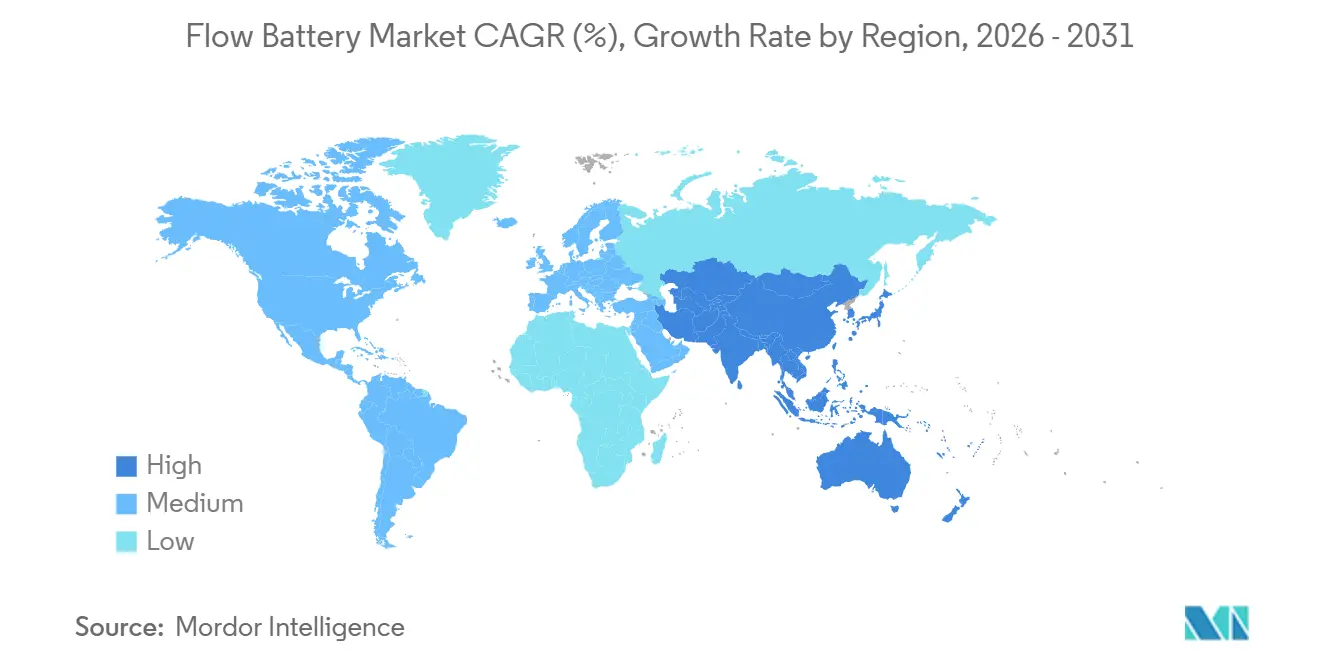
| Fastest Growing Market | North America |
| Largest Market | Asia Pacific |
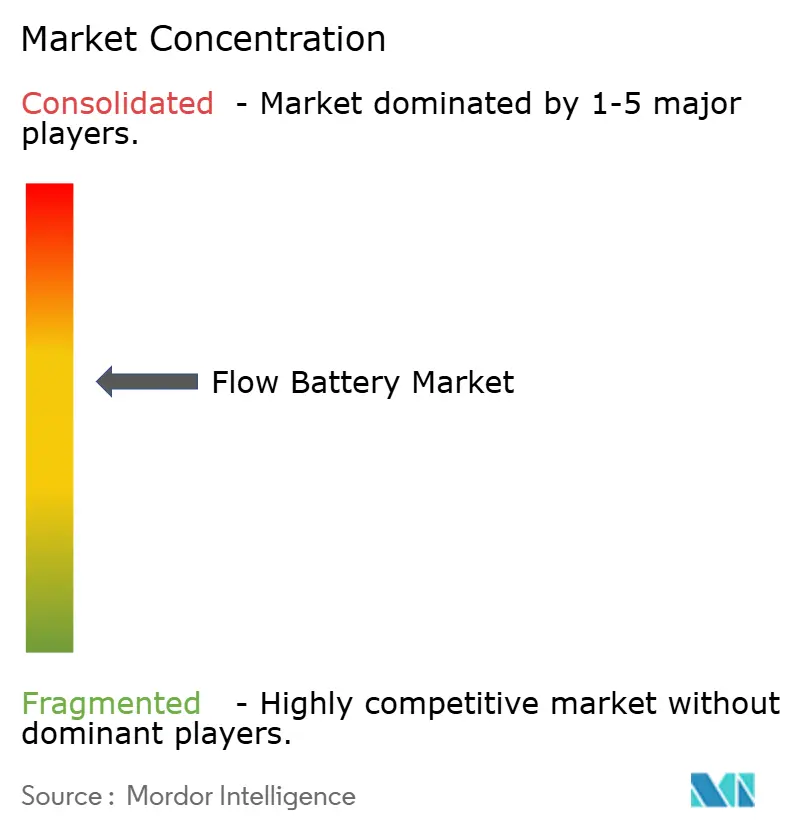
| Market Concentration | Medium |
Major Players *Disclaimer: Major Players sorted in no particular order Image © Mordor Intelligence. Reuse requires attribution under CC BY 4.0. | |
Flow Battery Market Analysis by Mordor Intelligence
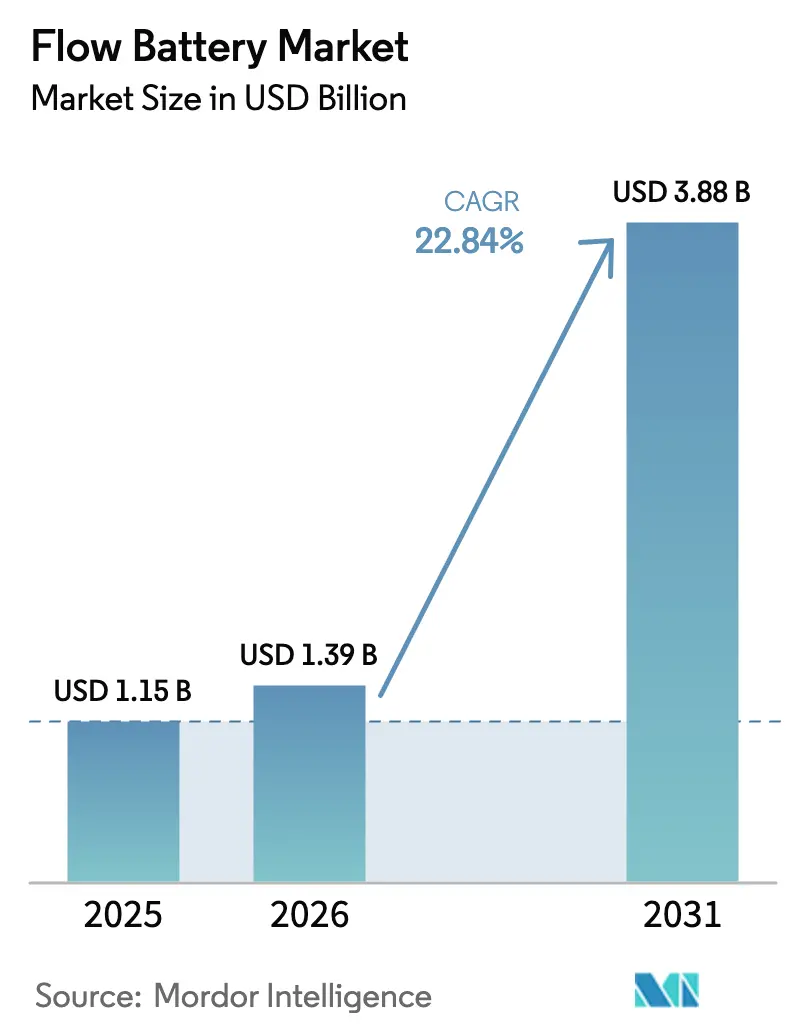
The Flow Battery Market size is expected to increase from USD 1.15 billion in 2025 to USD 1.39 billion in 2026 and reach USD 3.88 billion by 2031, growing at a CAGR of 22.84% over 2026-2031.
Surging renewable generation, mandates for eight-hour discharge capability, and declining electrolyte leasing costs are accelerating procurement. Utilities in California, China, and Germany currently specify 6-12 hour storage windows, a span that fixed-ratio lithium-ion cannot meet at competitive cost. Chinese manufacturers have widened price advantages through vertical integration that delivers electrolyte at RMB 180-220 per kg, undercutting Western vendors by 30-40% on turnkey systems. North America’s Inflation Reduction Act is spurring a wave of tax-advantaged projects, while new IEC and IEEE performance standards are removing certification friction for financiers. Corporate decarbonization goals, together with demand-charge arbitrage, extend addressable opportunities beyond the grid to commercial and industrial buyers that prize modularity, safety, and unlimited cycling capability.
Key Report Takeaways
- By battery type, vanadium redox held 80.2% revenue share in 2025; zinc-bromine is forecast to expand at a 25.1% CAGR through 2031.
- By system size, large-scale installations above 10 MWh captured 61.8% of 2025 revenue; small-scale units under 1 MWh are projected to advance at a 28.9% CAGR to 2031.
- By application, grid-peaking accounted for 52.5% of 2025 demand and is growing at a 22.3% CAGR; microgrids will pace the sector at a 27.5% CAGR through 2031.
- By end-user, utilities commanded a 50.9% share of the flow battery market size in 2025; commercial and industrial deployments are climbing at a 24.7% CAGR.
- By geography, Asia-Pacific led with 44.7% 2025 revenue, while North America is the fastest-growing region at 25.6% CAGR through 2031.
- Dalian Rongke Power, ESS Tech, Invinity Energy Systems, Sumitomo Electric, and VRB Energy collectively controlled close to 60% of installed capacity in 2025, with no single player above 25% share.
Note: Market size and forecast figures in this report are generated using Mordor Intelligence’s proprietary estimation framework, updated with the latest available data and insights as of January 2026.
Market Trends and Insights
Drivers Impact Analysis of Flow Battery Market*
| Driver | (~) % Impact on CAGR Forecast | Geographic Relevance | Impact Timeline |
|---|---|---|---|
| Renewables-driven long-duration storage demand | 6.50% | China, California, Germany, Australia | Medium term (2-4 years) |
| Falling electrolyte leasing costs | 4.20% | China core, North America and Europe emerging | Short term (≤2 years) |
| Stack manufacturing and membrane advances | 3.80% | Japan, Germany, China | Medium term (2-4 years) |
| China electrolyte capacity scale-up | 3.10% | APAC core, global spillover | Short term (≤2 years) |
| Utility resilience and regulatory mandates | 2.90% | North America, Europe | Medium term (2-4 years) |
| Source: Mordor Intelligence | |||
Renewables-Driven Long-Duration Storage Demand
Curtailment of wind and solar reached 8.3% of renewable generation in China’s northwest during 2024, costing operators USD 2.1 billion in lost revenue.[1] Provincial rules now call for 6-12-hour storage, an interval that the flow battery market fulfills economically through decoupled power and energy ratings.[2] California’s 11.5 GW long-duration target by 2032 prioritizes technologies with eight-plus hour discharge, effectively excluding most lithium-ion systems. Australia’s Yadlamalka Energy project and Germany’s negative-pricing events showcase arbitrage earnings when round-trip degradation is negligible.
Falling Electrolyte Leasing Costs (New Model)
Panzhihua’s 100 MW/500 MWh project pioneered electrolyte leasing that trimmed upfront capital 35-40%, replacing lump-sum vanadium purchase with USD 0.015 per kWh monthly fees. Largo Clean Energy’s VPURE+ now offers 20-year performance guarantees and end-of-life buyback in North America and Europe, mirroring solar power-purchase constructs. Lease accounting recasts electrolyte as an operating expense, raising internal rates of return by up to 300 basis points for utilities. South Africa’s Bushveld Minerals is porting the model to mining microgrids across sub-Saharan Africa.
Stack Manufacturing And Membrane Advances
Sumitomo’s third-generation bipolar plates, deployed at Kashiwazaki in 2024, cut internal resistance by 18% and lifted efficiency to 82%. Hydrocarbon membranes under development by Jena Batteries and VoltStorage demonstrate 30,000-plus cycles in tests, extending system life toward 25 years. Dalian Rongke’s standardized 250 kW modules reduce site work 40% by enabling plug-and-play stacking for multi-megawatt arrays. The shift away from perfluorinated membranes also anticipates emerging PFAS restrictions under the EU REACH framework. IEEE 1679.3 now offers buyers a unified performance test regime, cutting diligence costs.
China's Electrolyte Capacity Scale-Up
Vanadium pentoxide output climbed 22% in 2024 to 140,000 t/y as new mines in Panzhihua and Chengde ramped, delivering electrolyte at USD 25-31/kg versus USD 40-50/kg on Western spot markets. State-owned Pangang Group is stockpiling electrolyte as a strategic reserve, insulating domestic projects from volatility. Closed-loop recovery infrastructure enhances recyclability and reduces lifecycle costs, a competitive advantage spotlighted by the World Bank’s 2024 circular economy report. Rumored export controls on battery-grade vanadium could push Western developers to source from Australia, South Africa, or Canada.
Restraints Impact Analysis of Flow Battery Market*
| Restraint | (~) % Impact on CAGR Forecast | Geographic Relevance | Impact Timeline |
|---|---|---|---|
| High upfront CAPEX & vanadium price volatility | -3.7% | Global, acute in North America and Europe | Short term (≤ 2 years) |
| Low energy density vs. Li-ion | -2.4% | Global, limiting C&I and residential adoption | Long term (≥ 4 years) |
| Lack of global standards / installer base | -1.8% | North America, Europe, emerging markets (India, Southeast Asia, MEA) | Medium term (2-4 years) |
| Permitting complexities for large electrolyte tanks | -1.5% | North America, Europe; less acute in China | Short term (≤ 2 years) |
| Source: Mordor Intelligence | |||
High Upfront CAPEX & Vanadium Price Volatility
Turnkey vanadium redox systems averaged USD 600-750 per kWh for sub-10 MWh projects in 2025. Vanadium prices rose 15% in 2024, lifting levelized costs 3-4% when electrolyte represents 30-40% of spend. The United States imports 95% of its vanadium, exposing developers to tariff and disruption risk. Lease models mitigate upfront outlay yet narrow arbitrage margins in markets with limited peak-to-off-peak spreads.
Low Energy Density Versus Lithium-Ion
Flow batteries provide 20-40 Wh/kg, one-fifth that of lithium-ion, and occupy 150-200 m² for 1 MWh, restricting rooftop or basement siting. Transportation costs are 40-60% higher per kWh because of electrolyte mass. A 10 kWh residential system would weigh 400-500 kg, deterring single-family adoption. Zinc-bromine delivers 50-60 Wh/kg but faces corrosion trade-offs that cap cycle life at 10,000-15,000 cycles.
*Our forecasts treat driver/restraint impacts as directional, not additive. The impact forecasts reflect baseline growth, mix effects, and variable interactions.
Flow Battery Market Segment Analysis
By Battery Type:
Vanadium Redox Dominates, Zinc-Bromine Gains TractionVanadium redox captured 80.2% of 2025 revenue on the back of a proven 20,000-cycle life and China’s supply-chain control, positioning it as the anchor chemistry of the flow battery market.[3] Zinc-bromine systems are projected to grow 25.1% CAGR through 2031, owing to one-third electrolyte cost versus vanadium and simpler permitting regimes, which help them penetrate the commercial and industrial flow battery market share at 12% by 2031. Iron flow chemistry commands growing mindshare after ESS Tech delivered 75 MWh to Sacramento; its non-toxic electrolyte appeals in dense urban settings. Zinc-iron and all-iron remain pilot-scale due to corrosion and low efficiency, holding less than 1% revenue.
China’s vertically integrated mines, electrolyte plants, and module factories drive utility-scale vanadium costs below USD 300 per kWh, enabling 20-year warranties that protect flow battery market size economics. Zinc-bromine uptake is notable in Australia and Germany, where C&I users adopt modular 50-200 kWh racks that fit transformer yards without fire-suppression retrofits. Iron flow contenders aim to win U.S. federal grants that prioritize domestic mineral content.
By System Size:
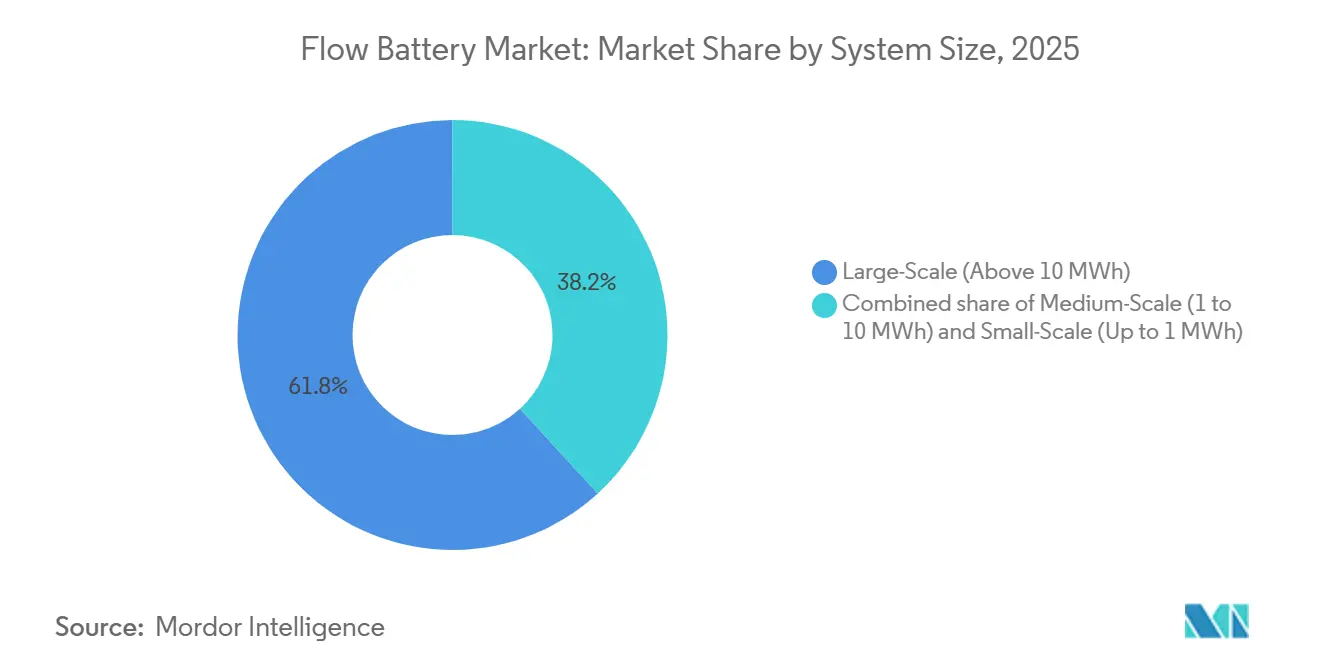
Utility-Scale Leads, Small-Scale SurgesInstallations above 10 MWh held 61.8% of revenue in 2025 as utilities centralize long-duration assets across multiple substations, yielding flow battery market size advantages via economies of scale.[4] Small-scale units, while only 8% of 2025 megawatt-hours, are set to expand 28.9% CAGR on microgrid adoption in islands and remote mines. Medium 1-10 MWh systems target demand-charge mitigation, but lithium-ion competition is intense where space premiums are high.
Cost curves favor big footprints. Dalian Rongke’s 200 MW/800 MWh Ordos site achieved sub-USD 300 per kWh by using steel tanks taller than 15 m, whereas microgrid developers value modular containerized units under 1 MWh despite higher USD 550-600 per kWh tags. California schools and data centers are piloting 2-4 MWh systems that shave peaks to cut USD 20-30 per kW demand charges. Small-scale sales will remain a minority of the flow battery market share to 2031, yet supply critical proof points for residential viability.

By Application:
Grid-Peaking Dominates, Microgrids AccelerateGrid-peaking and load-shifting locked in 52.5% of 2025 demand, exploiting 5-10x intraday price spreads and deferring gas peaker upgrades in California and China. Microgrids should post a 27.5% CAGR through 2031 as mines, islands, and military bases chase diesel displacement and multi-day autonomy. Renewable firming rounds out demand, aligning growth with wind and solar pipelines in Asia and the Middle East.
Flow batteries enable capacity deferral by time-shifting solar from midday to evening peaks when wholesale rates triple. In the Northern Territory, diesel prices above USD 2 per L make 20-year vanadium systems paired with PV achieve sub-USD 0.20 per kWh levelized costs. Chinese provinces with double-digit wind curtailment are contracting flow batteries for renewable portfolio compliance.
By End-User:
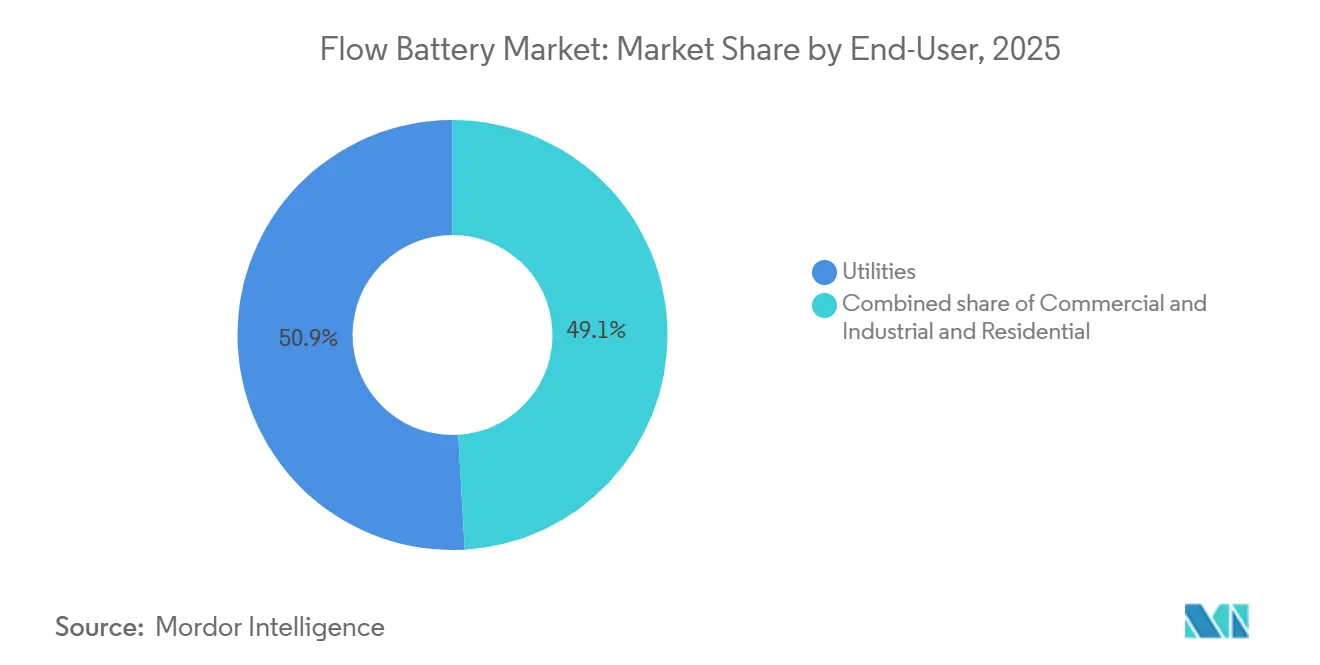
Utilities Lead, C&I AcceleratesUtilities generated 50.9% of 2025 revenue, driven by policy mandates and grid-modernization budgets, locking in long tenor power-purchase agreements that underpin bankability. Commercial and industrial buyers are on track to reach 35% share by 2031, spurred by demand-charge savings and ESG targets. Residential remains experimental, constrained by weight and footprint, but iron-salt pilots in Germany hint at a future niche.
California IOUs have already signed for 400-plus MWh of vanadium projects to meet 2026 targets. German manufacturing plants are installing 1-5 MWh zinc-bromine units to shave 15-25% of peak load, while data centers secure 20-year iron flow warranties that cut backup diesel runtime. Residential traction depends on shrinking system footprints below 2×2 m and hitting sub-EUR 10,000 installed price points.
Geography Analysis
APAC Flow Battery Market
Asia-Pacific led the flow battery market with 44.7% revenue in 2025 because China commissioned over 2 GWh of capacity and commands 70% of global vanadium output. Provincial mandates pairing 10-20% of renewable nameplate with storage created a captive buyer base, though February 2025 policy changes may temper speculative builds. Japan’s Kashiwazaki project underscores renewed interest as nuclear retirements tighten reserve margins.
North America Flow Battery Market
North America is the fastest-growing region at 25.6% CAGR thanks to the Inflation Reduction Act’s 30-50% investment tax credit and DOE demonstration grants. California utilities have queued over 300 MWh to hit 2026 goals, while Texas ERCOT reforms reward unlimited-cycling services. Canada sees early activity in Alberta microgrids, but project finance remains nascent without federal incentives.
Europe Flow Battery Market
Europe captured near 15% of 2025 revenue. Germany’s Energiewende and the United Kingdom’s capacity auctions offer 15-year contracts that derisk capital. The Netherlands and Spain explore flow batteries for black-start and congestion relief. Fragmented permitting and hazardous-materials rules lengthen timelines, yet IEC standardization is reducing certification delays.
MEA and LATAM Flow Battery Market
The Middle East and Africa count under 50 MWh cumulative, yet Vision 2030 in Saudi Arabia and South African mining microgrids are poised to lift demand as solar and wind pipelines pass 50 GW. Latin America remains exploratory; Brazilian utilities favor hydropower reservoirs, and Argentina leans toward lithium-ion for four-hour peaks.
Mordor Intelligence provides coverage of the flow battery market across other key regional markets, including Europe, each with their regulatory frameworks and demand patterns.
Regulatory Landscape
Policy and standards are increasingly tailoring requirements to long-duration storage, improving bankability while adding compliance workload. In the United States, the Inflation Reduction Act continues to shape project economics through tax-advantaged procurement for grid storage, while the US Department of Energy (DOE) Rapid Operational Validation Initiative (ROVI) progresses standardized test protocols and data reporting pathways used in DOE-funded demonstrations. In Europe, the EU Batteries Regulation (EU 2023/1542) tightens industrial-battery obligations and sets the battery passport timeline for February 2027, pushing flow-battery suppliers and integrators to formalize durability, performance, and traceability documentation earlier in the project cycle.
Market rules and permitting reforms are also evolving at the country level, with direct implications for multi-hour systems. In Great Britain, Ofgem has advanced the long-duration energy storage (LDES) cap-and-floor framework, with application guidance issued in April 2025 and support decisions referenced for summer 2026, providing a clearer route to contracted revenues for 6-12 hour assets. Spain has moved to streamline storage development through 2025 reforms that reclassify BESS and simplify permitting and reporting, while EU REACH-driven scrutiny of PFAS supports the market shift toward hydrocarbon membrane approaches highlighted by manufacturers and developers.
Competitive Landscape
The flow battery market is moderately concentrated. The top five vendors held about 60% of cumulative capacity in 2025, none exceeding 25% individually. Chinese suppliers leverage domestic vanadium, low-cost labor, and state-backed finance to bid turnkey plants at RMB 2.02 per Wh (USD 280/kWh), straining Western balance sheets. Western champions, therefore, emphasize supply-chain security, advanced warranties, and specialized chemistries.
Strategic moves include Largo Clean Energy’s electrolyte-as-a-service pact with Invinity that aligns mineral leasing with module sales. Sumitomo’s acquisition of membrane startups secures high-cycle hydrocarbon materials, and ESS Tech’s iron flow deployments provide a non-toxic value proposition attractive to utilities near population centers. VoltStorage and Jena Batteries target underserved small commercial and residential niches with iron-salt and organic electrolytes that dodge vanadium volatility.
U.S. federal grants could catalyze domestic manufacturing, but capital intensity remains high. Lockheed Martin’s GridStar Flow has shown limited progress since 2023, and CellCube’s 2024 restructuring highlights execution risk. In China, the National Energy Administration’s pivot away from mandatory storage quotas shifts competition toward merchant revenues, potentially slowing speculative gigawatt pipelines and giving Western players breathing room in international tenders.
Flow Battery Industry Leaders
-
Dalian Rongke Power Co. Ltd.
-
Sumitomo Electric Industries Ltd.
-
Invinity Energy Systems PLC
-
ESS Tech Inc.
-
CellCube (Enerox GmbH)
- *Disclaimer: Major Players sorted in no particular order
Flow Battery Market Companies Covered in this Report
- VRB Energy
- ESS Tech Inc.
- Vanadis Power GmbH
- Primus Power Corporation
- Redflow Ltd.
- Invinity Energy Systems PLC
- Dalian Rongke Power Co. Ltd.
- CellCube Energy Storage Systems Inc.
- Stryten Energy
- H2 Inc.
- Sumitomo Electric Industries Ltd.
- VFlow Tech Pte Ltd.
- Elestor BV
- Enerox GmbH
- Largo Clean Energy
- Lockheed Martin Corp. (GridStar Flow)
- SCHMID Energy Systems
- StorEn Technologies Inc.
- VoltStorage GmbH
- Jenabatteries GmbH
- Zinc8 Energy Solutions
- Big Pawer Co.
- Shanghai Electric Energy Storage Tech
Market Opportunities and Future Outlook
Commercial whitespace is widening where eight-plus hour discharge is being specified in procurement and market products, particularly for renewables integration and grid resilience. California has codified an 11.5 GW long-duration target by 2032 that prioritizes eight-plus hour discharge, and utilities in California, China, and Germany are specifying 6-12 hour windows, aligning with flow batteries that scale power and energy independently. Revenue stacking is also becoming more practical in liberalized power markets that recognize longer duration, including Texas ERCOT reforms that reward services from unlimited-cycling storage, expanding addressable use cases beyond peak shaving.
A second opportunity set comes from financing and industrialization models that reduce first-cost barriers and improve delivery certainty. Electrolyte leasing, demonstrated in China and mirrored by Largo Clean Energy offerings such as VPURE+ with long performance guarantees and end-of-life buyback, converts a large share of vanadium spend into operating expense and has been shown to cut upfront capital materially on reference projects. On the supply side, the market is moving toward serial production and larger project footprints, with large-scale installations above 10 MWh already accounting for 61.8% of 2025 revenue and Chinese manufacturers widening price advantages through vertically integrated electrolyte supply. Beyond the grid, data centers and commercial and industrial buyers represent active pull-through demand where non-flammability, modular siting, and long cycle life fit risk and uptime requirements, supporting microgrids and behind-the-meter deployments alongside utility-scale tenders.
Recent Industry Developments in Flow Battery Market
- July 2026: Sumitomo Electric Industries commenced construction on the fourth-phase expansion of its vanadium redox flow battery installation in Kashiwazaki, Japan. The phased build reinforces long-duration storage as a repeatable infrastructure asset rather than a one-off demonstration, and it also strengthens domestic supply and operating references for multi-hour systems in Japan.
- April 2026: Sumitomo Electric Industries was selected by Hokkaido Electric Power Network (HEPCO) to supply an 11 MW/33 MWh vanadium redox flow battery for wind integration at the Minami-Hayakita substation. The award signals utility tendering that explicitly values multi-hour operation for renewables integration, supporting standardized project structures and clearer revenue pathways for long-duration assets.
- February 2025: Dalian Rongke Power started construction of a vanadium flow battery electrolyte and bipolar plate production facility in Dalian, representing a RMB 520 million investment. By expanding upstream component and electrolyte capability, the project addresses cost and supply-risk constraints that have limited non-China deployments and supports larger, repeatable delivery of utility-scale systems.
Flow Battery Market Report Scope and Research Methodology
Market Definition and Coverage
For this study, the flow battery market is defined as revenue generated from flow battery energy storage systems and related components sold for stationary electricity storage, where energy is stored in a liquid electrolyte and circulated through a cell stack.
Scope exclusions: We exclude conventional lithium-ion and lead-acid batteries, and we also exclude upstream mining and bulk chemical commodity sales that are not sold as battery-grade electrolyte for flow systems.
Segments Covered in This Report
- By Battery Type
- Vanadium Redox Flow Battery
- Zinc-Bromine Flow Battery
- Iron Flow Battery
- Zinc-Iron Flow Battery
- All-Iron Flow Battery
- By System Size
- Large-Scale (Above 10 MWh)
- Medium-Scale (1 to 10 MWh)
- Small-Scale (Up to 1 MWh)
- By Application
- Renewable Energy Integration
- Grid-Peaking/Load-Shifting
- Microgrids and Off-Grid
- By End-User
- Utilities
- Commercial and Industrial (C&I)
- Residential
- By Geography
- North America
- United States
- Canada
- Europe
- Germany
- United Kingdom
- France
- Italy
- NORDIC Countries
- Russia
- Rest of Europe
- Asia-Pacific
- China
- Japan
- India
- South Korea
- ASEAN Countries
- Australia and New Zealand
- Rest of Asia-Pacific
- South America
- Brazil
- Argentina
- Rest of South America
- Middle East and Africa
- Saudi Arabia
- United Arab Emirates
- South Africa
- Egypt
- Rest of Middle East and Africa
- North America
Data Sources, Market Sizing, and Validation
Desk Research
Desk research starts with building a clean fact base on deployments, policy signals, and grid storage needs, and then it is translated into assumptions that can be tested. We relied on public sources such as the International Energy Agency (IEA), U.S. Energy Information Administration (EIA), and U.S. Department of Energy (DOE) publications to understand stationary storage additions and long duration storage context.
To ground regional adoption patterns, we also reviewed sources such as International Renewable Energy Agency (IRENA) datasets, national energy agencies and regulators, and customs and trade statistics where flow battery related equipment trade is visible. Company annual reports, investor presentations, and project announcements were used to validate commercialization timelines, typical system configurations, and pricing direction. In a few places, we used paid subscriptions for company financials and intelligence, patent databases, and shipment-level import and export checks to confirm activity signals. The desk sources listed here are illustrative, because multiple other public documents were also reviewed for data collection, validation, and clarification.
Primary Interviews and Surveys
Primary work was used to test the practical sizing boundaries, especially around what gets counted as a flow battery system sale versus adjacent power equipment. We spoke with a mix of manufacturers, integrators, project developers, utilities, and technical experts across major regions, so pricing, utilization, and pipeline assumptions could be checked and adjusted before finalization.
Distribution of primary research fieldwork respondents
| Company type | Respondent position | Region |
|---|---|---|
| Top tier: 25% | CXOs: 14% | APAC: 46% |
| Mid tier: 58% | Functional/Unit leaders: 40% | EMEA: 35% |
| Smaller Players: 17% | Managers: 46% | Americas: 19% |
Market-Sizing & Forecasting
Sizing is built using a top-down approach where grid-scale and commercial storage demand is reconstructed from energy storage additions, renewable build-out, and project pipeline signals, then filtered to the share that is technically and economically addressable by flow batteries. The totals are corroborated using selective bottom-up checks, such as sampled system pricing by power and duration, supplier and integrator revenue cues, and channel conversations that help avoid double counting.
Key inputs used in the model include announced and under-construction project capacities, typical discharge duration bands used in long duration storage procurements, electrolyte and stack cost direction, system average selling price movement by region, and permitting and interconnection timelines that shift commissioning into later years. Where some regions have limited disclosed projects, gaps are handled with proxy indicators such as policy-backed procurement targets and comparable storage build rates, then tested through a reasonableness check against interview feedback.
Forecasting is done mainly through scenario analysis supported by an ARIMA-style trend check on annual installations, since policy timing and large project awards can create step changes. Assumptions on adoption rates and price decline are revised only after alignment with what expert respondents consider achievable in the next contract cycle, so projections stay grounded in expected execution.
Data Validation & Update Cycle
Validation is carried out by comparing model outputs against independent signals such as project award lists, commissioning news, capacity additions reported in public energy statistics, and import and export movement for relevant system parts. If a variance is observed, the inputs are rechecked, outliers are reviewed, and clarifying follow-ups are triggered with industry participants when the gap is material.
Before sign-off, the model and assumptions go through multiple analyst reviews so unit logic, currency handling, and regional roll-ups remain consistent. Reports are refreshed annually, and interim updates are made when major announcements, policy shifts, or large project awards change the near-term outlook. Right before delivery, a final pass is completed so clients receive the most current view that can be traced back to clear inputs.
Mordor Intelligence's Flow Battery Market Sizing Compared With Other Published Estimates
Published market sizes for flow batteries often look different because the boundary of what gets counted is not always consistent, and the timing of project recognition can also shift the total. Differences also come from how firms treat multi-year utility awards, currency conversion timing, and whether pricing is kept flat or stepped down over the forecast window.
Project commissioning timelines, public award pipelines, and observed pricing movement are the checks that keep Mordor Intelligence's 2025 number tied to delivered and near-term shippable demand, rather than counting the full value of early stage announcements. Some publishers appear to focus on a narrower definition of system revenue, which can understate totals, while others fold in adjacent balance-of-plant or broader energy storage categories, which can lift the number.
Benchmark comparison
| Source | Market Size | Gaps in Research Methodology |
|---|---|---|
| Mordor Intelligence | USD 1.15 B (2025) | |
| Global Consultancy A | USD 0.60 B (2025) | Uses a narrower revenue boundary that appears to emphasize cell stack or core battery value and may treat integrator and EPC pass-through revenue as out of scope, which reduces the reported total for the same year. |
| Industry Publisher B | USD 0.50 B (2024) | Anchors the market to an earlier base year and may recognize projects only after full commissioning, which can lag award activity and procurement-driven demand, and it also reflects different currency timing. |
The spread is mostly explained by what is included as system revenue and how quickly large utility projects are recognized from award to delivery. By tying assumptions to observable project and pricing signals, we keep the estimate transparent and repeatable, and the steps can be revisited as new awards and commissioning updates come in.
Key Questions Answered in the Report
How large is the flow battery market in 2026?
The flow battery market size is projected at about USD 1.39 billion in 2026, on the trajectory toward USD 3.88 billion by 2031.
What CAGR is forecast for flow battery installations through 2031?
Global revenue is expected to advance at a 22.84% CAGR from 2026 to 2031.
Which battery chemistry holds the largest share?
Vanadium redox accounts for roughly 80% of 2025 revenue, maintaining clear leadership through the forecast period.
Why are utilities favoring flow batteries over lithium-ion for long-duration needs?
Flow batteries deliver 6-12 hour discharge without rapid degradation and enable independent scaling of power and energy, which cuts lifecycle cost for eight-hour duty cycles.
What regions are growing the fastest?
North America leads growth with a forecast 25.6% CAGR, supported by investment tax credits and long-duration procurement mandates.
How does electrolyte leasing improve project economics?
Leasing converts vanadium into an operating expense, slicing upfront CAPEX 35-40% and improving project IRR by up to 3 percentage points.