
Fireproofing Coatings For Wood Market Size and Share
Market Overview
| Study Period | 2021 - 2031 |
|---|---|
| Market Size (2026) | USD 640.83 Million |
| Market Size (2031) | USD 820.44 Million |
| Growth Rate (2026 - 2031) | 4.23 % |
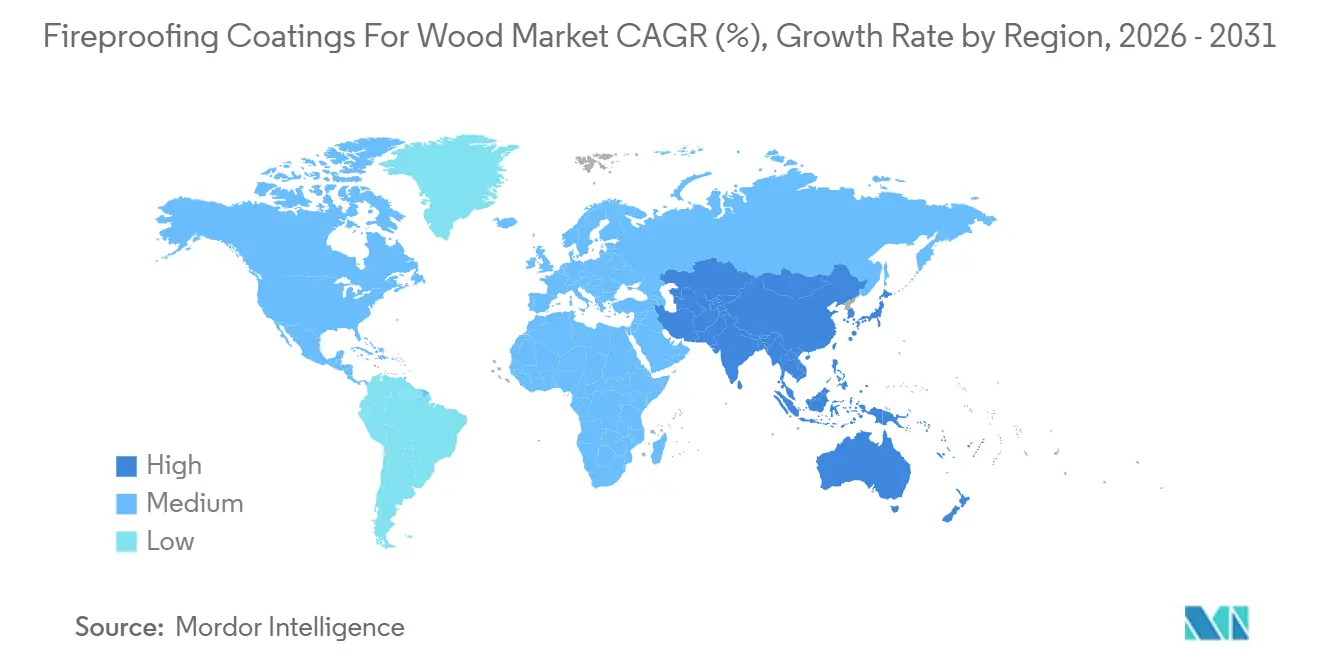
| Fastest Growing Market | Asia Pacific |
| Largest Market | North America |
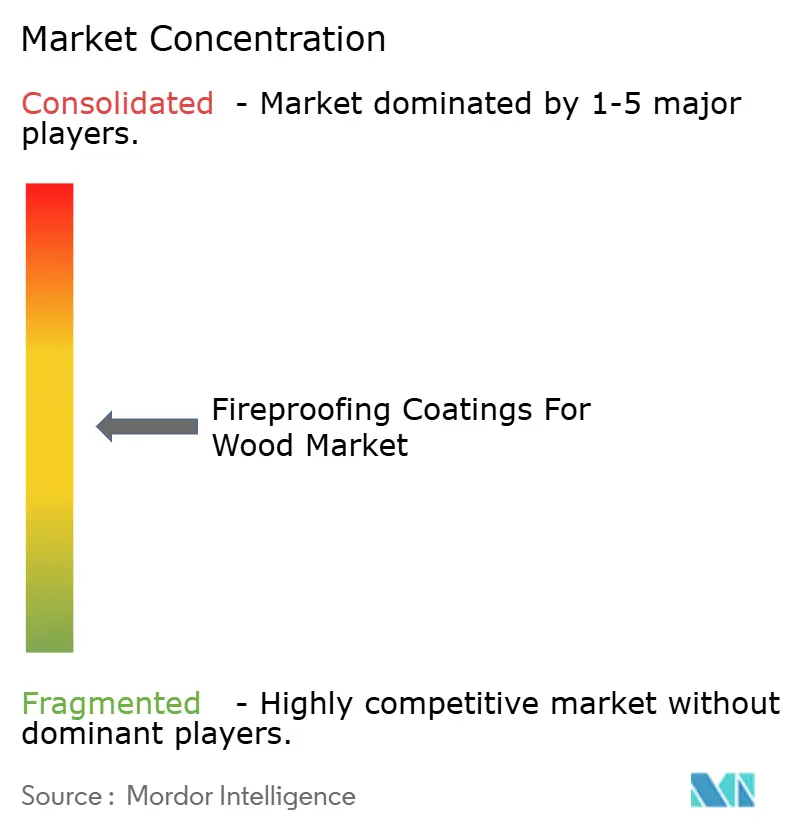
| Market Concentration | Medium |
Major Players *Disclaimer: Major Players sorted in no particular order Image © Mordor Intelligence. Reuse requires attribution under CC BY 4.0. | |
Fireproofing Coatings For Wood Market Analysis by Mordor Intelligence
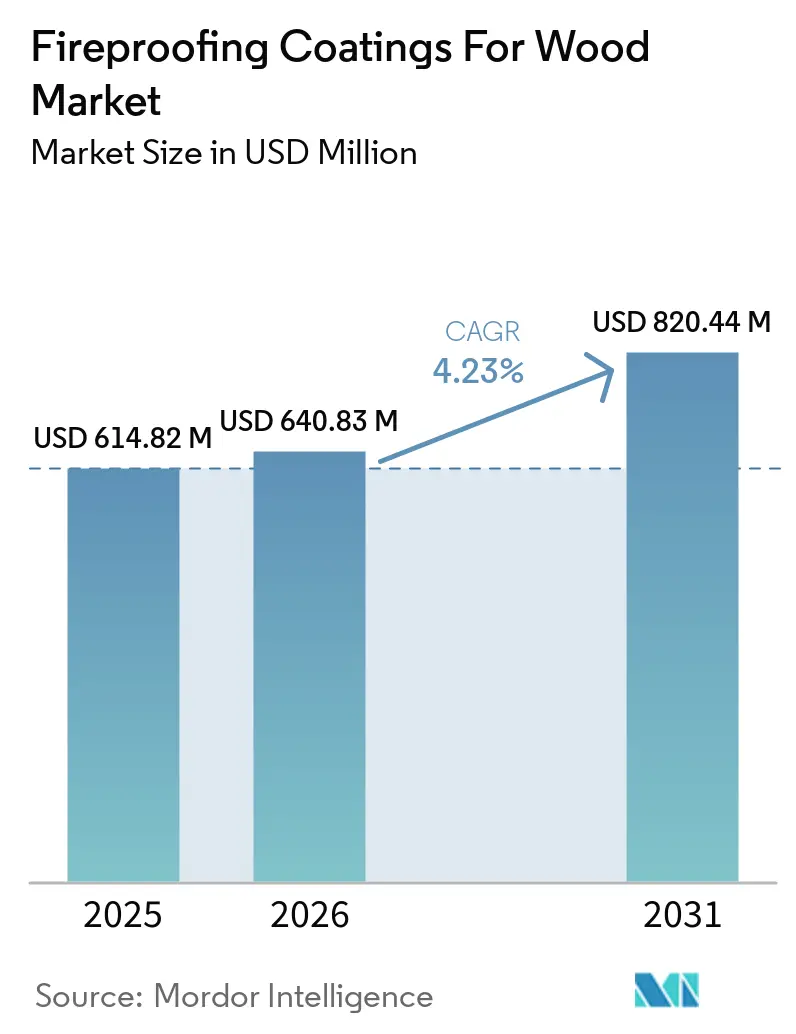
The Fireproofing Coatings For Wood Market size is projected to be USD 614.82 million in 2025, USD 640.83 million in 2026, and reach USD 820.44 million by 2031, growing at a CAGR of 4.23% from 2026 to 2031. Heightened fire-safety codes, insurance incentives, and the expansion of mass-timber construction elevate demand even as volume growth stays modest. Water-borne, halogen-free acrylic systems are replacing solvent formulations in response to VOC caps in California and the European Union. North America led with a 39.98% share in 2025, yet Asia-Pacific is on course for the fastest 4.87% annual growth on the back of Japan’s CLT boom and Australia’s carbon-neutral building mandates. Acrylic resins commanded 74.69% of demand in 2025 because their char chemistry tolerates moisture found in kiln-dried lumber. Insurance discounts for ASTM E84 Class A-rated timber further strengthen the pull for certified intumescent systems.
Key Report Takeaways
- By technology, water-borne technology secured 68.09% of 2025 revenue and is forecast to expand at a 4.47% CAGR to 2031.
- By resin type, acrylic resins captured 74.69% of demand in 2025 and are projected to grow at a 4.37% CAGR through 2031.
- By coating type, halogen-free coatings held 78.87% share in 2025 and represent the fastest 4.57% CAGR segment to 2031.
- By application, architectural applications commanded 88.12% of 2025 revenue; they are projected to expand at a 4.43% CAGR through 2031.
- By geography, North America led with a 39.98% share in 2025, whereas Asia-Pacific is forecast to post a 4.87% CAGR, the highest among all regions.
Note: Market size and forecast figures in this report are generated using Mordor Intelligence’s proprietary estimation framework, updated with the latest available data and insights as of January 2026.
Market Trends and Insights
Drivers Impact Analysis of Fireproofing Coatings For Wood Market*
| Drivers | (~) % Impact on CAGR Forecast | Geographic Relevance | Impact Timeline |
|---|---|---|---|
| Stringent fire-safety codes and certification mandates | +1.2% | Global, with strongest enforcement in North America, Europe, and Japan | Long term (≥ 4 years) |
| Expansion of mass-timber construction in Asia-Pacific | +1.0% | APAC core (Japan, Australia, China), spill-over to South Korea and New Zealand | Medium term (2-4 years) |
| Shift toward halogen-free, low-VOC formulations | +0.8% | North America and EU leading, APAC adoption accelerating | Medium term (2-4 years) |
| Insurance discounts for coated structural wood | +0.5% | North America (California, Louisiana), Australia | Short term (≤ 2 years) |
| BIM-integrated digital fire-rating specifications | +0.3% | North America and Europe, early adoption in Singapore and UAE | Long term (≥ 4 years) |
| Source: Mordor Intelligence | |||
Stringent Fire-Safety Codes and Certification Mandates
Under the 2024 International Building Code, mass-timber structures can rise to mid- and high-rise levels, provided the exposed wood achieves a flame-spread index within acceptable standards, whereas Fire protection materials improve the fire resistance and safety of structural wood, This benchmark is only attainable through the application of intumescent coatings. Meanwhile, Eurocode 5's 2025 update offers designers a financial edge: by recognizing the protective char from these coatings, they can reduce timber dimensions. In Japan, similar provisions apply to mid-rise CLT residences in seismic zones. Here, the stipulation is that certified coatings must achieve a rating on the ASTM E119 scale. Furthermore, NFPA 703 has introduced a mandate for third-party certification, a move that has bolstered market share for suppliers with accredited laboratories[1]National Fire Protection Association, “NFPA 703 Standard for Fire Retardant-Treated Wood,” nfpa.org. Together, these regulations firmly integrate intumescent coatings into the design framework for mid- and high-rise timber structures.
Expansion of Mass-Timber Construction in Asia-Pacific
Between 2024 and 2025, Japan saw a significant increase in the construction of CLT buildings, adding several structures taller than 10 stories[2]Japan CLT Association, “Mass Timber Construction Statistics Japan,” clta.jp. Under its 2025 National Construction Code, Australia now permits the use of CLT in bushfire-prone areas, provided the coated surfaces adhere to BAL 40 flow conditions. By 2027, China greenlit new CLT production lines, targeting a supply for timber housing; each square meter will require fire-rated coating. In 2025, South Korea allocated funding to subsidize CLT schools, ensuring they meet the KS F 3111 standards. Collectively, these initiatives are significantly boosting the demand for Fireproofing Coatings for Wood.
Shift Toward Halogen-Free, Low-VOC Formulations
Halogen-free coatings held 78.87% of 2025 demand and will grow at 4.57% through 2031 as specifiers avoid hydrogen-halide off-gassing that corrodes steel connectors. Water-borne acrylics already comply with regulatory standards that set a cap on emissions, effective in 2027. New product launches now prominently feature ammonium polyphosphate and melamine, stepping in for antimony trioxide, which has been banned under updated guidelines. The U.S. HAP standard for 2024 has cut the permissible level of methyl ethyl ketone, pushing manufacturers to pivot towards acetone. While acetone evaporates more rapidly, this characteristic narrows application windows, especially in humid conditions. Such regulatory shifts are steering the Fireproofing Coatings For Wood market towards the adoption of acrylic water-borne technology.
Insurance Discounts for Coated Structural Wood
California's FAIR Plan slashed premiums for CLT buildings showcasing ASTM E84 Class A coatings. This move rendered the upgrade cost-neutral within the inaugural policy year for numerous projects. In Louisiana, a discount was rolled out for hurricane-rated timber, treated with mold-resistant fire retardants. This initiative aims to reduce lifecycle costs, especially in the Gulf Coast's humid climate. Meanwhile, insurers in Australia have begun equating BAL 40-certified intumescent coatings with fiber-cement cladding. This shift translates to annual premium reductions. Such incentives bolster payback periods, encouraging developers to opt for certified products, even if they come with a heftier initial price tag.
Restraints Impact Analysis of Fireproofing Coatings For Wood Market*
| Restraints | (~) % Impact on CAGR Forecast | Geographic Relevance | Impact Timeline |
|---|---|---|---|
| High cost differential vs. conventional finishes | -0.7% | Global, most acute in price-sensitive APAC and South American markets | Medium term (2-4 years) |
| VOC/HAP limits on solvent technologies | -0.5% | North America and EU primary impact, ripple effect in APAC export-oriented manufacturers | Long term (≥ 4 years) |
| Premature weathering in tropical humidity | -0.3% | Southeast Asia (Indonesia, Vietnam, Thailand, Malaysia), coastal India | Short term (≤ 2 years) |
| Source: Mordor Intelligence | |||
VOC/HAP Limits on Solvent Technologies
California's Rule 1113 effectively sidelines traditional xylene-rich epoxies. Meanwhile, the EU is set to tighten its caps by 2027. In the U.S., a 2024 HAP rule drastically reduced permissible levels of methyl ethyl ketone. This change has led to extended cure times in humid areas, throwing contractor schedules into disarray. Over in China, the introduction of GB 38507-2020 set limits. However, with weak enforcement outside of tier-1 cities, a solvent-heavy gray market continues to thrive. As the industry rapidly shifts towards water-borne chemistries, smaller formulators, lacking expertise in dispersion, find themselves increasingly burdened.
Premature Weathering in Tropical Humidity
After months at high humidity, acrylic binders lose tensile strength. This degradation allows char salts to leach, reducing fire resistance from a standard duration to just around an hour. Field audits conducted revealed that a significant percentage of coated CLT façades experienced chalking within a relatively short period. While siloxane coupling agents can extend the service life, they come with an increase in formulation costs and necessitate pH adjustments, posing challenges for smaller regional producers. In Malaysia, government projects now mandate a rigorous QUV test, a benchmark that only a portion of products currently meet. These durability challenges not only hinder adoption in equatorial regions but also underscore a significant research and development focus for the Fireproofing Coatings for Wood industry.
*Our forecasts treat driver/restraint impacts as directional, not additive. The impact forecasts reflect baseline growth, mix effects, and variable interactions.
Fireproofing Coatings For Wood Market Segment Analysis
By Technology:
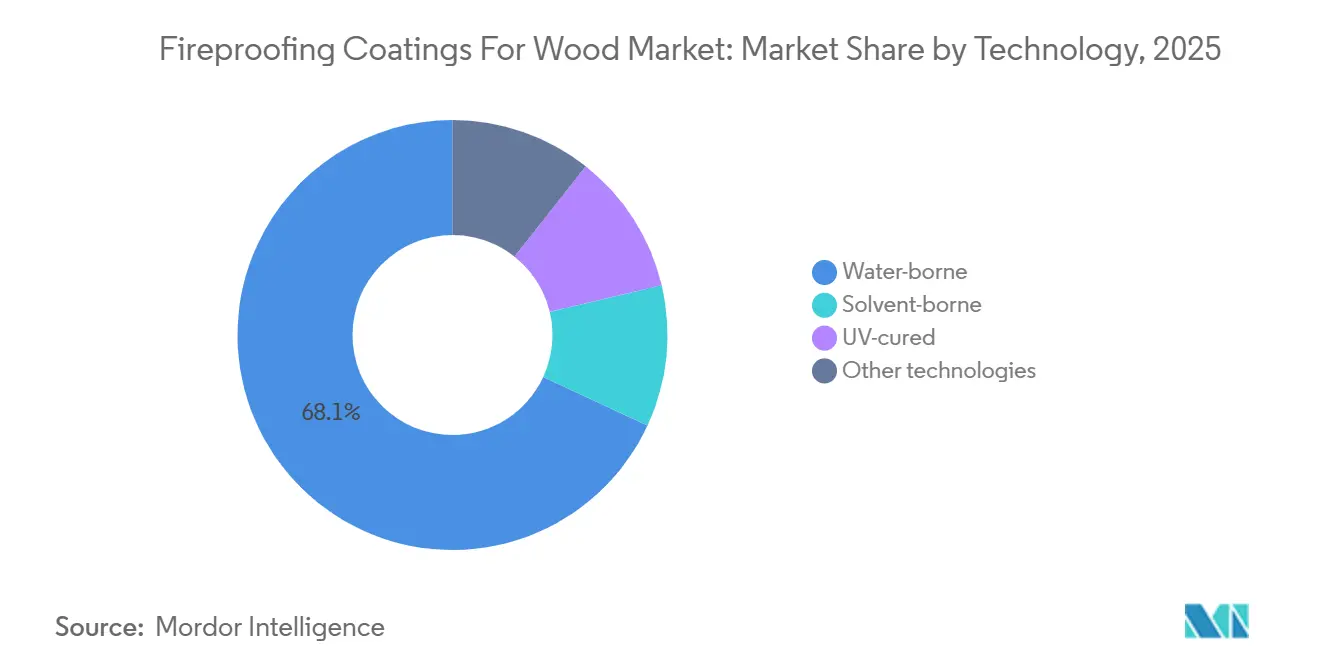
Water-Borne Systems Dominate Amid VOC CrackdownsWater-borne systems accounted for 68.09% of the Fireproofing Coatings For Wood market share in 2025 and are projected to grow at a 4.47% CAGR through 2031. These systems not only adhere to compliance standards but also manage timber moisture without blistering. The adoption of single-component packaging mitigates pot-life risks and simplifies contractor tooling, further solidifying this technology's lead. While solvent-borne products, preferred for rail interiors and marine bulkheads, commanded a significant portion of the demand, they grapple with tightening regulations, constraining their growth. UV-cured coatings, though enticing Scandinavian panel makers with rapid factory cures, remain a niche due to thick intumescent films limiting light penetration.
Transitioning to water-borne systems alters logistics dynamics: denser formulations elevate freight costs per liter, yet reduce onsite ventilation needs, streamlining permitting processes. Major producers, equipped with dispersion lines, can absorb these added costs, posing challenges for smaller firms and shifting the competitive balance. As regulations extend into emerging regions, the dominance of water-borne systems is poised to bolster the market size advantage for integrated multinationals in the Fireproofing Coatings for Wood sector.



By Resin Type:
Acrylic Dominance Rooted in Char ChemistryAcrylic resins captured 74.69% of consumption in 2025 and will maintain a 4.37% CAGR to 2031. Their phosphorus-rich char foams, which activate at specific temperatures and resist moisture in kiln-dried lumber, have made them the preferred choice for architects. Polyurethane boasts abrasion strength that is particularly valued in schools and hospitals. However, its two-component mixing process strains labor budgets. Silicone's hydrophobic network performs exceptionally in coastal and tropical climates. Still, its pricing limits its adoption to premium bushfire zones. Epoxy and vinyl ester are favored on offshore platforms, where chemical resistance is prioritized over VOC limits, and they are witnessing modest growth.
Acrylic's dominance is stabilizing the supply of raw materials, particularly ammonium polyphosphate and expandable graphite. This trend is also streamlining the learning curves for regional blenders. Furthermore, acrylics are bolstering long-term forecasts for the Fireproofing Coatings For Wood market, especially as upcoming code changes seem to favor increasingly stringent VOC thresholds, a challenge best addressed by acrylic solutions.
By Coating Type:
Halogen-Free Formulations Reshape Supply ChainsHalogen-free lines held 78.87% share in 2025 and will expand fastest at 4.57% CAGR through 2031. This growth is driven by rising concerns over corrosion from hydrogen halides and exclusions from LEED credits. Ammonium polyphosphate continues to be the preferred char former. However, a price surge followed a 2024 plant fire, highlighting the risks of supply concentration in Shandong. While graphite flakes offer significant expansion advantages, they come at a tripled cost, leading to loadings stabilizing. Halogenated systems, holding a smaller market share, are limited to regions with lenient regulations and older plant assets, resulting in subdued growth.
Transitioning to halogen-free compounds compels formulators to reevaluate their pigment stabilization and anti-settling strategies, elevating technical challenges. This shift benefits established players with substantial research and development investments, leading to a transformation in the supplier landscape of the Fireproofing Coatings for Wood market.
By Application:
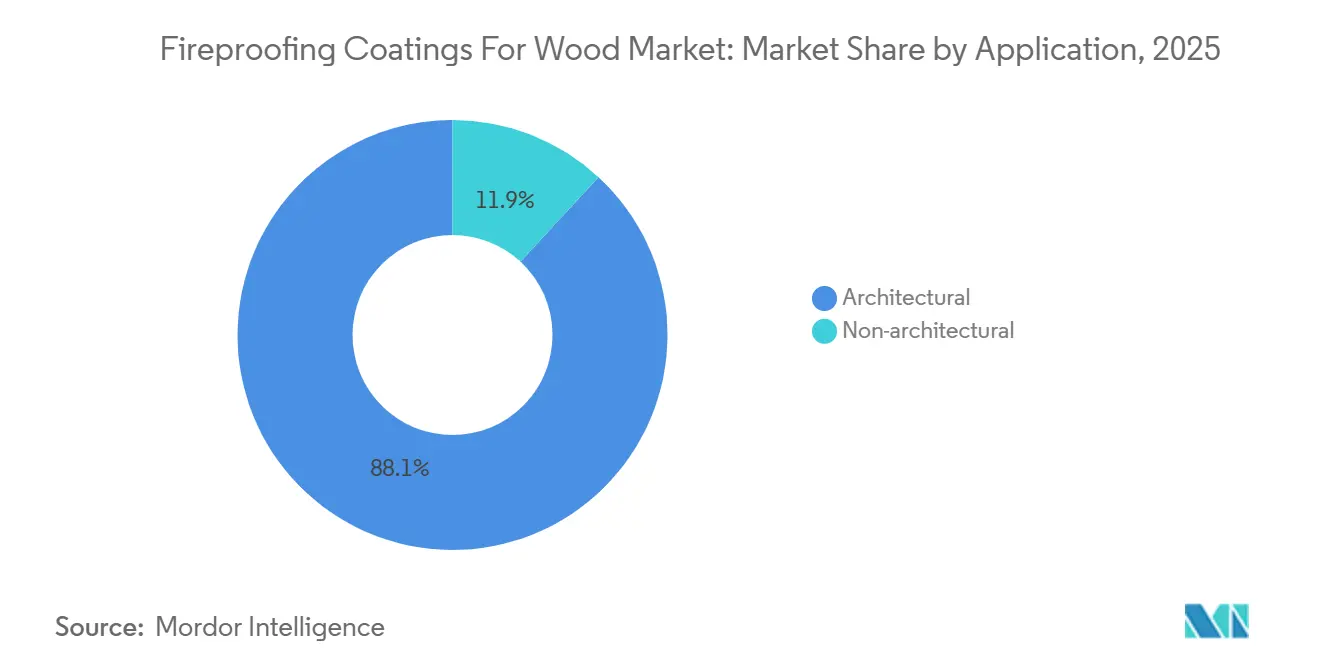
Architectural Segment Captures Mass-Timber BoomArchitectural uses represented 88.12% of 2025 revenue and will advance at a 4.43% CAGR to 2031, buoyed by the CLT high-rise pipeline authorized under IBC 2024. An 18-story tower alone could utilize significant volumes of coating, overshadowing the modest needs of rail or yacht interiors. Meanwhile, non-architectural applications, making up a smaller share of demand, are inching ahead, adapting to evolving marine and rolling-stock standards.
With architecture leading the way, research and development are pivoting towards quicker application methods and lighter hues to align with design aesthetics. Given the segment's prominence, water-borne acrylic formulations are becoming the industry standard, bolstered by regulatory preferences, thus ensuring steady growth for the Fireproofing Coatings For Wood market.
Geography Analysis
North America Fireproofing Coatings for Wood Market
North America led the Fireproofing Coatings for Wood market with a 39.98% share in 2025. This was bolstered by numerous mass-timber projects initiated under the USDA grant program. California's premium discount for ASTM E84 Class A timber invigorated momentum in areas prone to wildfires. Canada's updated 2025 code permits 12-story structures across the nation, while British Columbia mandates a significant timber usage in new public buildings, ensuring a robust stream for retrofitting. Collectively, these factors contribute to steady growth projected until 2031.
APAC Fireproofing Coatings for Wood Market
Asia-Pacific is the fastest-growing region at a 4.87% CAGR. Between 2024 and 2025, Japan constructed several CLT towers exceeding 10 stories. Australia's approvals in bushfire zones further amplify regional demand, China's commitment to timber housing, and South Korea's substantial subsidy. While Indonesia and Vietnam grapple with humidity-related weathering issues, technological solutions like siloxane couplers are bridging the gap.
Europe Fireproofing Coatings for Wood Market
Europe commanded a significant share in 2025. Leading the charge in mass-timber adoption are Germany, the UK, and Nordic countries, utilizing Eurocode 5’s reduced cross-section method. The UK’s Fire Safety Act has spurred a wave of retrofits, and France’s RE2020 carbon regulations are nudging residential builders towards timber. While Southern Europe hesitates due to seismic worries, it's experimenting with hybrid designs, favoring coated timber for its aesthetic appeal. The region is projected to grow steadily.
MEA and South America Fireproofing Coatings for Wood Market
South America, alongside the Middle-East and Africa, collectively holds a notable share. In 2024, Brazil greenlit multi-story timber structures, igniting demand in São Paulo. Meanwhile, Dubai and Riyadh, under broader sustainability agendas, have established timber content targets, introducing the Fireproofing Coatings For Wood market to regions traditionally dominated by steel. Challenges like limited local CLT production and import tariffs moderate growth.

Regulatory Landscape
Fireproofing coatings for wood are shaped by fire-test and building-code pathways that increasingly distinguish between surface-applied coatings and fire-retardant-treated wood intended for structural use. In the United States, NFPA 703 (2024 edition) sets performance expectations and third-party certification requirements for fire-retardant coatings and treatments, while ASTM E84-24 remains the common route for interior finish classification (Class A through C) used in specifications and insurance-driven requirements. Under IBC 2024 (Section 2303.2), structural applications face additional compliance constraints, including ASTM E2768 criteria, which increases the documentation and test burden for coatings marketed as substitutes for structural FRTW.
In Europe, CE marking and classification are anchored to the Construction Products Regulation framework, with EAD 350865-00-1106 covering the European Technical Assessment route for fire-protective coatings and requiring durability testing under defined environmental conditions (for example, internal-use condition types). Commission Delegated Regulation (EU) 2026/557 (dated March 2026) establishes classes of performance for resistance to fire for construction products, including fire protective coatings, reinforcing the need for harmonized classification and updated declarations of performance. Regulatory scrutiny of flame retardants also influences formulation choices, and ECHA has highlighted flame retardants, particularly halogenated and organophosphorus substances, within its regulatory strategy under REACH, supporting the market shift toward halogen-free, low-VOC systems already visible in North America and the EU.
Value Chain Analysis
The value chain begins with upstream suppliers of binders and intumescent packages, including acrylic and other resin systems, along with additives such as ammonium polyphosphate and related char-formers. Formulators then convert these inputs into water-borne and solvent-borne fireproofing coatings designed for timber. Product differentiation depends heavily on testing, certification, and environmental durability, which pulls accredited laboratories, notified bodies, and technical assessors deeper into the chain, including NFPA 703 pathways in the United States and ETA routes in Europe under EAD 350865-00-1106. Manufacturers with in-house dispersion capability and established certification files tend to manage tightening VOC and fire-class documentation requirements with less disruption.
Midstream and downstream activity splits between factory-controlled application and field application. Factory or panel-line integration is gaining weight alongside contractor-applied systems, as engineered-wood producers and chemical suppliers embed fire performance at the manufacturing stage rather than relying only on post-production coatings. Distribution typically runs through protective-coatings channels and wood-products distributors to fabricators, general contractors, and specialist applicators, with specifiers and insurers influencing demand through requirements such as ASTM E84 Class A and system-level validation. Ongoing service elements, including maintenance and overcoating guidance and environment-specific durability performance (interior versus exterior exposure), remain central to lifecycle compliance and repeat purchasing.
Competitive Landscape
The fireproofing coatings for wood market is moderately fragmented. Mid-tier specialists address regional needs with brush-applied, single-component products that bypass spray-booth capital, a boon in Southeast Asia’s fragmented contractor base. Niche innovators are piloting lignin-based binders that trim lifecycle carbon, although pricing remains above acrylics. Competitive intensity now hinges on humidity, durability, and digital specification libraries. Companies that verify 2,000-hour QUV performance and host full BIM datasets stand to capture a disproportionate share as mass-timber codes ripple worldwide.
Fireproofing Coatings For Wood Industry Leaders
Akzo Nobel N.V.
Teknos Group
The Sherwin-Williams Company
Sika AG
Rudolf Hensel GmbH
- *Disclaimer: Major Players sorted in no particular order
Fireproofing Coatings For Wood Market Companies Covered in this Report
- Akzo Nobel N.V.
- ASTRA VERNICI SRL
- Contego International Inc.
- Envirograf
- Jazeera Paints
- Remmers GmbH
- Rudolf Hensel GmbH
- Sika AG
- Teknos Group
- The Sherwin-Williams Company
- Tikkurila Oyj
- Treet

Market Opportunities and Future Outlook
A key whitespace is the connection between structural-code compliance and coating-based solutions, where IBC 2024 Section 2303.2 increases the role of ASTM E2768 and narrows the use-case for coatings positioned as substitutes for structural FRTW. This supports opportunities for suppliers that package coatings as fully tested systems (primer plus intumescent plus topcoat) and provide documentation that fits regulatory expectations and insurer requirements, including ASTM E84 Class A for interior finishes and NFPA 703 certification pathways. Europe is also tightening CPR-linked classification and documentation requirements, and Commission Delegated Regulation (EU) 2026/557 (March 2026) reinforces demand for products with clear, current fire-performance classes and durable-use condition evidence.
Recent deals also point to an opportunity shift toward integrated, factory-applied fire resistance, alongside closer partnerships across the wood-products ecosystem. Louisiana-Pacific launched LP BurnGuard FRT OSB in March 2026, and CitroTech and Hexion announced a 50/50 joint venture in April 2026 to integrate fire-retardant solutions directly for engineered-wood manufacturers, reflecting growth in manufacturing-embedded fire protection alongside traditional architectural coating demand. On formulation, the market continues to reward halogen-free and low-VOC systems already dominant in 2025, with halogen-free coatings at 78.87% share and water-borne at 68.09%. At the same time, humidity and weathering constraints in tropical climates leave room for premium durability upgrades, including system designs that sustain performance under exterior exposure without heavy maintenance cycles.
Recent Industry Developments in Fireproofing Coatings For Wood Market
- April 2026: CitroTech Inc. and Hexion Inc. announced a 50/50 joint venture to integrate fire-retardant solutions for plywood, OSB, and engineered wood manufacturers. The initiative supports a shift toward factory-embedded fire performance, which can streamline compliance documentation compared with approaches that rely only on field-applied coatings. It also tightens links between specialty chemical supply and wood-product manufacturing, shaping specification pathways for mass-timber and panel applications.
- October 2025: Remmers and Burnblock launched a Euroclass B fire-retardant system combining Burnblock treatment with Remmers topcoats for timber. The combined-system approach targets specifiers looking for documented assemblies rather than standalone coatings, supporting use across interior and exterior timber where both durability and fire classification are required. It also expands the set of sustainable options available to architects working under low-VOC and material-health constraints.
- June 2024: Arbor Wood Co. and SaferWood launched a partnership to produce ignition-resistant, Class A thermally modified wood siding and decking using Thermex-FR treatment. By linking a wood-product brand with a fire-retardant technology provider, the partnership reinforces demand for solutions that arrive pre-qualified for fire performance at the product level. This type of collaboration competes with on-site coating-only strategies in exterior applications where maintenance and weathering risks drive purchasing decisions.


Fireproofing Coatings For Wood Market Report Scope and Research Methodology
Market Definition and Coverage
This market covers the value of coatings applied on wood and mass timber surfaces to slow flame spread and improve fire resistance. It includes intumescent and fire retardant coating chemistries sold for architectural and non-architectural uses.
Scope exclusions: It excludes fireproofing products meant for steel, concrete, or textiles, along with non-coating fire retardant treatments that are sold mainly as additives, boards, or insulation materials.
Segments Covered in This Report
- By Technology
- Water-borne
- Solvent-borne
- UV-cured
- Other technologies
- By Resin Type
- Acrylic
- Polyurethane/Urethane
- Silicone
- Alkyd
- Other Resin Types
- By Coating Type
- Halogen-free
- Halogenated
- By Application
- Architectural
- Non-architectural
- By Geography
- Asia-Pacific
- China
- India
- Japan
- South Korea
- Malaysia
- Indonesia
- Vietnam
- Thailand
- Australia and New Zealand
- Rest of Asia-Pacific
- North America
- United States
- Canada
- Mexico
- Europe
- Germany
- United Kingdom
- France
- Italy
- Nordics
- Rest of Europe
- South America
- Brazil
- Argentina
- Rest of South America
- Middle-East and Africa
- Saudi Arabia
- South Africa
- United Arab Emirates
- Egypt
- Iran
- Turkey
- Morocco
- Rest of Middle-East and Africa
- Asia-Pacific
Data Sources, Market Sizing, and Validation
Desk Research
Desk work was used to build base demand signals for wood protection, then narrow down to fire-rated coating adoption. We reviewed public references such as US and EU building code and fire test references (for example, ASTM E84 and EN 13501 notes), guidance published by fire protection associations, and technical documents from standards bodies that describe reaction-to-fire classifications.
We also used sources such as national construction and housing statistics, customs trade data where coating and resin movements can be directionally tracked, and peer-reviewed journals that discuss intumescent behavior on timber. To ground the commercial side, we checked company annual reports, investor decks, and product technical data sheets for capacity additions, launches, and pricing direction. In some cases, paid subscriptions for company financials and patent databases were used to confirm ownership, formulation themes, and the manufacturer footprint. These are illustrative examples, and many other public sources were also referred to for data collection, validation, and clarification.
Primary Interviews and Surveys
Primary discussions were used to test what desk research could not answer cleanly, especially the share of wood coatings bought specifically for fire performance and the typical price spread by technology and rating. We spoke with a mix of coating manufacturers, formulators, distributors, applicators, and fire-safety consultants across major regions. The inputs were then used to confirm adoption levels, replacement cycles, and realistic near-term demand changes.
Distribution of primary research fieldwork respondents
| Company type | Respondent position | Region |
|---|---|---|
| Top tier: 31% | CXOs: 14% | APAC: 45% |
| Mid tier: 54% | Functional/Unit leaders: 37% | EMEA: 30% |
| Smaller Players: 15% | Managers: 49% | Americas: 25% |
Market-Sizing & Forecasting
Our sizing starts with a top-down build where construction activity, timber usage trends, and fire-code driven coating adoption are used to reconstruct the addressable coating spend for wood. To keep it practical, we translate the demand pool into value using a small set of measurable inputs, and the model is run by region before it is consolidated.
Key inputs used (illustrative) include growth in mass timber and engineered wood projects, building safety code adoption and enforcement signals, coating technology mix shifts (water-borne versus solvent-borne and UV-cured), typical dry film thickness and coverage rates for wood applications, and average selling price ranges by performance rating and application type. Where direct data is thin, we handle gaps by using adjacent coating consumption patterns and then adjusting using interview feedback on wood-specific penetration.
Forecasts are built using scenario analysis, because regulations and project pipelines can move faster than long-term averages in some countries. The scenario paths are informed by expert views on new building starts, renovation cycles, and expected substitution away from higher-VOC formulations, and then checked against observed price movement and product availability. Finally, selective bottom-up checks, such as sampled price times volume checks through channel conversations and supplier roll-ups for key regions, are used to validate the totals and reduce outliers.
Data Validation & Update Cycle
Validation is done through multiple checks so the final number is not driven by any single assumption. We compare model outputs with independent signals such as construction spending direction, timber demand indicators, and known shifts in coating technology preference. Then we review variance points that look inconsistent across neighboring countries.
Before sign-off, the draft model is reviewed internally and outliers are reworked with a clear reason trail. We also trigger re-contact when a key input moves, for example code changes, major plant additions, or abrupt pricing swings. Reports are refreshed annually, and interim updates are added when there is a material event that changes supply, demand, or regulatory momentum. Right before delivery, we do a final pass so clients receive an updated view aligned to the latest confirmed assumptions.
Mordor Intelligence's Fireproofing Coatings for Wood Market Size Versus Other Published Estimates
It is common to see different market sizes for wood fireproofing coatings because publishers do not always count the same products or apply the same fire-performance boundaries. Differences also come from how pricing is averaged across technologies, how fast regulations are assumed to translate into purchases, and how often assumptions are refreshed.
Key gap drivers in this market usually start with scope, because some estimates bundle general fire retardant coatings or broader passive fire protection materials. This can inflate the addressable value beyond wood-only coatings. Methods also vary in how they treat intumescent versus non-intumescent systems, and whether architectural specifications are counted differently from industrial maintenance demand. Currency timing and the year chosen for pricing can widen the spread when raw material and VOC-driven formulation shifts change selling prices quickly.
Benchmark comparison
| Source | Market Size | Gaps in Research Methodology |
|---|---|---|
| Mordor Intelligence | USD 0.61 B (2025) | |
| Global Consultancy A | USD 1.20 B (2024) | Uses a broader product boundary that likely blends wood-focused fireproofing coatings with adjacent fire retardant coating categories, and the base year pricing may reflect a wider set of industrial and architectural coatings not filtered to wood-only demand. |
| Regional Consultancy B | USD 1.04 B (2024) | Appears to apply a wider inclusion set across formulation families and end uses, with less clarity on whether non-coating fire retardant treatments are excluded, which can lift totals when wood protection spend is not separated by test rating and application type. |
By tracking coating technology mix, coverage rates on timber substrates, and fire-rating driven adoption by region, Mordor Intelligence sits closer to a wood-only demand pool that can be reproduced from construction and specification signals. The comparison shows that the spread is mostly explained by what gets counted as a wood fireproofing coating and how pricing is averaged across performance levels, and then confirmed through practical channel checks.


Key Questions Answered in the Report
How large is the Fireproofing Coatings for Wood market in 2026?
The Fireproofing Coatings for Wood market size is estimated at USD 640.83 million in 2026.
What is the expected growth rate for Fireproofing coatings through 2031?
Industry value is forecast to rise to USD 820.44 million by 2031, registering a 4.23% CAGR between 2026 and 2031.
Which technology leads current demand?
Water-borne systems captured 68.09% of 2025 revenue and remain the leading choice due to global VOC regulations.
Why are halogen-free coatings gaining share?
Halogen-free chemistries avoid corrosive hydrogen halides, qualify for LEED credits, and meet new regulations, driving a 4.57% CAGR.
Which region will grow fastest?
Asia-Pacific is set to post a 4.87% CAGR through 2031 as Japan, Australia, and China scale mass-timber projects.
Page last updated on:


 Your data is secure and never sold or shared.


