
Fiber Bragg Grating Sensor Market Size and Share
Market Overview
| Study Period | 2020 - 2031 |
|---|---|
| Market Size (2026) | USD 0.91 Billion |
| Market Size (2031) | USD 1.34 Billion |
| Growth Rate (2026 - 2031) | 8.12 % |
| Fastest Growing Market | Asia Pacific |
| Largest Market | North America |
| Market Concentration | Medium |
Major Players *Disclaimer: Major Players sorted in no particular order Image © Mordor Intelligence. Reuse requires attribution under CC BY 4.0. | |
Fiber Bragg Grating Sensor Market Analysis by Mordor Intelligence
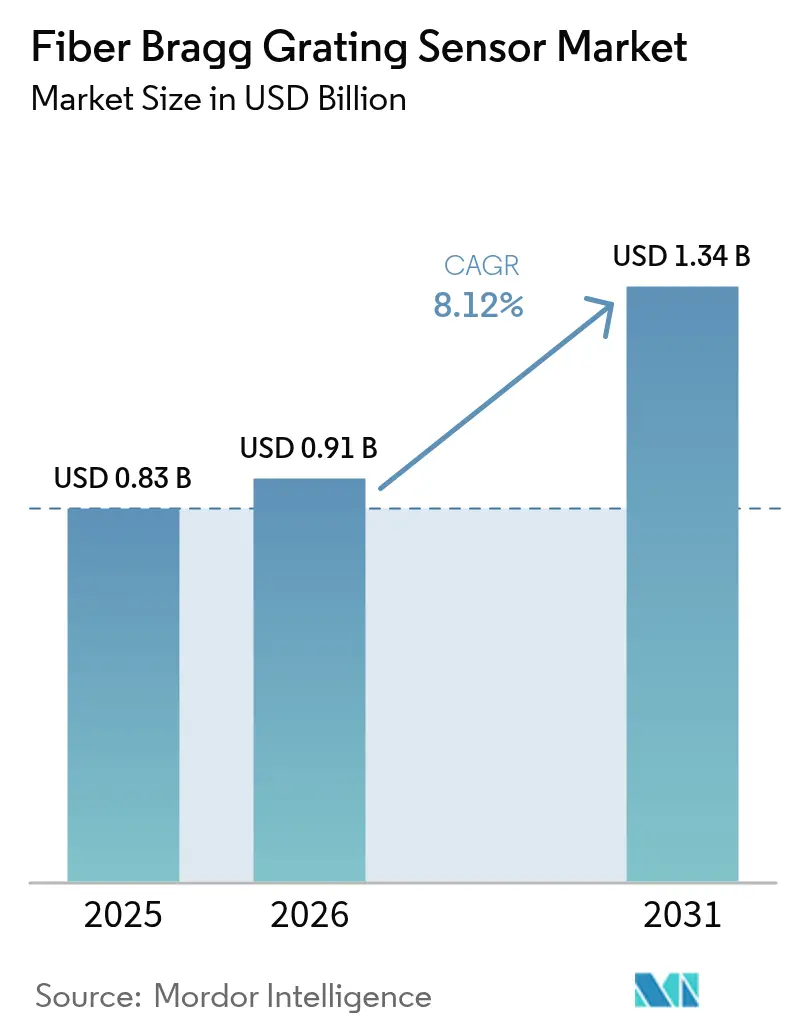
The Fiber Bragg Grating Sensor Market size is projected to expand from USD 0.83 billion in 2025 and USD 0.91 billion in 2026 to USD 1.34 billion by 2031, registering a CAGR of 8.12% between 2026 to 2031.
Widespread retrofits of aging bridges and tunnels, surging 5G fiber backhaul deployments, and accelerating adoption of distributed acoustic sensing in long oil and gas pipelines lift baseline demand across construction, telecom, and energy sectors. Mining operators add momentum as regulators insist on real-time ground control monitoring, while aerospace and defense programs embed sensors in composite airframes to reduce unscheduled maintenance. Vendors differentiate on interrogator sampling speed and multiplexing density, two factors that determine total system cost and competitive bid success. Meanwhile, customers see value migrating from raw wavelength data to cloud-based analytics that convert continuous streams into actionable maintenance decisions, stimulating partnerships between hardware specialists and software platforms.
Key Report Takeaways
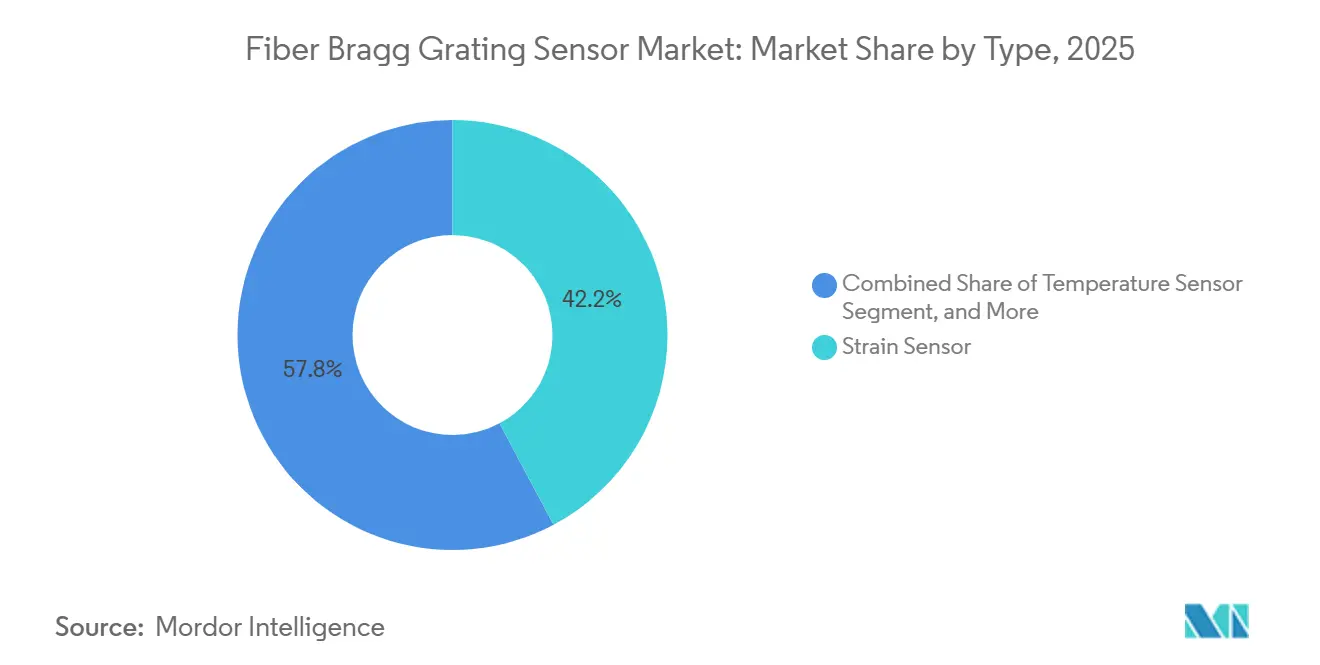
- By type, strain sensors led with 42.21% of the fiber Bragg grating sensor market share in 2025, whereas acoustic sensors are projected to expand at a 9.14% CAGR through 2031.
- By grating wavelength range, the C-band segment held 39.13% revenue share in 2025, while the L-band segment is forecast to grow at an 8.89% CAGR to 2031.
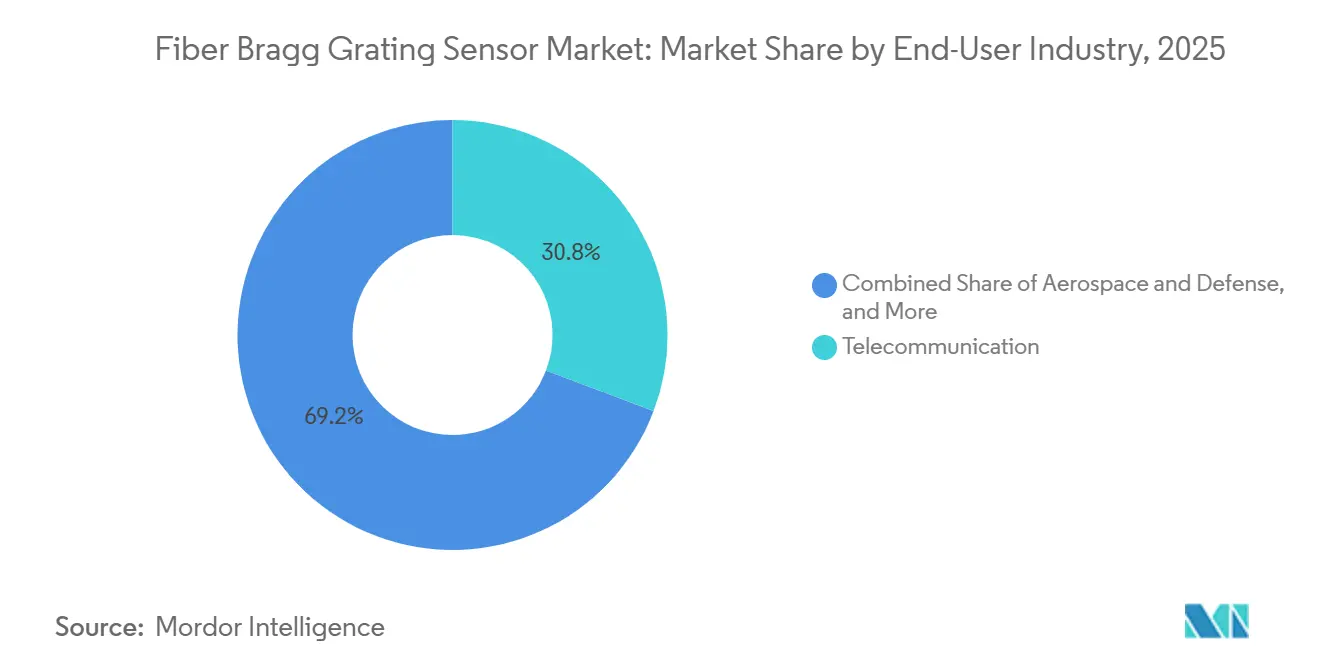
- By end-user industry, telecommunications accounted for 30.76% of the fiber Bragg grating sensor market in 2025, and mining is poised for the fastest 9.56% CAGR through 2031.
- By application, structural health monitoring captured a 37.32% share in 2025, whereas vibration and acoustic monitoring will advance at a 9.19% CAGR between 2026-2031.
- By geography, North America retained a 34.79% share of the fiber Bragg grating sensor market in 2025, yet Asia-Pacific is projected to register the highest 9.07% CAGR to 2031.
Note: Market size and forecast figures in this report are generated using Mordor Intelligence’s proprietary estimation framework, updated with the latest available data and insights as of 2026.
Market Trends and Insights
Drivers Impact Analysis of Fiber Bragg Grating Sensor Market*
| Driver | (~) % Impact on CAGR Forecast | Geographic Relevance | Impact Timeline |
|---|---|---|---|
| Growing Demand for Real-Time Structural Health Monitoring | +2.1% | Global, especially North America, Europe, Asia-Pacific urban centers | Medium term (2-4 years) |
| Expansion of 5G Fiber Backhaul Infrastructure | +1.8% | Asia-Pacific, North America, Europe | Short term (≤ 2 years) |
| Rapid Deployment of Distributed Acoustic Sensing in Oil and Gas Pipelines | +1.5% | Middle East, North America, Africa, South America | Medium term (2-4 years) |
| Increasing Use in High-Voltage Direct Current Cables | +1.2% | Europe, Asia-Pacific, North America | Long term (≥ 4 years) |
| Adoption in Hydrogen Pipeline Networks | +0.9% | Europe, Asia-Pacific, Middle East | Long term (≥ 4 years) |
| Defense Focus on Condition-Based Aircraft Maintenance | +0.7% | North America, Europe, Asia-Pacific | Medium term (2-4 years) |
| Source: Mordor Intelligence | |||
Growing Demand for Real-Time Structural Health Monitoring
Bridge and tunnel owners retrofit embedded fiber Bragg gratings to continuously measure strain and temperature, replacing manual inspections with 24-hour data streams that extend asset life by up to 20 years. Wind farm operators add arrays inside turbine blades, capturing micro-crack initiation after millions of fatigue cycles and scheduling blade swaps only when analytics flag risk. Fusion-energy laboratories and aerospace test stands select technologies that are immune to magnetic fields and cryogenic temperatures, thereby broadening credibility among high-reliability users. Cloud dashboards and machine-learning anomaly detection convert sensor data into maintenance work orders, shifting revenue toward software subscriptions. Collectively, these dynamics secure a multi-year volume pipeline for the fiber Bragg grating sensor market.
Expansion of 5G Fiber Backhaul Infrastructure
Mobile operators string dense fiber networks to connect more than three million 5G base stations across China, India, South Korea, Europe, and North America. Apodized gratings spliced at distribution nodes detect bending, temperature spikes, and micro-vibrations that jeopardize latency targets, enabling field crews to repair lines before service degradation. Operators increasingly favor L-band gratings for rural backhaul stretches exceeding 80 km, where lower attenuation cuts amplifier count and capital cost. Pilot projects that reuse installed communications fiber for both data and sensing reduce per-kilometer deployment expense by nearly half, accelerating adoption among railways and power utilities [1]. The telecom footprint therefore anchors near-term revenue for the fiber Bragg grating sensor market.
Rapid Deployment of Distributed Acoustic Sensing in Oil and Gas Pipelines
Pipeline operators confront stricter leak-detection rules that demand pinpoint localization within minutes. Distributed acoustic sensing converts buried fiber into a continuous microphone, enabling detection of excavations, pressure anomalies, or illegal taps with sub-10-meter accuracy over thousands of kilometers. Algerian trials across 14,000 km delivered a false-positive rate of 0.012 events per km per day, saving operators 20-30% in patrol costs and proving readiness for continental pipelines [2]. North American shale fields use the same platform to monitor hydraulic fracture propagation in real time, optimizing stage spacing and proppant use. These benefits push acoustic arrays to the top of capital budgets, bolstering multi-year growth prospects for the fiber Bragg grating sensor market.
Increasing Use in High-Voltage Direct Current Cables
HVDC links that evacuate offshore wind power expose cables to high electrical fields that cripple electronic gauges. Fiber Bragg gratings, immune to electromagnetic interference, embed directly into cable insulation during manufacture to map temperature gradients and detect mechanical strain that precedes a USD 50-100 million outage. The North Sea Wind Power Hub and similar Asia-Pacific projects plan thousands of kilometers of such cables, each demanding lifelong monitoring. Dual-grating designs separate strain from temperature, sustaining ±2 microstrain accuracy despite 40 °C load cycles [3]. As offshore wind complexes scale, turnkey sensor orders strengthen the fiber Bragg grating sensor market outlook.
Restraints Impact Analysis of Fiber Bragg Grating Sensor Market*
| Restraint | (~) % Impact on CAGR Forecast | Geographic Relevance | Impact Timeline |
|---|---|---|---|
| Cross-Sensitivity to Temperature and Strain | -1.3% | Global harsh-environment sites | Medium term (2-4 years) |
| High Upfront Installation Cost versus Electrical Gauges | -1.7% | Cost-sensitive markets worldwide | Short term (≤ 2 years) |
| Limited Dynamic Range in Ultra-Fast Events | -0.6% | Defense, aerospace, high-speed manufacturing | Long term (≥ 4 years) |
| Scarcity of Skilled Fiber-Optic Technicians | -0.9% | Asia-Pacific, Middle East, Africa | Medium term (2-4 years) |
| Source: Mordor Intelligence | |||
Cross-Sensitivity to Temperature and Strain
A 1 °C thermal change produces a wavelength shift equal to roughly 10 microstrain, forcing installers to pair each active grating with a strain-isolated reference device. Dual-channel configurations raise sensor counts and interrogator complexity by up to 40%, a premium many industrial owners resist. Attempts to solve the issue using software models require historical data that new users rarely have, delaying deployment. Although compensation hardware from leading vendors narrows errors to ±2 microstrain, cross-talk remains a design hurdle that tempers the expansion rate of the fiber Bragg grating sensor market.
High Upfront Installation Cost versus Electrical Gauges
A sixteen-channel optical interrogator can cost USD 15,000-40,000, several times as much as an electrical strain-gauge logger. Fusion splicers, specialized connectors, and certified technicians add to early outlays, straining capital budgets in mining, construction, and small utilities. Leasing plans and sensor-as-a-service contracts convert capital expenditures into operating expenses, yet adoption outside North America, Europe, and tier-one Asian markets still lags. A Canadian tender in 2025 sought interrogators capable of addressing 1,000 gratings, with Phase 2 funding up to CAD 1 million (USD 735,000), underscoring capital intensity [4]. Until volumes lift and component prices compress, sticker shock will subtract nearly two percentage points from the otherwise robust CAGR of the fiber Bragg grating sensor market.
*Our forecasts treat driver/restraint impacts as directional, not additive. The impact forecasts reflect baseline growth, mix effects, and variable interactions.
Fiber Bragg Grating Sensor Market Segment Analysis
By Type:
Strain Sensors Anchor Revenue while Acoustic Sensors Accelerate2025 sales show strain devices controlling 42.21% of the fiber Bragg grating sensor market size, reflecting their role in bridges, wind turbines, and aircraft structures that demand continuous load tracking. Volume remains steady as infrastructure owners mandate embedded monitoring to stretch service life. Acoustic formats, however, will chart a 9.14% CAGR to 2031, outpacing every other category as pipeline and perimeter-security buyers adopt distributed acoustic sensing that turns fiber into a kilometer-scale microphone grid.
Dual-FBG temperature-compensated strain designs push accuracy toward ±2 microstrain, satisfying nuclear, aerospace, and HVDC projects that cannot accommodate calibration shut-downs. Meanwhile, acoustic interrogators now sample at rates beyond 1 MS/s, capturing microseismic precursors in mines and high-frequency crack emissions in composites. This technical leap converts long-tail niche opportunities into scale shipments, lifting the fiber Bragg grating sensor market share of acoustic devices by the end of the forecast window.

By Grating Wavelength Range:
C-Band Dominance Faces L-Band ReachC-band sensors accounted for 39.13% of 2025 revenue thanks to compatibility with legacy erbium-doped amplifiers in telecom backbones. Installed gear lowers procurement friction, keeping C-band a staple for operators that already own matching optics. L-band models, however, promise longer reach and greater multiplex density, enabling 600-plus gratings on a single fiber where C-band supports roughly half that figure. The result is an 8.89% CAGR for the L-band slice through 2031.
Greenfield pipeline, railway, and HVDC projects now specify hybrid interrogators capable of reading both C- and L-band, future-proofing investments while easing migration. As unit volumes rise, component prices drop, opening opportunities for mid-tier suppliers and expanding total addressable demand across the fiber Bragg grating sensor market.
By End-User Industry:
Telecom Holds Lead while Mining Races AheadTelecommunication service providers represented 30.76% of the fiber Bragg grating sensor market revenue in 2025, driven by 5G fiber backhaul quality monitoring and node security. The segment will post moderate growth as networks mature, yet its share will erode to faster-moving verticals. Mining is projected to register a 9.56% CAGR to 2031, the highest among all industries, because regulators and insurers now treat real-time vibration sensing as mandatory for underground safety certification.
Energy and power utilities deploy gratings inside HVDC cables and transformers to capture temperature hotspots beyond electronic sensor limits, while aerospace and defense integrate arrays for condition-based maintenance that cuts fleet downtime by one-third. Diversified interest ensures balanced demand, but the standout momentum belongs to mines embracing predictive ground control.
By Application:
Structural Monitoring Prevails, Vibration Leads GrowthStructural health monitoring held 37.32% 2025 share, underscoring long-cycle bridge and tunnel retrofits across North America, Europe, and Asia-Pacific. Continuous strain and temperature logs feed digital twins that schedule targeted repairs, replacing calendar-based maintenance with data-driven decisions. Vibration and acoustic monitoring will accelerate at a 9.19% CAGR through 2031, propelled by pipeline leak detection, seismic perimeter security, and train-track condition programs.
Temperature mapping stays vital in power transformers and battery packs, whereas pressure sensing secures medical and chemical processes. Emerging load and weight use cases on rail axles and cranes illustrate the breadth of fiber Bragg grating sensor market applications, reinforcing the technology’s cross-sector resilience.
Geography Analysis
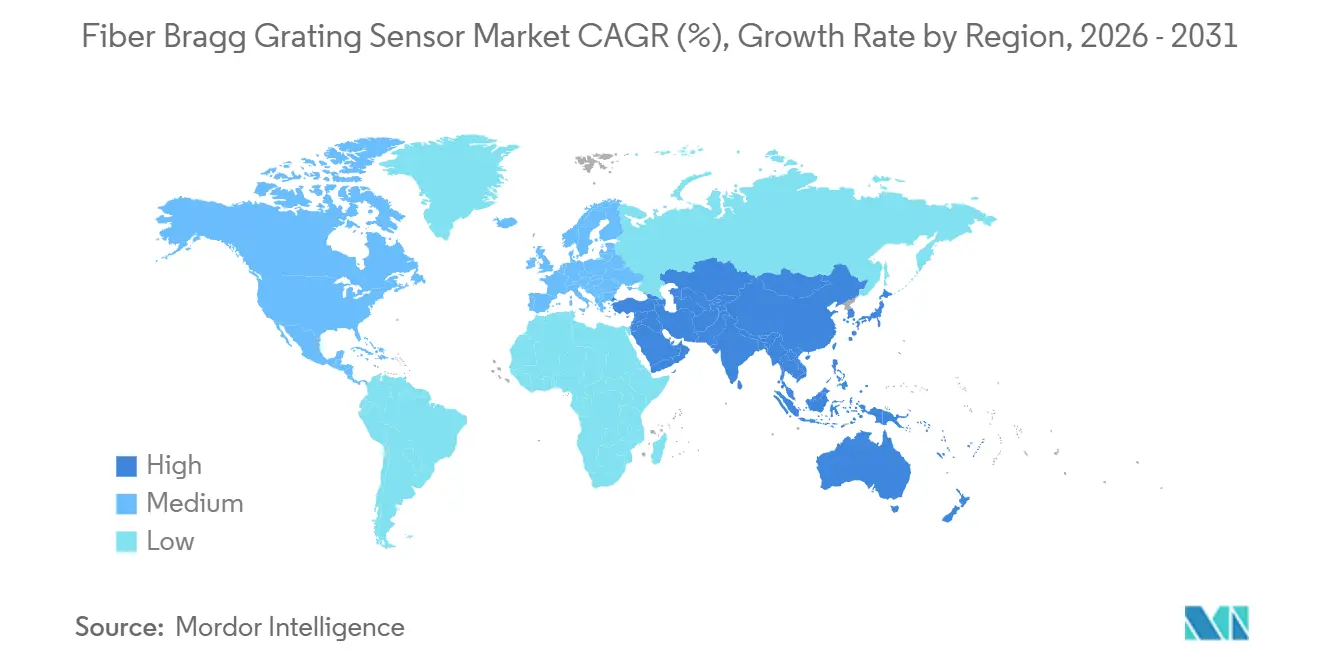
North America Fiber Bragg Grating Sensor Market
North America contributed 34.79% of 2025 sales as defense aircraft, shale pipelines, and aging highway bridges embedded gratings for condition-based oversight. Federal infrastructure grants financed structural retrofits, and the United States Air Force advanced full-fleet sensor integration on composite fighters. Canada’s research funding boosted domestic interrogator capability, while Mexican offshore platforms adopted optical arrays to avoid electromagnetic interference from high-voltage equipment.
APAC Fiber Bragg Grating Sensor Market
Asia-Pacific will record the swiftest 9.07% CAGR to 2031. China’s multiyear 5G rollout attaches inline fiber monitoring to every new base station, India’s metro rail projects hard-wire gratings into tunnels for continuous deformation alerts, and Japan’s November 2025 railway pilot showcases cost-saving reuse of existing telecom fiber for vibration surveillance. Technician shortages remain the lone bottleneck, prompting vendors to bundle installation services and remote diagnostic support.
EMEA and South America Fiber Bragg Grating Sensor Market
Europe balances mature bridge-monitoring portfolios with forward-looking hydrogen and offshore wind investments. Germany and the Netherlands are laying 1,200 km of hydrogen corridors that specify all-dielectric leak detection, and the North Sea Wind Power Hub will demand thousands of kilometers of HVDC cable carrying embedded gratings for lifetime thermal management. Middle East and African growth clusters around oil and gas, highlighted by Algeria’s 14,000 km acoustic pipeline rollout, while South America trails but shows pockets of uptake in Brazilian offshore fields and Argentine shale plays.
Regulatory Landscape
Standardization remains the main compliance driver for Fiber Bragg Grating (FBG) sensors, with procurement specifications increasingly referencing international test and calibration methods to support interoperability. The IEC 61757 family provides the core framework for fiber optic sensors, including IEC 61757-6-1:2024 for FBG-based displacement sensors and IEC 61757-8-1:2025 for pressure sensors, which tightens expectations around metrology, terminology, and acceptance testing across infrastructure, energy, and industrial deployments.
Regulators also influence qualification pathways by geography. In the United States, the Nuclear Regulatory Commission issued Regulatory Guide 1.257 in August 2025 endorsing IEEE 1682-2023 for qualifying fiber optic cables and splices in nuclear safety systems, increasing documentation and validation requirements for suppliers serving nuclear and adjacent safety-critical customers. In China, GB/T 18901.1-2025 updated the national general specification for fiber optic sensors, and in February 2026 the IEEE Standards Association published IEEE 3461-2025 to define a framework for smart infrastructure monitoring using fiber optic sensors, supporting more standardized tender language for bridges, rail, and other public works programs.
Value Chain Analysis
The value chain runs from high-purity silica and dopant inputs through optical preform and fiber drawing, FBG inscription (commonly via femtosecond laser point-by-point processes), and specialty coatings (polyimide, metallic, or other harsh-environment layers). Downstream, suppliers package gratings into sensor assemblies and then pair them with interrogators and demodulation software, before delivery through OEMs, system integrators, and engineering firms that design, install, and maintain solutions for structural health monitoring, telecom backhaul monitoring, pipelines, and power assets.
Constraint points center on precision inscription capacity, coating qualification for extreme environments, and the software layer required to compensate for temperature-strain cross-sensitivity at scale. Recent activity reflects both upstream capability and downstream integration shifts: Exail was selected in June 2026 by the ITER Organization to supply radiation-resistant aluminum-coated optical fibers manufactured via the Photonics Bretagne platform for FBG-based mechanical monitoring, highlighting how specialized fiber and coating supply matters in high-reliability programs. On the network side, the July 2026 FiberCop and Nokia memorandum of understanding to test fiber sensing integration into existing access networks suggests wider participation by telecom operators and equipment providers, which can shift deployments from dedicated sensing builds toward shared infrastructure and analytics-led service delivery.
Competitive Landscape
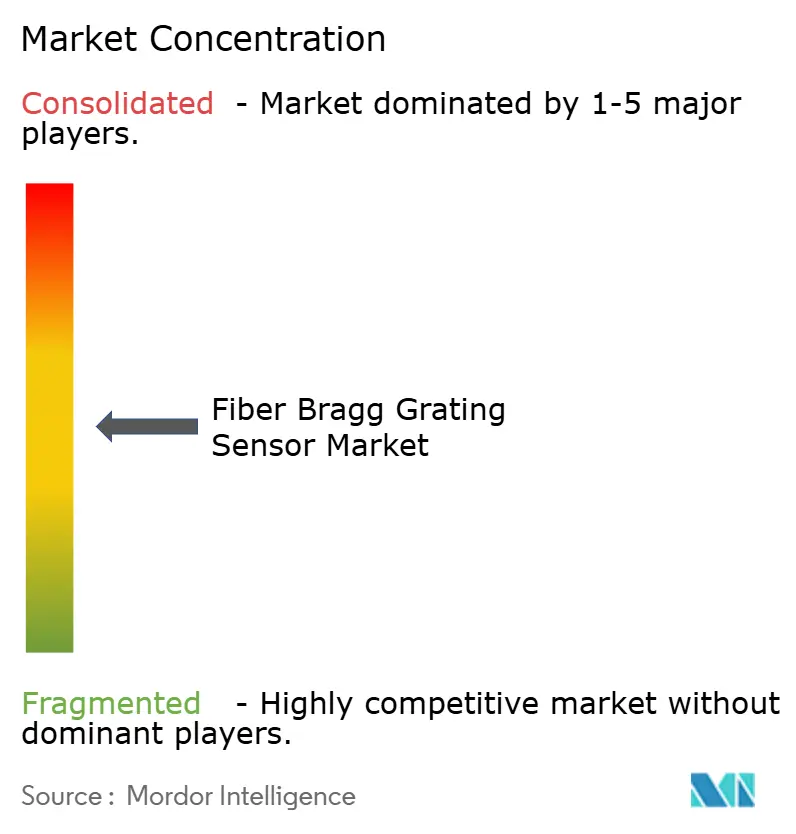
No single vendor controls more than 15% of revenue, so the fiber Bragg grating sensor market remains moderately consolidated yet open to challenger brands. Pure-play specialists such as FBGS International, Luna Innovations, Smart Fibres, and FiSens win projects that require custom grating design or niche coatings, while diversified measurement houses like HBK and National Instruments leverage global sales teams to bundle optical and electronic instrumentation into a single package. Buyers weigh interrogator sampling speed and multiplexing density heavily, and systems that now read more than 1,000 gratings on a single fiber often decide pipeline and railway tenders.
Strategic activity accelerated in 2024-2025 as vendors raced to pair hardware with analytics. Opterro acquired Redondo Optics in May 2024, adding high-speed distributed sensing that captures microsecond acoustic events for aerospace and defense users. FiSens merged with 5Io. Tech in May 2025 and immediately launched sensor-as-a-service contracts that convert capital budgets into subscription fees, a model attractive to cash-constrained construction and mining firms. JR West and NTT West, while not equipment suppliers, validated a dual-use approach in which telecom fiber also carries sensing signals, cutting incremental capital outlay by nearly half and nudging interrogator makers to support mixed traffic on the same strand.
Competition increasingly centers on software and certification. Vendors that secure ISO 9001 quality and IEC 60079 intrinsic-safety approvals lock in eligibility for pipeline and hydrogen corridor bids, where compliance is non-negotiable. At the same time, cloud dashboards that translate wavelength shifts into maintenance work orders tilt margin capture toward algorithm providers, prompting hardware firms to embed machine-learning engines inside edge interrogators. Price pressure persists on sensor elements, yet companies capable of delivering turnkey solutions, design, installation, analytics, and lifecycle support, protect average selling prices and sustain double-digit service revenue growth.
Fiber Bragg Grating Sensor Industry Leaders
-
Smart Fibres Ltd
-
Luna Innovations Inc. (Micron Optics)
-
Technica Optical Components LLC
-
Opsens Inc
-
FBGS International NV
- *Disclaimer: Major Players sorted in no particular order
Fiber Bragg Grating Sensor Market Companies Covered in this Report
- FBGS International NV
- Smart Fibres Ltd
- Luna Innovations Inc. (Micron Optics)
- Technica Optical Components LLC
- Opsens Inc
- Timbercon Inc
- National Instruments Corporation
- Hottinger Brüel & Kjaer HBM Inc
- Broptics Technology Inc
- ITF Technologies Inc
- Advanced Optics Solutions GmbH
- TeraXion Inc
- FISO Technologies Inc
- Optromix Inc
- Shenzhen Fibersail Technology Co Ltd
- Neoptix Inc
- Lightwave Logic Inc
- Smart Sensing Solutions GmbH
- Blue Road Research
- Cinogy Technologies GmbH
Market Opportunities and Future Outlook
Near-term whitespace is concentrated in standard-driven infrastructure programs and in deployments that reuse existing fiber rather than installing dedicated sensing lines. The publication of IEC 61757-6-1:2024 (FBG displacement sensor specifications and calibration procedures) and IEEE 3461-2025 (smart infrastructure monitoring using fiber optic sensors, including alignment of point sensing and distributed acoustic sensing concepts) supports more uniform tender requirements and reduces integration friction for multi-vendor projects in bridges, rail, and other public works.
Technology roadmaps are also shifting toward architectures that can support higher density and easier installation for structural health monitoring. Academic demonstrations reported in 2026 for programmable direct-patterning assembly of FBG sensor arrays and ultra-weak FBG array approaches for long-distance monitoring on suspension bridge main cables indicate a path toward larger sensor counts and surface-conformal installation formats that address manual assembly and installation cost constraints. Separately, 2026 research on dual-use of existing telecom fiber for monitoring aligns with operator-led field verification such as JR West and NTT West (November 2025), creating a commercialization route where interrogator makers and analytics platforms can sell upgrades and monitoring services into already-deployed fiber footprints.
Recent Industry Developments in Fiber Bragg Grating Sensor Market
- June 2026: Exail was selected by the ITER Organization to supply radiation-resistant aluminum-coated optical fibers manufactured via the Photonics Bretagne platform for mechanical monitoring in fusion reactors using FBG-based methods. The win reinforces demand for specialty fibers and coatings qualified for harsh environments, pulling more of the value chain toward high-reliability specifications and long-duration programs.
- December 2025: Technica Optical Components completed expansion of its Technica-Atlanta Advanced Manufacturing Lab to increase production volume for its M-Series and W-Series optical sensing interrogators. The added capacity supports higher-channel-count interrogator supply and can shorten lead times for multi-site infrastructure and industrial monitoring rollouts.
- May 2024: Technica Optical Components opened a new manufacturing facility in Atlanta, Georgia, equipped with femtosecond laser and high-precision alignment technologies for Fiber Bragg Grating sensor production. This investment expanded in-house inscription capability and positioned the company to serve higher-volume and more customized FBG sensor requirements.
Fiber Bragg Grating Sensor Market Report Scope and Research Methodology
Market Definition and Coverage
For this study, the market covers revenues generated from fiber Bragg grating (FBG) sensors used to measure physical parameters like strain, temperature, pressure, and acoustic signals across industrial and infrastructure settings, and it is counted at the point where the sensing element or sensor solution is sold.
Scope exclusions: We exclude pure fiber optic cable, connectors, and unrelated test equipment when they are sold as standalone items without an FBG sensing function.
Segments Covered in This Report
- By Type
- Temperature Sensor
- Strain Sensor
- Pressure Sensor
- Acoustic Sensor
- Other Types
- By Grating Wavelength Range
- C-Band (1530 to 1565 nm)
- L-Band (1565 to1625 nm)
- O-Band (1260 to 1360 nm)
- Other Grating Wavelength Ranges
- By End-User Industry
- Telecommunication
- Aerospace and Defense
- Construction and Infrastructure
- Energy and Power
- Oil and Gas
- Mining
- Other End-User Industries
- By Application
- Structural Health Monitoring
- Temperature Monitoring
- Vibration and Acoustic Monitoring
- Pressure Monitoring
- Load and Weight Monitoring
- Other Applications
- By Geography
- North America
- United States
- Canada
- Mexico
- Europe
- Germany
- United Kingdom
- France
- Russia
- Rest of Europe
- Asia-Pacific
- China
- Japan
- India
- South Korea
- Australia
- Rest of Asia-Pacific
- Middle East
- Saudi Arabia
- United Arab Emirates
- Rest of Middle East
- Africa
- South Africa
- Egypt
- Rest of Africa
- South America
- Brazil
- Argentina
- Rest of South America
- North America
Data Sources, Market Sizing, and Validation
Desk Research
Desk research started with a clear view of where FBG sensors are actually used, and which demand pools create repeatable purchasing. We reviewed public engineering and infrastructure references such as standards and application notes from bodies like IEC and ISO, technical notes from NIST, and published studies in journals such as IEEE and SPIE, which helped us frame typical use cases and measurement requirements.
We then grounded the market context using non-paywalled data and disclosures, including US Energy Information Administration updates for energy activity signals, USGS releases for mining and metals indicators, and FAA or similar civil aviation publications for aircraft fleet and maintenance signals that influence sensing adoption. Annual reports, investor presentations, and credible press were used to understand product focus and revenue exposure. A paid subscription covering company financials and news was used selectively to standardize entity mapping and reduce double counting. These sources are not exhaustive, and we also referred to other public documents and datasets for data collection, cross-checking, and clarification.
Primary Interviews and Surveys
Primary interviews and surveys were used to test what we built from desk research, particularly around typical selling prices, multi-point sensing deployments per asset, and how buying decisions differ by end user. We spoke with a mix of sensor suppliers, system integrators, and large end users across the main consuming regions, so assumptions on adoption timing, replacement cycles, and qualification lead times could be tightened before finalizing the model.
Distribution of primary research fieldwork respondents
| Company type | Respondent position | Region |
|---|---|---|
| Top tier: 29% | CXOs: 18% | APAC: 52% |
| Mid tier: 53% | Functional/Unit leaders: 30% | EMEA: 30% |
| Smaller Players: 18% | Managers: 52% | Americas: 18% |
Market-Sizing & Forecasting
Sizing relied on a top-down and bottom-up blend, where demand pools were first reconstructed from end-use activity and then checked using supplier-side reality checks. In practice, we built a top-down view by linking FBG sensor demand to measurable activity indicators like infrastructure monitoring deployments, energy and power asset additions, oil and gas integrity programs, and telecom network upgrades, and then translating these into expected sensor counts and value using interview-validated price ranges.
To keep the model traceable, inputs were kept simple and market-specific, such as average sensors per monitored asset, typical channel markups for packaged solutions, replacement and recalibration intervals, the share of projects that choose optical sensing over electrical sensing in harsh environments, and the mix shift between temperature and strain dominant applications. Where data was thin, gaps were handled through conservative ranges that were narrowed using channel checks and repeated calls with domain experts. Forecasts were produced using scenario analysis, where we adjusted adoption rates and price progression based on what participants expect for project pipelines, qualification cycles, and capex intensity across regions, and then applied reasonableness checks against the historical growth pattern implied by the study period.
Data Validation & Update Cycle
Outputs were validated through triangulation across the demand build-up, the pricing logic, and independent signals such as asset counts and investment cycles that can be observed outside the market model. If a region or application showed a jump that could not be explained by project timing, price moves, or a known policy change, we revisited assumptions and, when needed, re-contacted participants to confirm what shifted.
A multi-step review was followed, where one analyst rebuilt key calculations and another checked for unit consistency, currency treatment, and double counting across solution bundles. Reports refresh annually, and interim updates are made when material events occur, after which a final pre-delivery pass is completed so clients receive the latest updated view.
Mordor Intelligence's Fiber Bragg Grating Sensor Market Size Compared With Other Published Estimates
Published market values for FBG sensors do not always match because the boundary between an FBG sensing element and a broader fiber optic sensing system is drawn differently, and because price and adoption assumptions can be updated at different times. Some estimates also mix adjacent technologies under a similar label, which changes the demand pool even when the end use sounds the same.
Installation density checks from structural health monitoring projects, along with cross-verified pricing bands from supplier and integrator interviews, are the evidence used to anchor Mordor Intelligence values to a repeatable count of deployable sensing points rather than bundled fiber optic monitoring spend.
Benchmark comparison
| Source | Market Size | Gaps in Research Methodology |
|---|---|---|
| Mordor Intelligence | USD 0.83 B (2025) | |
| Industry Publisher A | USD 0.84 B (2024) | Uses a broader fiber grating sensor label that can pull in non-FBG grating solutions and packaged system revenue, and it also starts from a different base year that shifts the implied growth path. |
| Market Study B | USD 1.02 B (2025) | Appears to include wider component and technology buckets around fiber optic sensing, and it relies on a longer-range growth curve where price erosion and qualification lead times are not clearly constrained by near-term buying cycles. |
The spread is mainly explained by what gets counted as an FBG sensor sale versus a complete monitoring system, followed by how quickly adoption and pricing are allowed to move in the forecast. By keeping the unit logic visible (sensors per asset times validated price ranges) and then checking it against supplier-side reality, we end up with a number that clients can retrace and update when new project signals show up.
Key Questions Answered in the Report
How fast is global demand for fiber Bragg gratings growing?
Revenue is projected to climb from USD 0.91 billion in 2026 to USD 1.34 billion by 2031, reflecting an 8.12% CAGR.
Which segment will expand the quickest through 2031?
Acoustic sensors are forecast to post a 9.14% CAGR on increased distributed acoustic sensing projects in pipelines and perimeter security.
Why are miners adopting optical sensing?
Regulators and insurers now require real-time vibration monitoring to prevent rockfalls, pushing mining adoption at a 9.56% CAGR, the fastest among end-user industries.
What advantage does L-band provide over C-band sensors?
Lower attenuation over 80-100 km lines enables higher multiplexing density, cutting amplifier counts and per-sensor cost in long-haul installations.
How do upfront costs compare to electrical gauges?
A standard 16-channel optical interrogator costs USD 15,000-40,000, around four times an electrical data logger, but lower maintenance and longer service life offset capital over time.
Which regions show the most rapid uptake?
Asia-Pacific leads with a projected 9.07% CAGR, driven by China’s 5G backhaul expansion, India’s metro rail projects, and Japan’s railway safety modernization.