
Market Overview
| Study Period | 2019 - 2031 |
|---|---|
| Forecast Data Period | 2026 - 2031 |
| Base Year Market Size (2025) | USD 33.41 Million |
| Market Size (2026) | USD 45.90 Million |
| Market Size (2031) | USD 224.60 Million |
| Growth Rate (2026 - 2031) | 37.38 % |
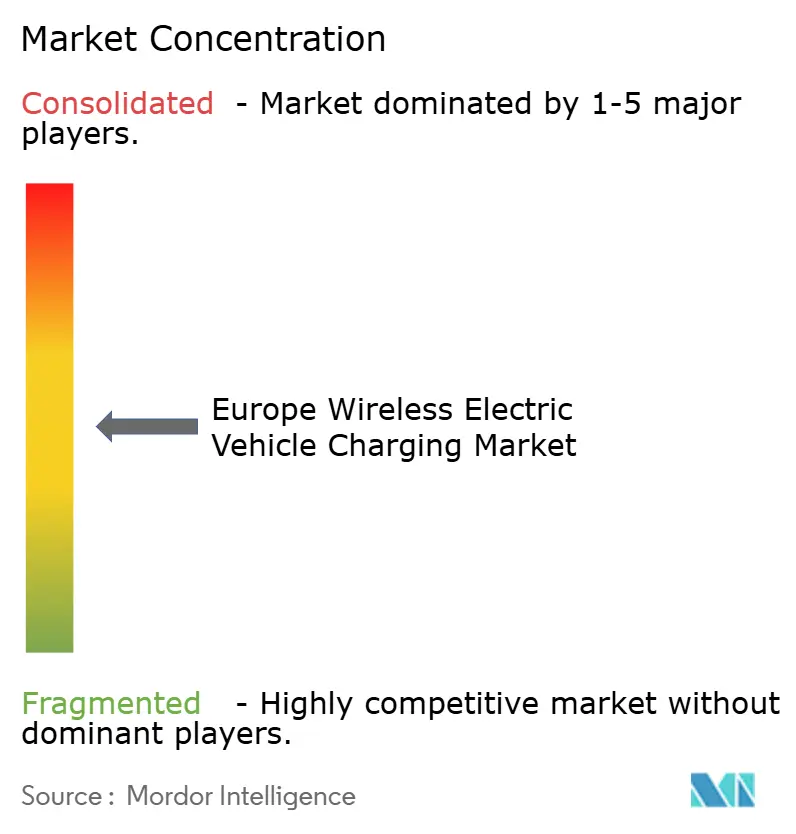
| Market Concentration | Medium |
Major Players *Disclaimer: Major Players sorted in no particular order Image © Mordor Intelligence. Reuse requires attribution under CC BY 4.0. | |
Europe Wireless Electric Vehicle Charging Market Analysis by Mordor Intelligence
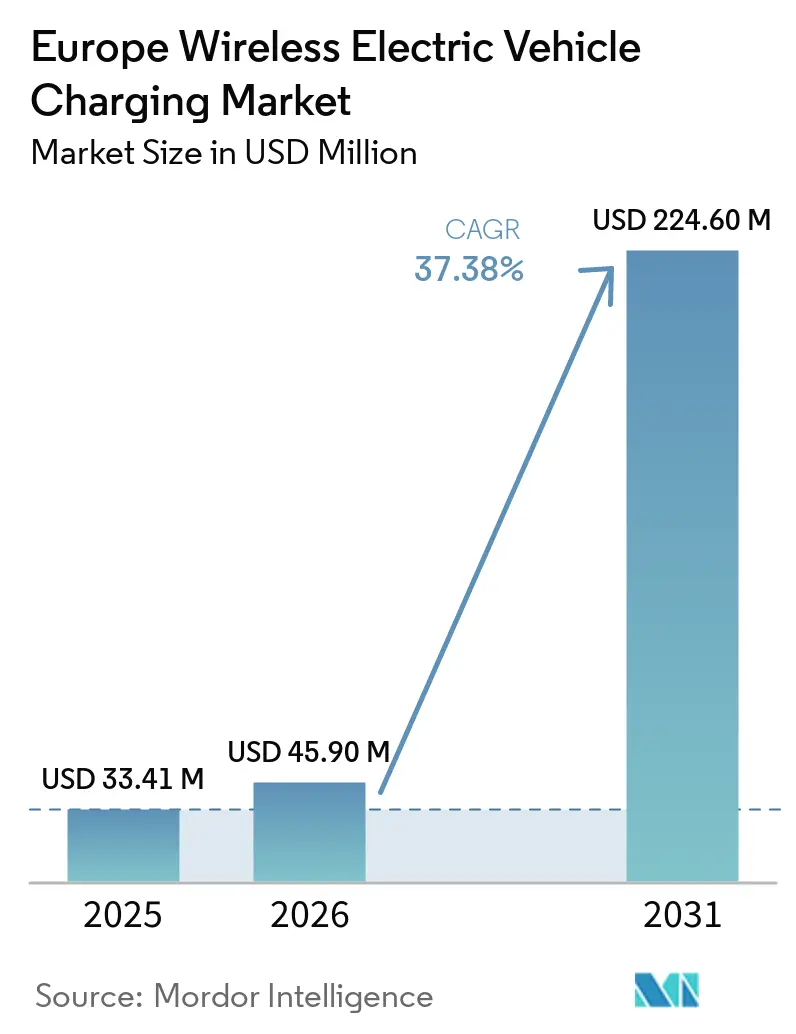
The Europe wireless electric vehicle charging market size was valued at USD 33.41 million in 2025, is estimated at USD 45.90 million in 2026, and is projected to reach USD 224.60 million by 2031, registering a CAGR of 37.38% between 2026 and 2031. The Europe wireless electric vehicle charging market is moving from funded demonstrations toward early commercial deployment in transit fleets and premium passenger vehicles. This transition involves different infrastructure requirements, purchasing processes, and operating patterns, although both use cases value reliable energy transfer without repeated manual cable connections. Both use cases aim to eliminate the driver action required for plug-in charging, thereby improving the consistency of charging activity when vehicles follow regular schedules and return to known locations. EU interoperability rules, OEM design decisions, and fleet interest in depot automation are shaping demand during the same period. The Europe wireless electric vehicle charging market will depend on receiver availability as much as on infrastructure investment because public pads need compatible vehicles to generate utilization. Vendors are therefore competing on technology performance, certification, system integration, and the ability to support different procurement models across public and private charging locations in Europe.
Key Report Takeaways
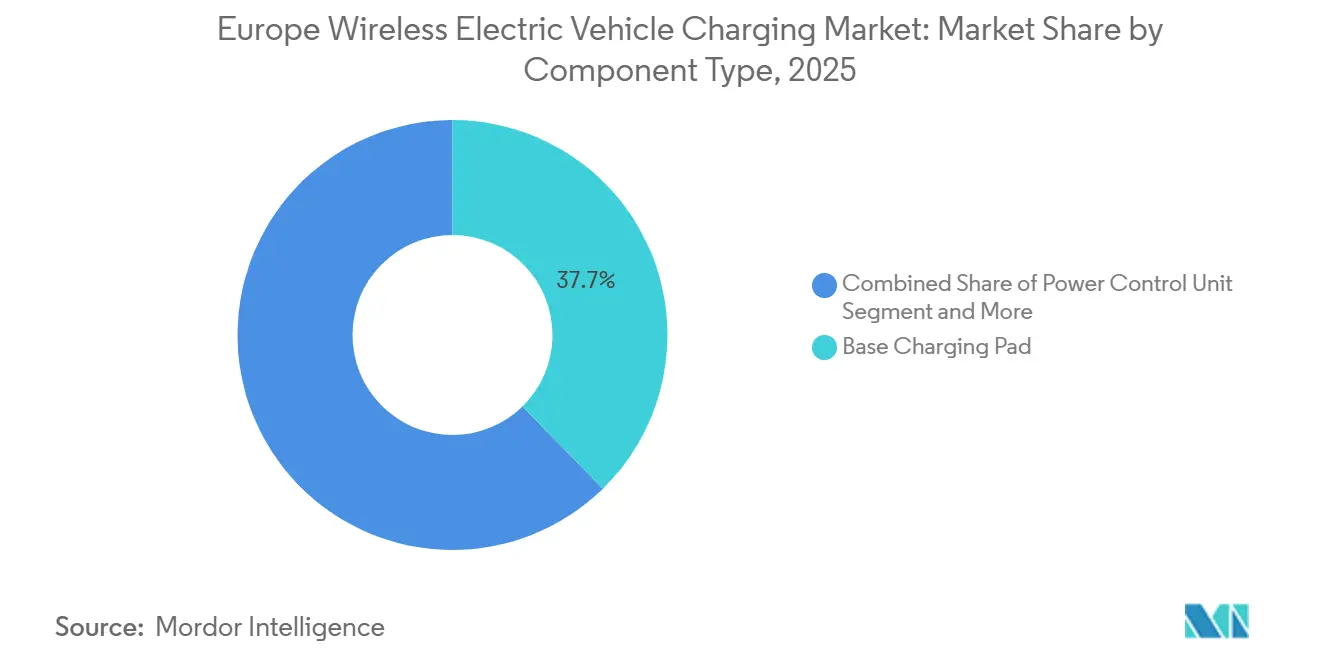
- By component type, base charging pads held 37.67% of the Europe wireless electric vehicle charging market share in 2025, while battery management systems are projected to grow at a CAGR of 40.39% through 2031.
- By charging type, static wireless charging accounted for 78.43% of 2025 revenue, while dynamic wireless charging is projected to expand at a CAGR of 53.29% through 2031.
- By vehicle type, passenger cars accounted for 63.17% of 2025 revenue, while commercial vehicles will advance at a CAGR of 41.76% through 2031.
- By power output, up to 10 kW configurations accounted for 51.29% of 2025 revenue, while above 150 kW configurations will grow at a CAGR of 61.42% through 2031.
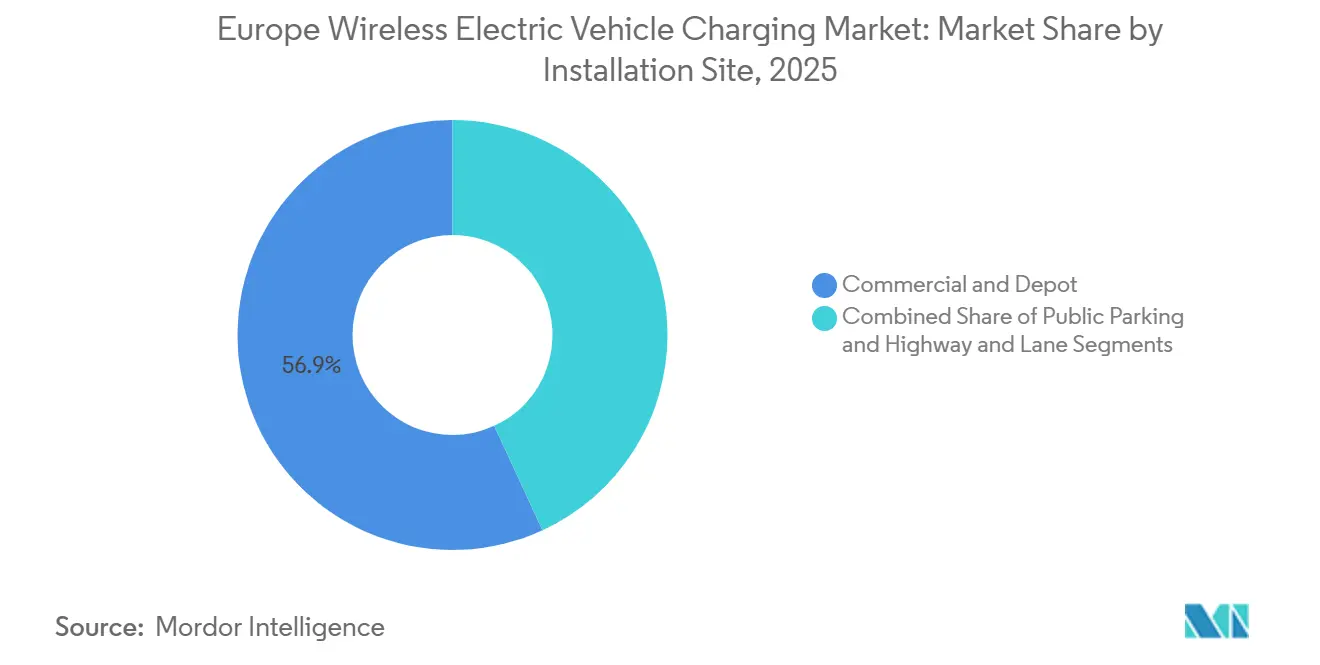
- By installation site, commercial and depot installations accounted for 56.87% of 2025 revenue, while highway and lane installations will record a CAGR of 49.91% through 2031.
- By technology platform, inductive resonant coupling accounted for 71.61% of 2025 revenue, while multi-coil alignment platforms are projected to expand at a CAGR of 58.27% through 2031.
- By country, Germany accounted for 28.35% of 2025 revenue, while the United Kingdom is projected to grow at a CAGR of 52.67% through 2031.
Note: Market size and forecast figures in this report are generated using Mordor Intelligence’s proprietary estimation framework, updated with the latest available data and insights as of January 2026.
Market Trends and Insights
Drivers Impact Analysis of Europe Wireless Electric Vehicle Charging Market*
| Driver | (~) % Impact on CAGR Forecast | Geographic Relevance | Impact Timeline |
|---|---|---|---|
| European Emissions Regulations and Electrification Mandates | +9.2% | EU-wide, highest in Germany, France, and the Netherlands | Short term (≤ 2 years) |
| Public Transit and Municipal Fleet Electrification | +7.1% | Germany, the United Kingdom, Norway, Finland, and the Netherlands | Short term (≤ 2 years) |
| Depot Automation and Fleet Uptime Economics | +5.8% | Germany, the United Kingdom, France, and Benelux | Medium term (2-4 years) |
| OEM Integration and Premium EV Adoption | +5.4% | Germany, the United Kingdom, France, and the Nordics | Medium term (2-4 years) |
| Dynamic Wireless Charging Corridors for Commercial Transport | +4.6% | France, Germany, the United Kingdom, and Norway | Long term (≥ 4 years) |
| Reduced Battery Sizing Through Opportunity Charging | +3.2% | Germany, France, and broader EU corridors | Long term (≥ 4 years) |
| Source: Mordor Intelligence | |||
European Emissions Regulations and Electrification Mandates
EU Delegated Regulation 2025/656 was adopted on April 2, 2025, and entered into force on January 8, 2026. It requires EN IEC 61980-1, EN IEC 61980-2, and EN IEC 61980-3 for inductive static wireless recharging points for light-duty electric vehicles. The common requirements give municipal buyers a clearer basis for including wireless equipment in tender specifications, which is important when public purchasers need documented compliance criteria before they can compare alternative infrastructure approaches. They also reduce the need for vendors to navigate separate national interpretations when serving several EU countries. The Europe wireless electric vehicle charging market can therefore benefit from a more consistent certification route for static systems. This matters for suppliers that want to offer the same core equipment across several countries, for public buyers that need comparable tender requirements, and for vehicle makers that do not want a charging option to require a different technical path in every European location. It can also make project discussions more focused on site design, grid connection, vehicle compatibility, and operational use rather than on unresolved differences in national interpretation. AFIR also requires a minimum pool power of 600 kW at TEN-T Core charging stations from 2027, which encourages operators to plan for a high-capacity wired foundation that can later support automation features [1].
Public Transit and Municipal Fleet Electrification
Public transit authorities are considering wireless charging as fleets are renewed, especially on bus routes with frequent, predictable operating cycles. Automated depot charging can eliminate an additional driver task and support vehicle availability during overnight operations. Oslo, Helsinki, and Amsterdam have dense bus networks with energy use that can be planned on a per-route basis. This setting improves the commercial case because pad use can be measured against the cost of each installation, and operators can relate the charging pattern to known routes, planned dwell time, and the number of vehicles using the site. Fleet procurement cycles typically run for 5-8 years, so systems specified in 2026 can influence the installed base into the early 2030s. The Europe wireless electric vehicle charging market has an opportunity to build references through transit deployments before broader fleet adoption.
Depot Automation and Fleet Uptime Economics
Wireless charging at depots removes the need for a driver to connect a cable during each charging event. This can reduce turnaround time for commercial vehicles and can be assessed against the cost of a pad installation, allowing a fleet operator to consider whether less manual handling and fewer missed charging events improve the economics of daily operations. A project in southwest Stockholm showed an electric light truck charging at a loading dock during goods handling and again overnight at an Ahlsell AB depot. This approach integrates charging with the normal logistics process rather than adding a separate stop. It is relevant where the charging event can occur while a vehicle is already stationary for loading, unloading, or an overnight return, so the operator does not have to create a separate procedure simply to obtain energy. Opportunity charging can also support smaller battery packs, which may reduce vehicle mass and preserve payload capacity for light commercial operators. The Europe wireless electric vehicle charging market is consequently relevant to both depot efficiency and total cost of ownership.
OEM Integration and Premium EV Adoption
Porsche launched an 11 kW wireless charging system for the Cayenne Electric in Europe in 2026 [2]. The system is factory-integrated, certified to EU and U.S. standards, and achieves transfer efficiency above 90% across an air gap of up to 18 cm. The launch changes wireless charging from a pilot or retrofit option into a feature that customers can purchase with a production battery-electric vehicle. It should create operational data from residential and semi-public charging use, including information on customer behavior, positioning performance, energy transfer, and the practical conditions that later vehicle and infrastructure programs will need to address. Suppliers can draw on this experience when pursuing subsequent model-specific approvals with other OEMs. Wider installation on volume platforms will still depend on lower receiver costs and demand commitments from multiple vehicle manufacturers.
Restraints Impact Analysis of Europe Wireless Electric Vehicle Charging Market*
| Restraint | (~) % Impact on CAGR Forecast | Geographic Relevance | Impact Timeline |
|---|---|---|---|
| High Capital Expenditure Compared With Wired DC Charging | -4.8% | EU-wide; most acute in Spain, Italy, Finland | Short to medium term (≤ 3 years) |
| Limited Factory-Fit Receiver Availability in Mass-Market Vehicles | -3.6% | EU-wide; partial relief from OEM pilots in Germany and UK | Medium term (2–4 years) |
| Permitting and Civil-Works Complexity for In-Road Systems | -2.1% | France, Germany, Norway; spill-over to Italy, Spain | Medium to long term (2–5 years) |
| Alignment, Efficiency, and Electromagnetic Compatibility Validation | -1.8% | EU-wide; most acute in Germany (KBA) and Netherlands | Medium term (2–4 years) |
| Source: Mordor Intelligence | |||
High Capital Expenditure Compared With Wired DC Charging
Dynamic wireless systems require excavation, coil embedding, and road-surface restoration, which raise the capital cost of a route compared with wired charging infrastructure. Road closures can add indirect costs to active logistics corridors. Static pads require less extensive civil work, but they can still cost more than alternatives that do not need sub-floor installation. The Europe wireless electric vehicle charging market must show operational savings and battery-related benefits to support a higher upfront investment. The commercial case is strongest where charging automation offers clear value for fleet uptime or labor utilization, since an operator must be able to link the higher project cost to measurable benefits from a more dependable charging process. Cost reduction will depend on installing coils alongside planned road maintenance and increasing hardware production volumes.
Limited Factory-Fit Receiver Availability in Mass-Market Vehicles
Public pads and charging lanes cannot create revenue without compatible receiver hardware on vehicles. Receiver penetration in Europe remains limited, aside from transit pilots and the Porsche Cayenne Electric launch. Retrofit programs can provide a partial alternative, but their volumes are not sufficient to change the vehicle base quickly. This limits utilization for operators who consider public wireless infrastructure before factory-fit options become common, leaving them unable to assume that many vehicles can use an asset simply because it is installed in a public or semi-public location. The constraint should ease as premium installations demonstrate demand and vehicle makers broaden their offerings. Until then, infrastructure operators are making a long-term commitment to the adoption of receivers in the Europe wireless electric vehicle charging market.
*Our forecasts treat driver/restraint impacts as directional, not additive. The impact forecasts reflect baseline growth, mix effects, and variable interactions.
Europe Wireless Electric Vehicle Charging Market Segment Analysis
By Component Type:
Base Charging Pads Lead Current Revenue While Battery Management Systems Grow FastestBase Charging Pads accounted for 37.67% of 2025 component revenue, making ground-side equipment the largest current hardware element. Each installation requires a transmitter pad, whether it serves a private parking space, a depot, or a road system, so the ground-side asset remains central to the delivered system value and the installation plan. Battery Management Systems are forecast to grow at a CAGR of 40.39% from 2026 to 2031. Wireless BMS designs can eliminate low-voltage wiring harnesses between battery cells, thereby changing the battery-pack architecture and giving vehicle developers another reason to coordinate charging and battery-system decisions. This can lower pack weight and simplify battery assembly. It can also support over-the-air diagnostics and predictive maintenance functions.
The Europe wireless electric vehicle charging market size for components will continue to reflect the need for both ground-side and vehicle-side equipment. Power Control Units manage power transfer across varying air gaps and vehicle positions. Vehicle Charging Pads receive the transmitted energy and must work with the vehicle battery system. EN IEC 61980-2:2023 defines communications between a pad and vehicle receiver under the EU requirements that apply from January 2026. This standard provides suppliers with a shared interface for integration, so that the charging pad, the receiver, and the vehicle systems can be designed around common communication expectations rather than different approaches for each national or vehicle-specific deployment. For suppliers, that consistency is particularly important when component development must align with multiple OEM programs and infrastructure projects simultaneously. It may lower the cost of adapting a wireless BMS architecture for multiple OEM programs.

By Charging Type:
Static Systems Anchor Revenue While Dynamic Corridors Scale RapidlyStatic Wireless Charging held 78.43% of 2025 revenue, reflecting its earlier commercial readiness in depots and parking locations. Vehicle positions are predictable in these settings, and civil work can be planned within a defined site. Operators can also estimate returns based on known fleet or parking use. Dynamic Wireless Charging will grow at a CAGR of 53.29% from 2026 to 2031, building on a smaller installed base. Its progress depends on corridor pilots moving into formal road-authority procurement, where sponsors must demonstrate that the technology can be installed, maintained, and operated within normal road-management practices. The assessment also extends beyond the charging equipment because authorities must consider traffic disruption, construction sequencing, road-surface quality, and the expected use by compatible commercial vehicles. The A10 project near Paris provides an operational test case for this transition.
The A10 deployment covers 1.5 km of live motorway and uses 900 copper induction coils. A consortium led by VINCI Autoroutes reported peak power exceeding 300 kW and average power exceeding 200 kW during trials. Independent laboratories from Gustave Eiffel University assessed the results. Static and dynamic applications serve different customer groups and use different contract structures, with site owners making focused equipment decisions and road authorities assessing longer-lived public infrastructure commitments. Static systems are usually sold for a specific site, while dynamic systems require long-term agreements with road authorities or concession holders. The Europe wireless electric vehicle charging market will require vendors to choose carefully between these operating models. A vendor serving a depot can work with a defined fleet owner, a known site, and a contained construction schedule. A vendor serving a public road faces a wider group of stakeholders that can include a road agency, a concession holder, construction contractors, electricity providers, local authorities, and commercial vehicle operators. The skills, timing, and financial structure for those opportunities are therefore materially different even when both use inductive energy transfer.
By Vehicle Type:
Passenger Cars Lead While Commercial Vehicles Grow FastestPassenger Cars accounted for 63.17% of 2025 vehicle-type revenue, driven mainly by premium residential and semi-public charging. Porsche’s 2026 Cayenne Electric is a current example of factory-fit passenger-vehicle integration. Commercial Vehicles will grow at a CAGR of 41.76% through 2031. Buses and coaches represent a major near-term use case because municipal fleets have dense routes and regular depot schedules. Heavy commercial vehicles could gain importance if highway pilots establish a workable freight model, particularly where a vehicle’s range, payload, and route timing make conventional stop-and-charge approaches less suitable. The value case will depend on whether energy can be delivered reliably during travel or at planned stops without disrupting freight schedules. Light commercial vehicles are also being assessed for pad-based charging as part of depot automation plans.
Germany registered more than 4,000 electric trucks in 2025, showing that commercial electrification had moved beyond isolated demonstrations. Charging selection now centers on keeping vehicles in service through their operating cycles, because lost time at a depot or during goods handling can affect route completion, vehicle use, and the practical value of fleet electrification. The Stockholm deployment showed a truck receiving energy at a loading dock and again overnight at a depot. This multi-touchpoint approach can make opportunity charging relevant without a dedicated highway lane. It also links charging decisions to delivery activity and goods-handling dwell time. These operational needs support the expansion of the Europe wireless electric vehicle charging market in commercial fleets.
By Power Output:
Below 10 kW Systems Lead While Above 150 kW Systems AccelerateBelow 10 kW accounted for 51.29% of the 2025 power-output revenue. They suit passenger vehicle homes and semi-public sites where grid capacity and vehicle needs limit practical output. Mid-range configurations between 11 kW and 150 kW support depot charging for buses and vans, where several vehicles may need energy within a defined overnight or between-shift window. The relevant requirement is not only the output of one pad but also how the site coordinates its available grid capacity across the fleet. Configurations above 150 kW will expand at a CAGR of 61.42% through 2031. These systems target dynamic roads and high-throughput commercial depots that need performance comparable with wired DC charging.
Electreon and Infineon used CoolSiC 2000 V EasyPACK 3B silicon carbide modules in the A10 system. The companies reported an average power of 200 kW and peak values above 300 kW. Silicon carbide supports the switching and thermal performance required in compact coils for road embedding. Component suppliers, therefore, have a direct role in whether high-power systems can move beyond pilot volumes, since the electrical design, thermal performance, equipment availability, and cost position must all support reliable service in demanding operating conditions. Their manufacturing capacity and pricing will affect the timing of broader deployment. The Europe wireless electric vehicle charging market will need reliable high-power electronics for its most demanding applications.
By Installation Site:
Depots Lead While Highway Sites Move Toward Commercial DeploymentCommercial and Depot installations held 56.87% of 2025 revenue, supported by controlled sites with known vehicle positions and managed grid connections. These conditions also reduce the public permitting challenges found in road projects. Public Parking serves premium passenger applications in cities and corporate locations. Its economics remain dependent on greater receiver availability, because a public parking asset has to serve enough compatible vehicles to justify its equipment and site costs. This differs from a fleet depot, where the operator can buy vehicles and charging equipment as part of the same operating decision. Highway and Lane installations will grow at a CAGR of 49.91% from 2026 to 2031. Their growth starts from corridor pilots and relies on transport agencies converting approvals into procurement programs, a process that requires confidence in equipment performance, construction methods, safety compliance, and the operating case for each route.
Highway deployment requires a different construction approach from depot deployment. Installation during scheduled pavement resurfacing can avoid a separate excavation project, allowing the road work and the charging work to be considered together instead of imposing two distinct construction programs on the same corridor. This approach can reduce disruption and may improve the long-term economics of in-road systems. It also ties project timing to road-maintenance cycles rather than vehicle purchase schedules. Operators and road authorities will need to balance construction, traffic management, and equipment performance requirements. These factors shape the next phase of the Europe wireless electric vehicle charging market for highway sites.
By Technology Platform:
Inductive Resonant Coupling Is Established While Multi-Coil Platforms Grow FastestInductive Resonant Coupling held 71.61% of the 2025 technology-platform revenue. Its position reflects technological maturity, established OEM certification pathways, and alignment with the requirements of EN IEC 61980. Those factors matter because vehicle makers and infrastructure providers can use a technology-based approach with defined communications, operational parameters, and a clearer route through the compliance process. Porsche uses this approach in the Cayenne Electric system at 85 kHz. The system also tolerates up to 10 cm of lateral misalignment. Inductive resonant coupling is expected to remain important in lower-power static applications. Its efficiency and alignment with standards give operators a well-understood path for deployment.
Multi-Coil Alignment Platforms will expand at a CAGR of 58.27% through 2031. Standard single-coil systems require close vehicle positioning, which can reduce throughput in busy depots. Multi-coil systems use overlapping transmitter arrays and adaptive electronics to serve vehicles across a defined parking zone. They can support mixed fleets with different receiver positions without mechanical reconfiguration, helping operators maintain a consistent charging process when buses, vans, or other fleet vehicles do not share the same underbody geometry. This is useful for bus depots that operate several vehicle models, where a charging zone that works across differing positions can reduce operational complexity and preserve the core benefit of removing repeated manual connection tasks. Other platforms, including capacitive coupling and tightly coupled ferrite-core designs, remain relevant for specialized industrial applications with challenging environmental conditions. These applications may involve underwater, underground, or high-vibration environments where the usual resonant coupling configuration is not the best fit for the vehicle or the operating location.
Geography Analysis
Germany Wireless Electric Vehicle Charging Market
Germany held 28.35% of the Europe wireless electric vehicle charging market share in 2025. The country combines OEM and Tier-1 supplier research activity with a growing commercial electric vehicle base, giving equipment providers access to vehicle-development relationships and fleets that can test charging systems in real operating conditions. Federal programs support infrastructure work with a commercial purpose, including charging corridors and fleet sites. Germany also has an expanding wired fast-charging base that can support later automation layers. Its projects cover motorway corridors, transit depots, and logistics hubs.
Germany’s scale makes it an important commercial reference for the region because its pipeline includes various deployment settings that collectively test vehicle integration, depot use, logistics operations, and road-based charging requirements. Type approval for grid-connected equipment can take 18-24 months under German electromagnetic compatibility rules. That process can slow individual deployments even when the infrastructure interest is strong. France has a complementary role because the A10 motorway project became the first live motorway dynamic charging system. Its performance is relevant to concession authorities evaluating road-embedded technology, because the project addresses the combination of power delivery, vehicle operation, embedded infrastructure, and live-road conditions. The results offer a practical reference for authorities that need evidence beyond laboratory testing before considering comparable work on their own networks. The Europe wireless electric vehicle charging market will watch how these two national settings turn pilots into repeatable projects, since repeatability will determine whether suppliers can move from one-off installations to models that road agencies and fleet operators can procure with greater confidence.
United Kingdom Wireless Electric Vehicle Charging Market
The United Kingdom will be the fastest-growing geography at a CAGR of 52.67% from 2026 to 2031. The UK Government committed funding to EV charging infrastructure. The package includes funding for the Strategic Charging Infrastructure scheme. Norway, Finland, and the Netherlands offer favorable conditions for transit, residential, and semi-public charging deployments, supported by high electric vehicle adoption and favorable policy frameworks. Spain and Italy face charging-density requirements and possess freight corridors that could become relevant as in-road charging costs decline. Russia remains constrained by its separation from EU supply chains, common standards, and OEM platform arrangements.
Competitive Landscape
The Europe wireless electric vehicle charging market is moderately concentrated among infrastructure specialists, Tier-1 automotive suppliers, and system integrators. WiTricity’s magnetic resonance licensing model supports an ecosystem that includes OEMs and suppliers such as ABT e-Line. Continental AG, Robert Bosch GmbH, and ZF Friedrichshafen AG compete in the component and integration layer. Their existing OEM relationships span power electronics, vehicle software, and electrification systems. These relationships can be difficult for independent technology specialists to replicate within a single procurement cycle, because a vehicle program must coordinate hardware, software, safety validation, manufacturing requirements, and service support before an option becomes available to customers. Competition, therefore, includes intellectual property, certification experience, and access to vehicle development programs, as suppliers need to demonstrate that their systems can operate within vehicle platforms and meet the formal requirements for charging equipment.
Electreon expanded its technical scope through the March 2026 acquisition of InductEV. The transaction combined 400 granted and pending patents across static pad, ultra-fast stationary, and dynamic in-road applications. This portfolio provides the combined company with coverage across passenger, delivery, transit, and heavy-duty use cases, allowing it to address applications with markedly different charging power, vehicle positioning, dwell time, and installation requirements. It also reduces the need to rely on a single deployment type as the basis for product development and customer engagement. Infineon has worked with Electreon on silicon carbide modules designed for high-power systems. This relationship shows that semiconductor suppliers can become development partners rather than only component vendors. In high-power wireless projects, component selection has consequences for the overall charging architecture, the physical size of equipment, and the performance the system can sustain under field conditions. The Europe wireless electric vehicle charging market also has room for software that assigns vehicles to pads, schedules power, and manages grid response across a mixed fleet, as the charging asset must operate with vehicle schedules, depot procedures, electricity constraints, and changing daily energy requirements.
Easelink offers an alternative approach to automation with its Matrix Charging conductive pin system. SEG Automotive is working with Easelink on industrialization and OEM series production. The system offers high transfer efficiency but uses physical contact and a ground-mounted pad. Magment’s magnetizable concrete method could reduce road installation time if it proves viable at a commercial scale. Electromagnetic field safety requirements under IEC 62233 and EU EMF Directive 2013/35/EU add certification work. Larger suppliers may be better placed to manage this regulatory burden, because established teams can coordinate safety documentation, technical validation, product changes, and discussions with customers across several European jurisdictions.
Europe Wireless Electric Vehicle Charging Industry Leaders
-
HEVO Power
-
WiTricity Corporation
-
Electreon Wireless Ltd.
-
ENRX Group AS
-
Plugless Power Inc.
- *Disclaimer: Major Players sorted in no particular order
Europe Wireless Electric Vehicle Charging Market Companies Covered in this Report
- WiTricity Corporation
- Electreon Wireless Ltd.
- HEVO Power
- Plugless Power Inc. (Evatran Group)
- Continental AG
- Robert Bosch GmbH
- Toshiba Corporation
- Qualcomm Technologies, Inc.
- Siemens AG
- ABB Ltd.
- Wireless Advanced Vehicle Electrification, LLC.
- ENRX Group AS
- Momentum Dynamics Corporation
- ZF Friedrichshafen AG
- Valeo SE
- Denso Corporation
- Hitachi Astemo, Ltd.
Read Analysis of Europe Wireless Electric Vehicle Charging Companies
Recent Industry Developments in Europe Wireless Electric Vehicle Charging Market
- June 2026: ERTICO – ITS Europe officially launched WiBiCharge, a new Horizon Europe project that brings together 16 organizations across Europe to advance the next generation of wireless bidirectional charging for electric vehicles.
- March 2026: IVECO introduced the first road-ready eDaily electric van with wireless charging. The vehicle supports both dynamic wireless power transfer (DWPT) while driving and static charging when parked. This development demonstrates the increasing practicality of inductive charging technology and its potential to support the transition to electric transportation.
Europe Wireless Electric Vehicle Charging Market Report Scope
The Europe Wireless Electric Vehicle Charging Market is Segmented by Component (Base Pad, PCU, Vehicle Pad, BMS), Charging (Static, Dynamic), Vehicle Type (Passenger Cars, Commercial), Power Output (Below 11 kW, 11-150 kW, Above 150 kW), Installation (Depot, Parking, Highway), Technology (Inductive, Multi-Coil, Other), and Geography (Germany, France, UK, Spain, Italy, Norway, Finland, Netherlands, Russia, Rest of Europe). The Market Size and Forecasts are Provided in Terms of Value (USD).
Segmentation Overview
By Component Type
| Base Charging Pad |
| Power Control Unit |
| Vehicle Charging Pad |
| Battery Management Systems |
By Charging Type
| Static Wireless Charging |
| Dynamic Wireless Charging |
By Vehicle Type
| Passenger Cars | |
| Commercial Vehicles | Buses and Coaches |
| Light Commercial Vehicles | |
| Heavy Commercial Vehicles |
By Power Output
| Below 10 kW |
| 11-50 kW |
| 50-150 kW |
| Above 150 kW |
By Installation Site
| Commercial and Depot |
| Public Parking |
| Highway and Lane |
By Technology Platform
| Inductive Resonant Coupling |
| Multi-Coil Alignment Platforms |
| Other Technology Platforms |
By Country
| Germany |
| France |
| United Kingdom |
| Spain |
| Italy |
| Norway |
| Finland |
| Netherlands |
| Russia |
| Rest of Europe |
| By Component Type | Base Charging Pad | |
| Power Control Unit | ||
| Vehicle Charging Pad | ||
| Battery Management Systems | ||
| By Charging Type | Static Wireless Charging | |
| Dynamic Wireless Charging | ||
| By Vehicle Type | Passenger Cars | |
| Commercial Vehicles | Buses and Coaches | |
| Light Commercial Vehicles | ||
| Heavy Commercial Vehicles | ||
| By Power Output | Below 10 kW | |
| 11-50 kW | ||
| 50-150 kW | ||
| Above 150 kW | ||
| By Installation Site | Commercial and Depot | |
| Public Parking | ||
| Highway and Lane | ||
| By Technology Platform | Inductive Resonant Coupling | |
| Multi-Coil Alignment Platforms | ||
| Other Technology Platforms | ||
| By Country | Germany | |
| France | ||
| United Kingdom | ||
| Spain | ||
| Italy | ||
| Norway | ||
| Finland | ||
| Netherlands | ||
| Russia | ||
| Rest of Europe | ||
Key Questions Answered in the Report
What is driving demand for wireless EV charging in Europe?
EU interoperability rules, fleet depot automation, and vehicle maker integration are supporting growth through 2031.
How large will European wireless EV charging become by 2031?
The category is forecast to reach USD 224.60 million by 2031, growing at a 37.38% CAGR from 2026.
Which charging approach leads current revenue in Europe?
Static Wireless Charging led with 78.43% of 2025 revenue because it is ready for depots and fixed parking locations.
Why are commercial fleets adopting wireless charging systems?
Automated charging can remove driver steps, support depot uptime, and enable opportunity charging during logistics activity.
What is limiting wider adoption of wireless charging for electric vehicles?
Higher installation costs and limited factory-fit receiver availability in mass-market vehicles remain the main barriers.