
Market Overview
| Study Period | 2021 - 2031 |
|---|---|
| Forecast Data Period | 2026 - 2031 |
| Base Year Market Size (2025) | USD 1.06 Billion |
| Market Size (2026) | USD 1.12 Billion |
| Market Size (2031) | USD 1.46 Billion |
| Growth Rate (2026 - 2031) | 5.39 % |
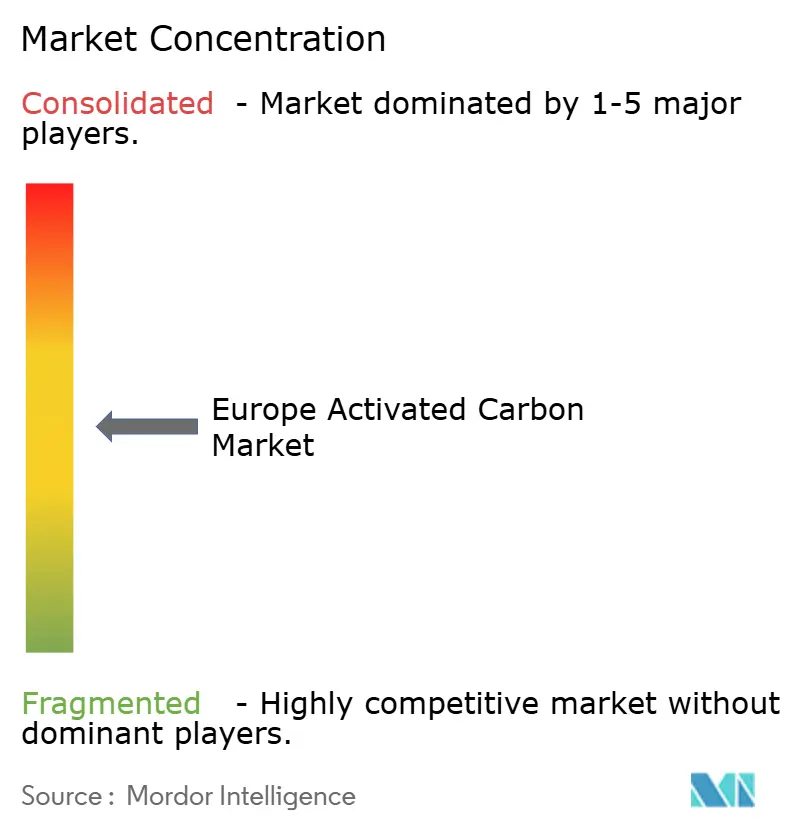
| Market Concentration | Medium |
Major Players *Disclaimer: Major Players sorted in no particular order Image © Mordor Intelligence. Reuse requires attribution under CC BY 4.0. | |
Europe Activated Carbon Market Analysis by Mordor Intelligence
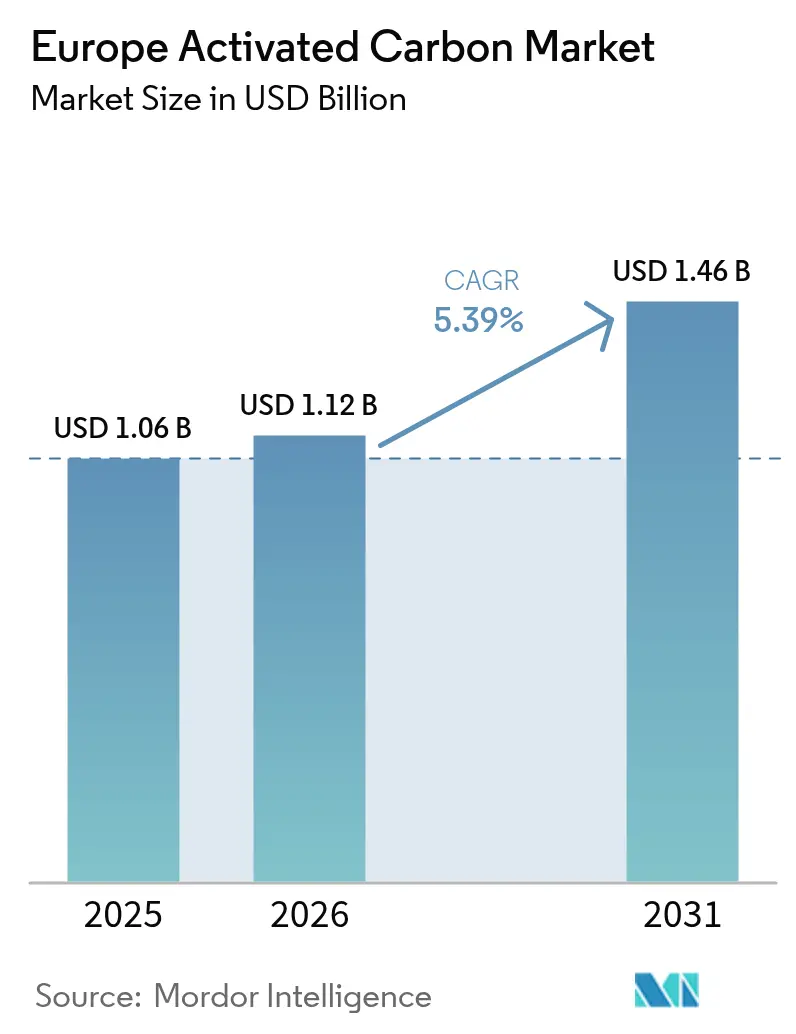
The Europe Activated Carbon Market size is projected to be USD 1.06 billion in 2025, USD 1.12 billion in 2026, and reach USD 1.46 billion by 2031, growing at a CAGR of 5.39% from 2026 to 2031. Persistent tightening of water-quality directives, rising scrutiny of industrial flue-gas emissions, and embedded-carbon disclosure rules are combining to lift baseline demand across utilities, process industries, and specialty-chemical segments. The new 0.10 µg/L limit for a group of 20 PFAS compounds under the revised Drinking Water Directive that came into force in January 2026 has already forced municipal operators in Germany, France, and the Netherlands to accelerate procurement cycles, often layering powdered or granular activated carbon into existing trains rather than waiting for scheduled media changeouts. Coal- and biomass-fired power plants are following a similar compliance arc after the 2024 BAT conclusions under the Industrial Emissions Directive lowered permissible mercury in flue gas to 1 µg/Nm³, a threshold that is driving adoption of brominated PAC injection systems. At the same time, the Carbon Border Adjustment Mechanism (CBAM) is widening the landed-cost gap between coal-based imports and lower-carbon coconut- or wood-based grades, reshaping sourcing strategies for utilities and beverage fillers alike. Taken together, these regulatory moves reinforce a structural uptrend in the Europe activated carbon market, even as feedstock price swings and early-stage biochar substitutes inject episodic volatility.
Key Report Takeaways
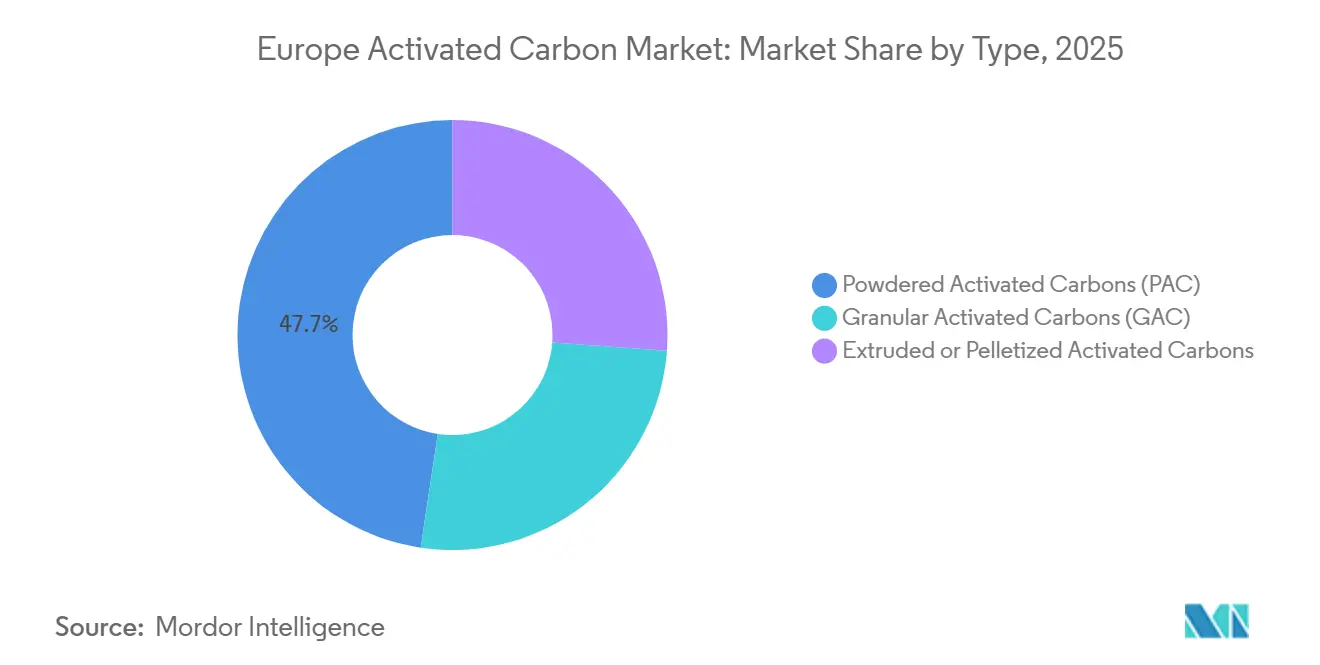
- By product type, Powdered Activated Carbon (PAC) held 47.63% of the Europe activated carbon market share in 2025 and is projected to expand at a 5.67% CAGR through 2031.
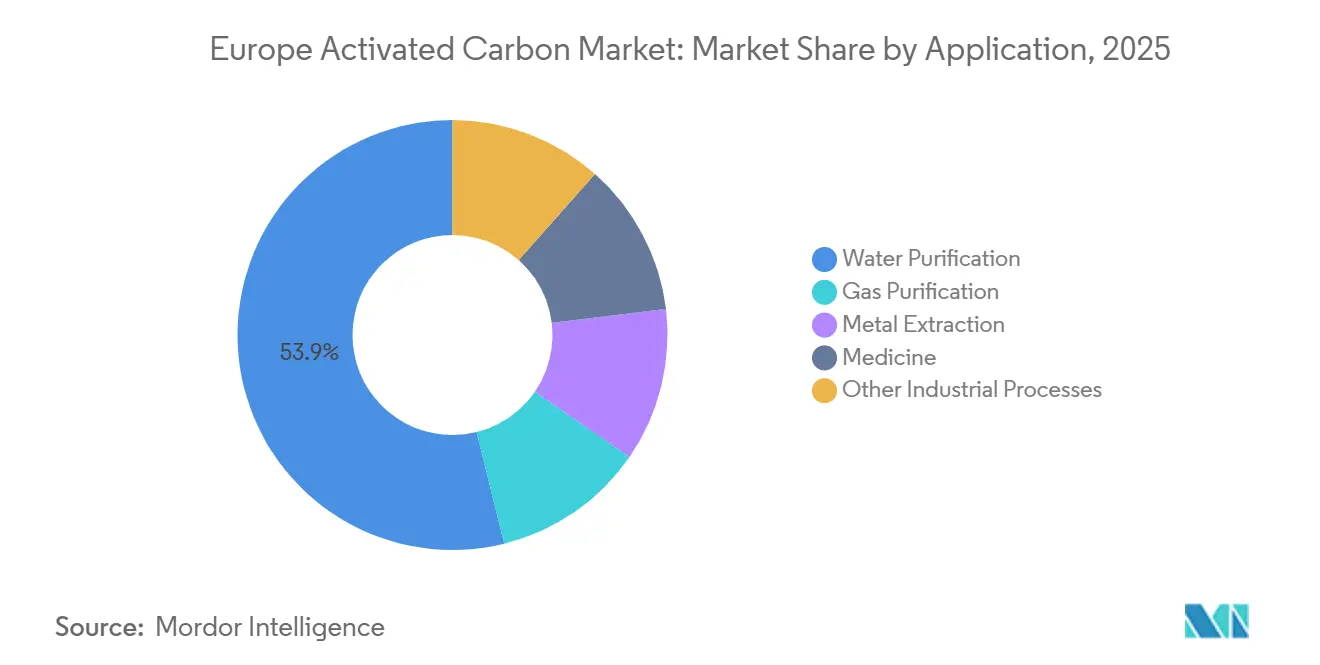
- By application, water purification commanded 53.87% of the Europe activated carbon market size in 2025, while medicine applications record the highest projected CAGR at 6.81% to 2031.
- By geography, Germany accounted for 31.99% revenue share in 2025; the country is advancing at a 5.92% CAGR through 2031.
Note: Market size and forecast figures in this report are generated using Mordor Intelligence’s proprietary estimation framework, updated with the latest available data and insights as of 2026.
Market Trends and Insights
Drivers Impact Analysis of Europe Activated Carbon Market*
| Driver | (~) % Impact on CAGR Forecast | Geographic Relevance | Impact Timeline |
|---|---|---|---|
| Surging demand from municipal water utilities | +1.2% | Germany, France, Netherlands, Belgium | Short term (≤ 2 years) |
| Mercury-emissions cap in coal & biomass co-firing | +0.9% | Germany, Poland, Czech Republic | Medium term (2-4 years) |
| Rising PFAS removal mandates in groundwater | +1.5% | Germany, Netherlands, Denmark, Sweden | Short term (≤ 2 years) |
| Regenerative carbon-reactivation service contracts gaining traction | +0.6% | Germany, France, UK, Italy | Medium term (2-4 years) |
| Expansion of European beer & hard-seltzer filtration lines | +0.4% | Germany, Belgium, UK, Czech Republic | Long term (≥ 4 years) |
| Source: Mordor Intelligence | |||
Surging Demand From Municipal Water Utilities
Utility buyers are front-loading orders to comply with the 2026 Drinking Water Directive, which fixes a binding deadline of January 2029 for PFAS monitoring and removal. Germany’s Federal Environment Agency disclosed in December 2025 that 23% of sampled groundwater wells already exceed the 0.10 µg/L ceiling, prompting emergency tenders across Bavaria and Hesse[1]. French operator Veolia committed EUR 85 million to retrofit 14 plants with fresh GAC beds and PAC-dosing skids, explicitly citing the inability of legacy media to meet short-chain PFAS targets. Supply-chain lead times have lengthened into Q3 2026, and product specifications now emphasize mesoporous carbons derived from coconut shell, which show higher uptake for four-carbon PFBA molecules. The ripple effect is a measurable uplift in spot pricing for both PAC and GAC, yet utilities appear willing to pay the premium because regulatory penalties for non-compliance can reach EUR 500,000 per incident. This dynamic injects near-term momentum into the Europe activated carbon market while foregrounding the importance of agile dosing technologies.
Mercury-Emissions Cap in Coal & Biomass Co-Firing
The 2024 BAT conclusions slashed mercury limits for large combustion plants above 300 MW th, compelling operators to double or even triple PAC injection rates. Poland’s PGE Energia is now consuming 1,200 t of brominated PAC annually across Bełchatów and Turów to hold stack concentrations below 1 µg/Nm³. RWE’s Neurath lignite complex followed a similar path, scaling injection equipment and entering multi-year supply contracts with specialty carbon vendors. Bromination raises unit prices by 30%–40%, but life-cycle cost models still favor PAC over catalytic sorbents when carbon-allowance expenses under the EU-ETS are factored in. Smaller biomass co-firing units confront the same threshold; their inherently lower baseline mercury is offset by wide variability in feedstock, forcing continuous PAC dosing as a guardrail. The upshot is sustained, moderately counter-cyclical demand that shores up revenue diversity inside the Europe activated carbon market.
Rising PFAS Removal Mandates in Groundwater
Beyond the drinking-water sphere, the European Chemicals Agency is finalizing a broad PFAS restriction that will push industrial property owners to remediate legacy hotspots between 2026 and 2031. The Dutch Ministry of Infrastructure and Water Management reported in June 2025 that 18 chemical sites near Dordrecht and Rotterdam have already installed pump-and-treat systems using coconut-shell GAC, totaling about 800 t of annual carbon throughput. Denmark’s Environmental Protection Agency ordered cleanup at 12 firefighting-training areas, again specifying high-micropore GAC for PFOA and PFOS sorption. Because such groundwater projects often run 5–10 years, they establish a predictable replacement cadence that insulates providers from short-term commodity swings. The backlog of remediation projects should therefore keep the Europe activated carbon market on a firm growth path even if municipal budgets temporarily tighten.
Regenerative Carbon-Reactivation Service Contracts Gaining Traction
Thermal reactivation at 800–900°C recovers 85%–95% of spent carbon mass, a metric that now carries financial heft as waste-disposal fees surpass EUR 150/t in Germany and the Netherlands. Desotec logged a 22% jump in reactivation contracts during 2025, citing pharmaceutical and chemical customers eager to lower Scope 3 footprints. Calgon Carbon introduced a subscription-style “Carbon-as-a-Service” bundle that converts capital outlays into operating costs and embeds real-time tracking for CSRD reporting. Contract lengths are stretching to 3–5 years, smoothing revenue visibility for suppliers and reducing spot-market volatility. As more corporates adopt internal carbon-pricing schemes, reactivation is expected to graduate from a cost-avoidance tool into a mainstream procurement norm, further undergirding the Europe activated carbon market.
Restraints Impact Analysis of Europe Activated Carbon Market*
| Restraint | (~) % Impact on CAGR Forecast | Geographic Relevance | Impact Timeline |
|---|---|---|---|
| Price volatility of coconut-shell & coal feedstocks | -0.8% | Europe-wide, acute in Germany, France, UK | Short term (≤ 2 years) |
| Availability of engineered biochar substitutes | -0.3% | Germany, Netherlands, Sweden | Medium term (2-4 years) |
| Carbon Border Adjustment Mechanism cost on coal-based grades | -0.5% | Import-dependent markets: Italy, Spain, Poland | Medium term (2-4 years) |
| Source: Mordor Intelligence | |||
Price Volatility of Coconut-Shell & Coal Feedstocks
Typhoon Mawar and Cyclone Mocha disrupted coconut-shell supply chains in 2025, slashing Sri Lankan charcoal exports by 24% and sending Rotterdam PAC spot prices from EUR 2,100/t in January to EUR 2,480/t by September[2]. Parallel spikes in anthracite followed TTF gas futures upward; when gas touched EUR 45/MWh in December 2025, anthracite climbed 14% month on month. Because coconut and coal markets are uncorrelated and lack hedging instruments, suppliers had little room to offset squeezes, narrowing gross margins across the Europe activated carbon industry. Utilities on fixed-price tenders bore the brunt, occasionally invoking force-majeure clauses to recover costs.
Carbon Border Adjustment Mechanism Cost on Coal-Based Grades
Full CBAM enforcement on 1 January 2026 now taxes embedded CO₂ at the EU-ETS price, adding EUR 300–350/t to Chinese coal-based carbon imports with a 4 t CO₂e footprint. Italian and Spanish processors that once sourced half their volumes from Asia are pivoting to coconut-shell or EU-made wood grades. This split is manifesting in a two-tier market: premium low-carbon grades for CBAM-exposed segments and legacy coal grades for less-regulated niches. The phenomenon is already redirecting capital toward European expansion projects and reinforcing the long-term resilience of the Europe activated carbon market.
*Our forecasts treat driver/restraint impacts as directional, not additive. The impact forecasts reflect baseline growth, mix effects, and variable interactions.
Europe Activated Carbon Market Segment Analysis
By Product Type:
PAC’s Dosing Agility Captures Municipal SurgePowdered activated carbon controlled 47.65% of revenue in 2025, and its share of the Europe activated carbon market size is projected to increase steadily at a 5.67% CAGR to 2031. Water utilities value the ability to spike PAC directly into clarifiers within hours of detecting river-borne PFAS or geosmin episodes, a flexibility unattainable with fixed-bed GAC systems. Veolia’s 2025 tender demanded 48-hour delivery for 3,200 t of PAC, underscoring how supply-chain responsiveness has become a procurement criterion. GAC, although slower growing, remains the backbone for continuous remediation and industrial reuse loops; Netherlands-based Waternet cut annual carbon consumption by 35% after switching a major plant to GAC despite paying EUR 4 million in upfront capex. Extruded and pelletized grades retain a smaller share but are indispensable in gas-phase VOC recovery where low pressure drop matters. Cabot’s launch of a wood-based pellet with 1,100 m²/g surface area offered a CBAM-friendly alternative and illustrates feedstock migration trends. This product mix evolution reinforces the depth of the Europe activated carbon market.

By Application:
Medicine Segment Outpaces Legacy Water UsesWater purification remained dominant at 53.87% of 2025 turnover, yet medicine is the breakout category, growing at 6.81%. The European Medicines Agency tightened heavy-metal limits in APIs in 2024, compelling drug makers to polish intermediates with ultrapure PAC. Merck KGaA now draws roughly 120 t per year of pharmaceutical-grade PAC across two German sites. Over-the-counter oral detoxification tablets gained two ANSM approvals in 2025, expanding retail channels in France. Gas purification applications are growing in lockstep with mercury and VOC constraints, while nascent energy-storage uses remain small but technically demanding, positioning suppliers like Ingevity, developing 1,800 m²/g capacitor carbons, for differentiated growth. Together, these dynamics widen the opportunity set embedded in the Europe activated carbon market.
Geography Analysis
Germany Activated Carbon Market
Germany cemented its pre-eminence in the Europe activated carbon market by accounting for 31.99% of 2025 revenue and charting a 5.92% CAGR to 2031. Emergency PFAS tenders exceeding 1,800 t of combined PAC and GAC in Bavaria and Hesse, coupled with 1,200 t of brominated PAC for mercury abatement in lignite plants, have made the country the region’s single largest offtake node. Reactivation infrastructure, such as Donau Carbon’s 12,000 t/yr facility in Offenbach, further binds German buyers to local supply chains, reducing CBAM exposure and shortening turnaround cycles.
Western and Southern Europe Activated Carbon Market
The United Kingdom and France trail closely, each propelled by distinctive catalysts. The UK’s Environment Agency imposed a precautionary PFAS cap on 47 compounds, triggering retrofit programs at Thames Water and Severn Trent. France, meanwhile, tightened PFAS limits in bottled water, prompting premium brands in the Auvergne-Rhône-Alpes basin to install PAC stages. Spain and Italy, smaller in absolute volume, are expanding faster in pharmaceutical and food uses, respectively; Spanish biosimilar plants lifted USP-grade carbon demand by 14% in 2025, while Italian wineries reported a jump in activated-carbon fining from 8% to 12% of members since 2023.
Nordics and Eastern Europe Activated Carbon Market
Nordic nations exemplify the sustainability edge of the Europe activated carbon market. Denmark’s mandate covering 12 firefighting-training sites and Sweden’s survey of 27 contaminated areas lock in priority for coconut-shell GAC, prized for lower Scope 3 emissions. Eastern Europe, led by Poland’s coal fleet, is the epicenter for brominated PAC, where 1,200 t/yr goes solely to PGE Energia plants. Although compliance deadlines narrow geographic spread in regulatory standards, local industrial mixes continue to set divergent growth arcs, ensuring that the overall Europe activated carbon market remains geographically diversified.
Value Chain Analysis
The Europe activated carbon value chain begins with feedstock sourcing (coconut shell, coal, wood, peat, and other nutshells), then moves through carbonization, activation (steam/chemical), and finishing steps such as washing, sizing, and impregnation (including bromination for mercury control). Supply for coconut-shell-based grades is often import-dependent, while European producers and converters tailor specifications to downstream needs like municipal PFAS removal and flue-gas mercury capture. With the January 2026 start of full CBAM enforcement, buyers face tighter cost and carbon-accounting scrutiny on coal-based imports, which has also increased interest in EU-made wood-based alternatives.
Downstream channels include direct supply to utilities and large industrial accounts, supported by technical service and dosing equipment integration for PAC systems. A second growth driver is spent-carbon logistics and reactivation, where established providers (for example, Chemviron, Donau Carbon, and other reactivation-centric specialists) operate facilities and service models that recover spent GAC and return it to service, reflecting pressure on waste costs and circular-economy procurement. Compliance overlays affect multiple nodes as well: REACH registration and dossier work coordinated through sector consortia (such as the REACH Activated Carbon Consortium), and constraints on handling and treating spent carbon under the EU POP Regulation (EU) 2019/1021, especially when PFAS loading requires controlled destruction pathways, which in turn shapes qualification, permitting, and the economics of reuse versus disposal.
Competitive Landscape
The Europe Activated Carbon market is moderately fragmented. Service innovation is rising as a competitive wedge. Jacobi’s low-temperature reactivation patent claims a 25% energy cut, a saving likely to resonate with Scope 3-aware clients. Calgon Carbon’s “Carbon-as-a-Service” converts capex to opex and feeds real-time compliance dashboards. Regional specialists, Desotec, CarboTech, Donau Carbon, exploit mobile reactivation fleets that shrink downtime and cut waste-handling fees.
Europe Activated Carbon Industry Leaders
-
Desotec
-
Donau Carbon GmbH
-
JACOBI CARBONS GROUP
-
Calgon Carbon Corporation
-
Cabot Corporation
- *Disclaimer: Major Players sorted in no particular order
Europe Activated Carbon Market Companies Covered in this Report
- AdFiS products GmbH
- Albemarle Corporation
- Cabot Corporation
- Calgon Carbon Corporation (Kuraray)
- Carbon Activated Corporation
- CarboTech Group
- Desotec
- Donau Carbon GmbH
- Haycarb PLC
- Ingevity
- JACOBI CARBONS GROUP
- KUREHA CORPORATION
- Norit
- Puragen
Market Opportunities and Future Outlook
A near-term gap in Europe is the expansion of regional reactivation capacity and service-based supply models that can reduce exposure to virgin feedstock volatility and CBAM-linked landed-cost shifts. Kemira announced plans in February 2026 to build an activated carbon reactivation plant at its Tarragona site in Spain (EUR 20 million investment, targeted for end-2029 operation), and Jacobi Group held a groundbreaking ceremony in November 2025 for a reactivation plant in Vierzon, France. Together, these projects broaden options for utilities and process industries that want closed-loop carbon management for cost control and CSRD-aligned reporting.
A second opportunity is rising demand for advanced treatment to remove micropollutants. Activated carbon (PAC and GAC) is already used as a reference media in many European treatment trains, and the revised Urban Wastewater Treatment Directive (Directive (EU) 2024/3019), in force since 1 January 2025, sets a long-dated compliance pathway for quaternary treatment at large plants, supporting technology standardization, certified product qualification (including national drinking-water and contact approvals), and longer-term framework contracting. At the same time, POP-regulation-compliant handling of PFAS-loaded media creates room for suppliers that pair adsorption performance with validated reactivation routes (including two-stage thermal approaches where applicable) and auditable chain-of-custody logistics, helping end users manage liability while keeping lifecycle costs competitive.
Recent Industry Developments in Europe Activated Carbon Market
- May 2026: Donau Carbon Technologies S.R.L. was incorporated into Babcock Wanson Italiana S.p.A. effective May 1, 2026, with the Donau Carbon brand and the Guanzate site continuing operations. The integration ties activated-carbon production and services more closely to an industrial group footprint, supporting continuity of supply and lifecycle services for Italian and broader European customers.
- November 2025: EQT Future announced an agreement to acquire a majority stake in Desotec. The deal targets Desotec's circular, mobile filtration and reactivation model, reinforcing investor focus on service-led activated carbon offerings tied to regulatory-driven water and air treatment demand.
- January 2025: AdFiS products GmbH initiated an R&D program to electrify steam-activation stages to improve energy efficiency and enable lower-carbon kiln configurations. The program addresses a key production cost and emissions hotspot, linking process upgrades to tightening embedded-carbon disclosure and procurement requirements in Europe.
Europe Activated Carbon Market Report Scope and Research Methodology
Market Definition and Coverage
The market is defined as revenues earned from activated carbon sold and used across Europe for purification and separation needs, covering common commercial forms used in industry and public infrastructure. Values are estimated in USD and reflect demand from key applications that regularly consume activated carbon.
Scope exclusions: This sizing excludes downstream equipment and systems (such as filters and vessels), reactivation services, and logistics and retail margins that sit outside activated carbon product revenue.
Segments Covered in This Report
- By Product Type
- Powdered Activated Carbon (PAC)
- Granular Activated Carbon (GAC)
- Extruded / Pelletized Activated Carbon
- By Application
- Water Purification
- Gas Purification
- Metal Purification
- Medicine
- Other Industrial Processes (solvent recovery and energy storage)
- By Geography
- Germany
- United Kingdom
- France
- Italy
- Spain
- Rest of Europe
Data Sources, Market Sizing, and Validation
Desk Research
Desk research was used to set the factual base for the model, before assumptions were pressure tested with industry voices. We relied on public sources such as Eurostat for industrial activity and trade context, the European Commission and ECHA pages for water and air compliance signals, and EEA publications for emissions and environmental indicators that influence adsorption demand.
To translate those signals into market logic, we also reviewed company annual reports and investor presentations, customs and port statistics, and reputable technical literature that discusses activated carbon usage, regeneration cycles, and typical performance ranges by application. A paid subscription for company financials and intelligence was used selectively to cross-check revenue ranges and footprint changes, and an import-export shipment-level database was referenced where it helped validate trade-linked volumes and pricing direction. These desk research sources are illustrative, and many other public documents and datasets were also consulted for data collection, validation, and clarification.
Primary Interviews and Surveys
Primary work focused on interviews and structured surveys with activated carbon producers, distributors, and large end users in water, air, and process industries across major European demand hubs. Respondent input was used to confirm which applications are actually purchasing activated carbon in meaningful volumes, typical replacement and reactivation patterns, and how pricing moves with feedstock and energy costs, which then helped us adjust desk-based assumptions that were too broad.
Distribution of primary research fieldwork respondents
| Company type | Respondent position |
|---|---|
| Top tier: 30% | CXOs: 16% |
| Mid tier: 53% | Functional/Unit leaders: 29% |
| Smaller Players: 17% | Managers: 55% |
Market-Sizing & Forecasting
Sizing started from a top-down build where industrial output, treatment activity, and trade signals were used to reconstruct the addressable demand pool for activated carbon across Europe, followed by mapping that pool to applications that consume the material regularly. Once the demand pool was structured, results were checked using selective bottom-up approximations, such as supplier and distributor revenue ranges, sampled price per ton by form, and volume sense checks from channel conversations. Totals were tuned where gaps appeared.
Key inputs used in the model included import and export trends for activated carbon and related HS codes, country-level water treatment upgrades and compliance timelines, industrial emissions control activity, mix shifts between powdered and granular use in purification, and observable pricing direction tied to feedstock and energy cost cycles. Forecasts were built using scenario analysis, where baseline growth was linked to regulatory follow-through and industrial activity, and then tightened using primary feedback on expected contract renewals, capacity utilization, and substitution risks. Where bottom-up checks had missing country coverage, we used conservative proxy ratios based on similar end-use intensity and validated those proxies through follow-up calls.
Data Validation & Update Cycle
Model outputs were triangulated against independent signals, including trade values, reported production footprint changes, and application-level consumption logic, so outliers could be spotted early. If a country or application showed a jump that did not match the real-world cues, the assumptions behind volumes, pricing, or penetration were reopened and reworked, and then reviewed again before sign-off.
A multi-step analyst review was followed so calculations, units, and currency timing stayed consistent across the full time series. The report is refreshed annually, and interim updates are triggered when material events occur, such as capacity additions, major regulatory changes, or sharp feedstock price moves. Before delivery, a final fresh pass is completed so clients receive the latest updated view.
Mordor Intelligence's Europe Activated Carbon Market Size Compared With Other Published Estimates
Published market sizes for Europe activated carbon often vary, even when the titles look similar, because the scope lines and pricing choices are not consistent across sources. Differences typically come from what is counted as product revenue versus broader value pools, and from how imports, exports, and local production are translated into consumption value.
A second driver is how applications are grouped and priced, since water and gas purification can use different forms and replacement cycles, and average selling prices can move quickly when energy and feedstock costs swing. Some estimates also stretch the market by including adjacent filtration systems or by using wholesale price conventions that remove parts of the value chain, and then the final USD number changes based on currency conversion timing and refresh cadence, which is why the spread remains visible in practice.
Benchmark comparison
| Source | Market Size | Gaps in Research Methodology |
|---|---|---|
| Mordor Intelligence | USD 1.06 B (2025) | |
| Industry Publisher A | USD 1.27 B (2024) | Uses a different base year and a broader value framing in its revenue build, which can lift totals when application pricing and growth assumptions are set more aggressively for later years. |
| Trade Data Analytics B | USD 1.10 B (2024) | Anchors value to nominal wholesale pricing and trade-consumption aggregation, which typically excludes parts of delivered price formation and can understate markets where domestically supplied volumes are priced above import averages. |
Overall, the comparison mainly reflects differences in year, price level, and whether the number represents product revenue across applications or a trade and wholesale value construct. When the model ties demand to application-level consumption signals and keeps equipment and service revenues outside the total, the estimate stays easier to reconcile across countries, which is the approach applied by Mordor Intelligence.
Key Questions Answered in the Report
How large will European demand for activated carbon be by 2031?
The Europe activated carbon market size is forecast to climb to USD 1.46 billion by 2031, expanding at a 5.39% CAGR from 2026.
Which product type is expected to grow fastest?
Powdered activated carbon is projected to rise at a 5.67% CAGR through 2031, benefiting from rapid-dose flexibility valued by water utilities.
Why is medicine the fastest expanding application?
Stricter EMA limits on elemental impurities in pharmaceuticals require ultrapure PAC polishing, pushing medicine demand to a 6.81% CAGR.
How does CBAM affect buying patterns?
The surcharge on coal-based imports adds 10%–12% to landed cost, steering many buyers toward coconut- or wood-based grades with lower embedded carbon.
Which country dominates regional consumption?
Germany leads with 31.99% of 2025 revenue and maintains momentum due to simultaneous PFAS and mercury-abatement programs.