
Market Overview
| Study Period | 2020 - 2031 |
|---|---|
| Forecast Data Period | 2026 - 2031 |
| Base Year Market Size (2025) | USD 11.61 Billion |
| Market Size (2026) | USD 12.14 Billion |
| Market Size (2031) | USD 15.17 Billion |
| Growth Rate (2026 - 2031) | 4.56 % |
| Market Concentration | Medium |
Major Players *Disclaimer: Major Players sorted in no particular order Image © Mordor Intelligence. Reuse requires attribution under CC BY 4.0. | |
Europe Wall Coverings Market Analysis by Mordor Intelligence
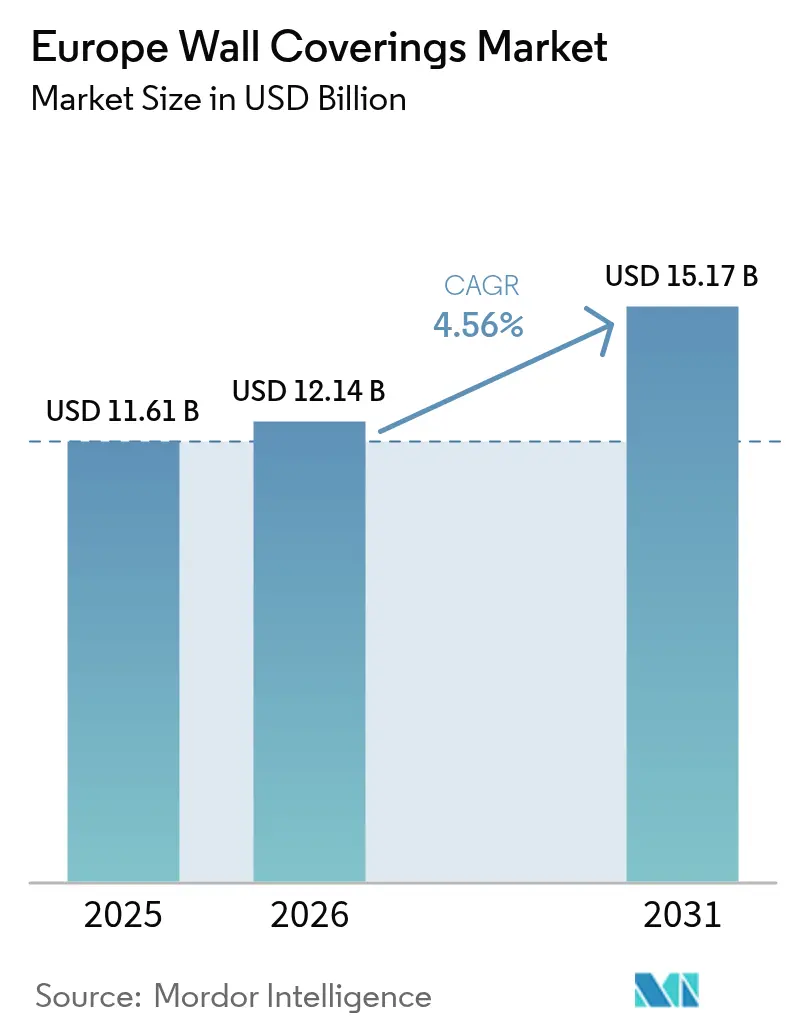
Europe wall coverings market size in 2026 is estimated at USD 12.14 billion, growing from 2025 value of USD 11.61 billion with 2031 projections showing USD 15.17 billion, growing at 4.56% CAGR over 2026-2031. The market’s resilience rests on renovation-led demand, heightened do-it-yourself activity, and strict environmental regulations that favor eco-certified products. Vinyl maintains dominance through durability and cost advantages, yet wood-based alternatives gain momentum as sustainability credentials strengthen. Wallpaper remains the largest product category, although wall panels accelerate on the back of modular construction adoption and 3-D printing customization. Hospitality renovations ahead of marquee international events continue to anchor commercial demand, while rising disposable incomes stimulate residential upgrades, particularly in Eastern Europe.
Key Report Takeaways
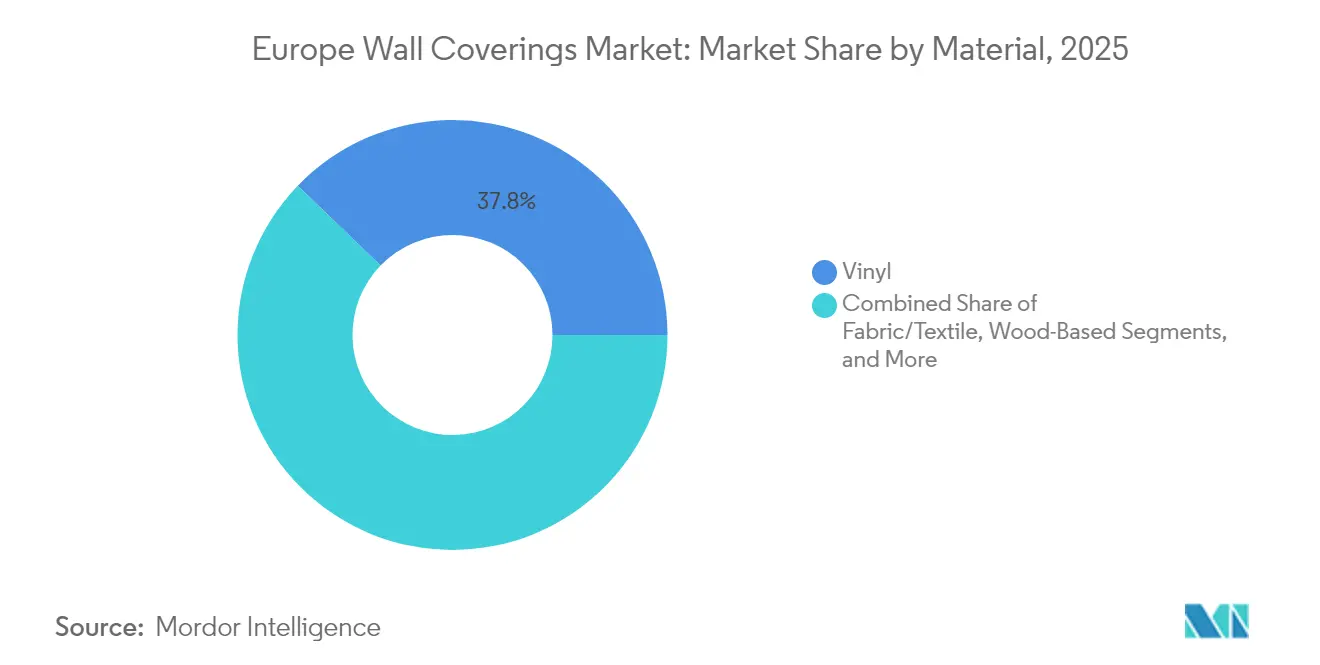
- By material, vinyl led with 37.78% Europe wall coverings market share in 2025, whereas wood-based materials posted the highest 5.21% CAGR through 2031.
- By product type, wallpaper accounted for 39.88% of the Europe wall coverings market size in 2025, while wall panels registered the fastest 5.55% CAGR to 2031.
- By end-use industry, hospitality captured 28.05% of the Europe wall coverings market size in 2025, and domestic housing expanded at a 6.41% CAGR over the forecast period.
- By country, the United Kingdom held 39.00% of the Europe wall coverings market share in 2025, while Poland exhibited the strongest 6.79% CAGR to 2031.
Note: Market size and forecast figures in this report are generated using Mordor Intelligence’s proprietary estimation framework, updated with the latest available data and insights as of 2026.
Market Trends and Insights
Drivers Impact Analysis of Europe Wall Coverings Market*
| Driver | (~) % Impact on CAGR Forecast | Geographic Relevance | Impact Timeline |
|---|---|---|---|
| Growing DIY home-improvement culture | +0.8% | UK, Germany, Scandinavia | Medium term (2-4 years) |
| Revival of heritage buildings and public-funded renovations | +0.6% | France, Italy, Central Europe | Long term (≥ 4 years) |
| Rapid e-commerce penetration in home-decor | +0.5% | Global Europe, strongest in Northern Europe | Short term (≤ 2 years) |
| Shift toward low-VOC and eco-certified coverings | +0.7% | Germany, Netherlands, Nordic countries | Medium term (2-4 years) |
| Hospitality refurbishment boom ahead of 2030 Olympics and EXPOs | +0.4% | France, Italy, Spain | Short term (≤ 2 years) |
| 3-D printed customised wall panels | +0.3% | Germany, Netherlands, UK | Long term (≥ 4 years) |
| Source: Mordor Intelligence | |||
Growing DIY Home-Improvement Culture
European households increasingly adopt self-directed renovation to bypass costly labor, a tendency propelled by abundant online tutorials and retailer training sessions. Specialty stores captured 30.21% channel share in 2024 by offering in-store demonstrations and advisory services. Labor costs that exceed EUR 35 per m² in Northern Europe encourage wider uptake of peel-and-stick wallpaper and modular panels that novices can apply with limited tools. Fragmented contractor markets-81,000 painting companies in France alone-underscore the potential for substitution by user-friendly materials. Advanced adhesives and pre-finished surfaces preserve professional aesthetics while reducing installation time, deepening consumer confidence in do-it-yourself solutions.
Revival of Heritage Buildings and Public-Funded Renovations
Europe’s Renovation Wave earmarks EUR 500 billion for energy and aesthetic upgrades to historical structures, guaranteeing multi-year demand for compliant wall coverings.[1] Conservation projects often stipulate fabric or paper-based finishes that replicate original textures, generating premium orders for artisanal suppliers. Fiscal incentives such as France’s heritage tax relief and Italy’s superbonus fuel owner participation. Custom reproduction and low-VOC mandates raise material complexity and favor local manufacturing that can meet tight specification windows. Central Europe’s dense catalog of heritage sites positions the region as a long-run demand hotspot.
Rapid E-Commerce Penetration in Home-Décor
Omnichannel retail surges as consumers research online, then verify texture and color in store. Franchise outlets combine brand consistency with neighborhood access, achieving 6.21% CAGR. Direct-to-consumer portals empower boutique producers to bypass wholesalers, enabling customized wallpaper runs with augmented-reality previews. Logistics improvements cut transit damage rates for fragile rolls, while instant-quote software simplifies cross-border shipping. Small manufacturers from Belgium and the Netherlands leverage digital platforms to enter the wider Europe wall coverings market without sizable capital outlays.
Shift Toward Low-VOC and Eco-Certified Coverings
Regulators tighten formaldehyde thresholds below 0.1 ppm under REACH, accelerating the shift from solvent-based vinyl to wood and non-woven substrates. Wood-based coverings log a 5.43% CAGR by integrating FSC-certified fibers and bio-adhesives. EMICODE labeling becomes a procurement prerequisite for healthcare and childcare facilities. German innovators pilot mycelium composites that meet durability standards while biodegrading at the end of life. Compliance costs heighten market entry barriers, nudging smaller import-reliant firms toward partnership or acquisition.
Restraints Impact Analysis of Europe Wall Coverings Market*
| Restraint | (~) % Impact on CAGR Forecast | Geographic Relevance | Impact Timeline |
|---|---|---|---|
| Price-sensitive post-inflation consumer sentiment | -0.9% | Southern Europe, Eastern Europe | Short term (≤ 2 years) |
| Tightened building-fire codes limiting vinyl wallpaper share | -0.4% | UK, Germany, Scandinavia | Medium term (2-4 years) |
| Volatile titanium-dioxide prices pressuring margins | -0.6% | Global Europe, strongest impact in Germany, Netherlands | Short term (≤ 2 years) |
| Ageing labor force in skilled wall-covering installation | -0.5% | Western Europe, particularly Germany, France, Italy | Long term (≥ 4 years) |
| Source: Mordor Intelligence | |||
Price-Sensitive Post-Inflation Consumer Sentiment
Persistently high living costs compress discretionary home-improvement budgets in price-conscious regions. Wall covering prices climbed 2.3% year-over-year in Q1 2025, outpacing broader CPI and curbing demand for premium designs. Hospitality operators in Southern Europe delay nonessential refurbishments, reallocating funds to energy upgrades. Polish façade refurbishments cost USD 37–62 per m², with materials composing up to 70% of the spend, magnifying the hit of raw-material inflation.[2] Manufacturers counter by streamlining SKUs and expanding value lines to protect volume without eroding brand equity.
Tightened Building-Fire Codes Limiting Vinyl Wallpaper Share
Post-Grenfell investigations catalyze stricter flame-spread and smoke-toxicity thresholds, curbing vinyl use in public and multi-family buildings. Alternative substrates such as fiberglass-reinforced paper gain approval despite higher cost. Extended testing and certification impose extra lead times and capital outlay for vinyl suppliers. Scandinavian hotel chains pivot toward non-woven solutions to ensure code compliance, eroding vinyl’s historical lead in commercial interiors. Producers invest in halogen-free additives and top coats, yet uptake remains cautious pending full-scale validation.
*Our forecasts treat driver/restraint impacts as directional, not additive. The impact forecasts reflect baseline growth, mix effects, and variable interactions.
Europe Wall Coverings Market Segment Analysis
By Material:
Vinyl Dominance Challenged by Wood-Based InnovationVinyl accounted for 37.78% of the Europe wall coverings market share in 2025, upheld by antimicrobial finishes and cleanability that suit healthcare corridors. Nevertheless, environmental pressure and fire-code revisions temper its long-term outlook. Wood-based coverings capitalize on sustainability and tactile warmth, registering a 5.21% CAGR through 2031 while attracting residential renovators and luxury hospitality brands. The Europe wall coverings market size contribution from recycled cellulose and mycelium composites is small today but rising as pilot programs scale. Vinyl producers deploy closed-loop recycling and bio-plasticizers to defend share, whereas paper and fabric makers leverage FSC supply chains and water-based inks to court eco-certified projects.
Demand polarization intensifies: high-traffic commercial venues favor robust vinyl, while premium boutiques and heritage sites opt for low-emission wood veneers. Fabric coverings extend into acoustic applications by laminating wool or hemp fibers onto mineral boards. Paper-based wallpaper enjoys a niche in conservation renovations, aided by digital heritage pattern archives that facilitate accurate reproductions. Metal and ceramic substrates satisfy laboratory and food-processing zones where hygiene and chemical resistance outrank aesthetics.

By Product Type:
Wall Panels Accelerate Through Modular ConstructionWallpaper retained 39.88% of the Europe wall coverings market size in 2025 thanks to ubiquitous roll formats, diverse prints, and rising peel-and-stick variants. Yet wall panels increased 5.55% CAGR as prefabricated buildings and flexible offices demand quick, dry installation. Large architects specify panels with integrated cable channels and acoustic cores, reducing post-fit alterations. 3-D printed panel offerings enlarge design scope, while digital wallpaper printing tailors small-batch motifs for boutique hotels. Tile and metal products address hygiene-critical environments and contemporary commercial settings.
The Europe wall coverings market experiences cross-fertilization: wallpaper producers launch clip-on panel ranges, and panel specialists offer complementary trim and corner guards. Consumers appreciate wall panels’ ability to conceal uneven substrates without intensive surface prep, lowering overall project time. In multi-family retrofits, combination schemes emerge, pairing feature-wall panels with cost-effective wallpaper on secondary surfaces.
By End-Use Industry:
Domestic Housing Momentum Drives GrowthDomestic housing delivers the fastest 6.41% CAGR as pandemic-induced home-centric lifestyles persist. Home offices and wellness areas spur the adoption of textured panels and nature-inspired wallpaper. The Europe wall coverings market benefits from mortgage-rate incentives in Western Europe and EU renovation subsidies in Central Europe. Hospitality keeps the volume crown, commanding 28.05% share in 2025 through cyclical refurbishments and strict branding guidelines. Healthcare maintains a steady pipeline, requiring antimicrobial, easy-clean surfaces. Retail layouts rotate rapidly to sustain customer engagement, reinforcing repeat orders for removable coverings.
Facility managers increasingly specify wall systems that couple visual refresh with resilience to disinfectants. Case studies such as the Metrodora Institute demonstrate the adoption of seamless medical-grade panels delivering infection-control compliance without sacrificing biophilic aesthetics. Corporate campuses favor demountable partitions to accommodate hybrid work patterns, combining writable surfaces with acoustic dampening.

By Distribution Channel:
Franchise Expansion Transforms Retail LandscapeSpecialty stores held a 29.90% share in 2025 by providing sample libraries and on-site color matching, anchoring consumer trust. Franchise networks grow 5.97% CAGR, driven by scalable branding and uniform service standards across regions. E-commerce accelerates as interactive visualization tools and live chat consultation replicate showroom experiences online. The Europe wall coverings market witnesses manufacturers investing in direct-to-consumer portals that offer curated design bundles, adhesives, and instructional videos.
Installation services evolve: retailers partner with vetted contractors, bundling product and labor warranties. Omnichannel approaches integrate click-and-collect options, enabling customers to inspect the texture before finalizing orders. For commercial clients, distributors deploy virtual mock-ups that overlay coverings onto CAD layouts, expediting specification cycles.
Geography Analysis
United Kingdom Wall Coverings Market
The United Kingdom accounted for 39.00% of the Europe wall coverings market in 2025, driven by vibrant renovation activity and robust DIY chains. Favorable mortgage refinancing and cultural emphasis on property investment motivate homeowners to refresh interiors regularly. Stricter post-Grenfell fire codes reshape material mix toward low-smoke-emitting substrates, opening space for non-woven and intumescent-coated panels. E-commerce growth accelerates via national courier networks that offer next-day delivery for wallpaper rolls and panel kits.
Germany and France Wall Coverings Market
Germany and France illustrate mature yet distinct profiles. German firms intertwine advanced automation with circular-economy initiatives, yielding export-ready eco-certified offerings. Domestic demand softens amid demographic headwinds, but retrofit programs anchored in energy-saving mandates sustain baseline volumes. French consumers display affinity for high-design motifs and heritage-compliant fabrics. Inflation lifted wall covering prices by 2.3% in Q1 2025, though tax incentives for energy upgrades indirectly boost interior refurbishment budgets.
Broader European Markets
Poland spearheads growth with a 6.79% CAGR through 2031 as EU funds modernize aging housing stock and build public infrastructure. Rising wages stimulate private renovations, and local installers expand capacity to address demand surges. Spain and Italy rely on hospitality refurbishments as tourist arrivals normalize, funneling capital into boutique hotels and vacation rentals. Nordic countries maintain steady expansion by specifying zero-VOC and cradle-to-grave certified coverings in both residential and public buildings. The remainder of Eastern Europe records varied trajectories, contingent on macroeconomic resilience and EU convergence progress.
Regulatory Landscape
The Europe wall coverings market is shaped by EU chemicals governance and national building safety requirements. Under REACH (Regulation (EC) No 1907/2006), tighter controls on substances affect substrates, coatings, inks, and adhesives used in wallcovering systems. A recent EU-level update is Commission Regulation (EU) 2026/1168, which amends Annex XVII of REACH on restrictions for synthetic polymer microparticles, increasing the compliance burden for formulations that may shed microplastic-like particles across the product life cycle.
Regulation (EU) 2025/40 on packaging and packaging waste (PPWR) entered into force on 11 February 2025 and applies from 12 August 2026. While paints, inks, varnishes, lacquers, and adhesives applied directly to a product are generally not classified as packaging under PPWR (with labeling being a key packaging-related exception), PPWR implementation raises documentation and conformity-assessment expectations across printing and labeling activity that intersects with wallcovering distribution and cross-border trade. This reinforces the market shift toward traceable, low-emission, and well-documented product offerings.
Value Chain Analysis
The value chain starts with raw materials such as PVC resins and plasticizers for vinyl, cellulose and FSC-certified fibers for paper/non-woven, textiles, wood veneers, glass fiber tissues, pigments (including titanium dioxide), and adhesives/coatings. Product development is linked to printing and converting capabilities (gravure, flexographic, and digital printing), and design innovation is often carried out through collaboration between wallcovering manufacturers, engravers, and printing ink suppliers, which helps shorten design-to-production cycles and supports customization.
Standardization and verification bodies influence specifications and procurement. Technical alignment is supported by committees such as BSI CW35 Wallcoverings and CEN TC 99 Wallcoverings, while environmental documentation is increasingly formalized through Environmental Product Declarations (EPDs), including IGI-developed EPDs aligned to EN 15804+A2 and ISO 14025:2011 verification. Downstream, distribution includes specialty stores, franchise networks, and e-commerce platforms, with installers and retailer-linked contractor networks shaping performance outcomes (fire compliance, adhesion durability, and finish quality). Where skilled labor availability is constrained, these installer networks can become a practical bottleneck.
Competitive Landscape
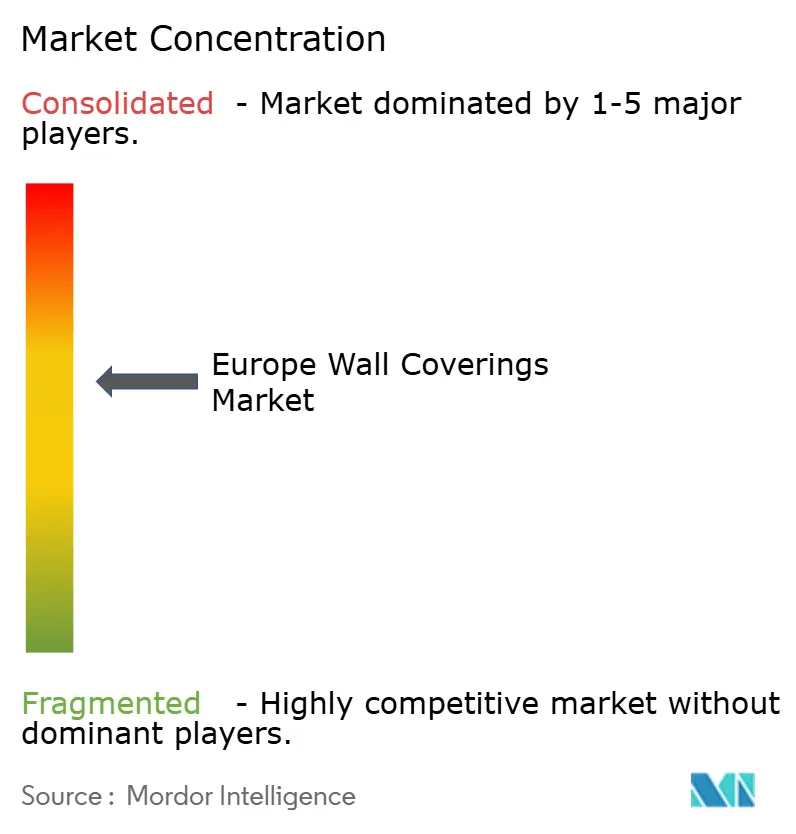
The Europe wall coverings market exhibits moderate concentration: leading five brands command roughly 45% combined share, leaving room for regional specialists. Companies differentiate through technology, sustainability portfolios, and integrated distribution. 3-D printing lines from Dutch pioneers and German conglomerates enable bespoke panel production without tooling delays, shortening design-to-installation cycles. Patent filings in bio-based binders and recycled content surged during 2024-2025, underscoring R&D intensity.[3]
Strategic alliances emerge between material suppliers and installer networks to mitigate labor shortages and guarantee workmanship quality. Some manufacturers launch training academies that certify contractors on new panel systems, enhancing product reliability and brand loyalty. M&A activity targets complementary capabilities: large vinyl producers acquire wood-veneer startups to diversify material mix, while specialty wallpaper houses absorb digital print boutiques to expand custom offerings.
Titanium dioxide prices peaked at EUR 2,900 per ton (USD 3388.01 per ton) in 2025, compressing margins for producers reliant on pigmented coatings. Firms hedge through long-term supply contracts and formulation optimization. Sustainability commitments intensify; Akzo Nobel publicly tied executive compensation to carbon-footprint reduction, mirroring industry-wide governance trends. Forward-looking competitors pilot smart wall coverings with embedded sensors, positioning for future demand in health monitoring and workspace analytics.
Europe Wall Coverings Industry Leaders
-
Ahlstrom-Munksjö Oyj
-
Akzo Nobel N.V.
-
A.S. Création Tapeten AG
-
Arte International N.V.
-
Benjamin Moore & Co.
- *Disclaimer: Major Players sorted in no particular order
Europe Wall Coverings Market Companies Covered in this Report
- Ahlstrom-Munksjo Oyj
- Akzo Nobel N.V.
- A.S. Creation Tapeten AG
- Arte International N.V.
- Benjamin Moore & Co.
- Brewster Home Fashions LLC
- DuluxGroup Ltd.
- Erismann & Cie. GmbH
- Farrow & Ball Holdings Ltd.
- Graham & Brown Ltd.
- Grandeco Wallfashion Group S.A.
- Grespania Ceramica, S.A.
- Industrie Emiliana Parati S.p.A.
- Marburg Wallcoverings GmbH & Co. KG
- Nippon Paint Holdings Co., Ltd.
- Orac Decor N.V.
- Omexco N.V.
- Saint-Gobain ADFORS S.A.S.
- York Wallcoverings, Inc.
- Zambaiti Parati S.p.A.
Market Opportunities and Future Outlook
Compliance-led product substitution continues to create whitespace for PVC-free, low-VOC, and documented wallcovering systems that simplify specification in regulated or risk-sensitive end uses such as healthcare, education, and multi-family housing. Procurement practices that reference recognized environmental documentation provide a clear pull, and IGI-developed EPDs aligned to EN 15804+A2 and ISO 14025 verification give manufacturers and specifiers a concrete way to compare impacts and qualify products in projects with sustainability requirements.
Regulatory change also opens adjacent opportunities in labeling, documentation, and traceability that affect wallcovering sales models, particularly cross-border e-commerce and contract channels. Regulation (EU) 2025/40 (PPWR) entered into force on 11 February 2025 and applies from 12 August 2026, raising the bar for conformity assessment and technical documentation for packaging placed on the EU market. With implementing acts on harmonized labeling, including digital formats, due by 12 August 2026, the packaging-focused emphasis still supports investment in compliant labeling workflows and data management across wallcovering portfolios that rely on printed labels and omnichannel fulfillment.
Recent Industry Developments in Europe Wall Coverings Market
- June 2026: Benjamin Moore extended Color Trends 2026 beyond the wall through strategic collaborations featuring handcrafted pieces. The expansion broadens the brand’s influence from paint selection into coordinated interior surface styling, supporting more bundled, design-led specification in residential and commercial refurbishments.
- June 2025: Ahlstrom expanded its FibRoc portfolio to include a Wall Liner segment, adding nonwoven and glass fiber tissue solutions for wall finishing. This strengthens the upstream supply of functional layers used to improve substrate performance, supporting faster installation and more consistent finishes in renovation-heavy projects.
- April 2025: Ahlstrom expanded its WallStar Digital portfolio, a 100% PVC-free nonwoven line for wallcoverings, by adding the Easy, Advance, and Essential segments. The portfolio segmentation improves fit across price and performance tiers while aligning material choices with tighter indoor-air and sustainability requirements.
Europe Wall Coverings Market Report Scope and Research Methodology
Market Definition and Coverage
For this study, the Europe wall coverings market is defined as revenues earned from wall covering products used on interior walls in residential and non-residential buildings across major European countries, measured in current USD.
Scope exclusions: we exclude paint, liquid coatings, and surface-prep materials such as primers, putty, and adhesives, unless they are bundled and priced as part of a wall covering system.
Segments Covered in This Report
- By Material
- Paper-Based
- Fabric/Textile
- Wood-Based
- Vinyl
- Other Materials
- By Product Type
- Wall Panel
- Wallpaper
- Vinyl Wallpaper
- Non-woven Wallpaper
- Paper-based Wallpaper
- Fabric Wallpaper
- Other Wallpaper Types
- Tile
- Metal Wall Covering
- Other Product Types
- By End-use Industry
- Hospitality
- Healthcare
- Retail
- Corporate Offices
- Education
- Domestic Housing
- Industrial Facilities
- Other End-use Industries
- By Distribution Channel
- Specialty Store
- Franchise store
- E-commerce
- Other Distribution Channels
- By Country
- United Kingdom
- Germany
- France
- Italy
- Spain
- Poland
- Rest of Europe
Data Sources, Market Sizing, and Validation
Desk Research
Desk work starts with mapping the demand drivers that move wall covering consumption in Europe, and then tying them to public indicators. We typically reference sources such as Eurostat construction output and building permits, national statistics offices for housing stock and renovation activity, European Commission policy pages for chemicals and sustainability rules, and UN Comtrade or similar customs series to understand trade flows of wall covering products.
To avoid building the model on one narrow dataset, we also review manufacturer and distributor websites, annual reports and investor presentations, reputable trade press, and pricing and product launch announcements that signal mix shifts (for example, towards non-woven and vinyl formats). Where needed, we use paid subscriptions for company financials, news screening, patent lookups, and shipment-level trade checks to validate the direction and scale of changes. These desk sources are illustrative, and we also used other public references to collect, cross-check, and clarify inputs.
Primary Interviews and Surveys
Primary work is used to test whether the desk-based demand story matches what is being seen in the market now, especially around renovation cycles, channel mix, and pricing. We speak with manufacturers, converters, distributors, installers, retailers, and large buyers such as contractors and specifiers across key European countries, then use follow-up questions to resolve gaps in product scope and assumptions about trade versus local production.
Distribution of primary research fieldwork respondents
| Company type | Respondent position |
|---|---|
| Top tier: 37% | CXOs: 15% |
| Mid tier: 45% | Functional/Unit leaders: 34% |
| Smaller Players: 18% | Managers: 51% |
Market-Sizing & Forecasting
Sizing starts from a top-down reconstruction of the addressable demand pool, where building and renovation activity is translated into wall surface refresh needs and then into value using observed price bands by product type and channel. That macro view is pressure-tested through selective bottom-up checks, such as rolling up a sample of supplier revenues, validating import and export direction for key product codes, and using sampled price points multiplied by plausible volumes to see if totals stay within a realistic range.
A few inputs that matter most in this market include residential renovation intensity, non-residential fit-out trends, housing completions, import dependence versus local production, and average selling price movement by material (paper, vinyl, textile, and non-woven). We also factor in substitution signals, such as when wallpaper is replaced by other interior finishes, and the share of projects routed through modern retail versus professional distribution.
For forecasting, scenario analysis is used with a base case built from construction and renovation outlooks, expected mix shift towards easier-to-install formats, and gradual price normalization. Where bottom-up detail is missing for smaller countries or informal installer channels, gaps are handled with transparent proxies, for example allocating demand using construction value shares and then adjusting with interview-based correction factors.
Data Validation & Update Cycle
Outputs are validated by comparing final totals with independent signals, such as trade balance direction, reported revenue trends of a sample of suppliers, and construction cycle indicators, then investigating any large variances. If a country or product line shows an unusual jump, we re-check inputs, review the calculation steps, and re-contact respondents to confirm whether the change is real or a modeling artifact.
Before sign-off, the model and assumptions go through multi-step analyst reviews, and country splits are checked for consistency with the broader Europe picture. Reports are refreshed annually, and interim updates are made when material events occur, for example sharp raw material price shifts or a sudden demand change tied to construction activity. Right before delivery, a final review pass is done so clients receive the most current view.
Mordor Intelligence's Europe Wall Coverings Market Size Measured Against Other Published Estimates
Published market values for Europe wall coverings can look far apart, even when the topic sounds the same, because the product boundary and the year labeling are not always aligned. Differences also show up when one estimate mixes retail value with factory-gate value, or when trade-heavy countries are treated as consumption markets without adjusting for re-exports.
The benchmark table shows a wide spread, and in Mordor Intelligence's model the scope is limited to interior wall covering products while paints and surface prep materials are excluded, which often lowers totals versus sources that bundle adjacent finishes. Gaps are also created by whether the year is a true base year with validated pricing and channel mix, or a forward-looking number presented as a current year.
Benchmark comparison
| Source | Market Size | Gaps in Research Methodology |
|---|---|---|
| Mordor Intelligence | USD 11.61 B (2025) | |
| Regional Consultancy A | USD 28.40 B (2026) | Uses a broader basket that appears to combine multiple wall finish categories and applies a forward year as the headline size, which can inflate the Europe total when retail markups and institutional fit-outs are blended in. |
| Industry Publisher B | USD 9.08 B (2021) | Relies on an older base year and may not fully reflect the post-2021 price and mix changes across non-woven and vinyl products, which can pull the value down when later renovation recovery is not captured. |
Looking across the three figures, most of the gap is explained by what is counted as a wall covering product, plus whether the stated year reflects a validated base year or a forward projection. By keeping the scope explicit, tying assumptions to construction and renovation signals, and cross-checking with trade and supplier-side indicators, the market size becomes easier to reproduce and more useful for planning.
Key Questions Answered in the Report
What is the current value of the Europe wall coverings market?
The market is valued at USD 12.14 billion in 2026 and is projected to reach USD 15.17 billion by 2031.
Which material leads sales in Europe?
Vinyl remains the leading material, representing 37.78% of 2025 revenue because of durability and easy maintenance.
Which segment is expanding the fastest?
Wood-based wall coverings grow at 5.21% CAGR through 2031, driven by sustainability preferences and bio-adhesive innovations.
Which country offers the strongest growth potential?
Poland leads with a 6.79% CAGR, supported by EU funding and rising household incomes.
Why are wall panels gaining popularity?
Modular construction, quick installation, and 3-D printing customization spur a 5.55% CAGR for wall panels across Europe.
How strict are environmental regulations affecting the industry?
REACH and national indoor-air regulations cap formaldehyde at 0.1 ppm, pushing demand toward low-VOC and eco-certified products.