
Europe Smart Parking Market Size and Share
Market Overview
| Study Period | 2020 - 2031 |
|---|---|
| Forecast Data Period | 2026 - 2031 |
| Base Year Market Size (2025) | USD 4.18 Billion |
| Market Size (2026) | USD 4.71 Billion |
| Market Size (2031) | USD 7.34 Billion |
| Growth Rate (2026 - 2031) | 9.28 % |
| Market Concentration | Medium |
Major Players *Disclaimer: Major Players sorted in no particular order Image © Mordor Intelligence. Reuse requires attribution under CC BY 4.0. | |
Europe Smart Parking Market Analysis by Mordor Intelligence
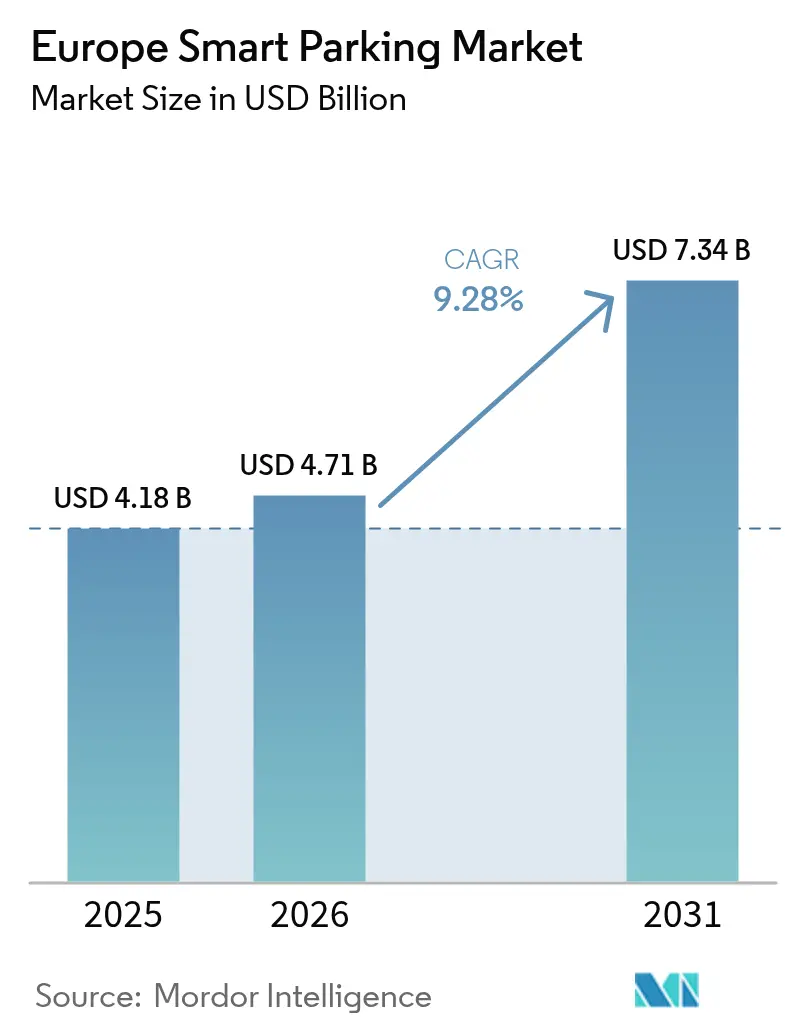
The Europe smart parking market size is projected to be USD 4.18 billion in 2025, USD 4.71 billion in 2026, and reach USD 7.34 billion by 2031, growing at a CAGR of 9.28% from 2026 to 2031. Cities are reframing curb management as a decarbonization and revenue lever, while the revised Intelligent Transport Systems Directive obliges open data sharing across the region. Electric-vehicle (EV) adoption is pushing operators to retrofit bays with charging hardware, and contactless payments have become the default interface for on-street transactions, cutting cash-handling costs. Municipal funding tied to Mobility-as-a-Service (MaaS) pilots is accelerating pilot projects, yet up-front sensor costs and fragmented procurement still slow rollouts in many mid-sized towns. Competitive intensity remains moderate because no firm controls more than 10% share, and software-only entrants are bypassing civil-works barriers to scale rapidly.
Key Report Takeaways
- By solution, software platforms led with 44.91% of Europe smart parking market share in 2025, while managed services are forecast to expand at a 10.14% CAGR to 2031.
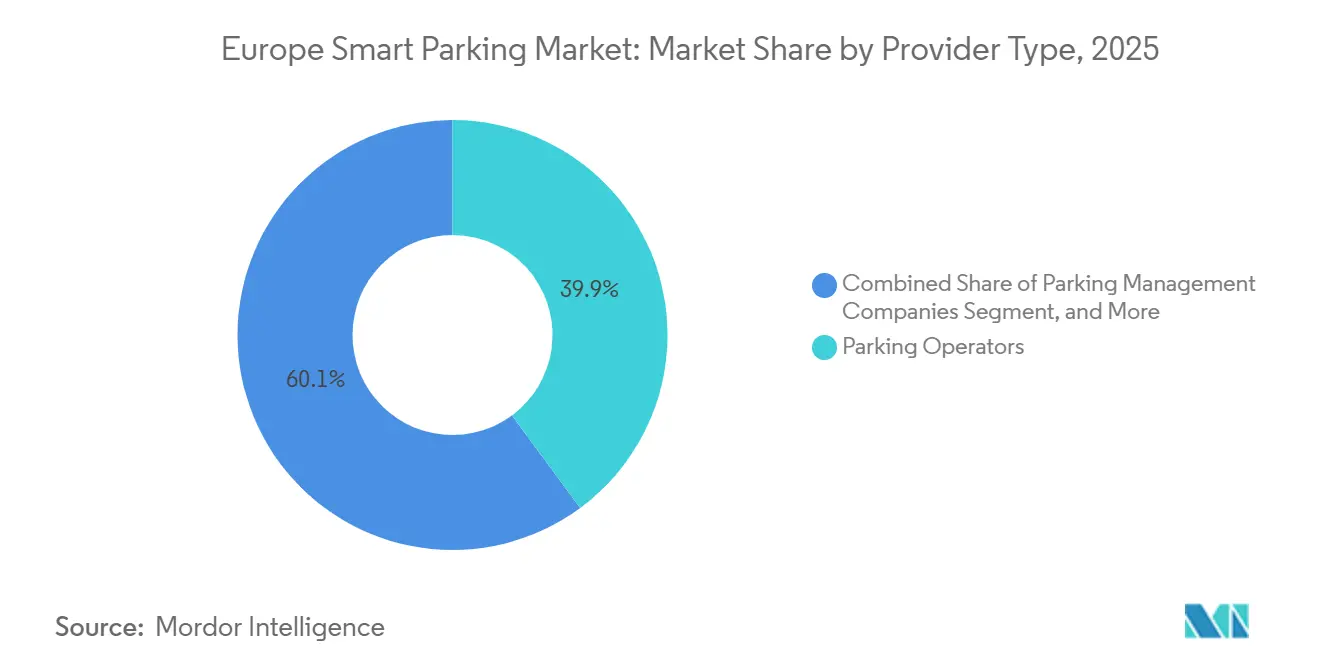
- By provider type, parking operators dominated with 39.87% share in 2025, whereas peer-to-peer platforms are projected to grow fastest at an 11.02% CAGR through 2031.
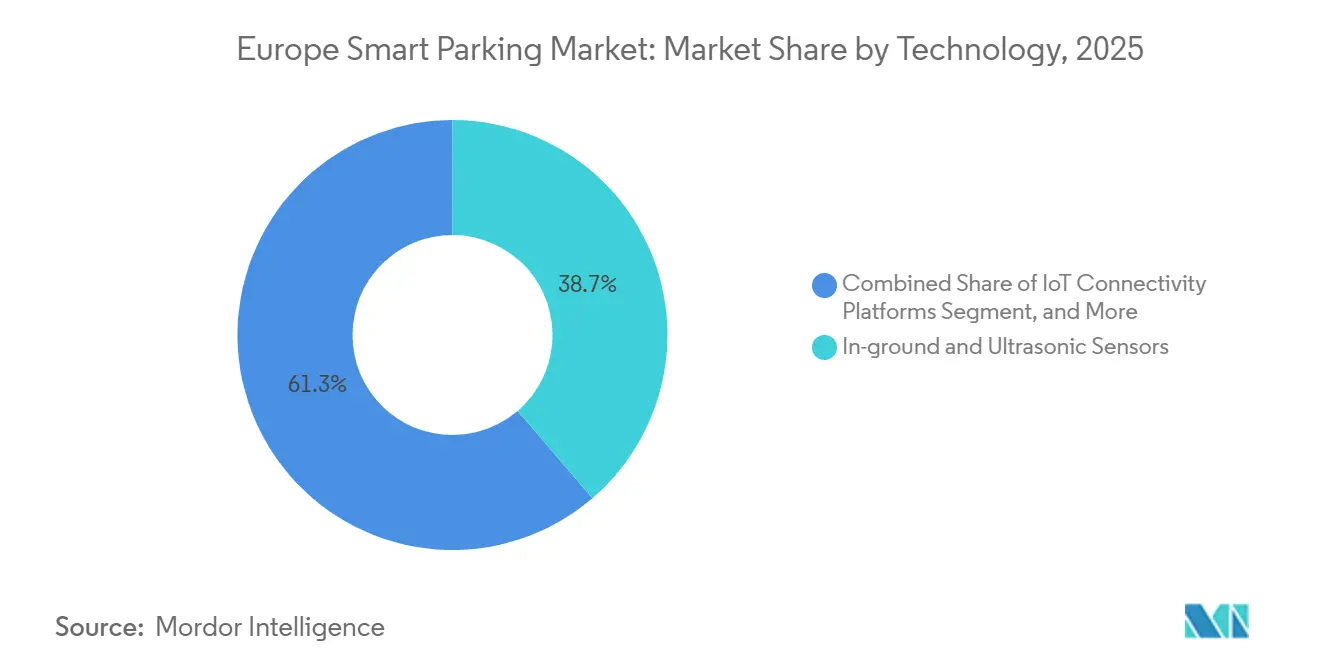
- By technology, in-ground and ultrasonic sensors accounted for 38.71% of Europe smart parking market size in 2025, but EV-charging-integrated parking is advancing at a 12.27% CAGR over 2026-2031.
- By end user, municipalities and government entities captured 41.74% spending in 2025, while corporate campuses are set to rise quickest at a 10.43% CAGR through 2031.
- By geography, Germany held 36.12% revenue share of the Europe smart parking market size in 2025, whereas Italy is expected to achieve the highest 11.02% CAGR to 2031.
Note: Market size and forecast figures in this report are generated using Mordor Intelligence’s proprietary estimation framework, updated with the latest available data and insights as of 2026.
Europe Smart Parking Market Trends and Insights
Drivers Impact Analysis*
| Driver | (~) % Impact on CAGR Forecast | Geographic Relevance | Impact Timeline |
|---|---|---|---|
| EV-Driven Parking Space Stress | +2.1% | Germany, Netherlands, Nordics, spillover to France and United Kingdom | Medium term (2-4 years) |
| Rise of Mobile Payments and Parking Apps | +1.8% | United Kingdom, Germany, France, Spain, Italy | Short term (≤ 2 years) |
| EU Smart-City Funding for MaaS Pilots | +1.5% | Italy, Spain, France, Central and Eastern Europe | Medium term (2-4 years) |
| Corporate Scope-3 Decarbonization Targets | +1.2% | Germany, United Kingdom, Netherlands, France | Long term (≥ 4 years) |
| EU Data-Sharing Mandates Under Revised ITS Directive | +0.9% | All EU member states | Medium term (2-4 years) |
| 15-Minute-City Zoning Accelerating Curb Reforms | +0.8% | France, Spain, Netherlands, pilot interest in Italy and Germany | Long term (≥ 4 years) |
| Source: Mordor Intelligence | |||
EV-Driven Parking Space Stress
Battery-electric vehicle registrations passed 1 million public charging points in 2024, and analysts see that figure doubling by 2030, forcing operators to retrofit facilities with power upgrades, conduit, and payment integration. The Alternative Fuels Infrastructure Regulation compels every member state to provide one public charger for every 10 EVs by 2030, converting parking areas into distributed energy nodes.[1] Energy utilities such as E.ON have earmarked EUR 40 billion (USD 45.2 billion) for charging networks and are now piloting vehicle-to-grid services with automotive OEMs. These initiatives create fresh revenue streams but introduce operational complexity as parking managers must comply with metering rules and manage peak-tariff exposure. Municipalities that blend parking and charging data can unlock congestion-pricing synergies while meeting climate targets, positioning EV-ready bays as premium real estate.
Rise of Mobile Payments and Parking Apps
Contactless transactions became mainstream during the pandemic, and by 2025 the United Kingdom recorded 81% penetration for parking fees, with most users preferring in-car or smartphone payments. EasyPark processed more than 250 million parking sessions across 4,000 cities in 2025, highlighting the shift from coin-operated meters to digital sessions that capture granular occupancy data.[2] Interchange-fee caps, 0.2% for debit and 0.3% for credit, lowered the cost barrier for small municipalities to adopt card-based systems . Mobile apps also enable real-time push notifications, bundled mobility rewards, and dynamic pricing experiments that were impossible with static kiosks. As curb management becomes data-rich, operators leveraging digital payments gain insights to calibrate tariffs and reduce cruising time, improving air quality in dense urban cores
EU Smart-City Funding for MaaS Pilots
Horizon Europe earmarked EUR 101.5 million (USD 114.7 million) for MaaS research in 2024, and the European Institute of Innovation and Technology added EUR 60 million (USD 67.8 million) for integrated mobility pilots.[3] Italy alone set aside EUR 561 million (USD 633 million) for city-scale pilots in Milan, Rome, and Turin. The revised ITS Directive obliges member states to release static and dynamic parking data by 2027, cutting vendor lock-in and letting MaaS aggregators display real-time availability alongside transit options. Spain followed with EUR 150 million (USD 169.5 million) for smart-mobility infrastructure, prioritizing parking data as the backbone of congestion-pricing experiments. Funding conditions that mandate open APIs and KPI-based payouts are steering procurement toward cloud-native platforms with strong analytics layers
Corporate Scope-3 Decarbonization Targets
Large enterprises are embedding commuter emissions into ESG scorecards, creating demand for workplace parking systems that log vehicle type, dwell time, and energy source. DHL aims to cut Scope 3 emissions by 2.6 million metric tons annually by 2030, and its parking analytics feed employee commute dashboards. Maersk and Unilever have announced similar metrics, while IKEA plans to use 100% renewable electricity across sites by 2030, integrating EV charging into staff parking. Tech giants Amazon, Google, and Microsoft already run reservation-based parking that enforces allocation rules and auto-generates emissions reports. Vendors that can couple parking bookings with carbon calculations are tapping a fast-growing B2B niche where buying cycles are shorter than municipal tenders and budgets are less constrained.
Restraints Impact Analysis*
| Restraint | (~) % Impact on CAGR Forecast | Geographic Relevance | Impact Timeline |
|---|---|---|---|
| Up-Front Sensor and Civil-Works Costs | -1.4% | All regions, acute in Southern and Eastern Europe | Short term (≤ 2 years) |
| Fragmented Municipal Procurement Cycles | -1.1% | Italy, Spain, France, Germany, United Kingdom | Medium term (2-4 years) |
| GDPR-Driven Restrictions on ANPR Analytics | -0.7% | All EU member states | Long term (≥ 4 years) |
| EV-First Kerb Allocation Shrinking Paid Bays | -0.5% | Germany, Netherlands, Nordics, United Kingdom | Medium term (2-4 years) |
| Source: Mordor Intelligence | |||
Up-Front Sensor and Civil-Works Costs
Municipalities spend USD 300-500 per bay to install in-ground sensors, covering excavation, cabling, and backhaul connectivity, a burden that deters smaller cities with modest parking revenues.[4] A Czech pilot using 3,676 sensors showed an average lifespan of just over five years before battery replacement, adding a recurring outlay for cash-strapped councils. Heritage zones further inflate costs because trenching requires archaeological supervision and adherence to strict restoration codes. Camera-based systems lower civil-works outlays but carry higher licensing fees and data-privacy compliance costs. Without external grants or outcome-based financing, many towns choose incremental meter upgrades rather than full smart-parking rollouts, slowing overall penetration.
Fragmented Municipal Procurement Cycles
European local authorities often run 18-24-month tender processes, and revised Italian procurement rules now score bids on social and environmental criteria, lengthening evaluations. Barcelona and Madrid each work with multiple concessionaires managing more than 100,000 bays, complicating integration and delaying region-wide standards. United Kingdom councils grappled with 20% real-term budget cuts between 2010 and 2025, forcing parking projects to compete with essential services for scarce funds. Vendors face high bid-preparation expenses, and staggered awards make it hard to achieve scale economies, keeping hardware prices elevated and dampening smart-parking adoption rates.
*Our forecasts treat driver/restraint impacts as directional, not additive. The impact forecasts reflect baseline growth, mix effects, and variable interactions.
Segment Analysis
By Provider Type: Peer-to-Peer Platforms Challenge Incumbents
Peer-to-peer players recorded the fastest growth trajectory, with an 11.02% projected CAGR through 2031, as asset-light models monetize idle residential driveways and off-peak office lots. This surge is eating into the 39.87% share parking operators held in 2025, pressuring concessionaires that rely on fixed tariffs and long-term contracts. Marketplaces such as JustPark, ParkBee, and Parclick advertise real-time availability, transparent pricing, and loyalty perks, creating a seamless user journey that traditional cash or kiosk environments cannot match. The Europe smart parking market is therefore witnessing a power shift toward data-driven platforms that can scale across borders without laying concrete.
Parking operators retain strategic advantages in airports and city-center garages, yet they must modernize apps, embed dynamic pricing, and partner with EV-charging networks to defend margins. As municipalities mandate open data, operators that cling to proprietary systems risk being sidelined in MaaS aggregators. Peer-to-peer hosts still navigate zoning, insurance, and tax hurdles, but once these frameworks mature, their low capital intensity will keep them at the growth frontier of the Europe smart parking market.

By Solution: Services Segment Gains Traction
Managed services are forecast to expand at a 10.14% CAGR to 2031, reflecting municipal appetite for outcome-based contracts that shift uptime and data-accuracy risk to vendors. Bundled packages that include software licenses, sensor maintenance, and analytics dashboards help budget-constrained cities convert large capital outlays into predictable operating expenses. Software already held 44.91% of Europe smart parking market share in 2025, illustrating the sector’s pivot from hardware-centric deployments to cloud-native platforms that aggregate real-time occupancy feeds and support API connectivity.
Hardware remains critical but is inching toward commoditization as sensor prices fall and multi-vendor interoperability becomes the norm. Services firms differentiate through rapid deployment, KPI guarantees, and integration expertise, enabling city managers to meet regulatory timelines without hiring in-house data scientists. As more municipalities adopt performance-based tenders, vendors offering cradle-to-grave support are well positioned to capture recurring revenue in the Europe smart parking market.
By Technology: EV-Charging Integration Accelerates
In-ground and ultrasonic sensors captured 38.71% of technology revenue in 2025, valued for detection accuracy yet hindered by costly civil works. Camera-based systems promise lower installation complexity and richer enforcement data, but GDPR constraints require robust consent and anonymization workflows, adding compliance overhead. Connectivity layers leveraging LoRaWAN and NB-IoT improve battery life and coverage, though signal attenuation inside multi-story garages remains a technical hurdle.
EV-charging-ready bays are the clear breakout, expected to post a 12.27% CAGR through 2031. Utilities, automakers, and parking operators are co-investing in integrated stalls that monetize both kilowatt-hours delivered and parking duration, creating dual revenue streams in the Europe smart parking market. Standards battles around roaming protocols and billing interoperability persist, yet early adopters like the Netherlands are proving that bundled parking-and-charging propositions can achieve faster payback than standalone chargers or meters.
By End User: Corporate Campuses Embrace Smart Parking
Municipalities and government entities still represent the largest spending bloc at 41.74% of 2025 outlays, but budget rigidity often limits the scope of projects to pilot corridors. Corporate campuses are emerging as the fastest-growing segment, predicted to climb at a 10.43% CAGR, because ESG reporting frameworks now demand granular commute data. Reservation-based systems that allocate bays according to carpool status or vehicle type optimize real-estate utilization while feeding Scope 3 dashboards.
Transport hubs, malls, and mixed-use developers also intensify investments as they compete for footfall in post-pandemic retail environments. Residential complexes, once reluctant to spend on parking technology, are rolling out app-based guest management to enhance security and property valuations. This broadening demand base underscores how the Europe smart parking market is evolving from a municipal service into a cross-sector digital utility.
Geography Analysis
Germany remains the revenue anchor, holding 36.12% of regional takings in 2025 thanks to early automatic number-plate recognition (ANPR) adoption and close ties between software providers and automotive OEMs. Berlin alone digitized more than 35,000 curbside spaces, and a 2026 pilot with PayByPhone and Goldbeck is testing demand-responsive tariffs across 118,500 bays, signaling scale readiness. Nevertheless, growth momentum is shifting southward. Italy is poised to log an 11.02% CAGR through 2031 on the back of EUR 561 million (USD 633 million) in MaaS grants and aggressive pilots in Milan, Rome, and Turin, each integrating parking APIs into multimodal planners that cut search time and pollution.
France benefits from Paris’s 15-minute-city zoning, which reallocates curb inventory from commuter storage to shared mobility, compelling the remaining bays to adopt rigorous dynamic-pricing logic. Spain channelled EUR 150 million (USD 169.5 million) into smart-mobility infrastructure, with Barcelona layering parking data into future congestion-charge schemes. The Netherlands punches above its weight in digital payments and EV adoption, yet limited absolute population caps its revenue potential compared with Germany. Nordic capitals demonstrate high technological readiness but face seasonal maintenance costs that lengthen sensor replacement cycles.
Central and Eastern Europe, including Poland, the Czech Republic, Hungary, and Romania, remains underpenetrated but registers rising interest in low-cost sensor grids and mobile payments as car ownership climbs. Pardubice’s example, where 3,421 hybrid sensors boosted annual parking income from CZK 23 million (USD 1.1 million) to CZK 40 million (USD 1.9 million), is prompting neighboring cities to launch similar tenders. Although starting from a smaller base, these markets could provide upside beyond 2028 as EU cohesion funds become available for digital infrastructure.
Regulatory Landscape
The regulatory backbone for smart parking in Europe is the EU Intelligent Transport Systems (ITS) Directive 2010/40/EU as amended by Directive (EU) 2023/2661, which is being used to support standardized exchange of mobility data, including parking information, across member states. Commission Delegated Regulation (EU) 2024/490 amends (EU) 2017/1926 to expand multimodal travel information requirements, explicitly covering parking location, availability, and tariffs as data sets that data holders must make accessible for multimodal information services.
Implementation is increasingly operationalized through National Access Points (NAPs), the mandated national platforms for mobility data exchange. NAPCORE coordinates common mappings and recommendations across standards such as DATEX II, APDS, and NeTEx. For freight-relevant parking, the European Commission initiated a first stakeholder workshop in January 2026 to revise specifications for information services on safe and secure truck parking. The framework also sets a deadline requiring static data provision for safe and secure parking places on the comprehensive TEN-T road network by December 2026, which raises requirements for data quality, interoperability, and ongoing updates by operators and municipalities.
Value Chain Analysis
The Europe smart parking value chain typically starts with hardware and edge components, including in-ground or surface-mounted occupancy sensors, camera and ANPR or computer-vision stacks, signage, and payment terminals. Connectivity layers such as LoRaWAN and cellular IoT then support data collection.
Software platforms translate this input into inventory management, pricing and tariff rules, reservation and permit workflows, enforcement integration, and APIs for third-party MaaS apps and municipal data portals. Deployments move through systems integrators and managed service providers that bundle civil works, installation, commissioning, cybersecurity, and maintenance into turnkey contracts, after which parking operators and municipalities run daily operations, monetize transactions, and publish required data sets via NAPs or local open-data channels. Downstream, digital payments, app-based sessions, and cloud analytics increasingly drive value capture, with multi-facility modernization programs bundling ticketless entry and centralized management (for example, Firenze Parcheggi upgrading 15 facilities using SKIDATA systems across 6,000+ spaces). The chain is also being reshaped by modular procurement (separating sensors, platforms, and services) and by city and national programs that aggregate demand and standardize interfaces, such as the Smart Cyprus initiative, which has supported large-scale sensor rollouts and pushes vendors to deliver interoperable data, integration tooling, and long-term operations support rather than one-off hardware sales.
Competitive Landscape
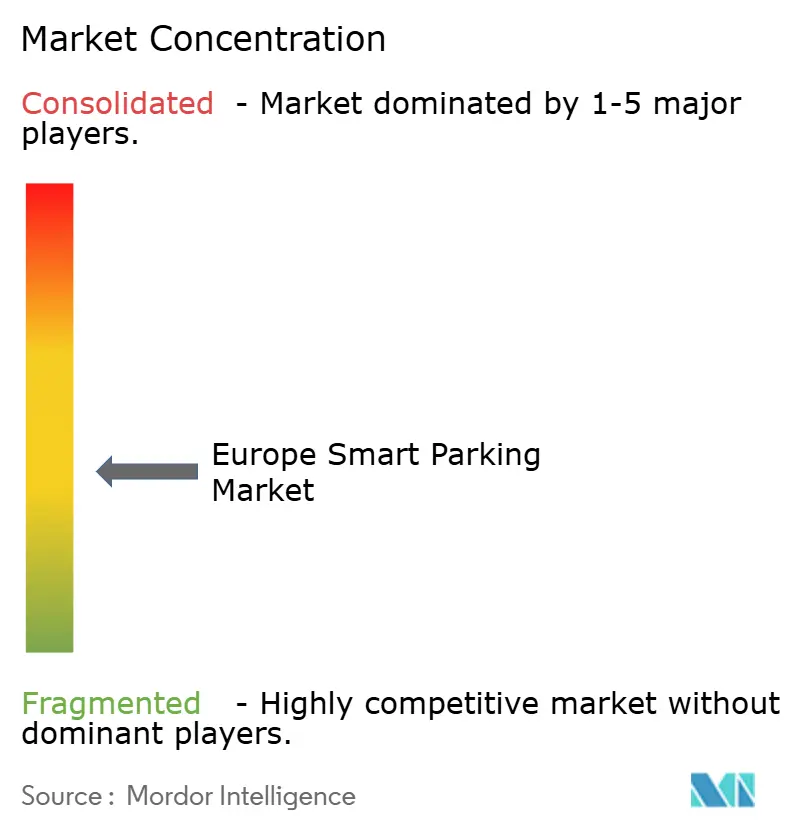
No vendor controls even a tenth of the Europe smart parking market, making the arena moderately competitive but highly fragmented. Incumbent operators such as APCOA (1.8 million spaces), Indigo Group (2.3 million globally), and EasyPark Group (250 million annual transactions) are leveraging scale to negotiate multi-city concessions while layering analytics onto existing estates. Their combined share still sits below 30%, leaving ample headroom for agile newcomers. Asset-light disruptors like ParkBee, JustPark, and Parclick curate underused private inventory and monetize via dynamic pricing, scaling without concrete or steel.
Technology specialists pursue two playbooks: sensor innovation and software-as-a-service. Fleximodo’s hybrid magnetometer-nanoradar device achieved 99% accuracy in the Czech Republic, raising the performance bar for ultrasonic legacy fleets. Cloud-native platforms are winning municipal RFPs because they interoperate with mixed sensor environments and comply with GDPR by design. Regulatory clarity on ANPR processing, issued by the European Data Protection Board in 2024, is a double-edged sword, it deters undercapitalized entrants yet rewards firms that invest early in privacy-by-default architectures.
Strategic moves include January 2026’s PayByPhone-Goldbeck alliance to roll out smart parking across German and Austrian campuses, and December 2025’s Autopay acquisition of Simplyture, bolstering free-flow ANPR capabilities in airports. Services integrators like Hitachi Rail are bundling AI cameras and ticketless entry into turnkey packages, evidenced by the 13-facility upgrade for METPARK Bordeaux. As municipalities mandate open data and outcome-based contracting, the battleground is shifting from hardware margins to recurring analytics and payment revenues, elevating software fluency as the key differentiator in the Europe smart parking market.
Europe Smart Parking Industry Leaders
-
Daimler Mobility
-
Flowbird SASU (Parkeon SA)
-
Urbiotica SL
-
BMW i Ventures (ParkNow heritage assets)
-
Q-Park NV
- *Disclaimer: Major Players sorted in no particular order
Market Opportunities and Future Outlook
Interoperable parking data, rather than standalone parking apps, is the key whitespace as EU and national requirements pull parking into wider mobility data ecosystems. A concrete catalyst is the European Commission adopting an Implementing Regulation in July 2026 under TEN-T Regulation (EU) 2024/1679, which mandates member states to collect and report harmonized urban mobility indicators, including parking data, with the first submission due by end-2027. This creates openings for software platforms and managed service providers that can normalize heterogeneous parking inventories, connect to National Access Points, and keep data quality consistent across operators, municipalities, and mixed sensor fleets.
EV-charging-integrated parking and ticketless access modernization continue to attract active investment, since operators can attach new revenue streams and operational controls to existing assets. The report context points to utilities such as E.ON earmarking EUR 40 billion for charging networks, and municipalities tying smart mobility funding to MaaS pilots (for example, Italy allocating EUR 561 million for city-scale pilots). That mix increases the demand for platforms that unify parking sessions, charging, reservations, and pricing. On deployment signals, Smart Cyprus activated national-scope sensor deployments (12,000 IoT sensors) and multiple municipalities progressed installations and launches in 2026. Projects involving Urbiotica and EYSA platform integrations in Donostia/San Sebastian also show how low-emission zone logistics (loading or unloading controls) is becoming a purchase driver alongside traditional occupancy and payments.
Recent Industry Developments
- May 2026: Urbiotica implemented smart park-and-ride guidance in Cluj-Napoca, Romania, deploying 101 LoRa-connected U-Spot 3.0 sensors to deliver real-time availability data. The project signals sustained demand for lower-civil-works sensor networks and citywide data layers that can be integrated into broader mobility platforms.
- December 2025: Autopay Technologies migrated to a cloud platform and acquired Simplyture to expand free-flow ANPR capabilities across more than 600 European locations. This combination strengthens ticketless access and enforcement workflows, and it increases competitive pressure on incumbents that still rely on on-premise systems.
- October 2024: The European Commission adopted Regulation (EU) 2024/490, amending the multimodal travel information specifications under (EU) 2017/1926 to include parking location, availability, and tariff data as required data sets for information services. This formalized the move toward standardized parking data provision and raised the importance of interoperable APIs and data governance in municipal and operator procurements.
Research Methodology Framework and Report Scope
Market Definition and Coverage
For this study, the Europe smart parking market is defined as revenues earned from smart parking solutions and services that help drivers find, access, pay for, and manage parking using connected systems and real time data across European countries.
Scope exclusions: We exclude conventional parking operations that do not use connected or data driven smart parking technology, along with unrelated mobility services that sit outside parking.
Segmentation Overview
- By Provider Type
- Parking Operators
- Parking Management Companies
- Infrastructure Providers (HW and SW)
- Peer-to-Peer (P2P) Parking Platforms
- Aggregators and Marketplaces
- By Solution
- Hardware
- Software
- Services
- By Technology
- In-Ground and Ultrasonic Sensors
- Camera and Computer-Vision and ANPR
- IoT Connectivity Platforms
- Mobile Apps and Digital Payments
- EV-Charging Integrated Parking
- By End-User
- Municipalities and Government
- Commercial Car-Parks and Malls
- Transport Hubs (Airports, Rail)
- Corporate Campuses and Business Parks
- Residential and Mixed-Use Developments
- By Region
- Germany
- United Kingdom
- France
- Spain
- Italy
- Netherlands
- Nordics
- Rest of Europe
Data Sources, Market Sizing, and Validation
Desk Research
We start with desk research to map the real world parking demand pool and the policy and infrastructure push behind smart parking across Europe. Public sources such as European Commission mobility and ITS publications, Eurostat urban and transport indicators, national transport ministries, city open data portals for curb and parking, and procurement portals for public tenders help us frame adoption and project timing.
To convert that context into a size model, we combine it with supplier disclosures such as annual reports, investor presentations, and product brochures that describe rollouts, pricing logic, and typical deployment mix. We also use paid subscriptions for company financials and news intelligence, patent databases for technology direction, and public press reporting on city deployments to spot changes that can affect pricing and volumes. These desk sources are illustrative rather than exhaustive, and we used additional references for data collection, validation, and clarification.
Primary Interviews and Surveys
Primary interviews and surveys then fill the gaps that public data often leaves behind, especially around pricing ranges, renewal cycles, and what share of deployments are on street versus off street across major European sub regions. We speak with solution providers, parking operators, system integrators, and city or transport stakeholders, so assumptions on adoption timing, scope boundaries, and average contract values can be checked before we finalize the model.
Distribution of primary research fieldwork respondents
| Company type | Respondent position |
|---|---|
| Top tier: 25% | CXOs: 14% |
| Mid tier: 59% | Functional/Unit leaders: 40% |
| Smaller Players: 16% | Managers: 46% |
Market-Sizing & Forecasting
The main size build uses a top-down approach where Europe level demand is reconstructed using indicators like urban vehicle density, smart city and ITS funding activity, the pace of sensor and camera based deployments, and the conversion of parking payments toward digital and contactless methods. Once these demand signals are aligned, we translate them into revenues using market typical pricing constructs such as installed base linked subscriptions, per bay monitoring fees, platform and analytics charges, and implementation services.
To keep the outcome realistic, we corroborate totals with selective bottom-up approximations, including sampled project values from public tenders, channel checks on common deployment sizes, and supplier revenue mix guidance where it is disclosed. When gaps exist, they are handled through conservative penetration assumptions by country cluster and by solution type, which are then stress tested in interviews. For forecasting, we use scenario analysis because policy driven rollouts and municipal budgets can shift timing, and we anchor the scenarios back to interview based consensus on adoption and ASP progression.
Data Validation & Update Cycle
We validate outputs through multiple checks, including comparing implied spend per managed bay against tender benchmarks and checking that growth rates align with realistic rollout capacity and budget cycles. Any large variance by country or solution type triggers a review of the underlying assumptions, followed by a re-check with a fresh set of field inputs where needed.
A multi step analyst review is applied before sign off so outliers are explained and the logic remains traceable. Reports are refreshed annually, with interim updates when material events occur, such as policy changes, large project awards, or sharp currency moves. A final pre delivery pass is completed so clients receive the most current view.
Mordor Intelligence's Europe Smart Parking Market Sizing Compared With Other Published Estimates
Published size estimates for Europe smart parking often differ, even when they look like they cover the same topic, because the counted revenue streams and the timing assumptions are not always aligned. Differences in how pricing is treated, what gets counted as smart parking versus adjacent parking tech, and how frequently numbers are updated can quickly widen the gap.
A common split comes from currency timing and how ASPs are moved forward year to year, especially when multi year public contracts include a mix of one time deployment and recurring software fees. By rechecking tender benchmarks and country level rollout signals on an annual refresh cycle, and then applying consistent USD conversion timing for the base year, the estimate stays tighter to paid deployments in the market, which is a discipline used by Mordor Intelligence.
Benchmark comparison
| Source | Market Size | Gaps in Research Methodology |
|---|---|---|
| Mordor Intelligence | USD 4.18 B (2025) | |
| Industry Briefing A | USD 2.48 B (2024) | Uses an earlier base year and appears to apply a narrower monetization lens, which can undercount multi year recurring platform fees that scale after initial deployments. |
| Trade Outlet B | USD 4.08 B (2025) | May include a broader smart mobility boundary or a more aggressive ASP uplift tied to EV and digital mandates, with limited visibility into tender based validation checks. |
Looking across the table, the spread is mainly explained by timing and what is treated as recurring versus one time revenue. When scope, currency timing, and ASP progression are made explicit and then checked against observable project signals, the resulting number becomes easier to reconcile and repeat in future updates.
Key Questions Answered in the Report
What is the current value of the Europe smart parking market?
It stands at USD 4.71 billion in 2026 and is projected to reach USD 7.34 billion by 2031.
Which technology segment is growing fastest?
EV-charging-integrated parking technology is expected to post a 12.27% CAGR through 2031.
Why is Italy the fastest-growing geography?
National MaaS grants of EUR 561 million (USD 633 million) and ambitious city pilots in Milan, Rome, and Turin drive an 11.02% CAGR to 2031.
How do peer-to-peer platforms impact traditional operators?
Asset-light models grow at an 11.02% CAGR, eroding operator margins by offering dynamic pricing and real-time availability to drivers.
What restrains adoption in smaller municipalities?
Up-front sensor costs of USD 300-500 per bay and fragmented 18-24-month procurement cycles slow full-scale deployments.
How are corporates using smart parking for ESG goals?
Enterprises deploy reservation-based systems that track vehicle type and charging data, feeding Scope 3 emissions reports and supporting decarbonization targets.