
Europe Rice Market Analysis by Mordor Intelligence
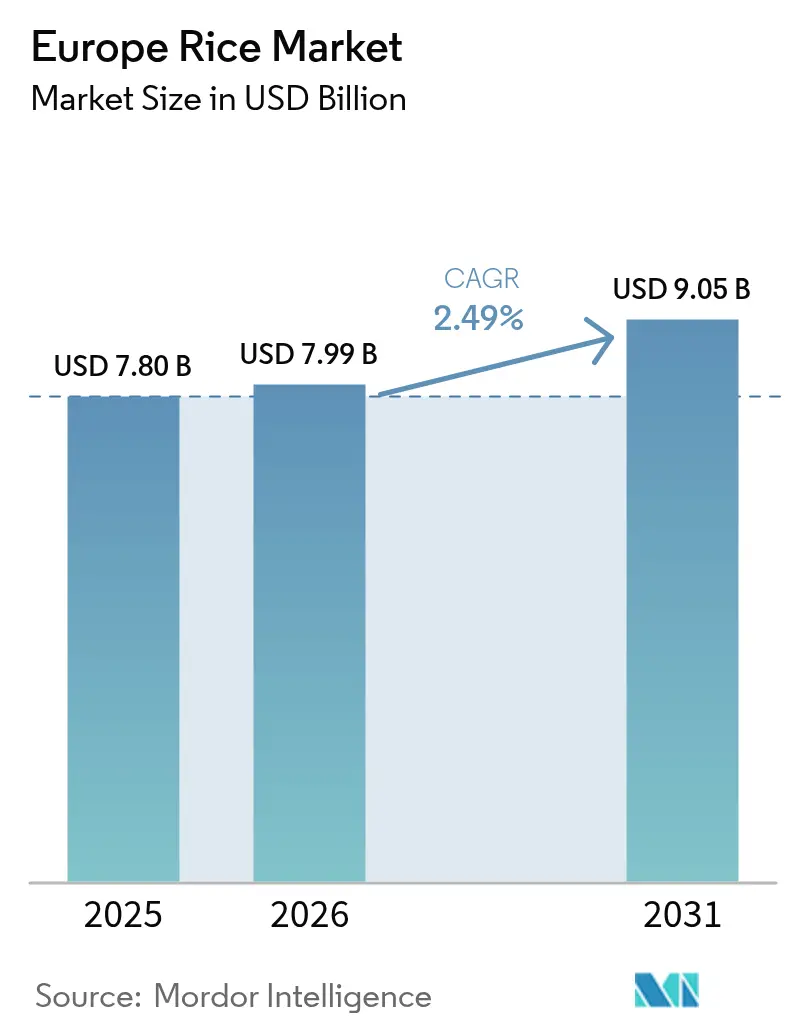
The Europe rice market size is expected to grow from USD 7.8 billion in 2025 to USD 7.99 billion in 2026 and is forecast to reach USD 9.05 billion by 2031 at 2.49% CAGR over 2026-2031. Consumer preferences for gluten-free and premium grains maintain stable demand across retail and food-service segments. The import volumes of aromatic varieties like Basmati and Jasmine rice exceed traditional long-grain rice, driven by increasing multicultural food preferences, particularly in Western Europe. Production decreases in Italy and Spain due to climate factors have constrained regional supply and increased costs, leading processors to establish extended agreements with Asian suppliers. The industry has implemented precision irrigation systems and digital traceability to reduce water consumption and enhance product authenticity. Consumer interest in sustainability and ethical sourcing has led companies to implement transparent supply chain practices. The growing adoption of plant-based diets has strengthened rice's position as an essential food ingredient in European cuisine.
Key Report Takeaways
- By geography, Italy held 27.60% of the Europe rice market size in 2025, and Spain is forecast to register the fastest 3.62% CAGR through 2031.
Note: Market size and forecast figures in this report are generated using Mordor Intelligence’s proprietary estimation framework, updated with the latest available data and insights as of 2026.
Market Trends and Insights
Drivers Impact Analysis of Europe Rice Market*
| Driver | (~) % Impact on CAGR Forecast | Geographic Relevance | Impact Timeline |
|---|---|---|---|
| Boom in Specialty and Ethnic Cuisine Demand | +0.8% | Western Europe, United Kingdom, Netherlands, Germany | Medium term (2-4 years) |
| Europe's Farm-to-Fork Subsidies for Sustainable Rice | +0.5% | EU-27, particularly Italy, Spain, France | Long term (≥ 4 years) |
| Adoption of Precision Irrigation and Water-saving Technologies | +0.4% | Italy, Spain, Southern France | Medium term (2-4 years) |
| Adoption of Climate-Resilient Rice Cultivars | +0.3% | Italy, Spain, Hungary | Long term (≥ 4 years) |
| Consumer Shift from Glutenous Cereals to Rice | +0.6% | Northern Europe, United Kingdom, Germany, Netherlands | Medium term (2-4 years) |
| Investments in Organic and Bio-fortified Rice | +0.4% | Western Europe, Nordic countries | Long term (≥ 4 years) |
| Source: Mordor Intelligence | |||
Boom in Specialty and Ethnic Cuisine Demand
European consumers show a growing preference for aromatic and specialty rice varieties, driven by diverse culinary preferences and health awareness. UK supermarkets have created dedicated sections for Basmati, Jasmine, and colored rice varieties, improving product visibility. Basmati rice sells at prices two to three times higher than conventional long-grain rice, generating higher retail margins.[1]CBI, “The European market potential for specialty rice,” cbi.eu To ensure authenticity and prevent adulteration, suppliers use elemental fingerprinting tests. The shift from ethnic stores to mainstream retail channels has increased consumer access and established premium pricing.
Europe's Farm-to-Fork Subsidies for Sustainable Rice
The European Union's agricultural policy provides payments to farmers who implement alternate wetting and drying techniques, which reduce methane emissions by up to 50% while maintaining crop yields. The Netherlands alone sets aside EUR 964 million (USD 1,060 million) each year to incentivize soil health and pesticide reduction measures.[2]European Commission, “At a glance: The Netherlands’s CAP Strategic Plan,” agriculture.ec.europa.eu The EU's Farm to Fork Strategy aims to decrease chemical pesticide usage and increase organic farming across member states. The policy includes multi-year funding guarantees that enable Italian and Spanish agricultural cooperatives to invest in energy-efficient pumps and laser land leveling equipment, supporting their long-term sustainability initiatives. The strategy provides financial support and technical guidance to help farmers implement precision agriculture and conservation practices that balance environmental protection with economic sustainability.
Adoption of Precision Irrigation and Water-saving Technologies
The implementation of Italy's first automatic flow-control system in Lombardy rice paddies reduced labor requirements and water consumption compared to traditional continuous flooding methods, despite higher initial investment costs. Spanish pilot farms demonstrated successful water conservation through alternate wetting and drying techniques while maintaining grain quality standards. The adoption of these water management practices expanded through stakeholder collaboration and research initiatives, supporting the European Union's objectives for climate resilience and resource efficiency.
Adoption of Climate-Resilient Rice Cultivars
Spanish breeders have identified quantitative trait loci associated with low-temperature germination, enabling rice cultivation in northern regions previously unsuitable for the crop. In Italy, field trials of the RIS8imo gene-edited variety demonstrate resistance to blast fungus, indicating potential reduction in fungicide use. French agronomists are testing cold-tolerant japonica varieties for wetland restoration projects that combine biodiversity conservation with food production. Portuguese researchers are evaluating salt-tolerant rice varieties to utilize coastal areas affected by rising sea levels.
Restraints Impact Analysis of Europe Rice Market*
| Restraint | (~) % Impact on CAGR Forecast | Geographic Relevance | Impact Timeline |
|---|---|---|---|
| Volatile Fertilizer and Energy Prices | -0.6% | EU-27, particularly energy-intensive production regions | Short term (≤ 2 years) |
| Low-cost Asian Import Pressure under GSP Quotas | -0.4% | EU-27, affecting domestic producers | Medium term (2-4 years) |
| Environmental Yield Uncertainty | -0.7% | Italy, Spain, Southern France | Medium term (2-4 years) |
| Stricter European Pesticide-Residue Limits | -0.3% | EU-27, affecting import compliance | Short term (≤ 2 years) |
| Source: Mordor Intelligence | |||
Volatile Fertilizer and Energy Prices
Natural gas supply disruptions led to temporary closures of nitrogen production facilities across Europe, causing urea prices to increase and reducing farmer profit margins despite stable rough-rice prices. According to Rabobank, persistent high input costs may force milling operations to move outside Europe to reduce expenses. Increased energy costs have affected fertilizer supply chains, creating additional challenges for producers. The ongoing volatility in input prices has prompted downstream processors to review their procurement strategies to protect profits and maintain a reliable supply.
Stricter European Pesticide-Residue Limits
The European Union established a maximum limit of 0.01 mg/kg for detectable pesticide residues in imported rice, requiring Asian suppliers to either adapt their agricultural practices or lose market access.[3]EUR-Lex, “Regulation 2023/915,” eur-lex.europa.eu Regulation EU 2023/915 further restricted inorganic arsenic content to 0.15 mg/kg in milled rice and 0.10 mg/kg in infant food products, increasing compliance costs while strengthening consumer trust. These strict limits have driven increased adoption of precision farming methods and post-harvest testing procedures. To maintain access to high-value European markets, exporters are implementing residue-free cultivation methods and traceability systems, as regulators prioritize food safety and public health in trade regulations.
*Our forecasts treat driver/restraint impacts as directional, not additive. The impact forecasts reflect baseline growth, mix effects, and variable interactions.
Geography Analysis
Italy Rice Market
Italy dominates the Europe rice market share with a 27.60% in 2025, primarily through its Arborio and Carnaroli varieties used in risotto production. While facing production challenges, Italian rice maintains a strong market demand. Processors address supply gaps by importing rice that complies with EU contaminant regulations. The country, home to Europe's largest continuous rice-growing region, enhances its infrastructure through improvements such as canal lining to reduce water wastage. Government support measures and seed development initiatives help maintain Italy's market position.
Spain Rice Market
Spain achieves the region's highest CAGR at 3.62%, driven by increased food-service demand and strategic imports of fragrant long-grain rice. The country adopts water-efficient farming practices, including alternate wetting and drying techniques, to offset irrigation costs and maintain production levels despite reduced cultivation areas. Ports in Valencia and Andalusia facilitate North African rice imports, strengthening Spain's role in Western European rice distribution. The combination of agricultural advancements and efficient logistics establishes Spain as a regional growth hub.
Broader European Markets
France, Germany, and the Netherlands maintain stable market positions while expanding their organic and specialty rice offerings for affluent, health-conscious consumers. France functions as a re-export center, with Marseille facilities processing Asian bulk shipments for European distribution. Germany and the Netherlands focus on premium segments, importing certified low-arsenic rice to meet strict labeling standards. The United Kingdom has diversified its supply sources post-Brexit, developing trade relationships with Pakistan and India for duty-free Basmati imports. The United Kingdom records Europe's highest Basmati consumption per capita, with urban areas showing increased demand during Ramadan and Diwali. Belgium strengthens its position as a logistics hub through specialized cleaning and polishing facilities that manage small-volume distribution across the EU.
Regulatory Landscape
The Europe rice market operates under EU food-safety, contaminants, and trade rules that affect both import sourcing and pricing. For trade, the European Commission periodically updates duties on certain rice categories through implementing regulations. Commission Implementing Regulation (EU) 2026/527 sets the import duty for certain husked rice (excluding Basmati) at EUR 30 per tonne effective 6 March 2026, following an earlier duty level of EUR 42.50 per tonne under Commission Implementing Regulation (EU) 2025/1804.
On market access and compliance, Commission Implementing Regulation (EU) 2023/2834 provides an import framework for rice, including specific rules for Basmati and conversion-related parameters used in the regime. Importers and brand owners also face non-tariff requirements, including pesticide-residue controls (commonly 0.01 mg/kg unless otherwise specified), inorganic arsenic limits under EU contaminant rules (as reflected in the report context), and organic production and labeling compliance under Regulation (EU) 2018/848. As a result, testing, traceability, and documentation remain central to commercial operations.
Value Chain Analysis
The European rice value chain covers input supply (seed, fertilizer, energy, irrigation equipment), cultivation concentrated in EU producing regions (notably Italy and Spain), post-harvest handling, milling and processing, packing, and distribution through retail, food service, and re-export hubs. With Europe acting as a structural net importer (imports cited at 1.73 million tonnes in the 2024/2025 marketing year), upstream procurement typically blends domestic paddy and milled rice with imported aromatic and long-grain volumes. Compliance testing for residues and contaminants is embedded before packing and private-label distribution.
Key cost and flow pinch points cluster around cultivation and processing. Water availability and energy costs shape field operations, while mills and packers manage authenticity controls for premium varieties and traceability requirements. Trade policy and safeguard mechanisms also affect sourcing decisions and inventory risk management. Alongside periodic duty updates for husked rice, the reformed GSP safeguard design adds an automatic trigger when imports from a beneficiary country exceed the 10-year average by 45%, reinforcing import-license monitoring, customs classification discipline, and diversified supplier portfolios for processors serving Western Europe’s premium and ethnic-cuisine demand.
Market Opportunities and Future Outlook
Premiumization and specialty segmentation remain a key focus for brand owners and private label, supported by mainstream retail shelf expansion for Basmati, Jasmine, and colored rice and by the price premium specialty rice can command versus conventional long-grain. At the same time, tighter compliance demands, including pesticide residues commonly at 0.01 mg/kg and stricter contaminant thresholds referenced in the report context, create room for suppliers with verified low-residue, low-arsenic programs, digital traceability, and authentication testing. This is particularly relevant in import-dependent markets such as the United Kingdom, Germany, and the Netherlands.
On the supply side, climate and water constraints in major producing areas keep agronomy and breeding innovation at the center of competitiveness. Field trials and EU-backed research programs provide momentum, including the RIS8imo gene-edited risotto rice field trial in Italy and the GRiNRICE project (launched 2026), which applies AI, genomics, and CRISPR/Cas tools. The project focus aligns with blast resistance and resilience to salinity, drought, and heat, which supports adoption of water-saving practices such as alternate wetting and drying and precision irrigation already being implemented and piloted in Southern Europe.
Recent Industry Developments in Europe Rice Market
- June 2026: Cereal Docks announced an agreement to acquire 75% of Pasini Riso e Derivati, expanding into rice- and oat-based ingredients, subject to approval under Italy's Golden Power legislation. The transaction strengthens its position in higher-value, gluten-free and plant-based ingredient applications beyond commodity rice flows, and broadens the downstream customer base across food manufacturing.
- April 2026: Euricom signed a binding agreement to acquire 100% of Ebly, securing the Chateaudun site described as the EU's largest ready-to-heat rice plant with capacity exceeding 100 million units annually. The acquisition adds industrial scale in convenient rice formats, improving control over processing capacity and branded or private-label supply for Western European retail channels.
- October 2024: Italy's Euricom formed a joint venture with Fatima Rice Mills to access Pakistan's Basmati processing capabilities. The partnership deepens premium aromatic sourcing links outside Europe, supporting continuity of supply and quality assurance for European buyers as domestic output in parts of Southern Europe faces climate-related constraints.


Europe Rice Market Report Scope and Research Methodology
Market Definition and Coverage
For this study, the market is defined as the value of rice consumed across Europe, covering domestically produced rice and imported rice that is sold for food use through retail and foodservice channels.
Scope exclusions: We exclude non-rice substitutes and rice derivatives such as rice protein, rice bran oil, and rice-based sweeteners.
Segments Covered in This Report
- By Geography (Production Analysis (Volume), Consumption Analysis (Volume and Value), Import Analysis (Volume and Value), Export Analysis (Volume and Value), and Price Trend Analysis)
- Belgium
- United Kingdom
- France
- Italy
- Germany
- Netherlands
- Spain
Data Sources, Market Sizing, and Validation
Desk Research
Desk work started by mapping Europe rice supply and demand signals, and then aligning them to a consistent market boundary. We used public datasets such as Eurostat, FAOSTAT, UN Comtrade, and the International Rice Research Institute, plus information from national agriculture ministries and customs releases where needed.
To make the value side reliable, we also reviewed importer and packer disclosures, retailer and foodservice pricing commentary in reputable press, and investor presentations that describe mix shifts (parboiled vs long-grain) and sourcing routes. In a few cases, paid subscription company financials and a shipment-level import database helped validate trade flows and identify re-exports, and then the assumptions were checked back against the public statistics. These desk sources are illustrative only, and many other references were used for data collection, cross-checking, and clarification.
Primary Interviews and Surveys
Primary inputs came from interviews and structured surveys with importers, millers, branded packers, large distributors, and downstream buyers that place regular rice tenders. We used these discussions to confirm consumption patterns by country, typical price ladders across major varieties, and how much volume moves through retail versus foodservice, and then we rechecked any outlier claims with follow-up calls.
Since this covers Europe-wide demand, we kept feedback balanced across key consuming and trading hubs to test whether desk indicators, such as import volumes and price spreads, were translating into actual sell-through.
Distribution of primary research fieldwork respondents
| Company type | Respondent position |
|---|---|
| Top tier: 27% | CXOs: 14% |
| Mid tier: 58% | Functional/Unit leaders: 33% |
| Smaller Players: 15% | Managers: 53% |
Market-Sizing & Forecasting
Sizing was built using a top-down model where production, import, and export series were used to reconstruct the apparent consumption pool, and then value was derived using country-level price benchmarks and mix assumptions. The totals were then corroborated with selective bottom-up checks, such as sampled retail shelf-price tracking, importer price lists, and a limited roll-up of major packers to make sure the final number stayed realistic.
Key inputs that shaped the model included import volumes by grain type and origin, domestic production and milling output in key producing countries, retail and wholesale price spreads, the share of parboiled and specialty rice in the basket, and observed substitution pressure from pasta and other staples during high inflation periods. For forecasts, we used scenario analysis supported by trend smoothing, where consumption growth, trade policy shifts, and expected price normalization were stressed in separate cases, and then aligned to what most interviewees viewed as the likely path.
Where bottom-up information was incomplete for smaller markets, gaps were handled through proxying using per-capita consumption ranges and validated price bands, followed by a consistency check against the trade balance.
Data Validation & Update Cycle
Outputs were validated in steps, starting with internal consistency checks across volume, value, and price, and then moving to country-level sanity checks against trade and consumption signals. Any large variance versus historical patterns was reviewed for drivers such as tariff changes, unusual stock builds, or re-export effects, and then assumptions were adjusted only after a second analyst review.
The report is refreshed annually, and interim updates are made when major events affect pricing or trade routes. Before delivery, we run a final pass to confirm that the latest public statistics and interview learnings are reflected in the model.
Mordor Intelligence's Europe Rice Market Sizing Compared With Other Published Estimates
Published market sizes for Europe rice can look far apart, even when the topic sounds similar, because sources do not always measure the same thing or anchor the value in the same year. Differences usually come from whether the study is counting consumer value versus trade value, whether it covers the whole region or only a subset of countries, and how prices are translated into USD.
Import volumes from Eurostat and UN Comtrade, together with country retail price benchmarks and mix checks from interviews, are the evidence that ties Mordor Intelligence to a consumption-value view of Europe rice, which helps avoid counting re-exports and non-food uses in the same total.
Benchmark comparison
| Source | Market Size | Gaps in Research Methodology |
|---|---|---|
| Mordor Intelligence | USD 7.80 B (2025) | |
| Regional Consultancy A | USD 0.77 B (2024) | The figure appears to reflect a narrower definition closer to trade or processing value, and it likely uses a smaller priced volume base, which compresses the total versus a consumption-value model. |
| Global Consultancy B | USD 119.67 B (2024) | The value is much higher than what Europe rice consumption can support from volume and price checks, suggesting broader food-grains scope or downstream packaged-food value being included beyond rice grain consumption. |
The spread is mainly explained by what is being priced and counted, not only by different growth expectations. By keeping the model anchored to observable consumption volumes, realistic price ladders, and clear inclusions, the resulting number stays traceable to repeatable steps that can be rechecked each year.


Key Questions Answered in the Report
How large is the Europe rice market in 2026?
The Europe rice market size reached USD 7.99 billion in 2026 and is projected to rise to USD 9.05 billion by 2031.
Which country consumes the most rice in Europe?
Italy led consumption with a 27.60% of the Europe rice market share in 2025.
What is driving specialty rice demand across Europe?
Rising multicultural cuisine preferences and broader health consciousness are pushing premium Basmati and Jasmine volumes upward.
What sustainability measures are European growers adopting?
Precision irrigation, alternate wetting and drying, and organic certification are the leading strategies supported by EU Farm-to-Fork subsidies.
Page last updated on:





