
Market Overview
| Study Period | 2021 - 2031 |
|---|---|
| Forecast Data Period | 2026 - 2031 |
| Base Year Market Size (2025) | USD 340.86 Billion |
| Market Size (2026) | USD 374.49 Billion |
| Market Size (2031) | USD 599.48 Billion |
| Growth Rate (2026 - 2031) | 9.87 % |
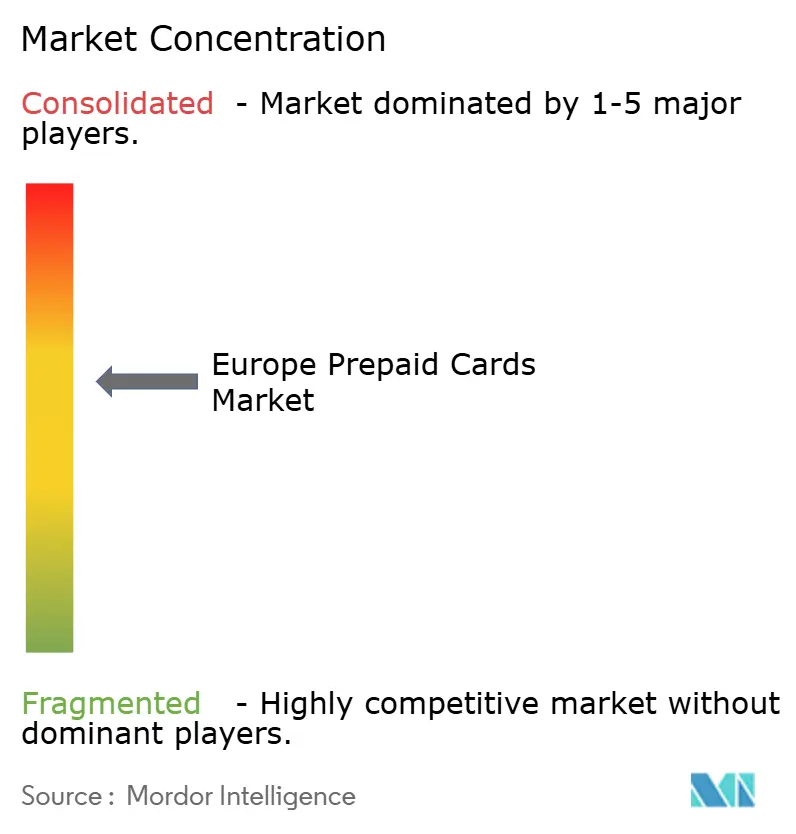
| Market Concentration | Medium |
Major Players
*Disclaimer: Major Players sorted in no particular order Image © Mordor Intelligence. Reuse requires attribution under CC BY 4.0. |
|
Europe Prepaid Cards Market Analysis by Mordor Intelligence
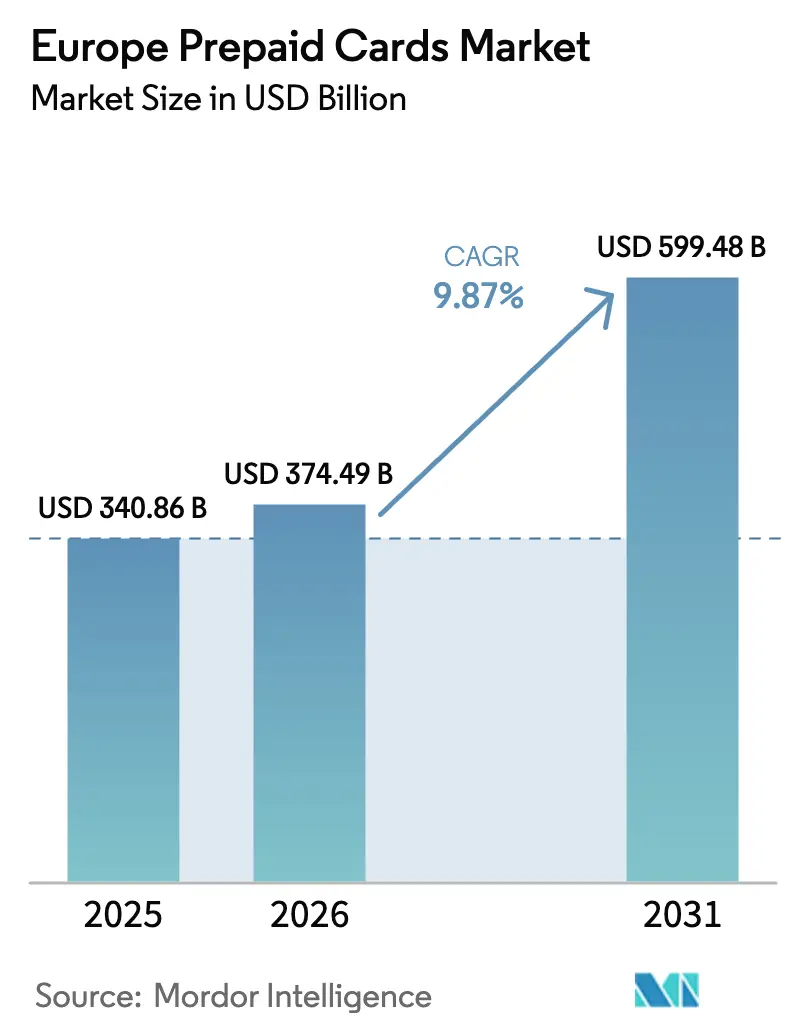
The Europe prepaid card market size was valued at USD 340.86 billion in 2025 and estimated to grow from USD 374.49 billion in 2026 to reach USD 599.48 billion by 2031, at a CAGR of 9.87% during the forecast period (2026-2031). Accelerated adoption of embedded-finance rails by neo-banks, mandatory instant-payment capabilities under the EU regulation effective 2024, and the rebound in Southern European tourism collectively sustain double-digit growth momentum.[1]European Commission, “Legislative proposal on instant payments,” finance.ec.europa.eu Physical cards continue to dominate everyday spending, yet virtual issuance is expanding quickly as corporate platforms and gig-work marketplaces demand instant provisioning and granular controls. Regulatory certainty under PSD2 and the forthcoming Payment Services Regulation encourages cross-border scalability, while tokenisation and mobile-wallet integrations lift security standards and user convenience. Incumbent payment networks defend pricing power even as interchange caps tighten, compelling issuers to monetise value-added services rather than pure transaction fees.
Key Report Takeaways
- By card type, multi-purpose open-loop cards led with 75.35% of the Europe prepaid card market share in 2025, whereas single-purpose closed-loop cards are projected to grow at an 11.31% CAGR through 2031.
- By the card model, physical cards held 67.20% revenue share in 2025; virtual cards exhibit the fastest expansion at an 10.94% CAGR to 2031.
- By reloadability, reloadable products accounted for 62.40% of the Europe prepaid card market size in 2025, while non-reloadable formats advance at a 10.02% CAGR.
- By usage, general-purpose reloadable cards captured 40.60% share in 2025, whereas payroll and incentive solutions are increasing at a 10.23% CAGR.
- By geography, the United Kingdom retained 23.70% share of the Europe prepaid card market size in 2025; the Nordic region is the fastest-growing cluster, expanding at an 10.95% CAGR.
Note: Market size and forecast figures in this report are generated using Mordor Intelligence’s proprietary estimation framework, updated with the latest available data and insights as of 2026.
Europe Prepaid Cards Market Trends and Insights
Drivers Impact Analysis*
| Driver | (~) % Impact on CAGR Forecast | Geographic Relevance | Impact Timeline |
|---|---|---|---|
| Rising Adoption of Embedded Finance by European Neo-banks | +1.8% | UK, Germany, Netherlands, France | Medium term (2-4 years) |
| EU Instant Payments Regulation Boosting Reloadable Prepaid Demand | +1.5% | Eurozone countries, expanding to non-euro EU | Short term (≤ 2 years) |
| Payroll Digitisation by Gig-Work Platforms Across UK & DACH | +1.2% | UK, Germany, Austria, Switzerland | Medium term (2-4 years) |
| SEPA Instant Payments Mandate Accelerating Open-Loop Prepaid Adoption | +1.0% | All SEPA participating countries | Short term (≤ 2 years) |
| Tourism Rebound Driving Multi-Currency Travel Cards (Spain, Italy) | +0.9% | Spain, Italy, France, Greece | Short term (≤ 2 years) |
| Municipal Digital-Voucher Schemes Fueling Retail Closed-Loop Cards | +0.7% | Germany, Greece, France, Netherlands | Medium term (2-4 years) |
| Tokenised Contactless & Mobile Wallet Integration of Prepaid Cards | +0.6% | Global, with early adoption in Nordics and UK | Long term (≥ 4 years) |
| Source: Mordor Intelligence | |||
Embedded Finance Adoption by European Neo-banks
European neo-banks scale prepaid issuance by embedding card functionality in third-party platforms, evidenced by Revolut’s 50 million customers and USD 545 million profit in 2024. Embedded rails reduce acquisition friction, allowing instant digital issuance across e-commerce, gig-work, and corporate-expense ecosystems. PSD2 passporting plus the forthcoming Payment Services Regulation harmonise compliance, enabling borderless distribution. Real-time analytics let issuers configure spend controls, loyalty rewards, and risk-scoring in-app, creating higher engagement than legacy prepaid propositions. Consequently, the Europe prepaid card market benefits from network-effects as fintech platforms bundle payments, budgeting, and lending around a single stored-value core.
EU Instant Payments Regulation Boosting Reloadable Demand
The 2024 regulation mandates equal pricing for instant versus traditional transfers and compels 24/7 availability, making reloadable prepaid instruments ideal for gig-economy payouts, cross-border remittances, and SME cash-flow management cashmanagement. Compliance obligations such as verification-of-payee create a scale advantage for established issuers, reinforcing moderate market concentration. Early movers leverage instant settlement to market “fund-in-seconds” propositions that improve card stickiness and interchange stability, thereby extending the Europe prepaid card market growth runway.
Payroll Digitisation by Gig-Work Platforms
Variable-income workers in the UK and DACH increasingly prefer prepaid payroll cards that circumvent 1–3-day bank clearing delays. Platforms issue virtual cards at the point of onboarding, satisfying IR35 and cross-border compliance rules while offering real-time earnings access. Card-linked apps bundle tax calculators and expense trackers, boosting worker retention. Industrial logistics and last-mile delivery sectors demonstrate outsized usage due to high shift variability, reinforcing demand throughout the Europe prepaid card market.
SEPA Instant Mandate Accelerating Open-Loop Adoption
The 2025 SEPA rulebook removes residual pockets of non-compliance, ensuring universal rail availability across 36 member states.[2]European Payments Council, “2025 SEPA Instant Credit Transfer Rulebook,” europeanpaymentscouncil.eu Open-loop prepaid cards integrate instant-credit transfers to provide continuous balance updates without correspondent banking overhead. Policy support from the European Central Bank favours domestic-scheme innovation, enabling issuers to differentiate via real-time refunds, peer-splitting, and dynamic FX conversion. Consequently, open-loop solutions consolidate their leadership position inside the Europe prepaid card market.
Restraints Impact Analysis*
| Restraint | (~) % Impact on CAGR Forecast | Geographic Relevance | Impact Timeline |
|---|---|---|---|
| Interchange Fee Regulation Compressing Issuer Margins | -1.4% | EU-wide, particularly affecting tourist card segments | Short term (≤ 2 years) |
| Declining Refugee Benefit Loads Post-2022 Peak | -0.8% | Germany, Poland, Central European countries | Medium term (2-4 years) |
| A2A Wallet Proliferation in Nordics Cannibalising Prepaid Usage | -0.6% | Denmark, Sweden, Norway, Finland | Medium term (2-4 years) |
| Fragmented AML/KYC Rules Elevating Cross-Border Issuance Costs | -0.5% | Cross-border operations, particularly affecting smaller issuers | Long term (≥ 4 years) |
| Source: Mordor Intelligence | |||
Interchange-Fee Regulation Compressing Margins
Visa and Mastercard agreed to extend EU tourist-card interchange caps through 2029, constraining issuer revenue pools. The UK Payment Systems Regulator calculates that domestic merchants pay USD 250 million additional scheme fees annually, intensifying scrutiny.[3]Payment Systems Regulator, "MR22/1.9 Market Review of Card Scheme and Processing Fees Interim Review., psr.org.uk Issuers respond by pivoting to subscription pricing, data monetisation, and B2B expense-management bundles to defend returns, reshaping profit pools within the Europe prepaid card industry.
Declining Refugee Benefit Loads Post-2022 Peak
Germany, Poland, and other CEE markets are tapering emergency disbursements as Ukrainian refugee inflows stabilise, reducing transaction volumes for specialised benefit cards. Providers that scaled rapidly on humanitarian programmes must diversify into municipal voucher and social-assistance schemes with tighter KYC rules and domestic-spend restrictions, moderating segment expansion inside the Europe prepaid card market.
*Our forecasts treat driver/restraint impacts as directional, not additive. The impact forecasts reflect baseline growth, mix effects, and variable interactions.
Segment Analysis
By Card Type: Open-Loop Strength, Closed-Loop Momentum
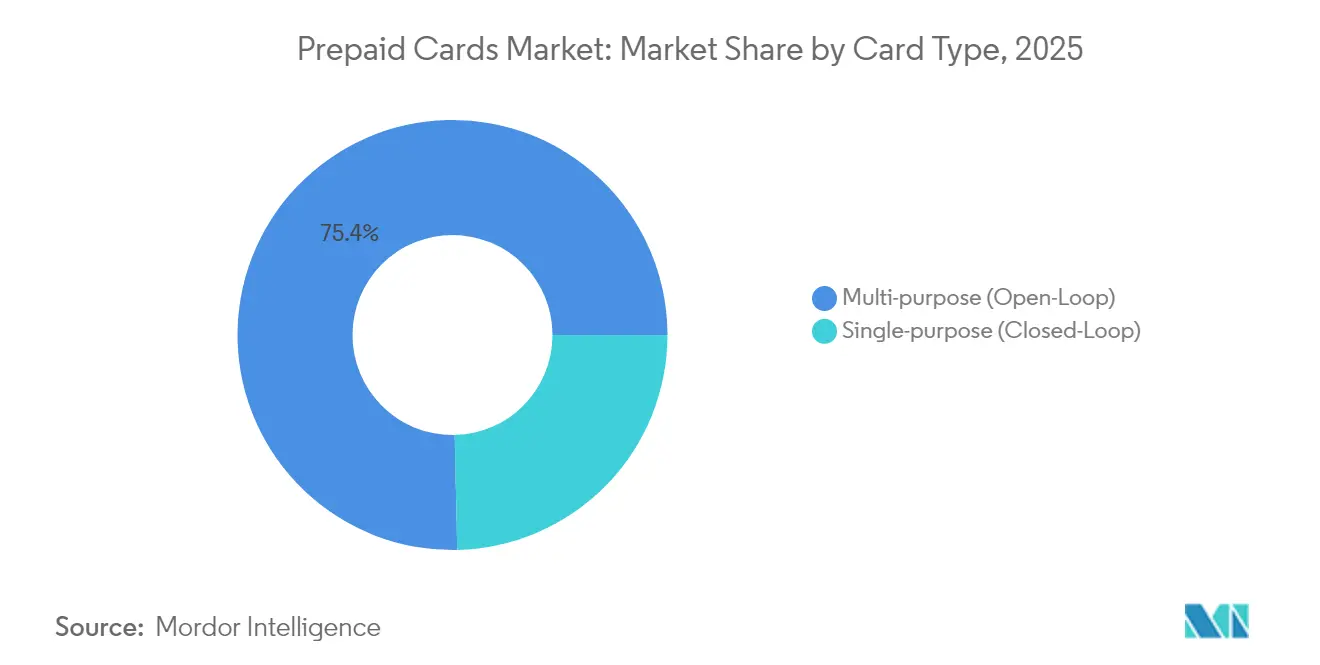
Multi-purpose open-loop solutions held 75.35% share in 2025, benefiting from universal merchant acceptance and regulatory harmonisation that streamlines cross-border top-ups. Instant-payment connectivity further enhances appeal to frequent travellers and SMEs operating pan-Europe. Government agencies, however, are adopting closed-loop architectures for asylum-seeker and tourism-voucher programmes, accelerating single-purpose card issuance at an 11.31% CAGR through 2031.
Closed-loop designs deliver granular spend controls, real-time analytics, and reduced fraud exposure, attributes suited to targeted subsidy and corporate-expense schemes. Municipal deployments in Germany and Greece showcase scalable templates that anchor future demand. As a result, closed-loop offerings widen their addressable base, even while open-loop formats remain the backbone of the Europe prepaid card market.



By Card Model: Physical Resilience, Virtual Upswing
Physical variants accounted for 67.20% usage in 2025, reflecting consumer familiarity, backup utility when mobile batteries fail, and the prevalence of contactless acceptance across transit and retail networks. Senior segments and tourist populations still prefer tangible cards, stabilising absolute volumes.
Virtual cards, expanding at an 10.94% CAGR, dominate new-to-market issuance on embedded-finance platforms. Instant provisioning, tokenisation-driven security, and merchant-specific dynamic controls make them the default choice for corporate-expense and gig-payout programmes. Neo-banks harness these attributes to deepen wallet share, reinforcing structural gains for digital issuance inside the Europe prepaid card market.
By Reloadability: Flexible Products Prevail
Reloadable formats represented 62.40% revenue in 2025, aligning with the EU Instant Payments Regulation that supports perpetual top-ups and real-time fund availability. Budget-management features and recurring payroll loads anchor consumer loyalty, especially among migrant and gig-economy segments.
Non-reloadable cards nevertheless grow at a 10.02% CAGR, propelled by gift-card programmes below EUR 150 (USD 165) thresholds that enjoy simplified KYC verestro.com. Tourism-oriented single-load products gain traction as travellers seek fixed-budget tools, reinforcing balanced growth across reload profiles in the Europe prepaid card market.
By Usage: General-Purpose Dominance, Payroll Acceleration
General-purpose reloadable solutions retained 40.60% share in 2025 as households use them for day-to-day spend, cross-border remittances, and disciplined budgeting. Neo-bank onboarding funnels amplify adoption by positioning prepaid as a stepping stone toward full banking relationships.
Payroll and incentive cards, expanding 10.23% CAGR, capitalise on immediate wage-access demands in the gig and logistics sectors. Integrated tax and expense modules embed the product deep into platform ecosystems, driving repeat loads. Gift, benefit, and travel cards continue to fill niche use cases, diversifying revenue streams within the Europe prepaid card market.
By Vertical: Retail Leads, Corporate Expense Surges
Retail and e-commerce applications command 37.65% share as omnichannel merchants deploy prepaid for loyalty, acquisition, and closed-loop gift solutions. Spending analytics generated by retail cards create upsell opportunities and drive incremental footfall.
Corporate-expense programmes post a 10.41% CAGR as firms digitise spend controls in hybrid work environments. Edenred’s EUR 1.395 billion (USD 1.53 billion) H1 2024 revenue underscores scale potential. Integration with ERP and HR systems ensures policy compliance and auditability, magnifying the strategic appeal of prepaid within B2B contexts of the Europe prepaid card market.
By Delivery Mode: Digital-First Leadership
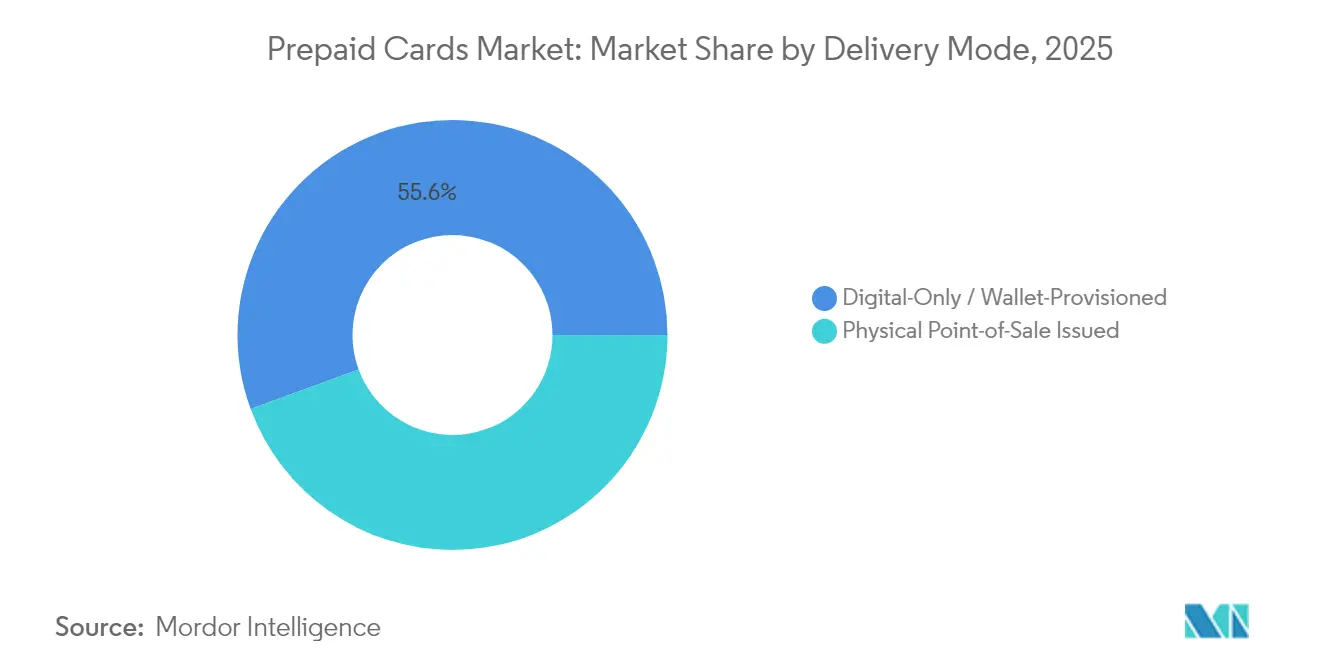
Digital-only provisioning captured 55.60% share in 2025, and it is growing fastest with 11.02% CAGR during the period. reflecting frictionless remote onboarding and zero physical-inventory costs. Fintech providers layer biometric ID verification and AI fraud screens to meet supervisory requirements while sustaining instant issuance.
Point-of-sale issued cards retain relevance for tourism and in-store gift applications, offering immediate tangibility and upsell potential at checkout. Nonetheless, falling unit costs for digital delivery and rising mobile-wallet penetration favour continued migration toward fully virtual distribution across the Europe prepaid card market.
By Distribution Channel: Online Platforms in Ascendance
Online and app-based channels generated 58.40% of 2025 sales as consumers gravitate to self-service interfaces and contextual card provisioning within e-commerce checkouts. Social-commerce integrations further propel digital activation volume.
Retail reload kiosks and partner supermarkets grow 10.98% CAGR, bridging cash-to-digital conversion for unbanked populations. Bank branches and post offices maintain niche roles for high-value loads and identity-verified issuance, sustaining multi-channel equilibria throughout the Europe prepaid card market.
Geography Analysis
The United Kingdom leads the Europe prepaid card market with 23.70% share, leveraging a mature fintech talent base, progressive Financial Conduct Authority guidance, and rapid uptake of embedded-finance services. London-based issuers export models across the continent through passporting equivalence post-Brexit, preserving scale economies while adapting to distinct EEA compliance regimes.
Nordic countries collectively advance at an 10.95%CAGR, pairing account-to-account wallets such as Wero with prepaid overlays that deliver merchant ubiquity absent among domestic schemes. Consumers embrace hybrid payment stacks that toggle seamlessly between bank and stored-value rails, fostering innovation clusters in Stockholm and Helsinki.
Core Eurozone markets—Germany, France, Italy, and Spain—sustain depth via diversified use cases: corporate-expense controls in DACH, tourism travel cards along the Mediterranean corridor, and municipal voucher programmes targeting SME digitisation. The Netherlands and Belgium act as cross-border testing grounds for real-time FX and multicurrency propositions, while Poland extends the Europe prepaid card industry’s reach into rapidly growing Central European retail segments.
Regulatory Landscape
Europe prepaid card issuance and processing sit within the EU payments framework led by the European Commission (DG FISMA), implemented by national competent authorities, and supported by rulemaking and supervisory convergence from the European Banking Authority (EBA) and the European Central Bank (ECB) for retail payment infrastructure. The Instant Payments Regulation (Regulation (EU) 2024/886) tightens requirements for euro instant credit transfers, including verification-of-payee obligations and staged compliance; for non-bank PSPs such as electronic money institutions that issue prepaid products, euro-area reachability obligations for instant payments extend to 9 April 2027. This increases the need for real-time rails integration, fraud controls, and liquidity processes.
Operational resilience requirements also increased with the Digital Operational Resilience Act (DORA), which applies from 17 January 2025 and brings harmonised ICT risk management, incident reporting, and third-party risk oversight for payment institutions and electronic money institutions. In parallel, PSD3 and the proposed Payment Services Regulation continue the shift toward a more unified authorization and rule set for payment services and e-money activity, including updates that explicitly cover prepaid instruments without printed holder names by treating them as individualized devices. EBA guidance and Q&A, including clarification that prepaid vouchers topping up e-money accounts fall under e-money rules, reinforce that prepaid programs must align product design, safeguarding, and KYC/AML controls with electronic money requirements.
Value Chain Analysis
The Europe prepaid cards value chain begins with scheme rails and processing, where international card schemes retain scale while European processors and issuers seek more control over cost and compliance. Issuers (banks and electronic money institutions) and BIN sponsors enable program managers, neo-banks, and vertical platforms (fleet, payroll, travel, corporate spend) to design propositions, manage KYC/AML onboarding, and run lifecycle controls. Processors, tokenisation providers, and fraud or risk vendors then support authorization, dispute management, and digital wallet provisioning, while card manufacturers and personalization bureaus remain important for physical cards, which still account for the majority of 2025 revenue share in the market.
On the distribution and usage side, fintech apps, online onboarding flows, retail and kiosk networks for cash-in and reload, and enterprise platforms embedding cards into workflows (ERP, HR, expense tools) shape adoption. Recent partnerships point to where value is moving: Nets (Nexi Group) and Visa with Eurowag (February 2025) highlight verticalized open-loop prepaid for fleet management, and TransactPay with Setld Pay (September 2025) points to SEPA Instant-funded card programs that reduce prefunding pressure and support faster balance availability. As DORA-led ICT controls and PSD3/PSR harmonization tighten compliance and resilience expectations, those capabilities increasingly influence which processors, issuers, and program managers can scale cross-border.
Competitive Landscape
Visa and Mastercard process 61% of euro-area card transactions, granting scale economies that partially offset interchange-fee compression. [4]European Central Bank, “Most EU countries rely on international card schemes for card payments,” ecb.europa.eu Their strategic extension of cap agreements to 2029 stabilises regulatory risk while prompting issuers to shift towards subscription and data-driven revenue constructs.
Neo-banks and embedded-finance specialists escalate rivalry by packaging prepaid cards as gateways to multicurrency accounts, crypto trading, and micro-savings products. Revolut’s USD 1 trillion annual transaction throughput and sustained profitability validate the platform thesis, while Solaris’ majority acquisition by SBI underscores capital-intensity and compliance overhead inherent in banking-as-a-service models.
Consolidation accelerates: Railsr’s USD 283 million purchase of Equals Group builds scale across FX and expense-management verticals, Edenred commits to 10% EBITDA growth via acquisitive expansion, and Visa bolsters risk analytics through its Featurespace buy-out. Competitive positioning now hinges on real-time fraud prevention, tokenisation breadth, and instant-credit transfer connectivity that deepen user engagement inside the Europe prepaid card market.
Europe Prepaid Cards Industry Leaders
-
Visa
-
Mastercard
-
PayPal Holdings Inc.
-
American Express Company
-
Green Dot Corporation
- *Disclaimer: Major Players sorted in no particular order

Market Opportunities and Future Outlook
Instant payments compliance creates a clear whitespace for prepaid issuers and program managers that can pair SEPA Instant funding with strong verification-of-payee and fraud controls, particularly in payroll, gig-platform payouts, and SME cash management where time-to-funds is a defining product attribute. The European Payments Council (EPC) activity around the Verification of Payee (VOP) scheme, including its 1 April 2026 public consultation on VOP rulebook change requests (v2.0) and the 5 March 2026 Scheme Technical Player discussions on scheme performance and rulebook change management, supports continued demand for interoperable, standardized real-time payment capabilities. These capabilities can be packaged into reload flows and embedded-finance propositions.
A second opportunity track is product innovation that bridges new payment assets with traditional acceptance while staying within European compliance expectations, illustrated by the June 2026 launch of Opera’s MiniPay Card, a digital Visa debit card that enables spending of stablecoin balances at Visa merchant locations in the European Economic Area (EEA). Alongside this, PSD3/PSR work to modernize definitions of payment instruments to cover individualized devices, including prepaid cards without printed holder names, supports the continued expansion of virtual-first issuance models used in corporate expense and embedded distribution. Taken together, these signals point to providers that can industrialize tokenised issuance, mobile wallet provisioning, and real-time funding across multiple European markets while meeting DORA-aligned third-party and ICT governance requirements.
Recent Industry Developments
- June 2026: Opera launches the MiniPay Card, a digital Visa debit card enabling spending of stablecoin balances at Visa merchant locations in the European Economic Area. Monavate and Gnosis Pay handle card infrastructure and issuance, illustrating how prepaid and debit programs are packaged into wallet-led consumer apps.
- November 2025: The European Parliament and Council reached a provisional agreement on PSD3 and the Payment Services Regulation, aimed at harmonising payment services rules and strengthening consumer protection. It supports scalable cross-border product design by reducing scope gaps across member states.
- December 2024: Nuvei introduced off-ramping of digital assets to cards via Mastercard Move in Europe, enabling conversion and payout flows that connect digital asset holdings to card-based spending. This strengthens the payments stack for fintechs and platforms that want to add card-linked payout and spend features without rebuilding end-to-end settlement infrastructure.


Research Methodology Framework and Report Scope
Market Definition and Coverage
We define the Europe prepaid cards market as the value of payments executed using prepaid cards across Europe, covering both single-purpose and multi-purpose prepaid instruments used by consumers and organizations for day to day purchases and services.
Scope exclusions: We exclude payments made through linked debit or credit accounts, and we do not treat pure account-to-account transfers as prepaid card spend.
Segmentation Overview
-
By Card Type
- Multi-purpose (Open-Loop)
- Single-purpose (Closed-Loop)
-
By Card Model
- Physical Cards
- Virtual Cards
-
By Reloadability
- Reloadable
- Non-Reloadable
-
By Usage
- General Purpose Reloadable
- Gift Card
- Government Benefit Disbursement
- Payroll and Incentive
- Travel and Foreign Currency
- Other Usage
-
By Vertical
- Retail and E-commerce
- Corporate Expense Management
- Government and Public Sector
- Financial Institutions and Fintech
- Travel and Hospitality
- Others
-
By Delivery Mode
- Physical Point-of-Sale Issued
- Digital-Only / Wallet-Provisioned
-
By Distribution Channel
- Bank Branches
- Online and Mobile Apps
- Retail Stores and Kiosks
- Others (Post Offices, Transit Hubs)
-
By Geography
- United Kingdom
- Germany
- France
- Italy
- Spain
- Netherlands
- Nordics (Denmark, Sweden, Norway, Finland)
- Poland
- Rest of Europe (Switzerland, Austria, Belgium, etc.)
Data Sources, Market Sizing, and Validation
Desk Research
Desk research was used to set guardrails for what should be counted as prepaid card value, and to map country-level payment behavior across Europe. We relied on public sources such as the European Central Bank payment statistics, Eurostat population and consumption indicators, the European Banking Authority regulatory publications, and national central bank payment reports for key markets.
Alongside these, we used issuer and processor annual reports, investor presentations, and audited filings to track shifts in product mix between physical and virtual issuance, and the pace of digital wallet provisioning. Where it was important to cross-check company scale or card program rollouts, we referenced paid subscriptions focused on company financials and intelligence, news and financials sources, and patent databases for payments-related innovations. The desk sources listed here are illustrative, and we also reviewed other public documents and datasets for data collection, validation, and clarification.
Primary Interviews and Surveys
Primary interviews and surveys were used to confirm what portion of prepaid activity is true spend value versus loads, re-loads, or dormant balances, because these items can inflate totals if they are counted in the same bucket. We spoke with a mix of program managers, issuers, distributors, and merchant-side stakeholders across major European countries and smaller markets, and then used those inputs to stress-test adoption, fee pass-through, and wallet-linked usage assumptions.
Distribution of primary research fieldwork respondents
| Company type | Respondent position |
|---|---|
| Top tier: 28% | CXOs: 15% |
| Mid tier: 56% | Functional/Unit leaders: 37% |
| Smaller Players: 16% | Managers: 48% |
Market-Sizing & Forecasting
Sizing was built using a top-down and bottom-up blend. We used country-level payment and prepaid usage indicators to reconstruct total prepaid card spend in value terms, and then cross-checked the results against selective issuer and program level signals. We started by building a country stack for major markets in Europe, then expanded to the rest using scaled indicators so the total stays consistent with observed payment mix patterns.
Key inputs tracked (as examples) include prepaid transaction value and volume trends, share of cashless payments, population by banked and underbanked cohorts, e-commerce share of retail, the split between physical and virtual prepaid issuance, and the pace of wallet provisioning for tokenized cards. These variables are tied to prepaid growth patterns, since online acceptance, travel and cross-border usage, payroll and benefits programs, and regulatory changes that affect instant payments and authentication tend to move together.
For forecasting, scenario analysis was used because prepaid demand is sensitive to a small set of policy and pricing changes. Those scenarios were then anchored to expert expectations gathered in interviews. Where country detail was thin, we used proxy ratios from similar European markets, followed by analyst review to keep implied spend per active card and growth curves realistic over time.
Data Validation & Update Cycle
Totals were validated by comparing modeled spend against independent signals, such as overall card payment growth, reported prepaid program performance cues, and country payment mix movements, and then investigating mismatches before final sign-off. Outliers were flagged through variance checks at the country level, followed by a second pass to assess whether drivers like e-commerce share or the virtual issuance ramp can explain the observed step change.
We refresh the model annually, and we also trigger interim checks when material events occur, such as a major rule change affecting payments flows or a sharp shift in consumer spending. Before delivery, we run a final update pass so the figures reflect the latest available public releases and the most recent expert feedback.
Mordor Intelligence's Europe Prepaid Cards Market Sizing Compared With Other Published Estimates
Published market sizes for prepaid cards in Europe can differ substantially because firms do not always count the same underlying metric, even when the topic name is similar. The biggest differences usually come from whether the number represents payment value, outstanding loaded balances, or total load value, and whether single-purpose programs are treated as part of prepaid.
Another common driver is how virtual prepaid usage is handled, especially when cards are provisioned into wallets and then used across cross-border e-commerce, which can shift spend quickly by country. Some estimates also mix issuer revenue with transaction value, or they apply different currency conversion timing when aggregating multi-country totals, and that can move the headline number even when underlying volumes are similar.
Benchmark comparison
| Source | Market Size | Gaps in Research Methodology |
|---|---|---|
| Mordor Intelligence | USD 340.86 B (2025) | |
| Industry Association A | USD 315.20 B (2025) | Typically leans on reported card loads or outstanding balances in a few tracked programs, which can understate spend where reload frequency and active usage are high across multiple countries. |
| Trade Journal B | USD 402.10 B (2025) | Often blends prepaid with adjacent stored-value and gift activity, and may treat loads as equivalent to spend, which can overstate market value when breakage and unused balances are not adjusted. |
The spread in the table is mostly explained by whether the metric is true payment spend and how much adjacent stored-value activity is folded in, along with currency timing across European markets. By keeping the figure tied to prepaid transaction value and filtering out load-only effects, the 2025 estimate stays closer to repeatable payment signals, which is the modeling choice applied by Mordor Intelligence.


Key Questions Answered in the Report
What is the current value of the Europe prepaid card market?
The Europe prepaid card market size stands at USD 374.49 billion in 2026.
How fast is the market expected to grow?
It is projected to expand at a 9.87%CAGR, reaching USD 599.48 billion by 2031.
Which card type holds the largest market share?
Multi-purpose open-loop cards led with 75.35% share in 2025.
Which geographic region is growing the fastest?
The Nordic region posts the highest growth trajectory at an 10.95%CAGR through 2031.
How are interchange-fee caps affecting issuers?
Caps extended to 2029 compress transaction-based margins, prompting issuers to pivot toward subscription and data-driven revenue models.
What role do neo-banks play in market expansion?
Neo-banks accelerate growth by embedding prepaid functionality in third-party apps, enabling instant digital issuance and cross-border scalability.
Page last updated on:





