
Europe Pallet Wrapping Machine Market Size and Share
Market Overview
| Study Period | 2020 - 2031 |
|---|---|
| Forecast Data Period | 2026 - 2031 |
| Historical Data Period | 2020 - 2024 |
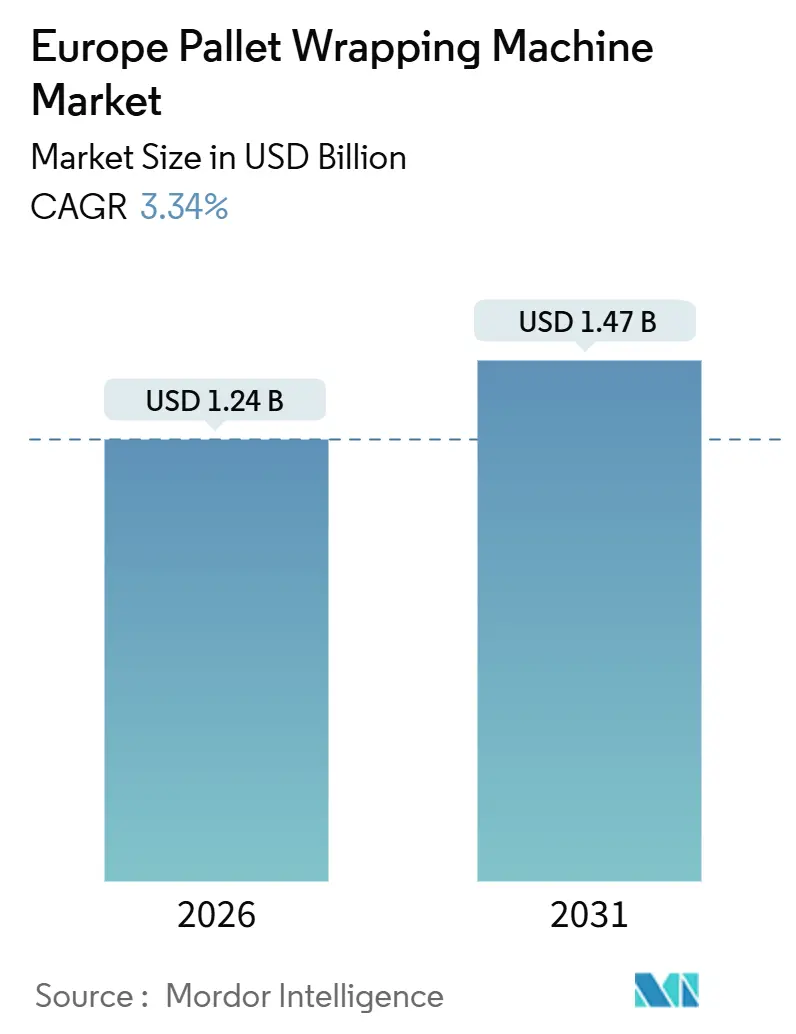
| Market Size (2026) | USD 1.24 Billion |
| Market Size (2031) | USD 1.47 Billion |
| Growth Rate (2026 - 2031) | 3.34 % |
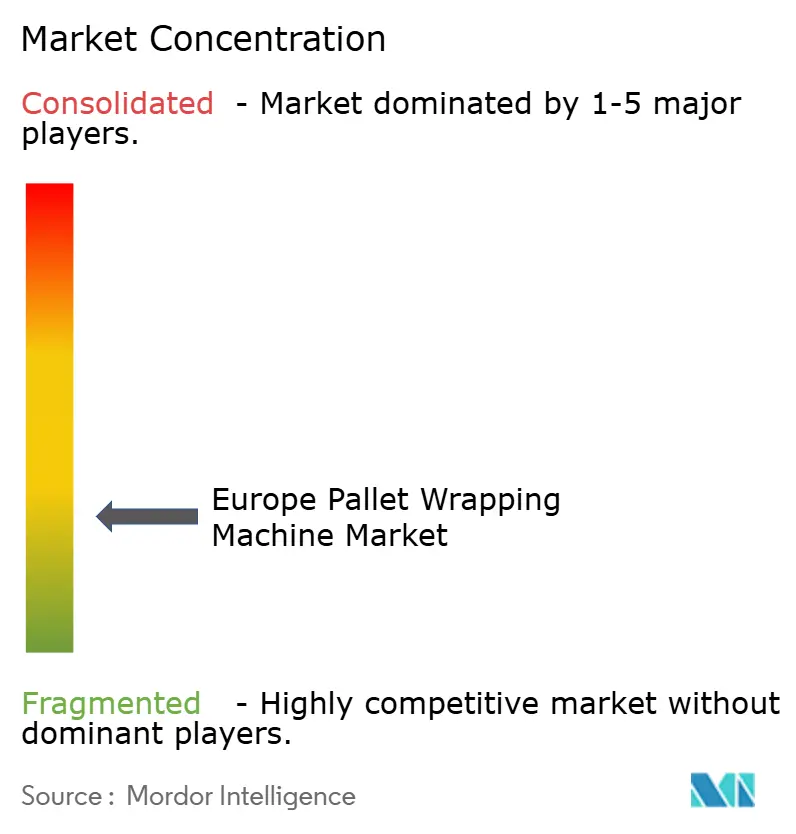
| Market Concentration | Low |
Major Players *Disclaimer: Major Players sorted in no particular order Image © Mordor Intelligence. Reuse requires attribution under CC BY 4.0. | |
Europe Pallet Wrapping Machine Market Analysis by Mordor Intelligence
The Europe pallet wrapping machine market size reached USD 1.24 billion in 2026 and is projected to expand to USD 1.47 billion by 2031, advancing at a 3.34% CAGR. This growth trajectory reflects a mix of automation-driven upgrades at e-commerce fulfillment hubs, incremental retrofits at midsized factories, and sustainability mandates that favor high-efficiency pre-stretch systems. Demand accelerators include Poland’s warehouse construction boom, the increasing use of bio-based films that require purpose-built tension controls, and the EU Carbon Border Adjustment Mechanism, which prompts exporters to track stretch-film usage for Scope 3 reporting. At the same time, capital-spending restraint among Southern European SMEs, talent shortages for mechatronics technicians, and competition from alternative load-securing solutions temper the adoption curve.
Key Report Takeaways
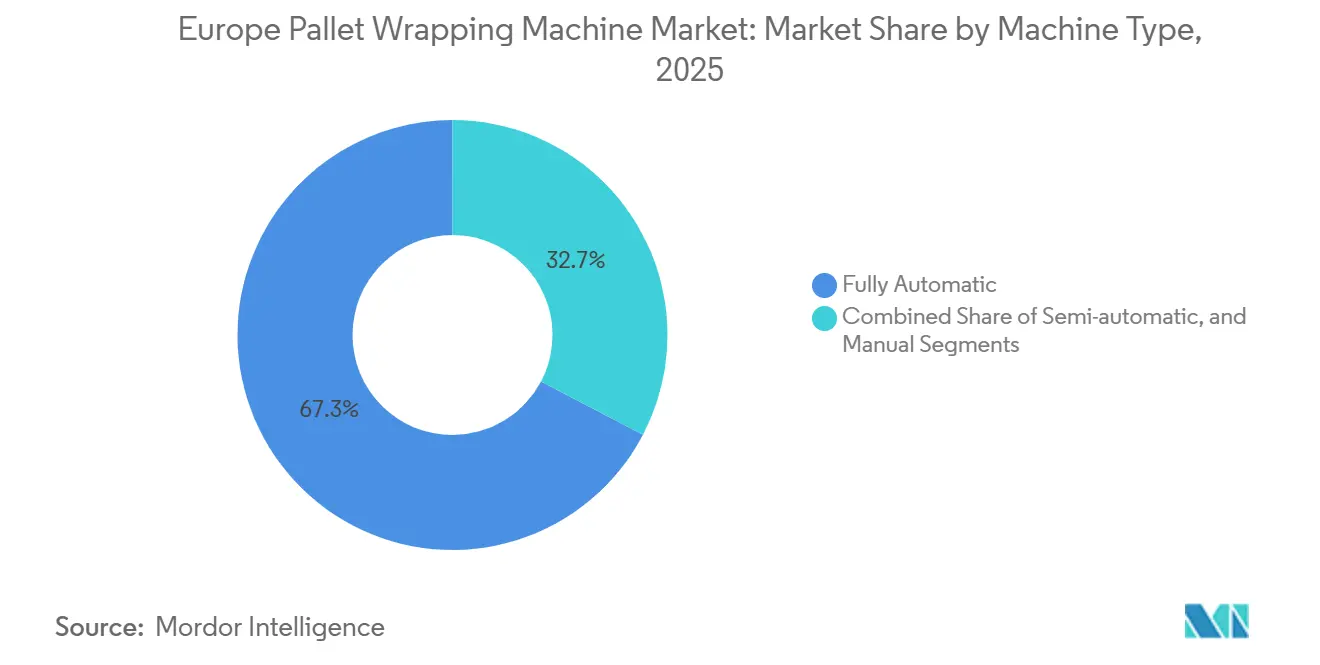
- By machine type, fully automatic systems captured 67.32% of the Europe pallet wrapping machine market share in 2025.
- By technology, the Europe pallet wrapping machine market size for ring wrappers is projected to grow at a 5.03% CAGR between 2026–2031.
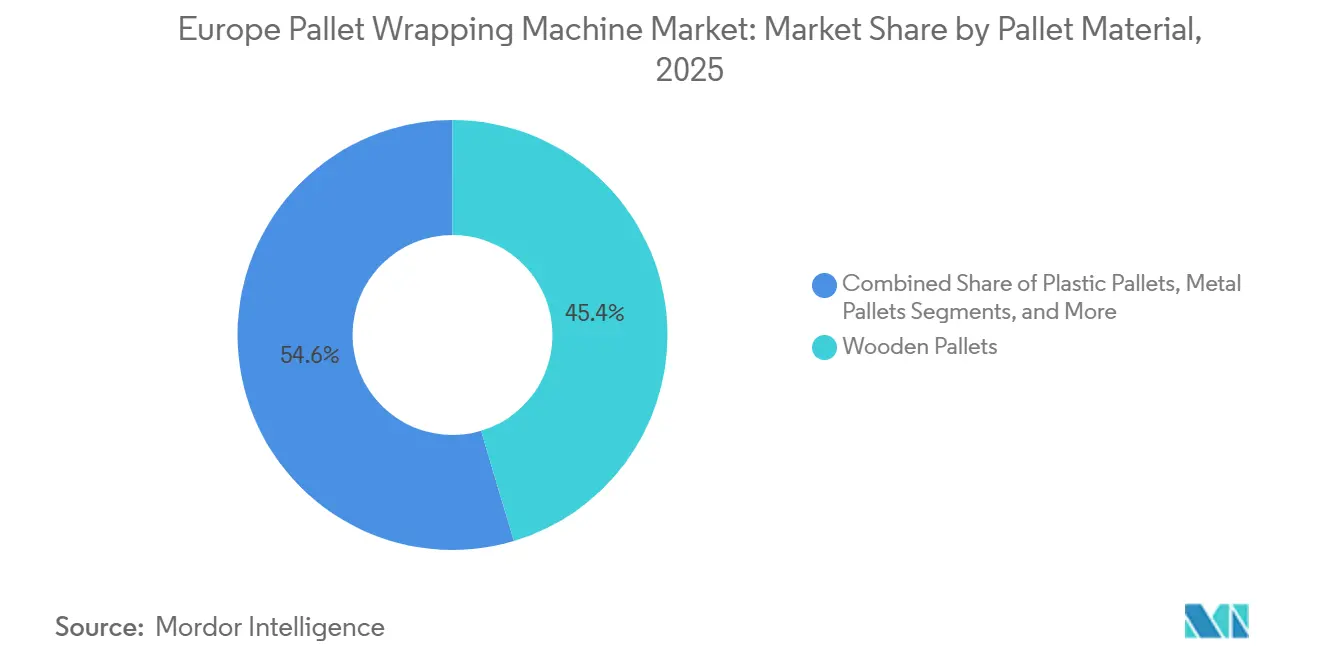
- By pallet material, wooden platforms captured 45.39% of the Europe pallet wrapping machine market share in 2025.
- By end-user industry, the Europe pallet wrapping machine market size for the pharmaceutical sector is projected to grow at a 5.38% CAGR between 2026–2031.
- By geography, Germany captured 19.50% of the Europe pallet wrapping machine market share in 2025.
Note: Market size and forecast figures in this report are generated using Mordor Intelligence’s proprietary estimation framework, updated with the latest available data and insights as of January 2026.
Market Trends and Insights
Drivers Impact Analysis of Europe Pallet Wrapping Machine Market*
| Driver | (~) % Impact on CAGR Forecast | Geographic Relevance | Impact Timeline |
|---|---|---|---|
| Growing Transportation and Logistics Sector | +0.9% | Pan-European with strength in Germany, Poland, Netherlands | Medium term (2-4 years) |
| Rising Pallet Demand as Tertiary Packaging | +0.5% | Western Europe is expanding into Central and Eastern Europe | Long term (≥4 years) |
| E-Commerce Fulfilment Centre Boom | +1.2% | Poland, Germany, the United Kingdom, and Spain | Short term (≤2 years) |
| Circular Pallet-Pooling Integrations | +0.4% | Pan-European CHEP and LPR networks | Long term (≥4 years) |
| Bio-Based Stretch Film Retrofits | +0.3% | Germany, France, Italy | Medium term (2-4 years) |
| EU Carbon-Border Automation Incentives | +0.6% | EU-27 export hubs | Medium term (2-4 years) |
| Source: Mordor Intelligence | |||
E-Commerce Fulfilment Centre Boom
Rapid parcel growth raises pallet flows at mega-warehouses and last-mile micro-hubs. Operators standardize high-speed rotary-ring machines that wrap 80-125 pallets per hour, shrinking payback periods to under 18 months even in low-wage locations. Compact semi-automatic models under 2 m² cater to urban micro-fulfilment, where floor space is at a premium. The result is a dense pipeline of both replacement and new orders for the European pallet wrapping machine market vendors, especially in Poland and Germany, where new distribution space is coming online.
EU Carbon-Border Automation Incentives
The Carbon Border Adjustment Mechanism, fully implemented in 2026, requires exporters to document the embedded emissions.[1]European Commission, “Carbon Border Adjustment Mechanism,” europa.eu Wrapping machines now ship with IoT sensors that meter film uses and energy draw, generating auditable data for customs filings. German manufacturers utilize Manufacturing-X data spaces to benchmark wrap patterns, while embedded edge controllers meet the EU Cyber Resilience Act requirements by keeping data on-premises.
Growing Transportation and Logistics Sector
Pan-European goods flow remains resilient, and modal shifts from road to rail and inland waterways increase pallet turns at consolidation terminals. Logistics operators invest in mobile robotic wrappers that travel between docks, trimming bottlenecks in cross-docking layouts. This fosters a steady baseline demand for the European pallet wrapping machine market as throughput gains outpace moderate GDP growth.
Bio-Based Stretch Film Retrofits
Paper-hybrid and bio-PE films cut greenhouse-gas intensity by more than 60%, yet their lower elongation requires upgraded tension systems. Retrofits cost EUR 8,000-15,000 (USD 9,040-16,950) per machine, but multinationals see a tangible ROI through film savings and brand equity. Suppliers offering plug-and-play carriages compatible with both plastic and paper are more likely to win contracts, particularly in food lines subject to extended producer responsibility rules.
Restraints Impact Analysis of Europe Pallet Wrapping Machine Market*
| Restraint | (~) % Impact on CAGR Forecast | Geographic Relevance | Impact Timeline |
|---|---|---|---|
| Alternative Load-Securing Technologies | -0.4% | Construction and textile sectors across Europe | Medium term (2-4 years) |
| High Upfront Capex for Fully Automatic Lines | -0.6% | Southern Europe SME regions | Short term (≤2 years) |
| Mechatronics-Talent Shortages | -0.5% | Germany, Poland, the Czech Republic | Medium term (2-4 years) |
| Shift to Reusable Plastic Pallets | -0.3% | Retail and FMCG in Western Europe | Long term (≥4 years) |
| Source: Mordor Intelligence | |||
High Upfront Capex for Fully Automatic Lines
Price tags of EUR 150,000-300,000 (USD 169,500-339,000) deter small plants processing fewer than 50 pallets daily. Leasing and robotics-as-a-service models exist, yet penetration remains below 10% of the installed base. Deferred capital expenditure in 2024-2025 prolongs turnover cycles, limiting near-term upgrades within the European pallet wrapping machine market.
Mechatronics-Talent Shortages
Unfilled automation-technician roles add 8-12 weeks to commissioning schedules. Vendors counter by embedding remote diagnostics and intuitive HMIs, but service contract pricing rises as specialist labor remains scarce. The talent gap hinders the rollouts of complex projects, especially in Germany and Poland, where automation intensity is high.
*Our forecasts treat driver/restraint impacts as directional, not additive. The impact forecasts reflect baseline growth, mix effects, and variable interactions.
Europe Pallet Wrapping Machine Market Segment Analysis
By Machine Type:
Semi-Automatic Retrofits Extend Asset LifeIn 2025, fully automatic equipment dominated the European pallet wrapping machine market, accounting for a 67.32% market share. Semi-automatic systems, however, are climbing at a 5.12% CAGR as factories retrofit legacy turntables with smart film carriages and IoT dashboards, deferring the EUR 200,000-plus outlay of new robotic cells. The European pallet wrapping machine market size tied to semi-automatic upgrades is set to expand as pharmaceutical and consumer goods plants seek flexibility for mixed SKU runs.
Mid-range models equipped to handle both petroleum-based and bio-based films reduce switching costs, which sustains momentum throughout 2026-2031. Semi-automatic units also suit third-party logistics firms that manage a variety of pallet formats. Mobile robots such as Aetna’s Robot S7 navigate aisles without fixed anchors, wrapping irregular loads and then returning to charge. Safety compliance under the EU Machinery Directive entails certification expenses; however, large suppliers absorb this overhead, thereby reinforcing their competitive edge.



By Technology:
Ring Systems Target High-Throughput LinesTurntables retained a 48.03% share in 2025, thanks to their compact footprint and a price range of EUR 15,000-40,000 (USD 16,950-45,200), making them the entry option for tight warehouses. Ring wrappers are advancing at a 5.03% CAGR because beverage, automotive, and export hubs require speeds of 90-125 pallets per hour, which turntables cannot deliver. The European pallet wrapping machine market size for ring systems is expanding as users aim for 260% pre-stretch ratios, which reduce film usage by up to 40%.
Arm-style machines cater to stationary pallet needs, but bearing maintenance and floor space requirements limit uptake. Horizontal wrappers address niche long-load applications, leveraging paper-tape and servo-drive controls to meet energy-efficiency goals. Across the mix, suppliers differentiate through IoT connectivity that measures wrap tension and alerts operators before film breaks.
By Pallet Material:
Plastic Gains Traction in Closed-Loop RetailWood remained dominant in the Europe pallet wrapping machine market, holding a 45.39% market share in 2025; however, plastic pallets are expected to grow at a 4.78% CAGR. Retailers favor closed-loop programs where plastic’s tighter tolerances reduce film use by up to 15% and prolong pallet life beyond 100 cycles. The European pallet wrapping machine market size linked to plastic platforms is rising as chain stores enforce recyclability targets under the EU Packaging and Packaging Waste Regulation.
Operators switching materials must recalibrate wrap force because plastic surfaces have lower friction. Enhanced controllers that store multiple tension recipes simplify this transition, creating aftermarket demand for software upgrades. Composite and metal pallets occupy smaller niches in the food, pharmaceutical, and heavy industries, where hygiene and load security take precedence over unit cost.[2]CHEP, “Pallets and Supply Chain Solutions for the FMCG Sector,” chep.com
By End-user Industry:
Pharma Leads Growth on Compliance NeedsFood and beverages supplied 36.72% of the 2025 demand, reflecting high-volume bottling and dairy lines that operate 24 hours a day. Pharmaceuticals exhibit the fastest 5.38% CAGR as Good Distribution Practice rules require tamper-evident wrapping, temperature loggers, and RFID traceability. The Europe pallet wrapping machine market size allocated to pharma cold chains is expected to expand through 2031 as vaccine and biologics output rises.
Consumer goods hold mid-volume share, relying on semi-automatic machines for frequent product changeovers. Automotive plants invest in flexible wrappers that adjust height and pattern to safeguard fragile components. Construction and textile firms remain price-sensitive, yet adoption inches forward as labor costs rise, making entry-level semi-automatic systems viable even at a 15-pallet daily throughput.
Geography Analysis
Germany Pallet Wrapping Machine Market
Germany generated 19.5% of 2025 revenue, primarily driven by automotive and food processors that rely on rotary-ring wrappers for lines handling 60-plus pallets per hour. Federal programs, such as Manufacturing-X, promote data sharing and the adoption of edge computing, encouraging upgrades that fuel demand in the European pallet wrapping machine market.
Poland Pallet Wrapping Machine Market
Poland is the fastest-growing geography, with a 5.59% CAGR from 2026 to 2031. Nearshoring inflows, container volume growth at the Port of Gdańsk, and robust e-commerce expansion drive continuous warehouse construction. This environment accelerates installations of both semi-automatic and fully automatic equipment as operators scale throughput quickly.
Broader European Markets
France, Italy, Spain, and the United Kingdom together account for roughly 40% of regional sales. Each market exhibits unique catalysts: France retrofits for biofilm compliance, Italy leverages local Packaging engineering expertise, Spain consolidates pallet flows through collaborative transport networks, and the United Kingdom invests in wrappers with integrated labeling to streamline post-Brexit customs checks.

Competitive Landscape
The European pallet wrapping machine market is fragmented. Aetna Group leads through the Robopac and OCME brands, operating 11 plants worldwide and servicing more than 200,000 machines.[3]Aetna Group, “Innovation,” aetnagroup.com Its TechLab algorithm lowered film use from 693 g to 337 g per pallet, saving 96,120 kg annually for a 100-pallet-per-day plant. Signode emphasizes high-speed Octopus ring machines that pair with strapping units to cut takt time.
Mid-market players, such as Lantech, Fromm, and Wulftec, focus on modular semi-automatic designs priced 20-30% below those of premium brands, targeting retrofit budgets. Disruptors like Aranco offer autonomous mobile wrappers with 5G navigation, eliminating the need for fixed-station installation costs and appealing to 3PLs. Certification under the EU Machinery Directive adds EUR 5,000-10,000 (USD 5,650-11,300) per new model, giving larger vendors with in-house testing labs a competitive edge in terms of time-to-market.
White space opportunities revolve around paper-film compatibility kits, collaborative-robot palletizing links, and predictive-maintenance modules that forecast bearing failure. Roughly 42% of Fortune 500 logistics operators now request native edge-AI diagnostics, guiding R&D roadmaps for the next product cycle.
Europe Pallet Wrapping Machine Industry Leaders
Aetna Group S.p.A.
Signode Industrial Group LLC
TOSA Group S.p.A.
Officina Meccanica Sestese S.p.A.
Italdibipack S.p.A.
- *Disclaimer: Major Players sorted in no particular order
Europe Pallet Wrapping Machine Market Companies Covered in this Report
- Aetna Group S.p.A.
- Signode Industrial Group LLC
- TOSA Group S.p.A.
- Officina Meccanica Sestese S.p.A.
- Italdibipack S.p.A.
- Atlanta Stretch SpA
- Siat S.p.A.
- Strema Maschinenbau GmbH
- Symach B.V. (Barry‑Wehmiller Group)
- Matco International Holding B.V.
- Movitec Wrapping Systems S.L.U.
- Lantech Inc.
- Wulftec International Inc.
- Messersì Packaging S.r.l.
- Fromm Packaging Systems Holding AG

Recent Industry Developments in Europe Pallet Wrapping Machine Market
- September 2025: Aetna exhibited the HELIX 3 EVO and integrated AGV transport at PACK EXPO Las Vegas, reinforcing its focus on full-line automation.
- September 2025: Brambles rolled out its 2030 Sustainability Programme, aiming for 80% recycled content in new products and 80% conversion of waste into net-positive solutions.
- September 2025: Lantech introduced the SL400 series semi-automatic stretch wrappers capable of handling both plastic and paper films, targeting the retrofit market.
- June 2025: Aetna showcased the Robot S7 mobile wrapper at ProPak China, following the October 2024 inauguration of its Jiaxing plant, which doubled regional production capacity.


Europe Pallet Wrapping Machine Market Report Scope
The scope of this study encompasses the analysis of the pallet wrapping machine market across Europe, focusing on its size, growth trends, and competitive landscape. The study examines key factors that influence market dynamics, including technological advancements, sustainability initiatives, and automation trends.
The Europe Pallet Wrapping Machine Market Report is Segmented by Machine Type (Fully automatic, Semi-automatic, and Manual), Technology (Ring, Arm, Turntable, and Other Technologies), Pallet Material (Wooden, Plastic, Metal, and Composite), End-user Industry (Food and Beverages, Pharmaceutical, Consumer goods, Automotive, Paper, Textile, Construction, Other End-user Industries), and Country. The Market Forecasts are Provided in Terms of Value (USD).
| Fully Automatic |
| Semi-automatic |
| Manual |
| Ring |
| Arm |
| Turntable |
| Other Technologies |
| Wooden Pallets |
| Plastic Pallets |
| Metal Pallets |
| Composite Pallets |
| Food and Beverages |
| Pharmaceutical |
| Consumer goods |
| Automotive |
| Paper |
| Textile |
| Construction |
| Other End-user Industries |
| United Kingdom |
| Germany |
| France |
| Italy |
| Spain |
| Poland |
| Rest of Europe |
| By Machine Type | Fully Automatic |
| Semi-automatic | |
| Manual | |
| By Technology | Ring |
| Arm | |
| Turntable | |
| Other Technologies | |
| By Pallet Material | Wooden Pallets |
| Plastic Pallets | |
| Metal Pallets | |
| Composite Pallets | |
| By End-user Industry | Food and Beverages |
| Pharmaceutical | |
| Consumer goods | |
| Automotive | |
| Paper | |
| Textile | |
| Construction | |
| Other End-user Industries | |
| By Country | United Kingdom |
| Germany | |
| France | |
| Italy | |
| Spain | |
| Poland | |
| Rest of Europe |


Key Questions Answered in the Report
What is the projected value of the Europe pallet wrapping machine market by 2031?
The market is forecast to reach USD 1.47 billion by 2031.
Which segment is expanding the fastest within the market?
Semi-automatic machines are projected to grow at a 5.12% CAGR through 2031.
Why are ring wrappers gaining popularity in Europe?
Ring systems offer speeds of 90-125 pallets per hour and support 260% pre-stretch ratios, which reduce film use by up to 40%.
How will EU carbon regulations influence equipment upgrades?
The Carbon Border Adjustment Mechanism drives adoption of IoT-enabled wrappers that log film and energy data for emissions reporting.
Which country shows the highest growth rate in equipment demand?
Poland is set to expand at a 5.59% CAGR thanks to warehouse construction and nearshoring investments.
How concentrated is the competitive landscape?
The top five vendors hold a share of about 35-40%, indicating moderate concentration with room for regional specialists.
Page last updated on:





