
Market Overview
| Study Period | 2020 - 2031 |
|---|---|
| Forecast Data Period | 2026 - 2031 |
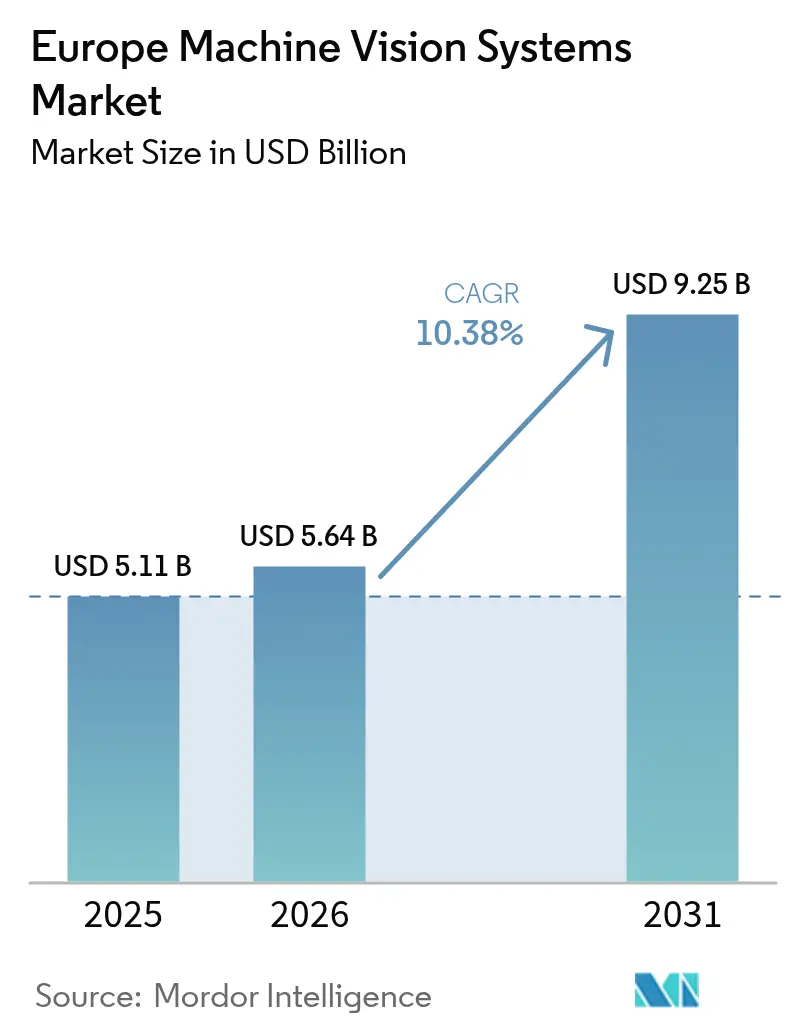
| Base Year Market Size (2025) | USD 5.11 Billion |
| Market Size (2026) | USD 5.64 Billion |
| Market Size (2031) | USD 9.25 Billion |
| Growth Rate (2026 - 2031) | 10.38 % |
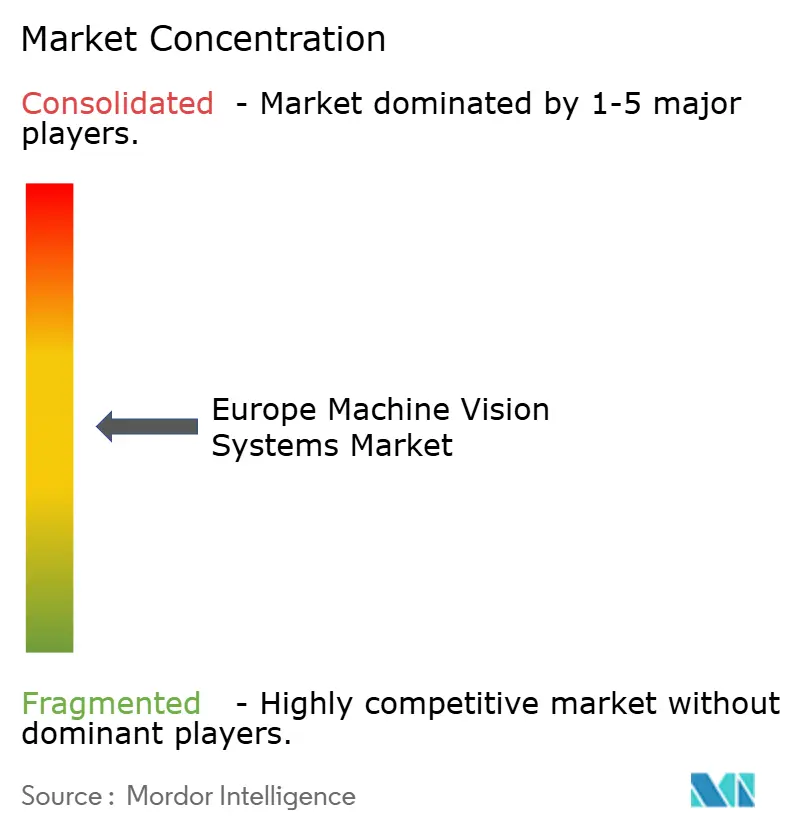
| Market Concentration | Medium |
Major Players *Disclaimer: Major Players sorted in no particular order Image © Mordor Intelligence. Reuse requires attribution under CC BY 4.0. | |
Europe Machine Vision Systems Market Analysis by Mordor Intelligence
Europe machine vision systems market size in 2026 is estimated at USD 5.64 billion, growing from 2025 value of USD 5.11 billion with 2031 projections showing USD 9.25 billion, growing at 10.38% CAGR over 2026-2031. Digitalization programs, EU sustainability rules, and labour shortages are accelerating demand for automated optical inspection across factories and warehouses. Hardware remains the largest spending category, but edge-enabled software is scaling fast as plants look for real-time analytics and AI-driven defect detection. Germany anchors regional revenue through its electric-vehicle supply chain, while Italy is expanding quickly on the strength of pharmaceutical machinery exports. Competition is moderate: global leaders and niche European specialists alike deploy deep learning and 3D vision to open new use cases and lower entry costs for small and mid-size manufacturers.
Key Report Takeaways
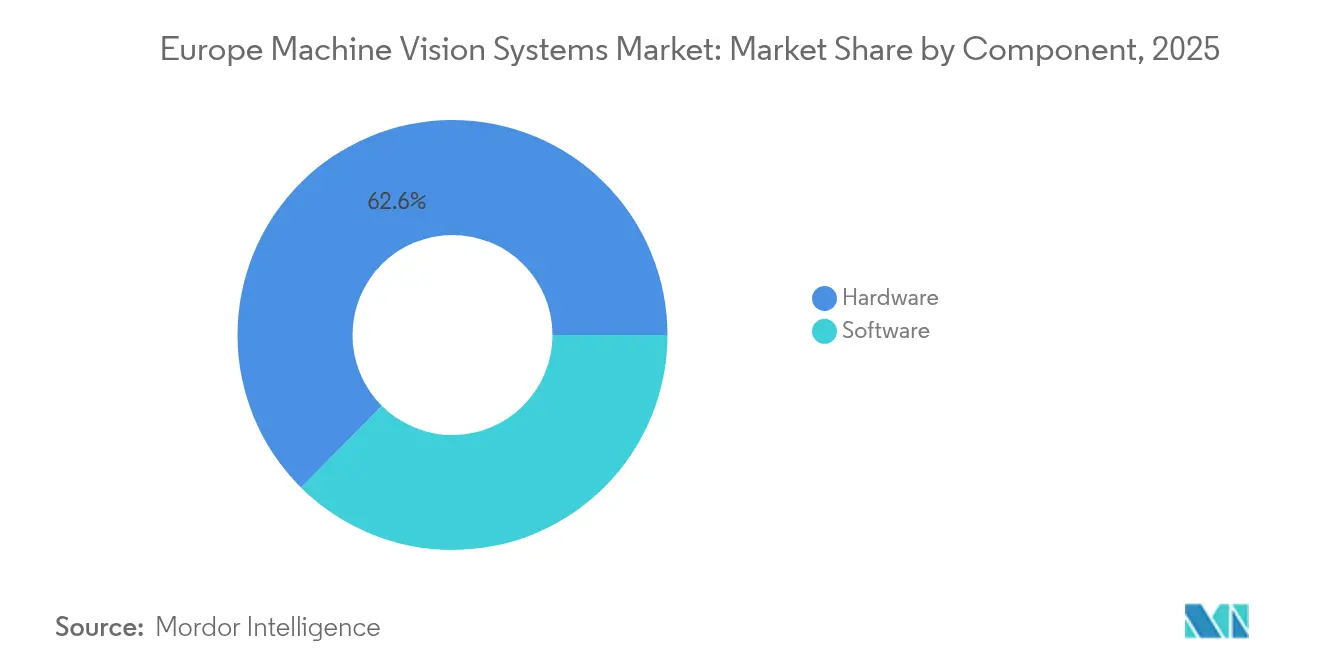
- By component, hardware captured 62.55% of Europe machine vision systems market share in 2025, whereas software is projected to grow at a 12.68% CAGR through 2031.
- By product, PC-based platforms held 56.42% of Europe machine vision systems market share in 2025; smart camera-based systems are poised for a 13.55% CAGR to 2031.
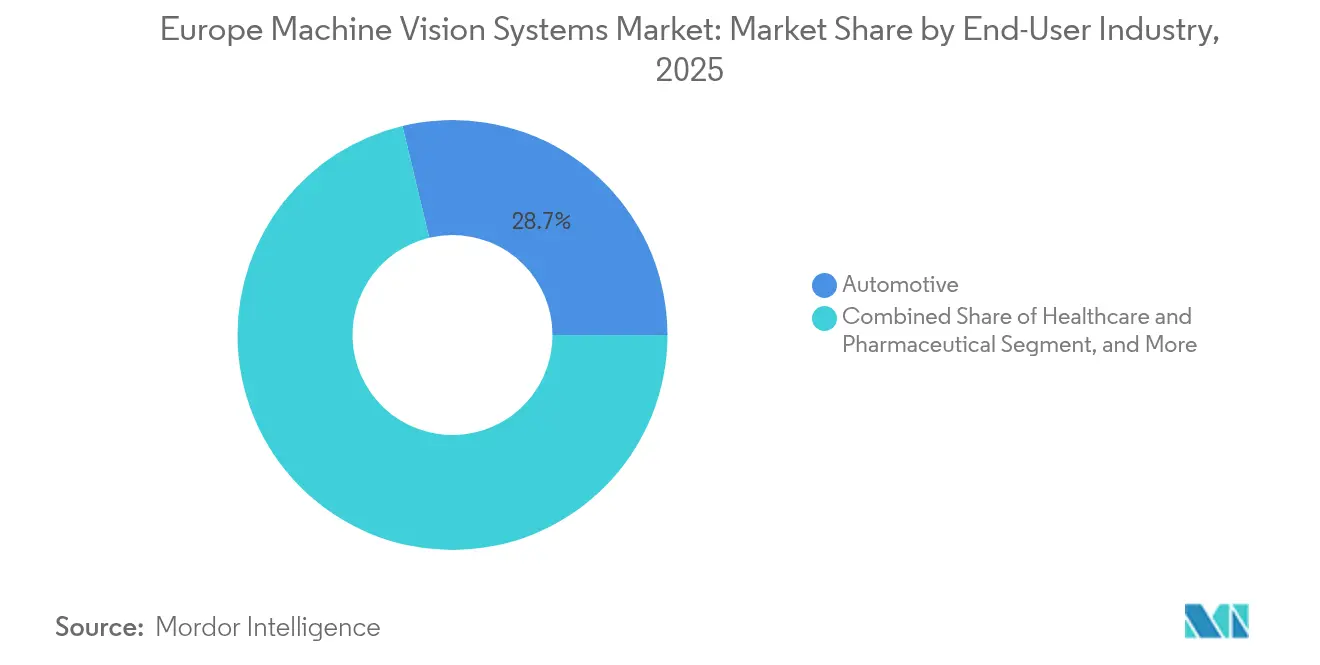
- By end-user, automotive accounted for 28.74% of Europe machine vision systems market share in 2025, while healthcare and pharmaceutical are set to expand at a 12.35% CAGR over 2026-2031.
- By application, quality inspection represented a 41.95% slice of Europe machine vision systems market size in 2025, and robotics safety and others are advancing at a 13.78% CAGR toward 2031.
- By geography, Germany contributed 27.50% of Europe machine vision systems market share in 2025; Italy is expected to log the region’s fastest 11.55% CAGR through 2031.
Note: Market size and forecast figures in this report are generated using Mordor Intelligence’s proprietary estimation framework, updated with the latest available data and insights as of 2026.
Market Trends and Insights
Drivers Impact Analysis of Europe Machine Vision Systems Market*
| Driver | (~) % Impact on CAGR Forecast | Geographic Relevance | Impact Timeline |
|---|---|---|---|
| Increasing Need for Quality Inspection and Automation | +2.30% | Global, strongest in Germany and Italy | Medium term (2-4 years) |
| Rising Demand for Accurate Defect Detection | +1.80% | Europe-wide, concentrated in automotive and electronics hubs | Short term (≤ 2 years) |
| Growing Adoption of Industry 4.0 and Smart Factories | +2.70% | Germany, Netherlands, Nordic countries with spillover to Eastern Europe | Long term (≥ 4 years) |
| Advancements in Camera Sensor Resolutions and Processing Speeds | +1.50% | Global with strong adoption in Western Europe | Medium term (2-4 years) |
| EU Sustainability Rules Driving Energy-Efficiency Audits | +1.20% | EU-wide, particularly Germany, France, Netherlands | Long term (≥ 4 years) |
| Edge AI Inferencing ASICs Unlocking New Use-Cases | +1.10% | Technology hubs in Germany, UK, France, Nordic region | Long term (≥ 4 years) |
| Source: Mordor Intelligence | |||
Increasing Need for Quality Inspection and Automation
European manufacturers are turning to vision-guided inspection to offset labour shortages and satisfy stricter quality rules. Euro 7 requirements now oblige detailed emissions monitoring, pushing automakers to integrate vision-enabled diagnostics into assembly lines.[1] German supplier Dürr embedded cameras into paint-shop robotics, cutting energy use by 30% through more precise spraying.[2] Pharmaceutical players such as Stevanato Group deploy AI-enhanced systems that inspect more than 600 containers per minute without human intervention. These successes encourage broader adoption across mid-sized plants seeking to safeguard yields and compliance.
Rising Demand for Accurate Defect Detection
Tolerance bands in electronics and semiconductor production continue to shrink, creating demand for sub-micron visual analytics. Belgian firm Robovision demonstrated 100 m-per-minute inspection speeds while maintaining PCB-grade accuracy.[3] Food and beverage processors follow suit with X-ray units such as Deep Detection’s PhotonAI, which analyzes 20 million photons / mm² / s to screen for contaminants. Illumination advances from UV to multispectral help identify previously invisible flaws, widening the value proposition of machine vision in Europe.
Growing Adoption of Industry 4.0 and Smart Factories
OPC UA-enabled data exchange has become standard in German and Nordic facilities, letting vision sensors feed real-time alerts into MES and energy dashboards. VDMA reported that 81% of machinery builders reallocated resources to automation after supply chains normalized in 2024.[4] Autonomous picking robots like Magazino’s TORU now combine 2D and 3D cameras for 20-hour shifts in warehouses, trimming fulfilment costs for retailers. Such examples illustrate how the Europe machine vision systems market continues to underpin factory digitalization agendas.
Advancements in Camera Sensor Resolutions and Processing Speeds
3D-stacked CMOS imagers with on-sensor neural engines, typified by the J3DAI prototype, cut latency and power draw for edge inspection. CoaXPress 2.1 lifts bandwidth ceilings to 50 Gbps, enabling real-time 8K analysis. EU-funded hyperspectral projects extend wavelength coverage for agriculture and vertical farming, where a 20% yield boost was recorded in trials. These technical leaps expand addressable applications and reinforce replacement demand for legacy equipment.
Restraints Impact Analysis of Europe Machine Vision Systems Market*
| Restraint | (~) % Impact on CAGR Forecast | Geographic Relevance | Impact Timeline |
|---|---|---|---|
| High Initial Deployment Costs for SMEs | -1.40% | Europe-wide, particularly Eastern Europe and Southern Italy | Short term (≤ 2 years) |
| Lack of Skilled Personnel for System Integration | -1.10% | Germany, Netherlands, Nordic countries with spillover effects | Medium term (2-4 years) |
| Fragmented European Harmonised Standards | -0.80% | EU-wide with varying national implementations | Long term (≥ 4 years) |
| Cyber-Security Risks in Cloud-Based Vision Analytics | -0.70% | Global with heightened concern in Germany and France | Medium term (2-4 years) |
| Source: Mordor Intelligence | |||
High Initial Deployment Costs for SMEs
Full-line vision installations often exceed EUR 100 000 (USD 113 000) and deter smaller factories, especially in wage-competitive regions of Eastern Europe. Smart cameras and no-code software such as MVTec MERLIC now sell for under EUR 25,000 (USD 28,250), shrinking barriers but not eliminating them. Upcoming EU consumer-protection directives on repairability may add life-cycle costs and stretch payback periods.
Lack of Skilled Personnel for System Integration
VDMA surveys rank labour shortages among the top bottlenecks for automation projects. The cross-disciplinary mix of optics, AI, and robotics skills is in short supply even around Munich and Eindhoven. Cognex has expanded training centers across 15 European sites to close the gap, yet competition from software giants keeps wage inflation high. Vendors increasingly bundle turnkey services to simplify commissioning for understaffed plants.
*Our forecasts treat driver/restraint impacts as directional, not additive. The impact forecasts reflect baseline growth, mix effects, and variable interactions.
Europe Machine Vision Systems Market Segment Analysis
By Component:
Hardware Dominance Faces Software DisruptionEurope machine vision systems market size for hardware reached a commanding share in 2025, when cameras, optics, and frame grabbers represented 62.55% of revenue. Vision systems cameras accounted for the bulk, aided by German makers like Basler and IDS Imaging that supply robust CMOS lines. *Europe machine vision systems market share* for hardware is expected to erode gradually as software value rises at a 12.68% CAGR. Software’s ascent stems from AI models optimized for embedded chips, vendor-agnostic platforms such as MVTec HALCON, and demand for no-code interfaces that let process engineers adjust inspection rules without coding knowledge.
Second-generation edge libraries now run sophisticated neural nets on fanless systems, lowering the total cost of ownership. Cloud analytics still plays a role for compute-heavy tasks, but GDPR compliance drives many factories to keep sensitive imagery on-premises. Cyber-hardened containers and ISO 27001 certifications have therefore become standard check-box items during procurement.

By Product:
Smart Cameras Challenge PC-Based SupremacyPC-based architectures retained 56.42% of Europe's machine vision systems market share in 2025, bolstered by GPU acceleration that handles multi-camera automotive paint inspection and wafer metrology. Smart cameras, however, are posting a 13.55% CAGR and chip away at rack-mounted solutions whenever one camera can do the job. Cost savings accrue from reduced cabling and cabinet hardware, while ARM and vision-processing units keep inference times under 10 ms.
Healthcare use cases exemplify this shift: Stevanato Group runs smart cameras to verify vial integrity at >600 units per minute and meets stringent pharma rules. Mobile robotics also benefits, as space constraints favour integrated optics and compute within a single housing. As firmware updates add new neural layers over time, smart cameras become an easily scalable entry point for SMEs testing automation waters.
By End-User Industry:
Healthcare Drives Growth amid Automotive LeadershipAutomotive lines remained the anchor customer base with a 28.74% share in 2025, as battery pack assembly and Euro 7 emissions checks multiply inspection stations. OEMs tap 3D vision to position prismatic cells within ±0.1 mm, while tire makers deploy vision to quantify particulate emissions. Healthcare and pharmaceutical applications lead growth at a 12.35% CAGR, propelled by 100% container inspection mandates and UDI serialization rules.
In drug injectables, AI classifiers now cut false rejects by double-digit percentages and preserve batch yields. Medical-device firms adopt vision to track micro-components during catheter assembly, ensuring traceability under EU MDR. With new biologics and personalized therapies requiring small-batch processing, demand for flexible, rapid-changeover vision lines is set to climb.
By Application:
Quality Inspection Dominance Faces Robotics DisruptionQuality inspection held 41.95% of Europe's machine vision systems market size in 2025, spanning paint anomalies, PCB solder bridges, and glass container scratches. Robotics safety and other emerging uses are expanding at a 13.78% CAGR as collaborative robots spread across logistics and assembly. 3D time-of-flight sensors create protective envelopes around co-workers, allowing higher line speeds without physical cages.
Metrology benefits from sub-micron sensors and algorithmic calibration routines, meeting aerospace tolerance demands. Code reading evolved from 1D barcodes to dot-peen data matrix and even etched titanium parts in medical implants. Positioning and guidance employ SLAM fusion, enabling AGVs to adapt routes when pallets or workers alter floor geography unexpectedly.
Geography Analysis
Germany Machine Vision Systems Market
Germany’s 27.50% share underscores its dense ecosystem of component suppliers, software firms, and integrators. Dürr uses vision to lower paint-shop energy by 30%, while MVTec’s HALCON toolkit underpins many OEM offerings. VDMA recorded 8% revenue growth for German vision vendors in 2024, with exports cushioning domestic slowdowns.
United Kingdom Machine Vision Systems Market
The United Kingdom grows more selectively after Brexit, focusing on aerospace and life-science niches that value AI algorithms derived from local research universities. Funding access remains uneven, nudging startups such as Vision Intelligence to hunt deals outside Europe. Customs frictions add lead-time buffers, yet strong AI talent continues to attract multinational R&D labs.
Italy Machine Vision Systems Market
Italy posts the region’s fastest 11.55% CAGR, powered by pharmaceutical equipment exports and automotive diversification. Stevanato Group commands a global share in parenteral inspection, and SEA Vision’s track-and-trace suite secures EUDAMED compliance. Lombardy’s machinery districts collaborate closely with Swiss optics specialists, yielding competitive turnkey lines for food packaging, where energy audits fuel upgrades.
Regulatory Landscape
Machine vision systems deployed in European factories are increasingly shaped by EU safety and AI governance frameworks that cover both the equipment and the software lifecycle. Regulation (EU) 2023/1230 (Machinery Regulation) replaces the Machinery Directive 2006/42/EC and becomes mandatorily applicable from 20 January 2027, explicitly capturing machinery products with safety functions that use self-evolving or machine-learning behavior, a design pattern relevant to vision-enabled robotics safety and inspection.
In parallel, the EU Artificial Intelligence Act (Regulation (EU) 2024/1689) sets a risk-based regime for AI systems, with high-risk categories requiring conformity assessment and CE-related obligations. This can apply to vision systems used for safety functions or tightly coupled to regulated equipment. European Commission-led standardization work via CEN and CENELEC supports compliance pathways, and the May 2026 Digital Omnibus adjustment clarified and extended certain compliance timelines for high-risk AI systems embedded in machinery, pushing key deadlines out to August 2028. Buyers therefore have added emphasis on traceability, technical documentation, and quality management aligned to harmonized standards.
Competitive Landscape
Europe machine vision systems market remains moderately concentrated. Cognex runs facilities in 15 countries, providing localized service and training. German vendors excel in algorithm libraries, with MVTec HALCON providing platform independence that OEMs value. Basler, IDS, and Allied Vision keep hardware supply resilient through European fabs.
Acquisition momentum is strong. Zebra Technologies bought Czech 3D specialist Photoneo in 2025 to enhance bin-picking accuracy. Hitachi purchased MA Micro Automation for USD 80.8 million, expanding its medical-device inspection reach. Lear added WIP Industrial Automation to boost vision-guided robotics for seating plants. Such deals highlight priority segments: 3D, medical, and logistics.
Emerging challengers center on AI. Robovision scaled sub-3 nm semiconductor inspection and opened a U.S. office after raising USD 42 million. EdgeCortix promotes low-power ASICs that shrink inference costs. Vendors differentiate through ISO 27001 software security and GDPR-ready cloud connectors, critical factors for European buyers wary of data leaks.
Europe Machine Vision Systems Industry Leaders
-
Cognex Corporation
-
Keyence Corporation
-
Omron Corporation
-
IDS Imaging Development Systems GmbH
-
Teledyne DALSA
- *Disclaimer: Major Players sorted in no particular order
Europe Machine Vision Systems Market Companies Covered in this Report
- Cognex Corporation
- Keyence Corporation
- Omron Corporation
- Basler AG
- Sick AG
- Teledyne DALSA Inc.
- National Instruments Corporation
- Datalogic SpA
- Perceptron Inc.
- USS Vision Inc.
- IDS Imaging Development Systems GmbH
- Stemmer Imaging AG
- Isra Vision AG
- Vitronic Dr.-Ing. Stein Bildverarbeitungssysteme GmbH
- Baumer Optronic GmbH
- Vision Components GmbH
- LMI Technologies Inc.
- MVTec Software GmbH
- Sony Europe B.V. - Industrial Cameras
- Hikrobot Technology Co., Ltd.
Market Opportunities and Future Outlook
A key whitespace in Europe is scaling machine vision from pilot cells into repeatable, multi-site programs that reduce integrator effort and stabilize quality across plants. This shift is visible in deployments that combine standardized camera footprints with centralized model development and distribution. In June 2026, Schneider Electric implemented Cognex In-Sight cameras with the OneVision AI development environment in France to create a centralized inspection framework, supporting rapid rollout of standardized AI models across facilities while addressing yield protection, labor-saving retrofits, and fast payback.
Opportunities are also expanding around funded manufacturing AI and edge-vision programs that lower adoption friction for SMEs and broaden the supplier base for software-led offerings. Horizon Europe-backed initiatives such as euroFMX (generative AI for manufacturing), MANUFACTOR (3D shopfloor vision for human-centric augmentation), and AI REDGIO 5.0 (AI-at-the-edge for SMEs) provide a pipeline for deployable tools and reference architectures that vendors and integrators can commercialize through packaging, validation, and support. On the demand side, integrators winning factory-floor contracts for AI vision in non-automotive lines, including Prevas securing a June 2026 contract with Kährs to develop real-time AI-based quality sorting for wood flooring, highlights addressable use cases beyond discrete automotive inspection, particularly where material variability and labor constraints support adaptive AI inspection rather than purely rule-based approaches.
Recent Industry Developments in Europe Machine Vision Systems Market
- May 2026: Cognex launched the In-Sight 3900 Vision System, an integrated embedded AI vision platform built on Qualcomm Dragonwing technology. The release expands edge AI inspection performance in a compact form factor, supporting deployments where cabinet space, power, and latency constraints limit PC-based architectures.
- May 2025: Keyence acquired Germany-based Cadenas Technologies, adding manufacturing software capabilities that complement its automation and inspection portfolio. The deal strengthens Keyence's ability to attach software workflows to hardware-led deployments, supporting broader digital factory integration across European customers.
- March 2025: IDS Imaging Development Systems introduced the uEye EVS industrial camera line incorporating Prophesee event-based Metavision sensing and processing. Event-based vision expands machine vision coverage into high-speed and high-dynamic-range inspection scenarios, helping OEMs and integrators address applications where conventional frame-based cameras struggle.
Europe Machine Vision Systems Market Report Scope and Research Methodology
Market Definition and Coverage
This market covers the revenues generated in Europe from machine vision systems used for automated inspection, measurement, identification, and guidance in industrial settings, counted across hardware and software that enable image capture, processing, and decision-making.
Scope exclusions: We exclude general-purpose CCTV/security surveillance, consumer photography gear, and non-industrial imaging that is not deployed for automated machine vision tasks.
Segments Covered in This Report
- By Component
- Hardware
- Vision Systems
- Cameras
- Optics and Illumination Systems
- Frame Grabbers
- Other Hardware
- Software
- Hardware
- By Product
- PC-Based
- Smart Camera-Based
- By End-User Industry
- Automotive
- Electronics and Semiconductors
- Food and Beverage
- Healthcare and Pharmaceutical
- Logistics and Retail
- Other Industries
- By Application
- Quality Inspection
- Measurement and Metrology
- Identification and Code Reading
- Positioning and Guidance
- Robotics Safety and Others
- By Country
- Germany
- United Kingdom
- Italy
- Rest of Europe
Data Sources, Market Sizing, and Validation
Desk Research
We started with desk research to pin down the Europe footprint, the core technology scope, and the typical buying patterns among manufacturing end users. Public sources were used to lock demand signals and the policy backdrop, including Eurostat industrial production series, European Commission updates on industry and digital policy, national statistics offices in key European economies, customs and trade releases for relevant optical and electronic components, and patent publications that describe machine vision related filings.
We also reviewed company filings and investor presentations to infer product mix, shipment commentary, and stated regional exposure, then checked those signals against reputable press and association websites focused on automation and industrial imaging. For gap filling, we used paid subscription databases for company financial intelligence and for patent and IP screening, mainly to reduce the risk of missing smaller, privately held activity. These examples are not exhaustive, and many other public sources were also used to compile data, validate assumptions, and clarify open questions.
Primary Interviews and Surveys
Primary work was used to test what we observed in desk research, especially around typical system configurations, pricing movements, and where adoption is accelerating or slowing. We spoke with a mix of hardware and software stakeholders, channel participants, and industrial users across major European sub-regions so assumptions on replacement cycles, integration intensity, and adoption timing could be checked. Where inputs did not align, follow-ups were done to reconcile differences before the model was finalized.
Distribution of primary research fieldwork respondents
| Company type | Respondent position |
|---|---|
| Top tier: 31% | CXOs: 12% |
| Mid tier: 55% | Functional/Unit leaders: 31% |
| Smaller Players: 14% | Managers: 57% |
Market-Sizing & Forecasting
For sizing, the model used a top-down approach where manufacturing activity and automation spend signals were used to reconstruct the addressable demand pool across Europe, and then mapped to machine vision system penetration in inspection and guidance tasks. We then cross-checked totals using selective bottom-up approximations, such as sampled price per system by configuration (PC-based versus smart camera-based) multiplied by estimated unit volumes from channel checks. These figures were adjusted when overlaps were detected.
Key inputs that shaped the model included industrial production trends, automotive and electronics output momentum, installed base replacement cycles, the mix shift between smart camera-based and PC-based setups, and average selling price movement driven by optics, illumination, and compute content. Where direct volume indicators were not consistently available, proxy indicators were used and corrected using interview feedback so the final result stayed realistic at the country cluster level.
Forecasting relied on scenario analysis supported by a focused set of drivers that were repeatedly validated in primary discussions, including automation investment outlook, labor availability pressure, and the pace of AI-enabled defect detection adoption. The scenarios were weighted back to the base case using recent order pipeline commentary and macro signals, and then rolled up to the regional total.
Data Validation & Update Cycle
Validation was performed through triangulation across independent signals, and then by checking variance at the component and system type levels so no single assumption could dominate the outcome. Outliers were flagged using consistency checks, including year-over-year growth ranges, pricing sanity checks against bill-of-material direction, and adoption logic versus industrial output changes, and then reviewed in a second analyst pass.
The model is refreshed annually, and interim revisions are triggered when material events occur, such as major regulatory shifts, sharp component cost changes, or sudden demand slowdowns in key end-user industries. Before delivery, we run a final update sweep so the published view reflects the latest available information.
Mordor Intelligence's Europe Machine Vision Systems Market Market Estimate Compared With Other Published Estimates
Published market sizes for Europe machine vision systems do not always match because different studies pick different year anchors, include different product definitions, and apply different pricing and adoption assumptions. In practice, the spread usually comes from how tightly the scope is defined and how often assumptions are refreshed to reflect real purchasing behavior.
Some external estimates also fold in broader industrial imaging or services-heavy integration value, and then keep a smooth price curve across the forecast. For the comparison, the Mordor Intelligence total is limited to Europe machine vision system hardware components (such as cameras, optics and illumination systems, frame grabbers, and other hardware) plus software, and it is checked using system type mix and practical ASP movements observed in field discussions.
Benchmark comparison
| Source | Market Size | Gaps in Research Methodology |
|---|---|---|
| Mordor Intelligence | USD 5.11 B (2025) | |
| Industry Data Publisher A | USD 5.76 B (2025) | Often presented as a broader machine vision view that can embed more adjacent imaging spend and uses a different component mix assumption, which tends to lift the 2025 total versus a systems-focused hardware plus software count. |
| Global Research Publisher B | USD 3.61 B (2024) | Uses an earlier base year and a narrower starting demand pool in Europe, and the pricing build can lean more on generalized component baskets, which can compress the 2024 level versus models that reflect system configuration intensity. |
Taken together, the differences mainly come down to scope tightness, base year selection, and how pricing and adoption are updated when demand shifts across automotive, electronics, and general manufacturing. By keeping the model tied to clear component and software inclusions and by validating the key drivers through repeat checks, the resulting size is easier to explain and replicate when assumptions need to be revisited.
Key Questions Answered in the Report
How big is the Europe machine vision systems market in 2026?
The market stands at USD 5.64 billion and is projected to reach USD 9.25 billion by 2031, reflecting a 10.38% CAGR.
Which component segment is growing fastest?
Software platforms are expanding at 12.68% CAGR as factories adopt AI and edge analytics to complement existing hardware.
What drives demand in the healthcare sector?
Strict 100% inspection rules for parenteral drugs and UDI traceability requirements are propelling 12.35% CAGR growth in healthcare and pharmaceutical applications.
Why are smart cameras gaining traction?
Integrated optics and on-board processors cut cabling and cabinet costs, helping smart camera systems grow at 13.55% CAGR, especially in space-constrained or single-camera setups.
Which country shows the fastest market growth?
Italy leads with an 11.55% CAGR, buoyed by strong pharmaceutical machinery exports and wider use of vision in packaging and automotive lines.