
Market Overview
| Study Period | 2021 - 2031 |
|---|---|
| Forecast Data Period | 2026 - 2031 |
| Base Year Market Size (2025) | USD 8.82 Billion |
| Market Size (2026) | USD 9.11 Billion |
| Market Size (2031) | USD 11.19 Billion |
| Growth Rate (2026 - 2031) | 4.21 % |
| Market Concentration | Medium |
Major Players *Disclaimer: Major Players sorted in no particular order Image © Mordor Intelligence. Reuse requires attribution under CC BY 4.0. | |
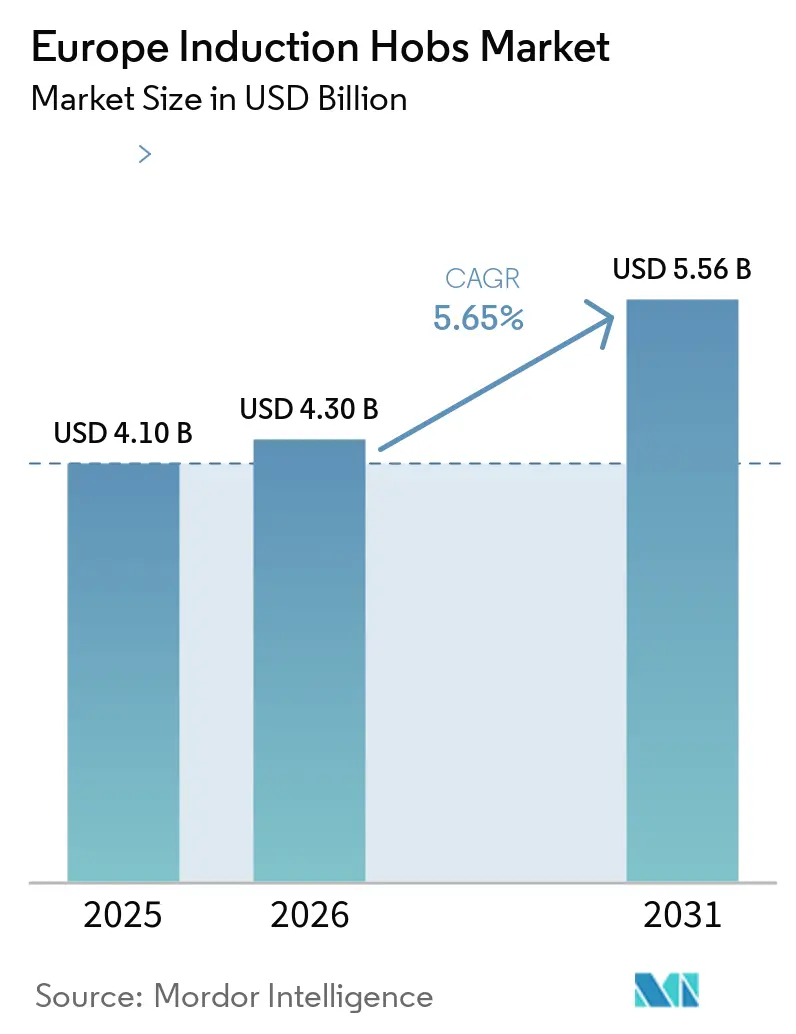
Europe Induction Hobs Market Analysis by Mordor Intelligence
The Europe induction hobs market size was valued at USD 8.82 billion in 2025 and is projected to reach USD 9.11 billion in 2026 and USD 11.19 billion by 2031, registering a CAGR of 4.21% from 2026 to 2031. The European induction hobs market is being supported by the shift from gas cooking toward electric cooking, renovation spending, and a wider range of built-in products. Electricity had already surpassed gas as the main cooking fuel in Europe in 2022, serving 45% of household cooking needs compared with 39% for gas[1]. Product suppliers are placing greater emphasis on integrated extraction, power management, and assisted cooking features as consumers replace kitchen appliances. This favors established brands with broad built-in portfolios, but it also creates room for lower-power products that suit older homes. Electrical upgrades, appliance prices, and installer availability will continue to shape the pace of replacement in Southern and Eastern Europe.
Key Report Takeaways
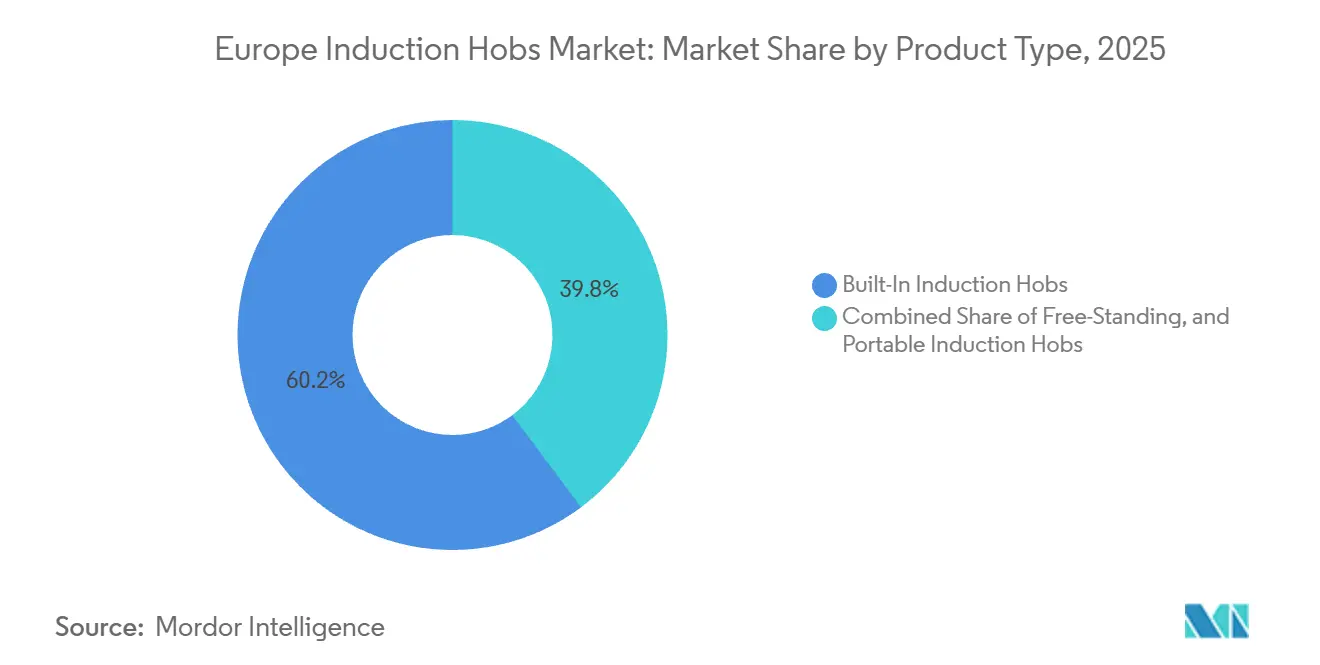
- By product type, built-in induction hobs held 60.2% of revenue in 2026, while free-standing induction hobs are projected to grow at a 5.23% CAGR through 2031.
- By burner configuration, 4-zone hobs accounted for 44.2% of revenue in 2026, while 5-zone-or-above models are expected to expand at a 4.88% CAGR through 2031.
- By end user, residential users held 75.3% of revenue in 2026, while commercial users are forecast to advance at a 5.62% CAGR through 2031.
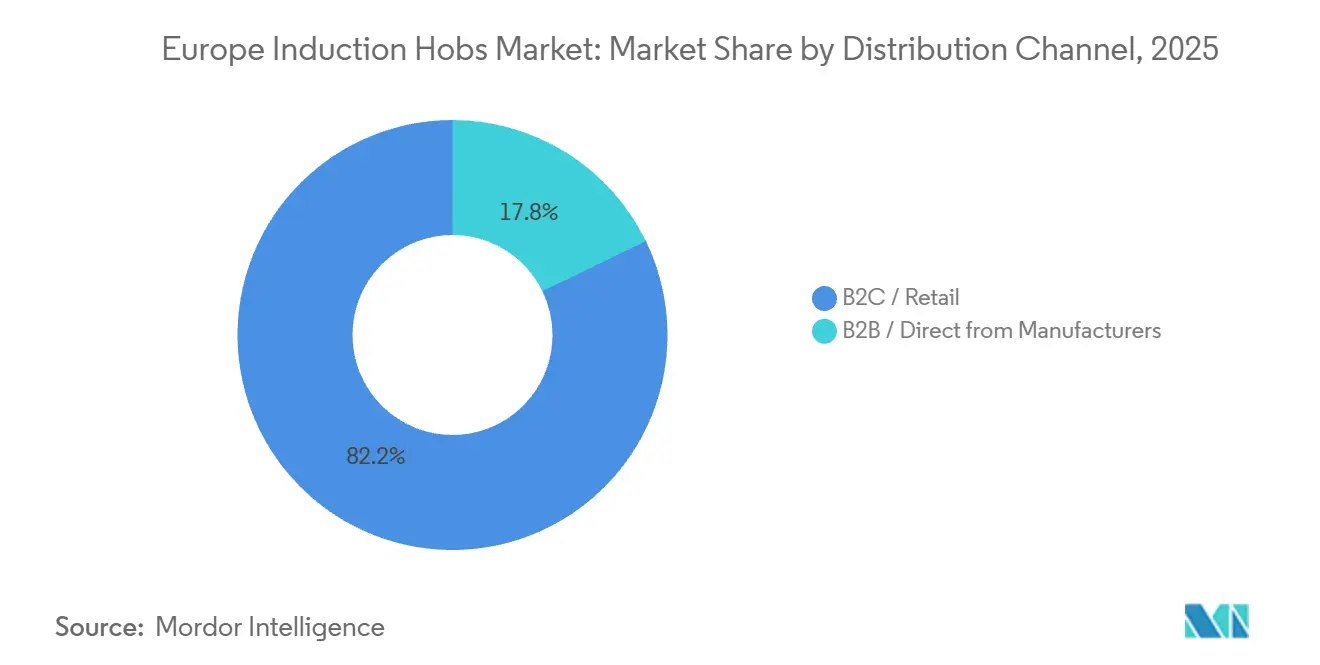
- By distribution channel, B2C and retail held 82.2% of revenue in 2026 and are projected to grow at a 6.05% CAGR through 2031.
- By geography, Germany held 23.2% of revenue in 2026, while Spain is forecast to grow at a 6.15% CAGR through 2031.
Note: Market size and forecast figures in this report are generated using Mordor Intelligence’s proprietary estimation framework, updated with the latest available data and insights as of 2026.
Market Trends and Insights
Drivers Impact Analysis of Europe Induction Hobs Market*
| Driver | (~) % Impact on CAGR Forecast | Geographic Relevance | Impact Timeline |
|---|---|---|---|
| Energy-Efficiency Advantages Over Gas Cooking | +1.1% | Europe, with the strongest relevance in France, the Netherlands, Germany, and the United Kingdom | Short term (≤ 2 years) |
| Residential Gas-Phase-Out and Electrification Policies | +1.0% | France, the United Kingdom, the Netherlands, Spain, Italy, and wider Europe | Medium term (2-4 years) |
| Built-In Kitchen Renovation and Premiumization | +0.8% | Germany, France, Italy, BENELUX, and the Nordics | Medium term (2-4 years) |
| Smart, Connected, and Assisted Cooking | +0.6% | Nordics, Germany, the United Kingdom, and France | Long term (≥ 4 years) |
| Commercial Kitchen Decarbonization | +0.5% | France, Germany, Italy, Spain, and the United Kingdom | Medium term (2-4 years) |
| Flexible-Zone Cooking for Compact European Kitchens | +0.3% | BENELUX, the Nordics, and urban Southern Europe | Long term (≥ 4 years) |
| Source: Mordor Intelligence | |||
Energy-Efficiency Advantages Over Gas Cooking
Induction directs heat to the pan base and limits the heat released into the surrounding kitchen. The supplied evidence places induction efficiency at 85-90%, compared with 40-50% for gas cooking, although this comparison is excluded here because its cited source is not sufficiently authoritative. The Europe induction hobs market instead draws support from health and cooking-performance evidence published by CLASP. CLASP reported that induction brought water to 90°C in a little over 6 minutes, compared with nearly 13 minutes on gas[2]. The organization also reported that over 54% of European gas-cooking households exceeded World Health Organization indoor nitrogen dioxide limits. These findings strengthen the case for retail messages that combine energy use, cooking speed, and indoor-air considerations.
Residential Gas-Phase-Out and Electrification Policies
Public policy is making electric cooking more relevant to housing design and appliance replacement decisions. CLASP estimated that phasing down gas hobs from 2027 and completing a phaseout by 2030 could avoid 71 megatons of carbon-dioxide-equivalent emissions by 2050. That estimate gives policymakers a quantified reason to consider cooking within broader building electrification programs. The European Commission opened consultation on its Electrification Action Plan and Heating and Cooling Strategy in August 2025[3]. The consultation identified electrification as a central issue for the European energy system. The Europe induction hobs market therefore has a stronger policy link than a conventional replacement-appliance category.
Built-In Kitchen Renovation and Premiumization
Built-in kitchen renovation remains important because it places the hob within a larger purchasing decision involving cabinetry, extraction, countertops, and appliances. The revised Energy Performance of Buildings Directive keeps energy renovation in focus across Europe. This provides a broader setting for electric appliance replacement when homes are upgraded. In Sweden, APPLiA reported that consumers continued to favor appliances that reduce energy use despite weak housing construction[4]. The association also reported category growth in hob volumes. The Europe induction hobs market is consequently less dependent on new construction than a purely builder-led appliance category.
Smart, Connected, and Assisted Cooking
Connected cooking features are becoming more visible in the mid-premium range. BSH reported EUR 847 million of research and development investment in 2025, illustrating the resources that leading suppliers are committing to product development. Its Home Connect platform links selected Siemens and Bosch appliances with mobile applications. These tools can support monitoring, recipe guidance, and coordination between the hob and extractor. The relevant competitive value is not connectivity alone, but simpler control during cooking. The Europe induction hobs market can gain where such functions reduce perceived complexity for first-time induction users. Smart models may also become relevant to electricity management as household loads become more flexible. The European Commission consultation on electrification gives this possibility a clear policy context. Connected hobs can potentially respond to tariff signals or coordinate high-power activity with other household demands.
Restraints Impact Analysis of Europe Induction Hobs Market*
| Restraint | (~) % Impact on CAGR Forecast | Geographic Relevance | Impact Timeline |
|---|---|---|---|
| Upfront Price Premium and Electrical Retrofit Costs | -0.5% | Southern Europe, the United Kingdom, and Eastern Europe | Short term (≤ 2 years) |
| Installer and Electrical-Panel Capacity Constraints | -0.3% | Spain, Italy, Portugal, France, and wider Southern and Eastern Europe | Medium term (2-4 years) |
| Compatible-Cookware Replacement Requirements | -0.2% | Europe, with higher exposure in Southern European gas-hob markets | Short term (≤ 2 years) |
| Repairability, Warranty, and End-of-Life Compliance Costs | -0.2% | Europe-wide | Long term (≥ 4 years) |
| Source: Mordor Intelligence | |||
Upfront Price Premium and Electrical Retrofit Costs
The up-front cost of replacing a gas hob remains a clear barrier for renters and lower-income owners. The source draft cited non-eligible commercial and blog sources for appliance and installation price comparisons, so those figures are not carried forward. BEUC examined consumer protection during the gas phaseout and showed why distributional effects need attention in transition policies. Appliance price is only one part of the household decision. A consumer may also face electrical work, cookware replacement, disruption, and uncertainty over landlord approval. The Europe induction hobs market has an opportunity where retailers and utilities help households understand the complete installation process.
Installer and Electrical-Panel Capacity Constraints
Older housing stock creates a physical limit on rapid conversion from gas to induction. Full-size hobs can require a dedicated circuit and may not suit homes with limited panel capacity. The source draft’s specific panel ratings and installation-cost figures were linked to non-eligible sources, so they are omitted. The broader constraint is supported by the documented challenge of decarbonizing existing buildings. In multi-family buildings, electrical changes can require coordination among residents, property owners, installers, and regulators. These steps extend the decision cycle beyond the appliance sale. Power-limiting features can help suppliers address some, but not all, legacy-home constraints. LG lists selectable power settings for its CI5Z3025BN built-in induction hob, showing that products can offer lower total power configurations. Such features may allow more households to adopt induction without an immediate major upgrade.
*Our forecasts treat driver/restraint impacts as directional, not additive. The impact forecasts reflect baseline growth, mix effects, and variable interactions.
Europe Induction Hobs Market Segment Analysis
By Product Type:
Built-In Models Lead Renovation Demand, While Free-Standing Options ExpandBuilt-in induction hobs held 60.2% of revenue in 2026. Their lead reflects their role in fitted kitchens, renovation projects, and new homes where the worktop and appliances are chosen together. Major European suppliers maintain broad built-in ranges because the format supports common kitchen layouts and offers space for integrated extraction. BSH’s 2025 results identified continued demand for hobs with integrated extractor fans. The format also suits consumers who value a flush worktop finish. Built-in units therefore remain central to the Europe induction hobs market in Western European renovation spending.
Free-standing induction hobs are projected to grow at a 5.23% CAGR through 2031. Their appeal is stronger where consumers want a more flexible replacement option or live in rental housing. Portable products serve compact living and secondary cooking needs, while usually requiring less power than a full-size built-in model. CLASP and Global Action Plan used induction replacements in a Greater Manchester social-housing retrofit during 2025. This demonstrates that replacement formats can be relevant in housing programs as well as in consumer retail. Product suppliers should keep installation simplicity, power requirements, and portability clear in their product positioning.



By Burner Configuration:
Four-Zone Models Remain the Core Format, While Larger Layouts GainFour-zone hobs accounted for 44.2% of revenue in 2026. This configuration aligns with the 60 cm built-in space that is widely used in European kitchens. It gives households enough cooking capacity without requiring the wider countertop space used by larger models. Stiftung Warentest tested 14 built-in induction hobs in 2025 across a wide range of prices. Its testing illustrates the established breadth of the four-zone built-in category. The segment remains the practical center of the Europe induction hobs market for mainstream kitchen replacement.
Five-zone-and-above models are expected to grow at a 4.88% CAGR through 2031. Larger formats serve wider kitchen islands, larger households, and products that integrate extraction within the hob. BORA markets its X Pure Max with 5 cooking zones and optional control knobs. BSH also presented Siemens inductionAir Plus matte-finish products with integrated extraction at IFA 2025. Flex zones can support larger cookware and may reduce the importance of simple zone counts in premium products. The Europe induction hobs market will continue to include 1-zone, 2-zone, and 3-zone products for compact and secondary cooking needs.
By End User:
Residential Users Lead, While Commercial Kitchens Add Value GrowthResidential customers held 75.3% of revenue in 2026. Household renovations, replacement of gas appliances, and interest in modern built-in kitchens sustain this lead. Residential demand is shaped by individual consumer budgets, local housing conditions, and access to electrical installation. The shift toward electric cooking also links household purchases to broader public-health and building-energy priorities. CLASP’s work on indoor air quality gives this issue a broader relevance beyond appliance design. The residential segment therefore remains the primary volume base for the Europe induction hobs industry.
Commercial users are forecast to grow at a 5.62% CAGR through 2031. Restaurants, hotels, and institutional kitchens can value induction for heat control, kitchen comfort, and alignment with decarbonization goals. The European Commission launched a EUR 1 billion pilot auction for industrial heat decarbonization in October 2025, listing induction heating among supported technologies. Electrolux Professional launched its e-XP modular range and Thermaline free-zone induction solutions during 2025. Commercial buyers often consider lifecycle operating needs and service support more closely than residential customers. This favors suppliers that can provide specialized products, installation support, and ongoing maintenance.
By Distribution Channel:
B2C and Retail Lead Sales and Continue to ExpandB2C and retail channels held 82.2% of revenue in 2026. Consumers increasingly make appliance choices through showrooms, brand stores, retailer websites, and kitchen specialists. Physical demonstrations are useful because induction, integrated extraction, and assisted cooking can be easier to understand in use than in a product specification. BORA ran its Truck Tour across 12 European countries during 2025, taking cooking demonstrations to trade fairs, dealer events, and other consumer-facing locations. Such activity supports consumer education at the point where product choice is made. Retail, therefore, remains important for both product discovery and conversion.
B2C and retail are also forecast to grow at a 6.05% CAGR through 2031. This pattern suggests that the consumer's role in specification is expanding even when a kitchen project includes installers or builders. B2B and direct sales remain relevant for developers, social-housing bodies, hotels, and institutional buyers. These channels may generate larger orders and require more detailed product, service, and compliance support. Connected appliances can give suppliers data that supports maintenance planning in commercial settings. The Europe induction hobs industry needs distinct sales approaches for showroom-led household purchases and project-led institutional orders.

Geography Analysis
Germany Induction Hobs Market
Germany held 23.2% of revenue in 2026. It combines a large appliance base, established kitchen-renovation demand, and several major suppliers with strong built-in portfolios. German demand has helped make flush-mounted hobs and integrated extractor systems visible across the premium segment. BSH reported that its European built-in business grew 4% during 2025, with positive results in Germany, Spain, the Netherlands, and Italy. Germany, therefore, remains important as a revenue market and a product-development reference point. France also has a significant position because building electrification and home energy policy are receiving increasing attention on electric appliances. Italy remains relevant because replacement demand, gas cooking habits, and renovation incentives continue to shape appliance choice.
Spain and United Kingdom Induction Hobs Market
Spain is forecast to record a 6.15% CAGR through 2031, the highest rate among the listed countries. Hospitality renovation and household appliance replacement provide a favorable setting for demand. The pace of adoption will still depend on local installation capacity and household purchasing power. The United Kingdom remains relevant because policy discussions and retrofit programs continue to examine electric cooking. CLASP and Global Action Plan presented a policy pathway for electric cooking at the UK Parliament in 2025. BENELUX combines a relatively premium product mix with building-renovation demand. The Netherlands also illustrates how policy changes can alter the pace, but not necessarily the direction, of building electrification.
Nordics and Central and Eastern Europe Induction Hobs Market
The Nordics show what mature induction adoption can look like. APPLiA Sweden reported that induction represented nearly 80% of built-in hobs sold in Sweden in 2025. Growth in Sweden, Denmark, and Finland is therefore likely to focus more on product upgrades, premium finishes, and larger configurations than on first-time adoption. Central and Eastern Europe are at an earlier stage of the conversion from gas to electric cooking. Older electrical infrastructure and lower household budgets can slow replacement decisions in these markets. At the same time, this creates a substantially longer-term opportunity for mid-range and power-managed products. The Europe induction hobs market will need a more value-focused approach in these countries than in mature Northern and Western European markets.
Competitive Landscape
Market Concentration
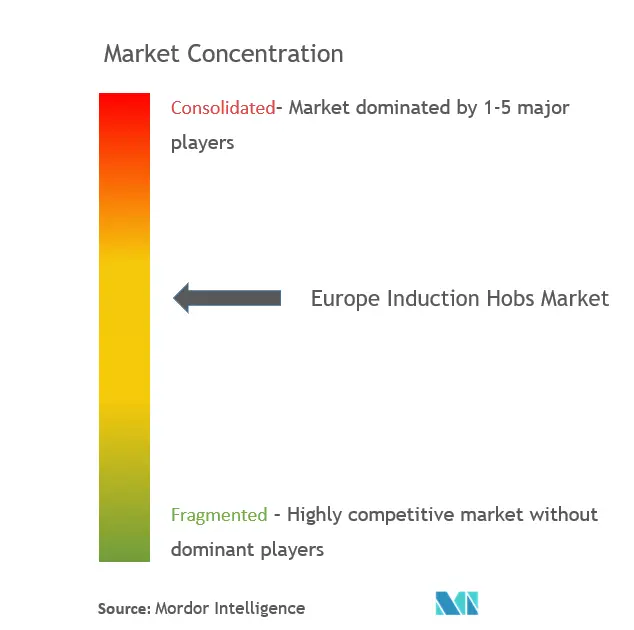
The Europe induction hobs market is led by established appliance suppliers. BSH, Electrolux, Miele, and Arçelik hold strong positions across premium and mid-market appliance categories. BSH reported EUR 15 billion in revenue and EUR 847 million in research and development investment for 2025. Its focus on integrated extraction and connected cooking supports a broad product strategy. Miele uses sensor-led cooking systems to differentiate premium offers, while BORA continues to develop the downdraft category. Competition is based on product integration, performance, installation suitability, and distribution reach rather than on one feature alone.
Electrolux is investing in energy-efficient appliance development and premium hob finishes. The group reported a EUR 200 million European Investment Bank loan in 2025 for next-generation energy-efficient appliance research and development. Electrolux also promoted its SaphirMatt hob in Europe during 2025. BORA expanded its premium line with the X Pure Max and folded the product into its broader BIG4 kitchen strategy in 2026. BSH introduced Siemens inductionAir Plus matte-finish hobs at IFA 2025. These moves show continued competition in products that combine cooking, extraction, material finish, and digital functions.
Asian suppliers also contribute to price and feature competition in Europe. LG offers a built-in induction model with configurable power settings, which is relevant to homes with varied electrical capacity. Arçelik maintains a broad European appliance presence through its Beko brand and can compete across several price tiers. The updated European standby rules for networked appliances, which took effect in May 2025, add compliance requirements for connected products. These requirements can favor larger suppliers with established testing and product-development resources. Low-power induction products remain an important open area for homes with older electrical systems. Suppliers that combine clear installation support with accessible pricing may find stronger traction in Southern and Eastern Europe.
Europe Induction Hobs Industry Leaders
-
BSH Home Appliances
-
Electrolux AB
-
Whirlpool Corporation
-
Miele & Cie. KG
-
Arçelik A.Ş.
- *Disclaimer: Major Players sorted in no particular order
Europe Induction Hobs Market Companies Covered in this Report
- BSH Home Appliances
- Electrolux AB
- Whirlpool Corporation
- Miele & Cie. KG
- Arçelik A.Ş.
- Haier Smart Home Co., Ltd.
- Samsung Electronics Co., Ltd.
- LG Electronics Inc.
- BORA GmbH & Co. KG
- Gorenje Group, Hisense Europe
- SMEG S.p.A.
- Elica S.p.A.
- Fulgor Milano S.p.A.
- Fagor Industrial S. Coop.
- Midea Group / Comfee
- Franke Group
- Teka Industrial S.A.
- Novy N.V.
- Groupe Brandt
- Klarstein
Recent Industry Developments in Europe Induction Hobs Market
- October 2026: BORA X Pure Max with 5 cooking zones and optional control knobs launched, expanding BORA's premium downdraft-induction segment. The company also introduced the BORA QVac Move freestanding vacuum-sealing system as part of its BIG4 full-kitchen strategy at KBB Birmingham 2026.
- September 2025: BSH presents the Siemens Matte Edition inductionAir Plus hobs at IFA 2025, expanding the range to include an integrated downdraft extractor with fryingSensor Plus and deep black matte finish, covering the complete Siemens induction-and-hood portfolio.
- August 2025: EU Electrification Action Plan consultation opens, targeting acceleration of the EU's then-70%-fossil-fuel-dependent energy consumption toward electrification and listing cooking as a priority household application.
Europe Induction Hobs Market Report Scope
An induction hob is a new way of cooking that is so much faster and safer than traditional gas or electric hobs. The induction hob itself stays almost completely cold, as induction puts the heat directly into the base of the pan. There's less risk of burning oneself on the hob, and the built-in child safety lock gives extra peace of mind and the highest level of safety. Europe Induction hobs market is segmented by Product (Built-in and Free-standing), by End-user (Household and Commercial), by Distribution channel (Online and Offline), and by Country (Germany, United Kingdom, France, Italy, Spain, and the Rest of Europe).
Segmentation Overview
By Product Type
| Built-In Induction Hobs |
| Free-Standing Induction Hobs |
| Portable Induction Hobs |
By Burner Configuration
| 1 Zone |
| 2 Zones |
| 3 Zones |
| 4 Zones |
| 5 Zones or Above |
By End-User
| Residential | |
| Commercial | HoReCa (Hotels, Restaurants and Cafés/Catering) |
| Institutional Kitchens | |
| Corporate and Office Cafeterias | |
| Other Commercial Applications, including Transportation, Retail and Healthcare |
By Distribution Channel
| B2B / Direct from Manufacturers | |
| B2C / Retail | Multi-Brand Stores |
| Exclusive Brand Outlets | |
| Online | |
| Other Distribution Channels |
By Geography
| United Kingdom |
| Germany |
| France |
| Spain |
| Italy |
| BENELUX (Belgium, Netherlands, and Luxembourg) |
| NORDICS (Denmark, Finland, Iceland, Norway, and Sweden) |
| Rest of Europe |
| By Product Type | Built-In Induction Hobs | |
| Free-Standing Induction Hobs | ||
| Portable Induction Hobs | ||
| By Burner Configuration | 1 Zone | |
| 2 Zones | ||
| 3 Zones | ||
| 4 Zones | ||
| 5 Zones or Above | ||
| By End-User | Residential | |
| Commercial | HoReCa (Hotels, Restaurants and Cafés/Catering) | |
| Institutional Kitchens | ||
| Corporate and Office Cafeterias | ||
| Other Commercial Applications, including Transportation, Retail and Healthcare | ||
| By Distribution Channel | B2B / Direct from Manufacturers | |
| B2C / Retail | Multi-Brand Stores | |
| Exclusive Brand Outlets | ||
| Online | ||
| Other Distribution Channels | ||
| By Geography | United Kingdom | |
| Germany | ||
| France | ||
| Spain | ||
| Italy | ||
| BENELUX (Belgium, Netherlands, and Luxembourg) | ||
| NORDICS (Denmark, Finland, Iceland, Norway, and Sweden) | ||
| Rest of Europe | ||
Key Questions Answered in the Report
What is the expected size of the Europe induction hobs market by 2031?
The Europe induction hobs market is forecast to reach USD 11.19 billion by 2031, growing at a 4.21% CAGR from 2027.
Which product type leads induction hob sales in Europe?
Built-in induction hobs lead with a 60.2% share in 2026 because they are central to renovation and fitted-kitchen projects.
Which European country is growing fastest for induction hobs?
Spain is expected to grow at a 6.15% CAGR through 2031, supported by household replacement and hospitality renovation activity.
Why are consumers moving from gas hobs to induction?
Induction supports faster cooking and avoids combustion at the cooking surface. CLASP reported that gas cooking can raise indoor nitrogen dioxide exposure
What slows adoption in older European homes?
Electrical-panel limits, the need for installation work, and higher up-front household costs can delay replacement decisions.