
Market Overview
| Study Period | 2021 - 2031 |
|---|---|
| Forecast Data Period | 2026 - 2031 |
| Base Year Market Size (2025) | USD 27.21 Billion |
| Market Size (2026) | USD 28.43 Billion |
| Market Size (2031) | USD 35.39 Billion |
| Growth Rate (2026 - 2031) | 4.48 % |
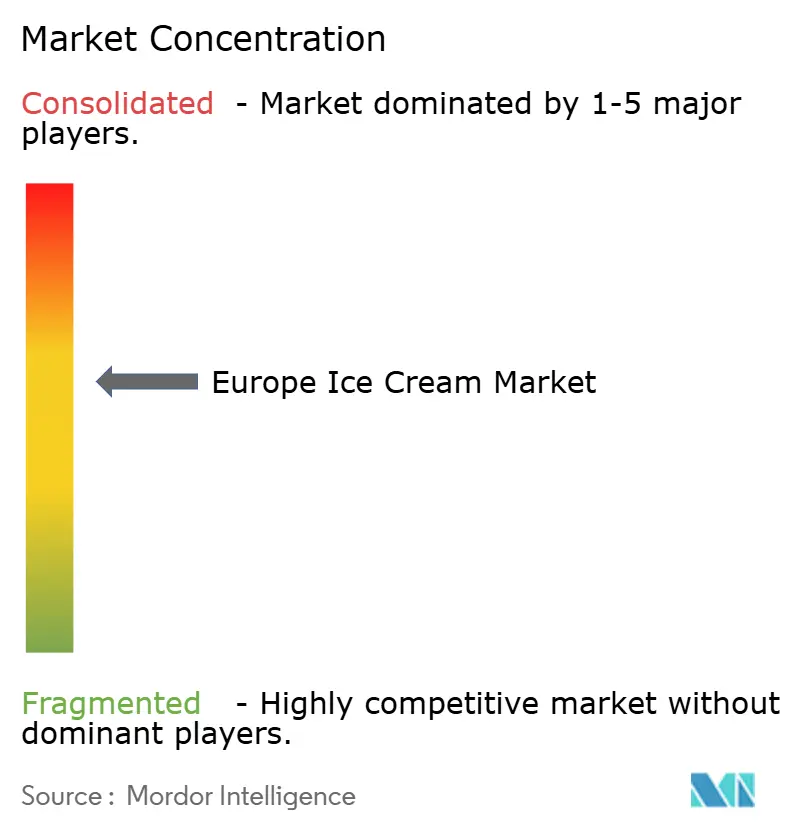
| Market Concentration | Medium |
Major Players *Disclaimer: Major Players sorted in no particular order Image © Mordor Intelligence. Reuse requires attribution under CC BY 4.0. | |
Europe Ice Cream Market Analysis by Mordor Intelligence
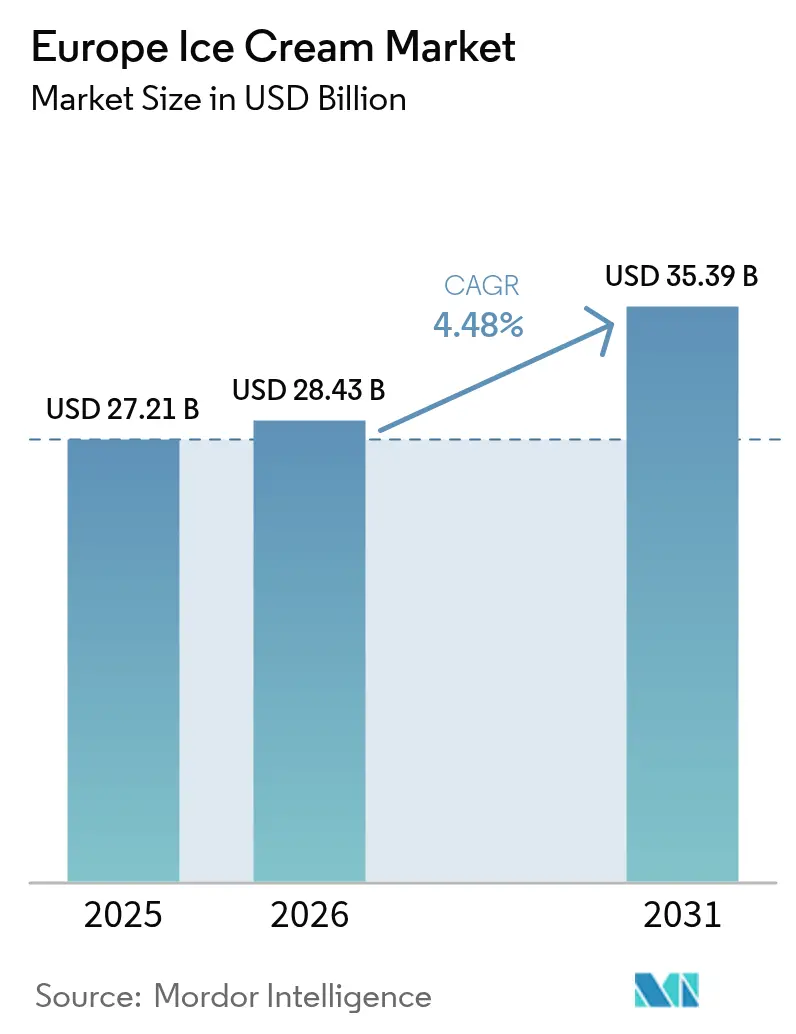
The Europe ice cream market size was valued at USD 27.21 billion in 2025 and estimated to grow from USD 28.43 billion in 2026 to reach USD 35.39 billion by 2031, at a CAGR of 4.48% during the forecast period (2026-2031). Despite facing inflationary challenges, the market is buoyed by several key trends. Premiumization is driving demand as consumers increasingly seek high-quality, indulgent products. The shift towards plant-based options is gaining momentum, catering to the growing vegan and health-conscious population. Adventurous flavor experimentation is also attracting consumers looking for unique and innovative taste experiences. Additionally, a strong emphasis on sustainability is shaping purchasing decisions, with eco-friendly packaging and transparent labeling becoming critical factors. Consumers are willing to pay a premium for products that align with these values. In response, established brands are actively renovating their portfolios to include such offerings while leveraging cost-efficient scales to maintain competitiveness and defend their market share.
Key Report Takeaways
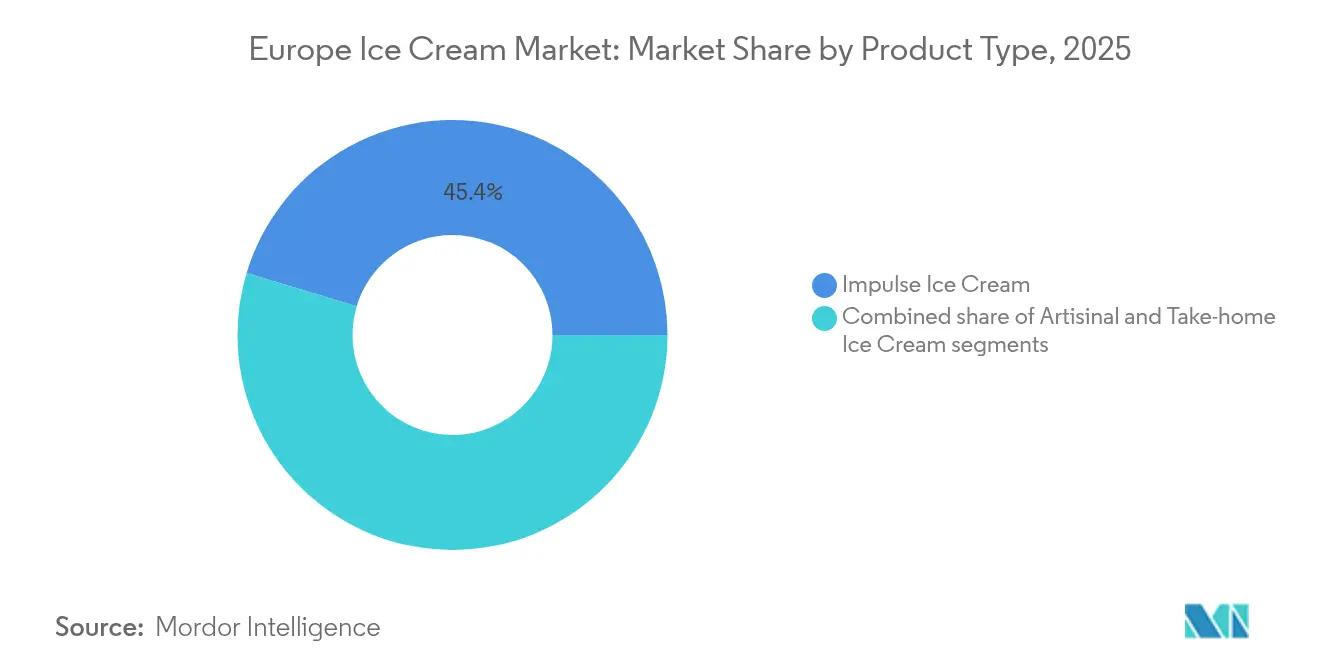
- By product type, impulse ice cream led with 45.35% of the Europe ice cream market share in 2025 while artisanal offerings are projected to advance at a 6.55% CAGR through 2031.
- By category, dairy accounted for 71.58% of the Europe ice cream market size in 2025, whereas non-dairy alternatives are expected to expand at a 7.09% CAGR between 2026-2031.
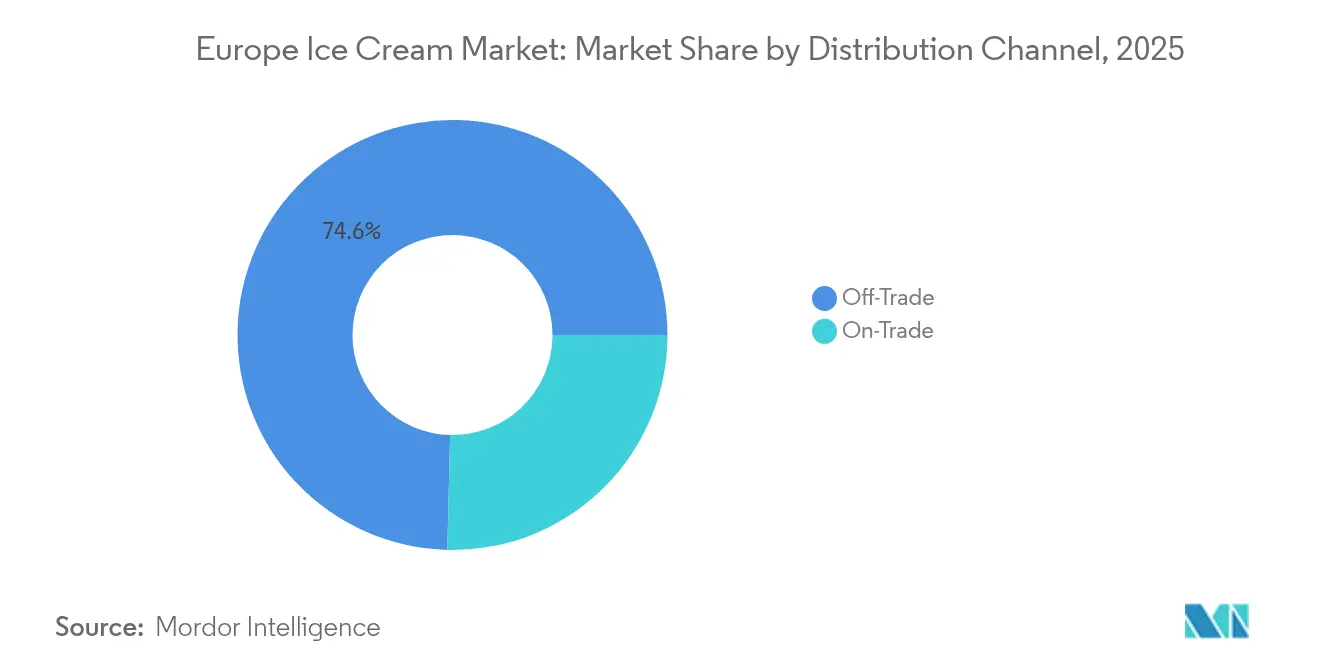
- By distribution channel, off-trade captured 74.62% value share of the Europe ice cream market size in 2025, yet on-trade is set to rebound at a 6.16% CAGR during the same horizon.
- By geography, Germany held 18.94% of the Europe ice cream market share in 2025, while Belgium is forecast to grow at a 7.33% CAGR to 2031.
Note: Market size and forecast figures in this report are generated using Mordor Intelligence’s proprietary estimation framework, updated with the latest available data and insights as of 2026.
Market Trends and Insights
Drivers Impact Analysis of Europe Ice Cream Market*
| Driver | (~) % Impact on CAGR Forecast | Geographic Relevance | Impact Timeline |
|---|---|---|---|
| Rising demand for premium, high-end, and artisan ice cream products | +1.8% | Italy, Germany, France, Belgium | Medium term (2-4 years) |
| Increasing consumer preference for low-calorie, low-sugar, and vegan options | +1.2% | Northern Europe, Germany, Netherlands | Long term (≥ 4 years) |
| Continuous flavor innovation and introduction of novel textures and formats | +0.9% | EU-wide | Short term (≤ 2 years) |
| Seasonal demand peaks in warmer months enhancing sales | +0.6% | Southern Europe, Mediterranean regions | Short term (≤ 2 years) |
| Indulgence-led snacking culture and premiumization | +0.7% | Western Europe, Urban centers | Medium term (2-4 years) |
| Growing emphasis on eco-friendly and sustainable packaging | +0.4% | EU-wide, Nordic countries | Long term (≥ 4 years) |
| Source: Mordor Intelligence | |||
Rising demand for premium, high-end, and artisan ice cream products
Consumers increasingly seek premium, high-end, and artisan ice cream products, driving growth in the market. For instance, the rising popularity of gelato and sorbet, known for their rich flavors and natural ingredients, reflects this trend. Additionally, brands are introducing innovative offerings, such as organic, dairy-free, and low-calorie options, to cater to health-conscious consumers while maintaining a premium appeal. This shift is further supported by the growing preference for unique and indulgent flavors, such as salted caramel, pistachio, and exotic fruit blends, which resonate with the evolving tastes of European consumers. Furthermore, the increasing focus on sustainability and ethical sourcing has led to the introduction of ice creams made with locally sourced ingredients and eco-friendly packaging. Premium brands, such as Häagen-Dazs and Magnum, continue to dominate the market by offering limited-edition flavors and collaborating with renowned chefs to create exclusive products. The rise of artisanal ice cream parlors across Europe, emphasizing small-batch production and handcrafted quality, also contributes to this growing demand.
Increasing consumer preference for low-calorie, low-sugar, and vegan options
The increasing consumer preference for low-calorie, low-sugar, and vegan ice cream options is a significant market driver fueling growth and innovation within the market. Consumers today are more health-conscious and environmentally aware, seeking treats that align with lifestyle choices centered on wellness, sustainability, and ethical consumption. Low-calorie and low-sugar ice creams appeal to those managing diets and conditions like diabetes or those simply wishing to indulge guilt-free, while vegan ice creams attract a broader demographic concerned with animal welfare, lactose intolerance, and reducing carbon footprints. Vegan ice cream innovation is thriving with brands introducing diverse flavor profiles and improved textures to satisfy consumers without compromising on indulgence. Popular bases like almond milk are favored for their creamy texture and lower calorie content compared to dairy, while flavors such as caramel and chocolate are reformulated to deliver richness that parallels traditional ice creams. Notable examples include companies like Over The Moo in the UK, which introduced new dairy-free chocolate, vanilla, and caramel flavors in 2024, further expanding the market’s appeal. This trend is supported by increased availability in supermarkets, specialty stores, and e-commerce platforms, making these healthier and ethical choices increasingly accessible.
Continuous flavor innovation and introduction of novel textures and formats
Manufacturers in Europe are driving the ice cream market by innovating with flavors and textures. They are creating unique combinations like lavender honey, matcha green tea, and salted caramel to meet evolving consumer preferences. Additionally, the market has seen the emergence of innovative textures like mochi ice cream and rolled ice cream, which offer consumers a distinctive sensory experience. Furthermore, the introduction of plant-based and dairy-free ice cream options, such as almond milk or oat milk-based products, has gained traction among health-conscious and vegan consumers. Seasonal and limited-edition flavors, such as pumpkin spice in autumn or berry-infused varieties in summer, also play a crucial role in attracting consumer interest. These advancements not only attract new customers but also encourage repeat purchases, contributing significantly to market growth. The incorporation of functional ingredients, such as probiotics or added protein, further enhances the appeal of ice cream products, aligning with the growing demand for healthier indulgence options.
Seasonal demand peaks in warmer months enhancing sales
The European ice cream market experiences a pronounced seasonal demand pattern, with sales peaking significantly during the warmer months. This seasonal surge is driven largely by consumer behavior favoring cold treats as a refreshing option to beat the summer heat. As temperatures rise, consumers increase their ice cream consumption, turning to a variety of formats such as cones, tubs, and bars, which are more appealing in warm weather. Retailers and manufacturers capitalize on this pattern through targeted marketing campaigns, innovative limited-edition summer flavors, and expanded product availability in convenience stores, supermarkets, and foodservice outlets. This peak season not only boosts volume sales but also allows premium and artisanal brands to introduce exclusive offerings that cater to heightened consumer indulgence during these months. The seasonal demand cycle enhances the overall market growth and revenue generation capacity. This seasonal spike is crucial for businesses to optimize production planning, supply chain logistics, and inventory management to avoid stockouts and meet surge demands efficiently. Moreover, the seasonality influences product innovation, with brands often launching lighter, fruit-based, and plant-based options tailored for summer consumption.
Restraints Impact Analysis of Europe Ice Cream Market*
| Restraint | (~) % Impact on CAGR Forecast | Geographic Relevance | Impact Timeline |
|---|---|---|---|
| Increasing awareness and concerns about sugar and fat content impacting sales | -0.8% | Northern Europe, Health-conscious markets | Medium term (2-4 years) |
| Competition from alternative frozen desserts and snacks | -0.6% | EU-wide, Urban centers | Short term (≤ 2 years) |
| Supply chain disruptions affecting raw material availability and costs | -0.4% | EU-wide | Short term (≤ 2 years) |
| Volatile dairy commodity prices and supply shocks | -0.5% | Western Europe, Urban centers | Medium term (2-4 years) |
| Source: Mordor Intelligence | |||
Increasing awareness and concerns about sugar and fat content impacting sales
Rising awareness of sugar and fat content is affecting sales in the European ice cream market. Consumers are increasingly prioritizing healthier dietary choices, leading to a decline in the demand for traditional ice cream products that are high in sugar and fat. In 2024, the International Diabetes Federation reports that approximately 66 million individuals in Europe are grappling with diabetes [1]. This alarming statistic highlights the growing health concerns among the population, further influencing purchasing decisions. Additionally, the increasing prevalence of obesity and related health conditions has amplified the demand for low-sugar, low-fat, or alternative dessert options. As a result, manufacturers are under pressure to reformulate their products and introduce healthier alternatives to cater to this shifting consumer preference. However, the reformulation process often involves higher production costs and challenges in maintaining the taste and texture of traditional ice cream, which can hinder market growth.
Competition from alternative frozen desserts and snacks
The market faces notable competition from alternative frozen desserts and snacks, which acts as a significant restraint on its growth. Consumers today are increasingly drawn to a wide range of frozen treats beyond traditional ice cream, such as frozen yogurt, dairy-free puddings, sorbets, gelatos, and plant-based alternatives, which offer different textures, flavors, and perceived health benefits. These substitutes appeal particularly to health-conscious consumers seeking lower-calorie, lower-fat, or lactose-free options, thereby eroding the conventional ice cream customer base. The availability and growing popularity of these alternatives reflect broader shifts in consumer preferences toward wellness, dietary restrictions, and ethical consumption practices. Frozen yogurt, for example, has gained traction as a perceived healthier substitute due to its probiotic content and lower fat profile compared to typical ice creams. Similarly, non-dairy frozen desserts made from almond, coconut, oat, or soy milk cater to vegan consumers and those with lactose intolerance. The rising adoption of plant-based diets in Europe has driven innovation and expanded the range of these products, making them increasingly competitive with traditional ice cream.
*Our forecasts treat driver/restraint impacts as directional, not additive. The impact forecasts reflect baseline growth, mix effects, and variable interactions.
Europe Ice Cream Market Segment Analysis
By Product Type:
Artisanal Momentum Challenges Impulse DominanceImpulse ice cream dominated the European ice cream market in 2025, capturing a substantial 45.35% share. This leadership is largely fueled by the widespread presence of convenience stores, which provide easy access and encourage spontaneous purchases. The format’s strength lies in its ability to cater to quick, on-the-go consumption, appealing to a broad demographic that values accessibility and immediate gratification. Impulse ice cream products typically include single-serve options such as cones, bars, and sandwiches, making them highly suitable for busy lifestyles. Retailers leverage prominent shelf placement and frequent promotions to drive volume sales within this segment across Europe’s diverse retail environments. Despite increasing competition from premium and artisanal offerings, impulse ice cream remains a cornerstone of market volume due to its convenience and affordability.
Conversely, artisanal ice cream represents the fastest-growing segment in the European market, expanding at an impressive CAGR of 6.55% through 2031. This growth mirrors consumer trends toward premiumization, where shoppers increasingly prioritize authentic, high-quality experiences over basic convenience. Artisanal ice cream appeals especially to discerning consumers who seek craftsmanship, unique and sophisticated flavor profiles, and often locally sourced or organic ingredients. This segment benefits from growing consumer interest in natural, less processed products as well as elevated packaging and storytelling that enhance perceived value. Premium artisanal brands typically focus on small-batch production and innovative recipes, differentiating themselves from mass-market offerings.

By Category:
Plant-Based Acceleration Amid Dairy DominanceDairy ice cream maintained its dominant position commanding a substantial 71.58% share in 2025. This segment’s longevity stems from deep-rooted consumer preferences for the traditional creamy texture, rich taste, and familiarity associated with dairy-based products. Many established brands continue to rely on their heritage dairy lines, supported by widespread availability across supermarkets, convenience stores, and foodservice outlets. The segment benefits from strong brand loyalty, extensive production capacity, and distribution efficiencies that help sustain its leading market presence. Moreover, continuous innovation within dairy ice cream—including new flavors, premium ingredients, and enhanced quality—helps maintain consumer interest. Despite rising health and ethical concerns, dairy ice cream remains the foundational choice for a wide demographic across Europe.
In contrast, non-dairy ice cream alternatives represent the fastest-growing segment, expanding at a notable CAGR of 7.09% through 2031. This surge is driven by increasing consumer demand for plant-based and vegan options, reflecting wider lifestyle shifts toward health consciousness, environmental sustainability, and ethical consumption. Non-dairy alternatives utilize a variety of bases such as almond, oat, coconut, and soy, appealing to lactose-intolerant consumers and those seeking cleaner, more natural ingredient profiles. The segment’s growth is further fueled by innovative formulations that closely mimic the texture and creaminess of traditional dairy ice cream, improving consumer acceptance. Additionally, heightened marketing efforts around sustainability and transparency, along with expanding retail and foodservice offerings, have boosted accessibility and consumer trial.
By Distribution Channel:
Off-Trade Strength Meets On-Trade RecoveryOff-trade channels dominated the European ice cream market in 2025, commanding a significant 74.62% share of total revenue. This leading position is largely supported by the widespread availability and extensive reach of supermarkets, hypermarkets, and grocery stores, which remain the primary purchasing destinations for most consumers. Off-trade benefits from strong distribution networks, competitive pricing, and frequent promotional activities that enhance product visibility and accessibility. The convenience of in-home consumption also sustains steady demand, especially for traditional and premium ice cream varieties. Additionally, the growth of e-commerce within off-trade offers consumers easy access to a broad selection of products, including niche and emerging brands, further reinforcing this channel’s dominance.
In contrast, on-trade channels are the fastest-growing segment, recovering at a CAGR of 6.16% through 2031 as hospitality venues rebound from pandemic disruptions. Establishments such as cafés, restaurants, hotels, and experiential dining venues are innovating their ice cream offerings, introducing creative serving formats that blur the lines between dessert and immersive culinary experiences. This growth reflects consumers’ renewed enthusiasm for social dining, premiumization, and unique indulgences that go beyond conventional ice cream consumption. On-trade operators increasingly emphasize artisanal products, novel presentations, and limited-edition flavors to attract discerning clientele seeking both quality and novelty. Moreover, sustainability considerations and ethical sourcing are becoming key differentiators in this segment, aligning with evolving consumer values.
Geography Analysis
Germany Ice Cream Market
In 2025, Germany commanded a notable 18.94% share of the market. This leadership is anchored in Germany's strong retail infrastructure and a pronounced consumer inclination towards premium and artisanal ice cream. Moreover, the nation champions sustainable agriculture and responsible ingredient sourcing. Urban hubs in Germany, where the urbanization rate reached 78% in 2024 (World Bank) , play a crucial role in fueling demand, particularly for plant-based and premium ice creams, reflecting a shift towards quality and health-conscious choices. Additionally, Germany's deep-rooted collaborations with local farmers and producers not only fortify its market stance but also drive innovation, ensuring both freshness and traceability. Furthermore, Germany's ice cream imports surged to approximately EUR 461.2 million in 2023, up from EUR 372.15 million in 2020, as reported by Statistisches Bundesamt , highlighting the growing demand for diverse ice cream offerings.
Belgium Ice Cream Market
Belgium emerges as the fastest-growing geography in the Europe ice cream market, with a projected CAGR of 7.33% through 2031. This growth is fueled by Belgium’s rich confectionery heritage and its strategic focus on premium positioning. Belgian producers capitalize on quality ingredient sourcing and artisanal innovation, attracting discerning consumers who value authentic, high-quality frozen treats. The country’s emphasis on craftsmanship and luxury in its confectionery and ice cream segments helps differentiate its offerings, supporting robust growth in both domestic and export markets.
Broader European Markets
Other key European markets also contribute prominently to the ice cream sector's landscape. The United Kingdom is poised for substantial growth, driven by urban hubs like London and Manchester that benefit from strong investments in e-commerce and grocery retail. The UK market notably embraces plant-based ice creams, reflecting broader shifts toward vegan and health-oriented diets. France maintains steady growth through premium and artisanal ice cream demand, supported by innovation hubs in Paris and a surge in online grocery sales. Italy is notable for its artisanal gelato tradition, with Milan and Rome leading in growth due to a focus on locally sourced ingredients and government incentives that support sustainable agricultural practices.
Regulatory Landscape
Ice cream sold in the European Union falls under the edible ices category for additives (food category 3) in Annex II of Regulation (EC) No 1333/2008, making compliance with EU rules on permitted food additives and their specifications central to formulation decisions (for example, stabilizers and emulsifiers commonly used in dairy and non-dairy products). In January 2026, Commission Regulation (EU) 2026/196 amended specifications for several stabilizers such as carrageenan (E 407), locust bean gum (E 410), and guar gum (E 412), with a transition that allows stocks lawfully placed on the market before 18 August 2026 to continue to be marketed. On the operations side, Commission Implementing Regulation (EU) 2025/33 introduced a time-bound exemption for certain artisanal gelato ice cream makers using fluorinated greenhouse gases (GWP >= 150) from 1 January 2025 to 30 June 2026, affecting equipment planning and service contracts as the exemption ends. For cross-border supply, ice cream containing dairy components must also align with EU import control rules for composite products, including requirements linked to the EU-listing status of relevant dairy establishments and applicable heat-treatment conditions, which can influence sourcing strategies for brands distributing across European markets.
Value Chain Analysis
The European ice cream value chain starts with inputs (milk and cream, sugar, cocoa, fruit preparations, stabilizers/emulsifiers, and packaging), followed by industrial or artisanal processing, hardening and frozen storage, and temperature-controlled distribution into off-trade and on-trade channels. Production is concentrated in major manufacturing countries, with Eurostat reporting EU ice cream production of 3.3 billion litres in 2024 (up 2% year on year), led by Germany (607 million litres), France (501 million litres), and Italy (492 million litres), supporting both domestic consumption and intra-European trade flows. Cold chain logistics and retail freezer execution are pivotal downstream steps because ice cream quality and shrink depend on uninterrupted temperature control from factory to point of sale. Industry sources point to a 15% to 25% increase in EU cold chain logistics costs since 2021, driven by energy price volatility, carbon-related costs, and labor constraints, which raises the importance of route optimization, energy-efficient cold stores, and packaging that maintains product integrity. Industry coordination bodies such as EuroGlaces (including committees that address topics like packaging) sit alongside national associations (for example, the Nordic Ice Cream Association), while manufacturers also manage seasonal capacity constraints at co-packers and raw-material availability pressures linked to environmental policies affecting EU dairy supply in key producing regions.
Competitive Landscape
The European ice cream market exhibits a moderate concentration with a score of approximately 6, indicating a competitive landscape where several large multinational corporations coexist with a vibrant array of regional artisanal producers. This structure reflects a balance that allows dominant companies to leverage their scale, extensive distribution networks, and brand recognition while creating space for smaller, craft-focused brands to thrive by catering to niche consumer preferences for authenticity and unique flavors. The coexistence of these two segments fuels innovation and variety in the market, ensuring a broad spectrum of products from mainstream to premium artisan offerings.
Established multinational players such as Unilever, Nestlé, General Mills, and Mars dominate significant market share by capitalizing on economies of scale, extensive Research and Development, and strategic marketing. These companies continuously renovate their portfolios to include premium, plant-based, and health-oriented products aligned with evolving consumer demands. Their widespread distribution across supermarkets, convenience stores, and online channels provides strong market penetration. Simultaneously, they also navigate inflationary pressures through cost efficiencies and supply chain optimization, solidifying their market leadership while responding to sustainability mandates with eco-friendly packaging and responsible sourcing.
On the other hand, the artisanal and regional producers form a critical segment, representing the growing consumer demand for high-quality, authentic, and locally sourced products. These smaller producers thrive on craftsmanship, innovative flavors, and traditional production methods, often emphasizing natural and organic ingredients. The artisanal segment's growth is propelled by consumers willing to pay a premium for personalized experiences and specialty formats such as gelato and organic varieties. This interplay between large multinationals and specialty brands defines the moderate concentration score and highlights the dynamic nature of the European ice cream market, where scale and specialization coexist to meet diverse consumer tastes and drive overall market growth.
Europe Ice Cream Industry Leaders
-
Unilever PLC
-
Mars, Incorporated
-
General Mills, Inc.
-
Nestlé S.A
-
Froneri International Limited
- *Disclaimer: Major Players sorted in no particular order
Europe Ice Cream Market Companies Covered in this Report
- Unilever PLC
- Froneri International Limited
- Nestlé S.A.
- General Mills Inc.
- Mars, Incorporated
- Wells Enterprises Inc.
- Lotte Corporation
- Lotus Bakeries NV
- Inspire Brands Inc. (Baskin-Robbins)
- Glacio NV
- Pasticceria Veneta SpA
- R&R Ice Cream Poland
- Sammontana S.p.A
- DMK Group
- Ardo NV (plant-based frozen desserts)
- GB Glace
- Mlekovita
- Orkla ASA (Panda, Diplom-Is)
- Gelati Roberto SRL
- TipTop Ice Cream
- Guestrower Milcheis GmbH
Market Opportunities and Future Outlook
Factory modernization and multi-format capacity additions are whitespace areas as brands balance premiumization, portion-controlled formats, and cost control under higher cold-chain and energy costs. In 2026, multiple Europe-based investments highlighted this direction, including Glacier's announced EUR 45 million program across Italy and Belgium to expand capacity and automation (covering extruded ice creams, linear moulded lollies, and portion-controlled bites) and The Magnum Ice Cream Company N.V. committing around EUR 10 million (HUF 4 billion) to modernize its Veszprem, Hungary facility with a new production line. These moves reinforce opportunities for equipment suppliers, co-packers, and ingredient partners that can support faster line changeovers, smaller-format innovation, and throughput improvements for impulse and bite-sized products. A second opportunity area is portfolio renovation around plant-based and permissible-indulgence positioning, supported by wider off-trade availability and experimentation with bases and textures, alongside stricter labeling and formulation discipline. With dairy still the majority category in 2025 (71.58% share) and non-dairy positioned as the fastest-growing category in the report framework, brands have room to differentiate through cleaner formulations aligned to EU additive specifications, and sustainability-linked packaging choices that work within extended producer responsibility systems and single-use plastics constraints. On the demand side, on-trade recovery creates whitespace for artisanal and premium formats where outlets can use provenance storytelling, seasonal menus, and portion control to lift margins while maintaining operational simplicity.
Recent Industry Developments in Europe Ice Cream Market
- July 2026: Glacier announced a EUR 45 million investment program to expand ice cream production capacity and automation, including two new production lines in Italy and upgrades at its Langemark site in Belgium. The added capability targets extruded products and portion-controlled formats, helping the company scale innovation while improving manufacturing efficiency. The move also increases competitive pressure on regional producers that rely on flexible co-packing capacity during peak season.
- July 2026: The Magnum Ice Cream Company N.V. (TMICC) announced an investment of EUR 10 million to modernize its Veszprem, Hungary plant and add a new production line, including capability linked to Magnum Bonbons. The upgrade supports higher output and broader format flexibility for premium and bite-sized products. It also strengthens localized supply for Central Europe, reducing lead times and cold-chain complexity for impulse distribution.
- November 2024: Ferrero UK expanded Kinder Bueno ice cream cones rollout to major retail chains across the UK, signaling intensified brand-led entry into frozen desserts and expanding distribution reach.
Europe Ice Cream Market Report Scope and Research Methodology
Market Definition and Coverage
For this study, the Europe ice cream market covers the value of packaged and served ice cream products sold through retail and foodservice channels across European countries, measured in USD for the base year and forecast period.
Scope exclusions: We exclude mixes and bases for ice cream, along with upstream dairy farming or ingredient markets that do not represent finished ice cream sales.
Segments Covered in This Report
- By Product Type
- Artisanal Ice Cream
- Impulse Ice Cream
- Take-home Ice Cream
- By Category
- Dairy
- Non-Dairy (Plant-based)
- Distribution Channel
- On-Trade
- Off-Trade
- Supermarkets/Hypermarkets
- Specialist Retailers
- Convenience Stores
- Online Retail Stores
- Other Distribution Channels
- By Geography
- Germany
- United Kingdom
- France
- Italy
- Spain
- Russia
- Netherlands
- Belgium
- Poland
- Sweden
- Rest of Europe
Data Sources, Market Sizing, and Validation
Desk Research
Desk research was used to establish the fact base for consumption, trade, and category structure before the market assumptions were modeled. We leaned on public statistics and reference materials such as Eurostat, national statistics offices, the European Commission trade databases, FAOSTAT for dairy context, and tariff and product-code notes used in customs reporting.
To build a complete view, we also reviewed company annual reports, investor presentations, retailer and foodservice channel disclosures, and reputable press for pricing and demand shifts (including premiumization and plant-based launches). For cross-checking price and volume direction, we also used paid subscriptions focused on company financials and intelligence, plus shipment-level import and export databases where helpful. The sources listed above are illustrative rather than exhaustive, and we referenced additional public materials to support data collection, validation, and clarification.
Primary Interviews and Surveys
Primary work focused on validating what drives market value in Europe, with a particular focus on price realization, channel mix, and the split between impulse, take-home, and artisanal formats. We spoke with brand-side leaders, distribution and category managers, and channel participants across major European markets and the rest of the region, then used their inputs to confirm assumptions derived from desk research.
Distribution of primary research fieldwork respondents
| Company type | Respondent position |
|---|---|
| Top tier: 31% | CXOs: 12% |
| Mid tier: 55% | Functional/Unit leaders: 39% |
| Smaller Players: 14% | Managers: 49% |
Market-Sizing & Forecasting
Sizing was built using a mix of top-down and bottom-up checks. The top-down layer starts from country-level packaged food and frozen dessert demand pools, then narrows them using channel splits and category shares that match ice cream consumption patterns in Europe. After the country totals were constructed, we summed them to a regional value and stress-tested the result.
To keep the model grounded, we used repeatable inputs such as per capita consumption direction, seasonality effects on monthly sell-through, premium versus value price ladders, on-trade versus off-trade mix, and the adoption pace of non-dairy offerings. Forecasts were developed using scenario analysis with a focused set of drivers, then aligned to what interviewees expected for pricing, promotions, and capacity plans over the forecast period. Bottom-up approximations were applied selectively, including sampled price per unit multiplied by volume indicators from retail and trade references, and supplier and channel checks used to fill gaps where public splits were missing.
Data Validation & Update Cycle
Outputs were validated through triangulation across independent signals, and any sharp jumps were flagged for re-checking assumptions before sign-off. If a country shows unusual pricing or volume behavior, we revisit the inputs, re-check trade and consumption cues, and re-contact relevant experts to confirm what changed and when it changed.
The report is refreshed annually, and we also run interim updates when major events materially shift demand or pricing, such as tax changes, regulation affecting ingredients, or large channel disruptions. Before delivery, an analyst performs a fresh pass on the latest public data so clients receive an updated view tied to the same consistent model steps.
Mordor Intelligence's Europe Ice Cream Market Estimate Compared With Other Published Estimates
Published market values for Europe ice cream do not always match because firms use different product definitions, country coverage, and pricing points, then project those assumptions forward on different timelines. In practice, those choices affect whether the result behaves like consumer spending, producer revenue, or a midpoint estimate.
Some estimates stay close to producer and trade-coded definitions, which can exclude parts of in-market value such as retailer margin and certain foodservice pricing effects. Others may also smooth pricing too aggressively across years, even though promotion intensity and premium mix shift differently by country, which changes the final USD value. Those two scope decisions explain much of the spread. In Mordor Intelligence, the count is limited to finished ice cream sold through on-trade and off-trade channels, excluding mixes and bases, and keeping pricing checks aligned to country-level sell-through signals.
Benchmark comparison
| Source | Market Size | Gaps in Research Methodology |
|---|---|---|
| Mordor Intelligence | USD 27.21 B (2025) | |
| Global Consultancy A | USD 22.90 B (2025) | This estimate applies a narrower basket of included countries and category mapping that often leans toward packaged retail-only definitions, which can undercount on-trade and some artisanal value. It also tends to apply a smoother price curve over time, which reduces the impact of promotion cycles that vary by country. |
| Trade Journal B | USD 11.10 B (2024) | This figure is built around a production and trade coded product definition and is closer to producer and importer revenue constructs, which leaves out retail margins and some in-country value add. It is also stated for a different year, so inflation and mix shifts between 2024 and 2025 are not captured in that number. |
The table shows that different product definitions and the value point in the chain being measured are the main reasons totals spread apart. When the same finished-product scope is carried consistently across countries and checked against independent channel signals, the results are easier to repeat and update as conditions change.
Key Questions Answered in the Report
What is the current value of the Europe ice cream market?
The market is valued at USD 28.43 billion in 2026.
How fast is plant-based ice cream growing across Europe?
Non-dairy alternatives are forecast to expand at a 7.09% CAGR between 2026-2031.
Which country leads regional sales?
Germany accounts for 18.94% of 2025 value thanks to large-scale production and strong exports.
Which product segment is expanding quickest?
Artisanal ice cream shows the fastest momentum with a 6.55% CAGR through 2031.