
Market Overview
| Study Period | 2021 - 2031 |
|---|---|
| Forecast Data Period | 2026 - 2031 |
| Base Year Market Size (2025) | USD 0.84 Billion |
| Market Size (2026) | USD 0.9 Billion |
| Market Size (2031) | USD 1.23 Billion |
| Growth Rate (2026 - 2031) | 6.62 % |
| Market Concentration | Medium |
Major Players
*Disclaimer: Major Players sorted in no particular order Image © Mordor Intelligence. Reuse requires attribution under CC BY 4.0. |
|

Europe Hair Loss Treatment Products Market Analysis by Mordor Intelligence
The Europe hair loss treatment products market size was valued at USD 0.84 billion in 2025 and estimated to grow from USD 0.9 billion in 2026 to reach USD 1.23 billion by 2031, at a CAGR of 6.62% during the forecast period (2026-2031). The growing demand for effective solutions to combat hair loss, coupled with the rising adoption of natural and organic products, is significantly influencing market dynamics. The aging population across Europe is a key driver, as hair loss is a common concern among older demographics. Additionally, younger consumers are increasingly seeking preventive measures and treatments, further fueling market growth. The availability of over-the-counter (OTC) products, including shampoos, serums, and supplements, has made hair loss treatments more accessible to a broader audience. Social media platforms and digital marketing campaigns are playing a pivotal role in raising awareness and promoting various hair loss treatment products, thereby boosting consumer engagement. Technological advancements in the formulation of hair loss treatments, such as the incorporation of active ingredients like minoxidil and finasteride, are enhancing product efficacy and driving consumer trust. Furthermore, the market is witnessing a surge in demand for personalized solutions, with companies offering tailored products based on individual hair and scalp conditions. The competitive landscape is evolving rapidly, with key players focusing on innovation, mergers, acquisitions, and strategic partnerships to strengthen their foothold in the market. Companies are also investing in research and development to introduce advanced products that cater to diverse consumer needs.
Key Report Takeaways
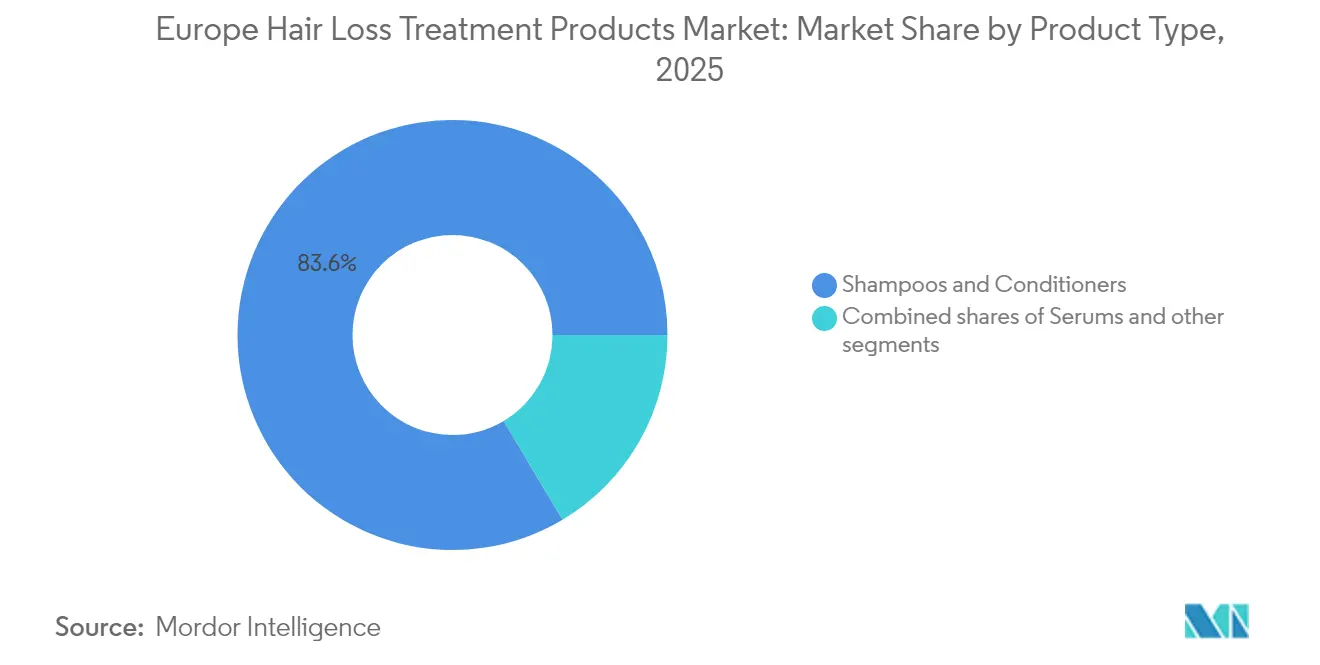
- By product type, shampoos and conditioners held 83.55% of the Europe hair loss treatment products market share in 2025, while serums are forecast to expand at a 6.92% CAGR through 2031.
- By gender, females accounted for 68.74% of 2025 revenue, whereas male demand is advancing at a 6.85% CAGR to 2031.
- By category, topical formats commanded 90.58% of the Europe hair loss treatment products market size in 2025 and oral products are set to grow at 7.12% CAGR over the forecast horizon.
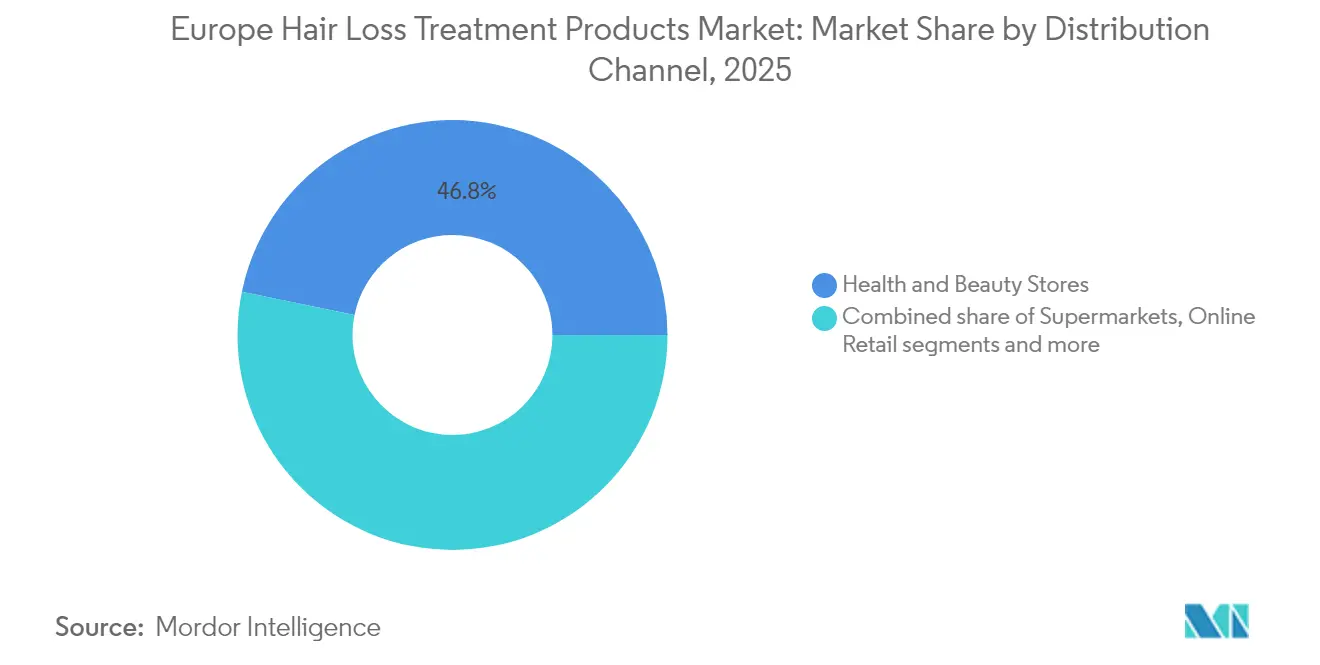
- By distribution channel, health and beauty stores led with 46.78% share in 2025; online retail stores deliver the fastest CAGR at 6.88% on the back of privacy-driven purchasing behavior.
- By geography, Germany secured 20.12% revenue share in 2025, while Spain is poised for the highest 7.05% CAGR to 2031.
Note: Market size and forecast figures in this report are generated using Mordor Intelligence’s proprietary estimation framework, updated with the latest available data and insights as of 2026.
Europe Hair Loss Treatment Products Market Trends and Insights
Drivers Impact Analysis*
| Driver | (~) % Impact on CAGR Forecast | Geographic Relevance | Impact Timeline |
|---|---|---|---|
| High prevalence of male pattern baldness and increasing hair loss issues | +1.8% | Europe-wide, with highest impact in Spain, Germany, Czech Republic | Long term (≥ 4 years) |
| Growing awareness and concern about personal appearance and grooming | +1.5% | Western Europe core, expanding to Eastern Europe | Medium term (2-4 years) |
| Rising demand for natural and organic hair loss treatment products | +1.2% | Germany, Netherlands, Scandinavia with spillover to France, Italy | Medium term (2-4 years) |
| High incidence of age-related hair thinning due to an aging population | +1.0% | Netherlands, Germany, Italy with demographic transition | Long term (≥ 4 years) |
| Availability of advanced and innovative hair loss treatment solutions | +0.8% | Technology hubs: Germany, Netherlands, France | Short term (≤ 2 years) |
| Social media influence promoting awareness and acceptance of hair loss treatments | +0.7% | Spain, United Kingdom, France with high social media penetration | Short term (≤ 2 years) |
| Source: Mordor Intelligence | |||
High prevalence of male pattern baldness and increasing hair loss issues
Male pattern hair loss (MPHL), also known as male androgenetic alopecia, is a highly heritable and age-dependent condition affecting a large proportion of men in Europe. According to a 2023 report by the National Institute of Health, hair loss in European men can begin as early as puberty, with a lifetime prevalence estimated to be approximately 80% [1]Source: National Center for Biotechnology Information, "Male-pattern hair loss: Comprehensive identification of the associated genes as a basis for understanding pathophysiology", pmc.ncbi.nlm.nih.gov. The condition is characterized by a progressive and distinct pattern of hair thinning and loss, typically starting with recession at the temples and thinning at the crown, eventually leading to baldness on the top of the scalp. This progressive hair loss has significant psychological and social effects, impacting self-esteem, confidence, and overall quality of life. The genetic basis of MPHL is strong, with androgen hormones playing a central role in follicular miniaturization and hair cycle disruption. Given its high prevalence and profound emotional impact, MPHL continues to be a key driver of demand for hair loss treatment products in Europe, encouraging innovation and the adoption of a range of therapeutic options.
Growing awareness and concern about personal appearance and grooming
Consumers in Europe are increasingly prioritizing convenience and protective benefits when purchasing wellness and beauty products. A 2023 survey conducted by Professional Beauty revealed that UK consumers, on average, spend GBP 4,600 annually on wellness-related products [2]Source: Professional Beauty, “Brits spend over £4.5K on self-care annually”, professionalbeauty.co.uk . . This substantial expenditure reflects a growing commitment to self-care and grooming, as consumers actively seek high-quality, effective, and convenient solutions to enhance their personal appearance and overall well-being. They are not only investing in products that deliver visible results but are also showing a preference for brands that align with their values, such as sustainability and ethical sourcing. The beauty and personal care sector continues to demonstrate robust growth and resilience, playing a significant role in strengthening the regional economy and driving advancements in treatments and product innovations. This ongoing trend highlights the market's shift towards premiumization, with consumers increasingly demanding scientifically advanced formulations that cater to their evolving needs and expectations.
Rising demand for natural and organic hair loss treatment products
There is a rising demand for natural and organic hair loss treatment products in Europe, driven by increasing consumer awareness of the potential harmful effects of chemicals in conventional formulations. Consumers are increasingly seeking products that offer effective results while aligning with their preferences for sustainable and clean-label ingredients. This trend is supported by a growing focus on health, safety, and environmental responsibility, encouraging manufacturers to innovate with plant-based, cruelty-free, and eco-friendly formulations. Additionally, leading players in the market are responding by expanding their portfolios to include natural and organic options, which cater to a broader demographic concerned with both aesthetics and wellness. This shift towards natural and organic products not only enhances consumer trust but also supports long-term market growth by addressing evolving ethical and regulatory standards in Europe.
High incidence of age-related hair thinning due to an aging population
The aging population is emerging as a critical factor influencing the Europe Hair Loss Treatment Products Market. With a growing number of individuals entering the 65-and-older age group, the prevalence of age-related hair thinning and hair loss is becoming increasingly common. This demographic shift is driven by rising life expectancy and persistently low birth rates, which are contributing to a steady expansion of the elderly population across the European Union. According to Eurostat, as of January 1, 2024, the EU's population was approximately 449.3 million, with over 21.6% falling into this age category [3]Source: Eurostat, "Population Structure and Ageing", ec.europa.eu. This trend is reshaping market demands, as older adults seek effective solutions tailored to their specific hair loss challenges. In response, manufacturers and marketers are focusing on developing innovative products that cater to the unique needs of this growing consumer segment, ensuring that the market evolves in alignment with the demographic changes occurring throughout Europe.
Restraints Impact Analysis*
| Restraint | (~) % Impact on CAGR Forecast | Geographic Relevance | Impact Timeline |
|---|---|---|---|
| High cost of hair loss treatment products limiting consumer affordability | -1.5% | Eastern Europe, Southern Europe with lower disposable income | Medium term (2-4 years) |
| Side effects and allergies associated with certain chemical-based products | -1.2% | Europe-wide due to regulatory scrutiny, particularly Germany, France | Short term (≤ 2 years) |
| Availability of counterfeit and low-quality products in the market | -0.8% | Online channels across Europe, particularly affecting premium segments | Medium term (2-4 years) |
| Lack of consumer knowledge regarding hair loss causes and treatments | -0.5% | Rural areas and older demographics across Europe | Long term (≥ 4 years) |
| Source: Mordor Intelligence | |||
High cost of hair loss treatment products limiting consumer affordability
The high cost of hair loss treatment products is a significant restraint on consumer affordability within the Europe Hair Loss Treatment Products Market. Premium products, including clinically approved topical treatments, oral medications, and advanced therapies such as platelet-rich plasma (PRP) and stem cell treatments, often carry price points that can be prohibitive for many consumers. For example, hair transplant procedures in Europe can range from approximately ERU 2,850 to EUR 12,000 depending on the clinic and treatment scope, while ongoing topical and oral treatments frequently require consistent investment over time. These costs, combined with limited insurance coverage for cosmetic treatments, restrict market accessibility, particularly among lower-income consumer segments. Additionally, the availability of alternative treatment methods such as surgery or laser therapy introduces competitive pressure, complicating purchasing decisions. Consequently, high pricing remains a considerable challenge that manufacturers and marketers must address to expand the user base and fully tap into the European market potential.
Side effects and allergies associated with certain chemical-based products
Side effects and allergic reactions associated with certain chemical-based hair loss treatment products pose a significant restraint for the Europe Hair Loss Treatment Products Market. Widely used medications such as finasteride, while effective, have been linked to serious adverse effects including sexual dysfunction, depression, and, in rare cases, suicidal thoughts. Topical treatments like minoxidil may cause scalp irritation, dryness, and allergic contact dermatitis in some users. These potential side effects raise concerns among consumers and healthcare providers, often limiting product adoption and long-term compliance. Moreover, increasing reports of adverse reactions have prompted stricter regulatory warnings and calls for improved safety monitoring. This risk profile encourages consumers to seek safer, natural alternatives, creating challenges for chemical-based treatments to maintain market share while driving the need for innovation focused on minimizing side effects.
*Our forecasts treat driver/restraint impacts as directional, not additive. The impact forecasts reflect baseline growth, mix effects, and variable interactions.
Segment Analysis
By Product Type: Serums Drive Innovation Despite Shampoo Dominance
Shampoos and conditioners held the dominant position in the Europe hair loss treatment products market in 2025, capturing a significant 83.55% share. Their strong presence is largely attributed to their established role as everyday essentials in personal grooming routines, offering convenience and familiarity to a wide base of consumers. These formats are perceived as easy-to-use, low-effort solutions that can be seamlessly integrated into existing hair care habits without requiring additional time or learning. This inherent accessibility continues to appeal to both new and existing consumers, reinforcing their popularity across diverse demographic segments. Moreover, shampoos and conditioners are widely available across retail channels, ranging from supermarkets to specialty stores, further supporting their leadership in this market. Their dominance also reflects consumer trust in tried-and-tested product forms, which are often the first line of defense when addressing hair loss concerns.
In contrast, serums represent the fastest-growing segment, projected to expand at a CAGR of 6.92% through 2031. Unlike traditional daily-use formats, serums are positioned as specialized treatments that deliver a higher concentration of active ingredients directly to the scalp or hair roots. This targeted approach resonates strongly with consumers seeking effective and visible solutions for hair thinning and loss, especially amid rising awareness of advanced treatment options. Their association with premiumization has further elevated the segment, as many serums are marketed with advanced formulations and clinically backed efficacy claims. Additionally, the growth of e-commerce and direct-to-consumer channels has made serums more accessible, enabling brands to highlight their value proposition to niche yet growing consumer groups. As personal care moves toward a focus on results-driven and customized solutions, serums are set to gain momentum as a preferred choice for consumers demanding more targeted outcomes.



By Gender: Male Acceleration Challenges Female Dominance
Female consumers commanded the largest share of the Europe hair loss treatment products market in 2025, accounting for 68.74% of the total. This dominance stems from the higher level of awareness among women regarding hair care and the greater emphasis placed on personal appearance and grooming. Women are more likely to seek proactive solutions to manage hair thinning or loss, making them the primary target group for a wide range of treatment products. Additionally, marketing strategies across brands often focus heavily on female consumers, reinforcing both visibility and adoption rates within this segment. The availability of diverse product formats, from shampoos and conditioners to advanced serums, further supports their engagement with the category. As a result, the female segment maintains its leading position, sustained by strong demand arising from lifestyle-driven concerns and ongoing self-care trends.
On the other hand, male consumers represent the fastest-growing segment, projected to expand at a CAGR of 6.85% between 2025 and 2031. This growth highlights a significant shift in treatment acceptance patterns among men, who are increasingly open to adopting preventive and corrective solutions for hair loss. Social changes and the reduced stigma around male grooming and self-care are key factors fueling this trend. Furthermore, the rising demand for targeted solutions, such as hair growth serums and scalp therapies designed specifically for men, has accelerated interest within this segment. The influence of digital platforms and direct-to-consumer marketing has also played a vital role in normalizing treatment options for male consumers, encouraging broader adoption. Consequently, the male demographic is evolving into a critical growth driver for the market, reshaping long-term demand dynamics within the hair loss treatment landscape.
By Category: Oral Treatments Gain Despite Topical Leadership
Topical treatments dominated the Europe hair loss treatment products market in 2025, securing a substantial 90.58% share. Their widespread adoption is primarily attributed to consumer preference for localized application methods, which are perceived as easier to use and more familiar compared to systemic alternatives. The direct application to the scalp provides a sense of targeted action, giving consumers confidence in the product’s effectiveness without the complexities associated with oral or prescription-based options. Perceived safety is another critical factor, as topical treatments are generally viewed as carrying fewer risks and side effects compared to systemic solutions. This perception has reinforced consumer trust, making them the first-line choice for individuals beginning hair loss treatments. In addition, the wide availability of topical products across retail, pharmacy, and online channels enhances accessibility, ensuring their continued dominance in the market landscape.
In contrast, oral treatments represent the fastest-growing category, projected to expand at a CAGR of 7.12% through 2031. Their rising appeal is connected to the increasing recognition of convenience, as oral formats require minimal time and effort compared to daily topical applications. Recent advancements in low-dose oral protocols have further strengthened confidence among consumers and healthcare providers by reducing potential side effect risks, which historically limited acceptance. This evolution is broadening the appeal of oral treatments beyond severe cases, fostering uptake among a wider consumer base seeking effective but manageable solutions. The growing endorsement of oral therapies in clinical recommendations and professional consultations is also bolstering credibility, driving stronger consideration rates. With greater innovation, rising consumer education, and expanding prescription accessibility, oral treatments are poised to reshape the competitive dynamic of the hair loss treatment products market over the coming years.
By Distribution Channel: Digital Transformation Accelerates
Health and beauty stores secured the largest share of the Europe hair loss treatment products market in 2025, accounting for 46.78% of the total. Their strong position is underpinned by advantages such as personalized consultations, where trained professionals can guide consumers toward the most suitable products. These outlets also provide opportunities for product sampling and trials, enabling consumers to experience formulations firsthand before committing to a purchase. Such experiential benefits foster greater trust and confidence in product efficacy, reinforcing loyalty to this distribution channel. The physical presence of health and beauty stores also allows brands to create an engaging retail environment, strengthening awareness and brand positioning. Combined with their ability to offer expert-driven recommendations, these stores continue to be the most influential and dependable sales avenue within the market.
In contrast, online retail stores represent the fastest-growing distribution channel, projected to register a notable 6.88% CAGR through 2031. The rapid expansion of e-commerce reflects the broader digital transformation of consumer buying behaviors, driven by convenience, accessibility, and the growing trust in online transactions. Online platforms provide a vast assortment of hair loss treatment products, empowering consumers to compare options, read reviews, and access professional endorsements at their convenience. In addition, subscription services and direct-to-consumer brands are gaining traction through online channels, offering cost savings and the ease of regular product delivery. Digital marketing strategies, including targeted advertising and social media campaigns, have further increased visibility and consumer engagement in this space. As shoppers continue to embrace digital purchasing habits and seek flexible access to specialized solutions, online retail stores are positioned to play a central role in shaping future market growth.
Geography Analysis
Germany emerged as the leading country in the Europe hair loss treatment products market in 2025, capturing 20.12% of the total revenue share. The country’s strong market presence is supported by high consumer awareness of hair health solutions, coupled with a well-established pharmaceutical and cosmetic industry that ensures the availability of advanced treatment options. German consumers are also highly receptive to preventive healthcare measures, driving consistent demand across both topical and oral formats. Furthermore, the country benefits from a dense network of pharmacies, health and beauty retailers, and specialized clinics, providing broad accessibility to professional consultations and products. Rising disposable incomes and lifestyle-driven grooming habits further reinforce Germany’s position as a key market driver. With continued emphasis on product innovation and clinically validated formulations, Germany is expected to maintain its leadership status in the regional landscape.
Spain, meanwhile, is projected to record the highest growth rate in the market, with a 7.05% CAGR anticipated through 2031. This expansion is fueled by growing consumer awareness of hair loss treatments, particularly among younger demographics who are increasingly adopting beauty and personal care regimens. Spanish consumers are showing greater willingness to experiment with premium and innovative solutions such as serums and oral supplements, reflecting shifting preferences toward targeted and convenient formats. The strong rise of e-commerce platforms and digital consultations in Spain has also expanded accessibility, making advanced solutions available to a wider segment of the population. Awareness campaigns and dermatologist-led endorsements are further building trust, accelerating adoption levels across both male and female consumers.
Beyond Germany and Spain, other European countries collectively represent a significant share of the hair loss treatment products market and contribute to the region’s overall growth. Markets such as France, the United Kingdom, and Italy continue to remain influential, each supported by strong beauty and personal care industries and high consumer spending on grooming products. Northern European countries, including Sweden and Denmark, are seeing emerging demand linked to lifestyle-driven health awareness and the rising adoption of premium solutions. Meanwhile, Eastern European markets are witnessing steady growth as increasing disposable incomes and expanding retail penetration enhance access to advanced treatments. These diverse country-level dynamics highlight the regional market’s complexity, where mature Western markets remain dominant while rapidly expanding southern and eastern markets contribute fresh growth momentum.
Regulatory Landscape
Hair loss treatment products in Europe operate under a split framework depending on positioning and claims. Cosmetics fall primarily under Regulation (EC) No 1223/2009, while medicinal products require marketing authorization routes and product information controls. Certain devices, for example laser-based hair restoration, must also align with the EU Medical Device Regulation requirements. For cosmetics, Commission Regulation (EU) No 655/2013 sets common criteria for claims substantiation, requiring efficacy and performance claims to be supported by adequate and verifiable evidence, and it prohibits claims that a product is authorized or approved by a competent authority.
Recent EU updates tighten formulation and labeling guardrails for cosmetic-led hair and scalp products. Commission Regulation (EU) 2026/78, applied from 1 May 2026, introduced new concentration limits for o-Phenylphenol and Sodium o-Phenylphenate and added bans tied to CMR classifications. Commission Regulation (EU) 2026/909, published 27 April 2026, bans Triphenyl Phosphate and revises restrictions for substances including Benzyl Salicylate, certain aluminium compounds, and Citral. From 15 July 2026, mandatory labeling requirements apply for formaldehyde-releasing preservatives when released formaldehyde exceeds 0.001%, which increases compliance workload across multi-country SKUs and makes ongoing ingredient and claims monitoring more relevant for hair loss product lines.
Competitive Landscape
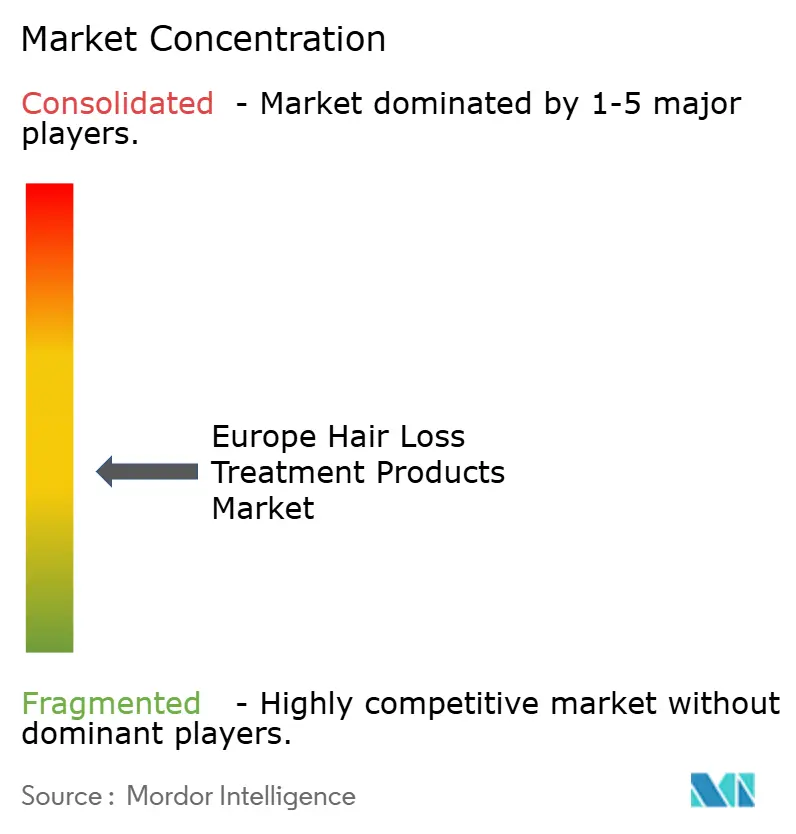
The European hair loss treatment products market demonstrates a moderately concentrated competitive landscape, with a score of 4 indicating balanced dynamics. This market features a mix of established pharmaceutical and consumer goods companies competing alongside emerging biotechnology firms and specialized device manufacturers. The competitive environment is shaped by the presence of key players who leverage their extensive resources and expertise to maintain their market positions while facing challenges from new entrants and evolving consumer preferences. Additionally, the market is influenced by increasing consumer awareness regarding hair loss treatments, which has led to a surge in demand for innovative and effective solutions.
Major players such as Procter & Gamble, L'Oréal, Henkel, and Unilever dominate the market by utilizing their expansive distribution networks and significant investments in research and development. These companies focus on developing innovative products and expanding their product portfolios to cater to a diverse consumer base. Their strong brand recognition and global presence provide them with a competitive edge, enabling them to capture a substantial share of the market. However, these established players must continuously adapt to changing regulatory frameworks and consumer demands to sustain their growth. Furthermore, partnerships and collaborations with dermatologists and trichologists are becoming a key strategy for these companies to enhance product credibility and reach.
Despite the dominance of these major companies, the market is witnessing increasing competition from smaller biotechnology firms and specialized device manufacturers. These emerging players are introducing advanced technologies and alternative treatment modalities, which are gaining traction among consumers seeking effective and non-invasive solutions. Additionally, regulatory scrutiny of traditional treatments is driving innovation, as companies strive to develop safer and more efficient products. The growing trend of e-commerce and direct-to-consumer sales channels is also enabling smaller players to compete more effectively by reaching a broader audience and reducing dependency on traditional retail networks. This dynamic environment fosters a competitive yet evolving market landscape in the European hair loss treatment products sector.
Europe Hair Loss Treatment Products Industry Leaders
-
Natura & Co.
-
Procter & Gamble Company
-
Henkel AG & Co., KGaA
-
Unilever PLC
-
L'Oréal SA
- *Disclaimer: Major Players sorted in no particular order

Market Opportunities and Future Outlook
Regulatory tightening and claim scrutiny in 2026 create room for brands that can keep hair-loss messaging conservative and compliant while backing it with stronger testing packages, particularly in leave-on formats where efficacy claims are central to differentiation. Commission Regulation (EU) No 655/2013 pushes manufacturers toward more rigorous evidence for statements such as reduced hair fall, improved density, and scalp performance, while the 2026 ingredient restriction updates (including Regulation (EU) 2026/78 and Regulation (EU) 2026/909) increase the need for reformulation capability, alternative preservative systems, and faster label updates across Europe.
Premium routine-based scalp care is also moving beyond traditional wash-off anti-hair fall products, which aligns with the report's emphasis on serums and targeted scalp treatments. Company activity supports this shift: in March 2026, Procter & Gamble started retail availability of Pantene Pro-V Grow Abundant in Germany with a scalp serum alongside wash products, and in February 2026 it rolled out Head & Shoulders upgraded collections with tailored formulas by scalp and hair type, reinforcing segmentation-led innovation. On the medical side, a positive CHMP opinion reported in June 2026 for AbbVies upadacitinib (RINVOQ) in severe alopecia areata highlights continued pipeline attention for clinically managed hair loss conditions, while also underlining the need for clear boundaries between cosmetic and medicinal-claim categories in Europe.
Recent Industry Developments
- April 2026: Henkel completed the acquisition of the North American haircare brand Not Your Mother’s within its Consumer Brands division. The acquisition expands Henkel’s haircare portfolio and adds brand platforms that can be adapted to European demand for scalp-focused and hair-thinning adjacent regimens.
- March 2026: Procter & Gamble commenced retail availability of the Pantene Pro-V Grow Abundant collection in Germany, featuring a scalp serum alongside shampoo, conditioner, and mask positioned around hair loss reduction. The launch extends mass-market access to multi-step routines and increases competitive pressure in the dominant shampoo and conditioner aisle by adding higher-value leave-on components.
- July 2024: Kintor Pharmaceutical launched a topical cosmetic product featuring its proprietary KX-826 after securing INCI approval for the ingredient. This added cosmetically positioned, active-led options for consumers looking for alternatives to traditional anti-hair fall offerings.


Research Methodology Framework and Report Scope
Market Definition and Coverage
This market covers retail and pharmacy sold hair loss treatment products used by consumers in Europe that are positioned to reduce hair fall, support regrowth, or manage thinning hair, and the sizing is done in value terms in USD.
Scope exclusions: We exclude clinic delivered hair restoration procedures and prescription only medicines that are not sold as consumer products.
Segmentation Overview
-
By Product Type
- Shampoos and Conditioners
- Serums
- Others
-
By Gender
- Male
- Female
-
By Category
- Topical
- Oral
-
By Distribution Channel
- Supermarkets/Hypermarkets
- Health and Beauty Stores
- Online Retail Stores
- Other Distribution Channels
-
By Geography
- Germany
- United Kingdom
- Italy
- France
- Spain
- Netherlands
- Poland
- Belgium
- Sweden
- Rest of Europe
Data Sources, Market Sizing, and Validation
Desk Research
Desk work starts with mapping the demand pool and the selling environment for hair loss treatment products across Europe, and then aligning it to what is consistently reported in public data. We used sources such as Eurostat household spend indicators, UN Comtrade trade statistics for relevant product movements, the European Medicines Agency public databases for treatment context, and consumer safety and ingredient references from the European Commission.
To make the model practical, we also reviewed company annual reports, investor decks, and earnings transcripts to understand how hair loss products sit within wider hair care portfolios, and how pricing and channel mix are described. Patent databases were checked to sense new actives and device style claims that can change category value over time, and an import and export shipment level database was used selectively to sanity check trade based signals where public series was thin. The source list here is illustrative, and we relied on additional public and paid references to collect, cross check, and clarify data points.
Primary Interviews and Surveys
Primary work focused on interviews and structured questionnaires with brand side teams, distributors and channel specialists, and pharmacy and retail stakeholders who see pricing and promotion changes early. We used these inputs to validate category boundaries for shampoos and conditioners, oils, and serums, and to pressure test assumptions on online share growth, pharmacy stocking behavior, and country level demand differences across major European markets.
Distribution of primary research fieldwork respondents
| Company type | Respondent position |
|---|---|
| Top tier: 28% | CXOs: 14% |
| Mid tier: 55% | Functional/Unit leaders: 28% |
| Smaller Players: 17% | Managers: 58% |
Market-Sizing & Forecasting
Our sizing starts from a top-down demand pool build for Europe hair loss treatment products, where category level hair care spending, retail channel splits, and product availability are used to reconstruct the addressable value before it is distributed across countries. After that, we run selective bottom-up checks, including sampled price per unit by format, channel checks in pharmacies and online retail, and a supplier and brand presence roll up to ensure the totals remain realistic.
A few inputs materially shape the model, including the mix shift between shampoos and conditioners versus serums and oils, the share of pharmacy sales versus mass retail and online, typical pack sizes and price bands across key countries, and how promotional intensity changes by season and channel. Where product definition or labeling differs by country, we handle gaps by using a consistent claim based boundary and then applying adjustment factors validated through expert calls.
For forecasting, we apply scenario analysis supported by simple regression style relationships between hair care spend, e-commerce growth, and price inflation, and then refine outputs using what interviewees expect on category expansion and shelf space changes. The final forecast path is kept steady and explainable, so each assumption can be traced back to a measurable signal and then reviewed.
Data Validation & Update Cycle
Validation is done through multiple checks so the model does not drift away from real market signals. Outputs are compared against independent indicators such as trade trends for relevant product groups, shifts in pharmacy and online retail channel performance, and the direction of pricing reflected in public statements and store observations.
If a country or channel shows an unusual jump, we re-check the input series, confirm currency conversion timing, and re-contact a small set of respondents to understand whether a one-time event is driving the change. Before sign-off, the work is reviewed in steps by another analyst, and the report is refreshed annually with interim updates when major regulatory, pricing, or distribution events occur. Right before delivery, we do a final data pass so clients receive the latest updated view.
Mordor Intelligence's Europe Hair Loss Treatment Products Market Estimate Compared With Other Published Estimates
Published market sizes for Europe hair loss treatment products can vary even when the topic name looks the same, since the product boundary, country coverage, and channel treatment are not always consistent. Differences also show up when one estimate leans more on manufacturer side signals, while another leans more on retail and consumer spending indicators.
By tracking claim based product eligibility and refreshing country level channel splits, Mordor Intelligence keeps the size tied to consumer sold shampoos and conditioners, oils, and serums, instead of mixing in clinical procedures or broad alopecia treatment values. Some publishers also use different base years, apply faster price escalation, or convert currencies at different points in time, which can widen the spread even when growth rates look similar.
Benchmark comparison
| Source | Market Size | Gaps in Research Methodology |
|---|---|---|
| Mordor Intelligence | USD 0.84 B (2025) | |
| Regional Consultancy A | USD 0.64 B (2025) | Uses a narrower counted basket and appears to underweight pharmacy led sales, which can reduce the value captured in higher priced treatment formats across large countries. |
| Industry Publisher B | USD 0.19 B (2024) | Works off an earlier base year and a tighter product list centered on core hair care formats, which can exclude parts of the treatment oriented assortment and delay the impact of online channel expansion. |
The table shows that scope and timing explain most of the gap, more than any single growth assumption. When the counted products are clearly defined and the channel mix is updated with practical checks, the resulting market size becomes easier to replicate and compare across countries and years.


Key Questions Answered in the Report
What is the current value of the Europe hair loss treatment products market?
The market is valued at USD 0.9 billion in 2026.
How fast is the market expected to grow?
It is projected to record a 6.62% CAGR, reaching USD 1.23 billion by 2031.
Which product type is expanding the quickest?
Serums lead growth with a 6.92% CAGR as consumers seek concentrated, leave-on solutions.
Why is Spain growing faster than other countries?
Spain combines the continent’s highest male baldness prevalence with rising per-capita beauty spending, driving a 7.05% CAGR.
How are online channels influencing sales?
E-commerce delivers discretion, subscription convenience and influencer discovery, growing at a 6.88% CAGR across the region.
Page last updated on:


 Your data is secure and never sold or shared.


