
Market Overview
| Study Period | 2021 - 2031 |
|---|---|
| Forecast Data Period | 2026 - 2031 |
| Base Year Market Size (2025) | USD 3.17 Billion |
| Market Size (2026) | USD 3.28 Billion |
| Market Size (2031) | USD 3.91 Billion |
| Growth Rate (2026 - 2031) | 3.57 % |
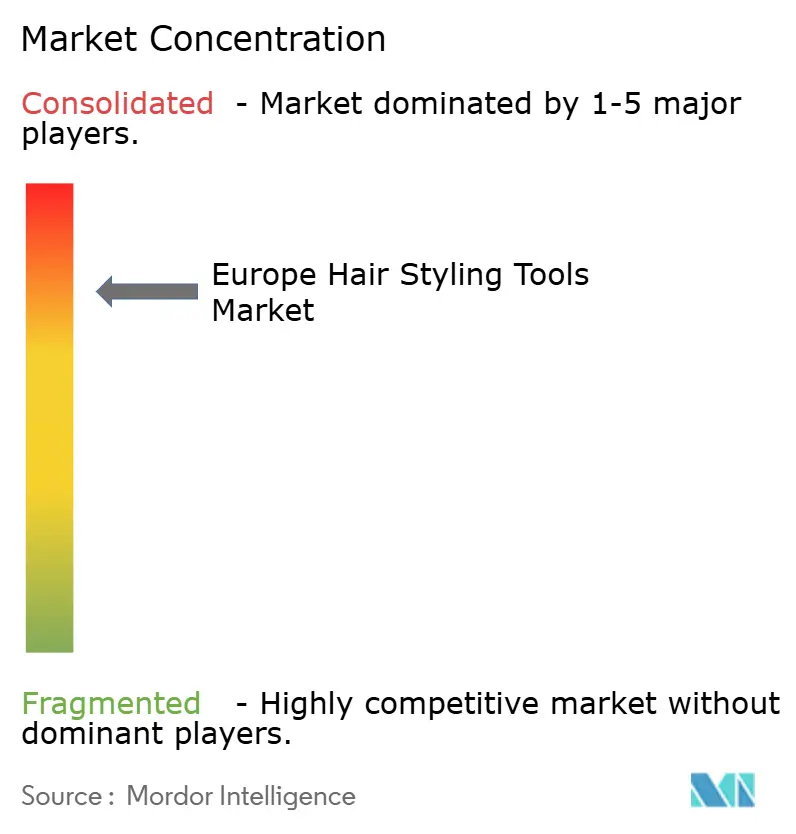
| Market Concentration | High |
Major Players
*Disclaimer: Major Players sorted in no particular order Image © Mordor Intelligence. Reuse requires attribution under CC BY 4.0. |
|
Europe Hair Styling Tools Market Analysis by Mordor Intelligence
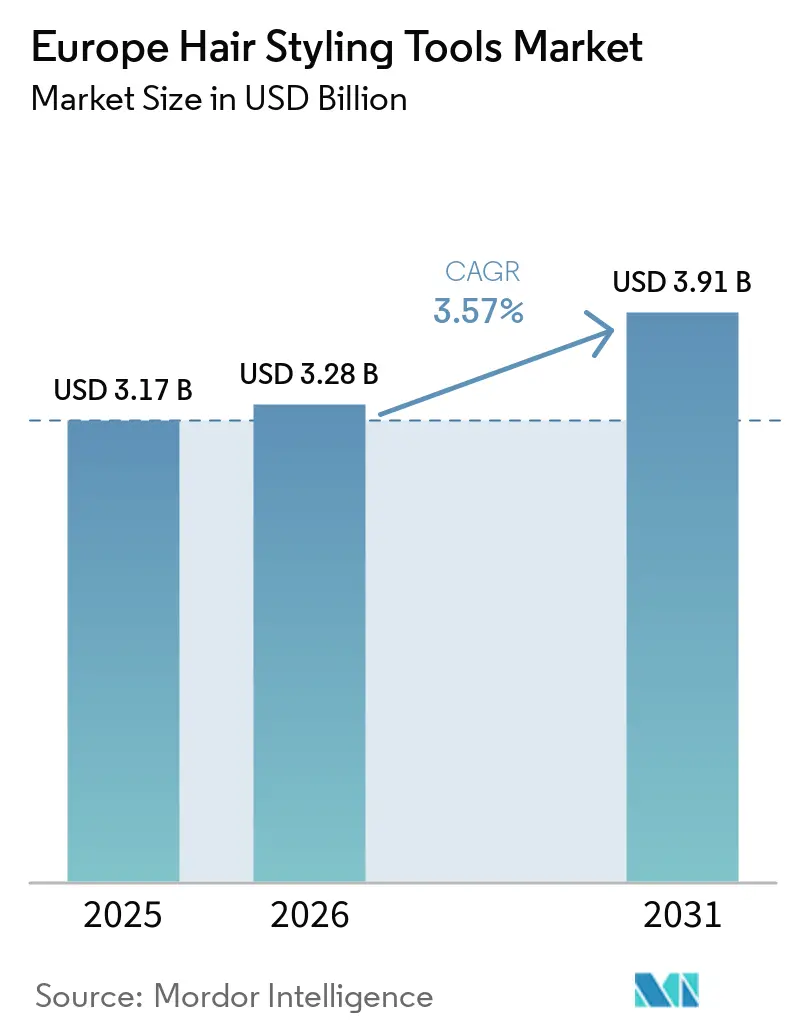
The European hair styling tools market size was valued at USD 3.17 billion in 2025 and estimated to grow from USD 3.28 billion in 2026 to reach USD 3.91 billion by 2031, at a CAGR of 3.57% during the forecast period (2026-2031). This growth is driven by advancements in cordless technology, the rising trend of premiumization, and an increasing preference among consumers to achieve salon-quality results at home. Cordless devices, in particular, are gaining traction among mobile European consumers due to their portability, compact design, and rechargeable features. Additionally, the growing influence of social media is significantly shaping the market, with beauty content enhancing brand visibility and driving purchase intent, especially among younger men, who are contributing to the expansion of the male grooming segment. While specialty retailers continue to attract consumers seeking tactile product demonstrations, digital channels are experiencing the fastest growth. This shift is attributed to the solidification of online purchasing habits that emerged during the pandemic, which have now become a permanent aspect of consumer behavior.
Key Report Takeaways
- By product type, corded devices led with 67.05% of the European hair styling tools market share in 2025, while cordless tools are projected to advance at a 3.68% CAGR through 2031.
- By equipment type, hair straighteners accounted for 79.84% of the European hair styling tools market size in 2025; hair styling brushes and combs are set to grow the quickest at a 3.78% CAGR to 2031.
- By end users, women held 67.92% revenue share in 2025, whereas the men’s segment is forecast to expand at a 4.12% CAGR during 2026-2031.
- By distribution channel, specialty stores captured 48.97% share of the European hair styling tools market in 2025; online retail stores show the highest projected CAGR at 4.55% through 2031.
- By geography, the United Kingdom commanded 23.44% of Europe's hair styling tools market share in 2025; Spain is poised for the fastest growth at a 5.08% CAGR to 2031.
Note: Market size and forecast figures in this report are generated using Mordor Intelligence’s proprietary estimation framework, updated with the latest available data and insights as of 2026.
Europe Hair Styling Tools Market Trends and Insights
Drivers Impact Analysis*
| Driver | (~) % Impact on CAGR Forecast | Geographic Relevance | Impact Timeline |
|---|---|---|---|
| Rising popularity of cordless rechargeable styling tools among European travellers | +0.8% | Western Europe, Nordic countries | Medium term (2-4 years) |
| Strong emphasis on self-grooming | +1.2% | Global, with concentration in United Kingdom, Germany, France | Long term (≥ 4 years) |
| Technological advancements in product design | +0.9% | Global, led by innovation hubs in United Kingdom, Germany | Long term (≥ 4 years) |
| Influence of social media platform and celebrity endorsement | +0.7% | Global, particularly strong in United Kingdom, Spain, Italy | Short term (≤ 2 years) |
| Expansion of professional salon services | +0.4% | Urban centers across Europe | Medium term (2-4 years) |
| Evolving fashion trends | +0.3% | Fashion capitals: Paris, Milan, London | Short term (≤ 2 years) |
| Source: Mordor Intelligence | |||
Rising popularity of cordless rechargeable styling tools among European travellers
European consumers are adopting portable hair styling tools that combine convenience, efficiency, and professional-quality results for home and travel use. This market shift stems from the increased implementation of cordless and rechargeable technologies, which accommodate modern work patterns, hybrid work environments, and business travel requirements. Compact, lightweight designs address the needs of European consumers, particularly in urban markets where storage space is constrained. The implementation of fast-charging lithium-ion batteries, dual-voltage compatibility, and heat-resistant travel cases has improved the functionality and dependability of portable devices. Manufacturers have implemented features including adjustable temperature settings, automatic shut-off mechanisms, and ergonomic designs to enhance safety and operational efficiency. Dyson's Corrale™ cordless hair straightener demonstrates this market development, providing flexible plates that reduce hair damage while enabling cordless operation across multiple environments. The market indicates a substantial demand for versatile, mens grooming products in Europe that maintain performance standards. Furthermore, manufacturers are incorporating energy-efficient components and sustainable materials to meet environmental requirements in the European market.
Strong emphasis on self-grooming
The European beauty market is experiencing a significant transformation, with personal grooming emerging as a key aspect of self-expression and professional image. This trend is transcending traditional gender boundaries, as men's grooming routines become increasingly sophisticated and reliant on advanced tools and products. This evolution reflects broader cultural shifts toward individualism and the growing importance of personal branding, particularly among younger demographics who view grooming as essential for enhancing both social and professional opportunities. Furthermore, the demand for premium grooming tools is on the rise, as European consumers prioritize products that deliver salon-quality results at home. The market demonstrates a notable transition toward at-home beauty solutions, primarily attributed to operational cost advantages and increased consumer accessibility compared to traditional salon services.
Technological advancements in product design
The hair styling tools market exhibits shortened innovation cycles as manufacturers implement advanced materials, sensor technology, and digital intelligence to address evolving consumer requirements. Companies prioritize the combination of performance metrics with energy efficiency, safety features, and customization capabilities in their product development strategies. L'Oréal's AirLight Pro demonstrates this approach, implementing infrared light technology to reduce drying time while decreasing energy consumption by 31%. Moreover, the industry's strategic shift toward intelligent, sustainable solutions indicates a transition to connected devices that align with contemporary requirements while addressing environmental considerations. Market competitiveness now depends on manufacturers' capabilities to develop technologically advanced, customized products that fulfill consumer requirements for efficiency, performance, and environmental compliance.
Influence of social media platform and celebrity endorsement
European consumers are increasingly turning to digital platforms to discover, evaluate, and purchase hair styling tools, with influencer-driven content playing a pivotal role in shaping demand. This content creates viral demand patterns that traditional marketing struggles to replicate. Social media tutorials have democratized beauty expertise, allowing consumers to master intricate styling techniques at home. As a result, demand for professional-grade tools, once exclusive to salon professionals, has surged. For instance, brands such as Dyson and ghd establish strategic partnerships with professional stylists during fashion weeks and develop co-branded tools with influencers. These collaborations utilize Europe's beauty community to generate product validation and consumer recommendations, targeting customers who require professional-quality styling tools for residential use. The trend influences younger Europeans, particularly millennials and Gen Z, who demonstrate higher engagement with authentic content and peer recommendations compared to traditional advertising. The UK's Office for National Statistics reported 14.69 million millennials in the UK in 2023, indicating this demographic's substantial market potential [1]Source: Office for National Statistics (UK), "Estimated population of Millennials in the United Kingdom in 2023, by single year of age and gender", ons.gov.uk . This digital-native consumer segment drives purchases of hair styling tools featured in social media content, including product collaborations and styling demonstrations. Companies that establish consumer connections through content creators increase their market share in Europe's competitive hair styling tools market.
Restraints Impact Analysis*
| Restraint | (~) % Impact on CAGR Forecast | Geographic Relevance | Impact Timeline |
|---|---|---|---|
| Increasing preference for long-term styling treatments | -0.6% | European Union, particularly strong in Germany, France | Long term (≥ 4 years) |
| Proliferation of counterfeit products | -0.4% | European Union-wide, concentrated in online channels | Medium term (2-4 years) |
| Health risks from chemical treatments | -0.3% | European Union, regulatory focus in Nordic countries | Long term (≥ 4 years) |
| Lack of product standardization | -0.2% | European Union-wide, affecting cross-border trade | Medium term (2-4 years) |
| Source: Mordor Intelligence | |||
Increasing preference for long-term styling treatments
European consumers are increasingly transitioning toward semi-permanent and permanent styling solutions, which are significantly impacting the demand for traditional styling tools. Professional salon treatments, such as keratin smoothing, chemical straightening, and long-lasting wave formations, are becoming more popular due to their ability to deliver convenience, durability, and reduced daily maintenance. These treatments cater to time-conscious consumers who prioritize efficiency and are willing to invest in salon services for long-term benefits. Thus, the hair straightener market segment experiences significant competitive pressure from professional salon treatments offering equivalent results with minimal consumer effort. This market dynamic reflects a fundamental shift in European consumer behavior, where the demand for efficient personal care solutions continues to rise, driven by the increasing value placed on time management and simplified grooming procedures.
Proliferation of counterfeit products
Counterfeit products significantly impact Europe's hair styling tools market, particularly affecting premium brands that focus on advanced technology and safety standards. Counterfeit straighteners, dryers, and curlers that do not meet quality and safety regulations reduce consumer confidence and affect brand value. Manufacturers are implementing anti-counterfeit measures, security packaging protocols, and consumer education initiatives to protect their market share and brand integrity. Furthermore, counterfeit products not only diminish brand value but also present serious safety hazards, further eroding consumer trust in the sector. In response to these challenges, the UK's Office for Product Safety and Standards has strengthened its enforcement efforts. Recent recalls of unsafe hair styling tools sold via online platforms highlight the ongoing risks associated with counterfeit goods [2]Source: Government of United Kingdom, "Product Safety Report: Loof Hair Extension Iron sold via Amazon (2501-0067)", gov.uk . The rise of e-commerce has further complicated the issue, as online platforms often lack the necessary tools and resources to effectively monitor and prevent counterfeit sales. This persistent challenge disrupts the market, emphasizing the urgent need for enhanced regulatory frameworks, advanced technological solutions, and stronger collaboration between industry stakeholders to combat counterfeiting effectively.
*Our forecasts treat driver/restraint impacts as directional, not additive. The impact forecasts reflect baseline growth, mix effects, and variable interactions.
Segment Analysis
By Equipment Type: Straighteners Lead While Brushes Surge
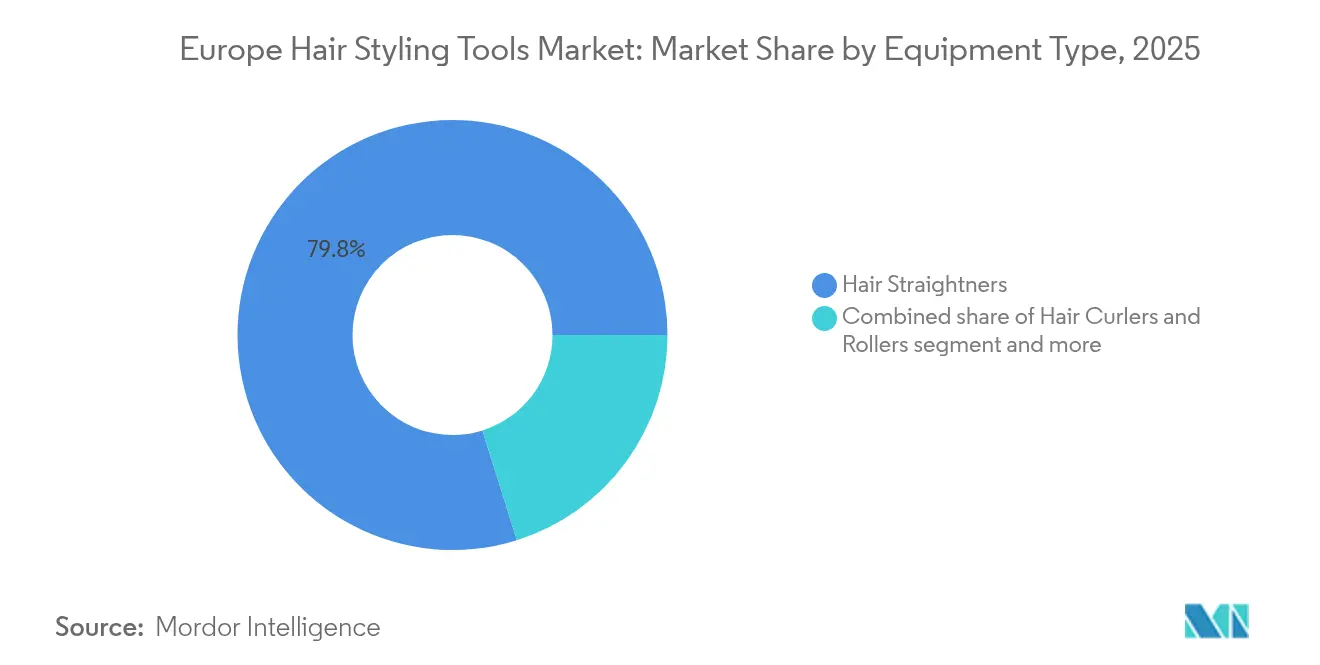
In 2025, hair straighteners dominate the market with an 79.84% share, reflecting European consumers' strong preference for sleek and professional styling that aligns with contemporary beauty standards. This segment's leadership is driven by its versatility, as straighteners are not only used for straightening but also for creating waves and curls, making them essential tools in daily grooming routines. The premium segment experiences significant growth due to the adoption of professional-grade straighteners featuring advanced plate technologies and precise temperature control systems. These innovations cater to consumers' increasing willingness to invest in high-quality tools that deliver salon-like results at home.
Hair styling brushes and combs represent the fastest-growing segment, with a projected CAGR of 3.78% through 2031. This growth highlights a shift in consumer preferences toward gentler styling methods that reduce heat damage and promote hair health. A notable example is Tangle Teezer's sustainability initiative, which saw the sale of 385,000 Plant Brushes in 2024, made from 85% sustainably sourced castor beans. This demonstrates how environmental consciousness is driving innovation within the segment. The rising awareness of heat damage risks and the growing popularity of natural styling techniques that preserve hair integrity further fuel this segment's expansion. Additionally, hair dryers and curlers maintain consistent demand, serving as complementary tools that enhance comprehensive styling routines.



By Product Type: Corded Dominance Faces Cordless Challenge
In 2025, corded hair styling tools dominate the market with a 67.05% share, attributed to their established performance reliability and cost-effectiveness, which appeal to budget-conscious European consumers. Professional salons continue to rely on corded tools for their consistent power output and unlimited usage time, ensuring a stable demand that sustains their market leadership. Despite this dominance, advancements in battery technology and motor efficiency are steadily narrowing the performance gap, making cordless alternatives increasingly viable for both professional and personal use. Additionally, the durability and lower maintenance requirements of corded tools further contribute to their sustained preference in the market.
Cordless hair styling tools, on the other hand, are emerging as the fastest-growing segment, with a projected CAGR of 3.68% through 2031. This growth is driven by the increasing mobility needs of European consumers and significant improvements in battery performance and efficiency. For example, Panasonic's launch of its new nanocare hair dryers in October 2024 demonstrates how manufacturers are addressing traditional cordless limitations. These dryers offer enhanced portability while incorporating advanced moisture-retention technology, catering to consumer demands for convenience without compromising functionality. The segment's growth is further bolstered by evolving European travel patterns and urban lifestyle preferences, which prioritize compact, space-efficient, and easy-to-use personal care solutions, positioning cordless tools as a compelling alternative in the market.
By End Users: Women Dominate While Men Accelerate
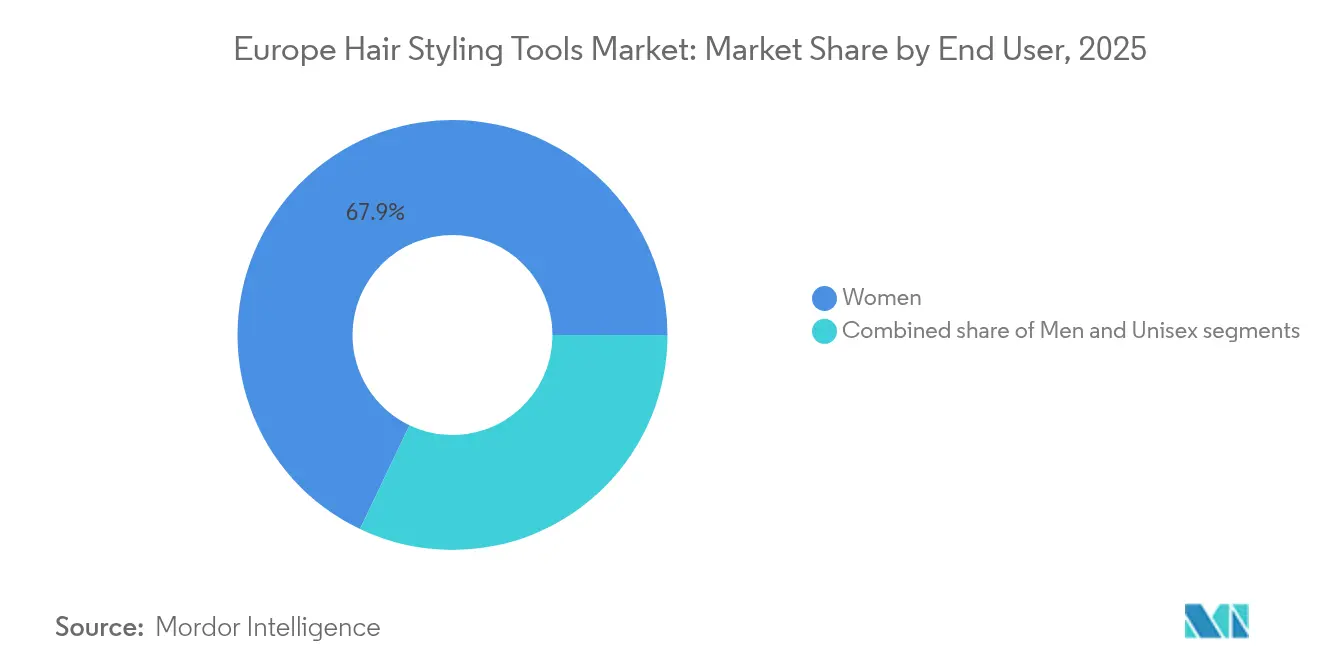
In 2025, women account for a dominant 67.92% share of the market, driven by the continued prevalence of traditional beauty routines and the frequent use of styling tools across European demographics. This segment's stability is underpinned by well-established grooming habits and societal norms that prioritize appearance as a critical aspect of professional and personal presentation. The strong preference for premium products among female consumers reflects their readiness to invest in advanced technologies that deliver superior styling results while minimizing hair damage. Additionally, the growing availability of innovative products tailored to women's specific needs further strengthens this segment's position in the market.
The men's grooming segment is the fastest-growing category, with a projected CAGR of 4.12% through 2031. This growth is fueled by shifting grooming standards and the increasing influence of social media, which has amplified male beauty awareness and encouraged the adoption of grooming routines. Changing perceptions of masculinity have made self-care and appearance management widely accepted among men, marking a significant cultural shift. Furthermore, professional grooming requirements in European business environments are prompting men to embrace more sophisticated styling practices, which were traditionally associated with women. The rising demand for unisex products also plays a crucial role in this growth, offering versatile and inclusive solutions that cater to diverse consumer needs and preferences within households.
By Distribution Channel: Specialty Stores Lead Online Growth
In 2025, specialty stores maintain a dominant 48.97% market share, driven by their ability to provide expert consultations and hands-on product demonstrations. These services are instrumental in building consumer trust, particularly for premium and high-value purchases. Specialty stores play a critical role in educating customers about product features, benefits, and proper usage techniques, which is especially important for complex styling tools that require precision for optimal performance. Their personalized service, coupled with robust after-sales support, strengthens brand loyalty and creates a competitive edge that online channels often fail to replicate effectively. Additionally, the in-store experience fosters a sense of trust and reliability, encouraging repeat purchases and long-term customer relationships.
Online retail stores are experiencing the fastest growth, with a projected CAGR of 4.55% through 2031. This growth is primarily driven by the post-pandemic acceleration of digital shopping behaviors and the increasing adoption of direct-to-consumer strategies by brands. According to Eurostat, in 2024, 12% of EU internet users purchased consumer electronics, including hair styling tools, online within three months . Online shopping growth demonstrates European consumers' demand for convenience, competitive pricing, and product variety. E-commerce platforms facilitate product specification comparisons, customer reviews, and price optimization for hair styling tools. The market shift necessitates companies to enhance their digital presence and e-commerce strategies to capture the growing online consumer segment. The integration of social media platforms and influencer marketing further enhances the online shopping experience, creating seamless purchase pathways that convert content engagement into sales. These strategies are particularly effective in targeting younger demographics, who rely heavily on online research and peer recommendations before making purchasing decisions. Meanwhile, supermarkets, hypermarkets, and other retail channels cater to convenience-focused consumers by offering basic styling tools at accessible price points, addressing the needs of budget-conscious and time-sensitive buyers.
Geography Analysis
European market dynamics highlight distinct regional preferences and growth patterns influenced by cultural diversity, economic conditions, and varying levels of consumer sophistication. In 2025, the United Kingdom dominates with a 23.44% market share, driven by its well-established beauty culture and high disposable income levels that encourage the adoption of premium products. British consumers exhibit strong brand loyalty and a willingness to invest in advanced styling technologies, creating a stable foundation for sustained market growth. Additionally, the post-Brexit regulatory environment, while maintaining alignment with EU cosmetics standards, offers UK-based manufacturers a competitive edge by enabling them to effectively operate under both regulatory frameworks.
Germany and France, as mature markets, are characterized by consumers who prioritize quality and technological innovation in their choice of styling tools. These markets benefit from a robust retail infrastructure and deeply ingrained beauty routines, ensuring consistent demand for premium products. Italian consumers, reflecting the country’s reputation for style and design excellence, show a strong preference for fashion-forward styling solutions. Sustainability is a growing focus across these markets, as evidenced by Schwarzkopf Professional’s commitment to utilizing 100% green energy in its production facilities by 2030, aligning with consumer demand for eco-friendly products. Spain is emerging as the fastest-growing market, with a projected CAGR of 5.08% through 2031. This growth reflects broader trends in the country, where increasing beauty consciousness and the adoption of styling tools are gaining momentum. The market’s upward trajectory indicates significant untapped potential, as Spanish consumers, influenced by social media and evolving lifestyle preferences, embrace more sophisticated grooming routines. In contrast, Russia presents a complex market environment shaped by geopolitical factors that may impact the presence of international brands and their market access. These challenges create opportunities for local manufacturers to strengthen their position, while global players may face constraints. The "Rest of Europe" category encompasses emerging markets with diverse growth potential, influenced by varying levels of economic development and cultural acceptance of advanced styling technologies.
Competitive Landscape
The European hair styling tools market is dominated by a few well-established players who control both the professional and consumer segments. Companies such as Dyson Ltd., Koninklijke Philips N.V., Panasonic Holdings Corporation, and Spectrum Brands Holdings hold significant market shares. They achieve this dominance through innovative technologies, premium product positioning, and strong brand recognition. High entry barriers, including the need for advanced research and development capabilities and compliance with strict regulations, make it difficult for new competitors to enter the market, further strengthening the position of these leading players.
To strengthen their market presence, companies are increasingly adopting vertical integration strategies. This approach allows them to manage their supply chains more effectively and ensure consistent product quality. Additionally, partnerships with professional salons and collaborations with beauty influencers are becoming common strategies to boost brand visibility and credibility. Growth opportunities exist in areas such as sustainable product development, AI-powered styling tools, and specialized solutions designed for Europe’s diverse hair types, reflecting the region's multicultural demographics.
Moreover, private labels and low-cost imports from Asia increase market competition in the entry-level segment by offering cost-effective alternatives for price-sensitive consumers. Major brands counter this by strengthening their premium market position, product design, and technological features to maintain higher price points. The proliferation of counterfeit products in Europe requires manufacturers to implement fraud prevention measures and consumer awareness initiatives. Market success depends on companies optimizing innovation, quality control, sustainability, and digital strategies to serve Europe's diverse styling tool market.
Europe Hair Styling Tools Industry Leaders
-
Dyson Ltd.
-
Koninklijke Philips N.V.
-
Panasonic Holdings Corporation
-
Spectrum Brands Holdings
-
Conair Corporation
- *Disclaimer: Major Players sorted in no particular order

Recent Industry Developments
- March 2025: Dyson introduced its Supersonic r hair dryer in the United Kingdom at GBP 449. The device incorporated the company's Hyperdymium motor and featured sensors that automatically adjusted settings based on the attached accessory. The hair dryer reduced drying time while improving hair smoothness and shine, with decreased frizz.
- February 2025: Boots implemented an expansion of its premium and professional haircare range through the introduction of ghd, a leading UK hair straightener brand. The range, which became available online and in selected Boots stores, included 34 products, featuring the ghd Chronos Max hair straightener, curling wands, heat protection products, and styling tools.
- May 2024: Babyliss released the Air Wand, a 3-in-1 hair styling device that operated as a hairdryer, straightener, and volumizing styler in a 385-gram unit. The product incorporated a digital motor that generated 123 km/h airspeed, ceramic plates for straightening, and an oval brush for volumizing. The device performed drying, straightening, and styling for multiple hair types.


Europe Hair Styling Tools Market Report Scope
Hair styling products are cosmetic substances used to enhance, modify, or hold a hairstyle in place. They come in various forms like sprays, gels, waxes, and pomades, each with unique properties to achieve specific styling effects like shine, volume, hold, or definition. The Europe hair styling products market is segmented by product type, ingredient, end user, distribution channel and country. Based on product type, the market is segmented into creams, gels and wax, sprays and mousse and others. Based on ingredient, the market is segmented into natural/organic and conventional. Based on end user, the market is segmented into male and female. Based on distribution channel, the market is segmented into supermarkets/hypermarkets, speciality stores, online retail stores and others. Based on country, the market is segmented into Germany, United Kingdom, Italy, Spain, France, Russia and Rest of Europe. The Report Offers Market Size and Values (in USD Million) for the Above Segments.
By Product Type
| Corded |
| Cordless |
By Equipment Type
| Hair Dryers |
| Hair Curlers and Rollers |
| Hair Straighteners |
| Hair Styling Brushes and Combs |
| Others |
By End Users
| Men |
| Women |
| Unisex |
By Distribution Channel
| Specialty Stores |
| Supermarkets/Hypermarkets |
| Online Retail Stores |
| Other Channels |
By Geography
| Germany |
| United Kingdom |
| Italy |
| Spain |
| France |
| Netherlands |
| Poland |
| Belgium |
| Sweden |
| Rest of Europe |
| By Product Type | Corded |
| Cordless | |
| By Equipment Type | Hair Dryers |
| Hair Curlers and Rollers | |
| Hair Straighteners | |
| Hair Styling Brushes and Combs | |
| Others | |
| By End Users | Men |
| Women | |
| Unisex | |
| By Distribution Channel | Specialty Stores |
| Supermarkets/Hypermarkets | |
| Online Retail Stores | |
| Other Channels | |
| By Geography | Germany |
| United Kingdom | |
| Italy | |
| Spain | |
| France | |
| Netherlands | |
| Poland | |
| Belgium | |
| Sweden | |
| Rest of Europe |


Key Questions Answered in the Report
What is the current size of the Europe hair styling tools market?
The Europe hair styling tools market is valued at USD 3.28 billion in 2026 and is projected to reach USD 3.91 billion by 2031.
Which product segment holds the largest share in Europe?
Hair straighteners commanded 79.84% of Europe hair styling tools market share in 2025, reflecting a strong consumer preference for sleek styling outcomes.
How fast is the cordless segment growing?
Cordless devices are expected to grow at a 3.68% CAGR through 2031 as battery technology and portability gains drive adoption among mobile consumers.
Which European country offers the highest growth potential?
Spain leads growth prospects with a 5.08% CAGR forecast between 2026 and 2031, supported by rising beauty awareness and disposable income.
Page last updated on:





