
Market Overview
| Study Period | 2021 - 2031 |
|---|---|
| Forecast Data Period | 2026 - 2031 |
| Base Year Market Size (2025) | USD 2.05 Billion |
| Market Size (2026) | USD 2.13 Billion |
| Market Size (2031) | USD 2.76 Billion |
| Growth Rate (2026 - 2031) | 5.33 % |
| Market Concentration | Medium |
Major Players *Disclaimer: Major Players sorted in no particular order Image © Mordor Intelligence. Reuse requires attribution under CC BY 4.0. | |
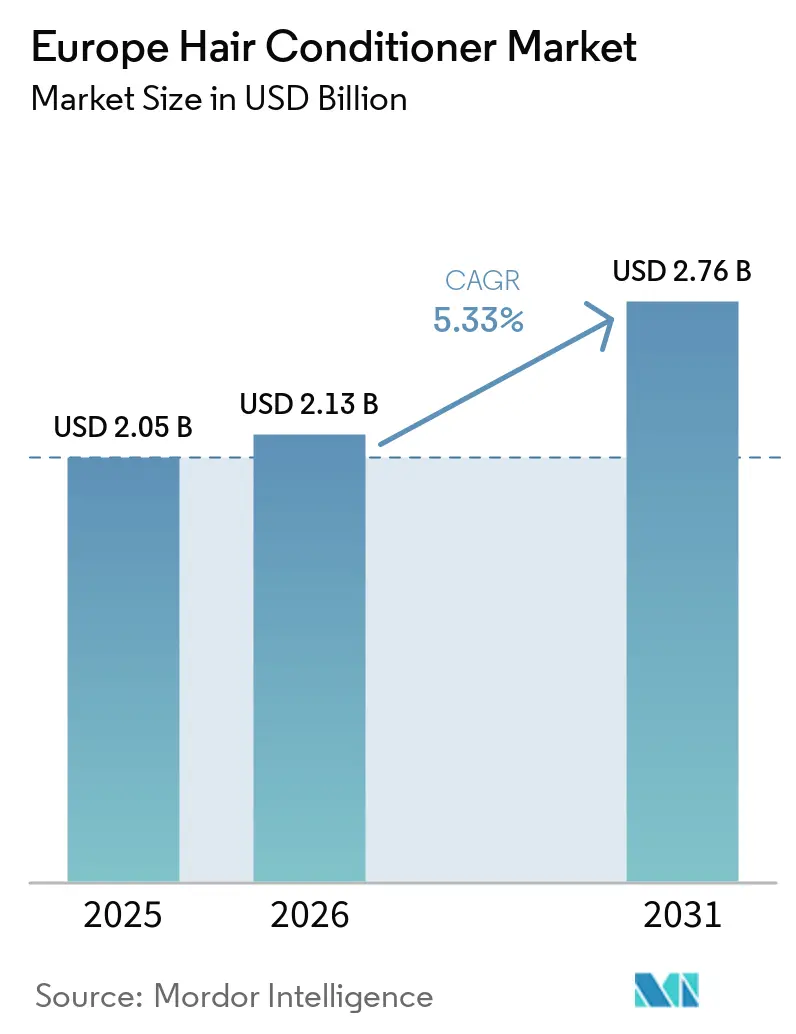
Europe Hair Conditioner Market Analysis by Mordor Intelligence
The Europe hair conditioners market size is valued at USD 2.13 billion in 2026, up from USD 2.05 billion in 2025, and is forecast to reach USD 2.76 billion by 2031, growing at a CAGR of 5.33% over 2026-2031. The Europe hair conditioners market is supported by consumers treating conditioning as a performance step within hair care rather than as a basic finishing product. Ingredient transparency, clinical performance claims, and premium product positioning are reshaping product development and retail communication across the region. Germany enters the forecast period with solid personal care demand, as hair care was the highest-revenue category in the country during 2024 and recorded 6% growth. The Europe hair conditioners market also faces shorter reformulation cycles as brands respond to cosmetics rules and consumer scrutiny of ingredients. These conditions favor companies that can substantiate efficacy, manage compliance, and offer differentiated formats through both retail and professional channels.
Key Report Takeaways
- By product type, rinse-out conditioners held 56.33% of the regional conditioner category share in 2025, while leave-in conditioners are forecast to grow at a 6.78% CAGR through 2031.
- By form, conventional conditioners held a 44.51% share in 2025, while natural and organic conditioners are forecast to grow at a 6.57% CAGR through 2031.
- By category, mass conditioners held a 78.22% share in 2025, while premium conditioners are forecast to grow at a 7.23% CAGR through 2031.
- By end user, adults held a 66.43% share in 2025, while the kids segment is forecast to grow at a 6.83% CAGR through 2031.
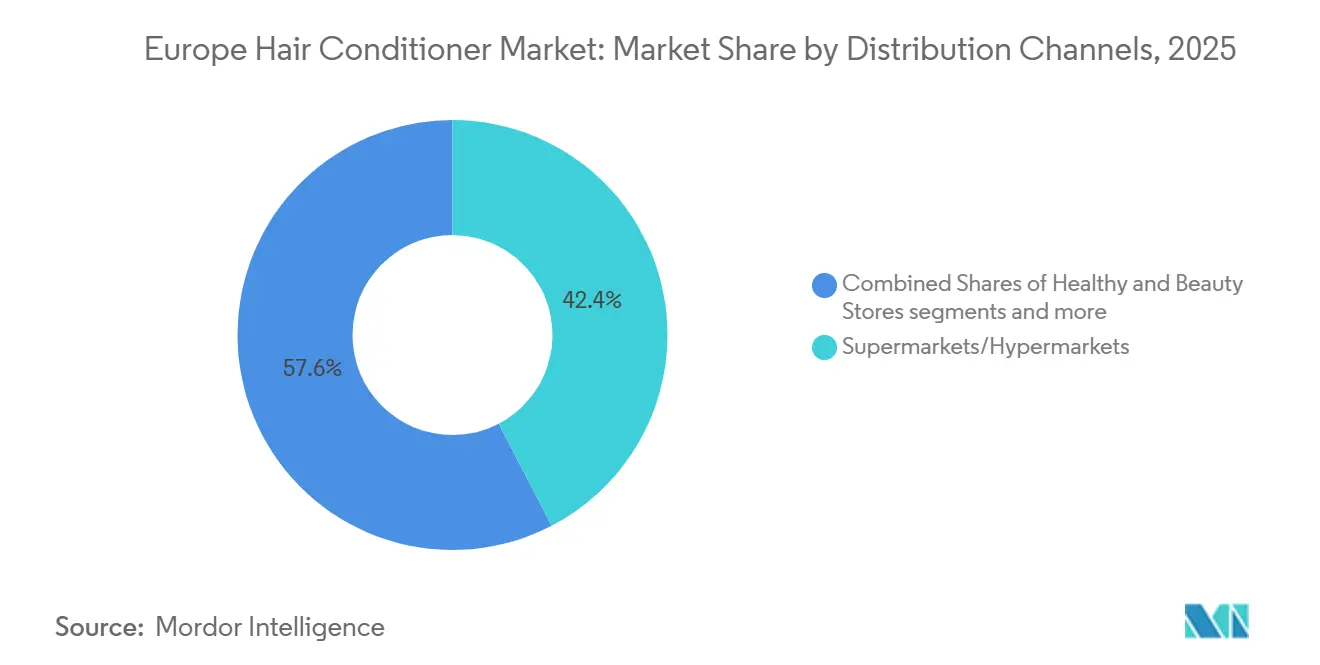
- By distribution channel, supermarkets and hypermarkets held a 42.36% share in 2025, while online retail is forecast to grow at a 6.67% CAGR through 2031.
- By geography, Germany held 25.48% share in 2025, while Poland is forecast to grow at a 6.13% CAGR through 2031.
Note: Market size and forecast figures in this report are generated using Mordor Intelligence’s proprietary estimation framework, updated with the latest available data and insights as of January 2026.
Europe Hair Conditioner Market Trends and Insights
Drivers Impact Analysis*
| Driver | (~) % Impact on CAGR Forecasts | Geographic Relevance | Impact Timeline |
|---|---|---|---|
| Consumer focus on hair care and personal grooming | +1.2% | Global, concentrated in Germany, United Kingdom, and France | Short term (≤ 2 years) |
| Demand for hair-type and concern-specific conditioners | +0.9% | Global, with early adoption in the United Kingdom, Germany, and Nordics | Medium term (2-4 years) |
| Natural, organic, and plant-based product demand | +0.8% | Western and Northern Europe, with growth in Poland and Central and Eastern Europe | Medium term (2-4 years) |
| Demand for heat and chemical damage repair products | +0.7% | Global, concentrated in the United Kingdom, Germany, France, and Italy | Short term (≤ 2 years) |
| Adoption of leave-in and multifunctional products | +0.6% | Northern and Western Europe, with acceleration in Southern and Eastern Europe | Medium term (2-4 years) |
| Preference for premium and salon-grade products | +0.5% | Germany, France, United Kingdom, and Scandinavia | Long term (≥ 4 years) |
| Source: Mordor Intelligence | |||
Growing Consumer Focus on Hair Care and Personal Grooming
The Europe hair conditioners market benefits from a change in how households view routine hair maintenance. Conditioning is increasingly presented as a product that can address damage, manage texture, and improve the appearance of hair between salon visits. This creates greater scope for a brand to discuss measurable performance instead of relying on fragrance or packaging. Dove Hair achieved double-digit growth through 2025 after the rollout of its Fibre Repair range with Bio-Protein Care technology. Unilever reported that the range is built around a patented technology and claims to make hair 10 times stronger. The Europe hair conditioners market therefore gives more value to brands that can support repeat purchase with clear product evidence. The growth supports the role of efficacy-backed communication in keeping consumers engaged after an initial purchase. In the Europe hair conditioners market, companies without tested claims may find it harder to defend price points as comparison shopping becomes more common.
Demand for Hair-Type and Concern-Specific Conditioners
The Europe hair conditioners market is becoming more specialized by hair texture, damage profile, and scalp sensitivity. Curly, color-treated, fine, and sensitive hair are increasingly addressed with distinct formulas and messages. This separation gives consumers a clearer reason to move beyond a single all-purpose conditioner. Olaplex introduced No.4FINE and No.5FINE Bond Maintenance Shampoo and Conditioner in May 2025 for fine hair, extending its bond-building platform into a lighter formula[1]. The launch illustrates how premium brands are adapting repair concepts to a more specific consumer need. The Europe hair conditioners market can consequently support broader portfolios without requiring every consumer to buy the same high-performance product. The Europe hair conditioners market is likely to reward products that communicate both fit for a hair concern and a transparent formula without making the choice unnecessarily complicated.
Natural, Organic, and Plant-Based Product Demand
Natural and organic products are becoming more relevant to the Europe hair conditioners market because consumer preferences and regulatory changes are moving in the same direction. Commission Regulation (EU) 2025/877 added substances classified as CMR category 1A or 1B to the prohibited list under the Cosmetics Regulation[2]. The regulation took effect in September 2025 and requires affected formulas to be reconsidered. This creates room for alternatives that use plant-derived actives and can document their sourcing. The change does not mean every botanical formula will deliver the same performance. It does mean that ingredient selection has become more central to product design and compliance planning. The Europe hair conditioners market gives such brands a way to make sustainability part of the product proposition rather than a separate corporate message.
Demand for Heat and Chemical Damage Repair Products
Repair products remain an important innovation area in the Europe hair conditioners market. Heat styling, chemical treatments, and color services create clear use occasions for conditioners that promise strengthening, smoothness, or reduced breakage. Mass and professional brands now compete around similar repair benefits, which reduces the distance between price tiers. Dove Intensive Repair uses Bio-Protein Care technology and brings clinical performance language into a widely accessible formula. This puts pressure on prestige brands that previously depended on exclusive technical positioning. It also gives consumers more reasons to compare proof of performance rather than only brand heritage. L'Oréal completed its acquisition of Color Wow in September 2025, strengthening its presence in professional hair care focused on frizz control and styling needs. The transaction shows the strategic value placed on specialist brands with recognizable performance claims. Repair and conditioning can be closely linked for consumers who color their hair or use high-heat tools.
Restraints Impact Analysis*
| Restraint | (~) % Impact on CAGR Forecasts | Geographic Relevance | Impact Timeline |
|---|---|---|---|
| Competition from masks, oils, serums, and alternatives | -0.6% | Global, most acute in the United Kingdom, Germany, and France | Short term (≤ 2 years) |
| Concerns about synthetic ingredients and chemical additives | -0.5% | Western and Northern Europe, particularly the United Kingdom, Germany, and Nordics | Medium term (2-4 years) |
| Risk of allergic reactions and scalp or skin irritation | -0.3% | Global | Medium term (2-4 years) |
| Stringent cosmetic ingredient and product safety regulations | -0.4% | European Union-wide, with a larger burden for small and medium enterprises | Long term (≥ 4 years) |
| Source: Mordor Intelligence | |||
Competition from Masks, Oils, Serums, and Alternatives
The Europe hair conditioners market competes with products that may appear to provide a stronger result from fewer applications. Masks, oils, serums, and bond-repair treatments all address smoothness, hydration, and damage control. This can reduce the frequency of a standard rinse-out conditioner purchase when consumers use a more intensive product instead. Olaplex launched the Rich Hydration Mask and Weightless Nourishing Mask during 2025 with biomimetic cuticle technology and claims of results lasting through 5 washes. These product propositions place a multi-day result against a routine conditioner use occasion. The competition is most visible where consumers already follow multi-step hair routines.
Concerns About Synthetic Ingredients and Chemical Additives
Ingredient concern has moved beyond social discussion into formal product and labeling requirements. Commission Regulation (EU) 2025/877 is part of the wider regulatory environment that requires companies to reassess affected ingredients and supporting documentation. Regulation (EU) 2023/1545 also expanded fragrance allergen disclosure requirements, requiring new allergens to appear on labels for relevant products placed on the EU market after July 31, 2026. These changes add packaging, labeling, and reformulation work. The burden can be especially demanding for private-label suppliers and smaller businesses with fewer internal regulatory resources. It can also delay product changes when a formula needs to be updated across several markets.
*Our forecasts treat driver/restraint impacts as directional, not additive. The impact forecasts reflect baseline growth, mix effects, and variable interactions.
Segment Analysis
By Product Type: Leave-In Formats Redefine the Conditioning Occasion
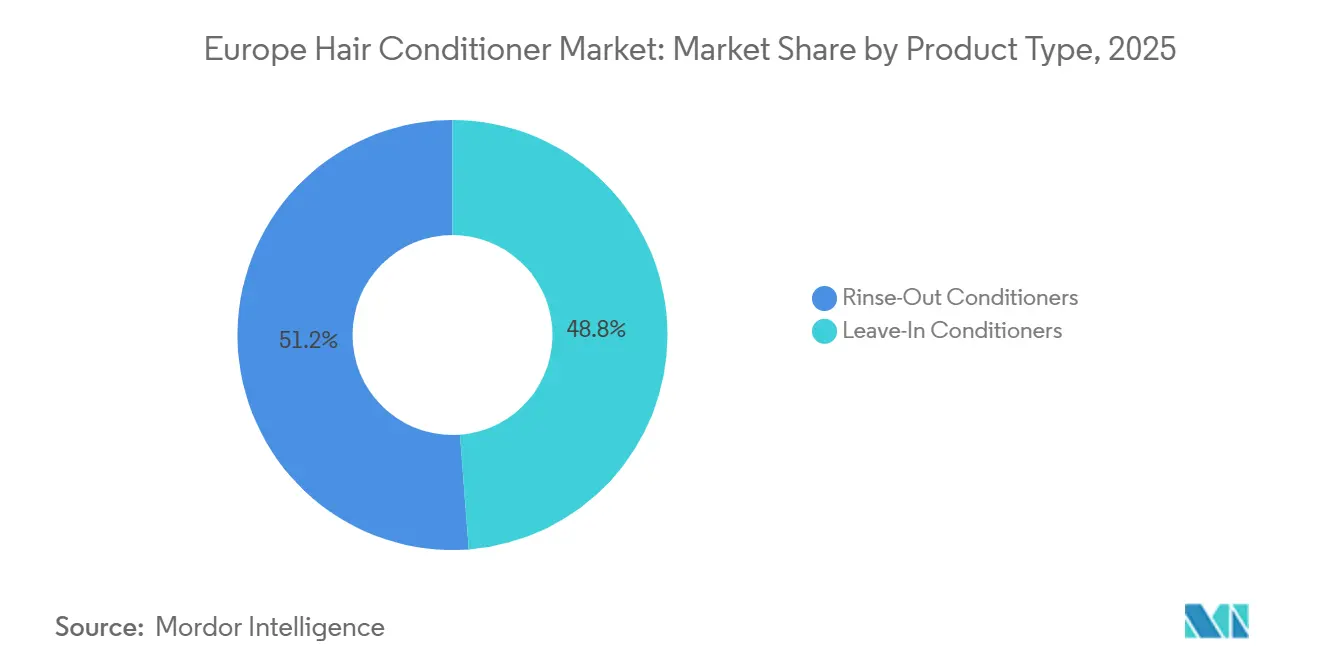
Rinse-out conditioners captured 56.33% of the Europe hair conditioners market share in 2025 because they remain embedded in common washing routines. Their broad usage supports repeat purchases across adult households and across mainstream grocery and drugstore retail. The format also benefits from private-label volume, particularly in Germany, France, and the United Kingdom. It provides a familiar product step for consumers who want uncomplicated hair care. This makes rinse-out products important for scale even when consumers explore more specialized alternatives. In the Europe hair conditioners industry, established rinse-out ranges also give companies a base for introducing new benefit claims. The segment remains central to volume, but it faces pressure to deliver more visible results. Product renovation is therefore important for brands that rely heavily on this format.
Leave-in conditioners are forecast to expand at a 6.78% CAGR through 2031, the fastest rate among product types. The format supports heat protection, frizz management, UV-related protection claims, and styling support in a single application. Wella Professionals launched Ultimate Smooth in March 2025, including a leave-in Miracle Oil Serum with a listed price of EUR 34.3 and an 85% smoother-hair claim from independent testing. The Europe hair conditioners market size for leave-in formats benefits when consumers see the product as a practical replacement for several separate steps. Its higher value proposition can support premium pricing and stronger margins. The category also gives professional brands a direct way to translate salon advice into a home-use product. Rinse-out leadership and leave-in growth can coexist because the formats serve different moments in a routine.
By Form: Natural and Organic Formulations Move into Core Ranges
Conventional conditioners held 44.51% of the Europe hair conditioners market in 2025. These products retain a strong position because they offer familiar sensory performance and accessible pricing. Large mass brands have established distribution, repeat purchase patterns, and broad consumer recognition. Their presence remains especially important in supermarkets, hypermarkets, and value-focused drugstores. Conventional formulas also provide a benchmark against which newer natural products are judged on texture, ease of use, and visible results. In the Europe hair conditioners industry, the segment will remain meaningful where shoppers prioritize dependable performance at a routine price. However, regulatory and consumer changes require suppliers to refresh formulas and improve transparency. The result is a more active competitive environment even within the established part of the category.
Natural and organic conditioners are forecast to grow at a 6.57% CAGR through 2031. Commission Regulation (EU) 2025/877 reinforces the need to reconsider some ingredient choices, which supports reformulation activity across the category. Alfaparf Milano has highlighted biodegradable formulas and packaging made from recycled aluminum within its professional portfolio. Davines uses regenerative organic certified ingredients to support an auditable supply chain and a differentiated product story. The Europe hair conditioners market size for natural and organic products is also supported by mass retail offerings that make the format accessible beyond prestige buyers. The segment can grow when brands pair natural positioning with performance consumers can notice in routine use. A natural claim alone is unlikely to be enough if the formula does not provide slip, softness, or repair support.
By Category: Premium Growth Outpaces Mass While Mass Retains Scale
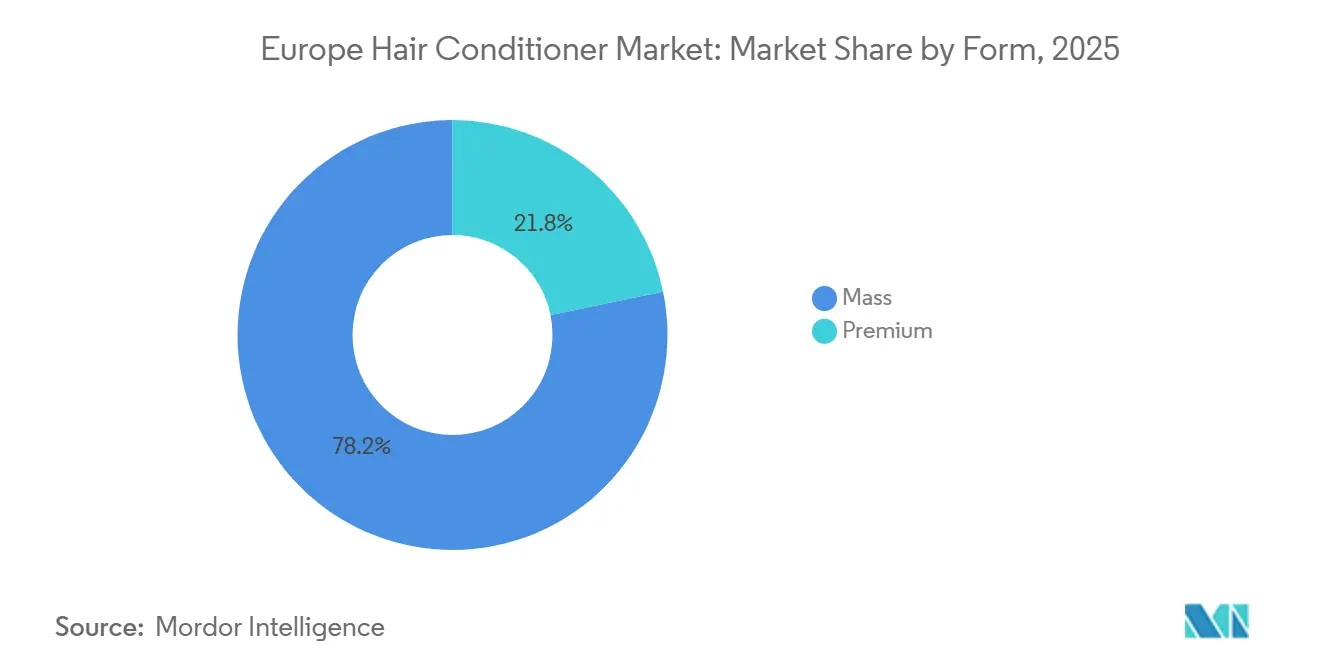
Mass conditioners held 78.22% of the regional conditioner category share in 2025. This position reflects broad supermarket access, strong private-label offerings, and the need for products that fit frequent use. Mass products serve households across income levels and remain a practical entry point for new product benefits. Their scale also gives major companies wide opportunities to introduce reformulated ranges. The segment is not limited to basic propositions because repair and damage-care claims are increasingly present in accessible products. Dove Hair’s performance during 2025 shows how a widely available brand can use technology-led communication to support growth. The Europe hair conditioners market continues to depend on mass ranges for unit volume and regular replenishment. Their value proposition must nevertheless remain credible as premium alternatives become more visible.
Premium conditioners are forecast to grow at a 7.23% CAGR through 2031. Consumers are willing to choose higher-priced products when they believe clinical claims, professional endorsement, or specialist formulas meet a specific need. K18 recorded double-digit volume growth through the first quarter of 2026, according to Unilever’s full-year results discussion. This does not mean mass and premium products necessarily compete for every purchase. Consumers can use a lower-priced conditioner for regular washing and select a premium repair product after coloring or heat styling. The Europe hair conditioners market benefits from this mixed purchasing behavior because companies can build a portfolio across price points. Premium growth depends on sustained proof of performance rather than scarcity alone. Brands also need to maintain clear differences between a premium product and an upgraded mass offer.
By End User: Kids Products Advance Through Safety and Specialist Needs
Adults held 66.43% of the Europe hair conditioners market in 2025. Adult demand is shaped by color treatment, heat styling, hair texture, and scalp-related concerns. This group has the broadest range of use occasions and often buys products through several channels. It also drives demand for both daily-use and treatment-focused conditioner formats. Adult products can be positioned around repair, smoothness, hydration, color care, and ease of styling. The Europe hair conditioners market remains anchored by this broad demand base because adults form the core audience for established mass and professional ranges. Their needs also provide a platform for product upgrades and premium trade-up. The category depends on converting these concerns into simple, believable product choices.
The kids segment is forecast to grow at a 6.83% CAGR through 2031. Parents increasingly apply ingredient and skin-sensitivity considerations to children’s hair care choices. The European Union’s draft Omnibus Act VIII, notified to the World Trade Organization on May 21, 2025, includes a stricter limit for hexyl salicylate in conditioners intended for children under 3[3]. This type of product-specific requirement increases the need for careful formula and label management. Specialist children’s conditioners are also offered around natural ingredients, dermatologist positioning, and curly-hair requirements. Germany, France, and Scandinavia lead demand for specialist children’s formats, while Southern Europe and Poland offer room for wider adoption. The Europe hair conditioners market can expand in this segment when brands balance mild formulas with performance that addresses detangling and everyday care. Clear safety communication is especially important because parents may avoid products with unclear ingredient information.
By Distribution Channel: Digital Sales Shift Category Access and Discovery
Supermarkets and hypermarkets held 42.36% of the Europe hair conditioners market in 2025. These outlets benefit from routine grocery visits, convenient replenishment, and extensive private-label ranges. They remain important for mass brands that depend on wide physical availability. Shelf presence can also encourage trial when packaging and price points are easy to compare. The channel is particularly relevant for rinse-out products bought as part of regular household shopping. It gives suppliers access to high-volume demand but can limit space for smaller brands. The Europe hair conditioners market therefore requires companies to balance the scale of grocery retail with the need for more targeted product storytelling. Retail execution remains central because consumers often make fast choices in this environment.
Online retail is forecast to grow at a 6.67% CAGR through 2031. Digital channels help specialist brands reach consumers across Europe without securing shelf space in every national retailer. The channel enables shoppers to research ingredient lists, usage methods, and product reviews before buying. It also gives professional and premium brands a practical route to reach consumers in markets where their physical distribution is still limited. Douglas Group reported EUR 4.58 billion in sales for 2024/25 across around 1,960 European locations, showing that health and beauty stores remain relevant for curated discovery. The Europe hair conditioners market will continue to use stores, salons, pharmacies, and digital retail for distinct roles in trial, education, and replenishment.

Geography Analysis
Germany held 25.48% of the Europe hair conditioners market share in 2025. Its position reflects strong personal care consumption and its role as a manufacturing base for multinational hair care companies. France and the United Kingdom form another major demand cluster, particularly for premium and professional hair care. Salon influence from Kérastase, L’Oréal Professionnel, and Wella helps shape expectations that later reach mainstream retail. Italy and Spain add demand related to color care and repair formats, while Belgium and the Netherlands serve important distribution and logistics functions for multinational suppliers.
Poland is forecast to grow at a 6.13% CAGR through 2031, the fastest rate among the geographic segments. The country offers both rising domestic demand and manufacturing relevance as a private-label production and export center. Online access gives premium international brands a route to Polish consumers without immediate wide physical distribution. This expands product choice and can speed premium adoption where traditional retail coverage is less extensive. The Europe hair conditioners market size in Poland is also supported by the country’s role in serving other European markets and Ukraine. This combination of consumption and production gives Poland a different opportunity profile from mature Western European countries. The market can attract companies looking for a base that supports local sales alongside regional supply.
Sweden and the Nordic markets show strong interest in direct-to-consumer subscriptions, refillable formats, and allergen-conscious formulas. These preferences are also reaching Denmark and the Netherlands through regional retail and digital channels. Romania and the Czech Republic add growth opportunities as rising incomes support first-time premium conditioner purchases. Southern and Eastern Europe have lower per capita conditioner consumption than Northern and Western Europe, leaving room for greater use and trade-up over time. Digital commerce helps reduce entry barriers for premium brands in these markets. The Europe hair conditioners market can use online availability to test demand before committing to wider physical distribution. This makes regional portfolio planning more flexible, but brands still need to adapt messaging, price points, and channel choices to local purchasing patterns.
Competitive Landscape
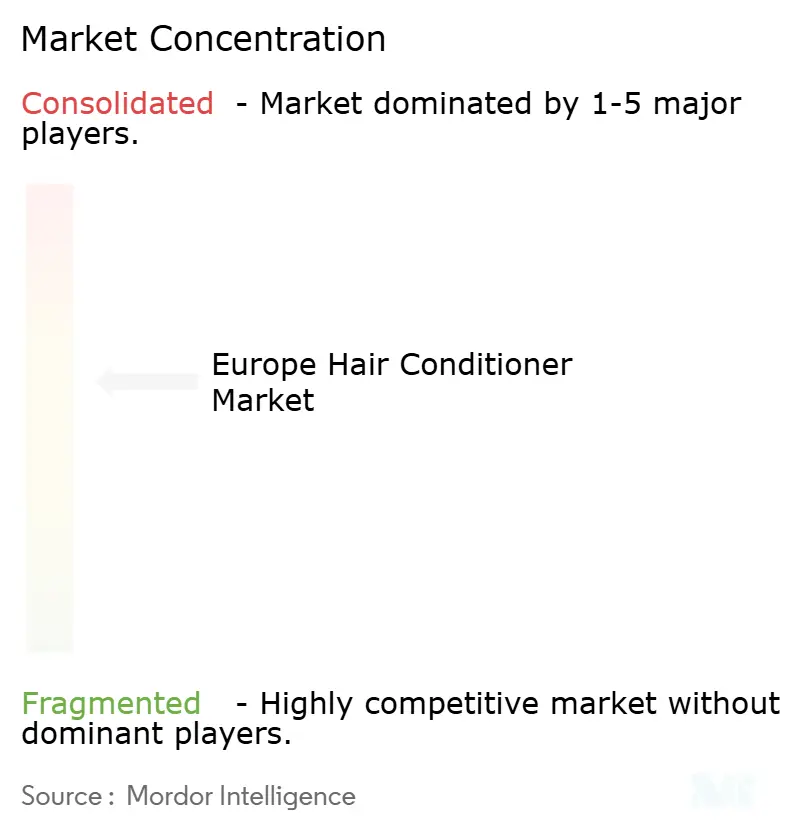
The Europe hair conditioners market has a moderate concentration because L’Oréal, Unilever, Henkel, and P&G have strong mainstream retail positions, although the supplied information does not establish a top-player combined share above 60%. These companies compete through well-known brands including Elvive, Dove, Schwarzkopf, and Pantene. Their scale provides advantages in distribution, formulation resources, and the ability to support multiple price tiers. However, professional specialists and premium challengers remain relevant where performance claims and salon credibility influence choice. The competitive setting is therefore not defined only by the largest supermarket brands. It also includes companies that can create a clear technical or sustainability-based point of difference. The Europe hair conditioners market has room for large portfolios and focused specialist brands because consumer needs vary by hair type, price point, and use occasion.
L’Oréal completed the Color Wow acquisition in September 2025, adding a professional brand associated with frizz control and specialist hair care L'ORÉAL. Henkel signed an agreement in March 2026 to acquire Not Your Mother’s, a hair care and styling brand that generated EUR 190 million in 2025 sales. These moves show how large companies use acquisitions to add capabilities, brand appeal, and access to different consumer segments. Wella’s 2025 Ultimate Smooth range uses Squalane and Omega-9 technology to support a smoother-hair proposition. Olaplex continues to use its proprietary bond technology across its portfolio, with fiscal 2025 net sales of USD 423 million. Such product platforms matter because technical claims are increasingly used to separate brands in both professional and retail environments.
Davines provides a different competitive model through sustainability credentials, traceable ingredients, and professional salon distribution. Its reported 12% growth in 2024 shows that a focused brand can develop meaningful scale within a category led by multinational groups. The opportunity is strongest where natural certification, children’s hair care, and professional retail meet, particularly in Central and Eastern Europe. Companies that operate across mass and premium tiers can also benefit when consumers use several products for different occasions. The Europe hair conditioners market is likely to remain competitive because retailers, salons, direct-to-consumer channels, and marketplaces all give brands different paths to reach consumers. Product claims need to be well supported as ingredient scrutiny rises. Compliance resources, formula performance, and channel execution will remain important competitive requirements.
Europe Hair Conditioner Industry Leaders
-
Procter & Gamble Company
-
L'Oreal S.A.
-
Henkel AG & Co., KGaA
-
Shiseido Company, Limited
-
Unilever
- *Disclaimer: Major Players sorted in no particular order
Recent Industry Developments
- April 2026: REHAB. expanded its hair care portfolio with Conditioner Milk, a lightweight conditioning product formulated with argan oil and shea butter to moisturize, detangle, soften, and smooth frizz without weighing down the hair.
- June 2025: Schwarzkopf Professional introduced three spray conditioners with updated vegan formulations and its Care Boost Complex. The products address hair repair, color protection, detangling, smoothness, and manageability
- March 2025: SEA+SOLU introduced its Moisture Melt Conditioner, a silicone-free formulation featuring fermented rice water, hyaluronic acid, deep-sea magnesium, algae oil, and pea protein to hydrate, strengthen, and improve hair softness. The product became available through selected Irish retailers and online channels.
Europe Hair Conditioner Market Report Scope
Europe hair conditioner market report analyses the recent trends, drivers, and challenges affecting the snack bar market. The market is segmented by product type, distribution channel, and by geography. The market by product type is segmented into intensive hair conditioner, traditional hair conditioner, other hair conditioners. By distribution channel, the market is segmented into supermarkets/ hypermarkets, convenience stores, online channels, other distribution channels. By geography, the market is further studied for the United Kingdom, Germany, France, Italy, Spain, Russia, and others. The report also provides a competitive analysis of prominent players along with their key strategies and product offerings in the respective market.
By Product Type
| Leave-In Conditioner |
| Rinse-Out Conditioner |
By Form
| Natural/Organic |
| Conventional |
By Category
| Mass |
| Premium |
By End User
| Adults |
| Kids |
By Distribution Channels
| Supermarket/Hypermarkets |
| Health and Beauty Stores |
| Online Retail Channels |
| Other Distribution Channels |
By Geography
| Germany |
| United Kingdom |
| France |
| Italy |
| Spain |
| Netherlands |
| Belgium |
| Poland |
| Sweden |
| Rest of Europe |
| By Product Type | Leave-In Conditioner |
| Rinse-Out Conditioner | |
| By Form | Natural/Organic |
| Conventional | |
| By Category | Mass |
| Premium | |
| By End User | Adults |
| Kids | |
| By Distribution Channels | Supermarket/Hypermarkets |
| Health and Beauty Stores | |
| Online Retail Channels | |
| Other Distribution Channels | |
| By Geography | Germany |
| United Kingdom | |
| France | |
| Italy | |
| Spain | |
| Netherlands | |
| Belgium | |
| Poland | |
| Sweden | |
| Rest of Europe |
Key Questions Answered in the Report
What is the value of the Europe hair conditioners market?
The Europe hair conditioners market is valued at USD 2.13 billion in 2026 and is forecast to reach USD 2.76 billion by 2031, at a 5.33% CAGR.
Which conditioner format is growing fastest in Europe?
Leave-in conditioners are the fastest-growing product type, with a forecast CAGR of 6.78% through 2031.
Why are premium hair conditioners growing faster than mass products?
Premium conditioners are forecast to grow at 7.23% CAGR, supported by demand for products with performance claims, professional positioning, and specialist repair benefits.
Which European country offers the fastest growth for hair conditioners?
Poland is forecast to grow at 6.13% CAGR through 2031, supported by domestic demand, digital access, and private-label production capabilities.