
Market Overview
| Study Period | 2021 - 2031 |
|---|---|
| Forecast Data Period | 2026 - 2031 |
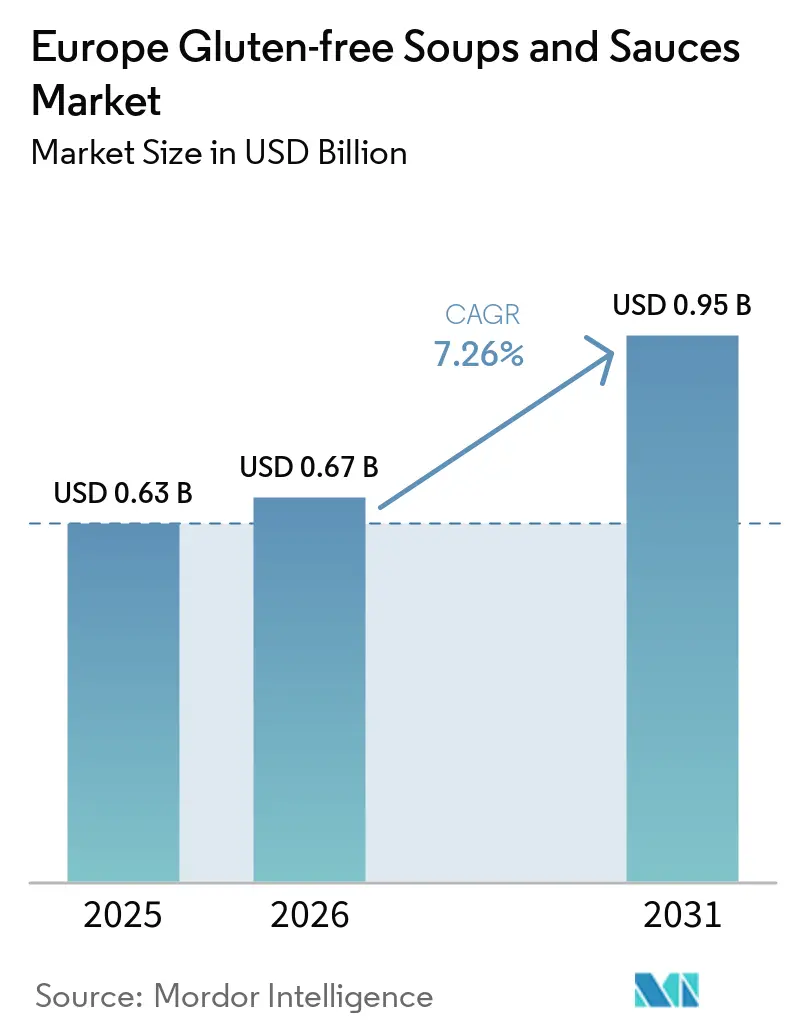
| Base Year Market Size (2025) | USD 0.63 Billion |
| Market Size (2026) | USD 0.67 Billion |
| Market Size (2031) | USD 0.95 Billion |
| Growth Rate (2026 - 2031) | 7.26 % |
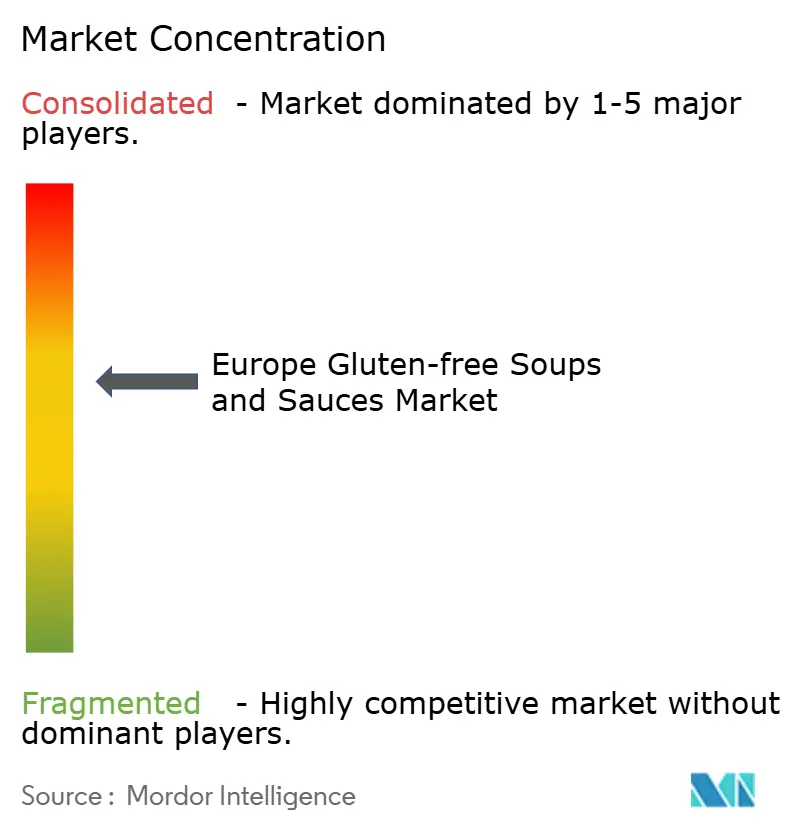
| Market Concentration | Medium |
Major Players *Disclaimer: Major Players sorted in no particular order Image © Mordor Intelligence. Reuse requires attribution under CC BY 4.0. | |
Europe Gluten-free Soups and Sauces Market Analysis by Mordor Intelligence
The Europe gluten-free soups and sauces market size is projected to expand from USD 0.62 billion in 2025 and USD 0.67 billion in 2026 to USD 0.95 billion by 2031, registering a CAGR of 7.26% between 2026 and 2031. The Europe gluten-free soups and sauces market is supported by demand from people with celiac disease and consumers seeking products with clearer ingredient lists. Improved identification of celiac disease can expand the base of regular buyers because diagnosed consumers need to avoid gluten over the long term. The legal threshold for a gluten-free claim gives manufacturers a common compliance standard and gives consumers a clearer basis for product selection[1]. Product developers are focusing on better texture, stable viscosity, and recognizable ingredients because these factors affect repeat purchases. Investment in dedicated capacity and formulation technology can strengthen access to both retail and foodservice customers, while higher production costs remain a barrier for smaller suppliers.
Key Report Takeaways
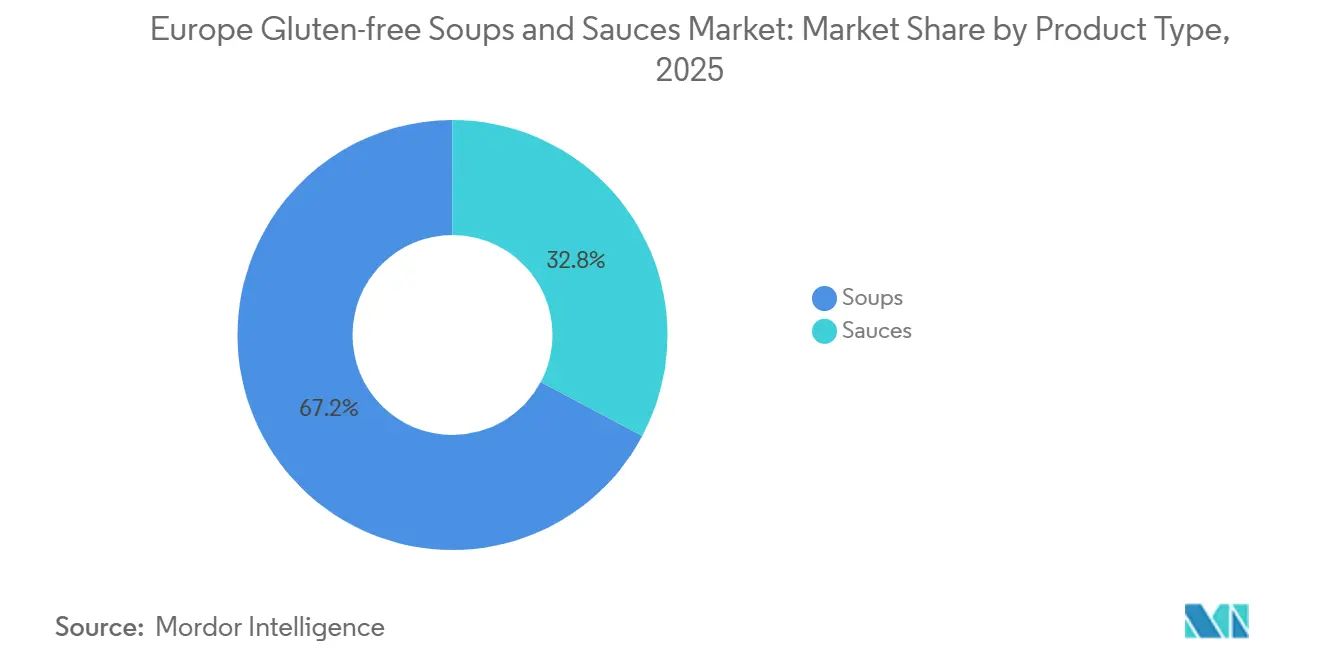
- By product type, soups held 67.21% revenue share in 2025, while sauces are forecast to expand at an 8.89% CAGR through 2031.
- By packaging type, cans held 41.27% revenue share in 2025, while jars and bottles are forecast to expand at an 8.34% CAGR through 2031.
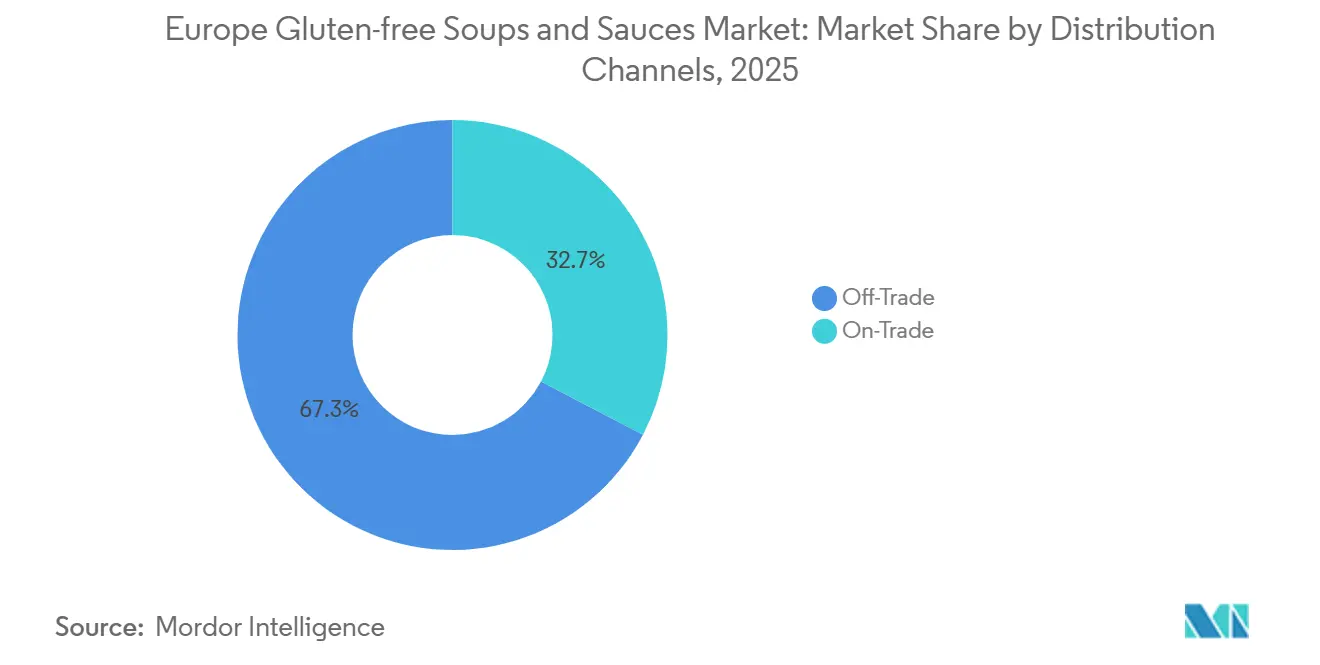
- By distribution channel, off-trade held 67.32% revenue share in 2025, while on-trade is forecast to expand at an 8.11% CAGR through 2031.
- By geography, Germany held 38.46% revenue share in 2025, while the United Kingdom is forecast to expand at a 9.12% CAGR through 2031.
Note: Market size and forecast figures in this report are generated using Mordor Intelligence’s proprietary estimation framework, updated with the latest available data and insights as of January 2026.
Market Trends and Insights
Drivers Impact Analysis of Europe Gluten-free Soups and Sauces Market*
| Driver | (~) % Impact on CAGR Forecasts | Geographic Relevance | Impact Timeline |
|---|---|---|---|
| Rising prevalence of celiac disease and gluten sensitivity | +2.5% | Global, concentrated in Northern Europe and Western Europe | Long term (≥ 4 years) |
| Increasing demand for convenient and ready-to-eat foods | +1.5% | Global, most acute in the United Kingdom, Germany, Netherlands, and Belgium | Short term (≤ 2 years) |
| Innovation in gluten-free ingredients and formulation technologies | +1.0% | Global, with early gains in France, Netherlands, and Denmark | Medium term (2-4 years) |
| Rising demand for clean-label and natural ingredients | +0.8% | Western Europe, with spillover to Poland and Sweden | Medium term (2-4 years) |
| Increasing popularity of international cuisines and diverse flavors | +0.6% | Global, concentrated in the United Kingdom, Germany, and Netherlands | Short term (≤ 2 years) |
| Expansion of plant-based and vegan food options | +0.5% | Global, with highest uptake in the United Kingdom, Germany, Netherlands, and Sweden | Medium term (2-4 years) |
| Source: Mordor Intelligence | |||
Rising Prevalence of Celiac Disease and Gluten Sensitivity
The Europe gluten-free soups and sauces market benefits from a clinically necessary consumer base that buys certified foods on a recurring basis. The 2025 European Society for the Study of Coeliac Disease guidelines reported a median histology-confirmed prevalence of 0.70% across Europe, while northern Europe recorded the highest histology-based prevalence at 1.60%. Diagnosed incidence reached up to 50 per 100,000 person-years in Scandinavia, Finland, and Spain, where antibody screening and clinical recognition have progressed. Each diagnosis can create sustained demand for verified gluten-free foods because patients must manage exposure throughout their lives. Italy’s monthly purchase vouchers for people with celiac disease show how public support can improve access to certified foods. Updated labeling guidance released on International Coeliac Day in May 2025 reinforced manufacturers’ obligations under the European gluten-free labeling framework[2].
Increasing Demand for Convenient and Ready-to-Eat Foods
Convenient meal formats remain important because soups, broths, stocks, and prepared sauces fit weekday meal occasions. The Europe gluten-free soups and sauces market can benefit when shoppers choose shelf-stable products that reduce preparation time without compromising allergen management. Ready-to-eat soups are especially relevant because consumers can inspect certified claims before purchase and use the product immediately. Foodservice demand also supports this pattern because kitchens need dependable bases and sauces that can be used under time pressure. Professional buyers can favor products that are easy to store, portion, and use across several recipes. These needs strengthen the role of convenience formats in routine gluten-free purchasing.
Innovation in Gluten-Free Ingredients and Formulation Technologies
Ingredient innovation addresses a central product challenge because gluten contributes thickness, suspension, and mouthfeel in liquid foods. Roquette launched AMYSTA L 123 in October 2025, a thermally soluble pea starch designed for dried soup, sauce, and condiment mixes. The ingredient can be declared as soluble pea starch in the European Union, which can help suppliers keep ingredient lists easy to understand. A 2025 scientific study found that instant soup premixes using 1.50% xanthan gum and 2.00% potato starch achieved stronger flowability and sensory acceptance than untreated controls. These outcomes matter for retail brands and professional kitchens because products must perform consistently during heating, storage, and reheating. Better texture can reduce the risk that consumers move back to conventional alternatives after a poor product experience.
Rising Demand for Clean-Label and Natural Ingredients
The Europe gluten-free soups and sauces market has an advantage in products based on tomatoes, legumes, vegetables, and broths because many of these ingredients are naturally free from gluten. This can make it easier to combine gluten-free certification with ingredient lists that avoid synthetic additives. Roquette reported in October 2025 that clean-label positioning appeared in nearly 1 in 3 new global food and beverage launches, and that more than 75% of consumers said brand transparency influenced purchase decisions. German retail conditions are favorable for products that combine organic and gluten-free credentials, although certified production still requires careful segregation and testing. The European Union’s Farm to Fork approach places added value on traceability, which is relevant to both allergen-free and clean-label products. Suppliers that document ingredient sourcing and control points can support a more credible premium proposition.
Restraints Impact Analysis of Europe Gluten-free Soups and Sauces Market*
| Restraint | (~) % Impact on CAGR Forecasts | Geographic Relevance | Impact Timeline |
|---|---|---|---|
| Higher production costs of gluten-free formulations | -1.2% | Global, most acute in Eastern Europe | Long term (≥ 4 years) |
| Challenges in replicating the texture and consistency of conventional products | -0.8% | Global, especially in sauces requiring thickening agents | Medium term (2-4 years) |
| Complexity of regulatory compliance and gluten-free labeling | -0.5% | European Union, especially Italy and Germany | Long term (≥ 4 years) |
| Supply chain disruptions and volatility in alternative ingredient costs | -0.7% | Global, with spillover to Central and Eastern Europe | Short term (≤ 2 years) |
| Source: Mordor Intelligence | |||
Higher Production Costs of Gluten-Free Formulations
Certified gluten-free soups and sauces require dedicated ingredient sourcing, segregated production, testing, and certification renewal. These requirements add fixed costs that conventional producers do not face, and they can make smaller entrants less competitive. Dr. Schär invested EUR 8.80 million in production and logistics efficiency during 2025 and committed EUR 28.00 million to expand Italian, Spanish, and German facilities in 2026. This scale of spending can improve operating efficiency for established suppliers, while newer brands may need to accept higher prices or lower margins. The Europe gluten-free soups and sauces market can therefore remain harder to enter in price-sensitive countries. Cost control will continue to influence whether certified products can reach a wider group of households.
Challenges in Replicating the Texture and Consistency of Conventional Products
Gluten gives soups and sauces a functional structure that is difficult to reproduce with alternative starches, gums, and proteins. In soups, it can support body and stable suspension, while sauces also need gloss, adhesion, thickness, and heat stability. Each substitute can change the process requirements, cost base, and consumer perception of the ingredient list. The 2025 instant soup study showed that texture and acceptance varied across 9 formulations, demonstrating the precision needed for commercial reformulation. Foodservice formats add further requirements because sauces may face commercial temperatures and freeze-thaw cycles. The Europe gluten-free soups and sauces market depends on formulations that protect sensory consistency and repeat purchases.
*Our forecasts treat driver/restraint impacts as directional, not additive. The impact forecasts reflect baseline growth, mix effects, and variable interactions.
Europe Gluten-free Soups and Sauces Market Segment Analysis
By Product Type:
Soups Lead Value, Sauces Drive GrowthSoups held 67.21% of the Europe gluten-free soups and sauces market share in 2025, supported by ready-to-eat and canned formats. Long shelf life and sealed packaging help consumers manage cross-contact concerns while retaining convenience. Broths and stocks provide certified bases for home cooking and professional kitchens. Dehydrated and instant soups are also gaining attention as portable single-serve products. Roquette designed AMYSTA L 123 for dried soup and sauce mixes, which supports efforts to improve these formats.
Sauces are projected to grow at an 8.89% CAGR from 2026 to 2031, which is faster than the overall category. Pasta sauces and tomato sauces have a formulation advantage because tomatoes are naturally gluten-free. Tamari-based soy sauces and ethnic condiments also fit a wider set of meal occasions. Kikkoman’s gluten-free tamari is brewed without wheat and serves retail and foodservice channels in Germany, the United Kingdom, and the Netherlands. These factors make sauces a key expansion area within the Europe gluten-free soups and sauces market.
By Packaging Type:
Cans Protect Compliance, Jars and Bottles Support Premium PositioningCans accounted for 41.27% of the Europe gluten-free soups and sauces market size in 2025. Hermetic sealing reduces post-production exposure risks and supports a longer shelf life for certified products. Italy’s CReNaRiA surveillance program analyzed 2,383 gluten-free product samples in 2025 and found that fewer than 1% exceeded the legal 20 mg/kg gluten limit. Cans also provide familiar value positioning for shoppers who buy pantry staples. These benefits explain why cans remain central to the Europe gluten-free soups and sauces market even as packaging requirements evolve.
Jars and bottles are projected to grow at an 8.34% CAGR from 2026 to 2031. The format aligns with premium sauces, including organic tomato sauces, pasta sauces, and tamari products. Glass packaging gives shoppers product visibility and can reinforce an artisanal position in Germany and the United Kingdom. Pouches and cartons support broths and stocks, while sachets serve dehydrated soups and instant sauce mixes. Packaging choices influence safety, brand presentation, and the operating cost of the Europe gluten-free soups and sauces market.
By Distribution Channel:
Off-Trade Retains Scale, On-Trade Builds DemandOff-trade channels accounted for 67.32% of category revenue in 2025. Supermarkets, hypermarkets, convenience stores, and online retailers give consumers access to a broad set of certified products. Dedicated free-from aisles help consumers identify suitable options, while online retail expands variety beyond smaller stores. Subscription models can make recurring pantry purchases easier for households that avoid gluten. These channels remain the main route to reach established buyers in the Europe gluten-free soups and sauces market.
On-trade distribution is projected to grow at an 8.11% CAGR from 2026 to 2031. Restaurants, caterers, hospitals, and institutional kitchens need ingredients that simplify allergen management. Regulation (EU) No 1169/2011 requires food businesses to provide information on 14 major allergens, which supports demand for verified cooking bases and sauce concentrates. Foodservice operators need products that remain stable under repeated heating and can be used across several dishes. Its growth can broaden the Europe gluten-free soups and sauces market beyond household consumption.
Geography Analysis
Germany Gluten-free Soups and Sauces Market
Germany held 38.46% of the Europe gluten-free soups and sauces market share in 2025. The country has 800,000 to 900,000 diagnosed celiac patients and an established certification environment through Deutsche Zöliakie-Gesellschaft. Organic and allergen-free claims are often complementary in German retail, supporting products that meet both needs. Dr. Schär has invested more than EUR 20.00 million in German facilities over the past decade and marks 20 years of German operations in 2026. Germany remains a key location for premium certified products in the Europe gluten-free soups and sauces market.
United Kingdom and Italy Gluten-free Soups and Sauces Market
The United Kingdom is projected to grow at a 9.12% CAGR from 2026 to 2031. The country has 2.90 million people who follow a gluten-free diet and benefits from broad supermarket availability. Wales launched a gluten-free food subsidy card in autumn 2025, adding support for eligible consumers. Italy’s monthly purchase vouchers and the AIC certified product database, which includes more than 3,500 items, provide practical support for people with celiac disease. These conditions create strong demand foundations for the Europe gluten-free soups and sauces market.
Northern Europe Gluten-free Soups and Sauces Market
Spain and Poland are emerging locations with double-digit growth in gluten-free food consumption, while Belgium, Sweden, and the Netherlands have above-average per-capita consumption. Northern Europe has a histology-based celiac disease prevalence of 1.60%, which gives the Scandinavian cluster a medically supported demand base[3]. Dr. Schär acquired Swedish specialist Semper in 2025 and completed the transition of its portfolio to the Schär brand in 2026.
Competitive Landscape
The Europe gluten-free soups and sauces market has a moderate concentration, with dedicated specialists, multinational food companies, and regional cuisine-focused suppliers all competing for shelf and foodservice presence. Dr. Schär leads the specialist group, while Kraft Heinz, Nestlé, Unilever, and Campbell’s extend established brands into gluten-free formats. Barilla, Mutti, Baxter Food Group, Hügli Holding, Kikkoman, Soupologie, and Casalasco support regional product and cuisine positions. Dr. Schär reported EUR 632.00 million in global revenue for FY2025 and committed EUR 28.00 million to capacity investment in Italy, Spain, and Germany for 2026. The Europe gluten-free soups and sauces industry rewards long-term investment because specialized capacity and certification systems are difficult to establish quickly.
Multinational competitors use brand recognition and distribution scale to reach customers, but they may enter through partnerships that shorten development time. In June 2026, The Campbell’s Company partnered with Banza to introduce a gluten-free condensed chicken noodle soup using chickpea penne. The product was launched through Amazon at a USD 1.99 suggested retail price before its planned rollout to United States retailers. This model can reduce time to market, but specialist suppliers may retain an advantage in the depth of their gluten-free capabilities.
The most open opportunities are in professional kitchens, institutional catering, and Eastern European markets where branded certified choices are still limited. Foodservice demand is shaped by the need for clear allergen information and products that perform reliably in high-volume kitchens. Roquette’s 2025 AMYSTA L 123 launch gives formulators a product option for clean-label dried soups, sauces, and condiments. Dr. Schär’s capacity investments and Semper brand transition show an infrastructure-led route to regional expansion. The Europe gluten-free soups and sauces market remains competitive because strong brands must address price, texture, and verified compliance.
Europe Gluten-free Soups and Sauces Industry Leaders
-
Amy's Kitchen Inc.
-
The Campbell Soup Company
-
The Kraft Heinz Company
-
Conagra Brands Inc.
-
Baxter Food Group Ltd
- *Disclaimer: Major Players sorted in no particular order
Europe Gluten-free Soups and Sauces Market Companies Covered in this Report
- Amy's Kitchen Inc.
- The Campbell Soup Company
- The Kraft Heinz Company
- Conagra Brands Inc.
- Baxter Food Group Ltd
- Barilla Holding S.p.A.
- General Mills Inc.
- The Hain Celestial Group Inc.
- Pacific Foods of Oregon LLC
- Kikkoman Corporation
- Soupologie Ltd
- Nestlé S.A.
- Unilever PLC
- Dr. Schär AG / S.p.A.
- Flandria Foods
- Hügli Holding AG
- Sapidum d.o.o.
- Mill & Folks
- Hanpol Sp. z o.o.
- Casalasco Società Agricola S.p.A.
- Mutti S.p.A.
- F.lli Polli S.p.A.
Read Analysis of Europe Gluten-free Soups and Sauces Companies
Recent Industry Developments in Europe Gluten-free Soups and Sauces Market
- June 2026: The Campbell’s Company partnered with Banza to launch the first-ever gluten-free condensed chicken noodle soup, using a specially engineered chickpea penne formula. The product launched on Amazon with a USD 1.99 SRP and is rolling out to US retailers. This marked the first time in the brand’s 150-year history that chicken noodle soup was available in a certified gluten-free format.
- March 2026: Dr. Schär announced EUR 28.00 million in capital investment for 2026, targeting production capacity expansion in Italy, Spain, and Germany. The plan includes hall extensions at its Apolda plant for gluten-free bread and roll production and the development of foodservice supply capabilities for restaurant operators.
- February 2026: Alvalle introduced two chilled, ready-to-heat vegetable soups made with Spanish-sourced vegetables, olive oil, and salt. The Vegetable Cream variety contains zucchini, carrot, potato, and onion, while the Pumpkin Cream variety includes pumpkin, carrot, onion, and sweet potato. Both products are gluten-free and contain no additives.
Europe Gluten-free Soups and Sauces Market Report Scope
The Europe gluten-free soups and sauces market is segmented by product type, packaging type, distribution channel, and geography. By product type, the market is categorized into soups and sauces. Soups include ready-to-eat soups, broths and stocks, and dehydrated and instant soups. Sauces include pasta sauces, tomato sauce, soy sauce, mustard sauce, and other sauces. By packaging type, the market is divided into cans, jars and bottles, pouches and cartons, sachets, and other packaging types. By distribution channel, the market covers on-trade and off-trade channels, with off-trade further segmented into supermarkets/hypermarkets, convenience stores, online retail channels, and other distribution channels. By geography, the market includes Germany, the United Kingdom, France, Italy, Spain, the Netherlands, Belgium, Poland, Sweden, and the rest of Europe.
Segmentation Overview
Product Type
| Soups | Ready-to-Eat Soups |
| Broths and Stocks | |
| Dehydrated and Instant Soups | |
| Sauces | Pasta Sauces |
| Tomato Sauce | |
| Soy-Sauce | |
| Mustard Sauce | |
| Other Sauces |
Packaging Type
| Cans |
| Jars and Bottles |
| Pouches and Cartons |
| Sachets |
| Others |
By Distribution Channels
| On-Trade | |
| Off-Trade | Supermarket/Hypermarkets |
| Convenience Stores | |
| Online Retail Channels | |
| Other Distribution Channels |
By Geography
| Germany |
| United Kingdom |
| France |
| Italy |
| Spain |
| Netherlands |
| Belgium |
| Poland |
| Sweden |
| Rest of Europe |
| Product Type | Soups | Ready-to-Eat Soups |
| Broths and Stocks | ||
| Dehydrated and Instant Soups | ||
| Sauces | Pasta Sauces | |
| Tomato Sauce | ||
| Soy-Sauce | ||
| Mustard Sauce | ||
| Other Sauces | ||
| Packaging Type | Cans | |
| Jars and Bottles | ||
| Pouches and Cartons | ||
| Sachets | ||
| Others | ||
| By Distribution Channels | On-Trade | |
| Off-Trade | Supermarket/Hypermarkets | |
| Convenience Stores | ||
| Online Retail Channels | ||
| Other Distribution Channels | ||
| By Geography | Germany | |
| United Kingdom | ||
| France | ||
| Italy | ||
| Spain | ||
| Netherlands | ||
| Belgium | ||
| Poland | ||
| Sweden | ||
| Rest of Europe | ||
Key Questions Answered in the Report
What is the projected growth rate for gluten-free soups and sauces in Europe?
The category is projected to grow at a 7.26% CAGR from 2026 to 2031, increasing from USD 0.67 billion in 2026 to USD 0.95 billion in 2031.
Which product category leads European gluten-free soups and sauces?
Soups lead with 67.21% of revenue in 2025, supported by ready-to-eat, canned, broth, and stock formats.
Why are gluten-free sauces growing faster than soups in Europe?
Sauces are projected to grow at an 8.89% CAGR through 2031 because naturally gluten-free tomato products, tamari, and other condiments have broad meal applications.
Which distribution channel has the strongest growth outlook?
On-trade is forecast to grow at an 8.11% CAGR through 2031 as restaurants and institutional kitchens seek verified allergen-managed ingredients.