
Market Overview
| Study Period | 2020 - 2031 |
|---|---|
| Forecast Data Period | 2026 - 2031 |
| Base Year Market Size (2025) | USD 3.33 Billion |
| Market Size (2026) | USD 3.53 Billion |
| Market Size (2031) | USD 4.71 Billion |
| Growth Rate (2026 - 2031) | 5.98 % |
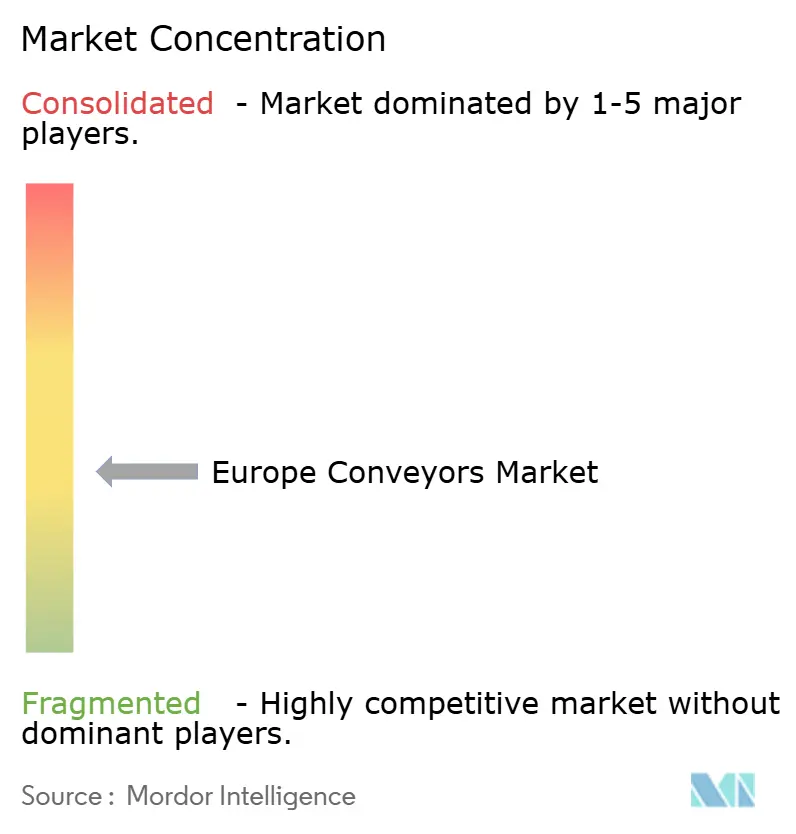
| Market Concentration | Medium |
Major Players *Disclaimer: Major Players sorted in no particular order Image © Mordor Intelligence. Reuse requires attribution under CC BY 4.0. | |
Europe Conveyors Market Analysis by Mordor Intelligence
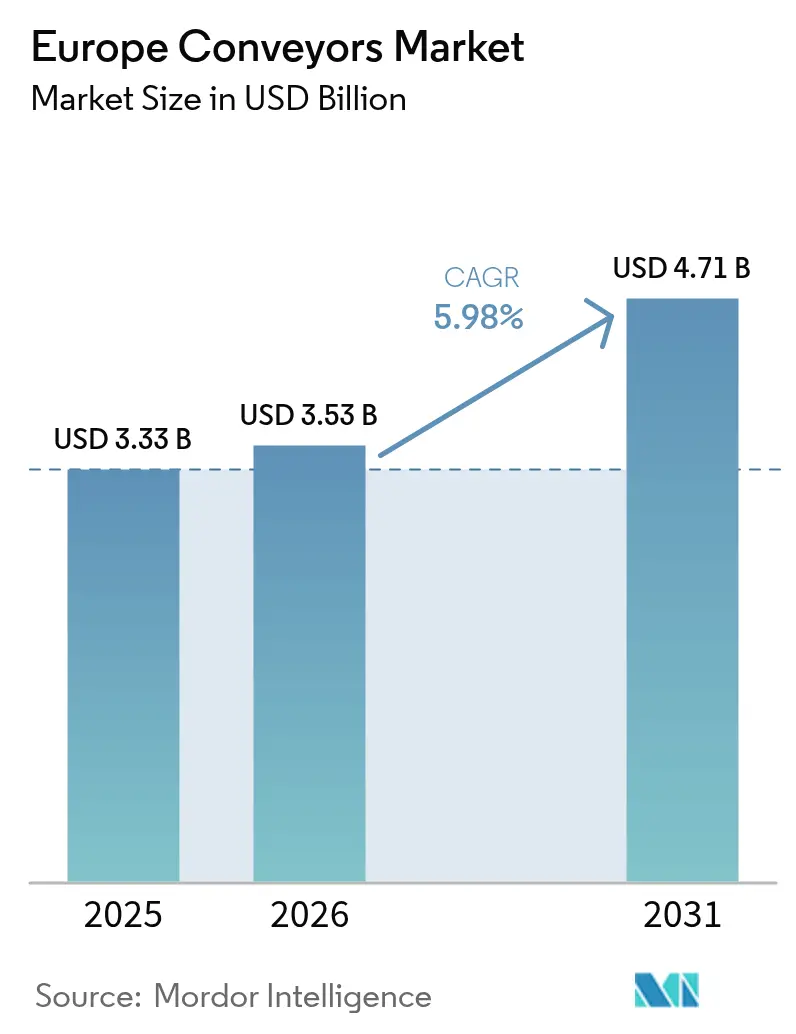
The Europe Conveyors Market size is expected to grow from USD 3.33 billion in 2025 to USD 3.53 billion in 2026 and is forecast to reach USD 4.71 billion by 2031 at 5.98% CAGR over 2026-2031. Wage inflation above 5% in Germany and France during 2024, rising vacancy rates in the Nordics, and tight delivery windows in e-commerce are turning boardroom focus from low-cost labor toward predictive-uptime economics. Subsidies of up to 40% on automation capital expenditure under the European Union’s Recovery and Resilience Facility have compressed conveyor payback horizons from four years to under 2.5 years for mid-sized manufacturers. Same-day e-commerce fulfillment is the fastest-growing end-use as micro-fulfillment centers deploy 800-1,200 meters of conveyors within 15 kilometers of urban cores. Variable-frequency drives and regenerative braking retrofits aimed at cutting industrial energy use by 11.7% before 2030 are beginning to reshape upgrade priorities under Directive 2023/1791. Autonomous mobile robots are encroaching on short-distance transfers, yet high-throughput sortation lines moving more than 10,000 parcels per hour remain firmly in conveyor territory due to AMR congestion, battery-swap logistics, and collision-avoidance latency
Key Report Takeaways
- By product type, belt conveyors led with 38.96% revenue share in 2025, while overhead conveyors are projected to expand at 8.17% CAGR through 2031.
- By end-user industry, airport baggage handling accounted for 28.41% of demand in 2025; e-commerce and retail installations are forecast to rise at 8.95% CAGR to 2031.
- By load type, unit-load configurations held 68.12% of the Europe conveyors market share in 2025 and are set to grow at 7.86% CAGR through 2031.
- By automation level, semi-automated systems represented 54.22% of installations in 2025, whereas fully automated smart platforms are advancing at a 7.62% CAGR forecast to 2031.
- By service,unit-load configurations held 28.85% of the Europe conveyors market share in 2025 predictive, IIoT-enabled service agreements moved from 10.04% of CAGR forecast to 2031.
- By country, Western Europe generated 55.18% of 2025 revenue; Eastern Europe is the fastest-growing region, posting an 8.64% CAGR forecast to 2031.
Note: Market size and forecast figures in this report are generated using Mordor Intelligence’s proprietary estimation framework, updated with the latest available data and insights as of 2026.
Europe Conveyors Market Trends and Insights
Drivers Impact Analysis*
| Driver | (~) % Impact on CAGR Forecast | Geographic Relevance | Impact Timeline |
|---|---|---|---|
| Rising Labor Costs Across Western Europe | +1.5% | Western Europe (Germany, France, UK, Benelux), spillover to Nordics | Medium term (2-4 years) |
| Explosive Growth of Same-Day E-Commerce Fulfilment | +1.8% | Pan-European, concentrated in urban hubs (Paris, Berlin, Amsterdam, Madrid) | Short term (≤ 2 years) |
| Tightening EU Food-Safety Regulations Prompting Hygienic Conveyor Adoption | +0.7% | Pan-European, strongest in Germany, France, Italy (dairy and bakery clusters) | Medium term (2-4 years) |
| Automation Subsidies Under EU Recovery and Resilience Facility | +1.2% | France, Italy, Spain, Poland (RRF beneficiary states) | Short term (≤ 2 years) |
| Shift Toward Predictive-Maintenance Contracts Powered by IIoT | +0.9% | Western Europe and Nordics (early adopters), expanding to Eastern Europe | Long term (≥ 4 years) |
| Sustainability Mandates Driving Energy-Efficient Conveyor Retrofits | +0.8% | Pan-European, compliance-driven in Germany, Netherlands, Sweden | Medium term (2-4 years) |
| Source: Mordor Intelligence | |||
Explosive Growth of Same-Day E-Commerce Fulfillment
Parcel volumes in the European Union increased 18% during 2024, pushing same-day delivery penetration in urban e-commerce to 22%. Retailers responded by opening micro-fulfillment centers within 15 kilometers of city centers, each fitted with high-speed sortation conveyors that handle 5,000-8,000 parcels per hour. Ocado’s Smart Platform at Auchan’s Polish facility routes totes via a grid of overhead conveyors to robotic pick stations, enabling 40,000 stock-keeping units to flow through a single site. Amazon’s EUR 700 million (815.5 USD million) network expansion added more than 1,000 mobile robots and complementary conveyor lines across Germany, France, and Spain. The spread of decentralized fulfillment nodes is boosting conveyor density per square meter, favoring modular layouts that bolt onto automated storage and retrieval systems. Cross-border e-commerce grew 12% in 2024 after simplified VAT rules streamlined customs clearance, elevating throughput demands at EU sortation hubs.[1]
Rising Labor Costs Across Western Europe
Manufacturing wages rose 5.2% in Germany, 5.1% in France, and 4.8% in the United Kingdom during 2024, compressing margins in labor-intensive warehousing. The EU minimum-wage directive set a floor at 60% of median pay, eliminating cheap-labor advantages for manual palletizing. SSI Schaefer installations demonstrate 30-50% headcount cuts after conveyor automation, improving return-on-investment timelines. Automotive producers retrofit overhead conveyors to move parts just-in-sequence, trimming assembly cycle times 15% and reducing repetitive-strain injuries. Labor shortages are acute in the Nordics, where Sweden’s manufacturing vacancy rate reached 6.8% in 2024, driving demand for conveyors integrated with collaborative robots that one operator can oversee from a single console
Automation Subsidies Under EU Recovery and Resilience Facility
The Recovery and Resilience Facility committed EUR 345 million (USD 402.01million) to France’s Industrie du Futur program and EUR 25 million (USD 29.13 million) to Italy’s CIM 4.0 initiative in 2024, underwriting up to 40% of qualified automation investments such as conveyor lines. Poland’s Smart Industry program co-financed EUR 18 million (USD 20.97 million) in logistics automation, and Spain’s Perte Agroalimentario earmarked EUR 12 million (USD 13.98 million) for hygienic conveyor upgrades. Subsidies shorten payback periods to under 2.5 years for companies with less than EUR 50 million (USD 58.26 million) in annual revenue, accelerating order cycles for European conveyor suppliers. Because most grants sunset by 2027, integrators are experiencing a near-term surge in bid activity, especially among smaller manufacturers that historically deferred automation for cost reasons. Suppliers able to package equipment, software, and grant-application support are converting tenders at higher win rates than hardware-only competitors.
Shift Toward Predictive-Maintenance Contracts Powered by IIoT
Sensor penetration on Western European conveyor lines hit 38% in 2024, enabling condition-based servicing that slices unplanned downtime 25-35% compared with fixed-interval programs. Interroll’s RollerDrive streams vibration and temperature data to cloud analytics, flagging bearing wear up to 72 hours before failure. Dematic’s iQ suite uses machine learning to predict component degradation and trim spare-parts inventories 20%. Siemens Logistics applied a digital twin at Munich Airport’s baggage-handling system to optimize diverter sequencing, removing peak-hour bottlenecks and sustaining throughput above 97% of rated capacity. Predictive-maintenance contracts generated 28% of leading suppliers’ aftermarket revenue in 2024, up from 19% in 2023, reflecting end-users’ willingness to pay for guaranteed uptime over transactional parts sales.
Restraints Impact Analysis*
| Restraint | (~) % Impact on CAGR Forecast | Geographic Relevance | Impact Timeline |
|---|---|---|---|
| High Up-Front Capital Expenditure for Advanced Systems | -1.3% | Pan-European, most acute in Southern and Eastern Europe (budget-constrained SMEs) | Short term (≤ 2 years) |
| Shortage of Skilled Conveyor-Maintenance Technicians | -0.9% | Western Europe and Nordics (aging workforce), emerging in Eastern Europe | Medium term (2-4 years) |
| Fragmented EU Regulations Hindering Cross-Border Standardisation | -0.5% | Pan-European, compliance overhead highest in multi-country operations | Long term (≥ 4 years) |
| Rising Competition From Autonomous Mobile Robots | -0.6% | Western Europe (early AMR adoption), expanding to Eastern Europe | Medium term (2-4 years) |
| Source: Mordor Intelligence | |||
High Up-Front Capital Expenditure for Advanced Systems
Fully automated conveyors with vision-guided sortation cost USD 500-800 per linear meter, versus USD 150-250 for semi-automated belts, deterring small and medium-sized enterprises in Southern and Eastern Europe. A 2,000 m² fulfillment center needs roughly 1,200 meters of conveyor, translating to USD 600,000-960,000 upfront for smart platforms. Leasing models remain nascent; only 12% of 2024 projects were financed as operating expenses, so most buyers still fund through capital budgets. European Central Bank deposit rates at 3.25% in mid-2024 lifted financing costs, lengthening payback periods especially in Poland and the Czech Republic where wages hover at USD 12-15 per hour. Energy-efficiency retrofits mandated under Directive 2023/1791 add USD 50-100 per meter, further inflating project totals.
Rising Competition From Autonomous Mobile Robots
European AMR shipments expanded 42% in 2024 to about 18,000 units, offering reconfigurable material flows without fixed tracks.[2]Yet conveyors dominate in high-throughput lines exceeding 10,000 parcels per hour, where AMR fleets struggle with congestion and battery-swap downtime. Overhead conveyors, forecast to grow 8.54% CAGR, are unaffected because they occupy vertical airspace. Hybrid sites combining AMRs for inbound receiving and conveyors for outbound sortation represent 16% of 2024 warehouse projects in Western Europe, signaling coexistence rather than substitution. Total cost of ownership for AMRs, including software licenses and battery replacements every 3-4 years, often surpasses conveyor maintenance over a decade.
*Our forecasts treat driver/restraint impacts as directional, not additive. The impact forecasts reflect baseline growth, mix effects, and variable interactions.
Segment Analysis
By Product Type: Overhead Systems Gain Altitude in Space-Constrained Facilities
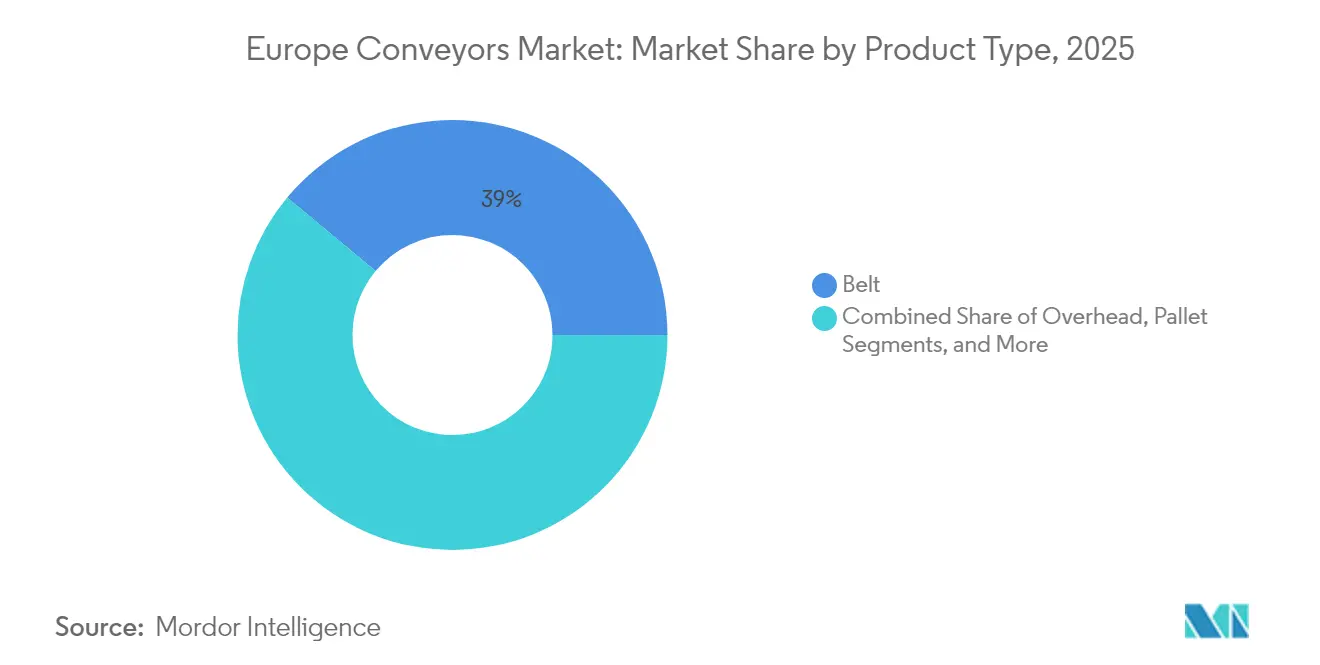
Overhead conveyors are projected to expand at 8.17% CAGR between 2026 and 2031, outpacing all other variants as paint shops and cleanrooms fight for floor space. Belt units commanded 38.96% of 2025 revenue, underpinned by food processing and parcel sortation, where flat surfaces handle irregular packages gently. Roller lines support automotive final assembly with zero-pressure accumulation that prevents part damage during stoppages. Pallet conveyors move loads exceeding one ton in bulk warehouses, while specialty spiral or climbing designs elevate products between mezzanine levels. Interroll’s plug-and-play modules cut installation time 30%, appealing to operators who must minimize downtime during changeovers.
Europe conveyors market demand for overhead designs is rising because they integrate easily with robotic paint-cells, maintaining ±2 mm positioning for uniform coats and less overspray. Pharmaceuticals favor ceiling-mounted tracks that eliminate floor supports harboring microbes, easing cleanroom validation. Specialty spiral units, climbing several floors, consume a third of the footprint required by inclined belts, freeing warehouse aisles for AGV traffic. Compliance with Regulation 2023/1230 obliges overhead makers to add redundant safety relays and cloud-accessible documentation, adding USD 8,000-15,000 per install but ensuring future cybersecurity readiness

By End-User Industry: E-Commerce Installations Surge Past Airport Modernization
E-commerce and retail lines will post a 8.95% CAGR through 2031 as two-hour delivery targets spur dense urban micro-fulfillment centers. Airports retained 28.41% share in 2025, underpinned by Brussels and Zurich baggage-system overhauls processing up to 50,000 bags daily. Automotive EV plants rely on synchronised conveyors to deliver battery packs and power electronics just-in-sequence, trimming line-side inventory. Food manufacturers invest in stainless-steel modular belts complying with EHEDG to cut wash-down time.
Europe conveyors market solutions for e-commerce couple vision-guided diverters achieving 99.8% sort accuracy at 2.5 m/s with tote-based loops tied to shuttle storage. KNAPP’s German facility merges 210 shuttles and 1,800 meters of conveyors to fill 12,000 order lines per hour. Pharmaceutical plants integrate conveyors with automated inspection, verifying vial fill, cap torque, and label placement at 600 units per minute. Mining sites in Poland and Spain still favor heavy-duty belts moving over 1,000 t/h of aggregates along multi-kilometer routes.
By Load Type: Unit-Load Dominance Reflects Omnichannel Distribution Shift
Unit-load systems accounted for 68.12% of the Europe conveyors market share in 2025 and should advance 7.86% CAGR to 2031 as omnichannel distribution requires carton-level traceability. Parcels pass barcode and RFID checkpoints at every junction, feeding real-time inventory data to WMS dashboards. Bulk-load conveyors remain vital in cement and grain, where capacities exceed 1,000 t/h, but new retail and 3PL warehouses seldom specify troughed belts.
Europe conveyors market installations at DHL’s Warsaw hub span 2,400 meters, process 25,000 parcels per hour, and reach 99.7% sort accuracy. Modular designs let operators re-route flows by swapping 1-meter sections without civil works, a flexibility that bulk systems cannot match. EU packaging rules requiring 65% cardboard recycling by 2030 are pushing retailers to standardize carton sizes, further aligning with unit-load conveyor dimensions.
By Automation Level: Fully Automated Platforms Close Gap on Semi-Automated Incumbents
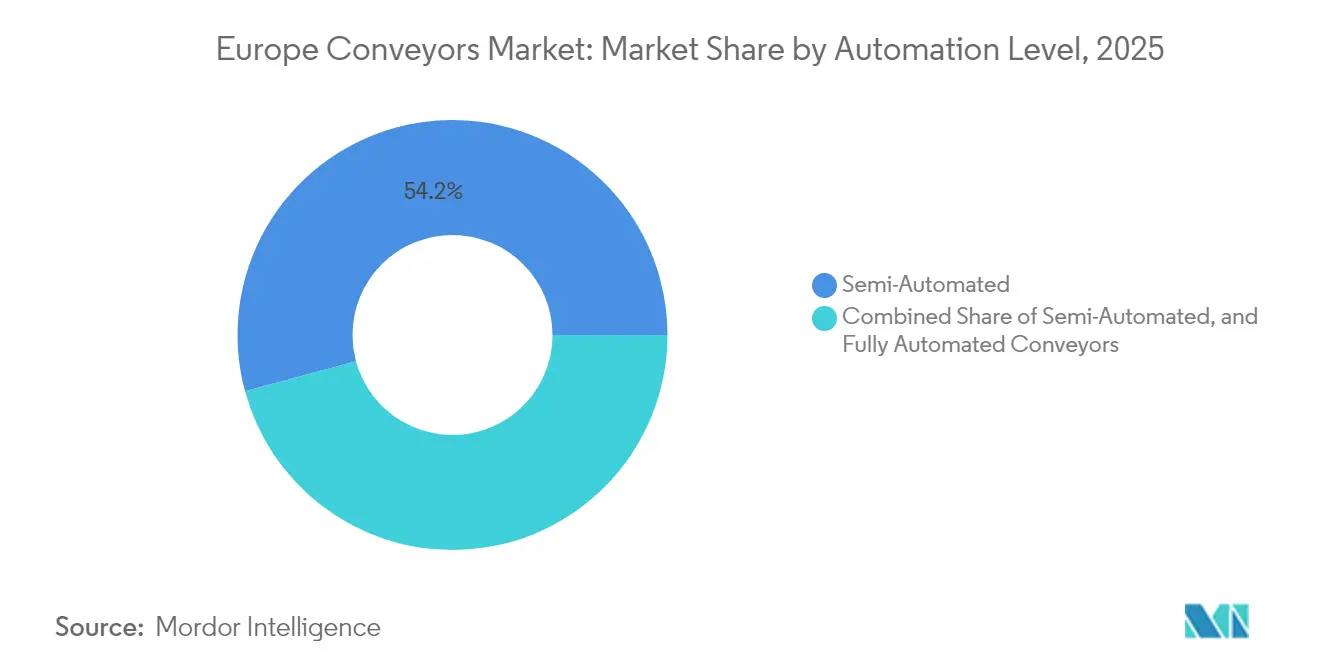
Semi-automated lines captured 54.22% revenue in 2025 thanks to lower costs, yet fully automated platforms are rising 7.62% CAGR on the back of labor scarcity in Nordics and Benelux. Smart conveyors monitor weight, dimensions, and barcodes in real time then tweak speed and diverter timing automatically to maximize flow. Siemens Logistics’ Parcel Sorter 3000 moves 12,000 parcels per hour with automated induction that erases manual singulation labor, trimming operating costs 40% .
Europe conveyors market buyers weighing semi- versus fully automated solutions balance upfront USD 200-350 per meter against USD 500-800 for advanced versions. Edge-computing gateways deliver sub-50 ms control loops, avoiding latency issues in cloud-based decision logic. Regulation 2023/1230 will require encrypted data links and audit logs, nudging even cost-sensitive operators toward smarter platforms that already embed cybersecurity.
By Service: Predictive Maintenance Contracts Reshape Aftermarket Economics
By service,unit-load configurations held 28.85% of the Europe conveyors market share in 2025 predictive, IIoT-enabled service agreements moved from 10.04% of CAGR forecast to 2031.Signaling a pivot from spare-parts sales to uptime guarantees. Installation wor civil engineering, cabling, commissioning still represents 15-20% of project value for multi-story sortation centers. Preventive maintenance based on fixed-hour intervals is giving way to sensor-driven programs that extend component life 20-30%.
Europe conveyors market suppliers like Dematic commit to 99.5% availability, accepting penalties if downtime exceeds thresholds. IIoT retrofits cost USD 3,000-8,000 per zone but pay back inside two years via lower overtime, reduced emergency call-outs, and optimized energy profiles. Directive 2023/1791 mandates energy audits every four years for large firms, putting additional momentum behind service contracts that couple performance monitoring with efficiency upgrades.
Geography Analysis
Western Europe generated 55.18% of 2025 revenue on the strength of Germany’s EV investments, UK parcel-hub upgrades, and France’s food-processing automation, yet growth trails emerging areas because most factories already run conveyors. German automakers poured EUR 4.2 billion into EV capacity in 2024, wiring overhead tracks that cut assembly cycles up to 18%. UK parcel carriers expanded hubs after cross-border e-commerce volumes rose 14% under simplified VAT rules. France’s Industrie du Futur grants covered 40% of qualified automation spend, compressing conveyor ROI below 2.5 years. Italy and Spain leveraged CIM 4.0 and Perte Agroalimentario subsidies to retrofit hygienic belts in dairy and bakery plants, slashing wash-down downtime by a quarter.
Northern Europe faces acute labor gaps; Sweden’s vacancy rate hit 6.8% in 2024. The Netherlands invested EUR 280 million (USD 326.27 million) in warehouse automation, dedicating up to 40% of capex to conveyors that link goods-to-person shuttles with sortation exits. Brussels Airport laid 20 kilometers of belts to lift on-time baggage delivery to 97.5% . Denmark’s meat exporters adopted stainless-steel modular lines that cut cleaning cycles from 90 to 35 minutes. Finland’s Digirail project piloted conveyor-based intermodal transfers, trimming container handling by 30%.
Eastern Europe is the growth engine, forecast at 8.64% CAGR through 2031 as nearshoring drives automotive and electronics inflows. Volkswagen committed USD 2.8 billion to Poland while LG Energy Solution added USD 1.7 billion (USD 139.82 million) in battery capacity, both requiring synchronized conveyors for JIS component feeds. The Czech Republic secured USD 2.2 billion for EV plants and USD 1.3 billion for tire lines, fueling heavy-duty roller demand. Poland’s Smart Industry grants cut fulfillment lead times from 48 hours to 24 hours in new 3PL warehouses. Hungary deployed EUR 120 million in tax incentives to lure tier-1 suppliers that installed overhead conveyors for EV components. Romania and Bulgaria attract light-manufacturing projects favoring semi-automated belts as a hedge against labor cost swings.
Regulatory Landscape
EU conveyor design, manufacture, and integration operate within a tightening product-safety and software-risk framework. Regulation (EU) 2023/1230 on machinery (which replaces the Machinery Directive regime) expands obligations around technical documentation and safety functions for connected machinery, with full applicability from 20 January 2027. This is pushing conveyor OEMs and system integrators to strengthen functional safety and cybersecurity practices ahead of that deadline. Harmonized safety standards such as EN 619:2022 for continuous mechanical handling equipment and systems for unit loads provide a primary conformity route for many conveyor installations used in parcel, retail, and manufacturing unit-load flows.
Automation features embedded in smart conveyors also intersect with EU-level rules on software and AI. The EU AI Act entered into force on 1 August 2024 and becomes fully applicable on 2 August 2026, adding governance requirements for AI-enabled control, inspection, and decision-support functions used in warehouse and airport automation. In 2026, EU institutions continued work on initiatives referenced as a Digital Omnibus on AI to streamline overlapping obligations between machinery compliance and AI rules, reinforcing the need for integrated risk assessment that covers both mechanical hazards and data-driven control logic in conveyor platforms.
Value Chain Analysis
The Europe conveyors value chain covers raw materials and engineered components (steel structures, rollers, belts, bearings, motors, gearboxes, VFDs, sensors, and safety devices), then extends through OEM fabrication, controls engineering, and project integration into end-user sites. Turnkey intralogistics providers and integrators (for example, KNAPP, Jungheinrich, and Mecalux) increasingly deliver conveyors as part of broader automated systems that also include WMS/WCS software, shuttles, and AMRs. This structure shifts value capture toward controls engineering, commissioning, and lifecycle service.
Industry coordination and standardization are supported by bodies such as VDMA (materials handling and intralogistics) and the European Materials Handling Federation (FEM), which anchor supplier networks across major European manufacturing hubs. Downstream, distribution and installation are shaped by site-specific engineering complexity and the availability of skilled technicians for commissioning and maintenance, aligning with the market shift toward predictive, IIoT-enabled service agreements. Supply resilience remains a practical constraint, as electronics and servo-drive subcomponents often depend on global supply chains while precision mechanical and automation engineering clusters remain geographically concentrated, increasing concentration risk when disruptions occur. Eurostat-reported enterprise impacts from transport bottlenecks and supply shortages reinforce why many buyers favor modular conveyor architectures and service-backed spares strategies to protect uptime in high-throughput parcel, airport, and manufacturing operations.
Competitive Landscape
The top five suppliers, Daifuku, SSI Schaefer, Dematic, Vanderlande, and KNAPP, held roughly 38-42% of 2024 revenue, indicating a moderately concentrated structure that still leaves room for mid-tier specialists. Turnkey integrators secure multi-year service contracts bundling hardware, warehouse software, and predictive analytics, locking clients into proprietary ecosystems that generate recurring revenue. Daifuku’s 2024 purchase of Contec added ISO Class 5-ready cleanroom conveyors for pharma and semiconductors. SSI Schaefer’s link-up with AutoStore embeds cube storage into high-speed sorters tailored for micro-fulfillment.
Europe conveyors market challengers such as Interroll and FlexLink differentiate on modularity, pre-assembled drives, and tool-free belt tensioning that slash installation hours 30% . Technology races center on IIoT sensors, edge-compute diverter control, and vision-guided sortation. Regulation 2023/1230 requires encrypted data streams and access logs, raising compliance overhead that favors large vendors with cybersecurity budgets.
Autonomous mobile robots threaten short-haul movements, but conveyors keep dominance above 10,000 items per hour. Hybrid projects that harness AMRs for inbound pallets and conveyors for outbound parcels are growing, yet throughput economics still steer high-volume flows toward belts. Finally, retrofit opportunities climb as 2010-vintage lines need energy-efficiency updates to meet Directive 2023/1791, a segment where smaller integrators can thrive by offering cost-effective upgrade kits.
Europe Conveyors Industry Leaders
-
SSI Schaefer AG
-
Mecalux S.A.
-
Beumer Group GmbH and Co. KG
-
KNAPP AG
-
Swisslog AG (KUKA AG)
- *Disclaimer: Major Players sorted in no particular order
Market Opportunities and Future Outlook
Retrofit-led modernization is a current whitespace, particularly as operators upgrade 2010-vintage conveyor lines with variable-frequency drives, regenerative braking, and energy monitoring to align with the EU Energy Efficiency Directive (Directive 2023/1791) and its target to lower industrial energy use before 2030. Interroll's positioning around energy-efficient modular conveyor platforms, along with the broader shift toward condition monitoring (sensor penetration reaching 38% on Western European conveyor lines in 2024), supports an installed-base opportunity for IIoT retrofit kits, controls refresh, and service contracts that bundle performance monitoring with efficiency upgrades.
Another opportunity is compliance-ready smart conveyor design that brings machinery safety and AI governance requirements into the same platform as vision-based identification, dynamic divert logic, and software-driven optimization expand. Regulation (EU) 2023/1230 (fully applicable from 20 January 2027) and the EU AI Act (fully applicable from 2 August 2026) create demand for encrypted data links, audit-friendly documentation, and integrated risk management across connected conveyor control stacks. Named deployments in the region, including Siemens Logistics using a digital twin for baggage handling optimization at Munich Airport and high-throughput e-commerce sortation lines exceeding 10,000 parcels per hour, show how data-centric conveyor platforms and uptime-guarantee service models are being used as procurement criteria beyond hardware pricing.
Recent Industry Developments
- July 2026: KNAPP partnered with SICK to automate production logistics at a factory in Hungary, combining automated storage and goods-to-person workstations with intralogistics automation. The project reinforces the shift toward tightly integrated automation stacks where conveyors are specified as part of end-to-end flow control, rather than as standalone mechanical lines.
- November 2025: Vanderlande Industries secured a contract to upgrade baggage handling infrastructure at Frankfurt Airport, deploying conveyor systems with AI-enabled sortation functions aligned to higher passenger volumes tied to Terminal 3 expansion plans. The win strengthens Vanderlande's reference base in large European airports, a segment that requires high availability, rapid jam recovery, and long-term service coverage.
- April 2024: BEUMER Group entered a strategic partnership with HORMANN Klatt Conveyors to launch the SECTRO hand baggage screening solution for airports, coupling screening equipment with conveyor and handling integration. The collaboration broadens BEUMER's airport security footprint and links conveyor specification more directly to screening throughput and compliance-driven checkpoint upgrades.
Research Methodology Framework and Report Scope
Market Definition and Coverage
For this study, the market covers revenues earned from conveyor systems sold and installed across Europe for moving unit loads or bulk materials inside facilities. This includes related integration and maintenance services that are typically bundled with the system sale.
Scope exclusions: We exclude non-conveyor intralogistics equipment and standalone spare parts when they are sold without a conveyor system project.
Segmentation Overview
- By Product Type
- Belt
- Roller
- Pallet
- Overhead
- Specialty (Spiral, Climbing, Sorting)
- By End-User Industry
- Airport
- E-Commerce and Retail
- Automotive Manufacturing
- General Manufacturing
- Food and Beverage
- Pharmaceuticals
- Mining and Bulk-Handling
- By Load Type
- Unit Load
- Bulk Load
- By Automation Level
- Manual
- Semi-Automated
- Fully Automated / Smart Conveyors
- By Service
- Installation
- Preventive Maintenance
- Predictive / IIoT-Enabled Maintenance
- By Country
- Western Europe
- United Kingdom
- France
- Germany
- Italy
- Spain
- Northern Europe
- Nordics
- Benelux
- Eastern Europe
- Poland
- Czech Republic
- Rest of Eastern Europe
- Western Europe
Data Sources, Market Sizing, and Validation
Desk Research
Desk research was used to set the base structure of the model and to define realistic boundaries for where conveyor demand sits in Europe. We used public sources such as Eurostat production and industrial turnover series, UN Comtrade trade flows for relevant machinery categories, and European Commission publications on manufacturing and logistics policy. For end-market direction, we referenced sources such as the European Automobile Manufacturers Association (ACEA), FoodDrinkEurope, and airport traffic statistics from ACI Europe to understand activity levels that typically influence new conveyor projects.
Alongside these, we reviewed company annual reports, investor presentations, product catalogs, and reputable industry press to map common system types, installation cycles, and service attachment behavior. When needed, we also used paid subscriptions for company financial intelligence, patent lookups, and shipment-level import and export checks to validate supplier footprints and pricing bands at a high level. The sources listed here are illustrative, and additional public references were used for data collection, validation, and clarification.
Primary Interviews and Surveys
Primary discussions were used to turn desk assumptions into inputs that can be consistently applied across Europe. This focused on average selling price movement, typical project sizes, and the share of revenue that comes from installation and maintenance. We spoke with a mix of system suppliers, component-focused firms, integrators, and large end users across Western, Northern, and Eastern Europe, and then rechecked the feedback across interviews to reduce the risk that a single perspective distorted the model.
Distribution of primary research fieldwork respondents
| Company type | Respondent position |
|---|---|
| Top tier: 32% | CXOs: 21% |
| Mid tier: 47% | Functional/Unit leaders: 30% |
| Smaller Players: 21% | Managers: 49% |
Market-Sizing & Forecasting
Sizing started with a top-down build that reconstructs demand from a Europe industrial activity pool, then filters it through conveyor adoption patterns by end-use and facility automation intensity. In practical terms, indicators such as manufacturing output, warehouse and parcel throughput, airport baggage handling upgrades, and mining or bulk-handling project activity were translated into an addressable project pipeline. Pricing was shaped using the typical system mix and service attachment behavior, so the value estimate reflects what buyers usually pay for the full conveyor project, not only a narrow equipment slice.
To keep totals realistic, we corroborated the output using selective bottom-up approximations such as roll-ups from a sampled supplier and integrator set, channel checks on large project counts, and sampled ASP times volume cross-checks. Where direct volume signals were weak, gaps were handled with proxy variables such as capex cycles in key industries and replacement timing, followed by a conservative adjustment based on interview validation. For forecasting, scenario analysis was used to reflect different capex and automation adoption paths, and the final trajectory was selected after primary inputs aligned with macro expectations and observed order book commentary.
Data Validation & Update Cycle
Validation was performed in multiple passes so the final numbers are not driven by any single source. We compared modeled totals against independent signals such as machinery trade direction, industrial production shifts, and reported revenue exposure patterns from public filings, then investigated any large variances before locking assumptions. When an outlier appeared, we revisited the related input and triggered follow-up calls to confirm whether the change reflected a real market movement or a data artifact.
Each report is refreshed on an annual cycle, with interim revisions when material events shift demand, pricing, or currency conditions. Before delivery, a final analyst review is completed to ensure the published view reflects the latest available data points and reconciled assumptions.
Mordor Intelligence's Europe Conveyors Market Size Compared Against Other Published Estimates
Published market sizes can vary even when the topic sounds the same, since boundaries around what counts as a conveyor system, what gets counted as services, and which year is treated as the pricing base are not consistent. Differences also show up in how exchange rates, inflation, and project-mix shifts are handled.
For this market, the biggest spread usually comes from how quickly average selling prices are refreshed and which currency timing is used when converting multi-country revenues into USD. When installation, preventive maintenance, and predictive maintenance are included as part of the delivered system value, totals move up. When only equipment hardware is counted, totals move down. The annual refresh and USD conversion checks that anchor the ASP path in this study are applied before the final number is published, which is a key reason the 2025 figure lands where it does for Mordor Intelligence.
Benchmark comparison
| Source | Market Size | Gaps in Research Methodology |
|---|---|---|
| Mordor Intelligence | USD 3.33 B (2025) | |
| Industry Databook A | USD 2.62 B (2025) | This estimate appears to emphasize hardware revenue, which can exclude installation and maintenance that are often bundled in Europe, leading to a smaller total even for the same base year. |
| Research Portal B | USD 12.00 B (2023) | The value is much higher and is reported for an earlier year, suggesting broader scope and different conversion and pricing assumptions, and it may include adjacent automation categories beyond conveyor system projects. |
Taken together, the comparison points to scope and timing as the practical drivers of differences. By keeping the inputs tied to observable demand signals, regularly refreshed price logic, and repeatable cross-checks, the final market size stays traceable to clear steps that a reader can follow and test.
Key Questions Answered in the Report
What is the current value of the Europe conveyors market?
The market stands at USD 3.53 billion in 2026 and is expected to rise to USD 4.71 billion by 2031.
Which product category holds the largest share today?
Belt conveyors lead with 38.96% of 2025 revenue thanks to broad use in parcel and food applications.
Which end-user segment is growing the fastest?
E-commerce and retail installations are forecast to expand at 8.95% CAGR through 2031, outpacing airports and automotive plants.
Why are overhead conveyors gaining popularity?
They free floor space in paint shops and cleanrooms, support heavier loads, and meet contamination-control standards.
How are EU subsidies affecting investment decisions?
Grants covering up to 40% of automation capex under the Recovery and Resilience Facility shorten conveyor payback periods to under 2.5 years, accelerating procurement.
What role do predictive-maintenance contracts play?
IIoT-enabled service agreements now account for 28% of supplier aftermarket revenue, reducing unplanned downtime by up to 35%.