
Europe Consumer Packaging Market Size and Share
Market Overview
| Study Period | 2020 - 2031 |
|---|---|
| Forecast Data Period | 2026 - 2031 |
| Base Year Market Size (2025) | USD 175.71 Billion |
| Market Size (2026) | USD 182.79 Billion |
| Market Size (2031) | USD 222.69 Billion |
| Growth Rate (2026 - 2031) | 4.03 % |
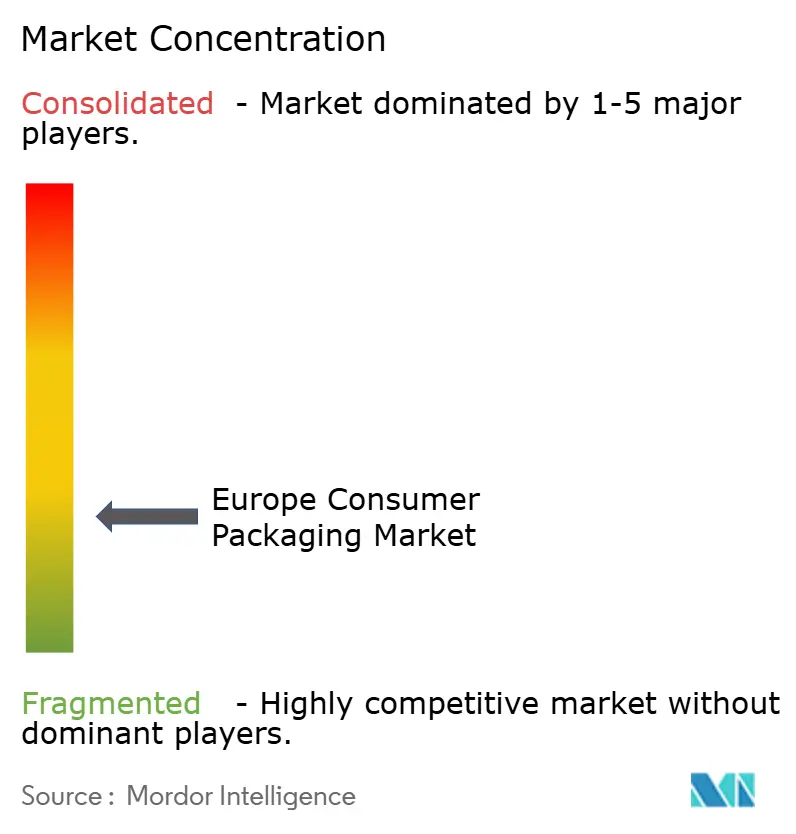
| Market Concentration | Low |
Major Players *Disclaimer: Major Players sorted in no particular order Image © Mordor Intelligence. Reuse requires attribution under CC BY 4.0. | |
Europe Consumer Packaging Market Analysis by Mordor Intelligence
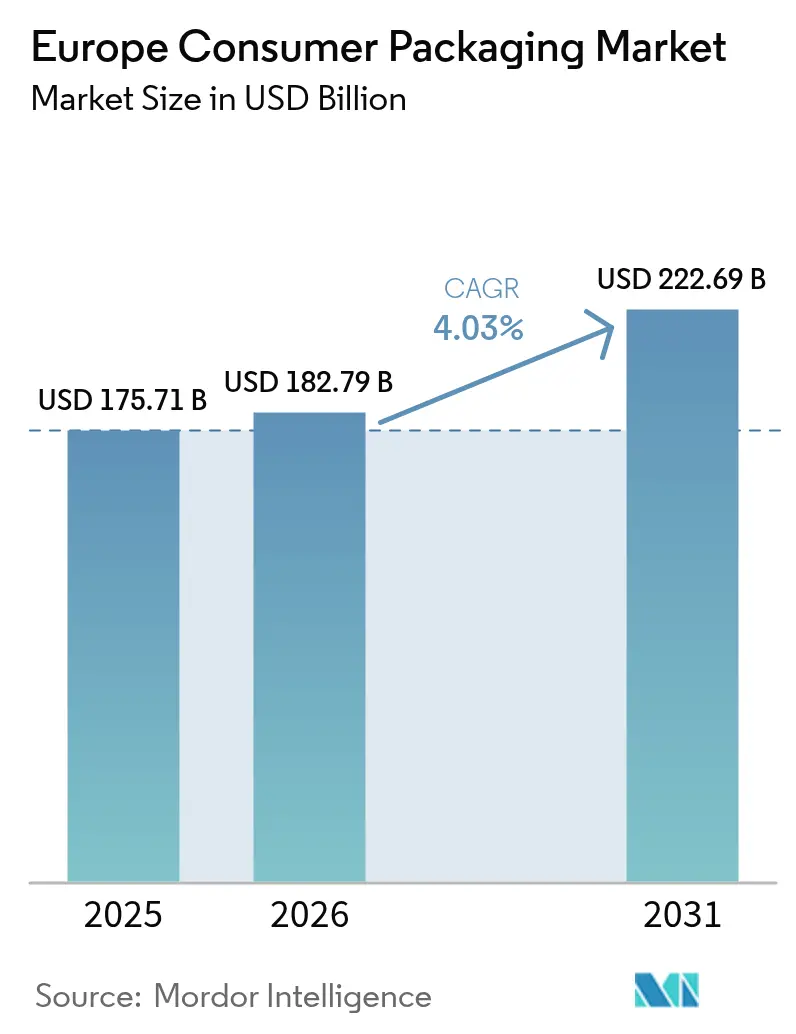
The Europe consumer packaging market size was valued at USD 175.71 billion in 2025 and estimated to grow from USD 182.79 billion in 2026 to reach USD 222.69 billion by 2031, at a CAGR of 4.03% during the forecast period (2026-2031). Growth is steered by the EU Packaging and Packaging Waste Regulation, accelerating brand commitments to closed-loop systems, and sustained momentum in e-commerce fulfillment.[1] Material substitution toward fiber, mono-PET, and lightweight metal formats is reshaping capital allocation, while energy-price shocks force converters to reassess operating footprints. The competitive field is further altered by digital printing, which shortens design-to-launch cycles and supports SKU fragmentation, and by deposit-return infrastructure that channels recycled feedstock into high-value beverage applications.
Key Report Takeaways
- By material, paper and board captured 35.22% the europe consumer packaging market share in 2025.
- By packaging format, the europe consumer packaging market for rigid solutions is projected to grow at a 5.62% CAGR between 2026-2031.
- By end-user industry, food applications captured 38.64% of the europe consumer packaging market share in 2025.
- By country, the europe consumer packaging market for Poland is projected to grow at a 5.15% CAGR between 2026-2031.
Note: Market size and forecast figures in this report are generated using Mordor Intelligence’s proprietary estimation framework, updated with the latest available data and insights as of 2026.
Worldwide, activity is shaped by contributions from multiple regions, with Europe representing one of the more structurally developed among them. The global report on consumer packaging market by Mordor Intelligence reflects how these regional layers combine into a single system.
Market Trends and Insights
Drivers Impact Analysis of Europe Consumer Packaging Market*
| Driver | (~) Impact on CAGR Forecast | Geographic Relevance | Impact Timeline |
|---|---|---|---|
| Convenience-driven demand for flexible plastic packs | +3.3% | Germany, France, United Kingdom | Medium term (2-4 years) |
| E-commerce boom creating last-mile packaging needs | +2.4% | Poland, Spain, core EMEA | Short term (≤ 2 years) |
| Shift toward lightweighting and easy-open formats | +2.0% | Germany, Netherlands, Nordics | Medium term (2-4 years) |
| EU Single-Use Plastics Directive spurring mono-material R&D | +2.8% | EU-27 | Long term (≥ 4 years) |
| Deposit-return schemes scaling rPET demand | +1.6% | Germany, France, Italy | Medium term (2-4 years) |
| Digital printing enabling SKU proliferation and short runs | +1.2% | Western Europe premium segments | Long term (≥ 4 years) |
| Source: Mordor Intelligence | |||
Convenience-driven demand for flexible plastic packs
Flexible formats continue to migrate volume from glass and metal as on-the-go consumption rebounds across urban corridors. Portion-controlled pouches with easy-open reclosable features meet the mobile lifestyle of 25- to 45-year-olds who prize portability and freshness. Price movements remain modest. 7-micron aluminum foil rose 4% in late 2024, but converters offset cost upticks through barrier-coated lightweight films that extend shelf life without adding bulk. Functionality now outweighs format loyalty, drawing liquid applications such as sauces and baby food toward spouted pouches and away from heavier rigid alternatives. The result is sustained share capture for flexibles in both food and personal-care aisles.
E-commerce boom creating last-mile packaging needs
Direct-to-consumer fulfillment adds multiple touchpoints where packs must survive conveyor drops, temperature shifts, and doorstep scrutiny. The PPWR mandates 40% reusable transport and sales packaging by 2030, pressuring retailers to harmonize automation with sustainability. Demand is surging for molded-fiber inserts and precision-engineered corrugated boxes that balance cushioning with dimensional efficiency. Poland and Spain show the steepest e-commerce penetration curves, widening the regional growth gap within the European consumer packaging market. Brand owners also leverage digital print to transform each parcel into a marketing canvas, elevating unboxing to a revenue lever rather than a cost center.
Shift toward lightweighting and easy-open formats
Pack owners cut material content by 10-15% while retaining barrier integrity through high-stretch alloys and multilayer polymer optimization. Ball’s 36 billion-unit 2024 EMEA can output demonstrates weight-down success without compromising performance. Ergonomic tabs and peel-off ends lighten cognitive and physical loads for aging consumers, satisfying regulatory accessibility objectives.[2]Freight savings multiply the cost benefit as retailers chase lower scope-3 emissions. Thin-wall PET bottles and ultra-light steel cans are reinforcing rigid packaging’s renaissance across beverages and household chemicals.
EU Single-Use Plastics Directive spurring mono-material R&D
Mono-PE and mono-PP films move from laboratory trials to commercial scale as converters replace traditional multilayer laminates that hinder recycling streams. Surface plasma coatings and vapor-deposited barriers deliver oxygen and moisture protection without foil or PET tie layers, aligning with the EU mandate that all packaging be recyclable by 2030. Copier-grade adhesives and de-inkable inks emerge as critical enablers for curbside compatibility. Capital inflows gravitate toward tech vendors offering integrated recyclable substrate systems, stimulating consolidation among specialty chemical suppliers.
Restraints Impact Analysis of Europe Consumer Packaging Market*
| Restraint | (~) Impact on CAGR Forecast | Geographic Relevance | Impact Timeline |
|---|---|---|---|
| Volatile polymer and paper pulp prices | -2.4% | All EU markets | Short term (≤ 2 years) |
| Expanding EU bans on difficult-to-recycle formats | -1.6% | EU-27 | Medium term (2-4 years) |
| Recycling gaps for multilayer flexibles | -1.2% | Western Europe | Long term (≥ 4 years) |
| Energy-price shocks inflating glass and metal costs | -2.0% | Energy-intensive regions | Short term (≤ 2 years) |
| Source: Mordor Intelligence | |||
Volatile polymer and paper pulp prices
Feedstock swings erode converter margins and disrupt pricing contracts fixed on quarterly indices. Polyethylene values softened in early 2024 amid weak downstream demand, yet PET tightened when Asian supply lines faltered, demonstrating the difficulty of forecasting input trajectories. On the fiber side, coated paper spiked nearly 10% in Q2 2024 before easing, driven by mill maintenance outages and logistics bottlenecks. Vertical integration into recycling or pulp assets is gaining favor, but it locks capital that could fund innovation or geographic expansion.
Expanding EU bans on difficult-to-recycle formats
National add-ons to EU rules generate a mosaic of compliance deadlines that strain design and inventory systems. Italy’s labeling statute requires granular disposal instructions, complicating shared artwork for pan-EU launches. Small converters frequently lack the engineering bandwidth to reformulate multi-layer pouches on tight timelines, which may accelerate market exits or mergers. Brands juggle dual inventories, legacy packs for exempt channels, and next-gen formats for regulated geographies, raising warehousing costs.
*Our forecasts treat driver/restraint impacts as directional, not additive. The impact forecasts reflect baseline growth, mix effects, and variable interactions.
Europe Consumer Packaging Market Segment Analysis
By Material:
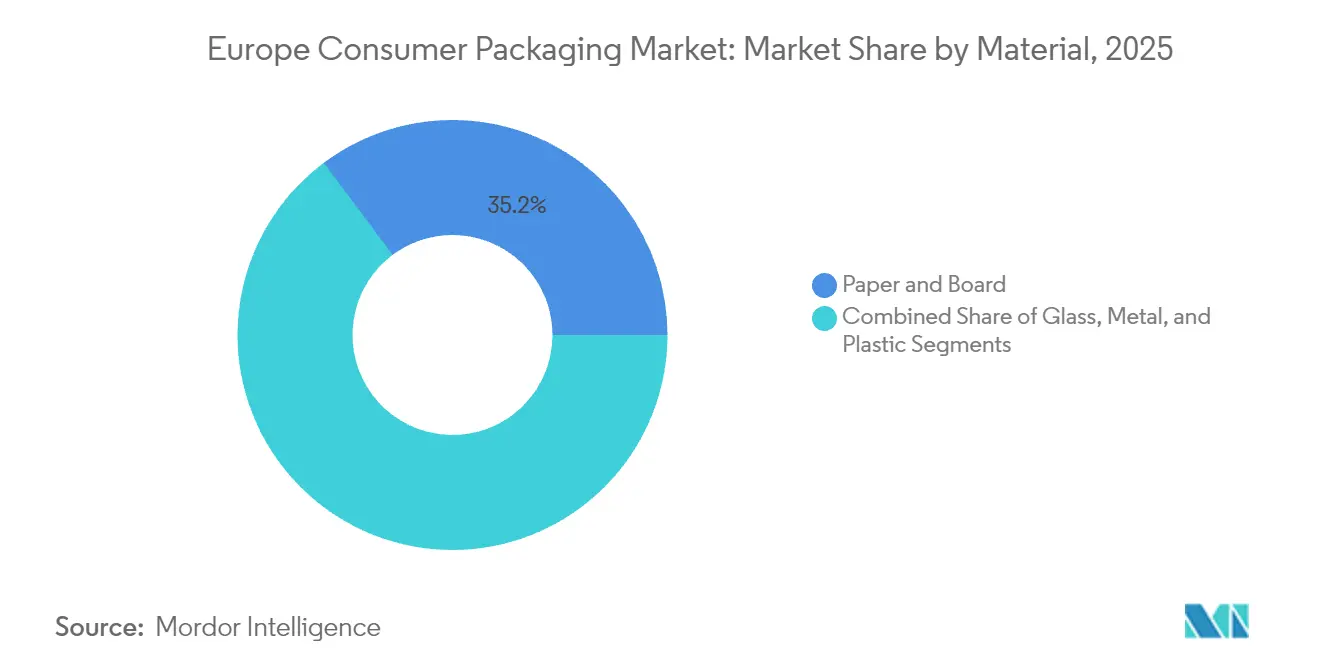
Paper Dominance Faces PET ChallengePaper and board defended 35.22% of 2025 revenue on the strength of e-commerce shippers and foodservice disposables. The Europe consumer packaging market size for paper-based solutions is projected to expand modestly as regulatory goodwill and consumer perception remain supportive. However, PET’s 5.74% CAGR underscores a decisive momentum swing driven by deposit-return economics and brand pledges for food-grade recycled content. Europe consumer packaging market share gains accrue to mono-PET beverage bottles that averaged 24% recycled resin in 2024, validating closed-loop viability. In contrast, PE and PP navigate headwinds from single-use caps, cutlery, and thin grocery bags disappearing under new bans.
The PET narrative is reinforced by mechanical recycling yields that reach 75% in optimized plants, narrowing the carbon delta versus fiber-based cartons. Meanwhile, glass lobbies are campaigning for EUR 20 billion in furnace electrification, but elevated electricity tariffs cloud competitiveness. Aluminum retains a strong circularity story, yet the liquidity of post-consumer can sheet fluctuates with regional redemption rates. Specialty polymers hold pockets of growth in pharma blister packs and personal-care pump components, where performance trumps uniform recyclability mandates.

By Packaging Format:
Rigid Growth Surprises MarketRigid formats counterintuitively post the fastest 5.62% CAGR through 2031 as mono-material clarity simplifies sortation and recapture. Brands leverage thinner gauges and alternative alloys to mitigate weight penalties, while consumer acceptance of lightweight cans and recycled-content PET jars improves shelf appeal. Flexible packs still own 47.58% of 2025 spending due to film thrift and logistical efficiency, but recyclability scoring under PPWR threatens complex laminates. Semi-rigid thermoforms emerge as a hybrid, coupling form stability with higher recycling rates than multilayer sachets.
Digital embossing and tactile coatings elevate rigid pack shelf presence, bolstering premium categories from nutraceutical gummies to single-origin coffees. Crown Holdings’ 5% European can volume uptick in Q3 2024 affirms beverage category resilience. Flexible converters respond with solvent-free lamination lines and mono-PE high-barrier films to safeguard their share. Format competition pushes R&D spending toward compatibility solutions, including detachable layers and water-soluble tie resins.
By End-user Industry:
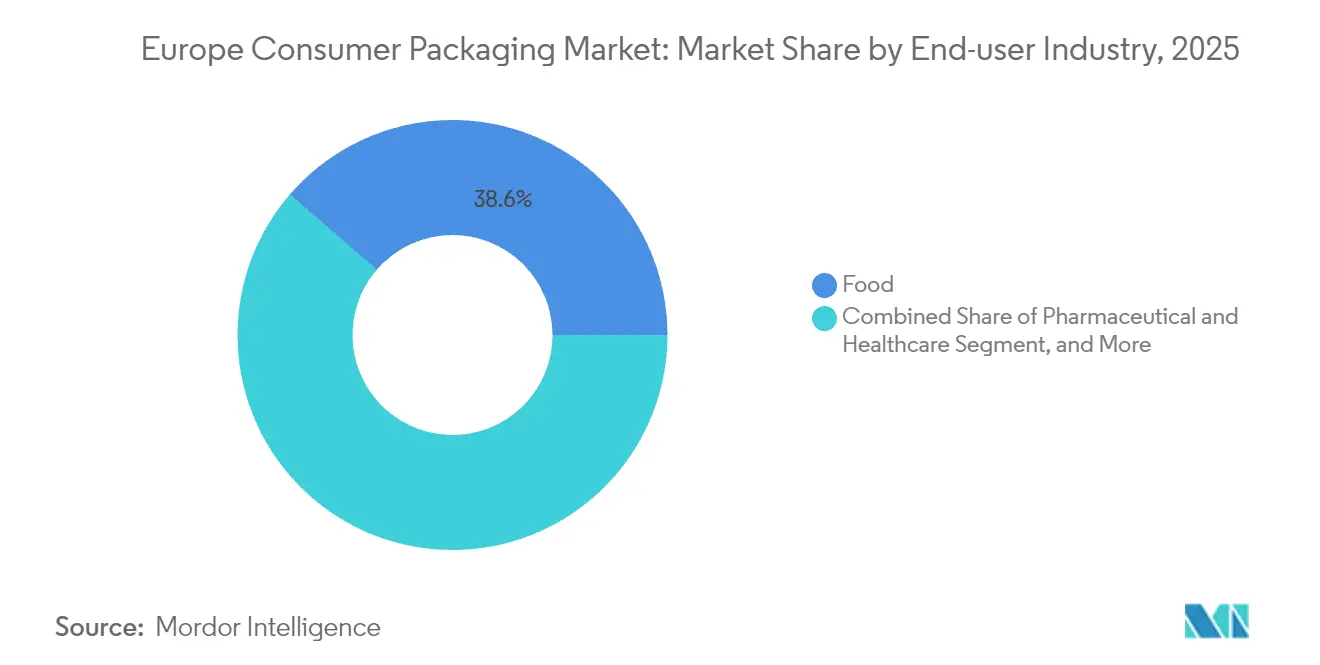
E-commerce Disrupts Traditional HierarchiesFood products contributed 38.64% of 2025 turnover thanks to established supply chains and mandatory shelf-life standards. Europe consumer packaging market size increments will keep food the anchor segment, yet e-commerce retail packs clock the fastest 6.11% CAGR as door-step fulfillment demands rugged, brandable formats. Beverages benefit from aluminum’s infinite recyclability and higher consumer recovery rates, though gas volatility adds margin risk.
E-commerce’s rise compels cosmetic and home-care brands to rethink secondary packaging, leading to corrugated inserts designed for social-media-friendly unboxing. Pharmaceuticals maintain stable growth on serialization and anti-counterfeit imperatives that require high-quality substrates and security inks. Niche industrial uses from EV battery components to precision electronics-drive uptake of molded pulp cushioning, showcasing the breadth of demand vectors inside the Europe consumer packaging market.
Geography Analysis
Germany Consumer Packaging Market
Germany anchors the Europe consumer packaging market with a 26.41% stake in 2025, supported by the continent’s most mature deposit-return logistics and an integrated recycling framework that hits 98% collection on aluminum beverage cans. Packaging producers cluster near automotive and FMCG corridors, leveraging automation to drive cost per thousand units lower than regional averages. Regulatory certainty and consumer eco-literacy justify ongoing investment in refillable glass and high-grade rPET infrastructure. Domestic growth tails off in volume, but value mix tilts upscale as brands deploy smart features such as NFC tags for provenance tracking.
Poland Consumer Packaging Market
Poland leads continental growth at 5.15% CAGR, spurred by rising household incomes and relocation of light-manufacturing plants from Western Europe and China. Government incentives coupled with EU cohesion funds modernize logistics corridors, trimming lead times for cross-border exports. E-commerce parcel density in Warsaw and Kraków surpasses 150 orders per 1,000 people weekly, amplifying corrugated and mailer demand. The forthcoming national deposit scheme primes PET and aluminum flows for closed-loop manufacturing, attracting extruder and flake-washing investment. Western converters enter joint ventures with Polish partners to hedge against labor cost inflation in core EU economies.
Broader European Markets
Southern and Western European markets France, Italy, Spain contribute scale but diverge in policy nuance. France fast-tracks a beverage deposit system, expanding reverse-vending machine fleets across retail chains. Italy mandates granular disposal labeling, compelling localized graphics lines, whereas Spain’s eco-modulation fees penalize virgin-plastic intensity, nudging brands toward fiber and compostables. The United Kingdom, while outside EU law, mirrors most PPWR goals and imposes a GBP 200 per tonne plastics tax on sub-30% recycled content, influencing cross-Channel pack decisions. Nordic economies carve a premium niche for bio-composites and fiber-based caps rooted in forestry supply chains, while the Benelux region pilots digital watermarking for high-speed sorting at MRFs, a technology expected to ripple across the Europe consumer packaging market over the forecast horizon.
Regulatory Landscape
The consumer packaging regulatory framework across Europe is being reshaped by the EU Packaging and Packaging Waste Regulation, Regulation (EU) 2025/40 (PPWR), which replaces Directive 94/62/EC. The PPWR entered into force on February 11, 2025 and becomes generally applicable on August 12, 2026, covering all packaging and packaging waste regardless of material or origin, and setting lifecycle requirements on sustainability, labeling, and circularity.
From August 12, 2026, compliance obligations extend across economic operators, including producer registration in each Member State where packaging or packaged products are made available, along with technical documentation and a Declaration of Conformity. The European Commission reinforced consistent interpretation through a Commission Notice (C/2026/3084) published on June 10, 2026, and the PPWR also brings hazardous substance limits, including restrictions affecting PFAS in food-contact packaging, into the compliance agenda from the same applicability date.
Value Chain Analysis
Europe's consumer packaging value chain spans raw-material supply (polymers, pulp and paper, glass batch, and metals), conversion (films, cartons, rigid containers, closures), filling and brand owners, and then distribution through retail and e-commerce. End-of-life systems increasingly influence upstream decisions: deposit-return and sorting infrastructure help steer higher-quality recycled feedstock into beverage and food-grade applications, while Extended Producer Responsibility practices and labeling requirements affect pack design, data capture, and supplier selection.
The chain is being re-optimized around compliance readiness and input volatility. With PPWR obligations applying from August 12, 2026, manufacturers, importers, and distributors are tightening traceability, conformity assessment processes, and documentation flows, while redesigning structures toward recyclable mono-material formats to protect EU market access. Upstream price shocks also remain a friction point for converters, and industry-reported Q2 2026 spikes in flexible substrates (for example, BOPP film and PET film) are pushing brand owners and converters toward regionalized sourcing, tighter pass-through clauses, and closer partnerships with recyclers and material innovators.
Competitive Landscape
Competition skews material-specific: Ball Corporation controls 39% of EMEA aluminum beverage can output, reflecting high capital barriers and entrenched brand contracts. Conversely, flexible packaging is fragmented, with more than 400 regional converters whose proximity advantages serve just-in-time delivery to food processors. M&A momentum leans toward scale and circularity; Mondi’s acquisition of Schumacher’s Western European assets expands Kraft-Liner's reach for e-commerce shippers.
Strategic levers center on vertical integration into recycled-material supply, automation that shrinks unit labor, and deployment of digital print fronts to capture premium runs. White-space innovation focuses on mono-material barrier flexibles, where converters pioneer plasma-coated PE films matched with de-inkable adhesives. Chemical suppliers partner upstream to deliver functional coatings that unlock recyclability credits under PPWR scoring.
Cost shocks from energy and feedstock volatility compress margins for glass and metal players, accelerating electrification pilots and renewable PPA contracts. Extended Producer Responsibility fees re-allocate end-of-life costs to producers, advantaging incumbents with closed-loop alliances. Certification under ISO 14001 and alignment to the European Sustainability Reporting Standards becomes a qualifier in tender bids, tightening procurement for suppliers lacking ESG credentials. Competitive intensity thus hinges less on price and more on regulatory fluency and proven circularity pathways within the Europe consumer packaging market.
Europe Consumer Packaging Industry Leaders
-
International Paper Company
-
Constantia Flexibles Group GmbH
-
Huhtamäki Oyj
-
Tetra Pak International SA
-
Amcor PLC
- *Disclaimer: Major Players sorted in no particular order
Europe Consumer Packaging Market Companies Covered in this Report
- Amcor PLC
- Huhtamäki Oyj
- Mondi PLC
- International Paper Company
- Tetra Pak International SA
- Ardagh Group S.A.
- Crown Holdings, Inc.
- Constantia Flexibles Holding GmbH
- Sealed Air Corporation
- Sonoco Products Company
- Stora Enso Oyj
- Smurfit Kappa Group Limited
- Ball Corporation
- Berry Global, Inc.
- Greiner Packaging International GmbH
- Albéa Group S.A.S.
- Gerresheimer AG
- Vetropack Holding AG
- Massilly Holding
Market Opportunities and Future Outlook
PPWR implementation creates whitespace for offerings that reduce compliance friction while improving recyclability, particularly mono-material structures, fiber-based packs with functional barriers, and approaches that simplify labeling and traceability for pan-European distribution. As the regulation is generally applicable from August 12, 2026 and requires all packaging placed on the EU market to be recyclable by 2030, converters and material suppliers able to deliver validated recyclable designs, food-contact suitable barrier performance, and documentation-ready specifications improve their position in retailer and brand tenders.
Recent moves by named suppliers also indicate where investment is concentrating. Coveris announced the acquisition of Germany-based GEFO in June 2026 to expand cast polypropylene (CPP) film capacity for sustainable, recyclable mono-material packaging. Tetra Pak introduced paper-based barrier cartons in April 2026 with commercialization partners, showing momentum behind barrier innovation that reduces reliance on traditional multi-material layers. On the capacity and footprint side, Van Genechten Packaging completed a EUR 10 million expansion at its VG Kvadra Pak facility in Riga, Latvia, which became operational from March 1, 2026, highlighting the opportunity around modernized, regionally placed packaging hubs aligned with European brand demand and logistics efficiency.
Recent Industry Developments in Europe Consumer Packaging Market
- June 2026: International Paper completed the USD 360 million acquisition of North Pacific Paper Company (NORPAC). The deal expands access to lightweight containerboard production capabilities, strengthening supply optionality for corrugated and e-commerce shipping packaging tied to European consumer goods flows.
- April 2026: Tetra Pak and Sterilgarda Alimenti launched an industry-first 1-litre aseptic carton featuring a paper-based barrier. The move advances fiber-based barrier performance in mainstream beverage cartons and supports brand conversion efforts aligned with recyclability and carbon-footprint objectives.
- April 2025: Amcor completed its combination with Berry Global. The transaction expands scale across consumer and flexible packaging platforms, increasing the ability to fund material innovation and to serve multinational brand owners with harmonized formats across Europe.
Europe Consumer Packaging Market Report Scope and Research Methodology
Market Definition and Coverage
This market covers the value of packaging used to pack consumer goods sold in Europe, counted across the main packaging materials and formats used to protect, store, and present products at retail.
Scope exclusions: Industrial bulk packaging used mainly for intermediate goods handling, and non-packaging printing services that do not result in a packaging unit, are excluded.
Segments Covered in This Report
- By Material
- Plastic
- PE (Polyethylene)
- PP (Polypropylene)
- PET (Polyethylene Terephthalate)
- PVC (Polyvinyl Chloride)
- Other Plastics
- Paper and Board
- Cartonboard
- Containerboard and Linerboard
- Molded Fiber
- Glass
- Metal
- Cans
- Caps and Closures
- Tubes
- Other Metals
- Plastic
- By Packaging Format
- Rigid
- Flexible
- Semi-rigid
- By End-user Industry
- Food
- Beverage
- Pharmaceutical and Healthcare
- Cosmetics, Personal and Home Care
- Other End-user Industry
- By Country
- Germany
- United Kingdom
- France
- Italy
- Spain
- Poland
- Rest of Europe
Data Sources, Market Sizing, and Validation
Desk Research
Desk work started with building a clean view of packaging demand by material and end-use, then mapping it to Europe and key countries. We relied on public sources such as Eurostat manufacturing and trade statistics, the European Commission updates on packaging and waste rules, UN Comtrade trade series, and national statistics offices that publish production and recycling indicators.
To keep inputs realistic, we also reviewed company annual reports, investor presentations, and credible press coverage on capacity changes, recycled content moves, and price trends. For cross-checks, analysts used paid subscriptions for company financials and intelligence, and an import and export shipment-level database to sense-check trade-linked flows of packaging materials. The sources listed here are illustrative only, and other public documents were reviewed to fill gaps, validate assumptions, and clarify definitions.
Primary Interviews and Surveys
Primary interviews were used to validate demand drivers and price direction, especially where public data is reported with delays or mixes categories. We spoke with packaging converters, material suppliers, brand-side procurement, and channel experts across major European markets, and the feedback was then used to adjust penetration assumptions and confirm the realism of forecast inputs.
Distribution of primary research fieldwork respondents
| Company type | Respondent position |
|---|---|
| Top tier: 34% | CXOs: 13% |
| Mid tier: 51% | Functional/Unit leaders: 27% |
| Smaller Players: 15% | Managers: 60% |
Market-Sizing & Forecasting
Sizing starts with a top-down build where packaging demand is reconstructed from country-level consumption indicators and packaged-goods output, then translated into packaging spend by applying material and format mixes. To keep totals grounded, selective bottom-up approximations are used as cross-checks, such as sampled price per kg or price per pack applied to implied volumes, plus channel checks on typical price moves.
Key model inputs include packaging material shares (plastic, paper and board, metal, and glass), the rigid versus flexible split, packaged food and beverage output trends, e-commerce shipment intensity (which changes secondary packaging needs), and recycling and deposit-return developments that influence substitution and lightweighting. Forecasts were built using scenario analysis around regulation timelines and cost pass-through, then aligned to expert consensus on how quickly brands can switch materials and how price progression is likely to behave. When bottom-up signals are incomplete for smaller countries or niche formats, gaps are handled by ratio-based extrapolation from similar markets, followed by a reasonableness check against trade and production series.
Data Validation & Update Cycle
Outputs are validated through multiple checks so results do not drift away from real market signals. We compare totals against independent indicators such as packaging material production trends, trade balances, and reported capacity changes, then investigate any large variances before the model is finalized.
A second analyst review is done for definitions, math consistency, and year-over-year movements, and interview follow-ups are triggered when pricing or substitution assumptions look inconsistent with current commentary. Reports are refreshed annually, and interim updates are made when major policy changes, energy shocks, or demand swings materially shift the outlook. Before delivery, the latest public releases are rechecked so clients receive an updated view.
Mordor Intelligence's Europe Consumer Packaging Market Size Compared With Other Published Estimates
Published market numbers for Europe consumer packaging do not always match because teams can start from different packaging definitions, country coverage, and timing assumptions for price changes. Differences also show up when one study mixes consumer packaging with broader packaging activity, or when currency timing and update cadence are not aligned.
Some external estimates appear to use a wider European packaging scope and faster value growth assumptions that can amplify the total when pricing is moving. In Mordor Intelligence, the value is counted for consumer packaging demand across the core materials and formats, and the country roll-up is reconciled to production and trade signals before the final number is published.
Benchmark comparison
| Source | Market Size | Gaps in Research Methodology |
|---|---|---|
| Mordor Intelligence | USD 175.71 B (2025) | |
| Global Consultancy A | USD 242.00 B (2024) | Uses an earlier base year and a broader packaged-scope framing with limited visibility on how consumer-only packaging is separated from adjacent packaging activity, which can raise the stated total. |
| Trade Journal B | USD 241.00 B (2024) | Cites a market-wide packaging figure that can include transport and secondary packaging beyond consumer packs, and the method details behind price and scope filters are not fully described. |
The spread in values mainly comes from how tightly consumer packaging is defined, and whether transport and wider packaging uses are included in the same pool. By keeping demand drivers, material splits, and pricing logic traceable to observable signals, the approach produces a practical number that can be repeated and checked year to year.
Key Questions Answered in the Report
What is the current value of the Europe consumer packaging market?
It is valued at USD 182.79 billion in 2026 and is projected to reach USD 222.69 billion by 2031.
How fast is the market expected to grow?
The forecast CAGR stands at 4.03% between 2026 and 2031.
Which material segment is expanding the quickest?
PET posts the fastest 5.74% CAGR, buoyed by deposit-return systems and recycled-content mandates.
Why is Poland the fastest-growing national market?
Manufacturing capacity shifts, low labor costs, and surging e-commerce adoption deliver Poland a 5.15% CAGR through 2031.
How are EU regulations influencing packaging design?
The PPWR requires all packs be recyclable by 2030, driving a pivot toward mono-material structures and higher recycled-content ratios.
Which end-user category is gaining the most momentum?
E-commerce retail packs are advancing at a 6.11% CAGR amid rising direct-to-consumer shipments.