
Market Overview
| Study Period | 2020 - 2031 |
|---|---|
| Forecast Data Period | 2026 - 2031 |
| Base Year Market Size (2025) | USD 75.24 Billion |
| Market Size (2026) | USD 78.58 Billion |
| Market Size (2031) | USD 97.64 Billion |
| Growth Rate (2026 - 2031) | 4.44 % |
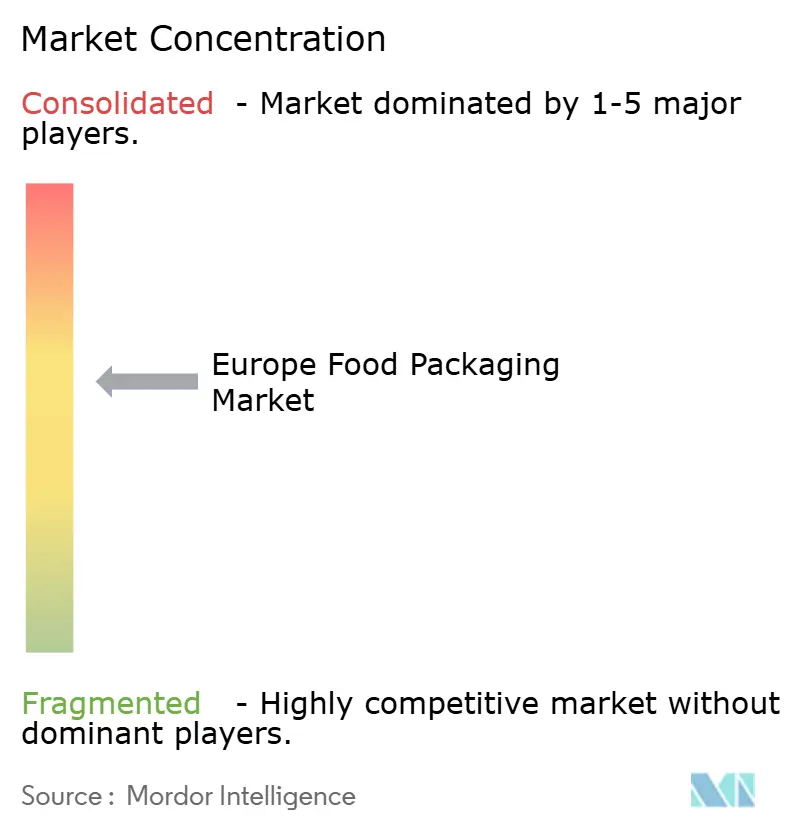
| Market Concentration | Medium |
Major Players *Disclaimer: Major Players sorted in no particular order Image © Mordor Intelligence. Reuse requires attribution under CC BY 4.0. | |
Europe Food Packaging Market Analysis by Mordor Intelligence
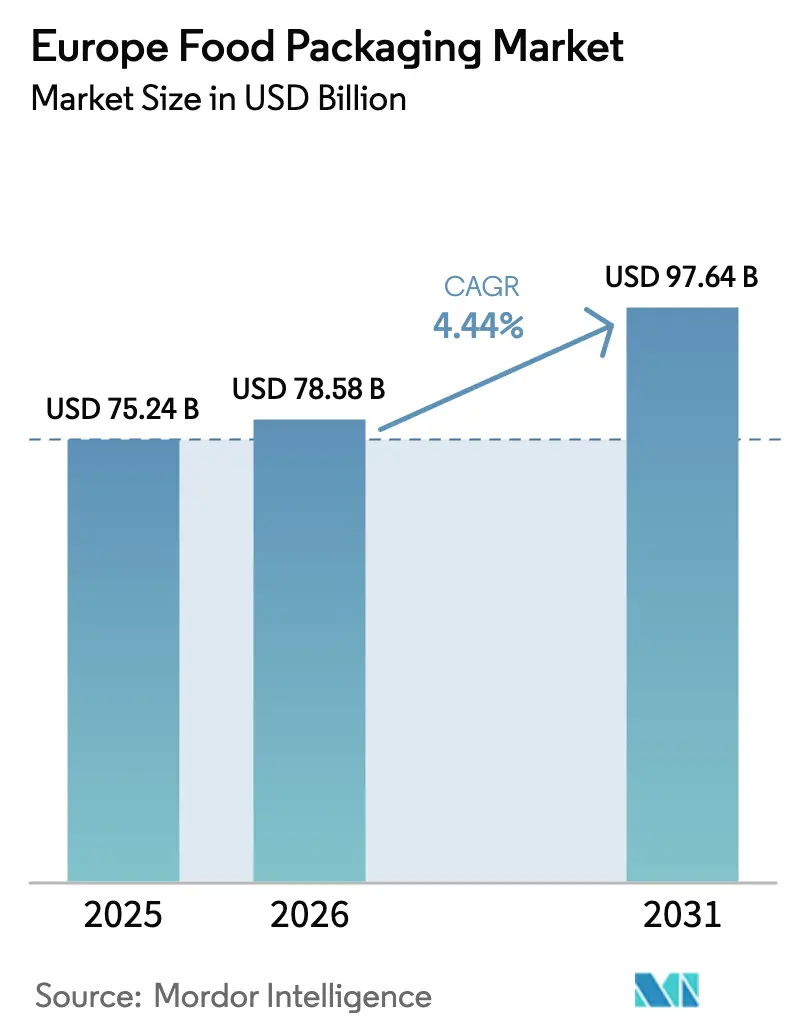
The Europe food packaging market size was valued at USD 75.24 billion in 2025 and estimated to grow from USD 78.58 billion in 2026 to reach USD 97.64 billion by 2031, at a CAGR of 4.44% during the forecast period (2026-2031). Robust demand for recyclable barrier materials, rising e-commerce grocery volumes, and a widening cold-chain footprint across Central and Eastern Europe are anchoring this trajectory. The EU Packaging and Packaging Waste Regulation (PPWR) is accelerating capital flows into recycling infrastructure and post-consumer resin (PCR) sourcing, allowing brand owners to meet the 30% recycled-content target for plastic beverage bottles by 2030.[1]European Commission, “Packaging and Packaging Waste,” europa.eu At the same time, rapid urbanization and smaller household sizes are spurring single-portion and convenience formats that rely on high-barrier films. Cold-chain expansion, exemplified by automated mega-warehouses in Poland and Hungary, is cementing demand for temperature-resistant packs that combine modified-atmosphere (MAP) and active-antimicrobial technologies. However, volatile polymer and aluminum prices continue to squeeze converters’ gross margins, encouraging vertical integration and recycled-content hedging strategies.
Key Report Takeaways
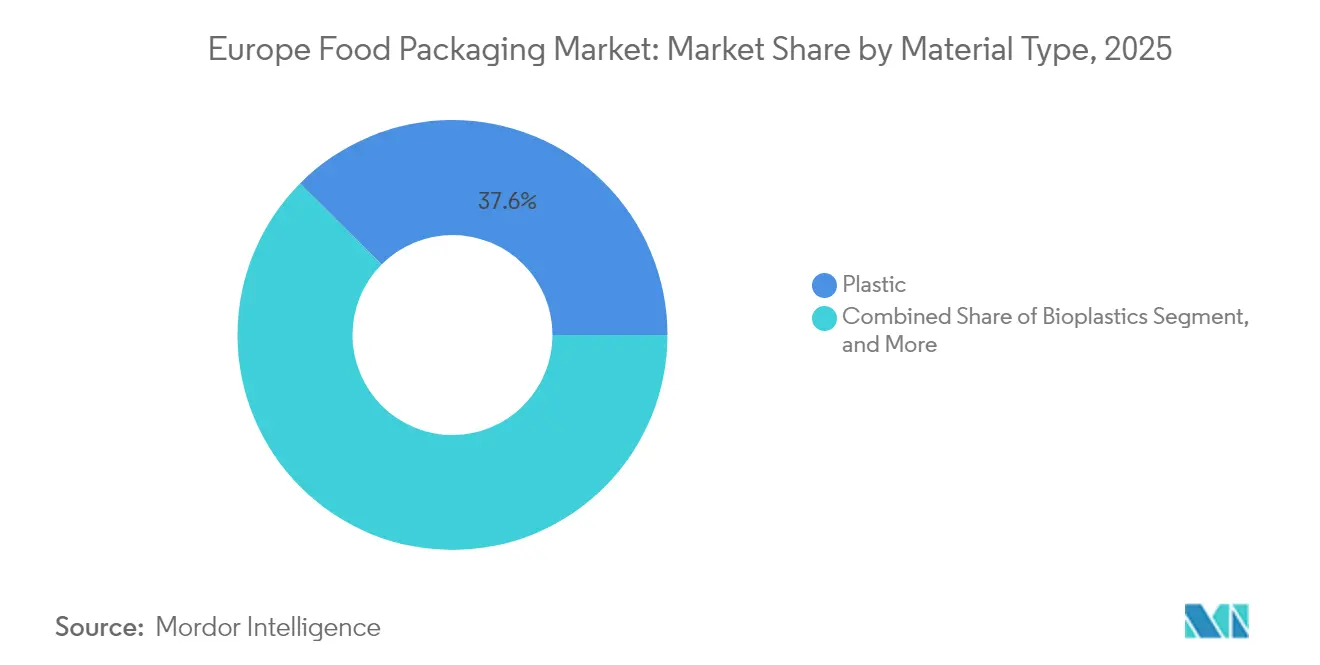
- By material, plastics retained 37.55% of Europe food packaging market share in 2025 while bioplastics are projected to post a 7.24% CAGR through 2031.
- By product type, bottles and containers held 30.88% revenue share of the Europe food packaging market size in 2025, whereas films and wraps are set to rise at a 6.52% CAGR to 2031.
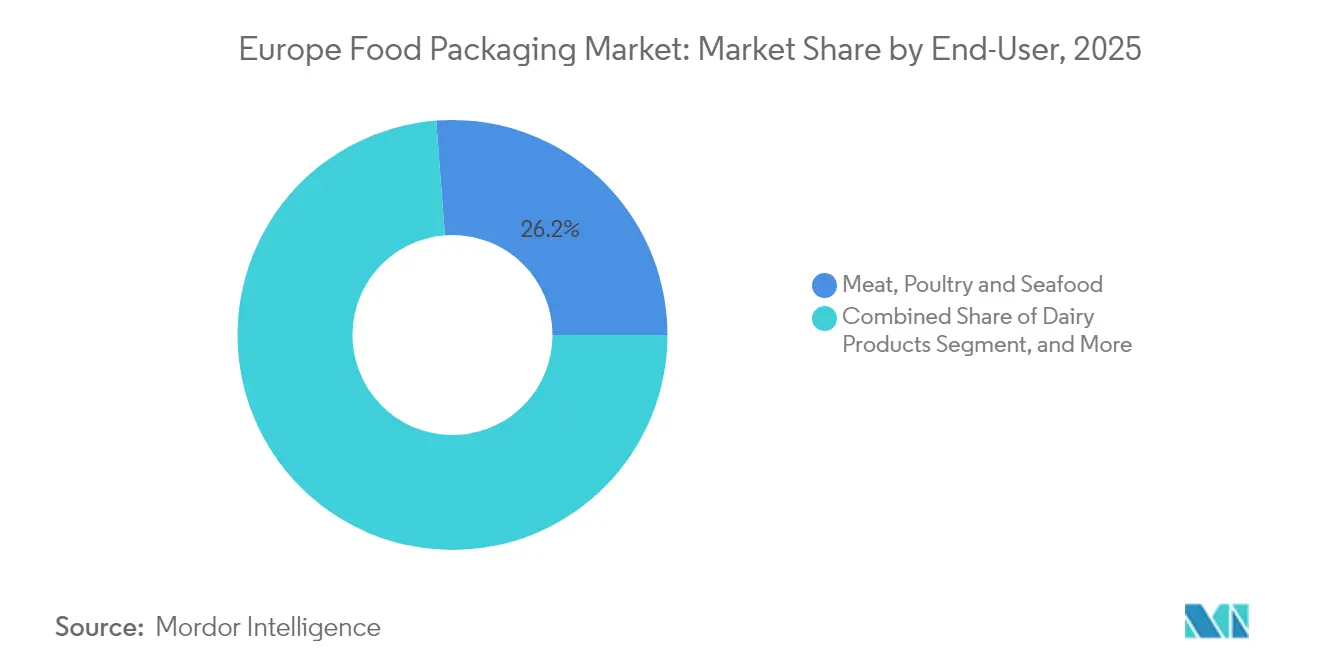
- By end-user, meat, poultry, and seafood applications led with 26.21% share of the Europe food packaging market size in 2025, while ready meals and convenience foods will accelerate at a 6.18% CAGR between 2026-2031.
- By packaging technology, modified-atmosphere systems commanded 28.61% of Europe food packaging market share in 2025; active and intelligent formats exhibit the fastest 7.63% CAGR through 2031.
- By country, Germany accounted for the largest national share in 2025, whereas Poland is predicted to log the highest mid-single-digit CAGR to 2031.
- Amcor, Mondi, Smurfit WestRock, Sealed Air, and Huhtamäki jointly controlled nearly 34.60% of 2025 revenue, reflecting a moderately consolidated landscape in Europe food packaging market.
Note: Market size and forecast figures in this report are generated using Mordor Intelligence’s proprietary estimation framework, updated with the latest available data and insights as of 2026.
Europe Food Packaging Market Trends and Insights
Drivers Impact Analysis*
| Driver | (~) % Impact on CAGR Forecast | Geographic Relevance | Impact Timeline |
|---|---|---|---|
| Rapid growth of food-service and take-away formats | +0.8% | Western Europe core, expanding to CEE | Short term (≤ 2 years) |
| E-commerce grocery boom accelerating secondary packaging demand | +0.7% | Germany, UK, France lead, spreading EU-wide | Medium term (2-4 years) |
| EU food-safety rules boosting high-barrier solutions | +0.6% | EU-27 uniform application | Long term (≥ 4 years) |
| Sustainability push toward recyclable and paper-based formats | +0.9% | Nordic countries lead, EU-wide adoption | Medium term (2-4 years) |
| Cold-chain expansion in CEE heightening demand for temperature-resistant packs | +0.5% | Poland, Hungary, Czech Republic focus | Medium term (2-4 years) |
| Demographic shift toward smaller households driving single-portion packs | +0.4% | Germany, Netherlands, Denmark highest impact | Long term (≥ 4 years) |
| Source: Mordor Intelligence | |||
Rapid growth of food-service and take-away formats
Take-away meals jumped 28% year over year in Germany during 2024, powered by platform aggregators and workplace mobility shifts. Operators seek multi-compartment and leakproof packs that remain compliant with the Single-Use Plastics (SUP) Directive’s reuse stipulations. Reusable container schemes, despite incurring operating costs 15-20% higher than disposables, are rolling out in quick-service chains to mitigate levy exposure. Packaging suppliers are responding with dishwasher-durable PP and molded-fiber solutions fitted with scannable tracking codes for reverse logistics. For small independents, hybrid paper-plastic packs that achieve recyclability without dishwashing present a pragmatic bridge solution. Demand concentration remains strongest in the top-25 EU cities, yet smaller Central European capitals are posting double-digit volume growth, indicating wider market penetration ahead.
E-commerce grocery boom accelerating secondary packaging demand
Online grocery penetration hit 8.3% of European food retail in 2024, reshaping packaging specifications for ship-to-home fulfillment. Temperature swings during last-mile delivery require insulation liners and moisture barriers that traditional shelf-ready packs never encountered. Flexible films with integrated air pouches now dominate fresh produce shipments because they offer protective cushioning at one-tenth the grammage of rigid plastics, trimming freight weight and carbon score alike. Grocers simultaneously wrestle with the PPWR’s source-reduction targets, prompting pack-design algorithms that cut void space by 12-15% per parcel. Reverse logistics for ice packs and insulation is emerging as a service niche for logistics firms in Germany and the Netherlands. As cold-chain parcel density rises, packaging converters positioned with rapid-response prototyping and mixed-material competence are winning multi-year supply contracts.
EU food-safety rules boosting high-barrier solutions
EFSA cleared 23 new active-packaging substances in 2024, widening the toolbox for oxygen, ethylene, and moisture scavengers that stretch shelf life by up to 40% in high-protein foods. Retailers are mandating these high-barrier packs to minimize markdowns from spoilage as inventory transit times lengthen inside regional distribution hubs. Advanced metallized PET and EVOH co-extrusions now appear routinely in chilled ready meals and premium cheeses. Breadth of adoption, however, varies by price segment; discount grocers favor simpler MAP while premium chains absorb the incremental 3-5 ¢ per pack for active layers. Compliance verification is tightening, requiring converters to supply migration test data under EU Regulation 10/2011. Companies with in-house barrier-film extrusion and analytical labs thus gain a speed-to-market edge.
Sustainability push toward recyclable and paper-based formats
Paperboard recycling already exceeds 75% across the bloc, but upcoming PPWR amendments seek 85% by 2030, catalyzing adoption of aqueous-coated fiber wraps for dry snacks and confectionery. Nordic mills have commercialized dispersion-barrier cartons that tolerate light oils, unlocking cereals and frozen bakery niches formerly served by PE-lined solutions. Nevertheless, moisture-sensitive applications still rely on ultra-thin PE or bio-based PLA tie layers, complicating fiber recovery. R&D labs are piloting enzymatic delamination to detach coatings at pulp plants, an advance that could lower recycling yields’ energy footprint by 8-10%. Large brands are publicly committing to “design for fiber” roadmaps to align with forthcoming extended producer responsibility (EPR) modulated fees that reward mono-material designs.
Restraints Impact Analysis*
| Restraint | (~) % Impact on CAGR Forecast | Geographic Relevance | Impact Timeline |
|---|---|---|---|
| Volatile polymer and aluminium feedstock prices | -0.9% | Global impact, EU manufacturing concentrated | Short term (≤ 2 years) |
| EU Single-Use Plastics (SUP) Directive compliance costs | -0.7% | EU-27 uniform application | Medium term (2-4 years) |
| Skilled-labour shortages in packaging-machinery operations | -0.4% | Germany, Netherlands highest impact | Long term (≥ 4 years) |
| Climate-linked uncertainty in bioplastic feedstock supply | -0.3% | Southern Europe agricultural regions | Medium term (2-4 years) |
| Source: Mordor Intelligence | |||
Volatile polymer and aluminum feedstock prices
Virgin LDPE and PP contract prices swung 15-20% quarter-to-quarter through 2024, tied to energy cost spikes and Middle-East cracker turnarounds, eroding converters’ margin visibility. Aluminum ingot rose 18% over H1 2024 before retreating in Q3, compelling can-sheet rollers to renegotiate annual supply agreements. Mid-tier converters with limited hedging facilities are adopting dual-sourcing strategies and raising PCR content to buffer fluctuations. Nonetheless, recycled resin trades at a 10-15% premium to virgin in high-purity grades, limiting immediate savings. Film extruders are experimenting with mass-balance PP blends that permit incremental PCR incorporation without sacrificing seal integrity, aiming to protect brand owners from future cost shocks.
EU Single-Use Plastics Directive compliance costs
The SUP Directive’s widened product list now covers certain lids, caps, and stirrers, forcing SMEs to divert EUR 2 million (USD 2.314 million ) per plant toward tooling conversion and certification, according to industry association. Tooling lead times of up to 10 months prolong revenue disruption, nudging family-owned converters to consider strategic alliances or outright exits. National transpositions vary: France enforces a deposit on take-away cups; Germany imposes mandatory reusable options for outlets exceeding 80 m². Such divergence adds layer-on-layer complexity for pan-European food-service chains that standardize SKUs. Early-mover converters specializing in molded fiber or reusable PP lines report order backlogs extending into 2026, underscoring a supply-demand mismatch that will linger through the compliance horizon.
*Our forecasts treat driver/restraint impacts as directional, not additive. The impact forecasts reflect baseline growth, mix effects, and variable interactions.
Segment Analysis
By Material Type: Bioplastics Scale Yet Battle Feedstock Risk
Plastic retained a 37.55% stake in Europe food packaging market share in 2025, supported by entrenched extrusion assets and continuously improving PCR streams. Bioplastics, while only a mid-single-digit slice of Europe food packaging market size, will post the highest 7.24% CAGR thanks to regulatory credits and retailer carbon pledges. The spread of closed-loop recycling hubs has stabilized rPET and rHDPE supply, enabling converters to hit 30% PCR thresholds without mechanical-property penalties. In parallel, fiber-based packs upgraded with water-borne dispersion coatings are cannibalizing thin-wall PP yogurt cups, reflecting advances that narrow the moisture barrier gap.
Growth prospects for bioplastics hinge on overcoming agricultural supply shocks and certification fragmentation. Southern Europe drought episodes curbed PLA resin output by low single digits in 2024, awakening interest in non-crop-based PHA and bacterial-cellulose films. Producers are lobbying for a harmonized “compostable at home” mark to reassure consumers and unlock municipal collection scale. Should EU Eco-design rules grant higher EPR rebates to compostables, the delta between bio- and petro-based solutions could compress, accelerating substitution.



By Product Type: Films and Wraps Leverage E-Grocery Logistics
Bottles and containers commanded 30.88% of 2025 revenue, anchored by beverage and dairy stalwarts. Films and wraps, however, will outpace all formats at 6.52% CAGR as they underpin the protective secondary layer demanded by online grocery fulfilment. Retailers favor multi-layer PE-PA structures that pair puncture resistance with peel-and-reseal convenience, elevating customer unboxing satisfaction scores. Trays and lids are evolving into mono-PET platforms to harvest recycle-ready credentials, while caps and closures integrate tethered designs to meet SUP rules and curb litter.
Advanced films adopting antimicrobial or antioxidant additives are migrating from premium meats into mainstream produce, extending shelf life by up to 5 days and shrinking shrinkage rates. Lightweighted shrink films allow pallet stabilization with 15% less material, contributing to PPWR reduction mandates. As corrugated e-commerce boxes slim down, wrapped primary packs shoulder greater cushioning duties, reinforcing the indispensability of flexible materials.
By End-User: Convenience Lifestyles Fuel Ready-Meal Momentum
Meat, poultry, and seafood preserved their 26.21% lion’s share of Europe food packaging market size in 2025, underpinned by stringent cold-chain standards and protein popularity. Yet ready meals and convenience foods will expand fastest at 6.18% CAGR as time-pressed urban consumers swap scratch cooking for microwaveable dishes. MAP trays blended with PP-EVOH maintain integrity through dual-oven cycles, delivering shelf life above 10 days without additives. Dairy packaging, historically rigid, is adopting thin-wall thermoformed PET pots paired with snap-fit paperboard over-sleeves to signal eco-wins without compromising mechanical protection.
Portion-controlled snack kits serving one to two people deliver premium per-gram margins and foster repeat purchases. Modified-atmosphere adoption in sushi and salads jumped double digits in 2024, evidencing retailers’ appetite for high-margin fresh aisles that depend on airtight, clear-barrier PET lidding. Government food-loss targets are reinforcing this shift by promoting pack formats that align quantity with consumption behavior.
By Packaging Technology: Active and Intelligent Converge Around Shelf-Life
Modified-atmosphere technology remained the top choice with 28.61% revenue share in 2025 owing to its broad applicability and proven ROI. Europe food packaging market size for active and intelligent formats, though smaller, is forecast to clock the tallest 7.63% CAGR as EFSA clears new oxygen scavengers and smart ink sensors. QR-code freshness indicators printed in-line enable distributors to triage near-expiry stock in real time, cutting waste and bolstering ESG metrics. Aseptic filling retains a stronghold in beverages and soups but faces cost pressure from ambient-stable retort pouches that slash logistics energy by eliminating chilled storage.
Vacuum skin packaging (VSP) continues to gain in premium red meat, delivering enhanced visual appeal while providing leakproof presentation. Edible films made from whey protein or seaweed derivatives are entering pilot trials for cheese slices and snack bars, foreshadowing a dissipation of the pack itself into consumable form over the long haul.
Geography Analysis
Germany accounted for the largest national slice of Europe food packaging market in 2025, benefiting from a mature recycling infrastructure that achieved a 67% packaging recovery rate. Domestic converters leverage dual systems and deposit schemes to secure steady PCR feedstock, buffering virgin-resin price shocks. France maintains leadership in premium and AOC-certified foods, driving sophisticated barrier requirements, particularly in wine, cheese, and pâtisserie categories. Italy’s flex-pack specialists are pioneering low-solvent gravure inks that reduce VOC emissions, aligning with stringent Lombardy air-quality ordinances.
The United Kingdom’s post-Brexit deviation from EU rules offers an experimental sandbox where graphene-enhanced barrier films gained regulatory clearance in late 2024, granting early-mover rights to local innovators. Spain’s fruit-export corridors rely heavily on MAP liners to reach Scandinavian buyers, underpinning a healthy replacement cycle for vented crates and breathable bags. Central and Eastern Europe represent the fastest-climbing sub-region: Poland alone is projected to outpace the continental average by 150 basis points as supermarkets scale and frozen food exports proliferate.Hungary and Czechia mirror this upswing, propelled by tax incentives for cold-storage investment. Nordic countries, meanwhile, register the highest per-capita use of fiber-based packs, with Sweden and Finland recording 85% collection rates for paper packaging in 2025. Tabularizing these contrasts shows a continent of micro-markets, each demanding tailored compliance, material, and branding strategies.
Regulatory Landscape
The Europe food packaging market operates under a tightening EU framework led by the Packaging and Packaging Waste Regulation (PPWR), Regulation (EU) 2025/40. Adopted on 19 December 2024, it entered into force on 11 February 2025 and applies from 12 August 2026. The PPWR sets EU-wide requirements, including that packaging placed on the EU market must be recyclable by 2030, and it tightens material compliance for food-contact uses. This includes restrictions on PFAS above specified concentration limits starting 12 August 2026, with no transitional period for exhaustion of stocks.
Member States administer and enforce compliance largely through controls tied to extended producer responsibility (EPR) and recycling targets. That structure raises the value of documentation and conformity systems across converters and brand owners. In March 2026, the European Commission published implementation guidelines and FAQs to support PPWR rollout, reinforcing near-term demand for verified declarations, traceability, and migration and safety evidence when food-contact performance is critical.
Value Chain Analysis
Europe food packaging value creation starts with upstream feedstocks (virgin and recycled polymers, paper and pulp, aluminum, and glass), along with additives, before moving to converting (extrusion, thermoforming, molding, carton converting, printing, and lamination) and then to filling and packing by food processors and brand owners. Secondary and tertiary packaging, distribution, and cold-chain logistics matter for e-grocery and cross-border trade, while end-of-life routes (collection, sorting, mechanical and chemical recycling, and fiber recovery) increasingly shape pack design decisions under PPWR.
The PPWR also raises coordination requirements across the chain, particularly around traceability, declarations of conformity, and risk management. Converters need to align material specifications with recyclers and retailers, which influence shelf standards and the scope of reuse pilots. Networked collaboration platforms, including the European Commission-supported S3 Partnership on Food Packaging and Value4Pack (involving clusters across multiple European countries through October 2025), reflect a more interconnected model where packaging suppliers, food producers, logistics providers, retailers, and recyclers work on recyclable barrier structures and fiber substitutions for complex multilayer formats.
Competitive Landscape
The market is moderately consolidated: the top five players Amcor, Mondi, Smurfit WestRock, Sealed Air, and Huhtamäki collectively controlled around 35% revenue in 2024, a level that grants scale purchasing power yet leaves white-space for nimble regional firms. Amcor’s USD 55 million buyout of Moda Systems brought digital-printing agility suitable for micro-runs and personalized SKUs, a core demand in direct-to-consumer food channels.[3]Amcor, “Amcor Acquires Moda Systems,” amcor.com Smurfit WestRock’s 2024 merger forged the world’s largest corrugated supplier, enabling cross-Atlantic know-how transfer in lightweight containerboard.
Sustainability credentials are a competitive battleground. Huhtamäki’s EUR 45 million (USD 52.04 million) fiber-molding expansion caters to quick-service chains coping with SUP restrictions on EPS and PS. Sealed Air’s launch of antimicrobial pouches, cleared by EFSA, extended red-meat shelf life by up to 40%, winning supply contracts with pan-EU retailers. Mid-cap innovators specializing in mono-material laminates and enzymatic de-inking report double-digit growth and are prime acquisition targets as incumbents bolster technology stacks.
Patent filings for active packaging climbed 28% in 2024, signaling ongoing R&D dynamism despite margin pressure. Players unable to finance innovation are forming joint ventures with academia to share risk while keeping a foot in premium niches. Overall, competition blends scale efficiency, regulatory fluency, and sustainability positioning.
Europe Food Packaging Industry Leaders
Amcor plc
Mondi plc
Smurfit WestRock
Tetra Laval International S.A.
Huhtamäki Oyj
- *Disclaimer: Major Players sorted in no particular order

Market Opportunities and Future Outlook
PPWR application from 12 August 2026 creates near-term whitespace for redesigns in food-contact packaging, especially where barrier performance and recyclability must be managed together (mono-material structures, recyclable coatings for fiber, and compliant additives). Investment signals from large converters point to upgrades in capacity and process capability linked to these requirements. That includes Smurfit WestRock's announced EUR 600 million modernization and decarbonization program for its French operations (July 2026) and Amcor's investment in a new printing line at Hardenberg, Netherlands, with commissioning starting in summer 2026 and full operation in autumn 2026.
Fiber-based barrier innovation is another opportunity area as brands look to reduce plastic complexity without weakening shelf-life performance. Tetra Pak's EUR 60 million pilot plant investment in Lund, Sweden, aimed at paper-based barrier technology, indicates a route for scaling paper-based barriers in broader food applications. EU-backed R&D efforts such as R3PACK (fiber-based alternatives to complex multilayer plastics) and ViSS (non-toxic, recyclable, biodegradable PHBV packaging from industrial organic residues) also highlight continuing work on substrates, coatings, and processing know-how that converters can draw on for pan-European food brands.
Recent Industry Developments
- June 2026: Tetra Pak partnered with Jealsa to launch the first carton packaging for shelf-stable tuna using Tetra Recart, initially rolled out in Sweden. The launch expands the use of carton formats in seafood and strengthens paper-based barriers and recyclability for seafood packaging.
- April 2026: Tetra Pak partnered with Sterilgarda Alimenti to launch an industry-first 1-litre aseptic carton featuring a paper-based barrier. The industry-first 1-litre aseptic carton with high renewable content boosts renewable content and barrier performance, aligning with PPWR goals.
- April 2026: Amcor collaborated with Metsa Group and G. Mondini to launch an integrated fibre-based tray system for protein and chilled ready-meal applications, to be demonstrated at Interpack 2026. The fiber-based tray system supports a shift toward fibre-based, recyclable formats and points to changing dependencies versus traditional plastics.


Research Methodology Framework and Report Scope
Market Definition and Coverage
For this methodology, the Europe food packaging market is defined as the value of packaging materials and formats used to pack food products sold through retail and foodservice channels across European countries.
Scope exclusions: We exclude packaging machinery, contract packing services, and non-food end uses (such as pharma and personal care packs) even if the same materials are used.
Segmentation Overview
- By Material Type
- Plastic
- Paper and Paperboard
- Metal
- Glass
- Bioplastics
- By Product Type
- Bottles and Containers
- Cartons and Pouches
- Cans
- Films and Wraps
- Trays, Caps and Closures
- By End-user
- Fruits and Vegetables
- Meat, Poultry and Seafood
- Dairy Products
- Bakery and Confectionery
- Ready Meals and Convenience Food
- By Packaging Technology
- Modified-Atmosphere Packaging (MAP)
- Aseptic Packaging
- Vacuum Skin Packaging
- Active and Intelligent Packaging
- Edible and Biodegradable Films
- By Country
- United Kingdom
- Germany
- France
- Italy
- Spain
- Rest of Europe
Data Sources, Market Sizing, and Validation
Desk Research
Desk research was used to set the market boundaries and to anchor the model to real-world packaging activity in Europe. We leaned on public statistics and technical references such as Eurostat production and trade series, European Commission updates on packaging and waste rules, and trade body publications in the food and packaging ecosystem that publish demand and recycling indicators.
To avoid building the model from a single data stream, the desk phase also used company annual reports, investor presentations, and reputable news coverage for capacity additions, resin and paper price direction, and sustainability commitments that change material mix. Where needed, we supplemented this with paid subscriptions for company financials and news, shipment-level trade checks, and patent databases to understand barrier and recyclable structure trends. The sources listed here are illustrative only, and many other references were used to collect data, validate assumptions, and clarify open questions.
Primary Interviews and Surveys
Primary work focused on validating pack-format demand, price movement, and the pace of material substitution across key European markets. We spoke with a mix of packaging converters, material suppliers, and food brand and retail procurement teams, and then used follow-up calls to pressure-test assumptions on recycled content availability, lightweighting, and shifts between rigid and flexible packs.
Distribution of primary research fieldwork respondents
| Company type | Respondent position |
|---|---|
| Top tier: 33% | CXOs: 15% |
| Mid tier: 52% | Functional/Unit leaders: 39% |
| Smaller Players: 15% | Managers: 46% |
Market-Sizing & Forecasting
Sizing was built using a top-down approach where food output and consumption indicators, packaging intensity factors, and material mix are used to reconstruct the addressable packaging value by country, followed by consolidation to the Europe total. Once that view was formed, it was corroborated using selective bottom-up checks, such as sample converter revenue mapping, channel checks on high-volume formats, and sanity tests using average selling price (ASP) ranges multiplied by estimated tonnage.
Key inputs used in the model include packaged food production and trade flows, retail-ready and convenience food penetration signals, material price direction for paper, plastics, metals, and glass, recycled content availability and collection rates (which affect feasible material shares), and pack-format mix shifts between flexible, rigid, and paper-based structures. For forecasting, scenario analysis was applied because regulation-led changes and feedstock costs can move faster than volume demand, and the scenarios were aligned to primary feedback on timing of compliance and price pass-through. Where bottom-up information was incomplete for smaller countries or niche formats, gaps were handled through ratio-based allocation from similar markets, which were then rechecked with expert input before finalizing totals.
Data Validation & Update Cycle
Validation is done through multiple checks so that the final numbers stay consistent with independent market signals. We compare model outputs against packaging production and trade patterns, price trends, and publicly stated capacity changes, and then investigate outliers before the market total is signed off.
A second analyst review is completed to challenge assumptions, and respondents are re-contacted when large variances appear in key inputs like material mix or ASP movement. The report is refreshed annually, with interim updates when there are material events such as major regulatory changes, shocks in feedstock pricing, or notable capacity additions. Before delivery, a final pass is performed so clients receive an up-to-date view based on the latest available information.
Mordor Intelligence's Europe Food Packaging Market Size Versus Other Published Estimates
Different published market sizes for Europe food packaging can look far apart, even when they talk about similar themes like sustainability, flexible packaging growth, and regulation. In most cases, the gap comes from how each publisher draws the scope, the year used as the base, and the way pricing and currency conversion are treated.
The main gap comes from whether adjacent services and non-food packaging are counted, and Mordor Intelligence treats the total as packaging value used specifically for food applications in Europe, with cross-checks on country roll-ups, material mix, and yearly price movement rather than assuming a single average price trend.
Benchmark comparison
| Source | Market Size | Gaps in Research Methodology |
|---|---|---|
| Mordor Intelligence | USD 75.24 B (2025) | |
| Industry Research Publisher A | USD 114.32 B (2024) | Uses an earlier base year and appears to apply a broader Europe revenue pool that can pull in wider packaging coverage by type and application, which can lift totals when food and non-food lines are not cleanly separated. |
| Industry Research Publisher B | USD 131.40 B (2026) | Reports a later year value that can reflect inflation and price pass-through, and the scope language suggests a wider inclusion of packaging layers, which can inflate the addressable value compared with a food-use-only count. |
The table shows that year selection and what is counted as in-scope packaging explain a large part of the spread. By keeping the count tied to food-use packaging value and then checking it against material mix and price movement by country, the estimate stays easier to reproduce and to update when conditions change fast in Europe.


Key Questions Answered in the Report
How large is the Europe food packaging market in 2026?
It is valued at USD 78.58 billion and is projected to reach USD 97.64 billion by 2031.
What CAGR is expected for Europe’s food packaging between 2026 and 2031?
The market is forecast to grow at 4.44% annually during the period.
Which packaging material grows fastest in Europe?
Bioplastics lead with a 7.24% CAGR, propelled by regulatory incentives and brand sustainability goals.
Why are films and wraps gaining popularity?
E-commerce grocery expansion requires lightweight, protective secondary packaging, boosting films and wraps at a 6.52% CAGR.
Which technology shows highest growth momentum?
Active and intelligent packaging systems are advancing at 7.63% CAGR due to stricter food-safety and shelf-life demands.
What key regulation shapes packaging strategies in Europe?
The EU Packaging and Packaging Waste Regulation mandates 30% recycled content in plastic bottles by 2030 and tightens recyclability criteria across all formats.
Page last updated on:





