
Animal Feed Preservatives Market Size and Share
Market Overview
| Study Period | 2021 - 2031 |
|---|---|
| Market Size (2026) | USD 6.03 Billion |
| Market Size (2031) | USD 8.62 Billion |
| Growth Rate (2026 - 2031) | 7.40 % |
| Fastest Growing Market | Asia-Pacific |
| Largest Market | Europe |
| Market Concentration | Medium |
Major Players *Disclaimer: Major Players sorted in no particular order Image © Mordor Intelligence. Reuse requires attribution under CC BY 4.0. | |
Animal Feed Preservatives Market Analysis by Mordor Intelligence
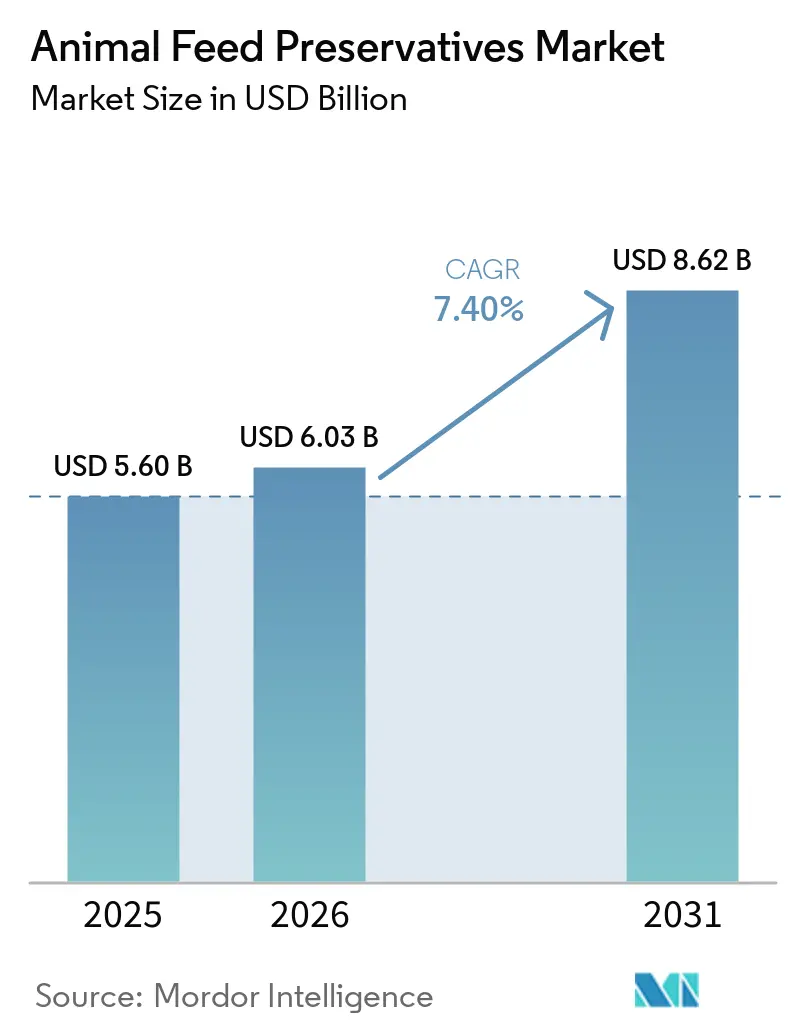
The animal feed preservatives market size is projected to grow from USD 5.60 billion in 2025 to USD 6.03 billion in 2026 and is projected to reach USD 8.62 billion by 2031, registering a CAGR of 7.40% during 2026-2031. The market is driven by stricter feed safety regulations, increasing concerns about livestock health, and rising demand for high-quality animal protein. This growth is further supported by the expansion of aquaculture production and the transition to industrialized feed systems, particularly in emerging markets. Acidifiers remain a common choice for controlling microbial contamination, while natural and plant-based preservatives are gaining popularity as producers focus on antibiotic-free and clean-label formulations. Poultry leads the market due to its higher susceptibility to feed spoilage, while aquaculture is witnessing rapid adoption. Market competition is shaped by advancements in formulation technologies and integrated supply chain capabilities, although challenges such as raw material price volatility and regulatory changes persist.
Key Report Takeaways
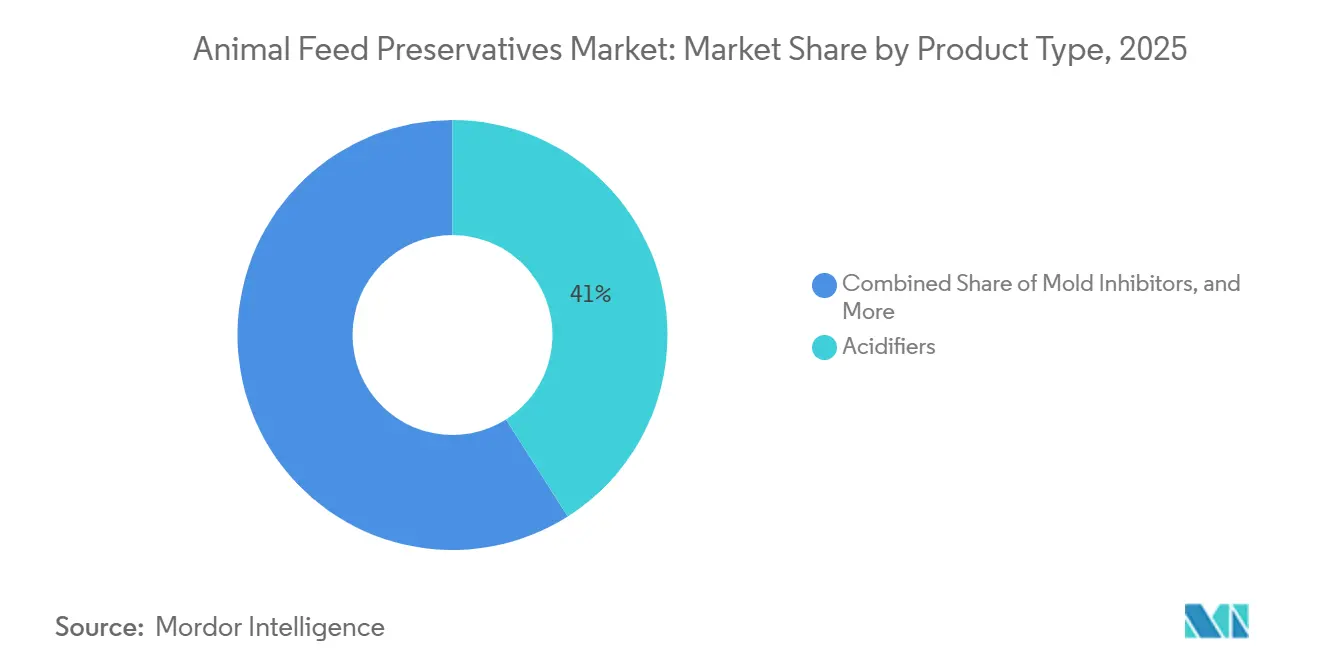
- By product type, acidifiers accounted for the largest share of the animal feed preservatives market in 2025, at 41%, whereas the mold inhibitors market size is projected to expand at the fastest 10.3% CAGR from 2026 to 2031.
- By livestock, poultry captured the largest 38% of the animal feed preservatives market share in 2025, while the aquaculture market size is anticipated to grow at the fastest 9.4% CAGR from 2026 to 2031.
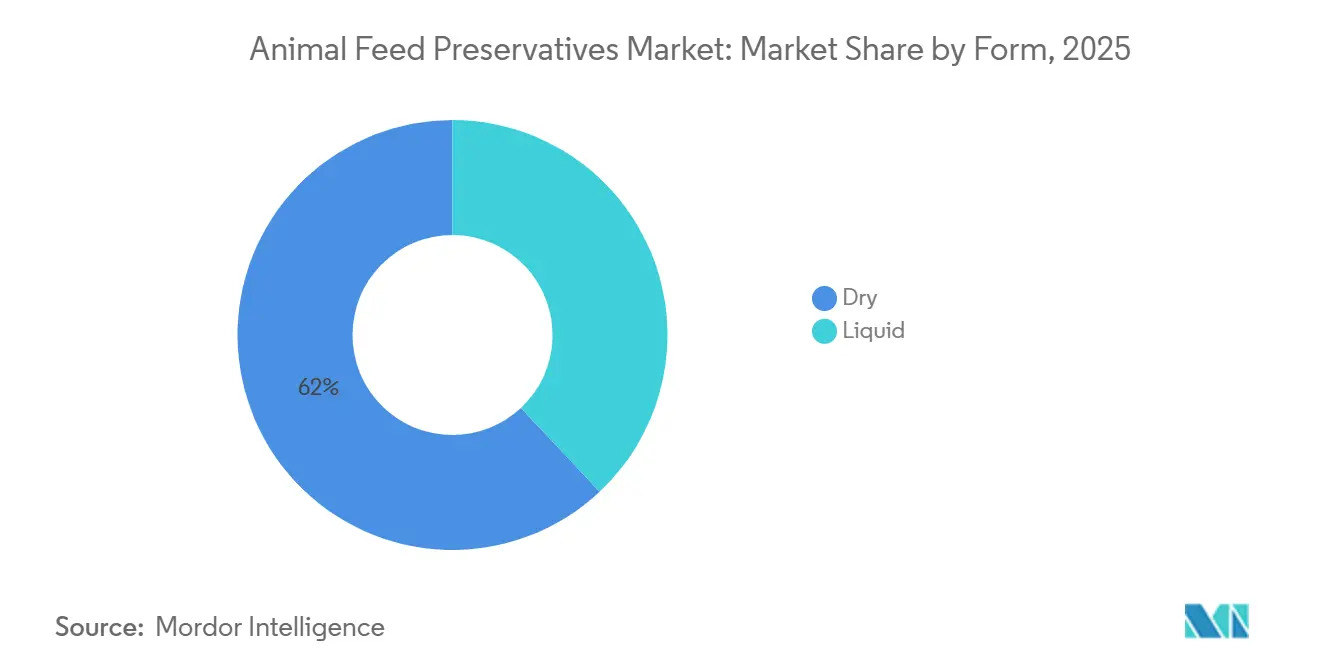
- By form, dry held the largest 62% of the animal feed preservatives market in 2025, whereas the liquid market is projected to grow at the fastest 8.7% CAGR from 2026 to 2031.
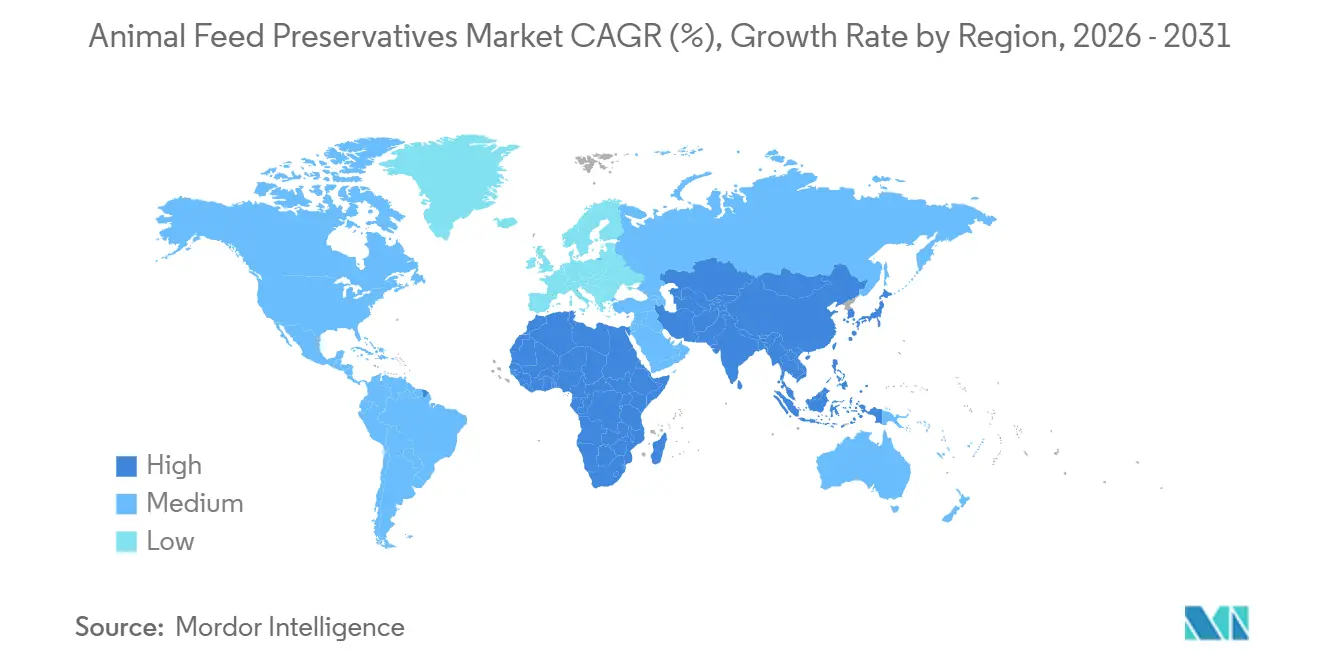
- By geography, Europe commanded the largest 29% of the animal feed preservatives market in 2025, while the Asia-Pacific market is projected to grow at the fastest 9.9% CAGR from 2026 to 2031.
Note: Market size and forecast figures in this report are generated using Mordor Intelligence’s proprietary estimation framework, updated with the latest available data and insights as of January 2026.
Market Trends and Insights
Drivers Impact Analysis of Animal Feed Preservatives Market*
| Driver | (~) % Impact on CAGR Forecast | Geographic Relevance | Impact Timeline |
|---|---|---|---|
| Rising demand for compound feed in intensive livestock production | +1.8% | Brazil, European Union, United States, and China | Medium term (2–4 years) |
| Stringent mycotoxin and mold-control regulations in Europe and North America | +1.5% | Europe and North America, spillover to South America and Asia-Pacific | Long term (≥4 years) |
| Rapid commercialization of natural and clean-label preservative chemistries | +1.3% | North America and Europe, early uptake in urban Asia-Pacific | Short term (≤2 years) |
| Expansion of aquaculture feed manufacturing capacity in Asia-Pacific | +1.2% | Asia-Pacific core, coastal Middle East and Africa | Medium term (2–4 years) |
| Digital quality-sensing technologies enabling dosage optimization | +0.9% | North America and Europe, pilots in Brazil and China | Medium term (2–4 years) |
| Feed-to-farm carbon-footprint reduction incentives | +0.7% | European Union, voluntary programs in North America and Australia | Long term (≥4 years) |
| Source: Mordor Intelligence | |||
Rising Demand for Compound Feed in Intensive Livestock Production
Centralized feed mills are producing larger volumes of compound feed to support intensive livestock systems, leading to a growing need for effective preservation during extended storage periods. According to the Alltech 2025 Agri-Food Outlook, global feed production increased by 1.2%, reaching 1.396 billion metric tons in 2024 [1]. This scale of industrial feed production heightens the risk of spoilage, mold growth, and mycotoxin contamination during storage and transportation. As a result, feed manufacturers are increasingly utilizing preservative solutions, such as acidifiers and mold inhibitors, to maintain feed quality and reduce losses in large-scale supply chains.
Stringent Mycotoxin and Mold-Control Regulations in Europe and North America
Stringent regulatory frameworks are enforcing stricter contaminant limits in animal feed to ensure food safety and protect animal health. For instance, the Canadian Food Inspection Agency, under the Feeds Regulations, 2024, has set the maximum allowable level of aflatoxins in total livestock diets at 20 parts per billion [2]. This reflects the increasing stringency of mycotoxin control standards in North America. These regulatory requirements drive feed manufacturers to implement preventive measures, such as using preservatives like organic acids and mold inhibitors, to manage contamination during storage instead of relying on expensive post-contamination treatments.
Rapid Commercialization of Natural and Clean-Label Preservative Chemistries
Natural and clean-label trends are increasingly shaping feed additive choices as consumer demand for antibiotic-free and naturally derived animal products grows. According to the National Center for Biotechnology Information (NCBI) published study in 2025, consumers demonstrate a notable willingness to pay a premium for antibiotic-free poultry products, indicating a clear shift toward clean-label preferences within the animal protein value chain. This evolving consumer demand is driving feed manufacturers to substitute synthetic preservatives with plant-based alternatives, including essential oils and botanical extracts, thereby fostering the adoption of natural preservative chemistries in the animal feed industry.
Digital Quality-Sensing Technologies Enabling Dosage Optimization
Digital quality-sensing technologies are being increasingly adopted in livestock and feed management systems to facilitate real-time monitoring and optimization. Researchers from Telkom University and IPB University, Indonesia, reported that in 2025, a sensor fusion-based IoT system achieved 100% accuracy in livestock identification and a ±0.5% margin of error in weight measurement under controlled conditions. This highlights the precision and reliability of integrated sensor technologies in tracking feed intake, animal weight, and environmental conditions. These capabilities enable real-time decision-making in feed operations, supporting optimized preservative dosing, minimizing spoilage risks, and enhancing efficiency in large-scale feed systems.
Restraints Impact Analysis of Animal Feed Preservatives Market*
| Restraint | (~) % Impact on CAGR Forecast | Geographic Relevance | Impact Timeline |
|---|---|---|---|
| Price volatility of organic acids derived from fermentation feedstocks | -0.8% | Global, acute in corn-importing regions | Short term (≤2 years) |
| Growing preference for antibiotic-free production limiting chemical preservatives | -0.6% | Europe and North America, emerging in urban Asia-Pacific and South America | Medium term (2-4 years) |
| Hazardous-substance classification for certain synthetic antioxidants | -0.5% | North America and Europe, indirect on exporters | Long term (≥4 years) |
| Supply-chain disruption risk for specialty chelating agents | -0.4% | Global, concentrated in single-source regions | Short term (≤2 years) |
| Source: Mordor Intelligence | |||
Price Volatility of Organic Acids Derived from Fermentation Feedstocks
Price volatility of organic acids derived from fermentation feedstocks remains a significant challenge for the animal feed preservatives market. In 2025, the European Feed Manufacturers’ Federation (FEFAC) reported that increasing volatility in the costs of organic acids and feed additives continued to exert pressure on feed compounders across Europe, particularly due to fluctuating energy and raw material prices. As propionic acid and formic acid are extensively used as feed preservatives to inhibit microbial growth and prolong feed shelf life, fluctuations in their prices directly impact formulation costs and procurement strategies for feed manufacturers. This persistent cost instability continues to constrain profit margins and pricing consistency within the animal feed preservatives market.
Growing Preference for Antibiotic-Free Production Limiting Chemical Preservatives
The rapid commercialization of natural and clean-label preservative chemistries is being driven by strong consumer demand for antibiotic-free animal products. A 2025 review published by the National Center for Biotechnology Information highlights that consumers are willing to pay a premium of 18%–20% for antibiotic-free chicken meat, indicating a clear preference for clean-label and synthetic-free production systems. This willingness to pay encourages feed manufacturers to adopt natural preservatives, such as essential oils and plant-based antioxidants, as alternatives to synthetic additives. Consequently, the demand for clean-label feed preservation solutions is rising, fostering the growth of natural preservative chemistries despite their comparatively higher costs.
*Our forecasts treat driver/restraint impacts as directional, not additive. The impact forecasts reflect baseline growth, mix effects, and variable interactions.
Animal Feed Preservatives Market Segment Analysis
By Product Type:
Acidifiers Retain Dominance while Botanicals AccelerateAcidifiers accounted for the largest share of 41% of the animal feed preservative market in 2025. Their dominance is attributed to broad-spectrum antimicrobial properties and effectiveness in controlling mold growth in stored feed. Acidifiers are compatible with various feed types and remain stable under different environmental conditions, ensuring consistent use across livestock production systems. Additionally, their strong adoption in regions with high humidity and large-scale feed storage further solidifies their leading role in feed preservation strategies.
The mold inhibitors market is projected to grow at the fastest CAGR of 10.3% from 2026 to 2031. This growth is driven by an increasing emphasis on feed safety and heightened awareness of mycotoxin contamination risks. Producers are increasingly adopting targeted preservation solutions to enhance feed quality and meet regulatory standards. The shift toward preventive feed management practices is boosting demand for mold inhibitors in both developed and emerging feed across the global markets.

By Livestock:
Poultry Leads as Aquaculture SurgesPoultry accounted for the largest 38% of revenue share in 2025. This dominance is due to the segment's high dependence on compound feed and its susceptibility to mold and toxin contamination. Intensive production systems and large-scale feed consumption require effective preservation to maintain feed quality and ensure productivity. Additionally, the growing demand for poultry products globally has further emphasized the need for preservatives to ensure feed safety and quality. These factors drive the continuous use of preservatives in poultry operations across major producing regions.
The aquaculture market size is anticipated to grow at the fastest 9.4% CAGR from 2026 to 2031. Growth is supported by increasing fish consumption and the expansion of aquaculture production systems. The need to maintain feed stability and prevent oxidation in aquatic feed is driving higher adoption of preservatives. Furthermore, advancements in aquaculture feed formulations and rising investments in feed manufacturing are contributing to the demand for specialized preservation solutions.
By Form:
Dry Formats Dominate, Liquids Gain via AutomationDry preservatives accounted for the largest share, 62%, of the animal feed preservative market in 2025. Their dominance is attributed to ease of handling, storage stability, and compatibility with feed processing systems. Additionally, their ability to withstand high temperatures during pelleting and ensure uniform mixing makes them a preferred choice for large-scale feed manufacturing operations. These operational benefits reinforce their leading position in the market, as they cater to the growing demand for efficient and reliable preservation methods in the animal feed industry.
The liquid preservatives market is projected to grow at the fastest CAGR of 8.7% from 2026 to 2031. This growth is driven by the increasing adoption of automated feed processing technologies, which enable precise dosing and improved efficiency. Liquid formulations provide better surface coverage and greater application flexibility, making them suitable for modern feed production systems. The focus on precision and efficiency is driving the rising demand for liquid preservatives, particularly in advanced feed manufacturing setups.
Geography Analysis
Europe Animal Feed Preservatives Market
Europe accounted for the largest 29% share of the animal feed preservative market in 2025. This dominance is attributed to stringent regulatory frameworks governing feed safety and contamination control. Strict limits on mycotoxins and additive usage promote the consistent adoption of preservative solutions in feed manufacturing systems. Additionally, the region benefits from a well-established compound feed production infrastructure and high awareness of livestock health management, ensuring steady demand for preservation technologies across poultry, swine, and aquaculture sectors.
APAC Animal Feed Preservatives Market
The Asia-Pacific market is projected to grow at the fastest CAGR of 9.9% from 2026 to 2031. This growth is driven by the rapid expansion of livestock and aquaculture production, coupled with increasing industrialization of feed manufacturing. Rising demand for animal protein and the intensification of farming practices are boosting the consumption of compound feed. These factors create a strong demand for preservatives to maintain feed quality, particularly in regions with warm climates and extended supply chains.
South America Animal Feed Preservatives Market
South America and other emerging regions are enhancing feed production systems, increasing the need for preservation solutions. According to the National Union of the Animal Feed Industry (Sindirações), as cited by the United States Department of Agriculture (USDA) Foreign Agricultural Service, Brazil's animal feed production is forecasted to reach 93 million metric tons by 2026, representing a 3.4% increase compared to the previous year [3]. The rising production volumes are encouraging the increased use of organic acid-based preservatives and feed stability solutions within the animal feed preservatives market.
Competitive Landscape
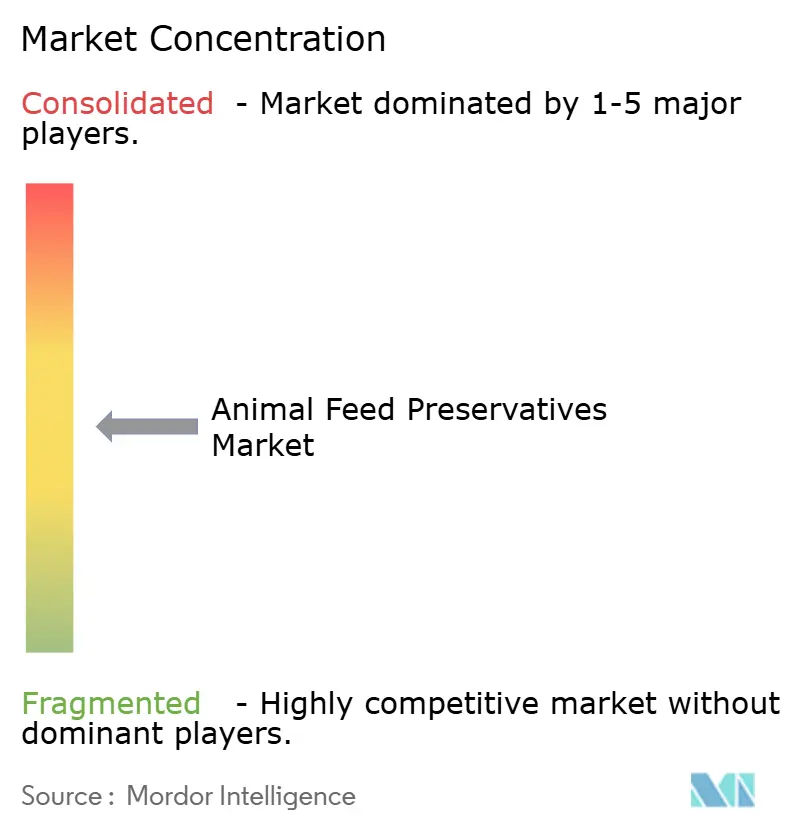
The market is moderately concentrated, with leading companies including Cargill, Incorporated, BASF SE, Archer-Daniels-Midland Company, Kemin Industries, Inc., and Nutreco N.V. These firms maintain their positions through integrated supply chains, diverse product portfolios, and global distribution networks. Their emphasis on organic acid blends, mold inhibitors, and natural preservatives aligns with evolving regulatory standards and consumer preferences. Ongoing investments in research and development enable these companies to improve product performance and expand applications across various livestock segments, reinforcing their competitive standing.
Competition in the market is driven by innovation in clean-label and functional preservative solutions, particularly as regulatory scrutiny intensifies. Companies are focusing on advancements in plant-based antioxidants, encapsulation technologies, and multi-functional additive blends to differentiate their products. Strategic investments in production efficiency and raw material sourcing help mitigate cost pressures from volatile feedstocks. These efforts allow manufacturers to ensure a stable supply while meeting the increasing demand for sustainable and high-performance preservation solutions in feed systems.
Strategic partnerships and industry consolidation remain critical competitive strategies as companies seek to enhance scale and operational efficiency. For example, in 2026, a joint venture between Archer-Daniels-Midland Company and Alltech integrated over 40 feed mills across North America. This initiative represents a significant step toward integrated feed production and distribution networks, improving supply chain control and responsiveness to regional demand. Such developments reflect a broader industry trend toward collaboration and capacity expansion to maintain competitiveness and foster innovation in feed preservation solutions.
Animal Feed Preservatives Industry Leaders
-
Cargill, Incorporated
-
BASF SE
-
Archer-Daniels-Midland Company
-
Kemin Industries, Inc.
-
Nutreco N.V.
- *Disclaimer: Major Players sorted in no particular order
Animal Feed Preservatives Market Companies Covered in this Report
- Cargill, Incorporated
- BASF SE
- Archer-Daniels-Midland Company
- Kemin Industries, Inc.
- Nutreco N.V.
- Novus International, Inc.
- DSM-Firmenich AG
- Alltech, Inc.
- Evonik Industries AG
- Lallemand Inc.
- Anpario plc
- Impextraco N.V.
- Norel, S.A.
- Orffa International Holding B.V.
- Bentoli, Inc.
Recent Industry Developments in Animal Feed Preservatives Market
- February 2026: Akralos Animal Nutrition was established as a joint venture between Archer-Daniels-Midland Company and Alltech, Inc., integrating their feed operations and expertise to provide animal nutrition solutions across North America.
- March 2025: Kemin Industries, Inc. introduced PROSIDIUM, a feed pathogen control solution utilizing peroxy acids. This product is designed to improve feed biosecurity and mitigate contamination risks from pathogens, including Salmonella and viruses.
- February 2025: Novonesis Group A/S acquired DSM-Firmenich AG’s stake in the Feed Enzyme Alliance for EUR 1.5 billion, bolstering its portfolio focused on feed nutrition and preservation applications. This acquisition expands the company's expertise in feed enzymes and probiotics, fostering advancements in animal feed stability and preservation solutions.
Global Animal Feed Preservatives Market Report Scope
Animal feed Preservatives are additives designed to inhibit microbial growth, prevent oxidation, and reduce spoilage in animal feed during storage and transportation. These preservatives help preserve feed quality, extend shelf life, and ensure the nutritional value and safety of feed for livestock consumption. The Animal Feed Preservatives Market Report is Segmented by Product Type (Acidifiers, Mold Inhibitors, Antioxidants, Binders, and Other Products), by Livestock (Poultry, Swine, Ruminants, Aquaculture, and Companion Animals), by Form (Dry and Liquid), and by Geography (North America, South America, Europe, Asia-Pacific, Middle East, and Africa). The Market Forecasts are Provided in Terms of Value (USD).
Segmentation Overview
| Acidifiers |
| Mold Inhibitors |
| Antioxidants |
| Binders |
| Others |
| Poultry |
| Swine |
| Ruminants |
| Aquaculture |
| Companion Animals |
| Dry |
| Liquid |
| North America | United States |
| Canada | |
| Mexico | |
| Rest of North America | |
| South America | Brazil |
| Argentina | |
| Rest of South America | |
| Europe | Germany |
| France | |
| United Kingdom | |
| Netherlands | |
| Rest of Europe | |
| Asia-Pacific | China |
| India | |
| Japan | |
| Australia | |
| Rest of Asia-Pacific | |
| Middle East | Saudi Arabia |
| United Arab Emirates | |
| Rest of Middle East | |
| Africa | South Africa |
| Kenya | |
| Rest of Africa |
| By Product Type | Acidifiers | |
| Mold Inhibitors | ||
| Antioxidants | ||
| Binders | ||
| Others | ||
| By Livestock | Poultry | |
| Swine | ||
| Ruminants | ||
| Aquaculture | ||
| Companion Animals | ||
| By Form | Dry | |
| Liquid | ||
| By Geography | North America | United States |
| Canada | ||
| Mexico | ||
| Rest of North America | ||
| South America | Brazil | |
| Argentina | ||
| Rest of South America | ||
| Europe | Germany | |
| France | ||
| United Kingdom | ||
| Netherlands | ||
| Rest of Europe | ||
| Asia-Pacific | China | |
| India | ||
| Japan | ||
| Australia | ||
| Rest of Asia-Pacific | ||
| Middle East | Saudi Arabia | |
| United Arab Emirates | ||
| Rest of Middle East | ||
| Africa | South Africa | |
| Kenya | ||
| Rest of Africa | ||
Key Questions Answered in the Report
What is the current value of the animal feed preservatives market?
The animal feed preservatives market size is USD 6.03 billion in 2026 and is projected to reach USD 8.62 billion by 2031, expanding at a 7.4% CAGR.
Which product type holds the largest share?
Acidifiers led with the largest 41% of animal feed preservatives market share in 2025.
Which livestock segment is growing fastest?
Aquaculture preservatives usage is advancing at the fastest 9.4% CAGR from 2026 to 2031.
Which region shows the highest growth?
Asia-Pacific is the fastest-growing region, registering a 9.9% CAGR from 2026 to 2031.