
Market Overview
| Study Period | 2021 - 2031 |
|---|---|
| Forecast Data Period | 2026 - 2031 |
| Base Year Market Size (2025) | USD 13.2 Billion |
| Market Size (2026) | USD 13.96 Billion |
| Market Size (2031) | USD 18.45 Billion |
| Growth Rate (2026 - 2031) | 5.74 % |
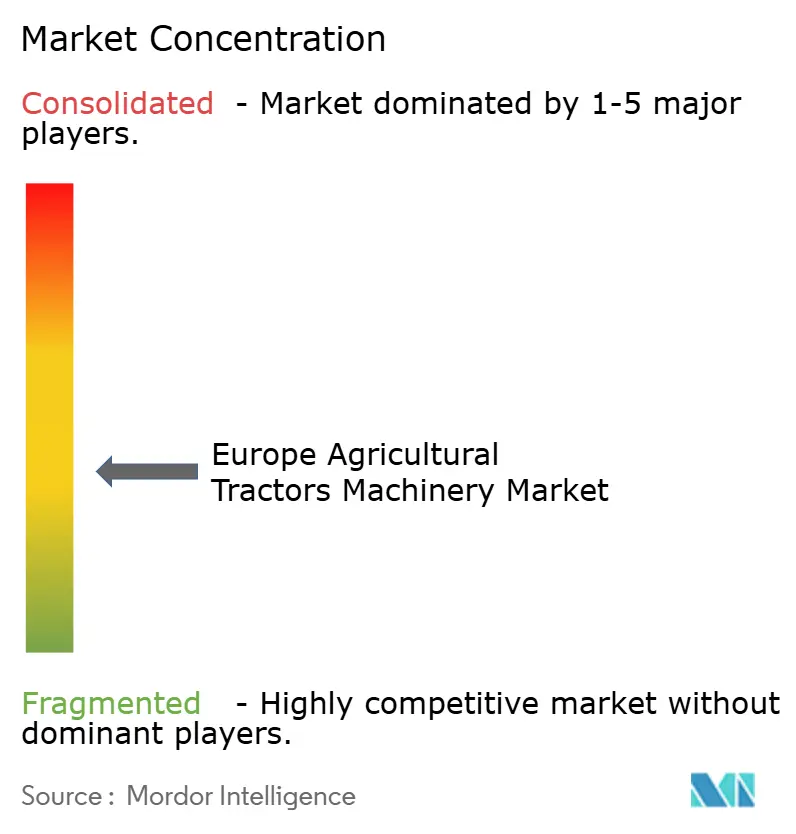
| Market Concentration | Medium |
Major Players *Disclaimer: Major Players sorted in no particular order Image © Mordor Intelligence. Reuse requires attribution under CC BY 4.0. | |
Europe Agricultural Tractor Machinery Market Analysis by Mordor Intelligence
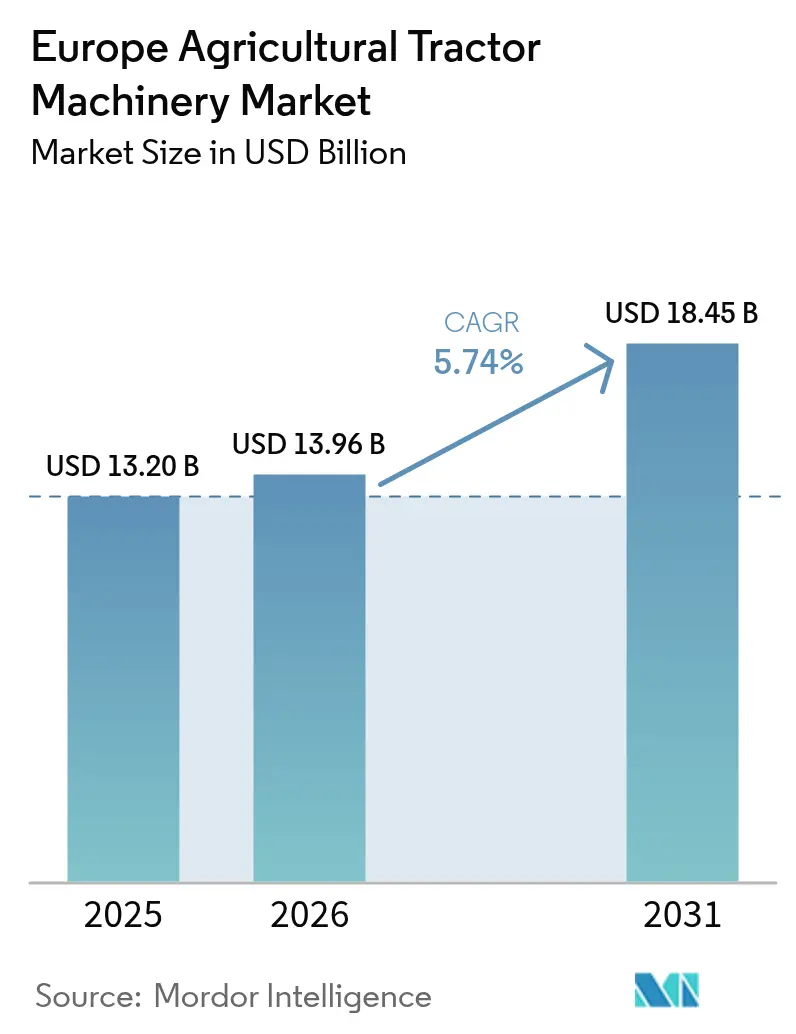
The Europe agricultural tractor machinery market size was valued at USD 13.2 billion in 2025 and estimated to grow from USD 13.96 billion in 2026 to reach USD 18.45 billion by 2031, at a CAGR of 5.74% during the forecast period (2026-2031). Demand gains stem from the European Union Common Agricultural Policy eco-schemes that underwrite precision-farming hardware, Stage V emissions compliance that accelerates fleet renewal, and persistent labor shortages that nudge farms toward automation[1]. Suppliers answer with powered, sensor-rich implements that integrate through the ISO 11783 (ISOBUS) protocol, while electrification pilots create a parallel pull for low-draw attachments compatible with battery tractors. At the same time, dealer inventory overhang from 2023, volatile commodity prices, and mixed-fleet interoperability frictions temper adoption in price-sensitive pockets of Central and Eastern Europe. Competitive intensity remains moderate because the top five vendors leave room for niche specialists that address strip-till, orchard under-vine mowing, or greenhouse applications.
Key Report Takeaways
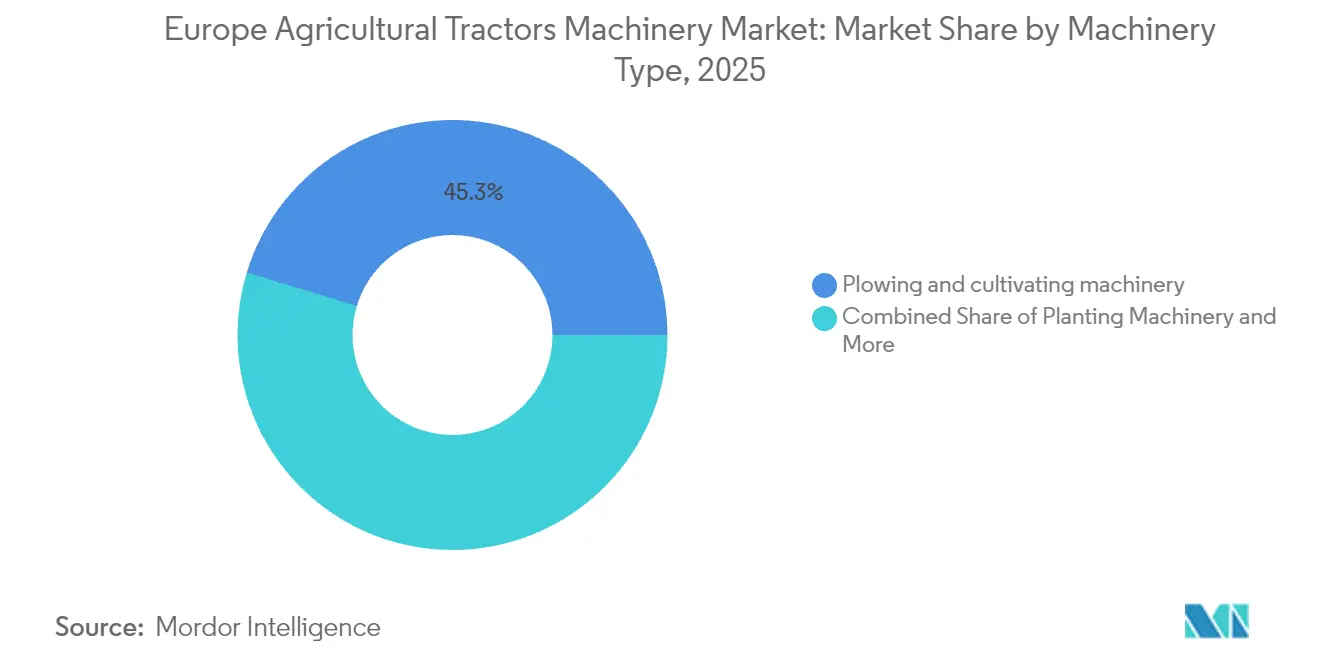
- By machinery type, plowing and cultivating machinery held 45.30% of the Europe agricultural tractor machinery market share in 2025, while planting machinery are advancing at a 7.66% CAGR through 2031.
- By geography, Germany accounted for 22.20% of regional revenue in 2025, while the Netherlands is forecast to post the fastest 7.98% CAGR through 2031.
Note: Market size and forecast figures in this report are generated using Mordor Intelligence’s proprietary estimation framework, updated with the latest available data and insights as of 2026.
Market Trends and Insights
Drivers Impact Analysis of Europe Agricultural Tractor Machinery Market*
| Driver | (~) % Impact on CAGR Forecast | Geographic Relevance | Impact Timeline |
|---|---|---|---|
| Precision-farming subsidies under the EU Common Agricultural Policy (2025–2027 tranche) | +1.2% | Pan-European, with highest uptake in France, Germany, and Netherlands | Medium term (2–4 years) |
| Labor shortages accelerating automation demand in Western and Northern Europe | +1.0% | Germany, Netherlands, Denmark, Sweden, and United Kingdom | Short term (≤ 2 years) |
| Stage V emissions rules driving retrofit and replacement of PTO-efficient implements | +0.9% | EU27 plus United Kingdom, Norway, and Switzerland | Medium term (2–4 years) |
| Growth of controlled-traffic farming boosting demand for lightweight, wide-working-width tillage tools | +0.7% | United Kingdom, Germany, France, and Denmark | Long term (≥ 4 years) |
| Surge in vineyard and orchard mechanization in Mediterranean countries | +0.8% | Italy, Spain, France (southern regions), Portugal, and Greece | Medium term (2–4 years) |
| Emerging electric-tractor ecosystem requiring low-draw, ISOBUS-ready implements | +0.6% | Netherlands, Germany, Scandinavia, pilot zones in France and Italy | Long term (≥ 4 years) |
| Source: Mordor Intelligence | |||
Precision-Farming Subsidies Under the EU Common Agricultural Policy (2025–2027 Tranche)
Mandatory eco-schemes now channel 25% of direct payments into proven input-efficiency projects, pushing farms to buy variable-rate planters, ISOBUS sprayers, and yield-mapping sensors. France, Germany, and Poland are moving toward such upgrades. Adoption lifts data-sharing, cooperative Terrena saw 38% of members stream implement telemetry in 2024, extending equipment life by 15%. Certification requirements favor ISO 11783-compliant brands and squeeze fringe suppliers out of subsidy eligibility, consolidating demand around a few large telematics ecosystems.
Labor Shortages Accelerating Automation Demand in Western and Northern Europe
Full-time farm employment in Germany fell 12% year on year in 2024. Horticulture in the Netherlands faces similar gaps, spurring take-up of robotic planters and vision-guided sprayers. Deere and Company reported a 47% jump in European shipments of its See and Spray system during 2024. Danish Agro deployed 15 autonomous mower-conditioner units that cut hay harvest labor costs by 30% while running day and night. The Europe agricultural tractor machinery market, therefore, tilts toward powered implements with embedded autonomy, widening the gap with legacy passive tools.
Stage V Emissions Rules Propelling Retrofit and Replacement of PTO-Efficient Implements
January 2024 enforcement of Stage V non-road mobile machinery rules reduces nitrogen oxides by up to 95% relative to Stage IV. Older implements lack the load-sensing electronics needed to sync with selective catalytic reduction dosing, pushing operators to newer PTO-efficient models. CNH Industrial’s Raven Autonomy platform links implement draft load to engine control and cut diesel-exhaust-fluid cost by EUR 4 (USD 4.2) per hectare in German trials. National retrofit grants in Italy and Spain, covering EUR 8,000 to EUR 15,000 (USD 8,500 to USD 15,900) per baler or forage harvester, shorten the replacement cycle in high-horsepower fleets.
Growth of Controlled-Traffic Farming Boosting Demand for Lightweight, Wide-Working-Width Tillage Tools
Controlled-traffic farming confines wheel tracks and curbs soil compaction by 70%[2]. United Kingdom adoption reached 18% of arable acres in 2024, aided by GBP 58 (USD 73) per hectare grants. Manufacturers answer with carbon-fiber tines and folding 12-meter cultivators. Väderstad’s TopDown TD 600 maintains 8 centimeter depth uniformity on rolling land and raised spring barley emergence by 9% in Danish trials. Large estates realize rapid paybacks while small farms struggle to fund the capital outlay.
Restraints Impact Analysis of Europe Agricultural Tractor Machinery Market*
| Restraint | (~) % Impact on CAGR Forecast | Geographic Relevance | Impact Timeline |
|---|---|---|---|
| Dealer over-inventory since 2023 suppressing fresh orders through 2026 | -0.8% | Germany, France, United Kingdom, and Benelux | Short term (≤ 2 years) |
| High capital cost for smart implements on fragmented small holdings in Eastern Europe | -0.6% | Poland, Romania, Hungary, Bulgaria, and Baltic states | Medium term (2–4 years) |
| Complex interoperability standards (ISOBUS, TIM) delaying adoption among mid-size farms | -0.5% | Pan-European, acute in mixed-fleet operations | Medium term (2–4 years) |
| Volatile commodity prices lowering farmers' cash flow for discretionary equipment | -0.7% | Arable regions: Poland, Romania, France (Beauce), and Germany (Saxony) | Short term (≤ 2 years) |
| Source: Mordor Intelligence | |||
Dealer Over-Inventory Amassed Since 2023 Suppressing Fresh Orders through 2026
European dealers carried 9.2 months of implement supply at the start of 2024 versus a normal 5.5 months. BayWa posted EUR 340 million (USD 360 million) in unsold tillage and seeding stock, then cut 2025 purchase plans by 22%. French distributor InVivo similarly trimmed new orders 18% and pivoted to refurbishing used assets. Manufacturers extended payment terms to 180 days and offered consignment, but the margin squeeze still discourages dealers from stocking incremental models, slowing near-term growth in the Europe agricultural tractor machinery market.
High Capital Cost for Smart Implements on Fragmented Small Holdings in Eastern Europe
Average farm sizes are 11.2 hectares in Poland, 3.9 hectares in Romania, and 6.1 hectares in Bulgaria[3]. A EUR 55,000 (USD 58,000) GPS precision seeder equals nearly five times the median annual income of a Polish arable farm, extending payback beyond normal planning horizons. Romania allocated budgets for shared-machinery grants yet saw less than 30% uptake due to co-financing hurdles. Fragmentation, therefore, bifurcates the Europe agricultural tractor machinery market into a high-tech core and a low-investment periphery.
*Our forecasts treat driver/restraint impacts as directional, not additive. The impact forecasts reflect baseline growth, mix effects, and variable interactions.
Europe Agricultural Tractor Machinery Market Segment Analysis
By Machinery Type:
Planting Machinery Outpace Plowing and Cultivating MachineryPlowing and cultivating machinery tools secured 45.30% of 2025 revenue in the Europe agricultural tractor machinery market. Planting machinery, aided by controlled-traffic mandates and real-time variable-rate algorithms, will grow at a 7.66% CAGR through 2031. French cooperative Axéréal documented a 12% reduction in seed cost per hectare after rolling out GPS section control across 85,000 hectares.
Planting machinery capture the fastest expansion because eco-scheme payments specifically reward reductions in seed waste. Lemken’s electric-meter Azurit planter sells at a 28% premium yet pays back within three seasons on farms above 500 hectares. Haying and forage machinery continue to serve the continent’s grassland but hinge on stable dairy and beef herds. Other specialty implements remain fragmented. The segment illustrates how subsidy rules and data capability shift profits toward powered, software-defined machines within the wider Europe agricultural tractor machinery market size.

Geography Analysis
Germany and France Agricultural Tractor Machinery Market
Germany accounted for 22.20% of regional revenue in 2025, but moderate growth ahead. Stage V compliance drove a 14% spike in PTO-efficient baler sales during 2024, yet EUR 340 million (USD 360 million) in dealer stock keeps orders subdued until 2026. France secures eco-scheme allocations every year, which boosts purchases of precision seeders and sprayers. Wheat price volatility does dampen discretionary spending, though subsidies and insurance soften the blow.
Southern Europe and United Kingdom Agricultural Tractor Machinery Market
Italy’s forecast growth rate relies on labor-saving vineyard tools in Piedmont, Veneto, and Tuscany, where manual work costs exceed EUR 1,200 (USD 1,270) per hectare. Maschio Gaspardo’s under-vine tiller shipments validate this trend. Spain pursues parallel moves in Andalusia and Catalonia under a subsidy that reimburses 40% of equipment spend. The United Kingdom experienced a 6% sales dip in 2024 as farms adjusted to new environmental land payments, although GBP 58 (USD 73) per hectare grants for controlled-traffic farming supported lightweight cultivator demand.
Broader European Markets
The Netherlands will log the region’s fastest 7.98% CAGR. Battery-electric tractors operate in dense greenhouse clusters, and nitrogen efficiency rules force rapid rollout of variable-rate fertilizer applicators. Central Europe grows more modestly because farm fragmentation inflates payback periods, yet large estates in western Poland and the Czech Republic deploy cutting-edge implements. Scandinavia leads autonomy pilots, highlighted by Danish Agro’s autonomous mower deployment, while the Balkans and Baltics continue to trail. These disparities reveal how the Europe agricultural tractor machinery market splits along both technology and purchasing-power lines.
Regulatory Landscape
Europe agricultural tractor machinery is shaped by EU type-approval and emissions compliance frameworks that affect tractor-implement compatibility and equipment renewal. The Mother Regulation, Regulation (EU) No 167/2013, underpins EU type-approval for agricultural and forestry vehicles, while Stage V emissions limits for non-road mobile machinery engines are set under Regulation (EU) 2016/1628. This keeps OEMs and implement makers focused on PTO efficiency, load-sensing, and in-service compliance.
Recent updates tighten road-safety and functional requirements for equipment operating on public roads and move standardization forward across member states. Regulation (EU) 2025/14 established a harmonized road safety approval system for non-road mobile machinery intended to circulate on public roads, with key provisions applying to equipment not registered or entered into service before 29 January 2028. Commission Delegated Regulation (EU) 2025/1117 amended braking and functional safety requirements (amending Regulations (EU) 2015/68 and (EU) 2015/208) and ended the placing on the market of new tractors with braking systems suitable only for single-line hydraulic connections from 1 January 2025, tightening conformity checks for tractors and compatible implements. Standards alignment also moved forward in March 2026, when Commission Implementing Decision (EU) 2026/546 published references to new harmonized standards, including EN 17744:2025 for specific agricultural and forestry machinery such as dusters, to reduce environmental contamination risk.
Competitive Landscape
The top five suppliers, Deere & Company, CNH Industrial, AGCO Corporation, Kuhn Group, and Lemken, collectively hold modest percentage of 2025 revenue, placing the Europe agricultural tractor machinery market in a moderately concentrated state. Deere’s computer-vision See and Spray system lifted herbicide precision and boosted European shipments 47% in 2024. CNH Industrial’s Raven Autonomy links implement draft load to tractor controls and cuts diesel exhaust fluid spend by EUR 4 (USD 4.2) per hectare.
Interoperability gaps persist, with 38% of supposedly ISOBUS-ready implements failing cross-brand tests. Below the top tier, Väderstad, Pöttinger, Amazone, Kverneland Group, Horsch, and Maschio Gaspardo carve share in specific niches. Väderstad’s TopDown TD 600 improved spring barley emergence by nine per cent in Danish trials and secured large estate orders. Pöttinger’s Aerosem drill targets electric-tractor buyers with 22% lower draw, while Amazone and Kverneland Group push retrofit kits that add ISOBUS task control to legacy seeders.
French startup Ekylibre raised funds to scale an open-source farm-management platform that aggregates data from any ISO 11783 implement, and Deere purchased a minority position to strengthen its ecosystem. Strategic moves show that vendors combining proprietary innovation with open standards earn trust across mixed-brand fleets inside the Europe agricultural tractor machinery market.
Europe Agricultural Tractor Machinery Industry Leaders
-
CNH Industrial N.V.
-
AGCO Corporation
-
Kuhn Group
-
Lemken GmbH & Co. KG
-
Deere & Company
- *Disclaimer: Major Players sorted in no particular order
Europe Agricultural Tractor Machinery Market Companies Covered in this Report
- Deere & Company
- CNH Industrial N.V.
- AGCO Corporation
- Kubota Corporation (Kubota Corporation)
- CLAAS KGaA mbH
- Kuhn Group (Bucher Industries AG)
- Lemken GmbH & Co. KG
- SDF Group
- Mahindra & Mahindra Ltd
- Tractors and Farm Equipment Ltd
- Amazonen-Werke H. Dreyer SE
- Pottinger Landtechnik GmbH
- Vaderstad AB
- Maschio Gaspardo S.p.A.
- Salford Group (Linamar Corporation)
Read Analysis of Europe Agricultural Tractor Machinery Companies
Market Opportunities and Future Outlook
Opportunity is concentrated in implement and attachment portfolios that help farms qualify for CAP 2023-27 eco-schemes and meet tightening safety and road-use requirements, while reducing friction in mixed-fleet interoperability. With mandatory eco-schemes channeling 25% of direct payments into input-efficiency projects in the current CAP cycle, buyers are placing more weight on precision-ready tools such as variable-rate planting equipment, ISOBUS sprayers, and task-control retrofit kits that bring legacy implements into subsidy-eligible workflows. Interoperability continues to function as a practical buying criterion, since cross-brand compatibility issues persist across ISOBUS-ready claims. That gap supports validated multi-brand integration, dealer-installed upgrade packages, and open data platforms that reduce deployment friction for mid-size farms running mixed fleets.
Regulation-driven road safety and environmental standards also support demand for compliant braking interfaces, road-circulation-ready machinery configurations, and product categories covered by updated harmonized standards, including dusters referenced under EN 17744:2025 in Commission Implementing Decision (EU) 2026/546. Regulation (EU) 2025/14 brings more uniform approval rules for non-road mobile machinery intended for public-road circulation, ahead of the 29 January 2028 applicability milestone for equipment not previously registered or entered into service, which raises the value of OEM documentation, conformity testing, and dealer compliance services. Commercial priorities in the near term are further shaped by sector sentiment, with CEMA reporting its Business Climate Index at -20 points in June 2026. That environment increases the appeal of technologies that improve input-use efficiency and strengthen dealer serviceability (parts availability, retrofitability, and uptime), rather than expanding fleets alone.
Recent Industry Developments in Europe Agricultural Tractor Machinery Market
- June 2026: CNH Industrial inaugurated a EUR 21 million investment at its San Matteo R&D hub in Modena, Italy, adding an advanced virtual simulation ecosystem and an automated AutoStore warehouse. The upgrade targets faster product development cycles and improved parts delivery performance, supporting higher-technology implement integration and aftersales responsiveness in Europe.
- September 2025: Horsch introduced new cultivation and seeding machinery across Europe with a focus on efficiency and precision-farming capability. The launch reinforced competitive momentum around sensor-enabled, data-ready implements as farms aligned purchases with CAP eco-scheme requirements.
- April 2025: New Holland and MASCHIO GASPARDO announced a cooperation in Europe to distribute and supply crop preparation implements such as mowers, mower conditioners, tedders, and rotary rakes, alongside co-development of future products led by MASCHIO GASPARDO engineering. The arrangement strengthened channel reach for hay and forage implements and increased the cadence of jointly developed offerings for European dealers and farm customers.
Europe Agricultural Tractor Machinery Market Report Scope and Research Methodology
Market Definition and Coverage
For this study, the Europe agricultural tractor machinery market is measured as the revenue earned from sales of tractor-mounted and tractor-pulled farm implements and attachments used for core field operations across Europe, reported in USD for the stated years.
Scope exclusions: The sizing excludes standalone self-propelled harvesting machines, non-agricultural tractors, and aftersales services and rentals when they are billed separately from new equipment sales.
Segments Covered in This Report
- By Machinery Type
- Plowing and Cultivating Machinery
- Plows
- Harrows
- Rotovators and Cultivators
- Other Plowing and Cultivating Machinery
- Planting Machinery
- Seed Drills
- Planters
- Spreaders
- Other Planting Machinery
- Haying and Forage Machinery
- Mowers and Conditioners
- Balers
- Other Haying and Forage Machinery
- Sprayers
- Other Types
- Plowing and Cultivating Machinery
- By Country
- Germany
- France
- Italy
- United Kingdom
- Spain
- Netherlands
- Poland
- Rest of Europe
Data Sources, Market Sizing, and Validation
Desk Research
Desk research was used to set the factual base for the model before numbers were shaped through interviews. We relied on public and repeatable data points such as Eurostat agricultural and farm structure statistics, FAOSTAT crop and land-use series, European Commission policy notes (including CAP implementation and machinery related incentives), and UNECE or similar safety and technical regulation references that influence equipment choices.
On the supply and trade side, we reviewed customs and trade statistics for agricultural machinery categories, along with country agriculture ministry releases and association updates that track mechanization and replacement cycles. Company annual reports, filings, and investor presentations were also used to confirm product mix cues and regional exposure. Where available, we used paid subscriptions for company financials and patent databases to cross-check innovation direction and approximate revenue pool boundaries. These desk sources are illustrative only, and many other public and paid references were used to collect, validate, and clarify data points.
Primary Interviews and Surveys
Primary work focused on validating what is being bought, at what price level, and how fast replacement and upgrades are happening across major European farming systems. We spoke with a mix of OEM-side functions, dealer and distributor stakeholders, and large farm and contractor buyers so pricing, financing, and availability assumptions could be challenged.
Coverage was balanced across Europe so that country differences in subsidy timing, emissions compliance, and crop mix could be reflected, and then used to close data gaps left by public statistics.
Distribution of primary research fieldwork respondents
| Company type | Respondent position |
|---|---|
| Top tier: 28% | CXOs: 13% |
| Mid tier: 52% | Functional/Unit leaders: 36% |
| Smaller Players: 20% | Managers: 51% |
Market-Sizing & Forecasting
The core sizing logic used a top-down build where Europe farm activity and mechanized operations are reconstructed into an equipment demand pool, and then translated into market value through price bands. Outputs were then stress-tested with selective bottom-up approximations, such as sampled price list checks, dealer sell-through discussions, and supplier and channel roll-ups where coverage was adequate.
Key inputs that shaped the model included tractor fleet renewal pace, implement attachment rates by farm type, machinery penetration in high-labor-cost regions, the share of compliant Stage V equipment in the active mix, and country-level cropping and arable land trends that influence tool width and power needs. Average selling price logic was handled by separating product categories and power compatibility, and then applying a moderated price progression that aligns with materials inflation, feature add-ons (like ISOBUS readiness), and incentive-linked purchasing behavior.
For forecasting, scenario analysis was used so that policy-linked demand swings and financing conditions could be expressed without overfitting the history. Assumptions were aligned to what interviewees expected for subsidy cycles, dealer inventory normalization, and replacement timing, and gaps in any channel-based roll-ups were handled through conservatively scaled expansion factors that were only applied after cross-checking against independent volume signals.
Data Validation & Update Cycle
Validation was done in layers so that large errors are caught early and small drifts are corrected before sign-off. Model outputs were compared against independent signals like import trends for machinery groups, reported shipment commentary in filings, and country-level mechanization indicators, and then any large variances were reworked back to the input assumptions.
Before finalization, anomalies were reviewed by another analyst, followed by a final sense check across price, volume, and growth consistency at country and region totals. The report is refreshed on an annual cycle, and interim updates are made when material events occur (such as a policy change, currency swings, or a supply disruption) so the delivered view stays current at the time of release.
Mordor Intelligence's Europe Agricultural Tractor Machinery Market Size Compared With Other Published Estimates
Published values for this market often do not match because studies pick different boundaries, and then treat prices, exchange rates, and the timing of updates in different ways. Even when the same region is named, the counted equipment set can shift between tractors only, tractor implements only, or a blended view that is not clearly stated.
A common gap driver is how average selling prices are moved forward, since some estimates apply broad inflation to the whole basket, while others keep prices flat and let only volumes change. Another source of spread is refresh cadence and currency timing, where a late-year EUR to USD conversion and re-checks with dealer discounting can move the current-year value, a check that is explicitly applied in this study before publishing under Mordor Intelligence.
Benchmark comparison
| Source | Market Size | Gaps in Research Methodology |
|---|---|---|
| Mordor Intelligence | USD 13.20 B (2025) | |
| Global Databook A | USD 8.40 B (2023) | Uses an earlier base year and focuses on agricultural tractors by engine power, which narrows the counted scope versus tractor implements and attachments, and it also reflects 2023 pricing and currency conditions. |
| Regional Research Publisher B | USD 12.00 B (2024) | Anchored to a 2024 base with a tractor-only framing and a longer forecast window, with limited visibility on how implement attachment rates and category-level ASP movements are handled inside the total. |
Across the three figures, the spread mainly traces back to what is included in the equipment basket and the year used for pricing and conversion. By keeping the scope tied to tractor machinery and re-checking price progression and current-year currency timing against interview feedback, the final number stays easier to reconcile with observable purchasing and trade signals.
Key Questions Answered in the Report
What is the 2026 value of the Europe agricultural tractors machinery market?
The market is valued at USD 13.96 billion in 2026.
How fast will the market grow to 2031?
It is forecast to increase at a 5.74% CAGR, reaching USD 18.45 billion by 2031.
Which machinery type is expanding fastest?
Planting machinery is rising at a 7.66% CAGR through 2031.
Why is the Netherlands the fastest growing country market?
Dense greenhouse clusters, 50% co-financing for precision implements, and early adoption of electric tractors drive an 7.98% forecast CAGR.