
Esomeprazole Market Size and Share
Market Overview
| Study Period | 2022 - 2031 |
|---|---|
| Market Size (2026) | USD 2.13 Billion |
| Market Size (2031) | USD 2.87 Billion |
| Growth Rate (2026 - 2031) | 6.08 % |
| Fastest Growing Market | Asia Pacific |
| Largest Market | North America |
| Market Concentration | Medium |
Major Players
*Disclaimer: Major Players sorted in no particular order Image © Mordor Intelligence. Reuse requires attribution under CC BY 4.0. |
|
Esomeprazole Market Analysis by Mordor Intelligence
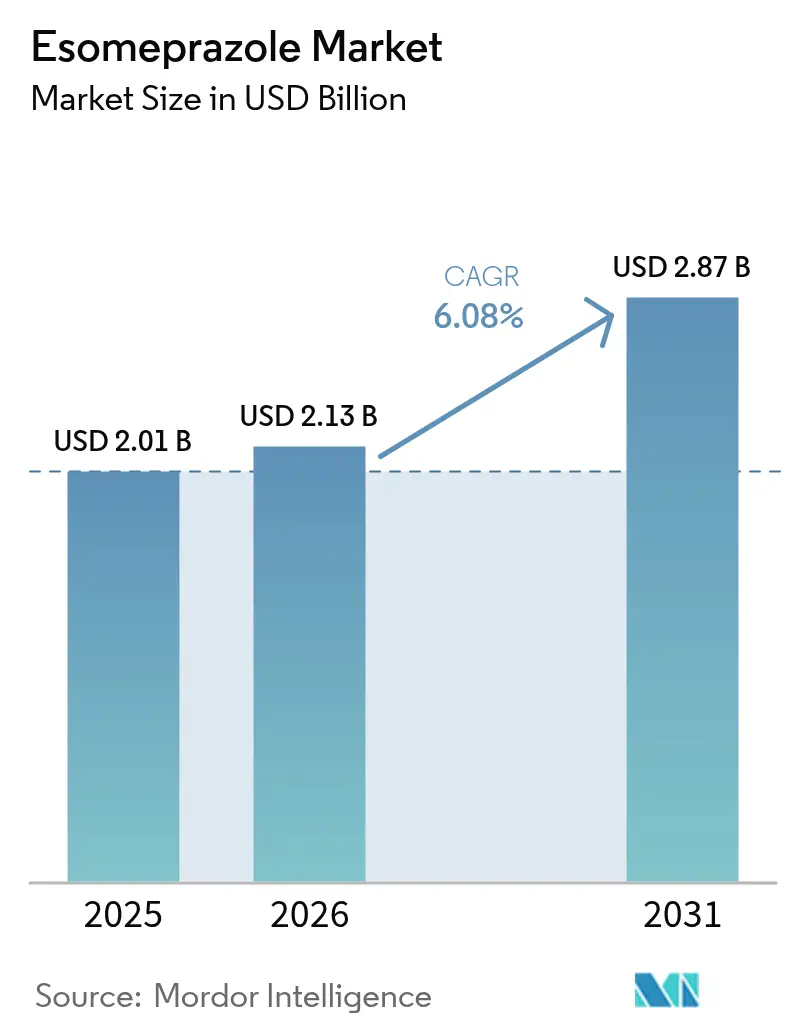
The esomeprazole market size was valued at USD 2.01 billion in 2025 and estimated to grow from USD 2.13 billion in 2026 to reach USD 2.87 billion by 2031, at a CAGR of 6.08% during the forecast period (2026-2031). Steady demand arises from the continuing rise in gastroesophageal reflux disease (GERD) cases, which stand at 783.95 million worldwide, and from the therapeutic need for sustained acid suppression. Competitive pressure from potassium-competitive acid blockers (P-CABs) such as vonoprazan is intensifying, yet brand familiarity, broad clinical guidelines, and a large installed patient base support ongoing growth. North America leads with 40.44% revenue contribution, while Asia-Pacific posts the fastest 7.22% CAGR on the back of healthcare capacity expansion and rising GERD awareness. Tablets hold sway with a 46.77% revenue share, but capsules show the strongest 7.11% growth thanks to dual-release and nano-delivery innovations. Generic entries continue to expand, lowering prices and widening access, even as P-CAB alternatives challenge the traditional therapeutic paradigm.
Key Report Takeaways
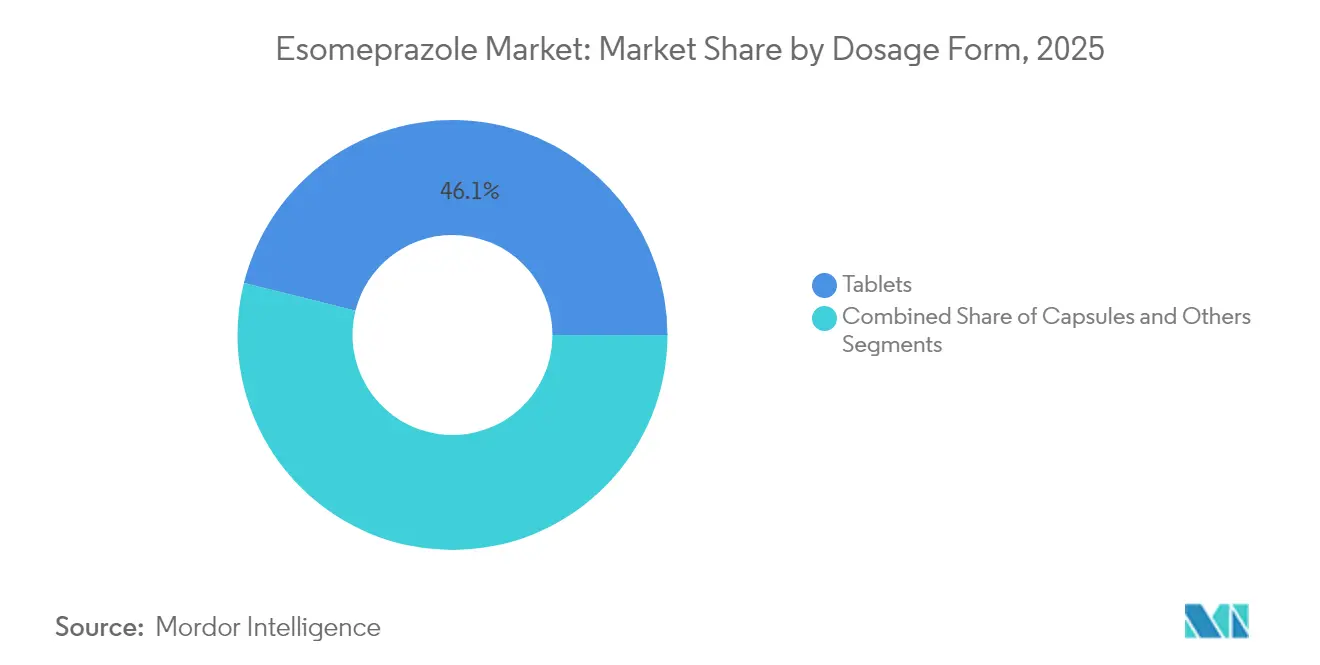
- By dosage form, tablets captured 46.12% of esomeprazole market share in 2025; capsules are projected to advance at a 6.98% CAGR through 2031.
- By strength, 20 mg held 64.72% share of the esomeprazole market size in 2025, while 40 mg strength is projected to expand at a 6.90% CAGR to 2031.
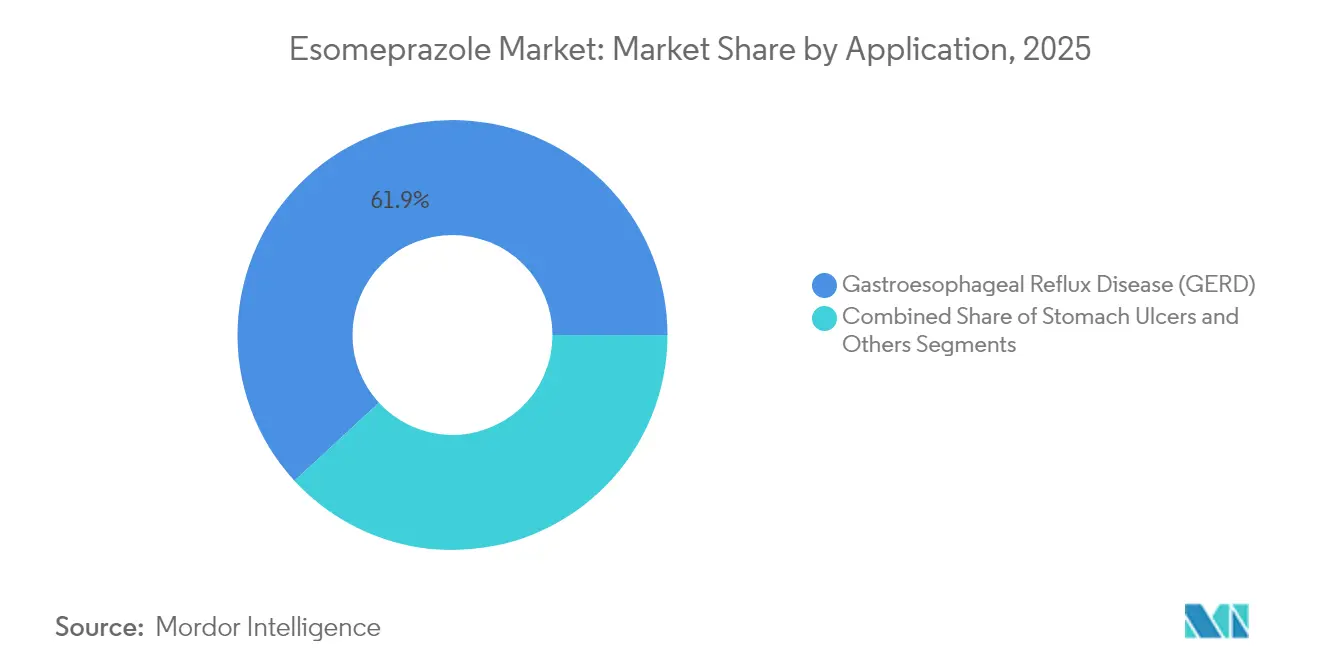
- By application, GERD accounted for 61.85% of the esomeprazole market size in 2025 and is forecast to grow at a 6.08% CAGR through 2031.
- By distribution channel, hospital pharmacies controlled 44.92% revenue share in 2025; online pharmacies are poised to record a 7.05% CAGR through 2031.
- By region, North America dominated with 40.12% revenue share in 2025, whereas Asia-Pacific is primed for a 7.08% CAGR to 2031.
Note: Market size and forecast figures in this report are generated using Mordor Intelligence’s proprietary estimation framework, updated with the latest available data and insights as of 2026.
Global Esomeprazole Market Trends and Insights
Drivers Impact Analysis*
| Driver | (~) % Impact on CAGR Forecast | Geographic Relevance | Impact Timeline |
|---|---|---|---|
| Increasing prevalence of GERD | +1.8% | Global, with highest impact in North America & Europe | Long term (≥ 4 years) |
| Ageing population-linked gastric disorders | +1.2% | Global, concentrated in developed markets | Long term (≥ 4 years) |
| Rx-to-OTC switch momentum in key markets | +0.9% | North America, Europe, Asia-Pacific | Medium term (2-4 years) |
| Escalating demand for pediatric-approved PPIs | +0.7% | Global, with regulatory focus in US & EU | Medium term (2-4 years) |
| E-pharmacy penetration in emerging economies | +0.6% | Asia-Pacific, Latin America, MEA | Short term (≤ 2 years) |
| Nano- & dual-release formulation breakthroughs | +0.5% | Global, led by developed markets | Long term (≥ 4 years) |
| Source: Mordor Intelligence | |||
Increasing Prevalence of GERD
Rising global GERD incidence propels esomeprazole market demand as the disorder now affects up to one fifth of the global population. Direct medical spending in the United States alone reaches USD 9.3 billion annually. Turkey’s 23% prevalence mirrors rates in Western economies, while Asia-Pacific sees rising diagnosis given lifestyle shifts and better endoscopic access. Elderly patients face heightened risks of Barrett’s esophagus and adenocarcinoma, prompting longer treatment courses. Clinicians thus continue to rely on high-potency proton pump inhibitors, keeping the esomeprazole market on a firm growth footing.
Ageing Population-Linked Gastric Disorders
Demographic aging creates a deeper pool of chronic acid-related diseases that underpin esomeprazole market expansion. Lower esophageal sphincter pressure, reduced saliva flow, and impaired motility worsen reflux in older adults, even when symptoms feel milder. Polypharmacy and comorbidities compound gastric mucosal stress, leading physicians to prefer proven PPIs for long-term control. Payers in developed markets have adjusted formularies to accommodate chronic prescription use, reinforcing esomeprazole market prospects.
Rx-to-OTC Switch Momentum in Key Markets
Wider self-care access continues after Nexium 24HR and Japan’s Pariet S received switch approvals, showing regulators’ confidence in 14-day lower-dose regimens. Broader OTC availability lifts compliance and offers manufacturers a post-patent revenue extension strategy. Retail pharmacists now play a central educational role, guiding consumers on safe use. Momentum in Asia-Pacific and parts of Europe is set to widen the accessible patient base, providing a stable lift to the esomeprazole market.
Escalating Demand for Pediatric-Approved PPIs
Regulators have cleared weight-based pediatric dosing protocols that deliver 89% erosive esophagitis healing within eight weeks. Development of flavored granules and sprinkle-style capsules addresses swallowing challenges and drives incremental volume growth. Hospitals and specialists thus treat pediatric GERD more aggressively, enlarging the esomeprazole market’s total addressable patient group [1]U.S. Food and Drug Administration, "Clinical Pharmacology Review," fda.gov.
Restraints Impact Analysis*
| Restraint | (~) % Impact on CAGR Forecast | Geographic Relevance | Impact Timeline |
|---|---|---|---|
| Generic price erosion & shrinking margins | -2.1% | Global, most severe in developed markets | Short term (≤ 2 years) |
| Long-term safety concerns | -0.8% | Global, regulatory focus in US & EU | Medium term (2-4 years) |
| Rapid uptake of P-CAB alternatives | -1.2% | Global, led by developed markets | Medium term (2-4 years) |
| API supply-chain volatility | -0.6% | Global, concentrated in Asia-Pacific sourcing | Short term (≤ 2 years) |
| Source: Mordor Intelligence | |||
Generic Price Erosion & Shrinking Margins
Once key patents lapsed, a wave of approvals for capsules and suspensions drove list prices down by as much as 80%. Major generics players leverage low-cost active ingredient sourcing in India and China, intensifying price competition. Hospital formularies now favor the least-expensive bio-equivalent option, and direct-to-consumer platforms further compress margins, redirecting strategic focus toward volume rather than brand premium.
Long-Term Safety Concerns
Observational studies link extended PPI use to kidney dysfunction, bone fractures, and C. difficile infection, prompting guideline bodies to recommend periodic deprescribing. Regulatory agencies have increased pharmacovigilance requirements, nudging prescribers toward the lowest effective dose and shorter treatment duration. This headwind modestly tempers esomeprazole market growth, especially among older adults with polypharmacy profiles [2]Bijaya K. Padhi, "Adverse cardiovascular outcomes associated with proton pump inhibitor use after percutaneous coronary intervention: a systematic review and meta-analysis," BMC Cardiovascular Disorders, bmccardiovascdisord.biomedcentral.com.
*Our forecasts treat driver/restraint impacts as directional, not additive. The impact forecasts reflect baseline growth, mix effects, and variable interactions.
Segment Analysis
By Dosage Form: Tablets Lead Despite Capsule Innovation
Tablets controlled 46.12% of the esomeprazole market in 2025 as payers and prescribers gravitated toward the most budget-friendly solid oral form. Capsules, helped by dual-release and nano-delivery technologies, are expected to outpace with a 6.98% CAGR thanks to better nightly symptom control and patient adherence. The esomeprazole market size for tablets is poised to expand steadily, yet capsules will narrow the gap by 2031. Liquid suspensions and intravenous formulations fill specialized gaps in pediatrics and hospitalized acute care.
Capsule makers adopt enteric pellets that release drug in sequential pH zones, offering an immediate and sustained effect that improves mucosal healing rates. Tablet producers defend share with blister-pack redesigns and high-volume cost efficiencies . Hospital procurement committees weigh price ceilings against clinical differentiation, keeping competitive tension strong within the esomeprazole market.



By Strength: 20 mg Dominance Shifts Toward Higher Dosing
The 20 mg segment held 64.72% of esomeprazole market share in 2025 as it remains the guideline-recommended starting dose for typical GERD. High-dose 40 mg variants are projected to rise at a 6.90% CAGR, supported by clinician experience that dose escalation speeds mucosal healing in refractory cases. The esomeprazole market size for 40 mg is therefore widening faster than its lower-dose counterpart.
Ten-milligram sachets address pediatric weight-based regimens, while combination products such as esomeprazole-domperidone target motility disorders. Strength choice increasingly reflects personalized medicine trends as clinicians calibrate dosing to symptom severity, comorbidities, and nighttime breakthrough episodes.
By Application: GERD Applications Drive Core Demand
GERD contributed 61.85% of the esomeprazole market size in 2025, underscoring the chronicity of the disorder and its reliance on maintenance therapy. Stomach ulcers, supported by dual therapy with antibiotics for H. pylori eradication, are poised for a 6.94% CAGR by 2031. Zollinger-Ellison syndrome and other hypersecretory states provide niche demand for high-dose regimens, bolstering overall esomeprazole market resilience.
Guideline updates that favor early endoscopy in high-risk GERD cases support prescription renewals, while data showing 89% pediatric healing rates broaden the therapeutic base. Concomitant use after endoscopic submucosal dissection further embeds esomeprazole in varied clinical pathways.
By Distribution Channel: Hospital Pharmacies Face Online Disruption
Hospital pharmacies retained 44.92% revenue share in 2025 owing to integrated electronic prescribing and bundled procurement contracts. The esomeprazole market size flowing through online pharmacies is expected to climb at 7.05% CAGR as digital health adoption accelerates. Retail drugstores remain pivotal for OTC 20 mg packs, but rapid home delivery platforms are steadily capturing refill volumes.
Institutional buyers emphasize acquisition cost, creating a battleground for generics. Online models differentiate via transparent pricing and subscription refills, attracting chronic users who seek both convenience and savings. Hospital and retail incumbents respond with click-and-collect options to defend share in the esomeprazole market.
Geography Analysis
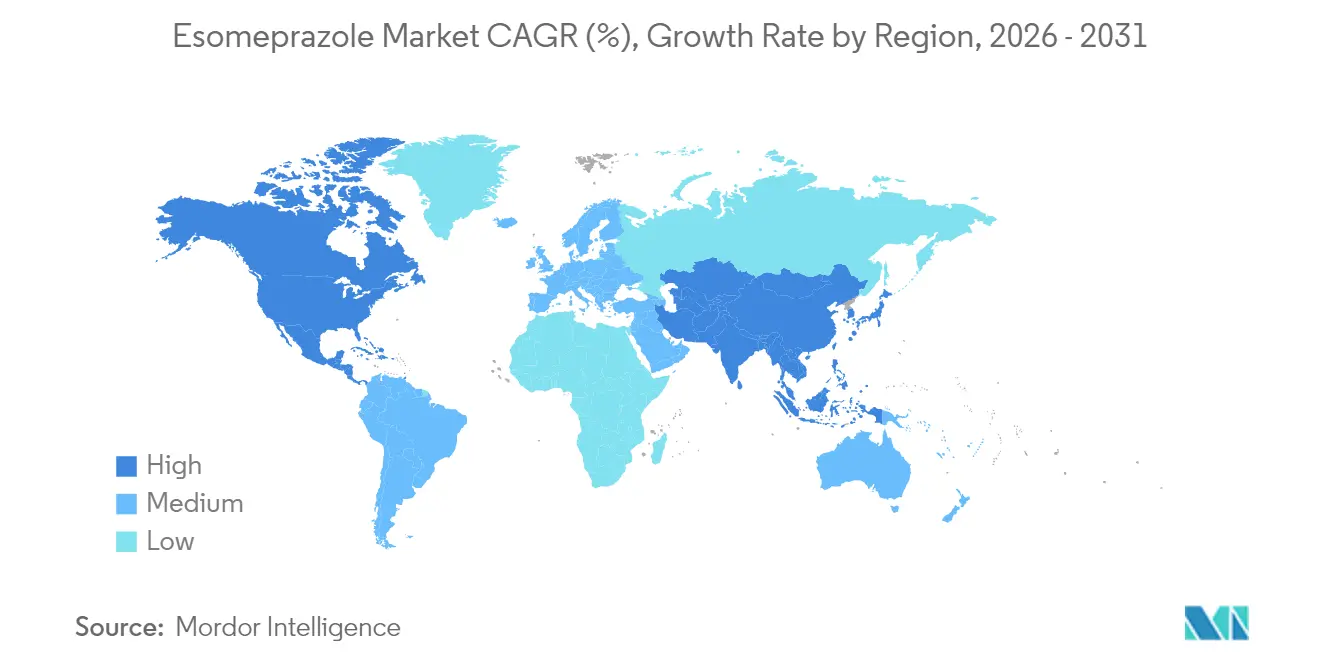
North America dominated with a 40.12% revenue share in 2025, anchored by GERD awareness programs, wide insurance coverage, and mature generic distribution. The esomeprazole market size in the region will remain substantial through 2031 as aging demographics heighten acid-related morbidity. Europe holds a balanced profile where strong generic uptake meets stringent pharmacovigilance, keeping volumes high but pricing tight.
Asia-Pacific is forecast to register a 7.08% CAGR, the fastest worldwide, driven by rising living standards, urban dietary shifts, and expanded endoscopic services. Local makers have introduced both PPIs and P-CABs, fostering price competition yet also elevating treatment penetration. Emerging regions in Latin America and the Middle East experience rising PPI use as public insurance schemes broaden formulary coverage, though currency volatility and distribution gaps temper upside. Europe maintains a significant market presence through established pharmaceutical manufacturing capabilities and comprehensive healthcare systems that support chronic disease management protocols. The region's regulatory environment promotes generic competition while maintaining quality standards, creating balanced market dynamics between innovation and affordability. Emerging markets in the Middle East and Africa, along with South America, represent growth opportunities driven by healthcare infrastructure development and increasing pharmaceutical access, though market penetration remains constrained by economic factors and regulatory complexities.

Regulatory Landscape
Esomeprazole products are regulated as prescription and OTC drugs through established pathways such as NDAs for innovators and ANDAs for generics, alongside ongoing post-approval labeling and pharmacovigilance obligations across major markets. In the United States, FDA product-specific guidances for esomeprazole magnesium cover bioequivalence and quality expectations for complex delayed-release forms, and an updated draft guidance released in May 2026 reinforces testing and comparability requirements that shape new filings and lifecycle changes.
In Europe, esomeprazole has long-standing authorization, including centrally authorized OTC Nexium Control managed under EMA procedures for variations and marketing authorization maintenance. Recent EMA procedure activity referenced in March 2026 also points to continued regulatory touchpoints for mature brands, while scrutiny across markets remains focused on impurities, stability, and appropriate OTC labeling given the category’s high volumes and broad self-care access.
Value Chain Analysis
The esomeprazole value chain begins with API production (commonly esomeprazole magnesium) under GMP, supported by documentation frameworks such as US DMFs, CEPs, and WHO-GMP depending on target markets. API manufacturing is globally distributed, with significant sourcing and manufacturing clusters in India and China, and supplier ecosystems and listed API marketplaces that support multi-sourcing strategies; participants referenced on the API side include Dr. Reddy's Laboratories and Vartika Chemicals & Pharmaceuticals.
Finished dosage manufacturing centers on enteric and delayed-release technologies (tablets, capsules, and specialized suspensions), followed by quality control, serialization or packaging, and regulated distribution through hospital, retail, and online pharmacies. Regulatory requirements influence process design and release testing, with FDA product-specific guidance for esomeprazole magnesium emphasizing in vitro performance and stability, including for delayed-release suspensions and administration via feeding tubes. EMA expectations for Module 3 documentation and process validation also raise the bar for contract manufacturing oversight and change control across global supply networks.
Competitive Landscape
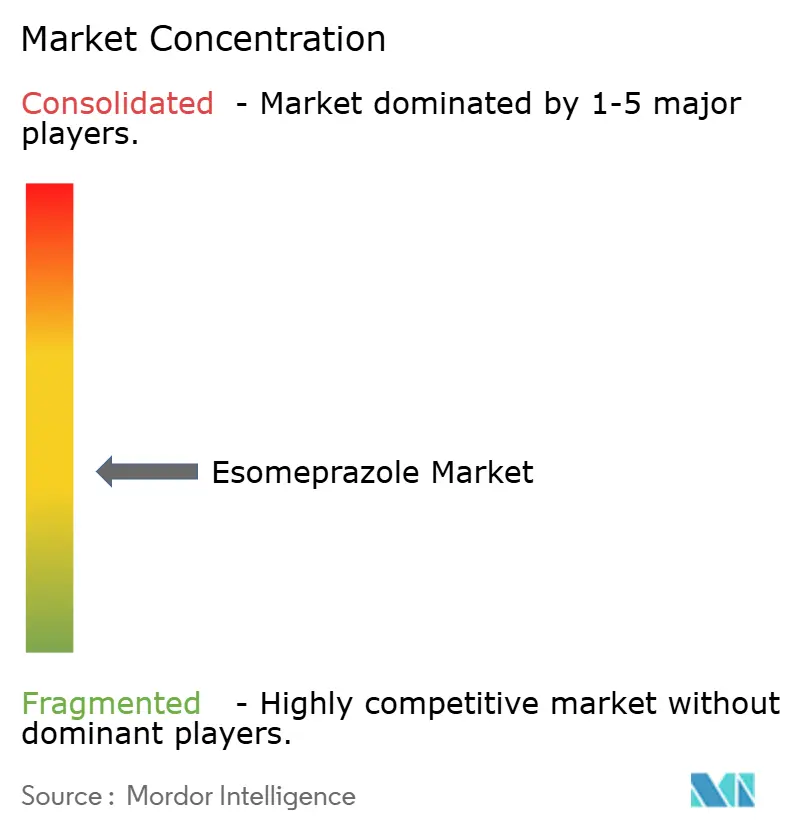
The esomeprazole market features moderate concentration. AstraZeneca retains strong brand equity through legacy Nexium promotion, yet its share is diluted by robust generic competition from Teva, Aurobindo, and Sun Pharmaceutical. Players compete on cost efficiency, cGMP compliance, and supply reliability as hospital tenders favor lowest unit price.
Formulation innovation is a key differentiator. Dual-release, nano-encapsulated, and pediatrics-optimized versions draw clinician interest and command modest premium pricing. Market entrants must also navigate the P-CAB advance; Phathom’s vonoprazan approval underscores acid suppression paradigms shifting towards faster, more potent agents.
Strategic partnerships for localized manufacturing and OTC brand building remain central to defending share in the esomeprazole market.
Esomeprazole Industry Leaders
-
Teva Pharmaceutical Industries Ltd.
-
Amneal Pharmaceuticals LLC
-
Viatris Inc.
-
DAIICHI SANKYO COMPANY, LIMITED
-
Sun Pharmaceutical Industries Ltd.
- *Disclaimer: Major Players sorted in no particular order

Market Opportunities and Future Outlook
Differentiation within a mature PPI class is increasingly tied to formulation and portfolio positioning rather than branded-to-generic substitution alone. The FDA’s updated draft guidance for esomeprazole magnesium in May 2026 provides a concrete pathway for manufacturers to develop or refine complex delayed-release presentations, including suspensions and feeding-tube compatible formats. This creates whitespace for companies that can demonstrate tighter in vitro performance and stability expectations while keeping cost competitiveness.
Emerging-market portfolio strategies show movement toward gastro-protective combinations and localized commercialization. In July 2026, RPG Life Sciences launched Naprosyn ES (naproxen plus esomeprazole) in India in partnership with Archerchem Healthcare, highlighting demand for fixed-dose combinations that bundle NSAID therapy with acid suppression to improve adherence and tolerability. At the same time, multinationals adjusting mature portfolios at country level, including AstraZeneca discontinuing Nexium IV supply in Korea in the first half of 2026 amid pricing and portfolio considerations, points to openings for alternative suppliers in hospital channels where IV PPI continuity of supply is prioritized.
Recent Industry Developments
- July 2026: RPG Life Sciences launched Naprosyn ES (naproxen plus esomeprazole) in India in partnership with Archerchem Healthcare. The new fixed-dose option expands gastro-protective choices for patients using NSAIDs and supports differentiated branding beyond standard PPI monotherapy.
- June 2025: The National Drug Scheduling Advisory Committee recommended that esomeprazole OTC packs above 280 mg move to Schedule II in Canada. The recommendation signals tighter control around higher total-dose OTC access, which may affect pack configurations and pharmacy dispensing requirements.
- June 2024: Glenmark Specialty gained FDA clearance to market 20 mg delayed-release OTC capsules in the United States. The approval increased competitive intensity in OTC channels and supported additional private-label and retailer-led offerings in a high-volume segment.


Research Methodology Framework and Report Scope
Market Definition and Coverage
This market covers the sales value of esomeprazole medicines used to reduce stomach acid, across the main dosage forms and care settings, and counted at the product level across major geographies.
Scope exclusions: We exclude broader proton pump inhibitor class totals and non-esomeprazole acid suppression drugs.
Segmentation Overview
-
By Dosage Form
- Tablets
- Capsules
- Others
-
By Strength
- 20 mg
- 40 mg
- Others
-
By Application
- Gastroesophageal Reflux Disease (GERD)
- Stomach Ulcers
- Others
-
By Distribution Channel
- Hospital Pharmacies
- Retail Pharmacies
- Online Pharmacies
-
By Geography
-
North America
- United States
- Canada
- Mexico
-
Europe
- Germany
- United Kingdom
- France
- Italy
- Spain
- Rest of Europe
-
Asia-Pacific
- China
- Japan
- India
- Australia
- South Korea
- Rest of Asia-Pacific
-
Middle East and Africa
- GCC
- South Africa
- Rest of Middle East and Africa
-
South America
- Brazil
- Argentina
- Rest of South America
-
North America
Data Sources, Market Sizing, and Validation
Desk Research
Desk work starts with checking how esomeprazole is used clinically and where volumes can be anchored to public health signals. For that, we refer to sources such as the World Health Organization, the US FDA drug labels and safety updates, the European Medicines Agency public assessment reports, and national health statistics portals that report GI disease burden and treatment patterns.
We then layer in market-facing inputs from sources such as customs and trade statistics portals, peer reviewed journals on GERD and peptic ulcer prevalence, and public procurement or tenders where hospital purchasing is visible. Company annual reports, investor presentations, and reputable press are also reviewed to understand pricing direction, generic intensity, and supply continuity. Paid subscriptions are used selectively for company financials and for patent tracking, to sanity-check lifecycle timing. The desk sources listed here are illustrative, and many other public references are also used for data collection, validation, and clarifying assumptions.
Primary Interviews and Surveys
Primary inputs were collected through expert interviews and structured surveys with manufacturers, distributors, pharmacists, and clinicians who see therapy switching and dosing changes in day to day practice. For a global view, we balance feedback across APAC, EMEA, and the Americas, and use it to close gaps around generic share, average pricing bands, and channel mix before finalizing the model.
Distribution of primary research fieldwork respondents
| Company type | Respondent position | Region |
|---|---|---|
| Top tier: 25% | CXOs: 16% | APAC: 48% |
| Mid tier: 58% | Functional/Unit leaders: 40% | EMEA: 32% |
| Smaller Players: 17% | Managers: 44% | Americas: 20% |
Market-Sizing & Forecasting
Sizing is built mainly using a top-down demand pool, where treated patients are reconstructed from GERD and ulcer prevalence signals, diagnosis rates, and typical therapy duration, and then converted into standard units and value using price bands seen in each region. To keep totals realistic, we corroborate the output with selective bottom-up checks, such as sampled volume by dosage form times average selling price, and distributor channel checks where coverage is available.
Key model inputs include the split between tablet, capsule, and other forms, the share of branded versus generic esomeprazole, dosing strength mix that affects unit counts, retail versus hospital dispensing share, and regional price erosion patterns after loss of exclusivity. Where country data is thin, we fill gaps using proxy countries with similar reimbursement and prescribing behavior, and then scale by population and access indicators.
For forecasting, scenario analysis is used because pricing and switching behavior can change quickly when generics expand or reimbursement rules tighten. In each scenario, we move the main drivers, including prevalence trend, treatment uptake, generic penetration, and net price change, then align the final forecast path to what primary respondents consider achievable over the period.
Data Validation & Update Cycle
Validation is done through checks that compare the market output against independent signals, like consumption direction by channel, expected generic share, and how fast prices normally fall in comparable GI medicines. Large variances are flagged, and the assumptions that created them are reviewed again, followed by a second pass by another analyst before sign-off.
If a new label update, a supply disruption, or a major policy change is reported, we re-contact relevant experts and refresh the sensitive inputs so the model stays current. Reports are refreshed annually, and interim updates are made when material events can shift demand or pricing. Before delivery, a final analyst pass is completed so clients receive the latest updated view.
Mordor Intelligence's Esomeprazole Market Sizing Compared With Other Published Estimates
Published esomeprazole market values can look far apart even when the growth story sounds similar, because the counted product set, year selection, and pricing logic are not always aligned. Differences also show up when one study emphasizes prescriptions only, and another blends in a wider set of channels and patient groups.
Combination therapies and adjacent acid suppression drugs are common add-ons in some estimates, but those are kept outside Mordor Intelligence's scope, which is one practical reason the figures can separate. We also see gaps when a model applies a single global price trend instead of tracking generic penetration and country level net price movement, and when currency conversion uses a different timing window.
Benchmark comparison
| Source | Market Size | Gaps in Research Methodology |
|---|---|---|
| Mordor Intelligence | USD 2.13 B (2026) | |
| Trade Journal A | USD 2.08 B (2025) | Uses a 2025 base year and a broader inclusion list that explicitly blends branded and generic across multiple channels and age groups, which can pull value forward versus a later-year pricing base. |
| Industry Publisher B | USD 1.90 B (2024) | Anchors value on a historical lookback with limited transparency on net pricing and generic erosion, which can understate newer demand and later-year unit growth in faster-growing regions. |
The table shows that year choice and what is counted alongside esomeprazole can move the total materially, even before forecast assumptions are applied. By tying demand to treated-patient signals and then pressure-testing value with channel and pricing checks, the estimate stays traceable to clear inputs that can be repeated and updated.


Key Questions Answered in the Report
What is the current esomeprazole market size?
The esomeprazole market size stood at USD 2.13 billion in 2026 and is projected to reach USD 2.87 billion by 2031.
Which region leads esomeprazole revenue?
North America leads with a 40.12% share in 2025, buoyed by widespread GERD diagnosis and insurance coverage.
Why are capsules growing faster than tablets?
Capsules integrate dual-release and nano-delivery technologies that deliver longer acid suppression, driving a 6.98% CAGR through 2031.
How significant is generic competition?
Generic entries now sell at up to 80% lower prices than legacy brands, prompting hospitals and insurers to prioritize cost-efficient sourcing.
Are safety concerns limiting long-term use?
Regulators advise periodic review because chronic use may raise risks such as kidney issues and bone fractures, though therapeutic benefits often outweigh risks when managed appropriately.
Page last updated on:


 Your data is secure and never sold or shared.


